
Universal Data Element Framework UDEF The Semantic DNS
- Slides: 27
Universal Data Element Framework (UDEF) The Semantic DNS and a Disaster Response Pilot Use Case Ron Schuldt, Chair The Open Group UDEF Forum December 6, 2005
Agenda • The Problem • The UDEF • The Open Group UDEF participants • UDEF current status • The problem and associated UDEF business value • What the UDEF is and what it is not • A brief description of the UDEF • A metadata managed architecture that UDEF supports • UDEF – Like A Semantic DNS • The UDEF Disaster Response Pilot Use Case • A brief description of a UDEF pilot to support disaster response teams • Video clip of the UDEF disaster response pilot demo as of December 1, 2005
The Problem
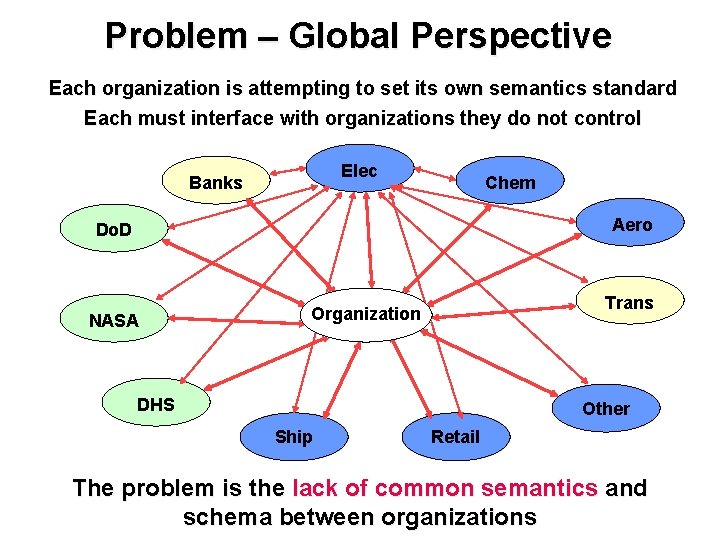
Problem – Global Perspective Each organization is attempting to set its own semantics standard Each must interface with organizations they do not control Elec Banks Chem Aero Do. D NASA Trans Organization DHS Other Ship Retail The problem is the lack of common semantics and schema between organizations
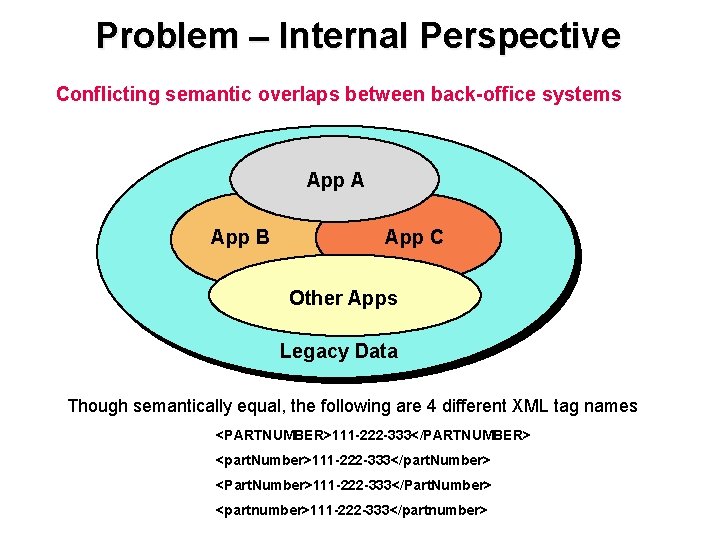
Problem – Internal Perspective Conflicting semantic overlaps between back-office systems App A App B App C Other Apps Legacy Data Though semantically equal, the following are 4 different XML tag names <PARTNUMBER>111 -222 -333</PARTNUMBER> <part. Number>111 -222 -333</part. Number> <Part. Number>111 -222 -333</Part. Number> <partnumber>111 -222 -333</partnumber>
The Legacy Applications Issue • Across the globe there are millions of legacy applications that need to be Web enabled – in preparation for Web Services and SOA - XML and associated W 3 C standards address the syntax requirements but an adopted semantics standard does not exist yet • Users of the legacy applications consistently resist changing the names of the fields - The semantics solution needs to be non-intrusive to the application user
The UDEF
The Open Group UDEF Participants l l l l l The Open Group Staff Lockheed Martin Unicorn Safyre Solutions IBM Raytheon Boeing Capgemini SICo. P BEA Systems Adobe Contivo Cemantica OMG OAGi NDIA-AFEI GEIA Comp. TIA l l l l l And others W 3 C Semantic Web Rosetta. Net POSC SWIFT Dublin Core Metadata Global Exchange Services Chevron Texaco Proctor & Gamble Northrop Grumman SAIC Man. Tech MITRE Envision Metamatrix Ericsson DLA Canadian Government Penn State University
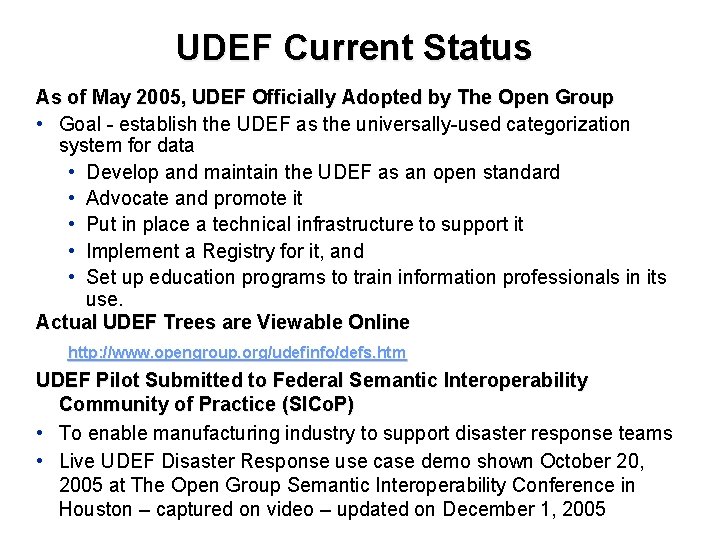
UDEF Current Status As of May 2005, UDEF Officially Adopted by The Open Group • Goal - establish the UDEF as the universally-used categorization system for data • Develop and maintain the UDEF as an open standard • Advocate and promote it • Put in place a technical infrastructure to support it • Implement a Registry for it, and • Set up education programs to train information professionals in its use. Actual UDEF Trees are Viewable Online http: //www. opengroup. org/udefinfo/defs. htm UDEF Pilot Submitted to Federal Semantic Interoperability Community of Practice (SICo. P) • To enable manufacturing industry to support disaster response teams • Live UDEF Disaster Response use case demo shown October 20, 2005 at The Open Group Semantic Interoperability Conference in Houston – captured on video – updated on December 1, 2005
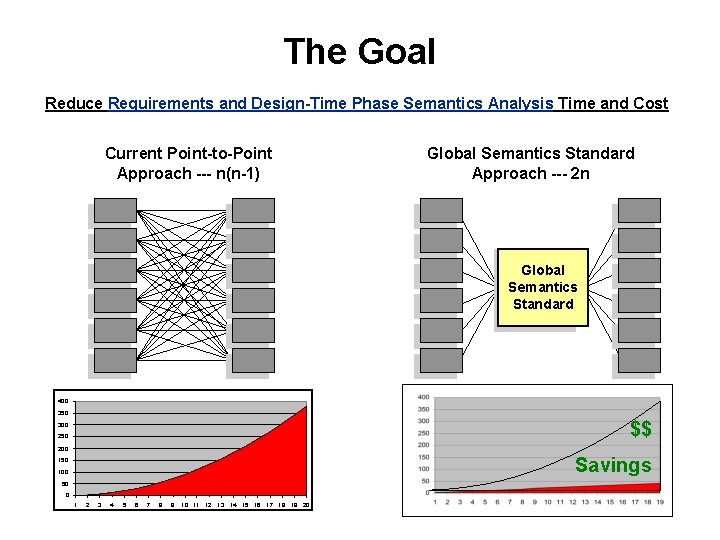
The Goal Reduce Requirements and Design-Time Phase Semantics Analysis Time and Cost Current Point-to-Point Approach --- n(n-1) Global Semantics Standard Approach --- 2 n Global Semantics Standard 400 350 $$ 300 250 200 Savings 150 100 50 0 1 2 3 4 5 6 7 8 9 10 11 12 13 14 15 16 17 18 19 20
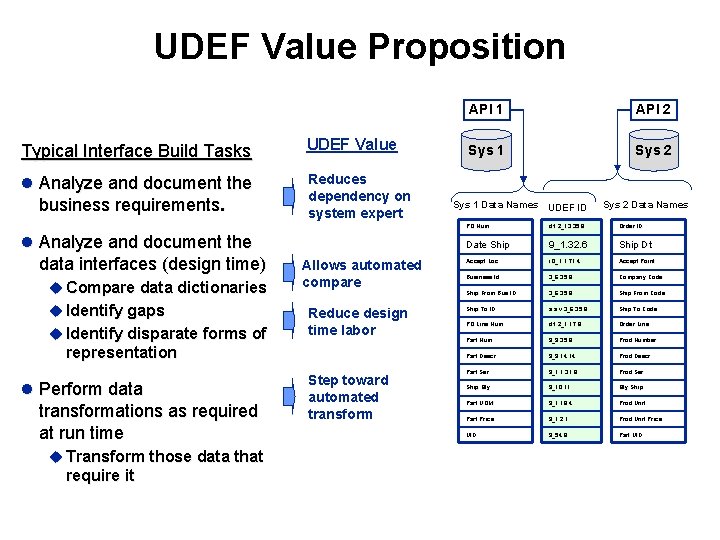
UDEF Value Proposition Typical Interface Build Tasks UDEF Value l Analyze and document the Reduces dependency on system expert business requirements. l Analyze and document the data interfaces (design time) u Compare data dictionaries u Identify gaps u Identify disparate forms of Allows automated compare Reduce design time labor representation l Perform data transformations as required at run time u Transform those data that require it Step toward automated transform API 1 API 2 Sys 1 Sys 2 Sys 1 Data Names UDEF ID Sys 2 Data Names PO Num d. t. 2_13. 35. 8 Order ID Date Ship 9_1. 32. 6 Ship Dt Accept Loc i. 0_1. 1. 71. 4 Accept Point Business Id 3_6. 35. 8 Company Code Ship From Bus ID 3_6. 35. 8 Ship From Code Ship To ID a. a. v. 3_6. 35. 8 Ship To Code PO Line Num d. t. 2_1. 17. 8 Order Line Part Num 9_9. 35. 8 Prod Number Part Descr 9_9. 14 Prod Descr Part Ser 9_1. 1. 31. 8 Prod Ser Ship Qty 9_10. 11 Qty Ship Part UOM 9_1. 18. 4 Prod Unit Part Price 9_1. 2. 1 Prod Unit Price UID 9_54. 8 Part UID
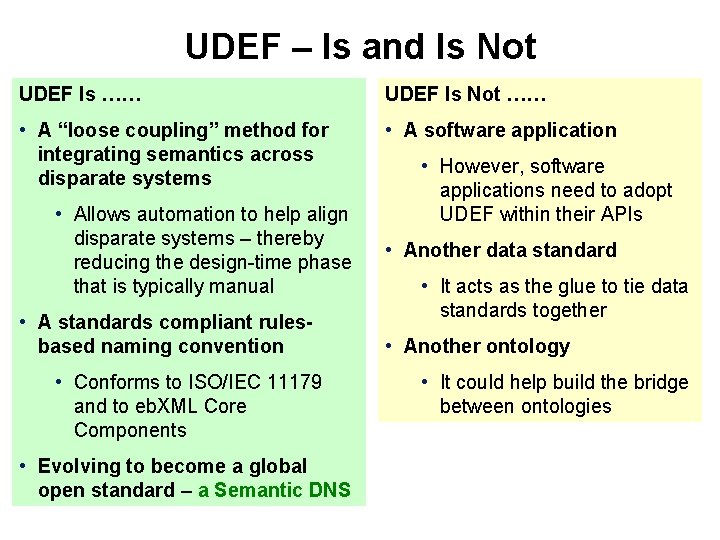
UDEF – Is and Is Not UDEF Is …… UDEF Is Not …… • A “loose coupling” method for integrating semantics across disparate systems • A software application • Allows automation to help align disparate systems – thereby reducing the design-time phase that is typically manual • A standards compliant rulesbased naming convention • Conforms to ISO/IEC 11179 and to eb. XML Core Components • Evolving to become a global open standard – a Semantic DNS • However, software applications need to adopt UDEF within their APIs • Another data standard • It acts as the glue to tie data standards together • Another ontology • It could help build the bridge between ontologies
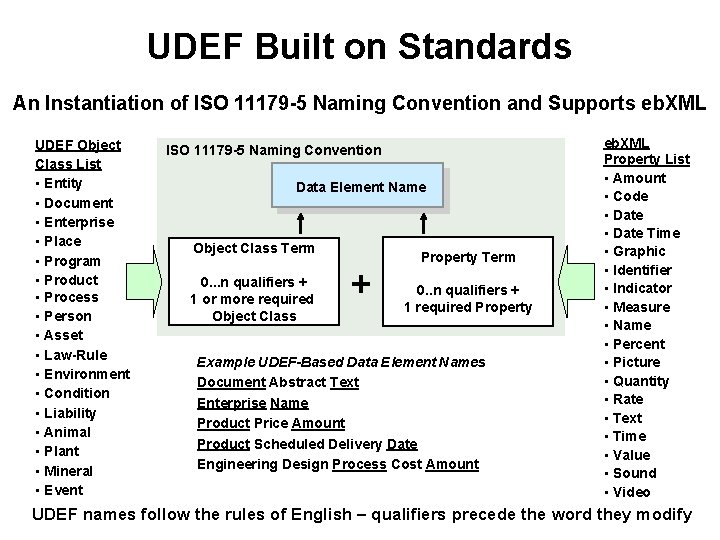
UDEF Built on Standards An Instantiation of ISO 11179 -5 Naming Convention and Supports eb. XML UDEF Object Class List • Entity • Document • Enterprise • Place • Program • Product • Process • Person • Asset • Law-Rule • Environment • Condition • Liability • Animal • Plant • Mineral • Event ISO 11179 -5 Naming Convention Data Element Name Object Class Term 0. . . n qualifiers + 1 or more required Object Class + Property Term 0. . n qualifiers + 1 required Property Example UDEF-Based Data Element Names Document Abstract Text Enterprise Name Product Price Amount Product Scheduled Delivery Date Engineering Design Process Cost Amount eb. XML Property List • Amount • Code • Date Time • Graphic • Identifier • Indicator • Measure • Name • Percent • Picture • Quantity • Rate • Text • Time • Value • Sound • Video UDEF names follow the rules of English – qualifiers precede the word they modify
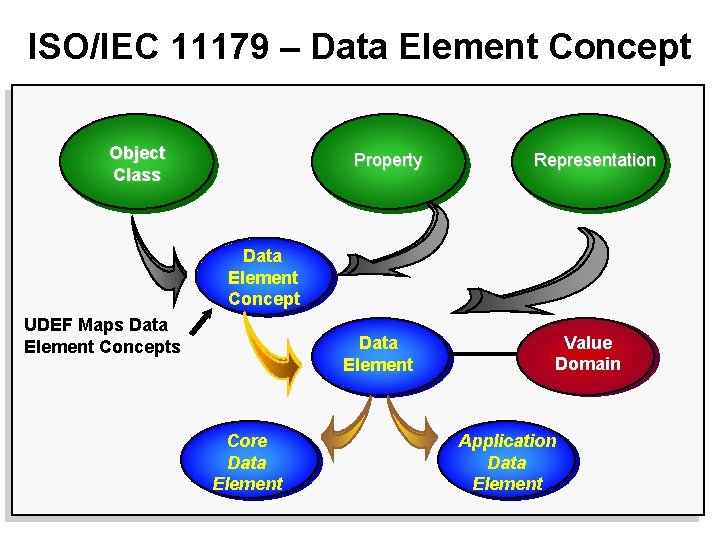
ISO/IEC 11179 – Data Element Concept Object Class Property Representation Data Element Concept UDEF Maps Data Element Concepts Data Element Core Data Element Value Domain Application Data Element
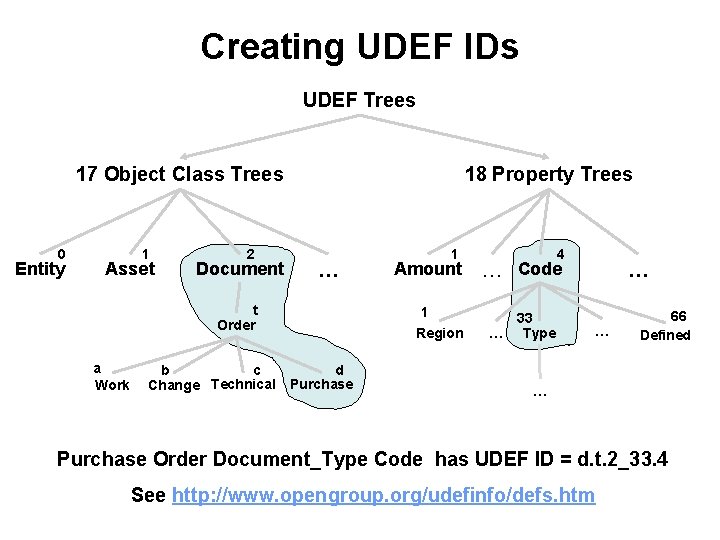
Creating UDEF IDs UDEF Trees 17 Object Class Trees 0 Entity 1 Asset 2 Document 18 Property Trees … t Order a Work b c Change Technical 1 Amount 1 Region d Purchase 4 … Code … 33 Type … … 66 Defined … Purchase Order Document_Type Code has UDEF ID = d. t. 2_33. 4 See http: //www. opengroup. org/udefinfo/defs. htm
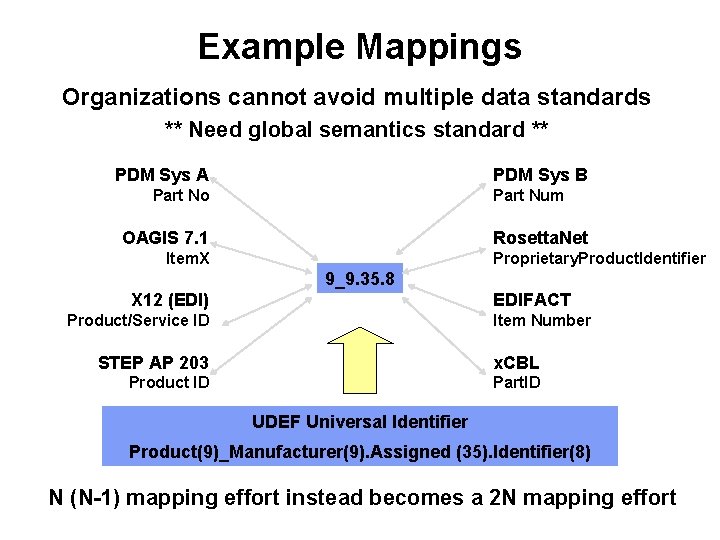
Example Mappings Organizations cannot avoid multiple data standards ** Need global semantics standard ** PDM Sys A PDM Sys B Part No Part Num OAGIS 7. 1 Rosetta. Net Item. X Proprietary. Product. Identifier 9_9. 35. 8 X 12 (EDI) EDIFACT Product/Service ID Item Number STEP AP 203 x. CBL Product ID Part. ID UDEF Universal Identifier Product(9)_Manufacturer(9). Assigned (35). Identifier(8) N (N-1) mapping effort instead becomes a 2 N mapping effort
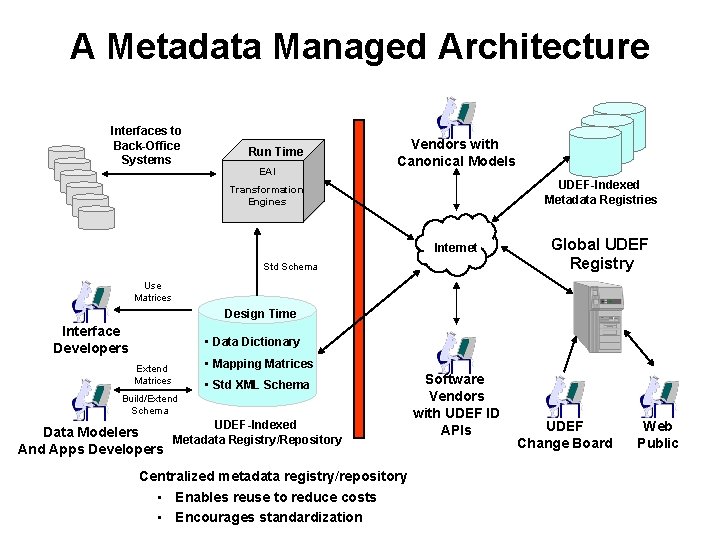
A Metadata Managed Architecture Interfaces to Back-Office Systems Run Time EAI Vendors with Canonical Models UDEF-Indexed Metadata Registries Transformation Engines Internet Std Schema Global UDEF Registry Use Matrices Design Time Interface Developers • Data Dictionary Extend Matrices • Mapping Matrices • Std XML Schema Build/Extend Schema UDEF-Indexed Data Modelers Metadata Registry/Repository And Apps Developers Centralized metadata registry/repository • Enables reuse to reduce costs • Encourages standardization Software Vendors with UDEF ID APIs UDEF Change Board Web Public
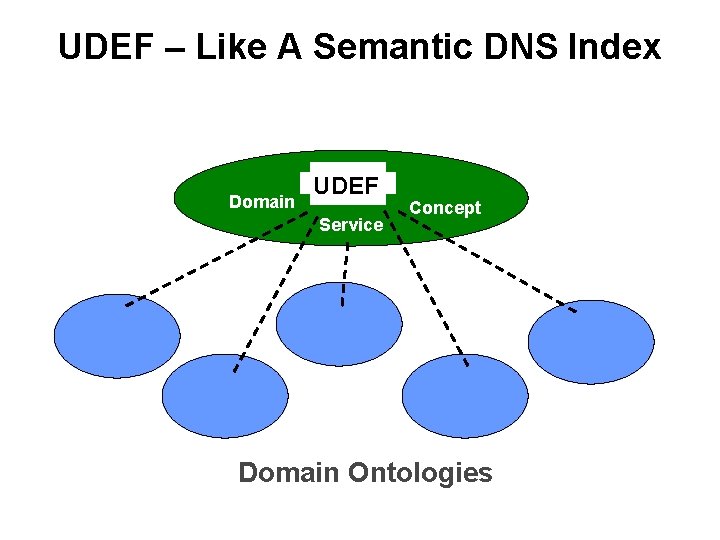
UDEF – Like A Semantic DNS
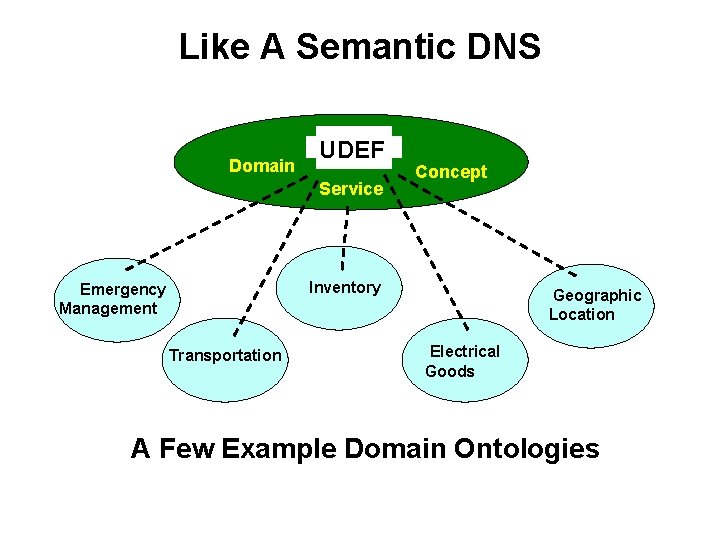
Like A Semantic DNS Domain UDEF Service Concept Inventory Emergency Management Transportation Geographic Location Electrical Goods A Few Example Domain Ontologies
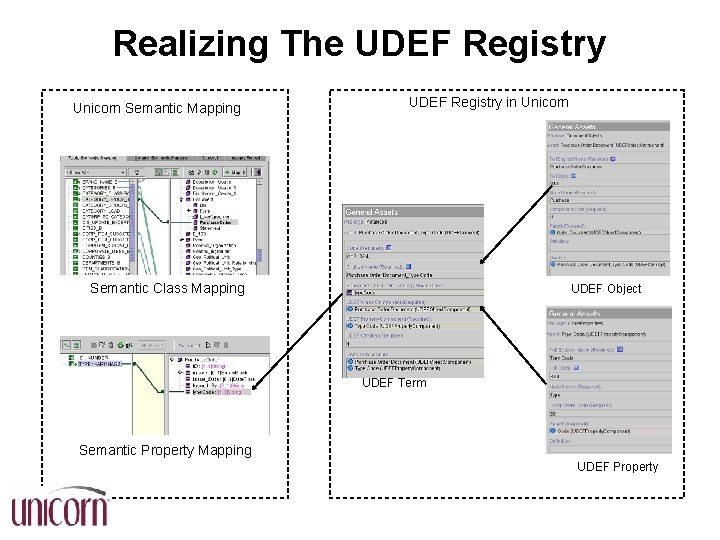
Realizing The UDEF Registry Unicorn Semantic Mapping UDEF Registry in Unicorn Semantic Class Mapping UDEF Object UDEF Term Semantic Property Mapping UDEF Property
UDEF Disaster Response Pilot Use Case
UDEF Pilot Participants l The Open Group Staff l Lockheed Martin l Unicorn l Safyre Solutions
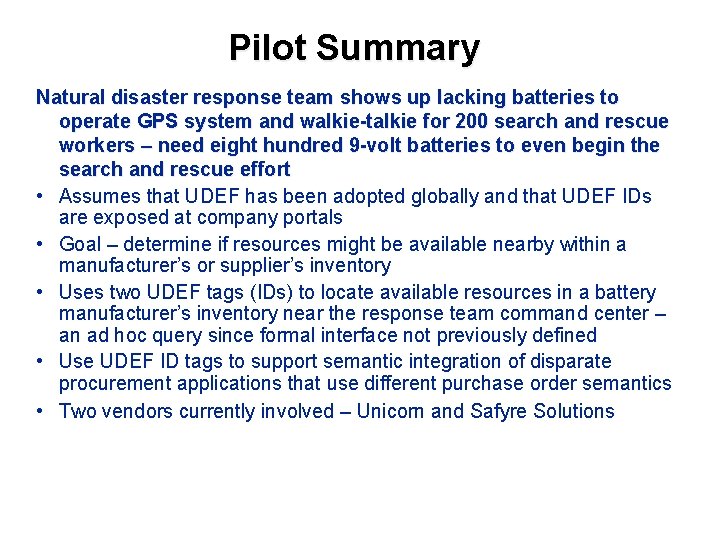
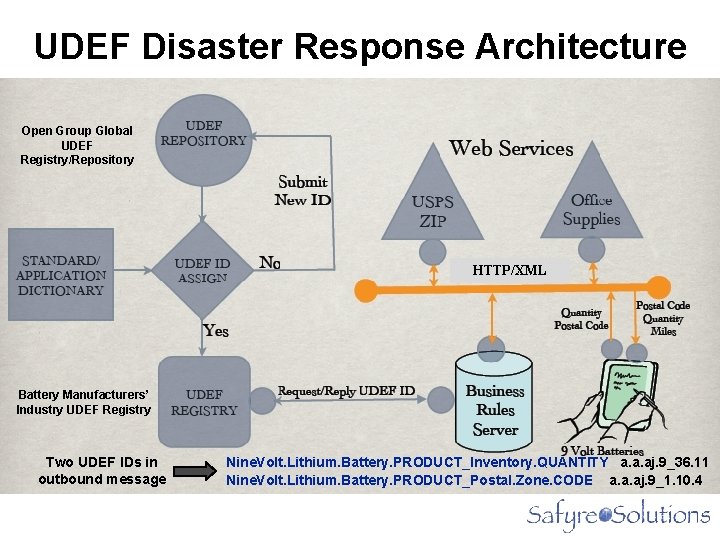
Pilot Summary Natural disaster response team shows up lacking batteries to operate GPS system and walkie-talkie for 200 search and rescue workers – need eight hundred 9 -volt batteries to even begin the search and rescue effort • Assumes that UDEF has been adopted globally and that UDEF IDs are exposed at company portals • Goal – determine if resources might be available nearby within a manufacturer’s or supplier’s inventory • Uses two UDEF tags (IDs) to locate available resources in a battery manufacturer’s inventory near the response team command center – an ad hoc query since formal interface not previously defined • Use UDEF ID tags to support semantic integration of disparate procurement applications that use different purchase order semantics • Two vendors currently involved – Unicorn and Safyre Solutions
UDEF Disaster Response Architecture Open Group Global UDEF Registry/Repository HTTP/XML Battery Manufacturers’ Industry UDEF Registry Two UDEF IDs in outbound message Nine. Volt. Lithium. Battery. PRODUCT_Inventory. QUANTITY a. a. aj. 9_36. 11 Nine. Volt. Lithium. Battery. PRODUCT_Postal. Zone. CODE a. a. aj. 9_1. 10. 4
UDEF Disaster Response Video
UDEF – Like A Semantic DNS Index Domain UDEF Service Concept Domain Ontologies
For Additional Information ISO/IEC 11179 – Specification and standardization of data elements http: //isotc. iso. ch/livelink/fetch/2000/2489/Ittf_Home/Publicly. Available. Standards. ht m The OPEN GROUP UDEF Forum Web Site http: //www. opengroup. org/udef/ Videos of the live UDEF Disaster Response Pilot demo http: //www. opengroup. org/udefinfo/demo 0511/demos. htm Oct 20, 2005 http: //www. opengroup. org/projects/udef/doc. tpl? CALLER=index. tpl&gdid=9189 Dec 1, 2005 For Possible Follow-up Implementations - Contact Dr. Chris Harding – c. harding@opengroup. org Ron Schuldt – ron. l. schuldt@lmco. com Loren Osborn – loren. osborn@unicorn. com Al Slater – aslater@safyre. com