
Universal Credit Overview Corinne Gregory LHC Group Partnerships

- Slides: 28
Universal Credit Overview Corinne Gregory LHC Group Partnerships Team **The content in this presentation is correct as of July 2017 Information contained within may be subject to change**
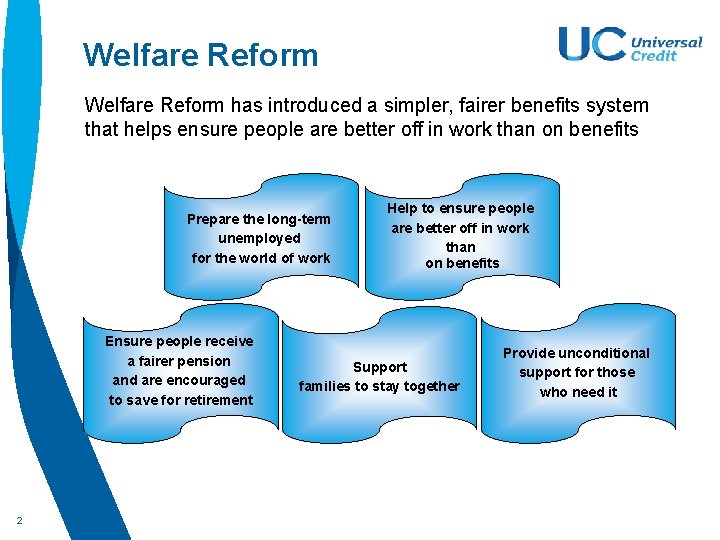
Welfare Reform has introduced a simpler, fairer benefits system that helps ensure people are better off in work than on benefits Prepare the long-term unemployed for the world of work Ensure people receive a fairer pension and are encouraged to save for retirement 2 Help to ensure people are better off in work than on benefits Support families to stay together Provide unconditional support for those who need it
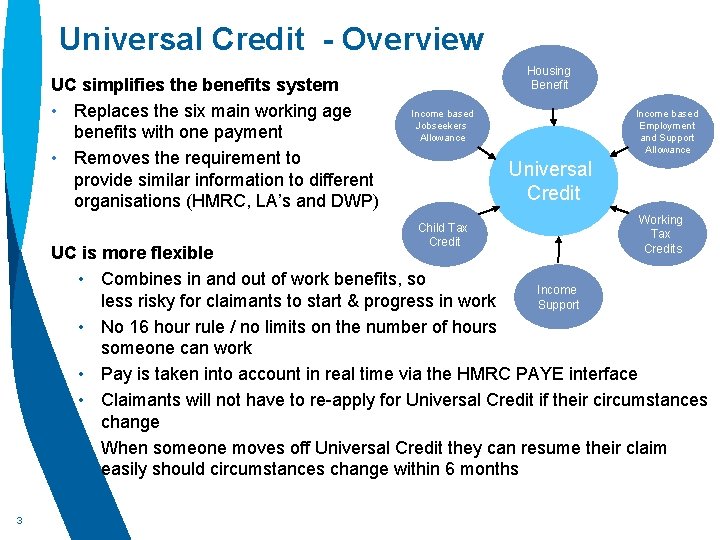
Universal Credit - Overview UC simplifies the benefits system • Replaces the six main working age benefits with one payment • Removes the requirement to provide similar information to different organisations (HMRC, LA’s and DWP) Housing Benefit Income based Employment and Support Allowance Income based Jobseekers Allowance Universal Credit Child Tax Credit Working Tax Credits UC is more flexible • Combines in and out of work benefits, so Income less risky for claimants to start & progress in work Support • No 16 hour rule / no limits on the number of hours someone can work • Pay is taken into account in real time via the HMRC PAYE interface • Claimants will not have to re-apply for Universal Credit if their circumstances change • When someone moves off Universal Credit they can resume their claim easily should circumstances change within 6 months 3
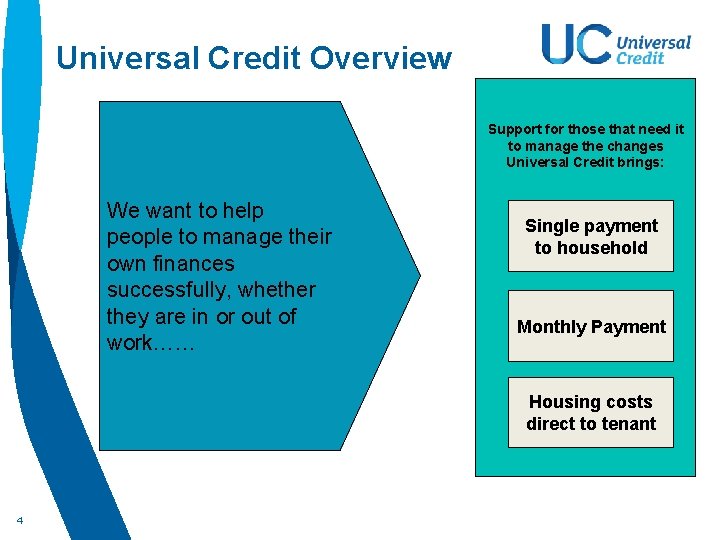
Universal Credit Overview Support for those that need it to manage the changes Universal Credit brings: We want to help people to manage their own finances successfully, whether they are in or out of work…… Single payment to household Monthly Payment Housing costs direct to tenant 4
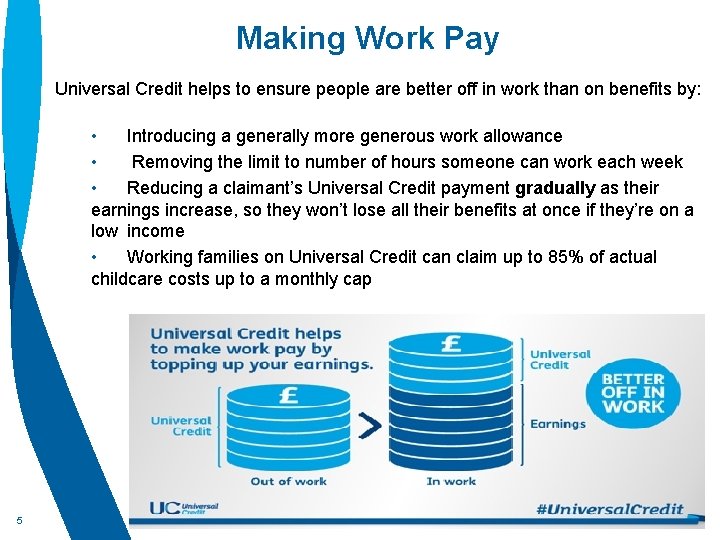
Making Work Pay Universal Credit helps to ensure people are better off in work than on benefits by: • Introducing a generally more generous work allowance • Removing the limit to number of hours someone can work each week • Reducing a claimant’s Universal Credit payment gradually as their earnings increase, so they won’t lose all their benefits at once if they’re on a low income • Working families on Universal Credit can claim up to 85% of actual childcare costs up to a monthly cap 5
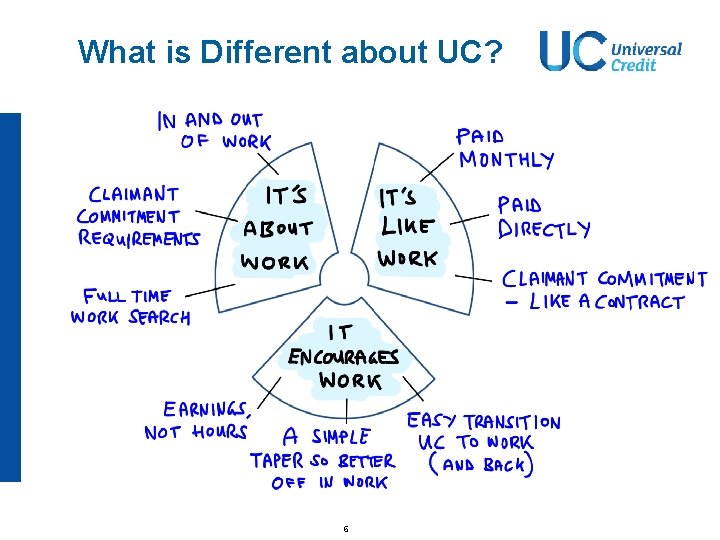
What is Different about UC? 6
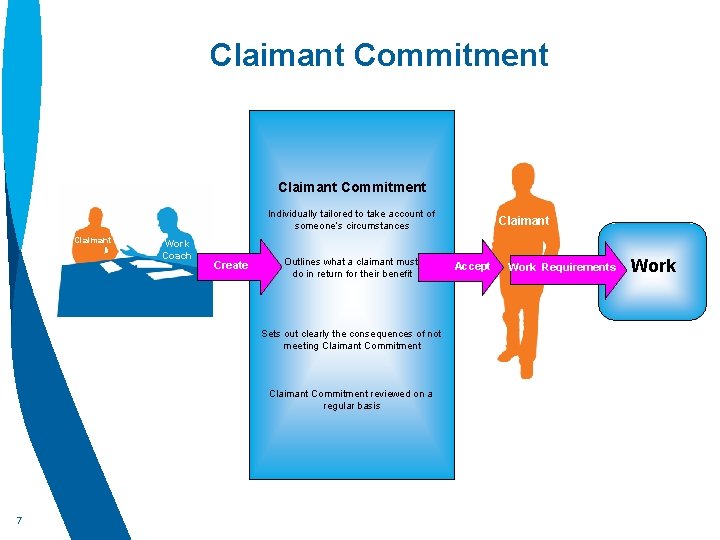
Claimant Commitment Individually tailored to take account of someone’s circumstances Claimant Work Coach Create Outlines what a claimant must do in return for their benefit Sets out clearly the consequences of not meeting Claimant Commitment reviewed on a regular basis 7 Claimant Accept Work Requirements Work
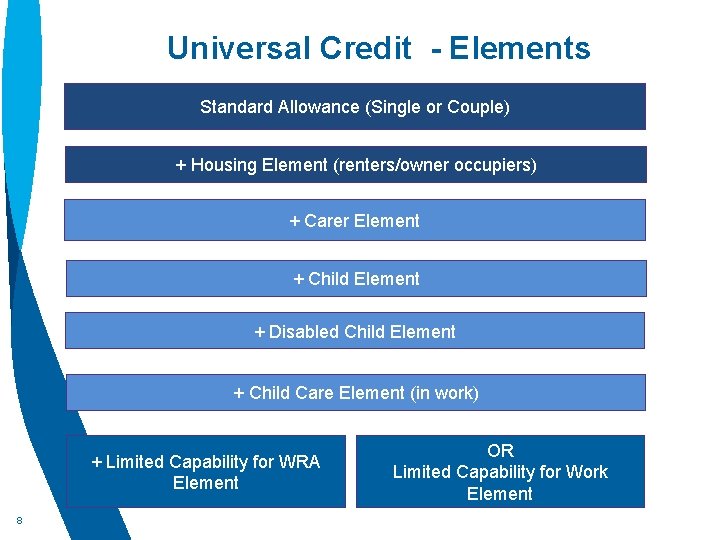
Universal Credit - Elements Standard Allowance (Single or Couple) + Housing Element (renters/owner occupiers) + Carer Element + Child Element + Disabled Child Element + Child Care Element (in work) + Limited Capability for WRA Element 8 OR Limited Capability for Work Element
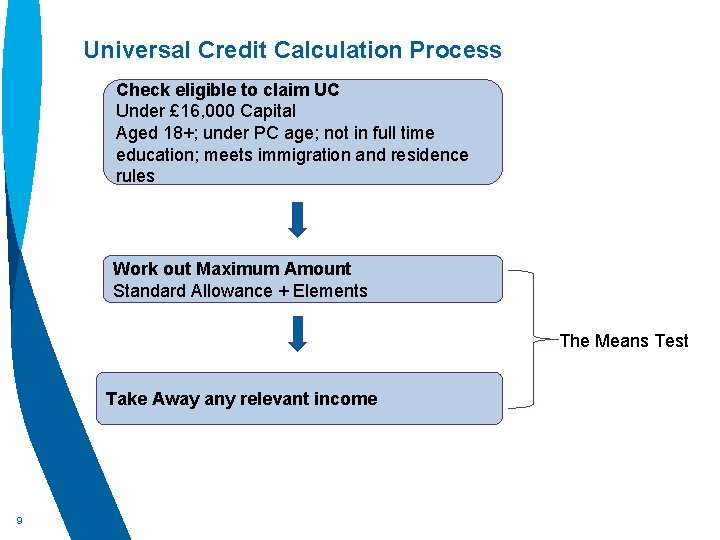
Universal Credit Calculation Process Check eligible to claim UC Under £ 16, 000 Capital Aged 18+; under PC age; not in full time education; meets immigration and residence rules Work out Maximum Amount Standard Allowance + Elements The Means Test Take Away any relevant income 9
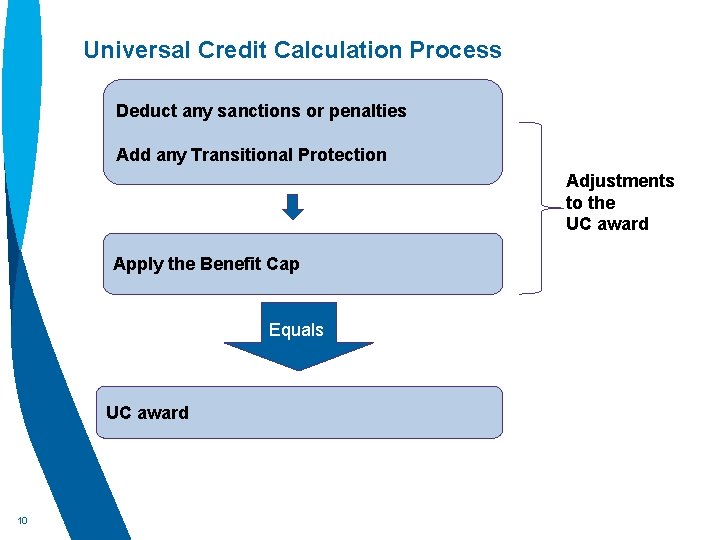
Universal Credit Calculation Process Deduct any sanctions or penalties Add any Transitional Protection Adjustments to the UC award Apply the Benefit Cap Equals UC award 10
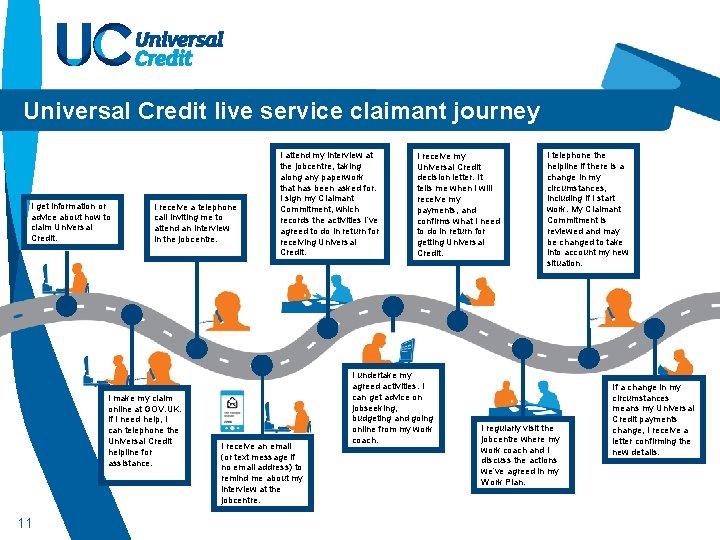
Universal Credit live service claimant journey I get information or advice about how to claim Universal Credit. I receive a telephone call inviting me to attend an interview in the jobcentre. I make my claim online at GOV. UK. If I need help, I can telephone the Universal Credit helpline for assistance. 11 I attend my interview at the jobcentre, taking along any paperwork that has been asked for. I sign my Claimant Commitment, which records the activities I’ve agreed to do in return for receiving Universal Credit. I receive an email (or text message if no email address) to remind me about my interview at the jobcentre. I receive my Universal Credit decision letter. It tells me when I will receive my payments, and confirms what I need to do in return for getting Universal Credit. I undertake my agreed activities. I can get advice on jobseeking, budgeting and going online from my work coach. I telephone the helpline if there is a change in my circumstances, including if I start work. My Claimant Commitment is reviewed and may be changed to take into account my new situation. I regularly visit the jobcentre where my work coach and I discuss the actions we’ve agreed in my Work Plan. If a change in my circumstances means my Universal Credit payments change, I receive a letter confirming the new details.
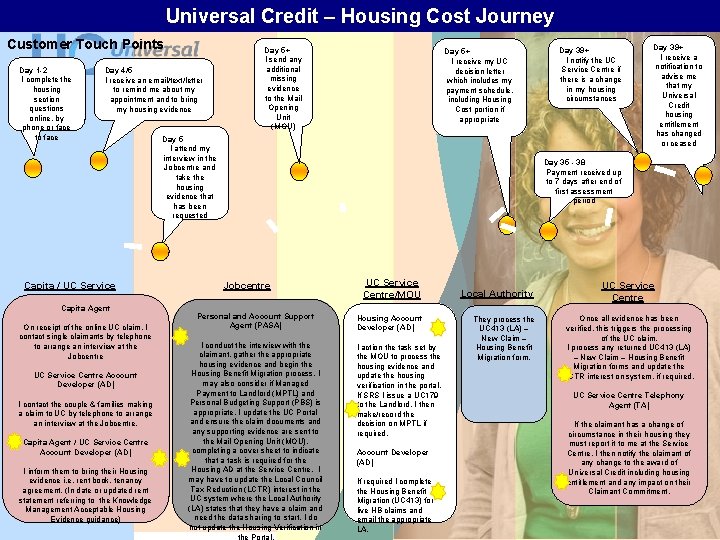
Universal Credit – Housing Cost Journey Customer Touch Points Day 1 -2 I complete the housing section questions online, by phone or face to face Day 4/5 I receive an email/text/letter to remind me about my appointment and to bring my housing evidence Capita / UC Service Centre Capita Agent On receipt of the online UC claim, I contact single claimants by telephone to arrange an interview at the Jobcentre UC Service Centre Account Developer (AD) I contact the couple & families making a claim to UC by telephone to arrange an interview at the Jobcentre. Capita Agent / UC Service Centre Account Developer (AD) I inform them to bring their Housing evidence i. e. rent book, tenancy agreement. (In date or updated rent statement referring to the Knowledge Management Acceptable Housing Evidence guidance) Day 5+ I send any additional missing evidence to the Mail Opening Unit (MOU) Day 5+ I receive my UC decision letter which includes my payment schedule, including Housing Cost portion if appropriate Day 5 I attend my interview in the Jobcentre and take the housing evidence that has been requested Day 39+ I notify the UC Service Centre if there is a change in my housing circumstances Day 39+ I receive a notification to advise me that my Universal Credit housing entitlement has changed or ceased Day 35 - 38 Payment received up to 7 days after end of first assessment period Jobcentre Personal and Account Support Agent (PASA) I conduct the interview with the claimant, gather the appropriate housing evidence and begin the Housing Benefit Migration process. I may also consider if Managed Payment to Landlord (MPTL) and Personal Budgeting Support (PBS) is appropriate. I update the UC Portal and ensure the claim documents and any supporting evidence are sent to the Mail Opening Unit (MOU), completing a cover sheet to indicate that a task is required for the Housing AD at the Service Centre. I may have to update the Local Council Tax Reduction (LCTR) interest in the UC system where the Local Authority (LA) states that they have a claim and need the data sharing to start. I do not update the Housing Verification in the Portal. UC Service Centre/MOU Housing Account Developer (AD) I action the task set by the MOU to process the housing evidence and update the housing verification in the portal. If SRS I issue a UC 179 to the Landlord. I then make/record the decision on MPTL if required. Account Developer (AD) If required I complete the Housing Benefit Migration (UC 413) for live HB claims and email the appropriate LA. Local Authority They process the UC 413 (LA) – New Claim – Housing Benefit Migration form. UC Service Centre Once all evidence has been verified, this triggers the processing of the UC claim. I process any returned UC 413 (LA) – New Claim – Housing Benefit Migration forms and update the LCTR interest on system, if required. UC Service Centre Telephony Agent (TA) If the claimant has a change of circumstance in their housing they must report it to me at the Service Centre. I then notify the claimant of any change to the award of Universal Credit including housing entitlement and any impact on their Claimant Commitment.
Universal Credit – National Expansion
Universal Credit Full Service (UCFS) What is UCFS? Ø UC Full Service is the “End State” for Universal Credit Ø A digital service for all claimants who would have previously claimed one of 6 included benefits: JSA, ESA, IS, Housing Benefit, Working Tax Credits, Child Tax Credits Ø Built and designed using Agile methodology; meaning small, frequent updates and enhancements moving us slowly towards a fully featured system Ø DWP are rolling it out slowly across the country, increasing the number of claimants as we increase the functionality of “The Build” LHC have been very much at the forefront of the UCFS roll-out: ü South London being the first district to go live üSutton was the first site to deliver UCFS in November 2014 üUCFS rollout until June 2018 14
Universal Credit Full Service (UCFS) What’s different? Claimant’s point of view: They have a fully on-line service with their own account allowing them to: Øsee when and how much they will paid Øadvise of changes of circumstances Øconverse with their work coach etc. The onus is on the claimant to take ownership of their claim and their job search; and to enter into a coach/athlete relationship with their Work Coach so that we no longer advise them what to do but coach them to think in the right way to change their own lives and become independent of benefits 15
Universal Support Delivered Locally for Vulnerable People & Personal Budgeting Support
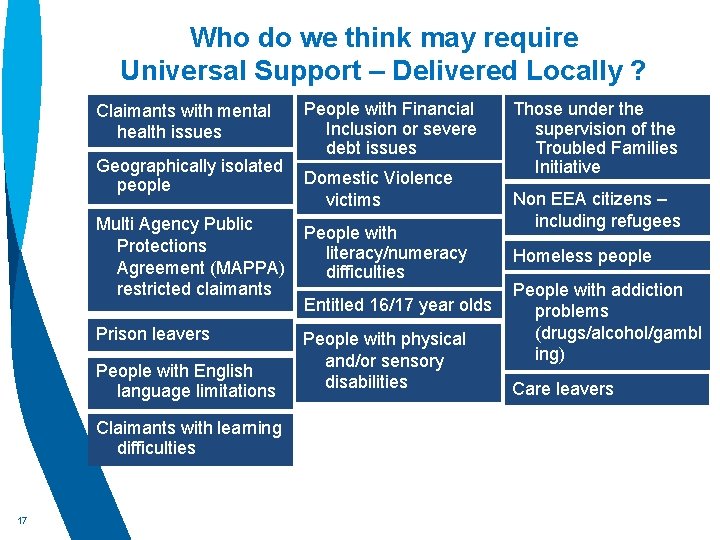
Who do we think may require Universal Support – Delivered Locally ? Claimants with mental health issues Geographically isolated people Domestic Violence victims Multi Agency Public Protections Agreement (MAPPA) restricted claimants People with literacy/numeracy difficulties Prison leavers People with physical and/or sensory disabilities People with English language limitations Claimants with learning difficulties 17 People with Financial Inclusion or severe debt issues Entitled 16/17 year olds Those under the supervision of the Troubled Families Initiative Non EEA citizens – including refugees Homeless people People with addiction problems (drugs/alcohol/gambl ing) Care leavers
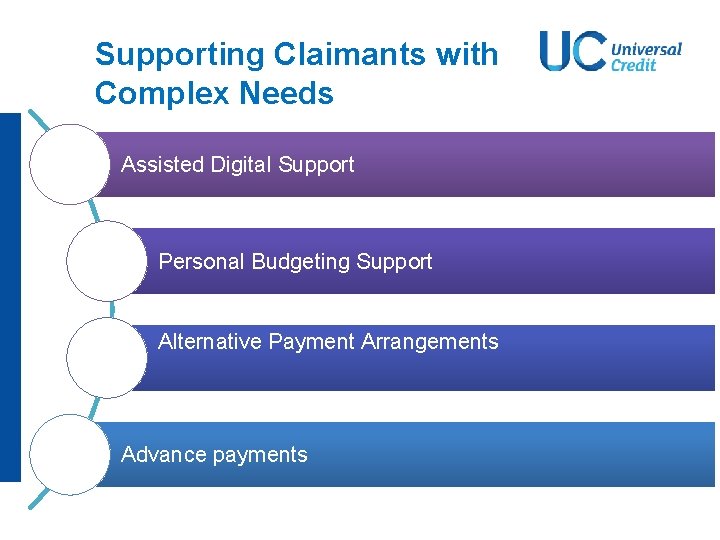
Supporting Claimants with Complex Needs Assisted Digital Support Personal Budgeting Support Alternative Payment Arrangements Advance payments
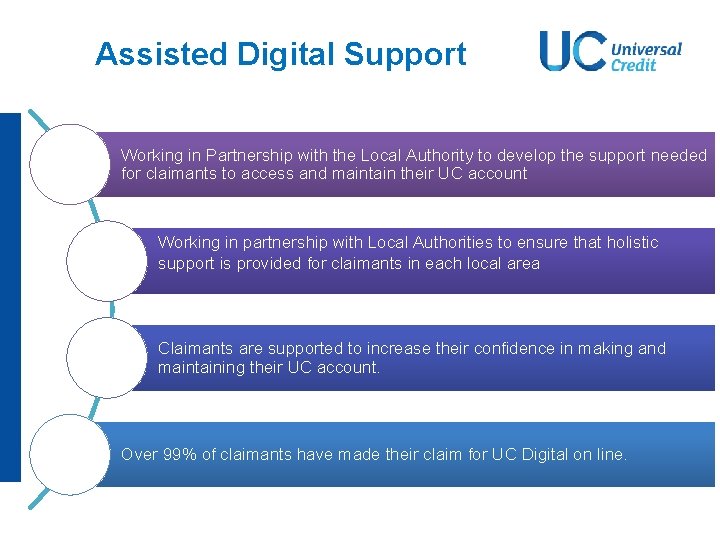
Assisted Digital Support Working in Partnership with the Local Authority to develop the support needed for claimants to access and maintain their UC account Working in partnership with Local Authorities to ensure that holistic support is provided for claimants in each local area Claimants are supported to increase their confidence in making and maintaining their UC account. Over 99% of claimants have made their claim for UC Digital on line.
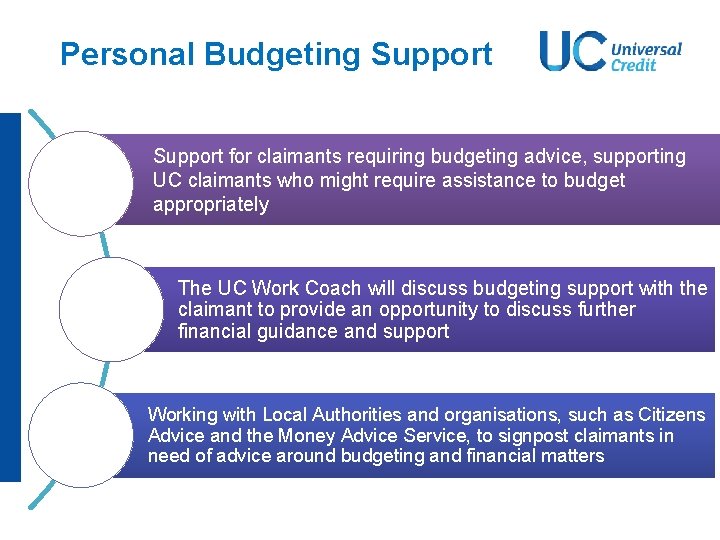
Personal Budgeting Support for claimants requiring budgeting advice, supporting UC claimants who might require assistance to budget appropriately The UC Work Coach will discuss budgeting support with the claimant to provide an opportunity to discuss further financial guidance and support Working with Local Authorities and organisations, such as Citizens Advice and the Money Advice Service, to signpost claimants in need of advice around budgeting and financial matters
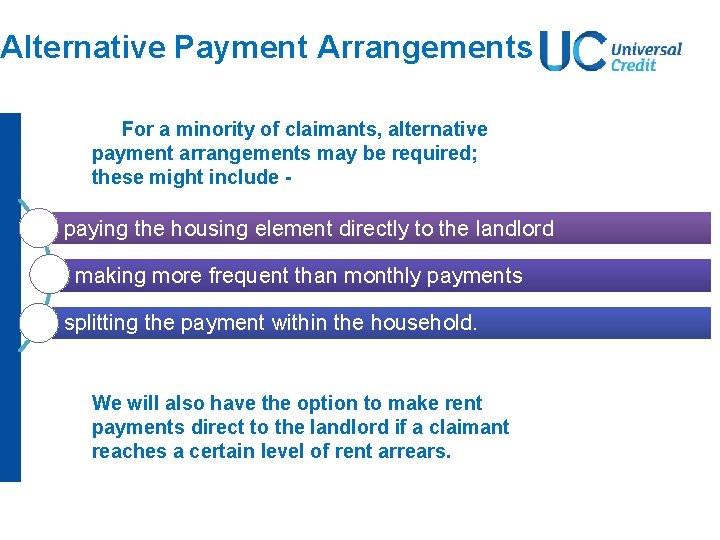
Alternative Payment Arrangements For a minority of claimants, alternative payment arrangements may be required; these might include - include: might paying the housing element directly to the landlord making more frequent than monthly payments splitting the payment within the household. We will also have the option to make rent payments direct to the landlord if a claimant reaches a certain level of rent arrears.
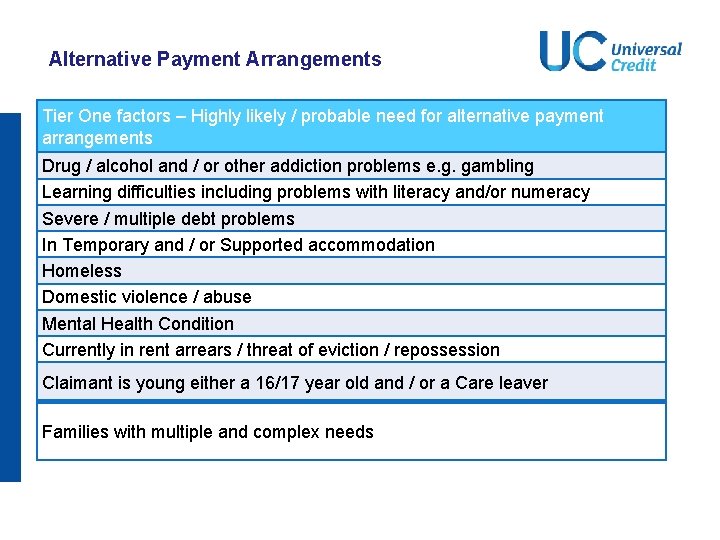
Alternative Payment Arrangements Tier One factors – Highly likely / probable need for alternative payment arrangements Drug / alcohol and / or other addiction problems e. g. gambling Learning difficulties including problems with literacy and/or numeracy Severe / multiple debt problems In Temporary and / or Supported accommodation Homeless Domestic violence / abuse Mental Health Condition Currently in rent arrears / threat of eviction / repossession Claimant is young either a 16/17 year old and / or a Care leaver Families with multiple and complex needs
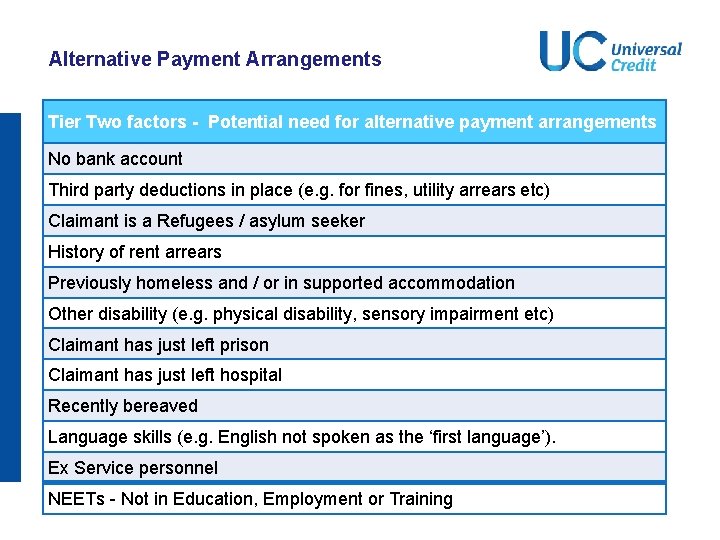
Alternative Payment Arrangements Tier Two factors - Potential need for alternative payment arrangements No bank account Third party deductions in place (e. g. for fines, utility arrears etc) Claimant is a Refugees / asylum seeker History of rent arrears Previously homeless and / or in supported accommodation Other disability (e. g. physical disability, sensory impairment etc) Claimant has just left prison Claimant has just left hospital Recently bereaved Language skills (e. g. English not spoken as the ‘first language’). Ex Service personnel NEETs - Not in Education, Employment or Training
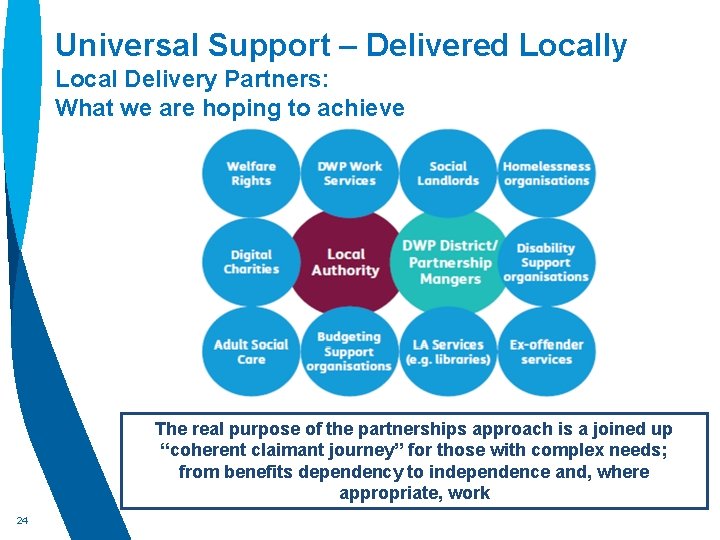
Universal Support – Delivered Locally Local Delivery Partners: What we are hoping to achieve The real purpose of the partnerships approach is a joined up “coherent claimant journey” for those with complex needs; from benefits dependency to independence and, where appropriate, work 24
Questions?
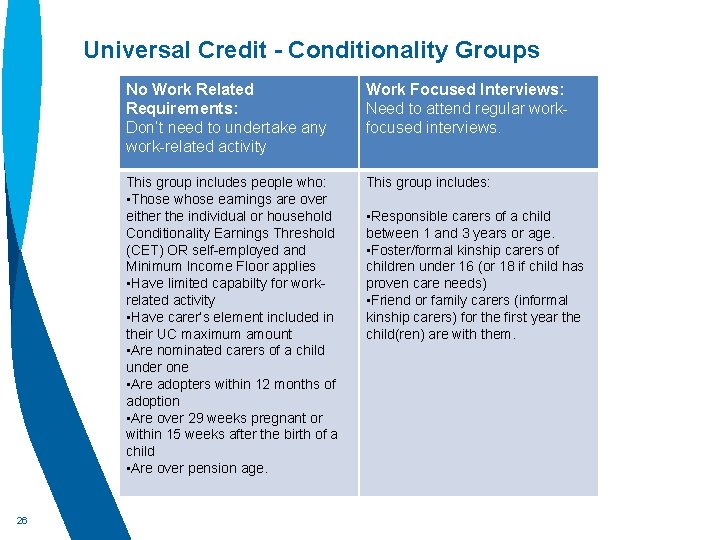
Universal Credit - Conditionality Groups 26 No Work Related Requirements: Don’t need to undertake any work-related activity Work Focused Interviews: Need to attend regular workfocused interviews. This group includes people who: • Those whose earnings are over either the individual or household Conditionality Earnings Threshold (CET) OR self-employed and Minimum Income Floor applies • Have limited capabilty for workrelated activity • Have carer’s element included in their UC maximum amount • Are nominated carers of a child under one • Are adopters within 12 months of adoption • Are over 29 weeks pregnant or within 15 weeks after the birth of a child • Are over pension age. This group includes: • Responsible carers of a child between 1 and 3 years or age. • Foster/formal kinship carers of children under 16 (or 18 if child has proven care needs) • Friend or family carers (informal kinship carers) for the first year the child(ren) are with them.
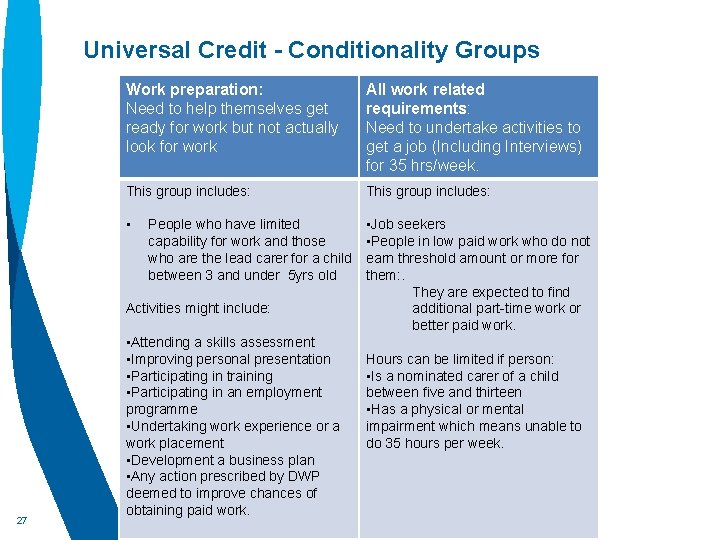
Universal Credit - Conditionality Groups Work preparation: Need to help themselves get ready for work but not actually look for work All work related requirements: Need to undertake activities to get a job (Including Interviews) for 35 hrs/week. This group includes: • • Job seekers • People in low paid work who do not earn threshold amount or more for them: . They are expected to find additional part-time work or better paid work. People who have limited capability for work and those who are the lead carer for a child between 3 and under 5 yrs old Activities might include: 27 • Attending a skills assessment • Improving personal presentation • Participating in training • Participating in an employment programme • Undertaking work experience or a work placement • Development a business plan • Any action prescribed by DWP deemed to improve chances of obtaining paid work. Hours can be limited if person: • Is a nominated carer of a child between five and thirteen • Has a physical or mental impairment which means unable to do 35 hours per week.
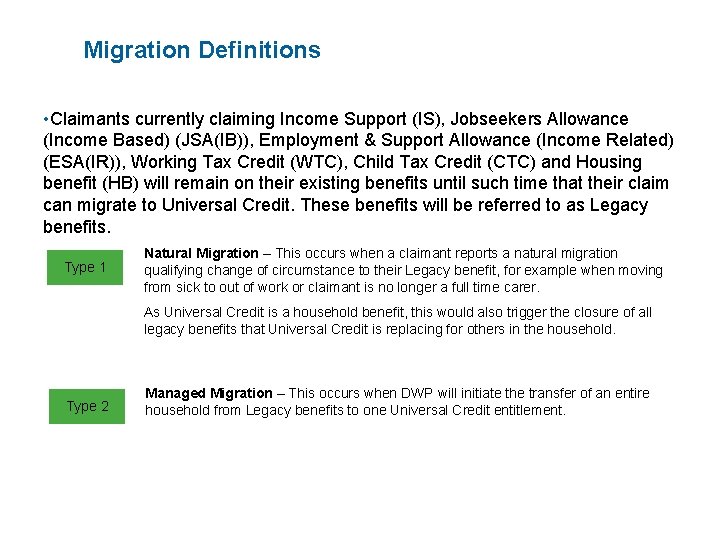
Migration Definitions • Claimants currently claiming Income Support (IS), Jobseekers Allowance (Income Based) (JSA(IB)), Employment & Support Allowance (Income Related) (ESA(IR)), Working Tax Credit (WTC), Child Tax Credit (CTC) and Housing benefit (HB) will remain on their existing benefits until such time that their claim can migrate to Universal Credit. These benefits will be referred to as Legacy benefits. Type 1 Natural Migration – This occurs when a claimant reports a natural migration qualifying change of circumstance to their Legacy benefit, for example when moving from sick to out of work or claimant is no longer a full time carer. As Universal Credit is a household benefit, this would also trigger the closure of all legacy benefits that Universal Credit is replacing for others in the household. Type 2 Managed Migration – This occurs when DWP will initiate the transfer of an entire household from Legacy benefits to one Universal Credit entitlement.