
Universal Adjustment Platform UAP System reliability and radiation
Universal Adjustment Platform (UAP) System reliability and radiation hardness / maintainability M. Sosin Review of HL-LHC Alignment and Internal Metrology (WP 15. 4) CERN, 26 -28 August 2019

Outline § UAP critical components identification § UAP components lifetime and operation components assumptions § Reliability driven design § First radiation test results § Failure Mode Effects Analysis for critical components failures § Maintanability § Conclusions

Universal Adjustment Platform Critical components - failure source equipment § Joints § Vertical adjustment jig § Radial adjustment jig § Motorized adapter unit § Vertical jig knob extension
UAP components – livetime and operation conditions assumptions § Platform lifetime: 10 years § Assumed nominal scenario: 5 minutes of operation per week over 10 years § Static system, alignment mostly triggered by ground motions § Total operation time: 43. 5 h § Big system shift expected only during initial alignment § Small shifts of platform during corrective realignments (< 100 µm), local wear expected § Operation in ambient (tunnel) temperature § Ultimate Total Ionizing Dose for UAP: 1 MGy

UAP components design & relibility High radiation levels (see morning G. Lerner presentation) and difficult access forces surveyors to deploy possible-maintenance free platform Simple and robust mechanical design § Minimum amount of rotating / moving parts § Transmissions designed with low load ratio § Materials selected according to best tribological performance and radiation hard § Lubrication using Molykote BR 2 plus § Self lubricating (sintered bronze) sliding bearings and spherical joint
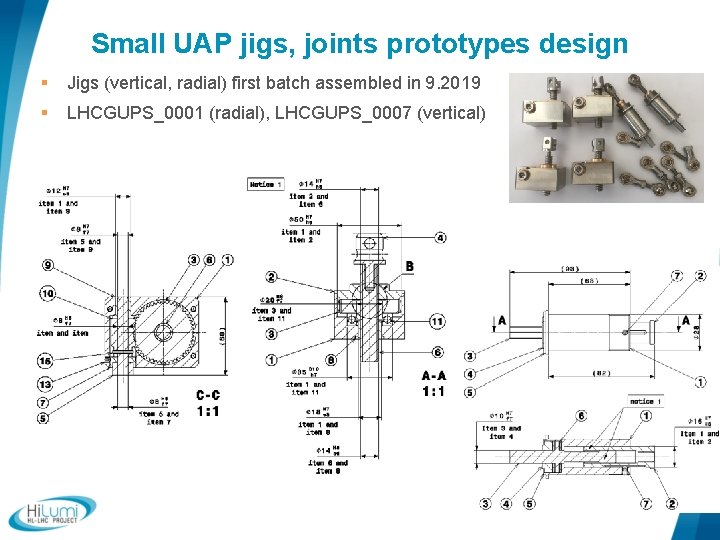
Small UAP jigs, joints prototypes design § Jigs (vertical, radial) first batch assembled in 9. 2019 § LHCGUPS_0001 (radial), LHCGUPS_0007 (vertical)

Small UAP jigs radiation tests § Preliminary 3 MGy radiation tests in Fraunhofer Institute 8 -10. 2018 § Report: EDMS 2138404 § No operational issues observed, no grease problems (Molykote BR 2 plus)
Failure Mode Effects Analysis (FMEA) § Involves reviewing as many components, assemblies, and subsystems as possible to identify failures, and their causes and effects § Only basic analysis considered for the jigs and joints § Results (Risk Priority Number) dependent on assembly quality and machining tolerances
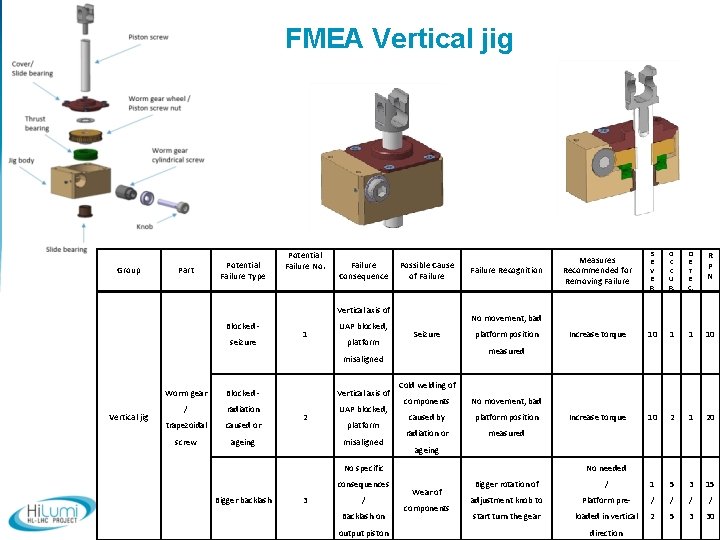
FMEA Vertical jig Group Part Potential Failure Type Potential Failure No. Failure Consequence Possible Cause of Failure Vertical axis of Blocked seizure 1 UAP blocked, platform Vertical jig Blocked - Vertical axis of / radiation UAP blocked, trapezoidal caused or screw ageing 2 platform misaligned Seizure platform position Bigger backlash 3 / Backlash on output piston O C C U R. D E T E C. R P N Increase torque 10 1 1 10 Increase torque 10 2 1 20 measured Cold welding of components No movement, bad caused by platform position radiation or measured ageing No specific consequences S E V E R. No movement, bad misaligned Worm gear Failure Recognition Measures Recommended for Removing Failure No needed Wear of components Bigger rotation of / 1 5 3 15 adjustment knob to Platform pre- / / start turn the gear loaded in vertical 2 5 3 30 direction
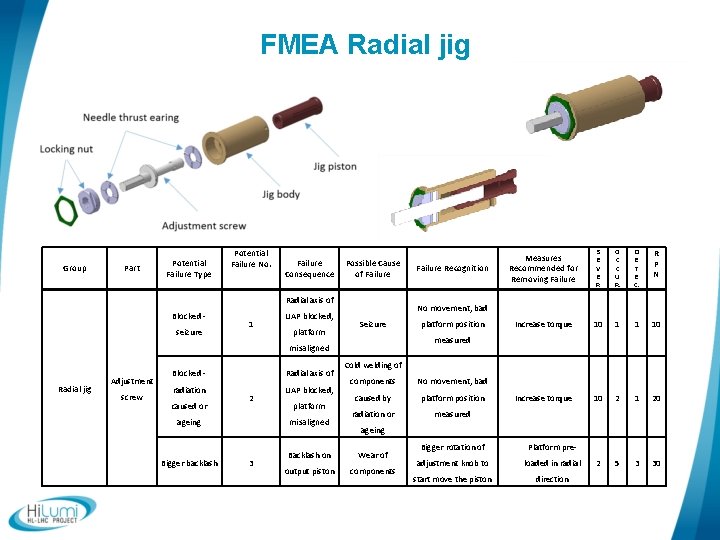
FMEA Radial jig Group Part Potential Failure Type Potential Failure No. Failure Consequence Possible Cause of Failure Radial axis of Blocked seizure 1 UAP blocked, platform Radial jig Adjustment screw Radial axis of radiation UAP blocked, caused or 2 ageing Bigger backlash platform misaligned 3 S E V E R. O C C U R. D E T E C. R P N Increase torque 10 1 1 10 Increase torque 10 2 1 20 2 5 3 30 No movement, bad Seizure platform position measured misaligned Blocked - Failure Recognition Measures Recommended for Removing Failure Cold welding of components No movement, bad caused by platform position radiation or measured ageing Backlash on Wear of output piston components Bigger rotation of Platform pre- adjustment knob to loaded in radial start move the piston direction
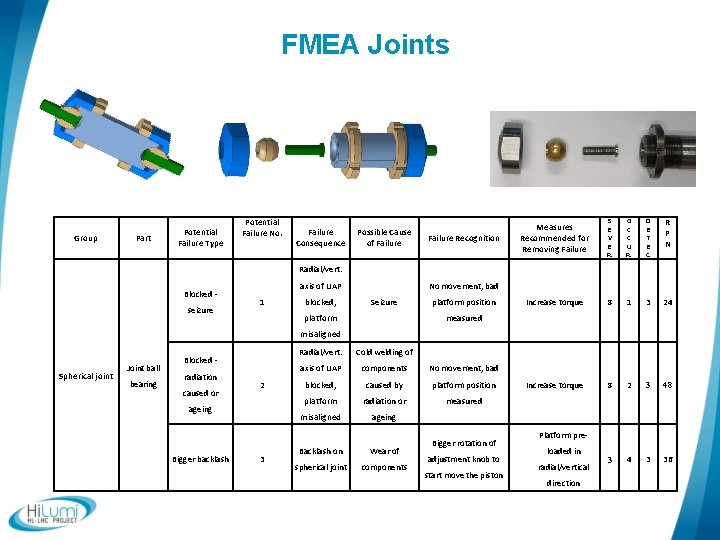
FMEA Joints Group Part Potential Failure Type Potential Failure No. Failure Consequence Possible Cause of Failure Recognition Measures Recommended for Removing Failure S E V E R. O C C U R. D E T E C. R P N Increase torque 8 1 3 24 Increase torque 8 2 3 48 3 4 3 36 Radial/vert. Blocked seizure axis of UAP 1 blocked, No movement, bad Seizure platform position measured misaligned Spherical joint Joint ball bearing Blocked radiation caused or 2 ageing Bigger backlash 3 Radial/vert. Cold welding of axis of UAP components No movement, bad blocked, caused by platform position platform radiation or measured misaligned ageing Backlash on Wear of spherical joint components Bigger rotation of adjustment knob to start move the piston Platform preloaded in radial/vertical direction
FMEA initial analysis conclusions and further tests § Risk Priority Number low, neverthless assumptions should be verified § Jigs and joints lifetime not yet tested with full operation time § Cycling tests planned in October 2019 after modification of Small UAP jigs and manufacturing of prototype series of Big UAP jigs § Cycling tests (operation time), including small displacements impact check § Verification of assumed lifetime of components § Check wear of mechanical components (backlash increase) § Radiation tests § Final prototypes

Impact of UAP failures on accelerator reliability § Risks scenarios of the misaligned UAP supported components, to be analysed § Risk evaluation using i. e. RIRE
UAP maintainability Maintainability assessment attributes: Curtesy P. Moreu de Leon, „A practical method for the maintability assesment. . . ”
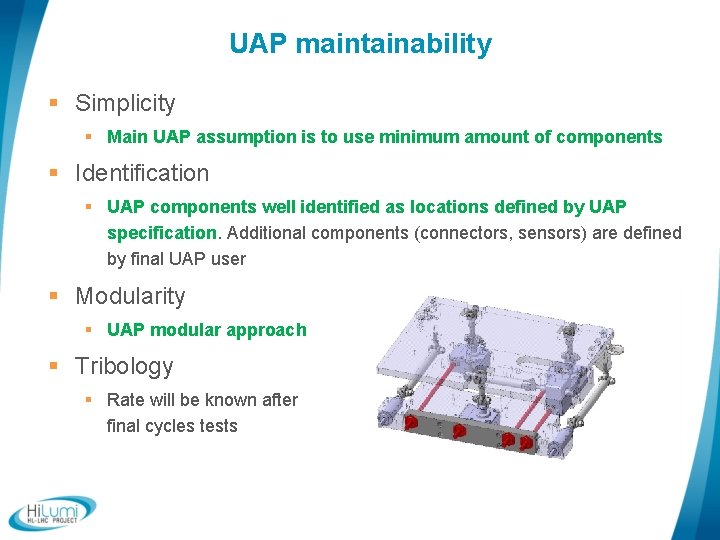
UAP maintainability § Simplicity § Main UAP assumption is to use minimum amount of components § Identification § UAP components well identified as locations defined by UAP specification. Additional components (connectors, sensors) are defined by final UAP user § Modularity § UAP modular approach § Tribology § Rate will be known after final cycles tests
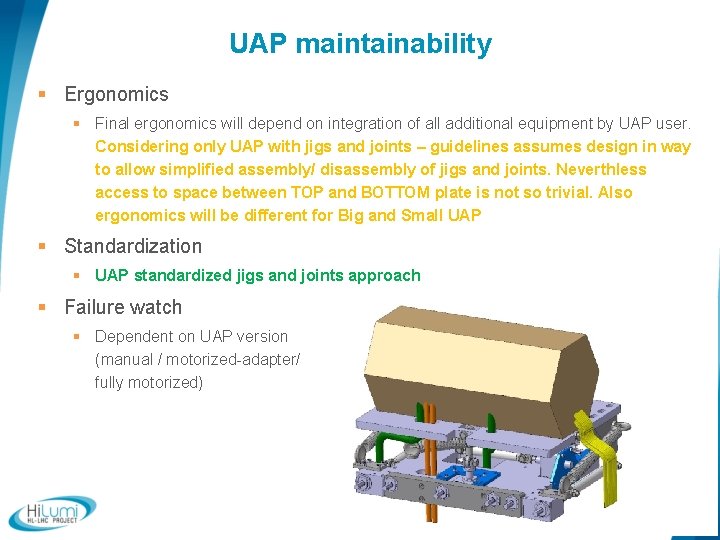
UAP maintainability § Ergonomics § Final ergonomics will depend on integration of all additional equipment by UAP user. Considering only UAP with jigs and joints – guidelines assumes design in way to allow simplified assembly/ disassembly of jigs and joints. Neverthless access to space between TOP and BOTTOM plate is not so trivial. Also ergonomics will be different for Big and Small UAP § Standardization § UAP standardized jigs and joints approach § Failure watch § Dependent on UAP version (manual / motorized-adapter/ fully motorized)
Conclusions § UAP concept assumes high reliability and maintainability of platform § Reliability of the UAP sub-components will be known after components cycle-testing and final tests of Small and Big UAP prototypes § Impact of UAP failures on accelerator reliability to be analyzed

Thank you for your attention 18
- Slides: 18