
Univariate EDA Exploratory Data Analysis Univariate EDA Describe

Univariate EDA
Exploratory Data Analysis • Univariate EDA – Describe the distribution – Distribution is concerned with what values a variable takes and how often it takes each value • Univariate EDA (for quantitative data) – Graphically – Numerically – Model Quantitative Univariate EDA Slide #2
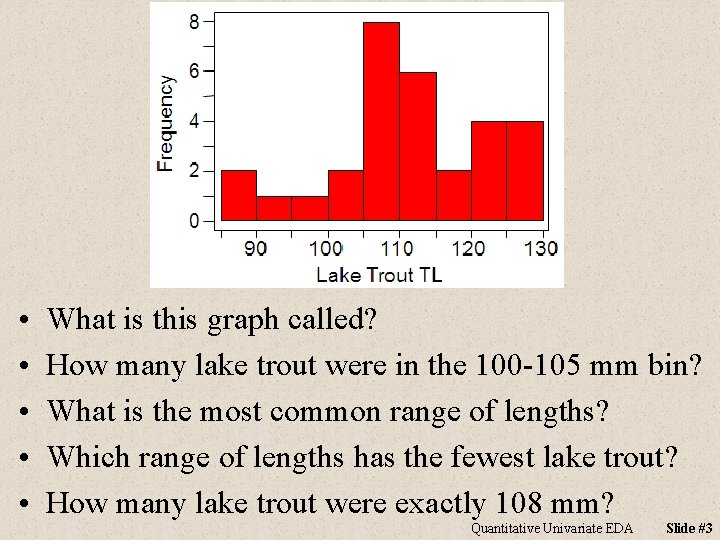
• • • What is this graph called? How many lake trout were in the 100 -105 mm bin? What is the most common range of lengths? Which range of lengths has the fewest lake trout? How many lake trout were exactly 108 mm? Quantitative Univariate EDA Slide #3
Quantitative Univariate EDA What four things are described? • • Shape Outliers Center Dispersion Quantitative Univariate EDA Slide #4
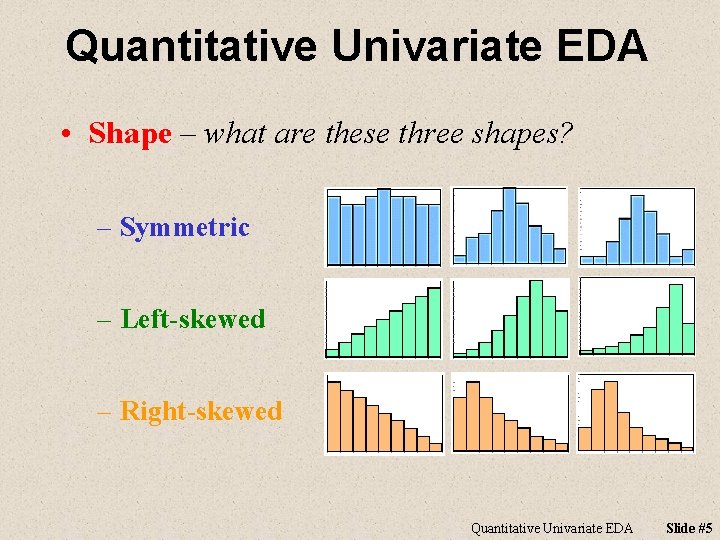
Quantitative Univariate EDA • Shape – what are these three shapes? – Symmetric – Left-skewed – Right-skewed Quantitative Univariate EDA Slide #5
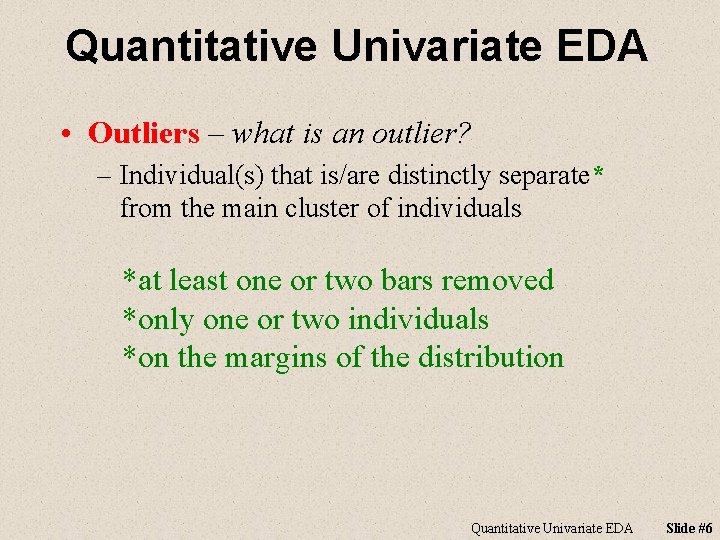
Quantitative Univariate EDA • Outliers – what is an outlier? – Individual(s) that is/are distinctly separate* from the main cluster of individuals *at least one or two bars removed *only one or two individuals *on the margins of the distribution Quantitative Univariate EDA Slide #6
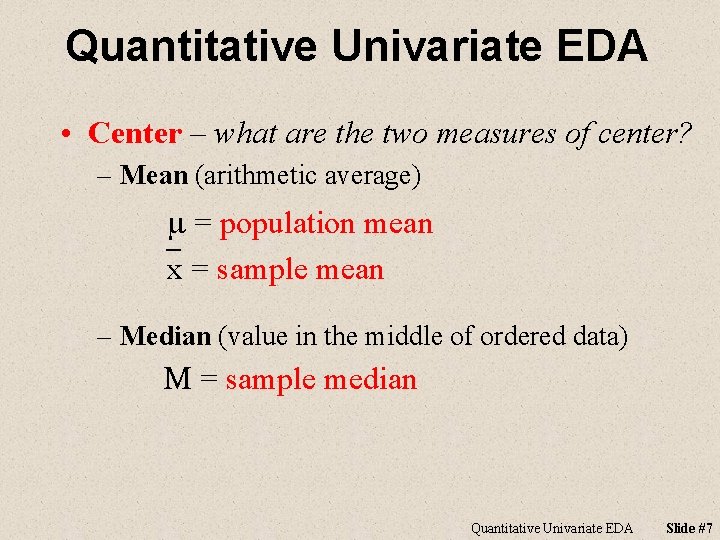
Quantitative Univariate EDA • Center – what are the two measures of center? – Mean (arithmetic average) m = population mean `x = sample mean – Median (value in the middle of ordered data) M = sample median Quantitative Univariate EDA Slide #7
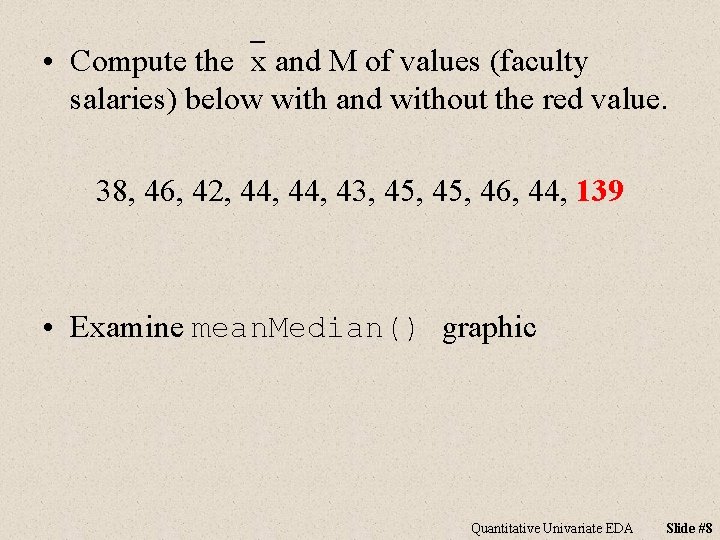
• Compute the`x and M of values (faculty salaries) below with and without the red value. 38, 46, 42, 44, 43, 45, 46, 44, 139 • Examine mean. Median() graphic Quantitative Univariate EDA Slide #8
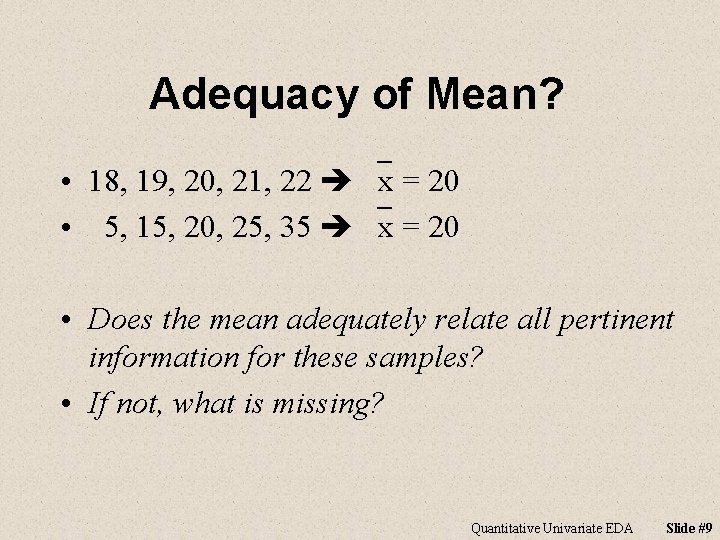
Adequacy of Mean? • 18, 19, 20, 21, 22 `x = 20 • 5, 15, 20, 25, 35 `x = 20 • Does the mean adequately relate all pertinent information for these samples? • If not, what is missing? Quantitative Univariate EDA Slide #9
Quantitative Univariate EDA • Dispersion -- variability among individuals What are three measures of dispersion? – Range (minimum, maximum) – Inter-Quartile Range (IQR; Q 1, Q 3) – Standard Deviation (average difference from mean) s = population standard deviation s = sample standard deviation Quantitative Univariate EDA Slide #10
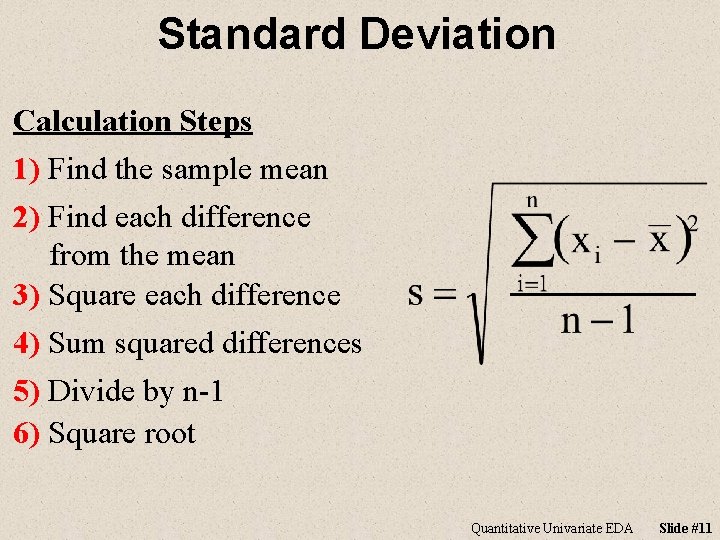
Standard Deviation Calculation Steps 1) Find the sample mean 2) Find each difference from the mean 3) Square each difference 4) Sum squared differences 5) Divide by n-1 6) Square root Quantitative Univariate EDA Slide #11
• Compute s from the values below (use table 3. 4 in the book as a model). 5, 8, 9, 11, 12 • Compute the IQR of values (faculty salaries) below with and without the red value. 38, 46, 42, 44, 43, 45, 46, 44, 139 Quantitative Univariate EDA Slide #12
Quantitative Univariate EDA in R • Examine Handout – hist() – Summarize() Quantitative Univariate EDA Slide #13
Overall Numerical Summaries • If outliers exist then use the Median and IQR • If outliers do not exist, but distribution is strongly skewed then use the Median and IQR • If outliers do not exist and the distribution is symmetric or only slightly skewed then use the Mean and standard deviation Quantitative Univariate EDA Slide #14
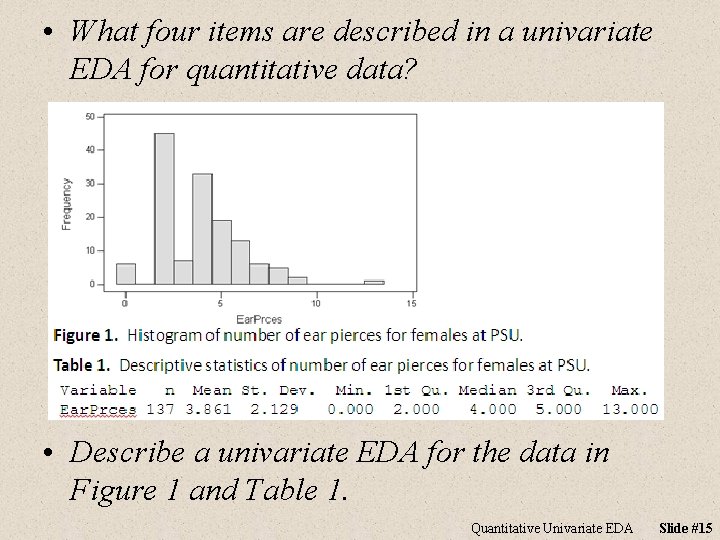
• What four items are described in a univariate EDA for quantitative data? • Describe a univariate EDA for the data in Figure 1 and Table 1. Quantitative Univariate EDA Slide #15
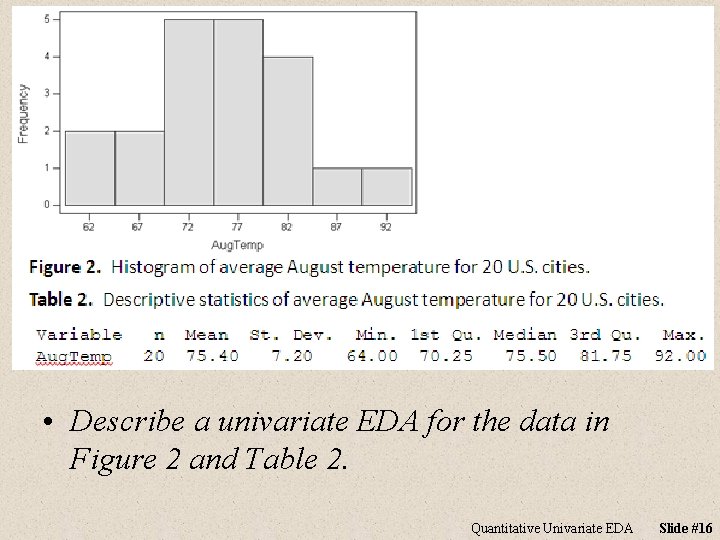
• Describe a univariate EDA for the data in Figure 2 and Table 2. Quantitative Univariate EDA Slide #16
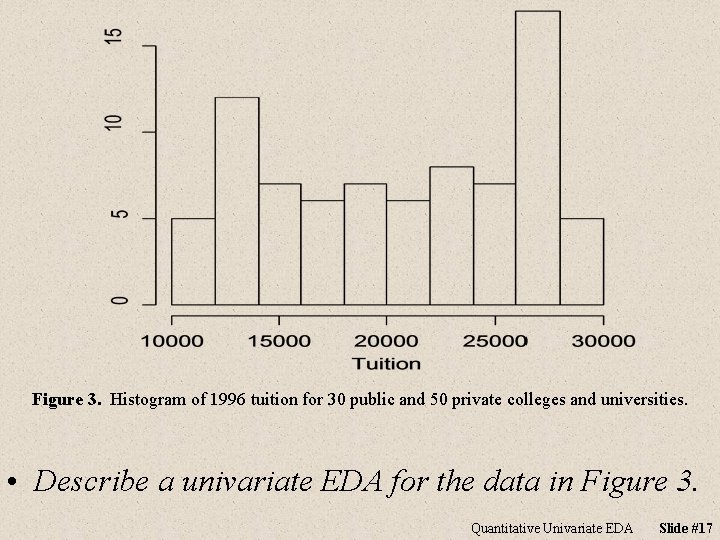
Figure 3. Histogram of 1996 tuition for 30 public and 50 private colleges and universities. • Describe a univariate EDA for the data in Figure 3. Quantitative Univariate EDA Slide #17
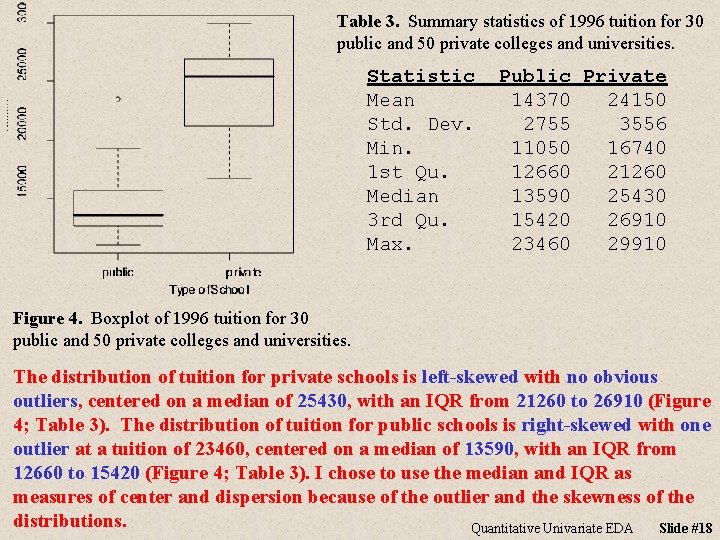
Table 3. Summary statistics of 1996 tuition for 30 public and 50 private colleges and universities. Statistic Mean Std. Dev. Min. 1 st Qu. Median 3 rd Qu. Max. Public Private 14370 24150 2755 3556 11050 16740 12660 21260 13590 25430 15420 26910 23460 29910 Figure 4. Boxplot of 1996 tuition for 30 public and 50 private colleges and universities. The distribution of tuition for private schools is left-skewed with no obvious outliers, centered on a median of 25430, with an IQR from 21260 to 26910 (Figure 4; Table 3). The distribution of tuition for public schools is right-skewed with one outlier at a tuition of 23460, centered on a median of 13590, with an IQR from 12660 to 15420 (Figure 4; Table 3). I chose to use the median and IQR as measures of center and dispersion because of the outlier and the skewness of the distributions. Quantitative Univariate EDA Slide #18
- Slides: 18