
Unity through Relationship Congruent Care Theory Dialogue Practice
- Slides: 62
Unity through Relationship Congruent Care: Theory Dialogue - Practice Dublin, November 9, 2015 DR. JIM ANGLIN PROFESSOR, SCHOOL OF CHILD AND YOUTH CARE UNIVERSITY OF VICTORIA, BC CANADA
A “THEORY IN USE” (“MENTAL MODELS”) (Chris Argyris, Theory in Practice, 1974)) Each of us, in fact, carries with us a “theory in use” * whether it is coherent, or not, * whether we can articulate it, or not, and * whether we are intentional and
Unified field theory, in particle physics, is an attempt to describe all fundamental forces and the relationships between elementary particles in terms of a single theoretical framework. Can, or should, CYC aspire to describe the fundamental forces and relationships between (and amongst) adults and young people in terms of a theory that seeks to unify our existing and potential knowledge
PERHAPS WE CAN LEARN A FEW THINGS FROM PHYSICS… The pursuit of a unified theory – whether it can or will be successful or not – leads to the search for and discovery of “new particles” and dynamics. It leads physicists to address, and strive to overcome, apparent and real contradictions in current thinking, systems of thought and organizational
An incomplete theory can still bring useful order and convergence into a complex and apparently chaotic environment. The attempt to articulate a unified theory of the field of CYC could perhaps be a “struggle for congruence, ” and an ideal that may never be achieved (but which may
“A UNIFYING SOMETHING” A. E. TRIESCHMAN “The problem for the child care worker and the program administrator alike is to achieve some sort of integrative focus what Albert E. Trieschman called a "unifying something" - as a basis for building a coherent helping environment…for professional child care work. ” (xiv) - (Maier, H. W. (1987). Developmental Group Care of Children and Youth: Concepts and Practice, Binghamton,
In a word “It’s all about relationship” In a sentence, the uniqueness of child and youth work could be summed up as: How we share our self • in care interactions • in the life-space of young people and families • to create transformative developmental and therapeutic experiences. An article, a book, a career, a unified theory?
TOWARDS A THEORY OF RESIDENTIAL CARE The research study: • 10 group care programs for young people • 4 to 14 beds • ages 10 to 17 • engaged sites over 14 months • 85 formal interviews • 18 residents and former residents
Purpose: to develop a theoretical framework for understanding the dynamics of good residential group care. What makes a good, or wellfunctioning, group home?
Method: • grounded theory The Discovery of Grounded Theory (Glaser & Strauss, 1967)
Kurt Lewin: “there is nothing so practical as a good theory”. A good theory “fits, works and is relevant” to actual practice. Barney Glaser
Theory is a way of thinking about the world. To my mind, thinking is the most underrated child and youth care skill
“Everything should be made as simple as possible, but not simpler. ” Albert Einstein
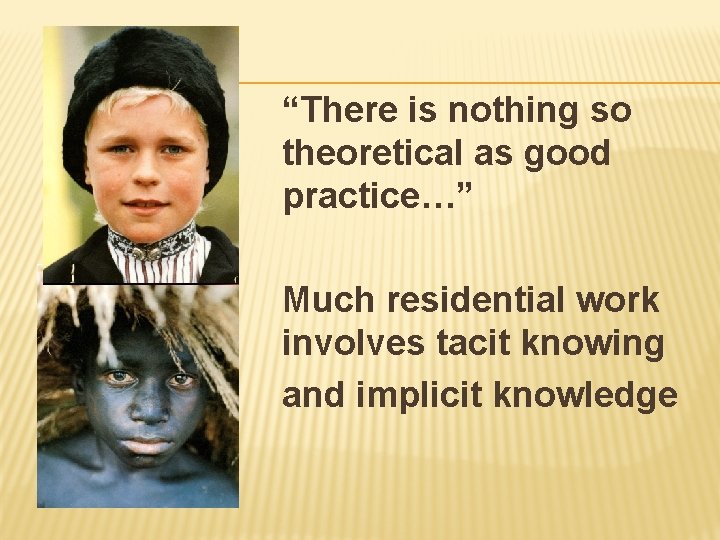
“There is nothing so theoretical as good practice…” Much residential work involves tacit knowing and implicit knowledge
The central element in grounded theory is the core theme, variable, or problematic. Frequently the core theme is a psychosocial process; that is, a process involving the intertwining of the personal and the collective experience.
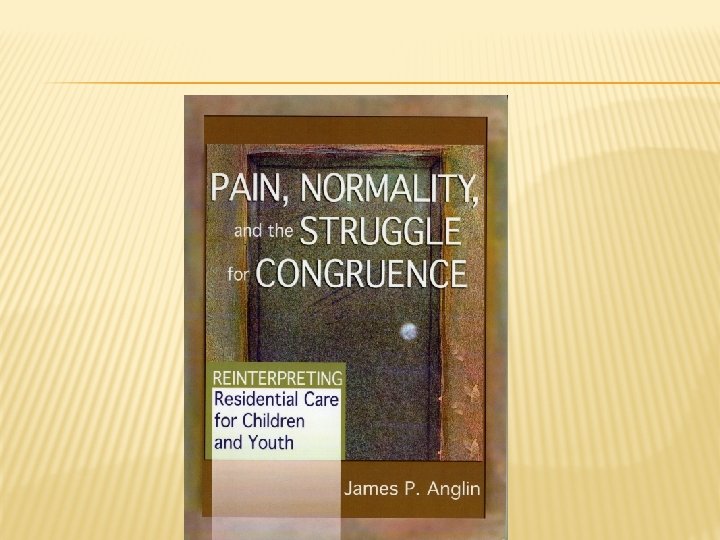
Core theme discovered in this study: “the struggle for congruence in service of the children’s best interests”.
• Congruence means that core values and principles are evident in action within each level and across all levels of an organization (extra-agency, management, supervision, line staff, clients) • The flow of congruence - from the top of the organisation to the bottom • The struggle for congruence - congruence is never fully achieved but is an ideal to strive for
What does it mean to work in“the children’s best interests”? Everyone thinks they are acting in the children’s best interests, but often they are not, or at least not consistently.
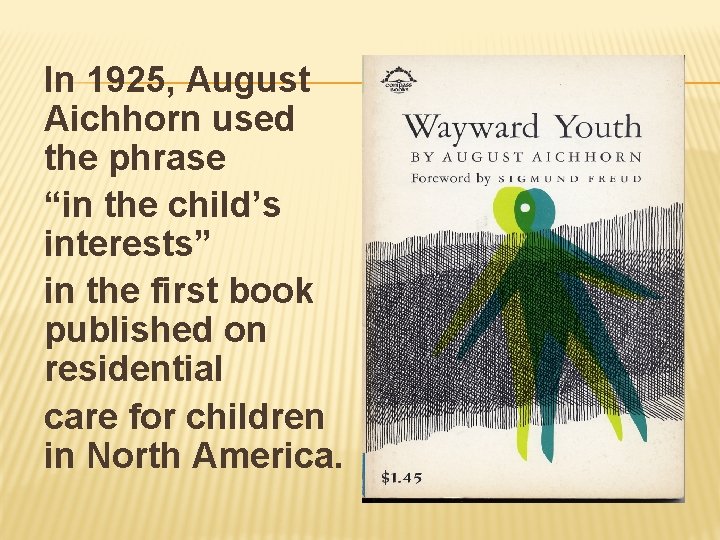
In 1925, August Aichhorn used the phrase “in the child’s interests” in the first book published on residential care for children in North America.
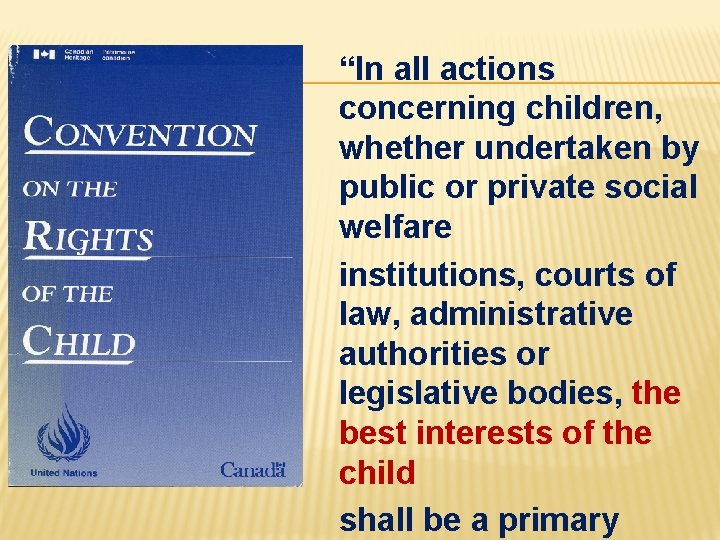
“In all actions concerning children, whether undertaken by public or private social welfare institutions, courts of law, administrative authorities or legislative bodies, the best interests of the child shall be a primary
Full congruence is an ideal state or goal, and is never fully achieved; there are competing priorities, including: - Financial constraints Referring agencies’ needs Staff convenience or preferences Program/system rules and procedures Maintaining control or exerting authority Pressure to “fill beds”
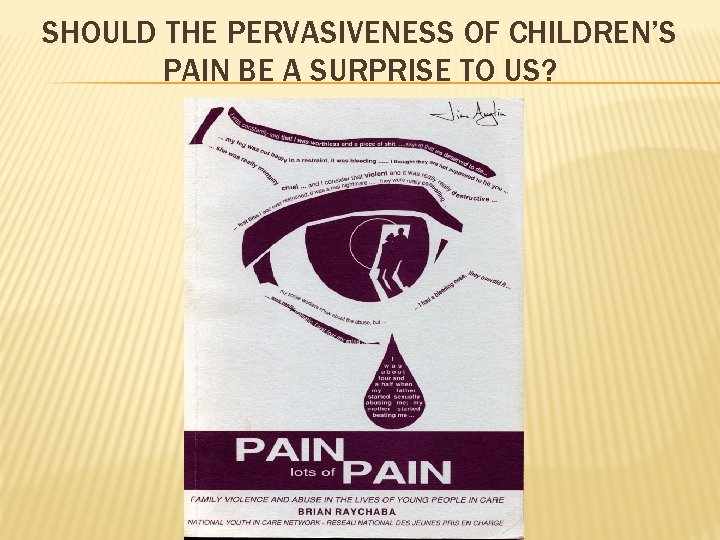
One of the most striking discoveries in my study was that 100% of the young people in the residential care homes were suffering from deep, profound and long-lasting psycho-emotional pain. Thus it became evident that much of their behavior was understandably pain-based behavior.
We tend to use gloss words to refer to what is going on with young people in residential care: we talk of “troubled” or “troubling” children and youth e. g. Re-Educating Troubled Youth (Brendtro & Ness) Caring for Troubled Children (Whittaker) Working with Troubled Children (Savicki & Brown) The Troubled and Troubling Child (Hobbs)
We have talked of “acting out” behaviour, but seldom paused to consider the “inside of acting out” We have talked of “behaviour management”, or “controlling children’s behaviour”, but seldom took the time to understand what lies behind the behaviour – where this behaviour originates.
SHOULD THE PERVASIVENESS OF CHILDREN’S PAIN BE A SURPRISE TO US?
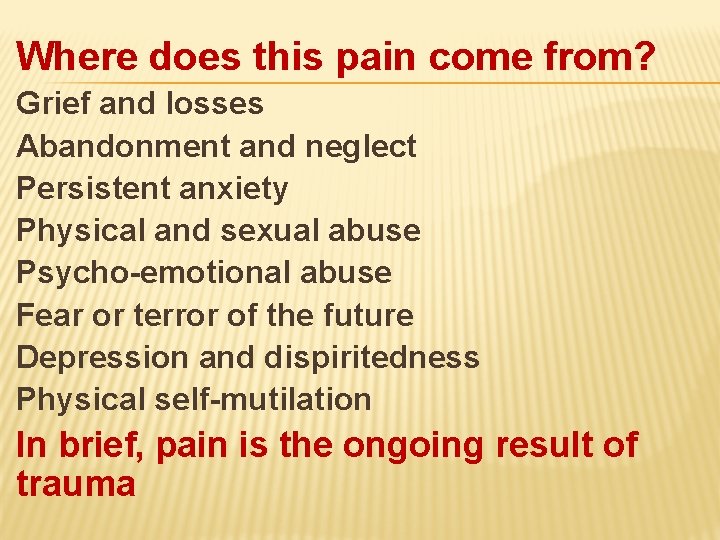
Where does this pain come from? Grief and losses Abandonment and neglect Persistent anxiety Physical and sexual abuse Psycho-emotional abuse Fear or terror of the future Depression and dispiritedness Physical self-mutilation In brief, pain is the ongoing result of trauma
Residential workers work in cultures of pain. • There is growing evidence that most of the “critical incidents” in residential homes are triggered by staff reactions to children’s pain-based behaviors; • The mix of children’s pain and pain-based behaviour and adult caregivers’ reactivity is a recipe for confrontation, power struggles and abusive behavior.
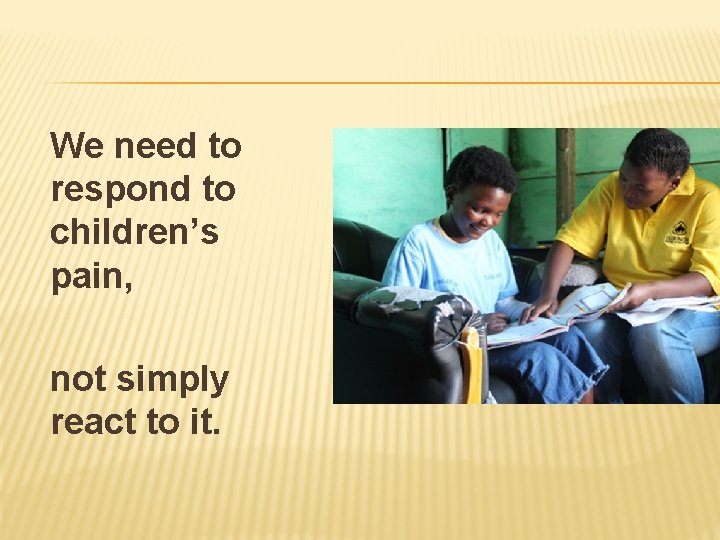
We need to respond to children’s pain, not simply react to it.
To react is to act on the basis of some inner motive; some feeling, emotion, desire or physical need in the person reacting that provides the impulse to act. To respond is to act on the basis of intent; some aim, plan, or state of mind that is fastened on some purpose relating to the person being responded to, rather than on a need of the reactor.
Living and working with such pain and being subject to pain-based behavior creates pain-based challenges for care workers and other residential staff. This reality necessitates DIALOGUE, through: • Education and training • Orientation • Planning and anticipation • Supervision • Team meetings/ shift changes • Debriefing • Conferences, workshops, etc…!!!!
PARADOX: While a group home is not a “normal” or “natural” setting for young people in our communities, residents are able to develop a sense of normality across numerous dimensions of their development.
Experience of normality may include: a sense of belonging, a sense of dignity, a sense of self-worth, a sense of meaning in their lives, a sense of order and predictability, a sense of loyalty and continuity, a sense of caring, a sense of mastery, a sense of potential and capability, a sense of personal power and discernment, a sense of independence, a sense of gratitude and generosity, a sense of hope and opportunity, a sense of connectedness.
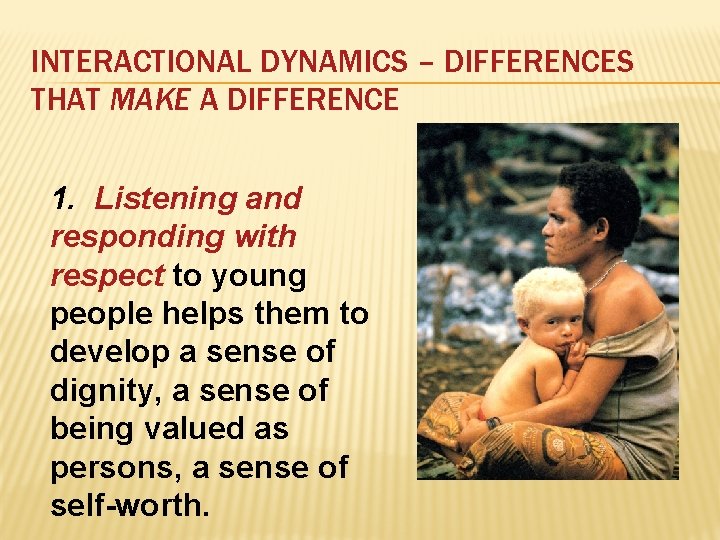
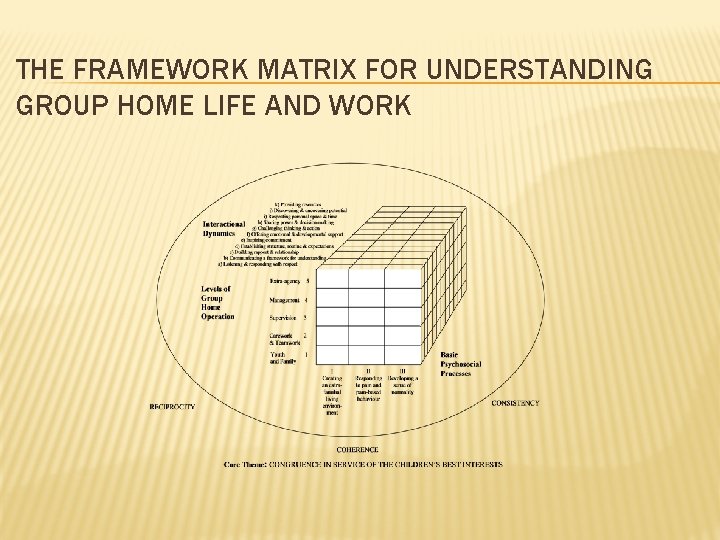
INTERACTIONAL DYNAMICS – DIFFERENCES THAT MAKE A DIFFERENCE 1. Listening and responding with respect to young people helps them to develop a sense of dignity, a sense of being valued as persons, a sense of self-worth.
INTERACTIONAL DYNAMICS – DIFFERENCES THAT MAKE A DIFFERENCE 2. Communicating a framework for understanding with young people helps them to develop a sense of meaning and a sense of the rationality within daily life. 3. Building rapport and relationships with young people helps them to develop a sense of belonging and connectedness with others.
INTERACTIONAL DYNAMICS - DIFFERENCES THAT MAKE A DIFFERENCE 4. Establishing structure, routine, and expectations with young people assists them to develop a sense of order and predictability in the world, as well as a sense of trust in the reliability of others. 5. Inspiring commitment in young people encourages them to develop a sense of value, loyalty, and continuity.
INTERACTIONAL DYNAMICS – DIFFERENCES THAT MAKE A DIFFERENCE 6. Offering young people emotional and developmental support helps them to develop a sense of caring and mastery. 7. Challenging the thinking and actions of young people helps them to develop a sense of potential and capability.
INTERACTIONAL DYNAMICS – DIFFERENCES THAT MAKE A DIFFERENCE 8. Sharing power and decision-making with young people encourages them to develop a sense of personal power and discernment. 9. Respecting the personal space and time of young people helps them to develop a sense of independence.
INTERACTIONAL DYNAMICS – DIFFERENCES THAT MAKE A DIFFERENCE 10. Discovering and uncovering the potential of young people helps them to develop a sense of hope and opportunity. 11. Providing resources to young people helps them to develop a sense of gratitude and generosity.
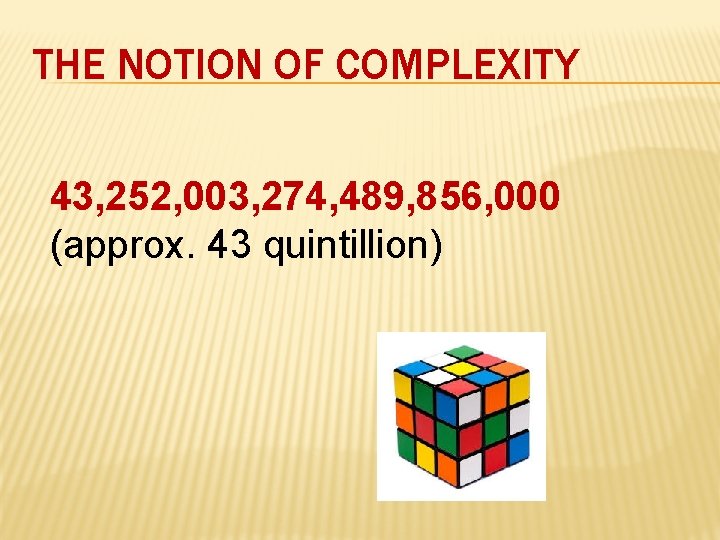
THE NOTION OF COMPLEXITY 43, 252, 003, 274, 489, 856, 000 (approx. 43 quintillion)
But what is the maximum number of changes that need to be made to solve the Rubik’s cube from any position? 20
Scotsman Breandan Vallance, 18, a recent world Rubik’s Cube champion had an average solving time of an astonishing 10. 74 seconds.
THE FRAMEWORK MATRIX FOR UNDERSTANDING GROUP HOME LIFE AND WORK
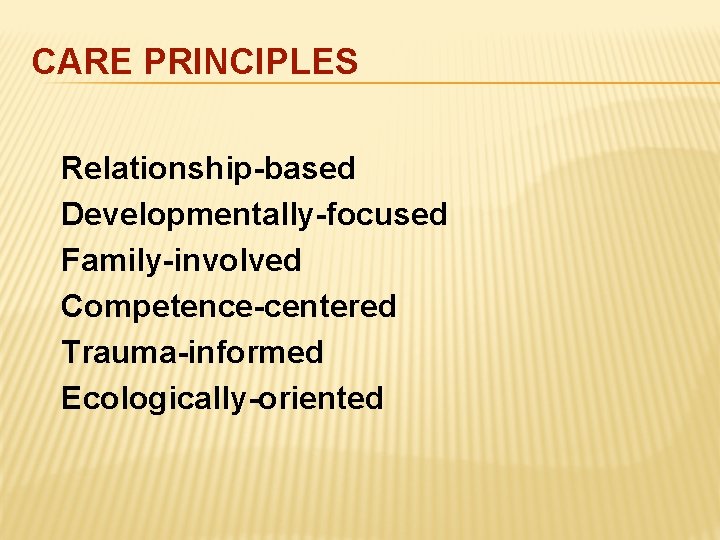
CARE PRINCIPLES Relationship-based Developmentally-focused Family-involved Competence-centered Trauma-informed Ecologically-oriented
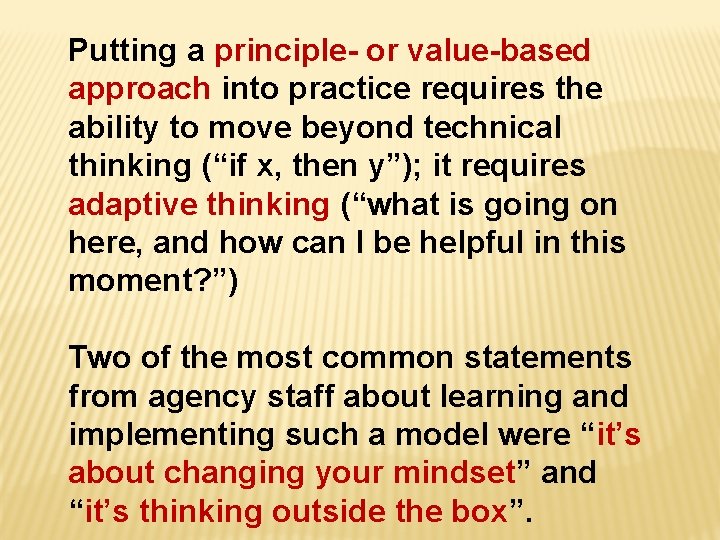
Putting a principle- or value-based approach into practice requires the ability to move beyond technical thinking (“if x, then y”); it requires adaptive thinking (“what is going on here, and how can I be helpful in this moment? ”) Two of the most common statements from agency staff about learning and implementing such a model were “it’s about changing your mindset” and “it’s thinking outside the box”.
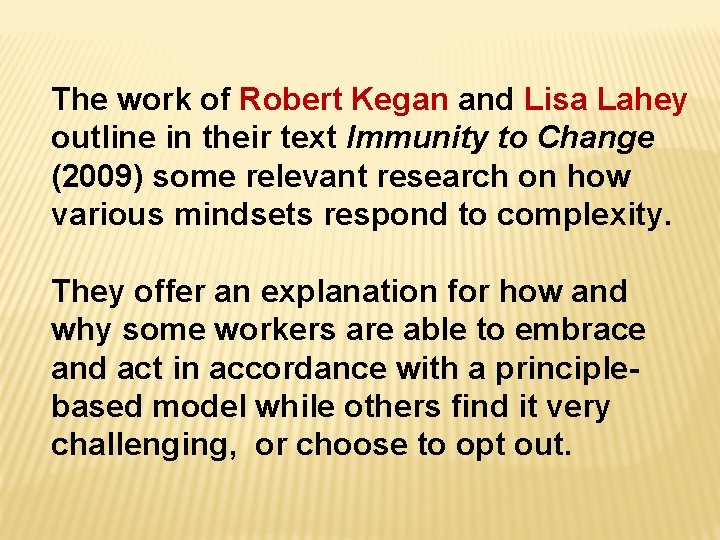
The work of Robert Kegan and Lisa Lahey outline in their text Immunity to Change (2009) some relevant research on how various mindsets respond to complexity. They offer an explanation for how and why some workers are able to embrace and act in accordance with a principlebased model while others find it very challenging, or choose to opt out.
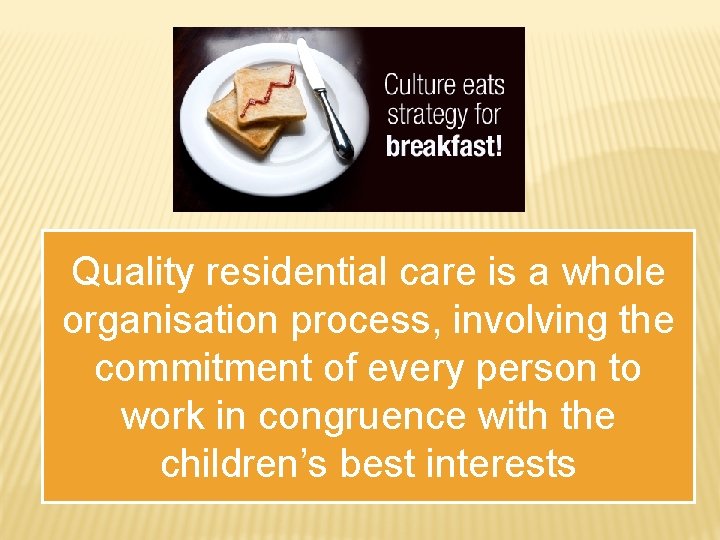
Quality residential care is a whole organisation process, involving the commitment of every person to work in congruence with the children’s best interests
As a result of being exposed to the notion of congruence and a set of developmental principles, agency leaders become aware of the need to review and revise their agency policies, procedures, practices, and structures, in order to be congruent with the principles and to align with what is in the children’s best interests.
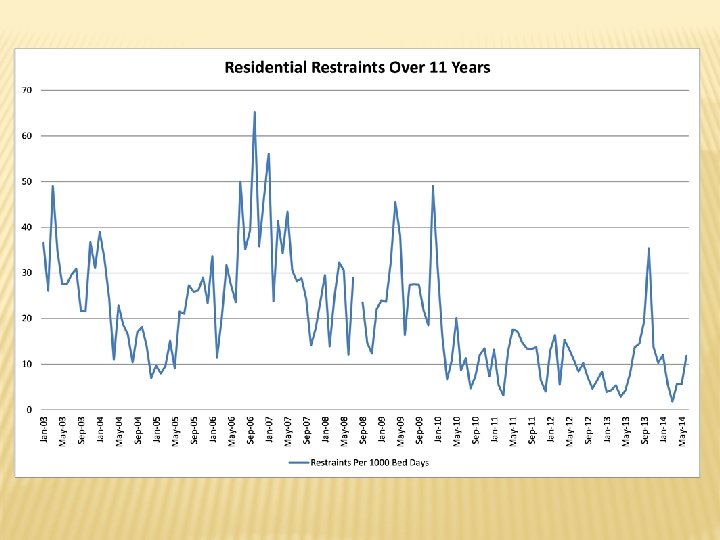
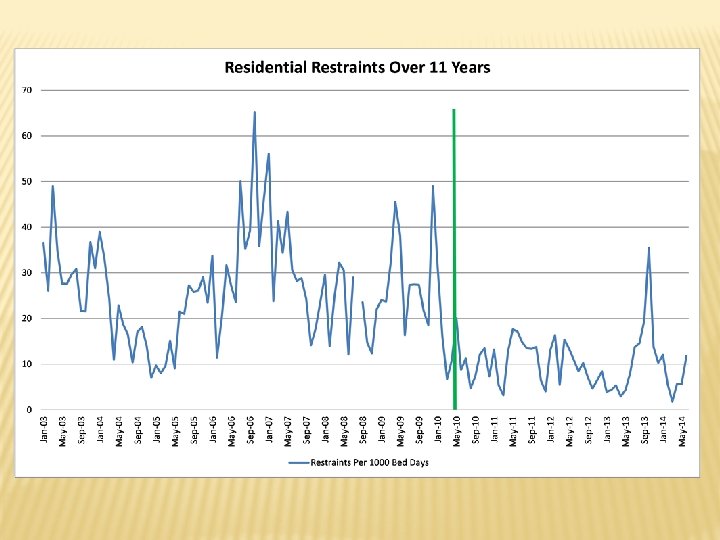
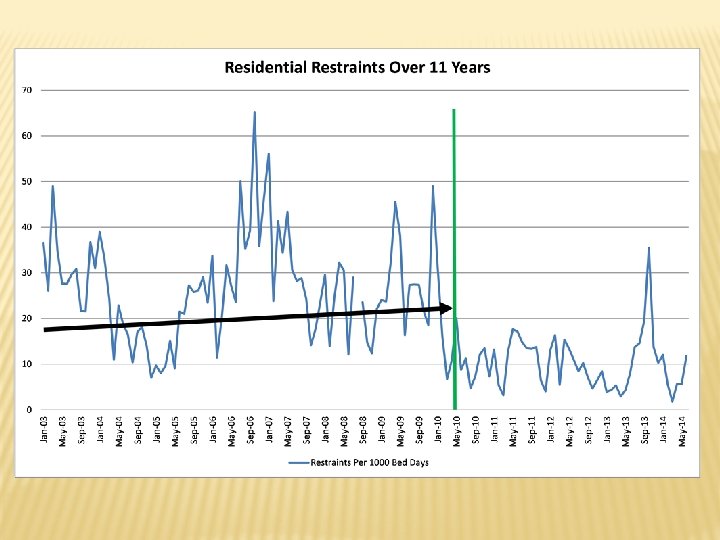
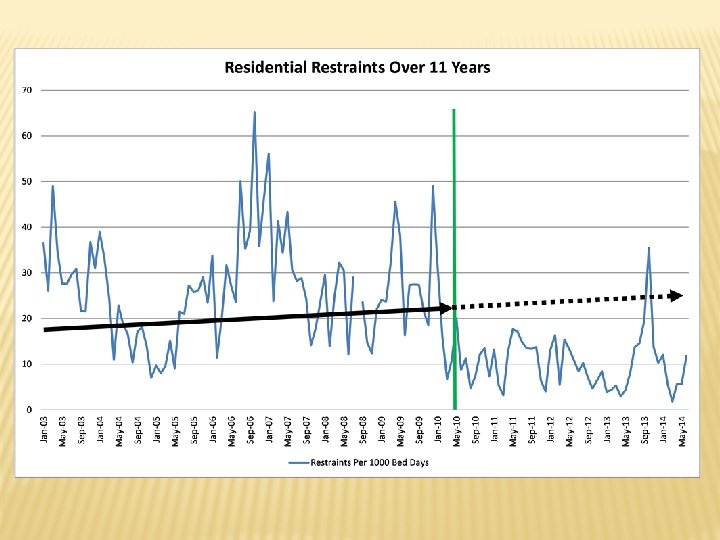
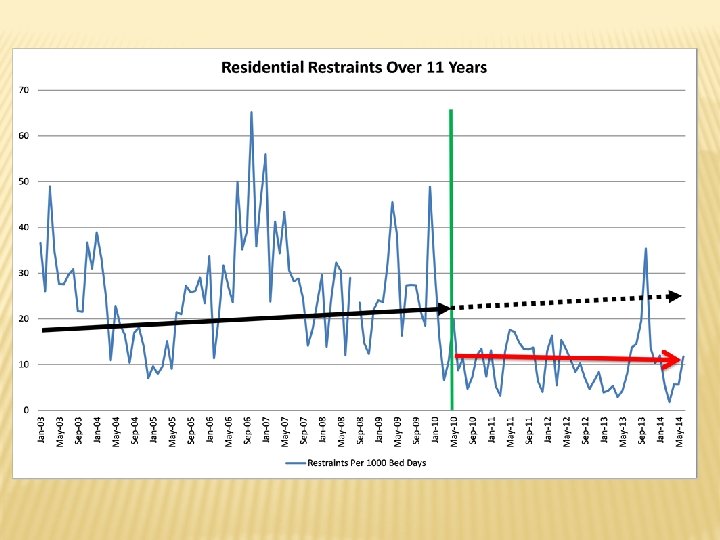
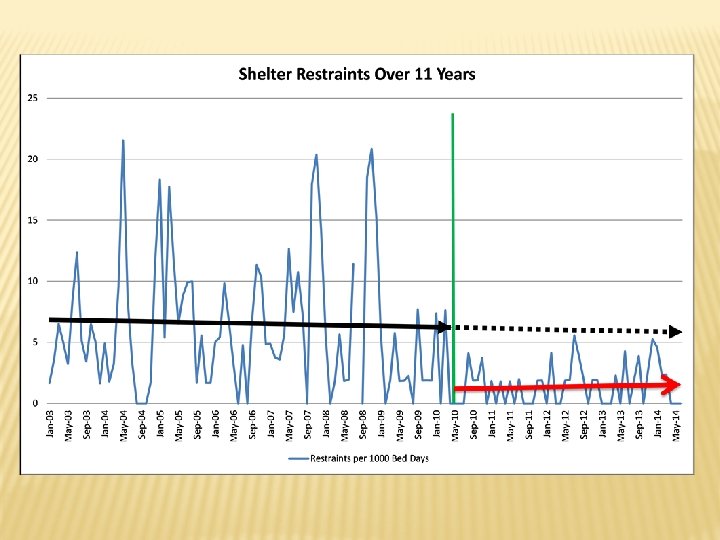
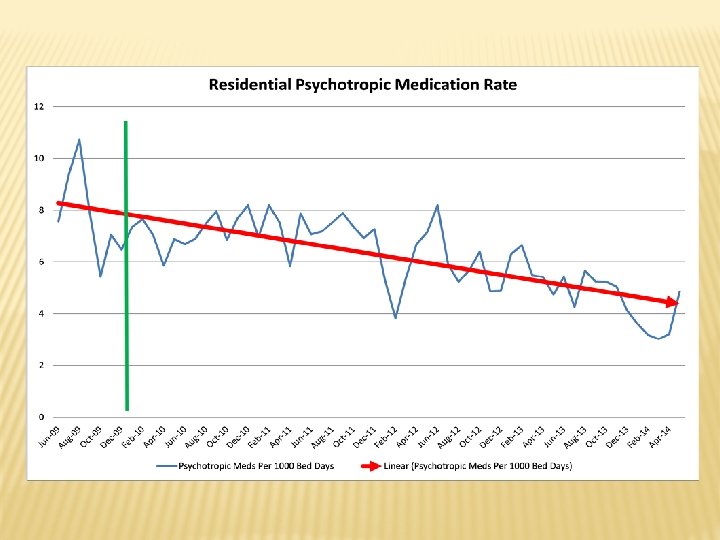
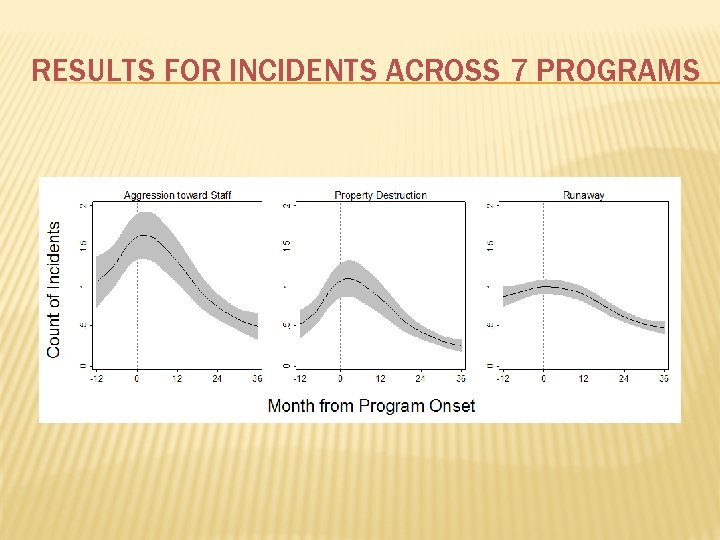
But does implementing this approach make a difference? What are the results of research and evaluation telling us?
RESULTS FOR INCIDENTS ACROSS 7 PROGRAMS
IN CONCLUSION… Residential care should not be seen as “a last resort”, or as a negative option. It needs to be understood as a positive and preferred option for those young people who need it, when they need it.
Residential care is not rocket science; It’s far more complex than that! However, we are discovering ways to respond to this complexity in the best interests of
Now, let the dialogues begin! (towards a unified theory of child and youth care? )