
Unity of invention outcome of the IP 5


- Slides: 19
Unity of invention – outcome of the IP 5 work MEETING OF INTERNATIONAL AUTHORITIES – QUALITY SUBGROUP Camille Bogliolo (PCT Affairs) and Luigi Petrucci (Patent Procedures), EPO Cairo, 11 -12 February 2019
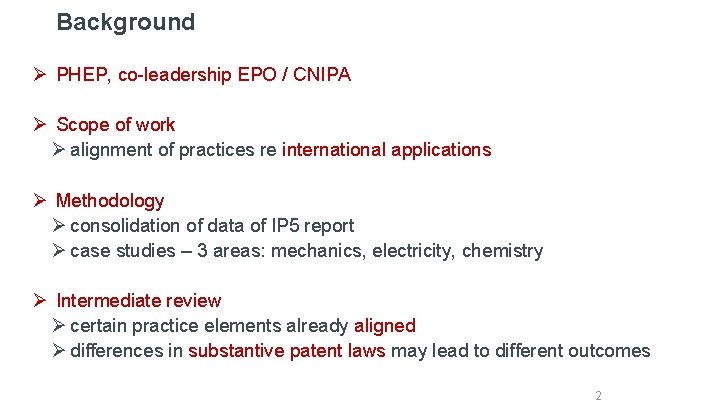
Background Ø PHEP, co-leadership EPO / CNIPA Ø Scope of work Ø alignment of practices re international applications Ø Methodology Ø consolidation of data of IP 5 report Ø case studies – 3 areas: mechanics, electricity, chemistry Ø Intermediate review Ø certain practice elements already aligned Ø differences in substantive patent laws may lead to different outcomes 2
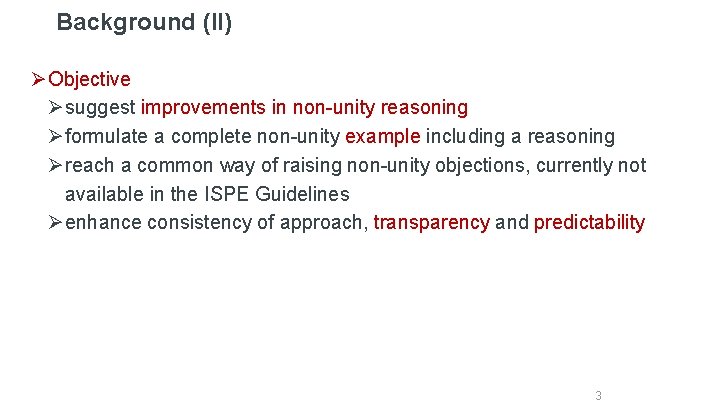
Background (II) Ø Objective Ø suggest improvements in non-unity reasoning Ø formulate a complete non-unity example including a reasoning Ø reach a common way of raising non-unity objections, currently not available in the ISPE Guidelines Ø enhance consistency of approach, transparency and predictability 3
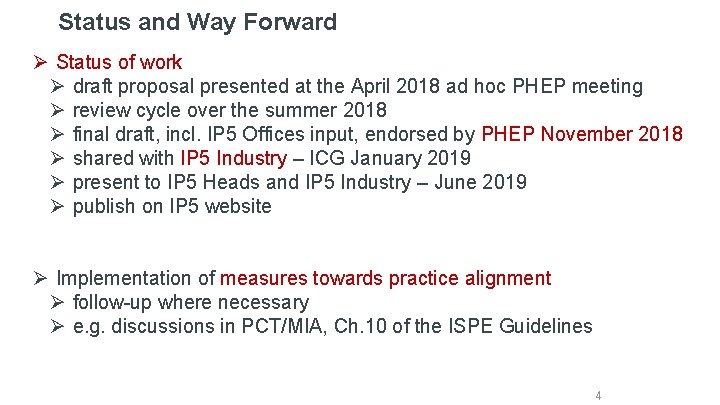
Status and Way Forward Ø Status of work Ø draft proposal presented at the April 2018 ad hoc PHEP meeting Ø review cycle over the summer 2018 Ø final draft, incl. IP 5 Offices input, endorsed by PHEP November 2018 Ø shared with IP 5 Industry – ICG January 2019 Ø present to IP 5 Heads and IP 5 Industry – June 2019 Ø publish on IP 5 website Ø Implementation of measures towards practice alignment Ø follow-up where necessary Ø e. g. discussions in PCT/MIA, Ch. 10 of the ISPE Guidelines 4
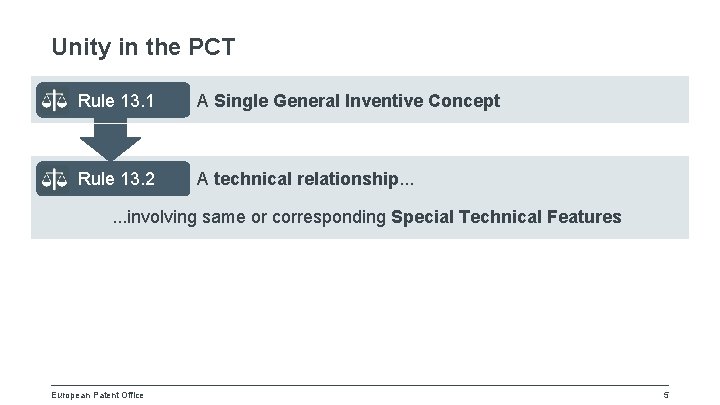
Unity in the PCT Rule 13. 1 A Single General Inventive Concept Rule 13. 2 A technical relationship. . . involving same or corresponding Special Technical Features European Patent Office 5
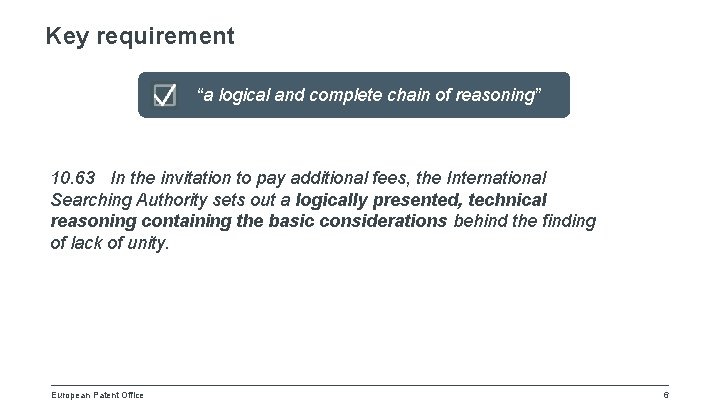
Key requirement “a logical and complete chain of reasoning” 10. 63 In the invitation to pay additional fees, the International Searching Authority sets out a logically presented, technical reasoning containing the basic considerations behind the finding of lack of unity. European Patent Office 6
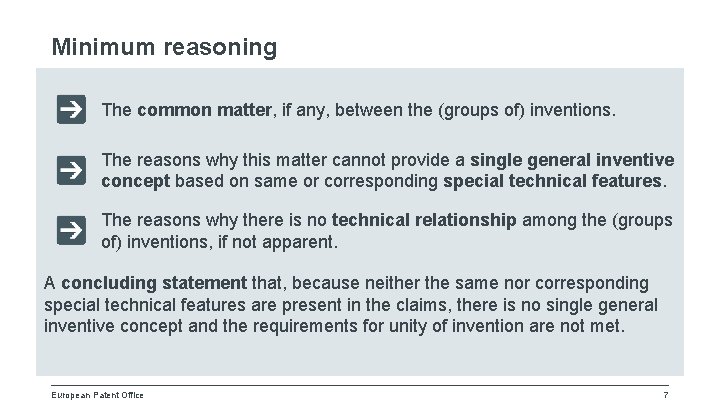
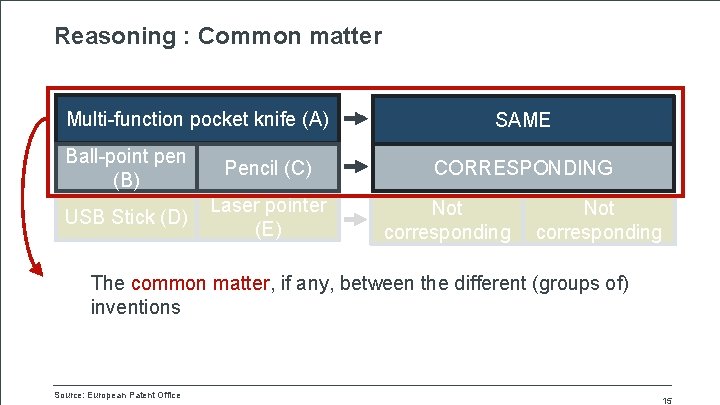
Minimum reasoning The common matter, if any, between the (groups of) inventions. The reasons why this matter cannot provide a single general inventive concept based on same or corresponding special technical features. The reasons why there is no technical relationship among the (groups of) inventions, if not apparent. A concluding statement that, because neither the same nor corresponding special technical features are present in the claims, there is no single general inventive concept and the requirements for unity of invention are not met. European Patent Office 7
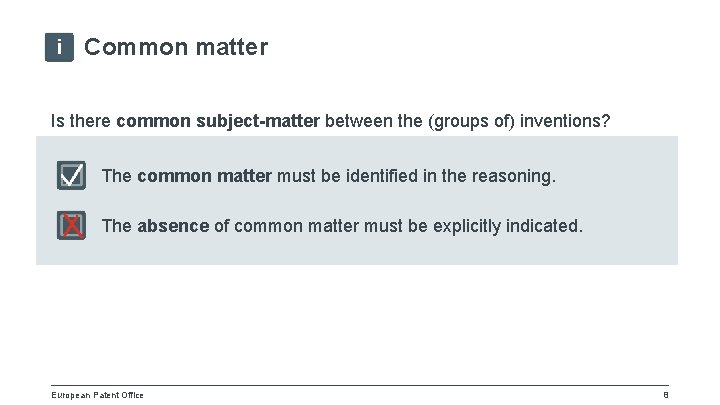
i Common matter Is there common subject-matter between the (groups of) inventions? The common matter must be identified in the reasoning. The absence of common matter must be explicitly indicated. European Patent Office 8
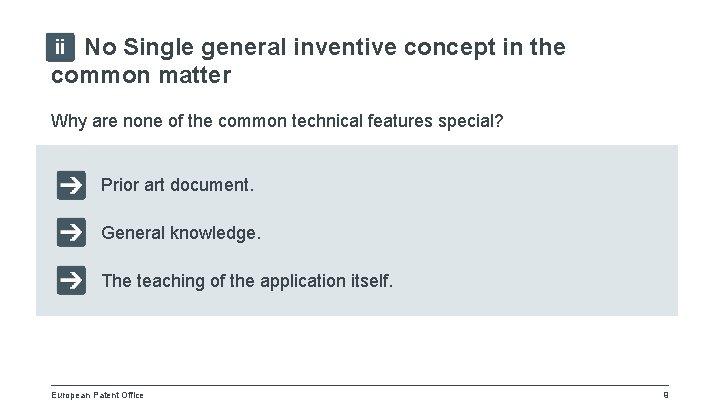
No Single general inventive concept in the common matter ii Why are none of the common technical features special? Prior art document. General knowledge. The teaching of the application itself. European Patent Office 9
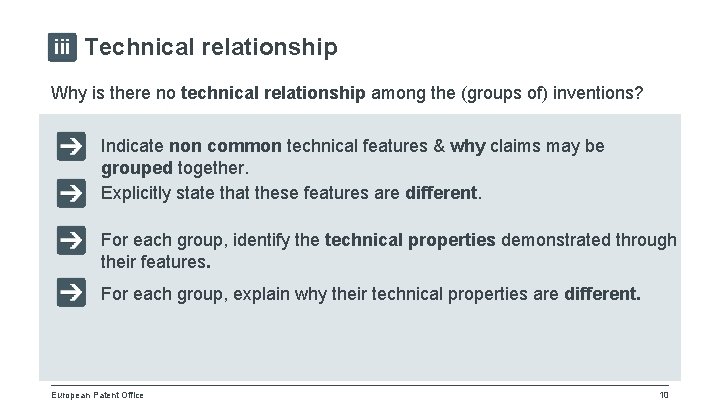
iii Technical relationship Why is there no technical relationship among the (groups of) inventions? Indicate non common technical features & why claims may be grouped together. Explicitly state that these features are different. For each group, identify the technical properties demonstrated through their features. For each group, explain why their technical properties are different. European Patent Office 10
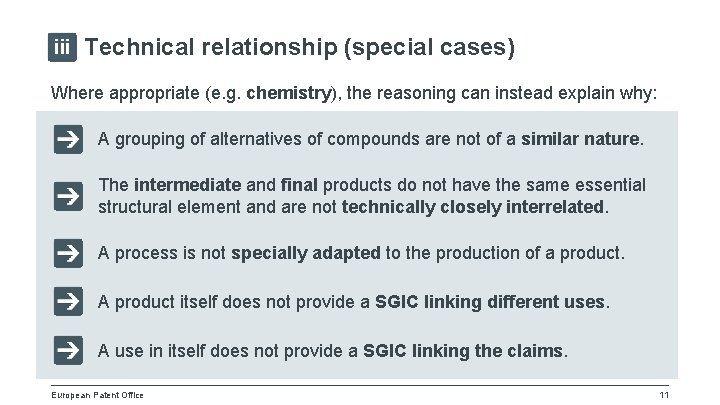
iii Technical relationship (special cases) Where appropriate (e. g. chemistry), the reasoning can instead explain why: A grouping of alternatives of compounds are not of a similar nature. The intermediate and final products do not have the same essential structural element and are not technically closely interrelated. A process is not specially adapted to the production of a product. A product itself does not provide a SGIC linking different uses. A use in itself does not provide a SGIC linking the claims. European Patent Office 11
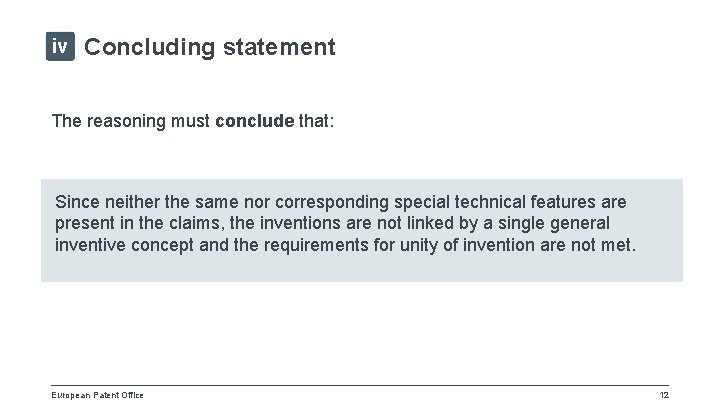
iv Concluding statement The reasoning must conclude that: Since neither the same nor corresponding special technical features are present in the claims, the inventions are not linked by a single general inventive concept and the requirements for unity of invention are not met. European Patent Office 12
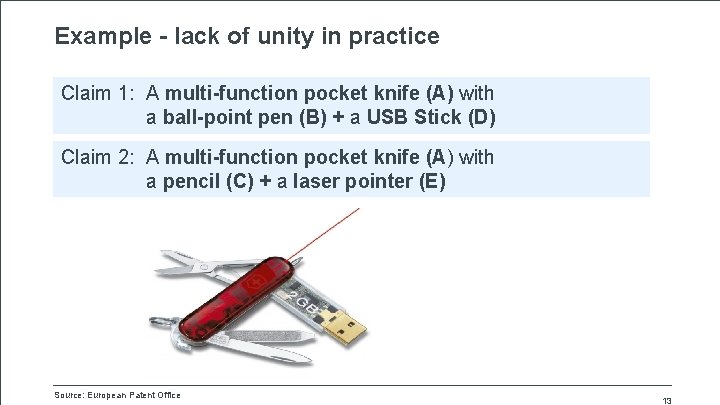
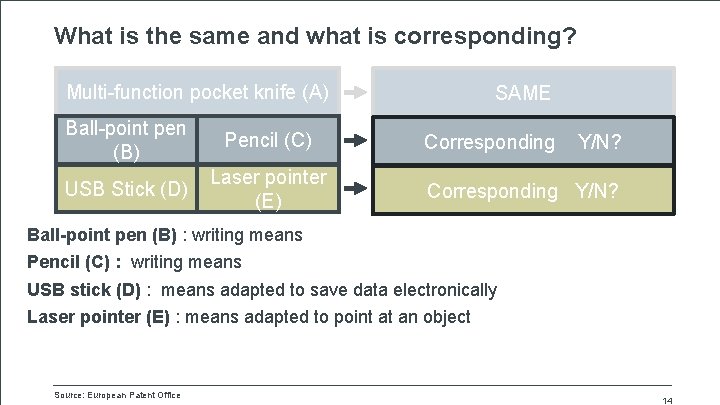
Example - lack of unity in practice Claim 1: A multi-function pocket knife (A) with a ball-point pen (B) + a USB Stick (D) Claim 2: A multi-function pocket knife (A) with a pencil (C) + a laser pointer (E) Source: European Patent Office 13
What is the same and what is corresponding? Multi-function pocket knife (A) Ball-point pen (B) Pencil (C) USB Stick (D) Laser pointer (E) SAME Corresponding Y/N? Ball-point pen (B) : writing means Pencil (C) : writing means USB stick (D) : means adapted to save data electronically Laser pointer (E) : means adapted to point at an object Source: European Patent Office 14
Reasoning : Common matter Multi-function pocket knife (A) Ball-point pen (B) Pencil (C) USB Stick (D) Laser pointer (E) SAME CORRESPONDING Not corresponding The common matter, if any, between the different (groups of) inventions Source: European Patent Office 15
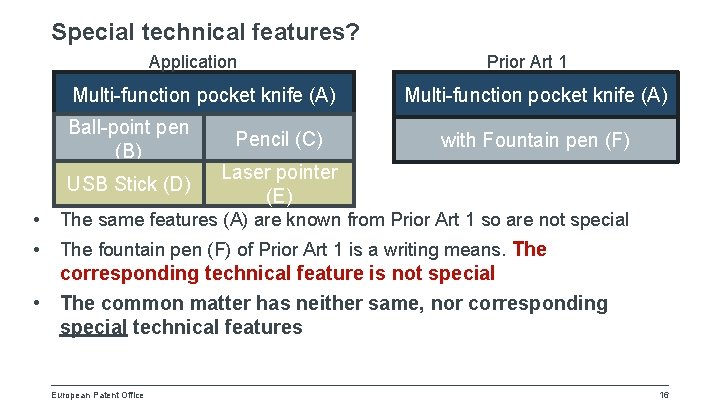
Special technical features? Application Multi-function pocket knife (A) Ball-point pen (B) USB Stick (D) Pencil (C) Prior Art 1 Multi-function pocket knife (A) with Fountain pen (F) Laser pointer (E) • The same features (A) are known from Prior Art 1 so are not special • The fountain pen (F) of Prior Art 1 is a writing means. The corresponding technical feature is not special • The common matter has neither same, nor corresponding special technical features European Patent Office 16
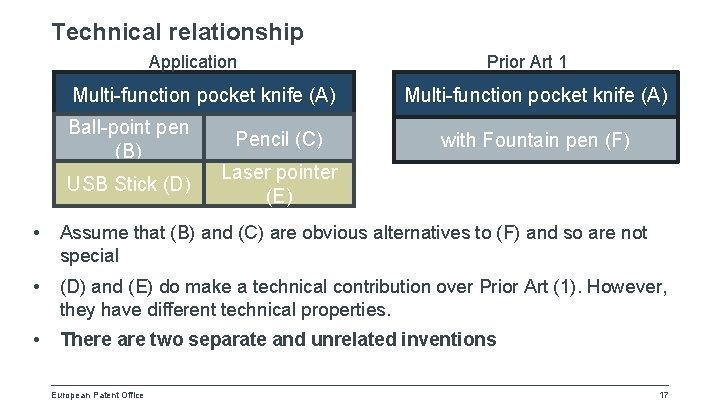
Technical relationship Application Multi-function pocket knife (A) Ball-point pen (B) USB Stick (D) Pencil (C) Prior Art 1 Multi-function pocket knife (A) with Fountain pen (F) Laser pointer (E) • Assume that (B) and (C) are obvious alternatives to (F) and so are not special • (D) and (E) do make a technical contribution over Prior Art (1). However, they have different technical properties. • There are two separate and unrelated inventions European Patent Office 17
Conclusion Since neither the same nor corresponding special technical features are present in claims 1 and 2, the inventions are not linked by a single general inventive concept and the requirements for unity of invention are not met. European Patent Office 18
Thank you for your attention!