
UnitXII FISH NUTRITION AND FEED MANAGEMNT FISH NUTRITION










- Slides: 32
Unit-XII FISH NUTRITION AND FEED MANAGEMNT
FISH NUTRITION AND FEED MANAGEMNT • The nutritional requirements of fish are similar to those of land animals for growth, reproduction and other normal physiological functions • Good nutrition in animal production systems is essential to economically produce a healthy, high quality product. • In fish farming, nutrition is critical because feed represents 40 -50% of the production costs. • Fish nutrition has advanced dramatically in recent years with the development of new, balanced commercial diets that promote optimal fish growth and health.
FISH NUTRITION AND FEED MANAGEMNT Natural fish food organism or Live food organisms • A variety of natural fish food organisms are found in a waterbody • The natural food provides the constituents of a complete and balanced diet • Natural feeds have high protein and fat contents, which promote the growth of the fish
FISH NUTRITION AND FEED MANAGEMNT Classification of food and feeding habits of fishes As per Schaprclas, 1933 Main food : It is the most preferred food on which the fish will thrive best Occasional food : It has relatively high nutritive values and is liked and consumed by fish whenever the opportunity presents Emergency food : It is fed upon/ accepted when other food material is not available. As per Nikolsky, 1963 Basic food : It is normally eaten by the fish and comprises most of the gut contents. Secondary food : It is frequently consumed in smaller quantities. Incidental food : It is consumed rarely. Obligatory food : The fish consumes this food in the absence of basic food.
FISH NUTRITION AND FEED MANAGEMNT As per Das and Moitra, 1963 Herbivorous fishes : They feed on plant material, which forms more than 75% of gut contents. Omnivorous fishes : They consume both plant and animal food. Carnivorous fishes : They feed on animal food, which comprises of more than 80% of the diet. Herbivores are divided into 2 sub-groups. Planktophagous fishes Detritophagous fishes : They consume only phyto- and zooplankton : They feed on detritus.
FISH NUTRITION AND FEED MANAGEMNT Plankton • • Fish production in a waterbody is directly or indirectly dependant on the abundance of plankton. Planktons are free floating organisms found in water Phytoplankton • Phytoplankton gives green colour to the water due to the presence of chlorophyll. • Phytoplankton occupy the base of the food chain and produce • phytoplankton consist of three major classes a. Chlorophyceae b. Cyanophyceae c. Bacillariophyceae.
FISH NUTRITION AND FEED MANAGEMNT a. Chlorophyceae • These are called green algae due to the presence of chlorophyll. • Many chlorophyceae members are useful as food to fishes. • Chlamydomonas. • Volvox, • Chlorella. Filamentous algae like • Ulothrix, • Spirogyra • Scenedesmus • Cosmarium. etc.
FISH NUTRITION AND FEED MANAGEMNT Cyanophyceae • These are also called as myxophyceae • commonly known as blue green algae • This colour is due chlorophyll a. carotenoids and biliproteins Nostoc Oscillotoria Anabaena Microcystis,
FISH NUTRITION AND FEED MANAGEMNT Bacillariophyceae • These are called diatoms • They are unicellular organisms with different shapes and sizes. • These may be yellow or golden brown or olive green in colour • The diatoms consumed by fish are Diatom Navicula Nitzschia Rhizosolenia Cyclotella
FISH NUTRITION AND FEED MANAGEMNT Zooplankton Plankton consisting of animals is called zooplankton The zooplankton forms an important group as it occupies an intermediate position in the food web a. Protozoans b. Crustaceans c. Rotifiers
FISH NUTRITION AND FEED MANAGEMNT Protozoans • Protozoans are most primitive, unicellular and microscopic animals. • The protozoans with flagella are included under the class flagellata • Euglena is the most common fish food organism under flagellate Ceratium Chilomonas and Phacus are also used as fish food • The protozoans with cilia are included in the class Ciliata • Here the cilia persist throughout life Paramecium Metropus Euplotes. The ciliates are the dominating organisms among the zooplankton
FISH NUTRITION AND FEED MANAGEMNT Crustaceans • The aquatic animals with 19 pairs of appendages and branchial respiration • The important microcrustaceans are copepodes and cladocerans • The crustacean nauplii temporary planktons • Copepods are. Cyclops, Mesocyclops, Diaptomus • The cladocerans are Daphnia, Ceriodaphnia, Moina,
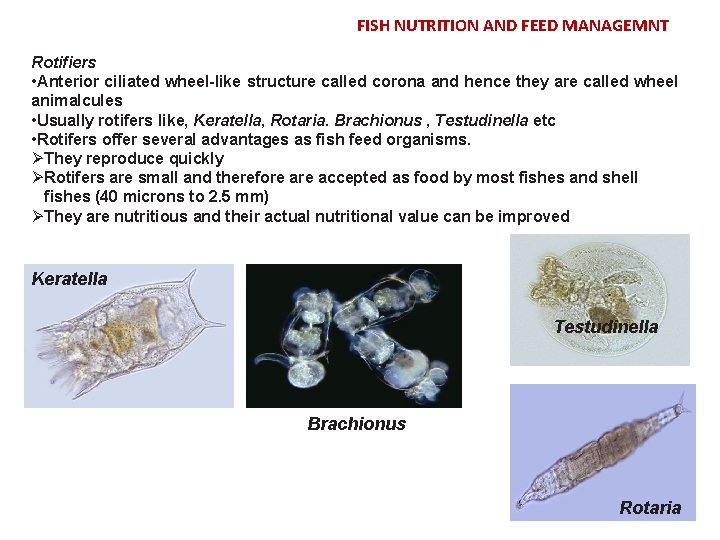
FISH NUTRITION AND FEED MANAGEMNT Rotifiers • Anterior ciliated wheel-like structure called corona and hence they are called wheel animalcules • Usually rotifers like, Keratella, Rotaria. Brachionus , Testudinella etc • Rotifers offer several advantages as fish feed organisms. ØThey reproduce quickly ØRotifers are small and therefore accepted as food by most fishes and shell fishes (40 microns to 2. 5 mm) ØThey are nutritious and their actual nutritional value can be improved Keratella Testudinella Brachionus Rotaria
FISH NUTRITION AND FEED MANAGEMNT Bioenriched feeds Process involved in improving the nutritional status of live feed By feeding or incorporating within them various kinds of materials such as Microdiets Microencapsulated diets Genetically engineered baker’s yeast Emulsified lipids rich in w 3 HUFA (Highly Unsaturated Fatty Acid) together with fat soluble vitamins.
FISH NUTRITION AND FEED MANAGEMNT Prepared (artificial) Diets Artificial diets may be either complete or supplemental Complete diets supply all the ingredients • Protein • Carbohydrates • Fats • Vitamins • minerals
FISH NUTRITION AND FEED MANAGEMNT Protein • Protein is the most expensive part of fish feed • It is important to accurately determine the protein requirements of the cultured fish • Proteins are formed by linkages of individual amino acids • Over 200 amino acids occur in nature, only about 20 amino acids are common • Of these, 10 are essential amino acids that cannot be synthesized by fish • Essential amino acids methionine, arginine, threonine, tryptophan, histidine, isoleucine, lysine, leucine, valine and phenylalanine
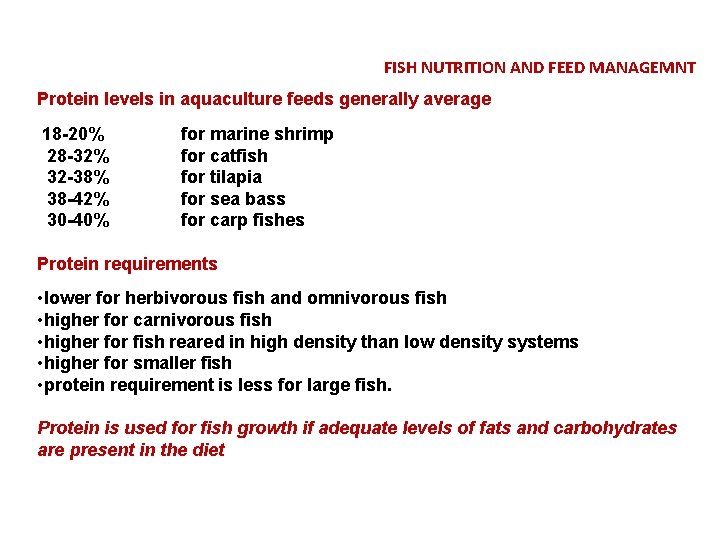
FISH NUTRITION AND FEED MANAGEMNT Protein levels in aquaculture feeds generally average 18 -20% 28 -32% 32 -38% 38 -42% 30 -40% for marine shrimp for catfish for tilapia for sea bass for carp fishes Protein requirements • lower for herbivorous fish and omnivorous fish • higher for carnivorous fish • higher for fish reared in high density than low density systems • higher for smaller fish • protein requirement is less for large fish. Protein is used for fish growth if adequate levels of fats and carbohydrates are present in the diet
FISH NUTRITION AND FEED MANAGEMNT Lipids (fats) • Fats are the principal form of energy storage in plants and in animals • Fat contains more energy per unit weight than any other biological product • Lipids supply about twice the energy as proteins and carbohydrates • Supply essential fatty acids (EFA) and serve as transporters for fat-soluble vitamins The two major EFA of this group are Eicosapentaenoic acid Docosahexaenoic acid Simple lipids include fatty acids and triacylglycerols a) Saturated fatty acids (SFA, no double bonds) b) Polyunsaturated fatty acids (PUFA, >2 double bonds) c) Highly unsaturated fatty acids (HUFA; > 4 double bonds) Marine fish typically require n-3 HUFA for optimal growth and health ranging from 0. 5 -2. 0% of dry diet Freshwater fish do not require the long chain HUFA, but often require an omega -3 fatty acid ranging from 0. 5 to 1. 5% of dry diet. In high lipid feed is used then the excessive fat deposition in the liver can decrease the health and market quality of fish.
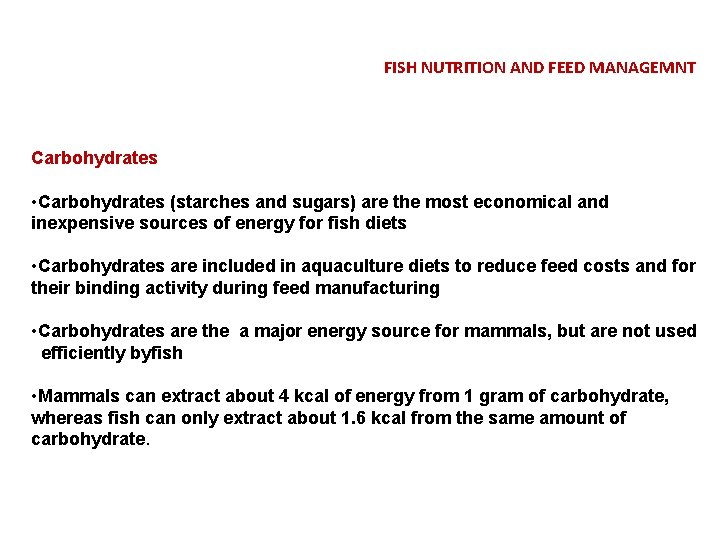
FISH NUTRITION AND FEED MANAGEMNT Carbohydrates • Carbohydrates (starches and sugars) are the most economical and inexpensive sources of energy for fish diets • Carbohydrates are included in aquaculture diets to reduce feed costs and for their binding activity during feed manufacturing • Carbohydrates are the a major energy source for mammals, but are not used efficiently byfish • Mammals can extract about 4 kcal of energy from 1 gram of carbohydrate, whereas fish can only extract about 1. 6 kcal from the same amount of carbohydrate.
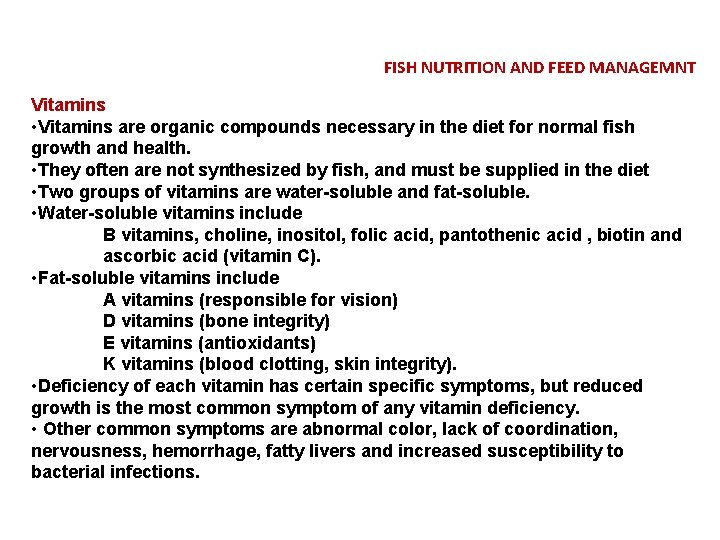
FISH NUTRITION AND FEED MANAGEMNT Vitamins • Vitamins are organic compounds necessary in the diet for normal fish growth and health. • They often are not synthesized by fish, and must be supplied in the diet • Two groups of vitamins are water-soluble and fat-soluble. • Water-soluble vitamins include B vitamins, choline, inositol, folic acid, pantothenic acid , biotin and ascorbic acid (vitamin C). • Fat-soluble vitamins include A vitamins (responsible for vision) D vitamins (bone integrity) E vitamins (antioxidants) K vitamins (blood clotting, skin integrity). • Deficiency of each vitamin has certain specific symptoms, but reduced growth is the most common symptom of any vitamin deficiency. • Other common symptoms are abnormal color, lack of coordination, nervousness, hemorrhage, fatty livers and increased susceptibility to bacterial infections.
FISH NUTRITION AND FEED MANAGEMNT Minerals are inorganic elements necessary in the diet for normal body functions. They can be divided into two groups Macro-minerals Micro-minerals Based on the quantity required in the diet Common macro-minerals are Sodium Chloride Potassium Phosphorous. • These minerals regulate osmotic balance and aid in bone formation and integrity • Micro-minerals (trace minerals) are required in small amounts as components in enzyme and hormone systems • Common trace minerals are copper, chromium, iodine, zinc and selenium. • Fish can absorb many minerals directly from the water through their gills and skin
FISH NUTRITION AND FEED MANAGEMNT Feed Types Commercial fish diets are Extruded (floating or buoyant) • Extruded feeds are more expensive due to the higher manufacturing costs • The farmer can directly observe the feeding intensity of his fish and adjust feeding rates accordingly Pressure-pelleted (sinking) feeds Shrimp, for example, will not accept a floating feed they feed on pellet feed • Feed is available in a variety of sizes ranging from fine crumbles for small fish to large (1/2 inch or larger) pellets. • The pellet size should be approximately 20 -30% of the size of the fish species mouth gape. • Feeding too small a pellet results in inefficient feeding because more energy is used in finding and eating more pellets. • Conversely, pellets that are too large will depress feeding and, in the extreme, cause choking. • Select the largest sized feed the fish will actively eat.
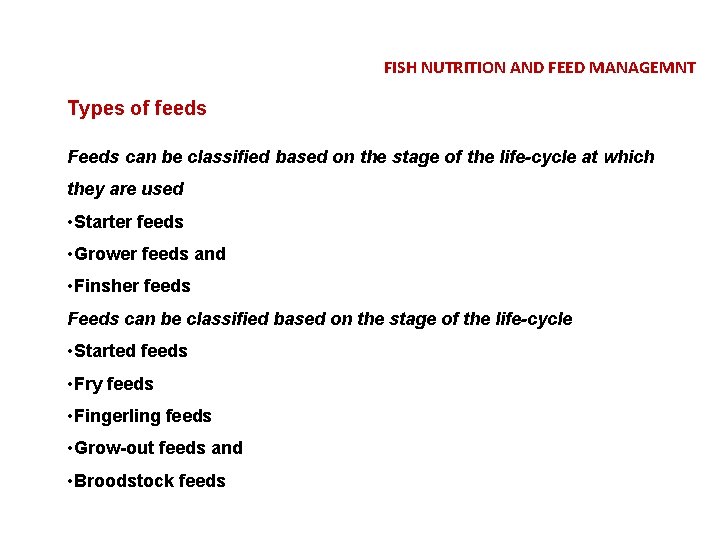
FISH NUTRITION AND FEED MANAGEMNT Types of feeds Feeds can be classified based on the stage of the life-cycle at which they are used • Starter feeds • Grower feeds and • Finsher feeds Feeds can be classified based on the stage of the life-cycle • Started feeds • Fry feeds • Fingerling feeds • Grow-out feeds and • Broodstock feeds
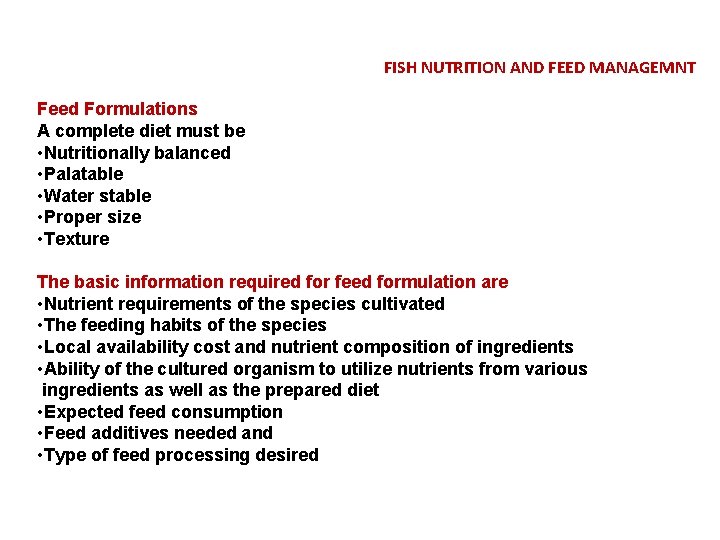
FISH NUTRITION AND FEED MANAGEMNT Feed Formulations A complete diet must be • Nutritionally balanced • Palatable • Water stable • Proper size • Texture The basic information required for feed formulation are • Nutrient requirements of the species cultivated • The feeding habits of the species • Local availability cost and nutrient composition of ingredients • Ability of the cultured organism to utilize nutrients from various ingredients as well as the prepared diet • Expected feed consumption • Feed additives needed and • Type of feed processing desired
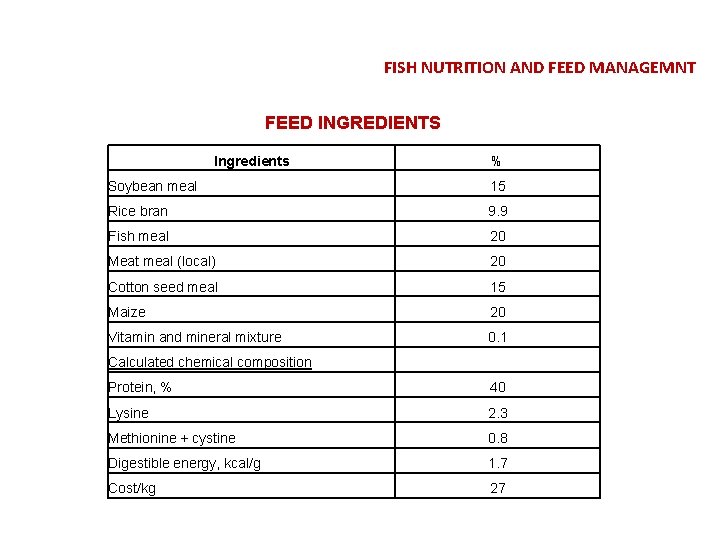
FISH NUTRITION AND FEED MANAGEMNT FEED INGREDIENTS Ingredients % Soybean meal 15 Rice bran 9. 9 Fish meal 20 Meat meal (local) 20 Cotton seed meal 15 Maize 20 Vitamin and mineral mixture 0. 1 Calculated chemical composition Protein, % 40 Lysine 2. 3 Methionine + cystine 0. 8 Digestible energy, kcal/g 1. 7 Cost/kg 27
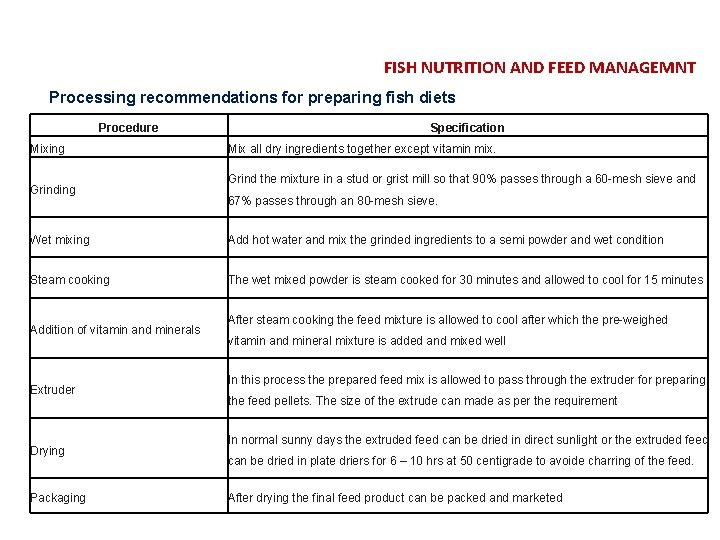
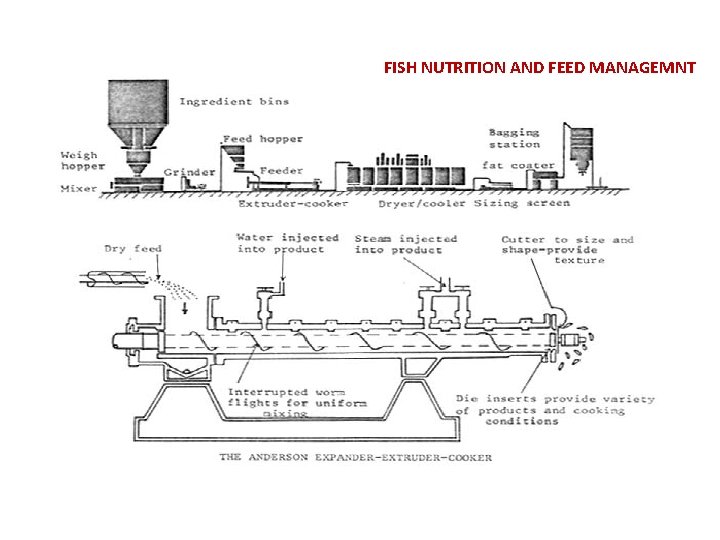
FISH NUTRITION AND FEED MANAGEMNT Processing recommendations for preparing fish diets Procedure Mixing Grinding Specification Mix all dry ingredients together except vitamin mix. Grind the mixture in a stud or grist mill so that 90% passes through a 60 -mesh sieve and 67% passes through an 80 -mesh sieve. Wet mixing Add hot water and mix the grinded ingredients to a semi powder and wet condition Steam cooking The wet mixed powder is steam cooked for 30 minutes and allowed to cool for 15 minutes Addition of vitamin and minerals Extruder Drying Packaging After steam cooking the feed mixture is allowed to cool after which the pre-weighed vitamin and mineral mixture is added and mixed well In this process the prepared feed mix is allowed to pass through the extruder for preparing the feed pellets. The size of the extrude can made as per the requirement In normal sunny days the extruded feed can be dried in direct sunlight or the extruded feed can be dried in plate driers for 6 – 10 hrs at 50 centigrade to avoide charring of the feed. After drying the final feed product can be packed and marketed
FISH NUTRITION AND FEED MANAGEMNT
FISH NUTRITION AND FEED MANAGEMNT Feed storage • A manufactured diet requires storage at least at the place of manufacture and on the farm. • Feeds are composed of perishable biological material which deteriorates with storage. Deteriorative effects during storage are caused by • Oxidative damage • Microbial damage • Insect and or rodent damage / infestation and • Other chemical changes during storage.
FISH NUTRITION AND FEED MANAGEMNT Feeding Rate, Frequency and Timing • Depends on stocking density • Type of farming • Type of species farmed
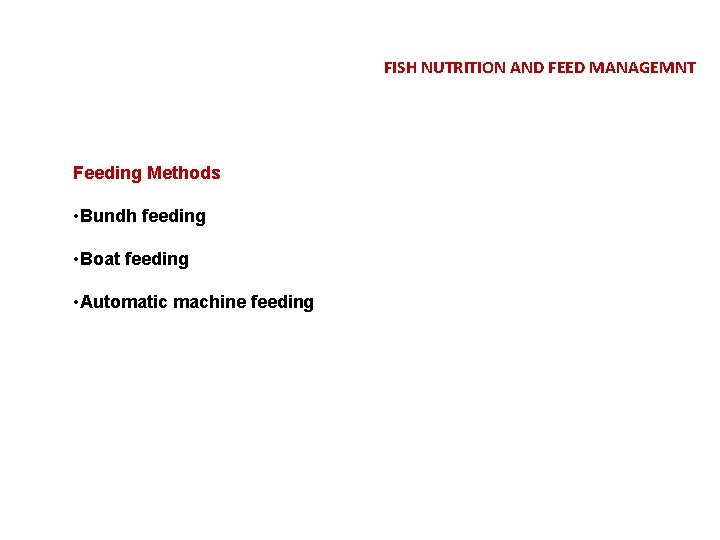
FISH NUTRITION AND FEED MANAGEMNT Feeding Methods • Bundh feeding • Boat feeding • Automatic machine feeding
FISH NUTRITION AND FEED MANAGEMNT Mass culture of microalgae Mass production of phytoplankton or “green water” for rotifers Chlorella sp. , Isochrysis galbana Pavlova lutheri Nannochloropsis oculata and N. gaditana Dunaliella tertiolecta Tetraselmis suecica.
FISH NUTRITION AND FEED MANAGEMNT Mass production systems For aquaculture purposes, microalgae are mass produced in three main ways: • Batch (or discontinuous or multistep back-up system) culture • Semi-continuous culture and • Continuous culture