
UNITV PHOTONICS AND FIBRE OPTICS Basics of laser
UNIT-V PHOTONICS AND FIBRE OPTICS
Basics of laser ˝LASER˝ - Light Amplification by Stimulated Emission of Radiation Properties • Highly Monochromatic • High intense • Highly directional • High coherent
Conditions for laser action 1. Population inversion (N 2>N 1) in the atoms of medium 2. The energy density of radiation on the medium should be increased. 3. The ratio of Einstein’s coefficient should be less (A 21/B 21< 1 ) so that more stimulated emission to take place than the spontaneous emission
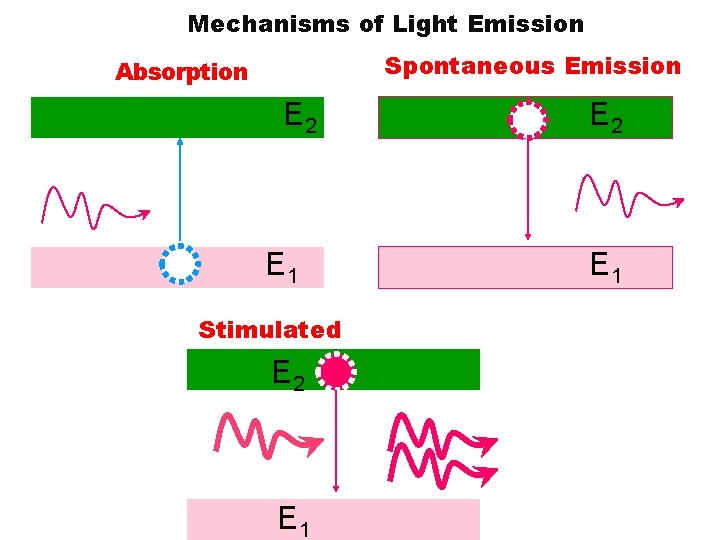
Mechanisms of Light Emission Spontaneous Emission Absorption E 2 E 1 Stimulated Emission E 2 E 1
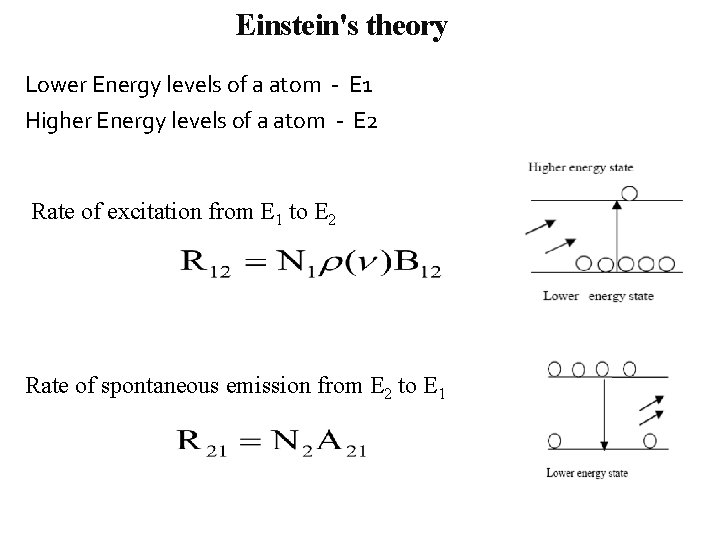
Einstein's theory Lower Energy levels of a atom - E 1 Higher Energy levels of a atom - E 2 Rate of excitation from E 1 to E 2 Rate of spontaneous emission from E 2 to E 1
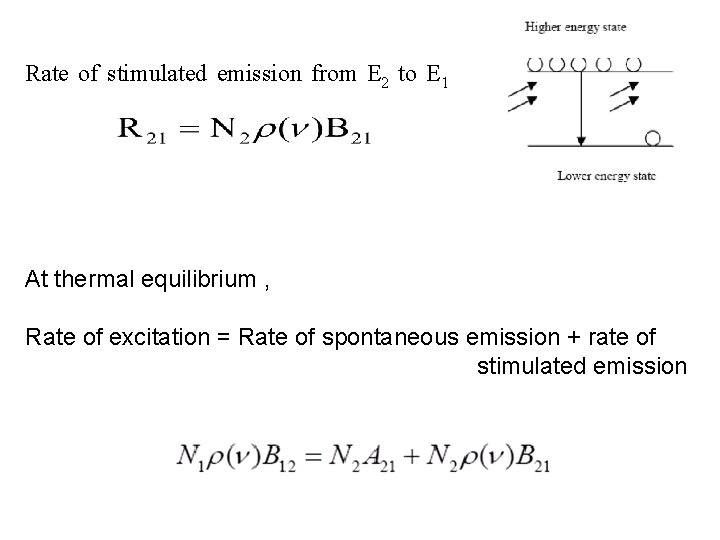
Rate of stimulated emission from E 2 to E 1 (3) At thermal equilibrium , Rate of excitation = Rate of spontaneous emission + rate of stimulated emission
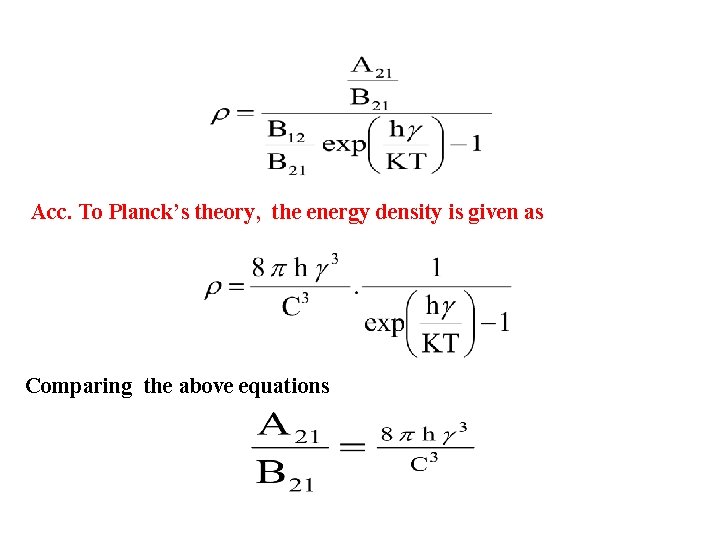
Acc. To Planck’s theory, the energy density is given as Comparing the above equations
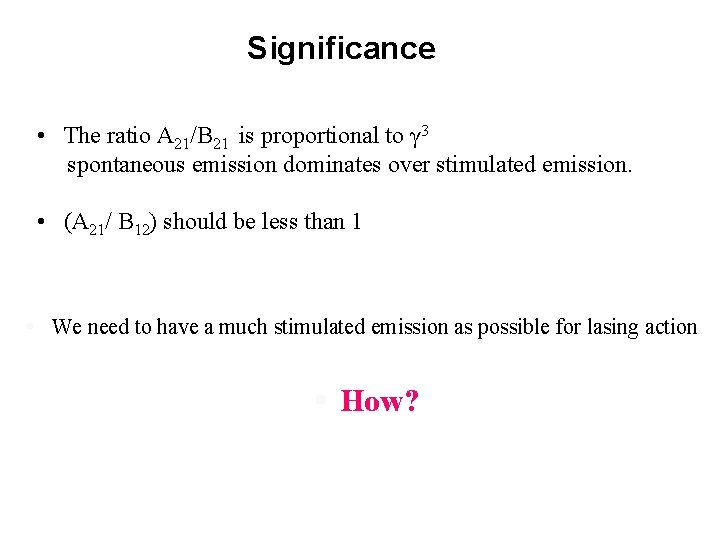
Significance • The ratio A 21/B 21 is proportional to γ 3 spontaneous emission dominates over stimulated emission. • (A 21/ B 12) should be less than 1 We need to have a much stimulated emission as possible for lasing action How?
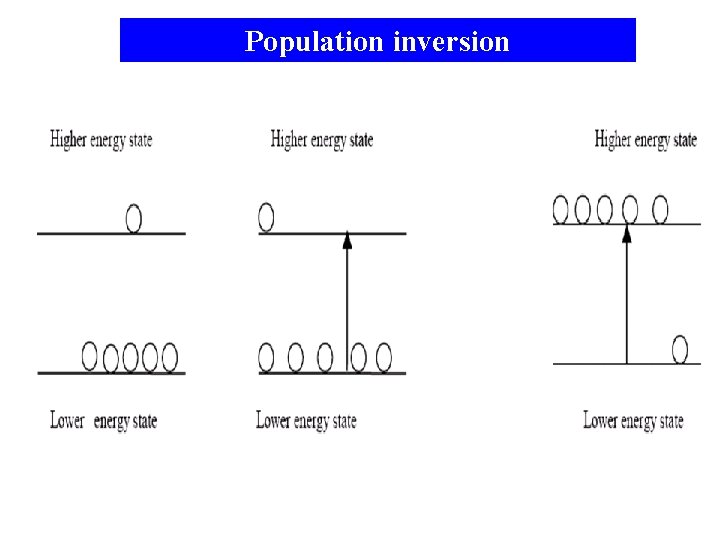
Population inversion
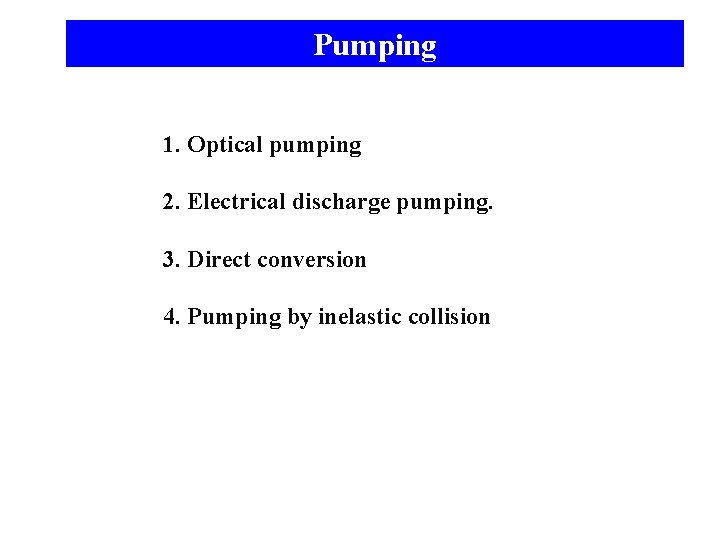
Pumping 1. Optical pumping 2. Electrical discharge pumping. 3. Direct conversion 4. Pumping by inelastic collision
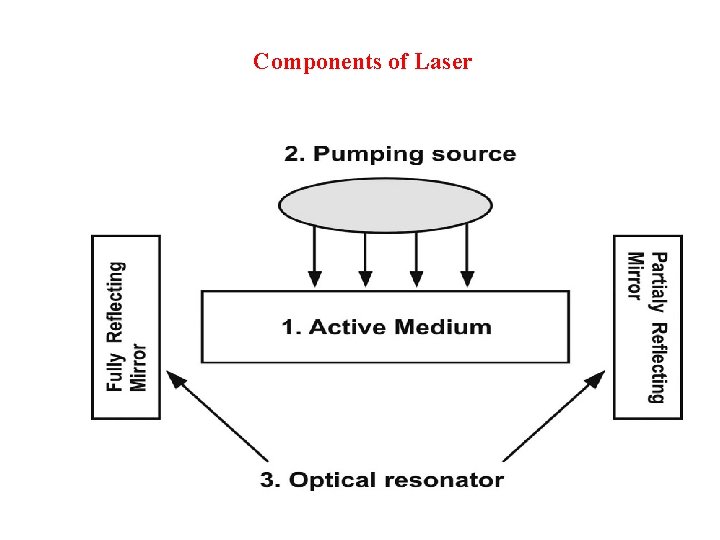
Components of Laser
Some Types of Lasers • Nd-YAG laser • CO 2 -laser • Semiconductor lasers
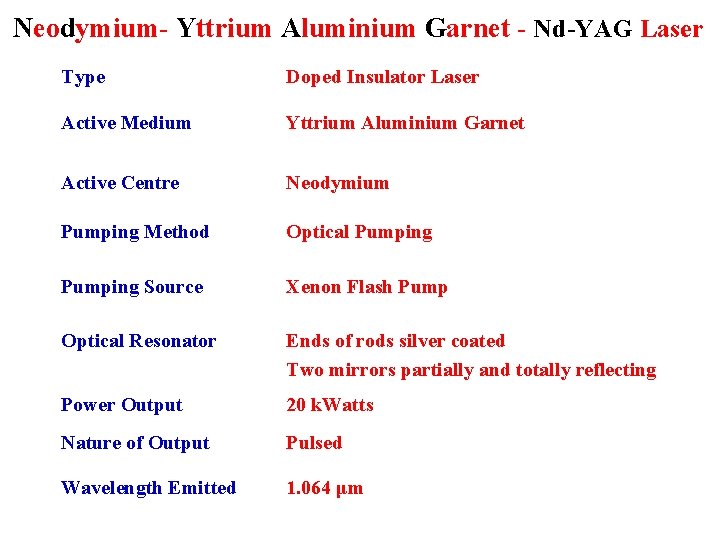
Neodymium- Yttrium Aluminium Garnet - Nd-YAG Laser Type : Doped Insulator Laser Active Medium : Yttrium Aluminium Garnet Active Centre : Neodymium Pumping Method : Optical Pumping Source : Xenon Flash Pump Optical Resonator : Ends of rods silver coated Two mirrors partially and totally reflecting Power Output : 20 k. Watts Nature of Output : Pulsed Wavelength Emitted : 1. 064 μm
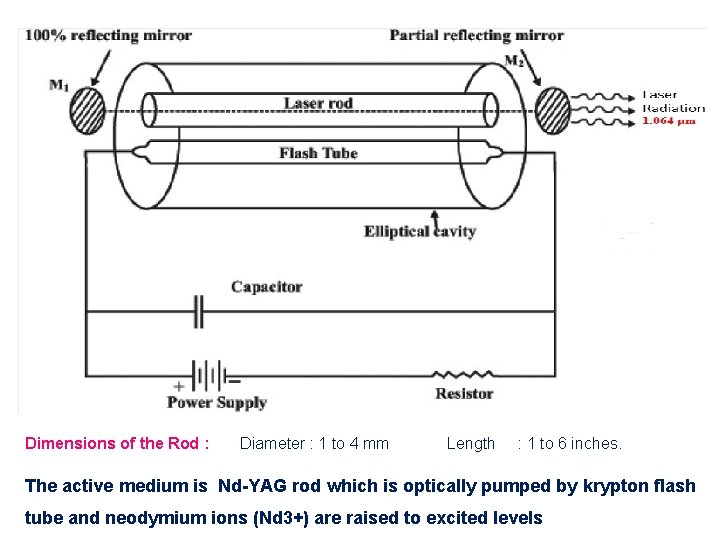
Dimensions of the Rod : Diameter : 1 to 4 mm Length : 1 to 6 inches. The active medium is Nd-YAG rod which is optically pumped by krypton flash tube and neodymium ions (Nd 3+) are raised to excited levels
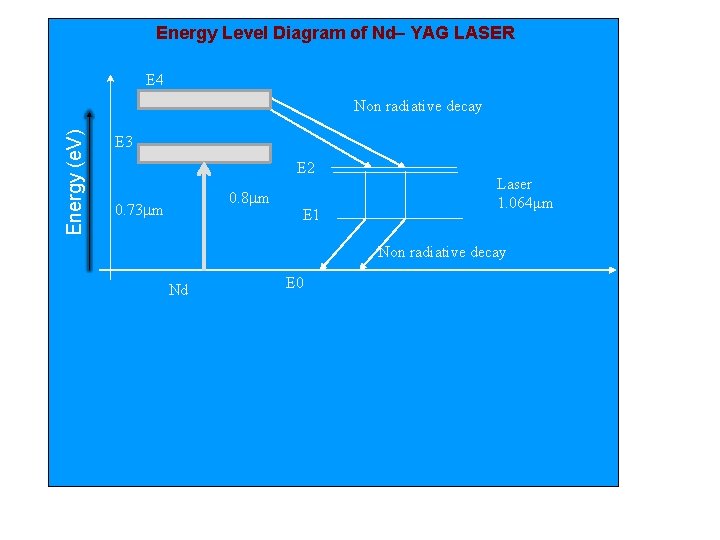
Energy Level Diagram of Nd– YAG LASER E 4 Energy (e. V) Non radiative decay E 3 E 2 0. 8 m 0. 73 m E 1 Laser 1. 064μm Non radiative decay Nd E 0
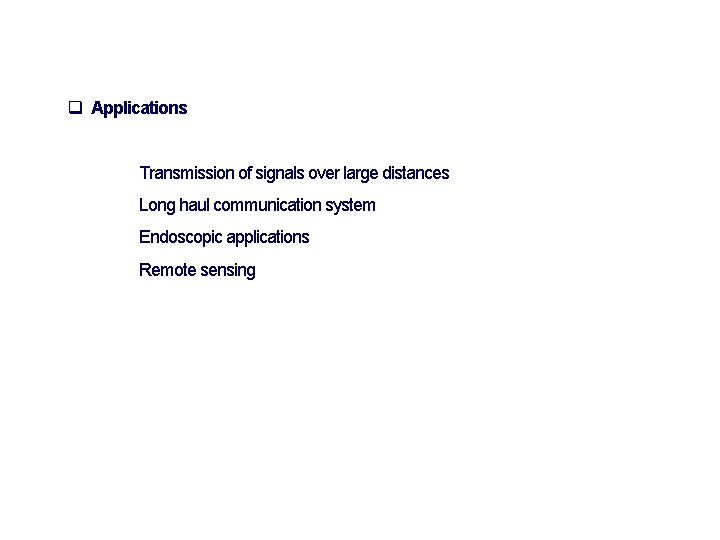
q Applications Transmission of signals over large distances Long haul communication system Endoscopic applications Remote sensing
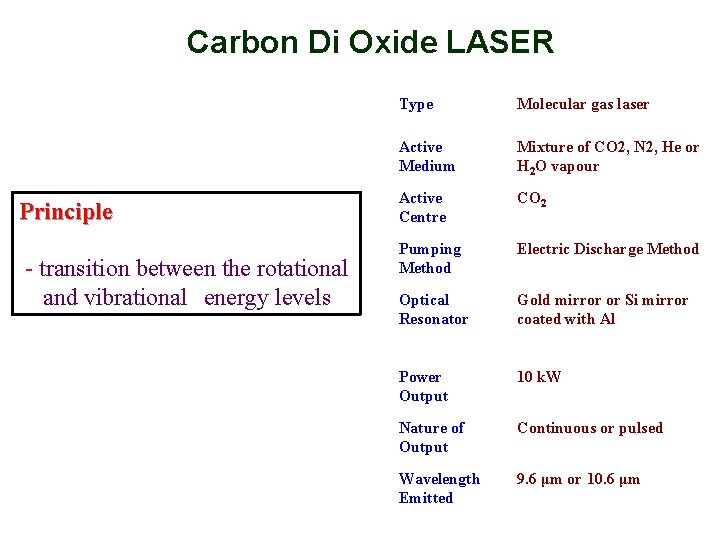
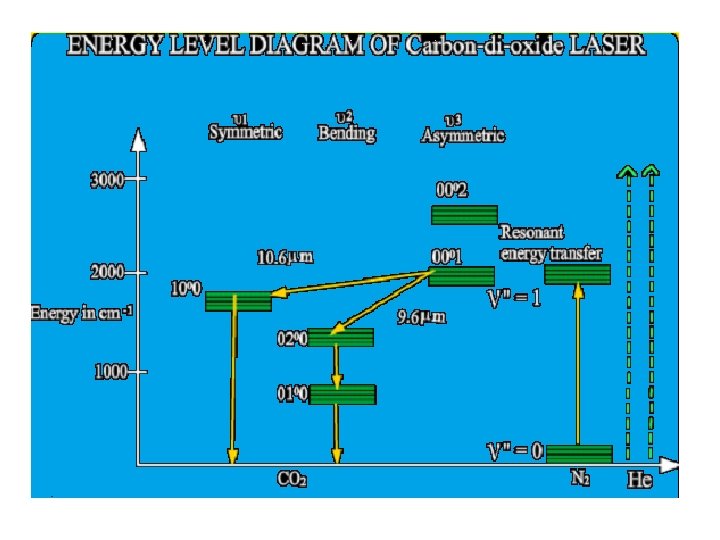
Carbon Di Oxide LASER Principle - transition between the rotational and vibrational energy levels Type : Molecular gas laser Active Medium : Mixture of CO 2, N 2, He or H 2 O vapour Active Centre : CO 2 Pumping Method : Electric Discharge Method Optical Resonator : Gold mirror or Si mirror coated with Al Power Output : 10 k. W Nature of Output : Continuous or pulsed Wavelength Emitted : 9. 6 μm or 10. 6 μm
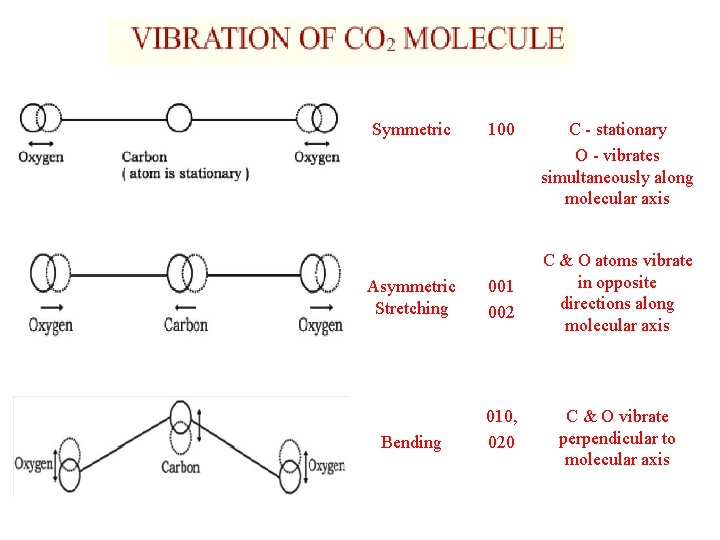
Symmetric 100 C - stationary O - vibrates simultaneously along molecular axis Asymmetric Stretching 001 002 C & O atoms vibrate in opposite directions along molecular axis Bending 010, 020 C & O vibrate perpendicular to molecular axis
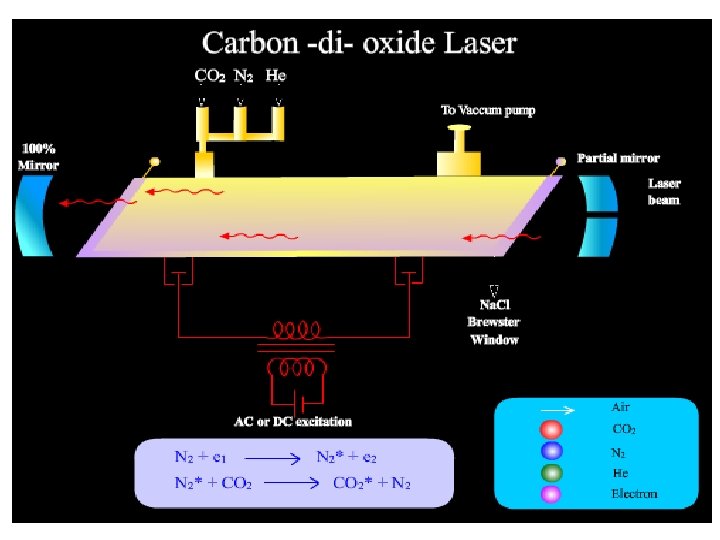
Applications Bloodless surgery Open air communication Military field
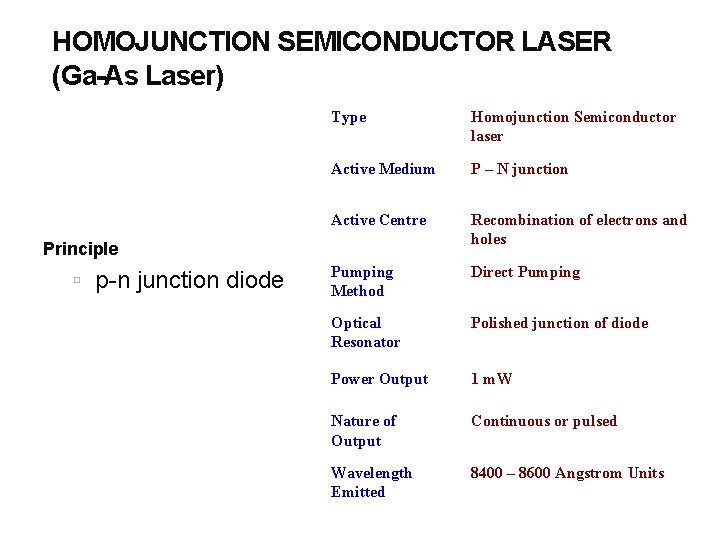
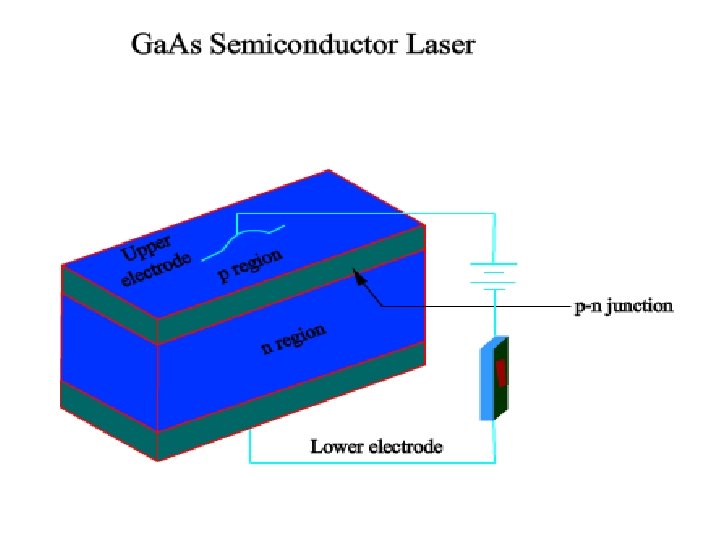
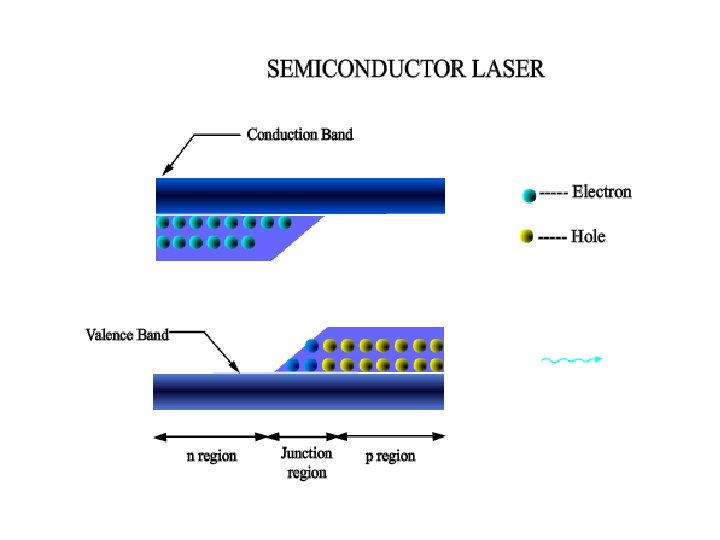
HOMOJUNCTION SEMICONDUCTOR LASER (Ga-As Laser) Type : Homojunction Semiconductor laser Active Medium : P – N junction Active Centre : Recombination of electrons and holes Pumping Method : Direct Pumping Optical Resonator : Polished junction of diode Power Output : 1 m. W Nature of Output : Continuous or pulsed Wavelength Emitted : 8400 – 8600 Angstrom Units Principle p-n junction diode
Applications • Compact & used in fibre optic communications • CD writer • Relieves pain • Laser printers
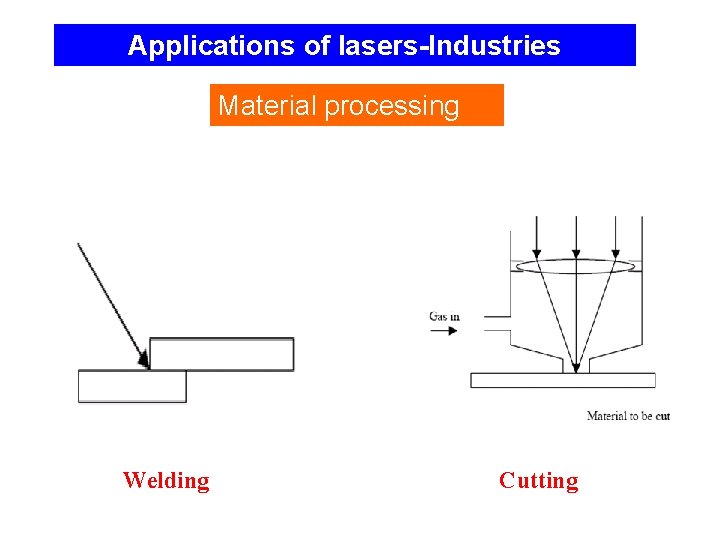
Applications of lasers-Industries Material processing Welding Cutting
Vaporizing and deposition - Some pre selected area of material may be evaporated or evaporatrant may be located closed to the substance. - Brittle material like rock marble etc. , can be fractured using laser beams.
Laser in Medicine Mechanism of visuals & Retinal repair On the part of Cornea and the lens at the back of the human eye the light sensitive elements are present called Retina. When the light falls on a lens and retina, the photosensitive cells present on retina converts light in to electrical signal and the optical nerve carries the signal to brain. The resulting is the mechanism of visuals
Retinal treatment using laser • Due to some diseases or impact, the retina could detach and created partial blindness. Before the application of laser therapy, the Xenon lamp was in use to attach the retina • The unique application of laser is to attach the retina, where laser can be used to focus the small spot of light precisely. The time involved is also extremely small in the order of 300 usec. at 1 J of energy.
Laser for cancer treatment Lasers are used extensively in the cancer treatment. In laboratories the Amelanotic melanoma was given to the lab animals and ruby laser radiation was administered for complete tumor treatment which disappeared in 30 days
lasers in Holography A Photography is two dimensional recording of three dimensional scenes. Since, the photo sensitive material is coated on to photo film which could record intensity variations and does not respond to phase distribution. Since the intensity variations are alone recorded, the 3 dimesion features is lost.
UNIT-V FIBRE OPTICS
Optical fibre • A thin flexible and transparent wire prepared for light propagation • The optical fibre has been constructed for the following reasons: 1. The light wave cannot traverse long distance in air without any losses –air friction and other related losses. 2. To make loss less light wave propagation, the optical waves can be guided through optical fibre.
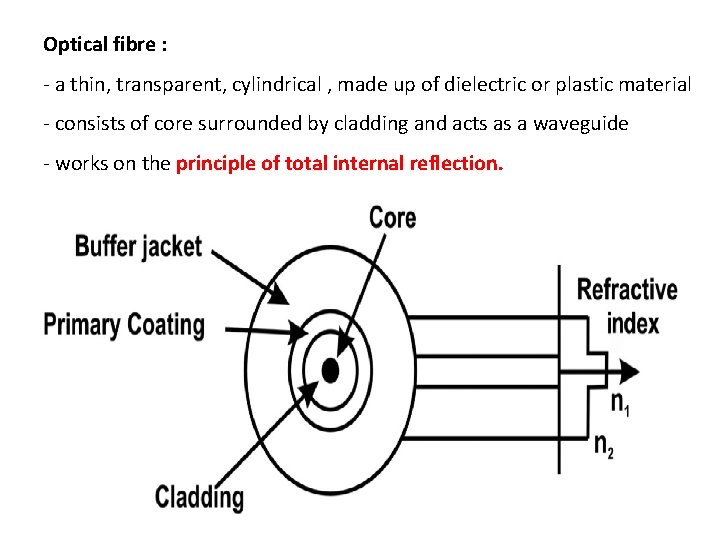
Optical fibre : - a thin, transparent, cylindrical , made up of dielectric or plastic material - consists of core surrounded by cladding and acts as a waveguide - works on the principle of total internal reflection.
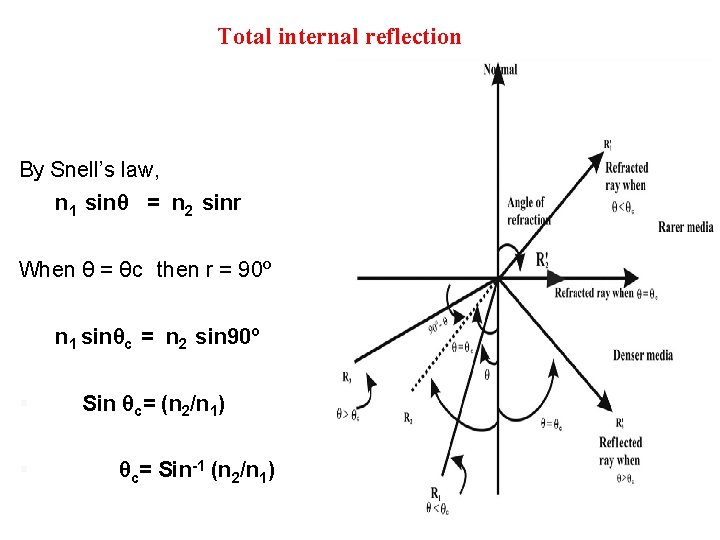
Total internal reflection By Snell’s law, n 1 sinθ = n 2 sinr When θ = θc then r = 90º n 1 sinθc = n 2 sin 90º Sin θc= (n 2/n 1) θc= Sin-1 (n 2/n 1)
Conditions for total internal reflection: (i) The light should pass from a denser to a rarer medium. n 1 to n 2. (i) The incident angle should be greater than the critical angle i > C Numerical Aperture: • Light gathering capacity of an optical fibre • Sine of the acceptance angle Acceptance Angle • The maximum angle at (or) below which the light can suffer total internal reflection
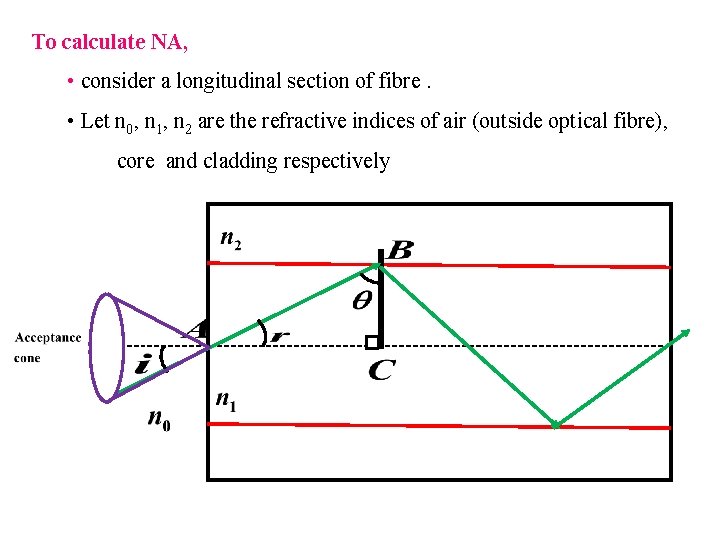
To calculate NA, • consider a longitudinal section of fibre. • Let n 0, n 1, n 2 are the refractive indices of air (outside optical fibre), core and cladding respectively.
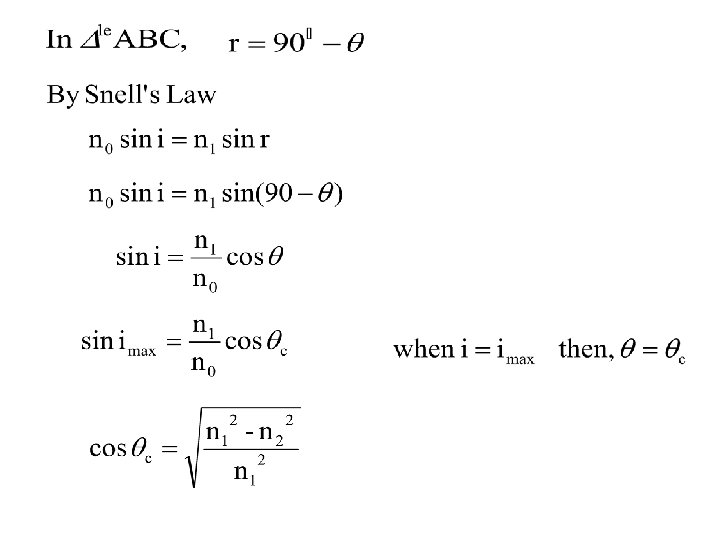
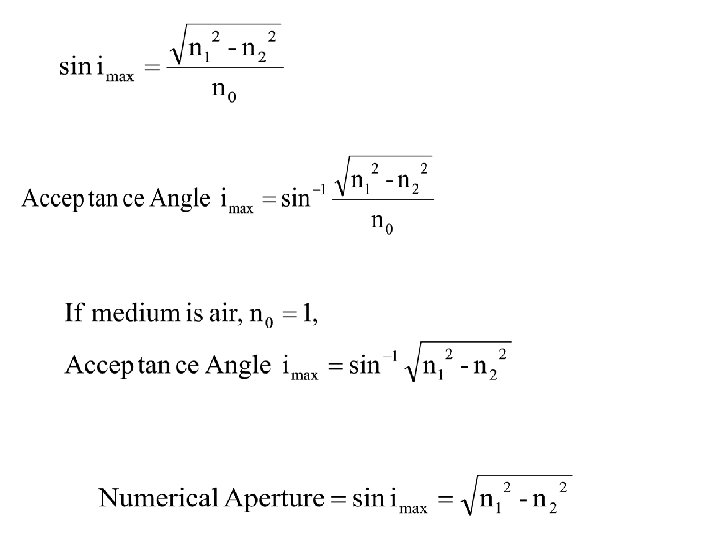
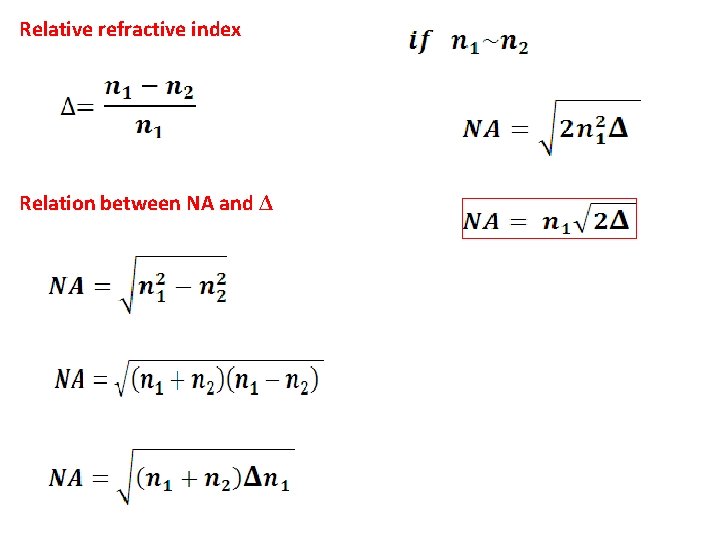
Relative refractive index Relation between NA and Δ
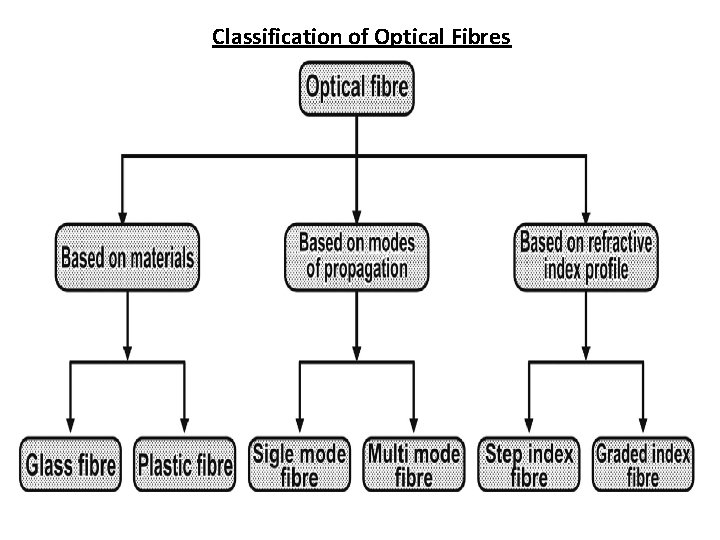
Classification of Optical Fibres
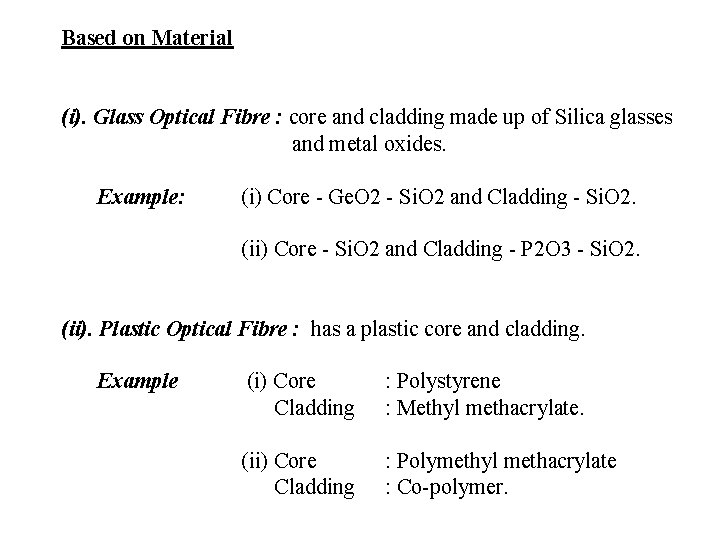
Based on Material (i). Glass Optical Fibre : core and cladding made up of Silica glasses and metal oxides. Example: (i) Core - Ge. O 2 - Si. O 2 and Cladding - Si. O 2. (ii) Core - Si. O 2 and Cladding - P 2 O 3 - Si. O 2. (ii). Plastic Optical Fibre : has a plastic core and cladding. Example (i) Core Cladding : Polystyrene : Methyl methacrylate. (ii) Core Cladding : Polymethyl methacrylate : Co-polymer.
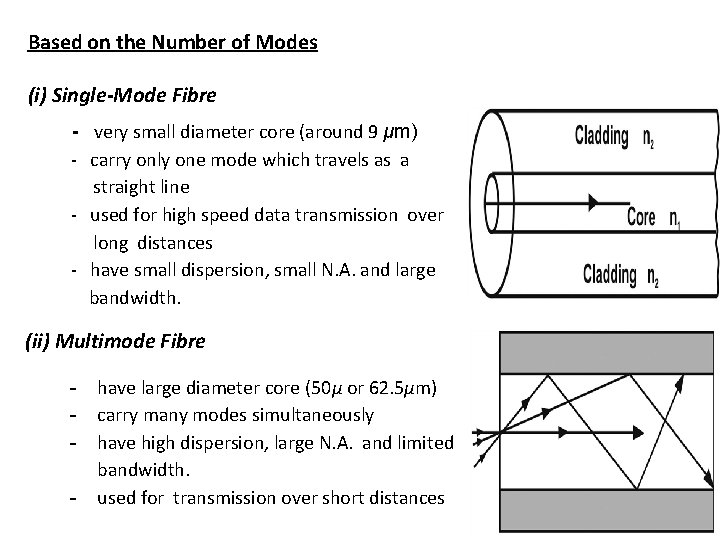
Based on the Number of Modes (i) Single-Mode Fibre - very small diameter core (around 9 μm) - carry only one mode which travels as a straight line - used for high speed data transmission over long distances - have small dispersion, small N. A. and large bandwidth. (ii) Multimode Fibre - have large diameter core (50μ or 62. 5μm) - carry many modes simultaneously - have high dispersion, large N. A. and limited bandwidth. - used for transmission over short distances
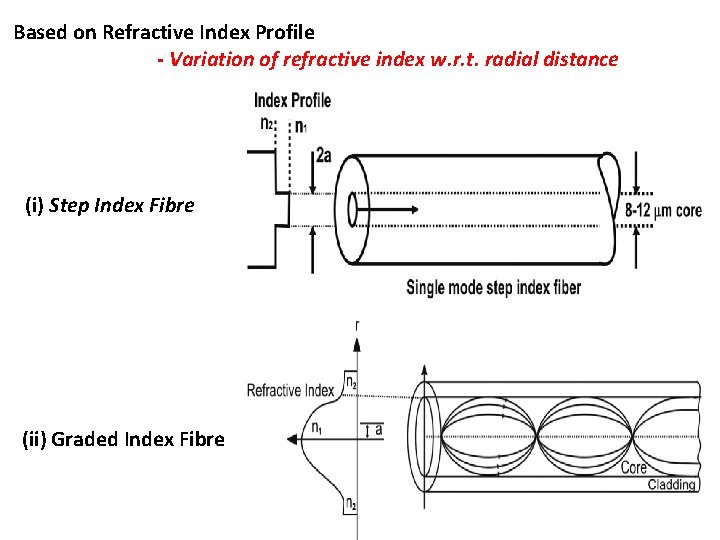
Based on Refractive Index Profile - Variation of refractive index w. r. t. radial distance (i) Step Index Fibre (ii) Graded Index Fibre
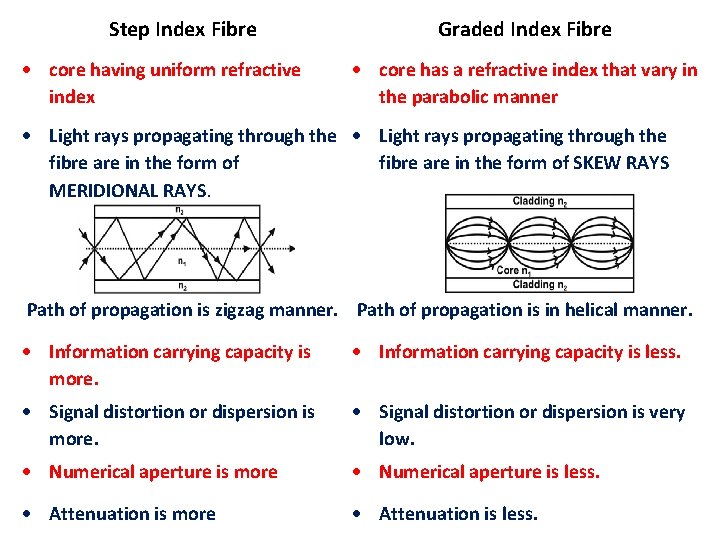
Step Index Fibre core having uniform refractive index Graded Index Fibre core has a refractive index that vary in the parabolic manner Light rays propagating through the fibre are in the form of SKEW RAYS MERIDIONAL RAYS. Path of propagation is zigzag manner. Path of propagation is in helical manner. Information carrying capacity is more. Information carrying capacity is less. Signal distortion or dispersion is more. Signal distortion or dispersion is very low. Numerical aperture is more Numerical aperture is less. Attenuation is more Attenuation is less.
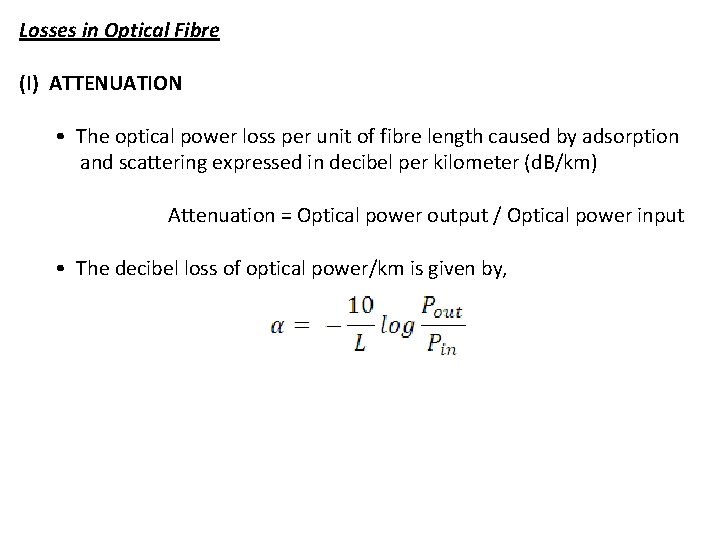
Losses in Optical Fibre (I) ATTENUATION • The optical power loss per unit of fibre length caused by adsorption and scattering expressed in decibel per kilometer (d. B/km) Attenuation = Optical power output / Optical power input • The decibel loss of optical power/km is given by,
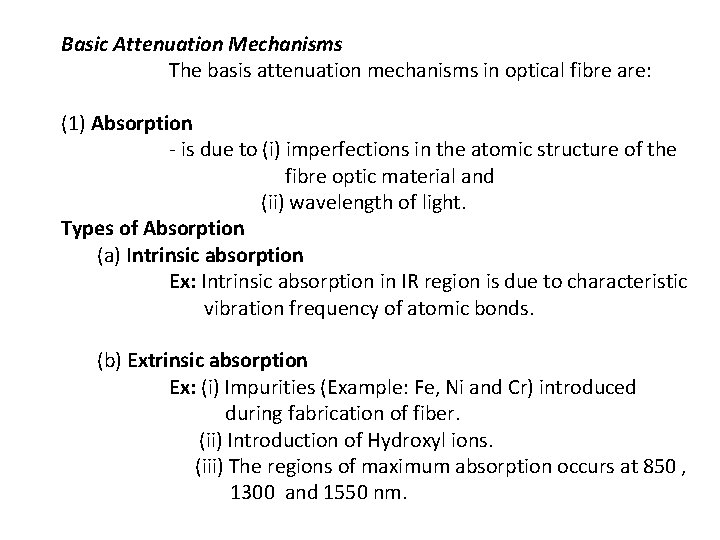
Basic Attenuation Mechanisms The basis attenuation mechanisms in optical fibre are: (1) Absorption - is due to (i) imperfections in the atomic structure of the fibre optic material and (ii) wavelength of light. Types of Absorption (a) Intrinsic absorption Ex: Intrinsic absorption in IR region is due to characteristic vibration frequency of atomic bonds. (b) Extrinsic absorption Ex: (i) Impurities (Example: Fe, Ni and Cr) introduced during fabrication of fiber. (ii) Introduction of Hydroxyl ions. (iii) The regions of maximum absorption occurs at 850 , 1300 and 1550 nm.
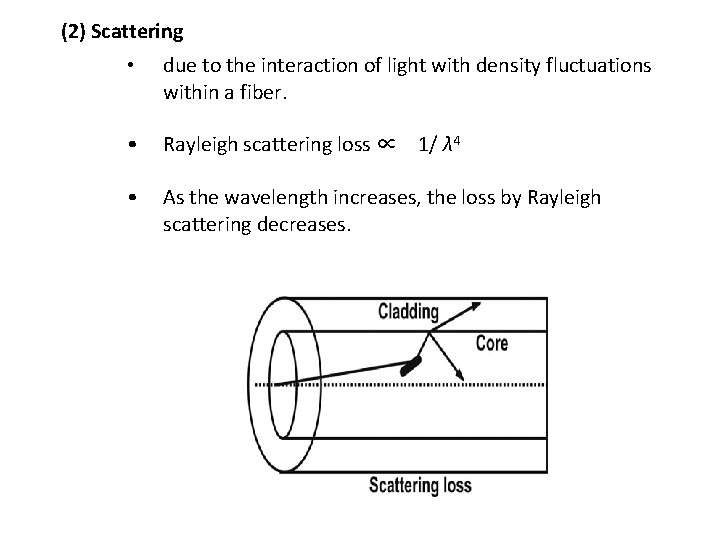
(2) Scattering • due to the interaction of light with density fluctuations within a fiber. • Rayleigh scattering loss ∝ 1/ λ 4 • As the wavelength increases, the loss by Rayleigh scattering decreases.
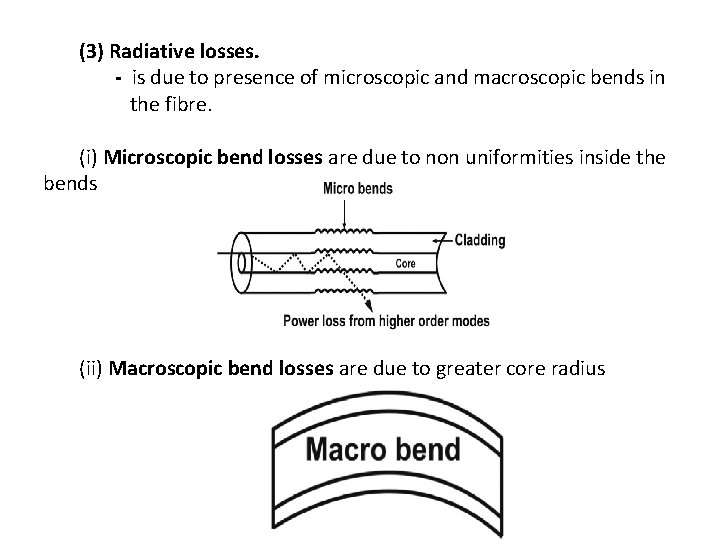
(3) Radiative losses. - is due to presence of microscopic and macroscopic bends in the fibre. (i) Microscopic bend losses are due to non uniformities inside the bends (ii) Macroscopic bend losses are due to greater core radius
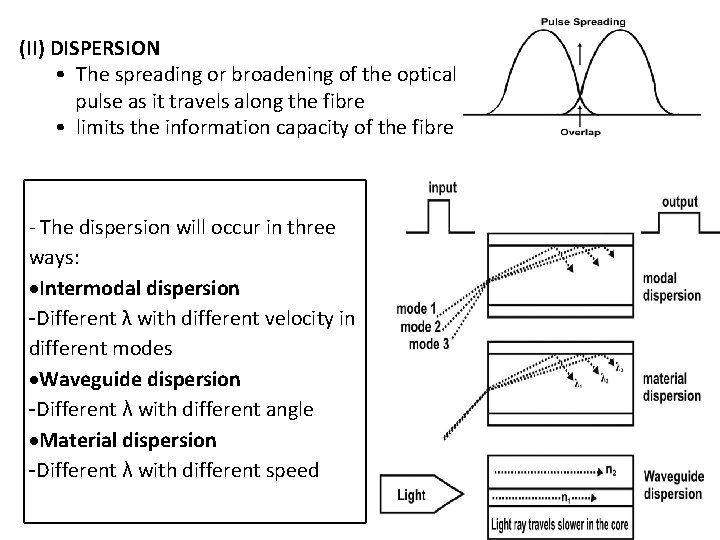
(II) DISPERSION • The spreading or broadening of the optical pulse as it travels along the fibre • limits the information capacity of the fibre - The dispersion will occur in three ways: Intermodal dispersion -Different λ with different velocity in different modes Waveguide dispersion -Different λ with different angle Material dispersion -Different λ with different speed
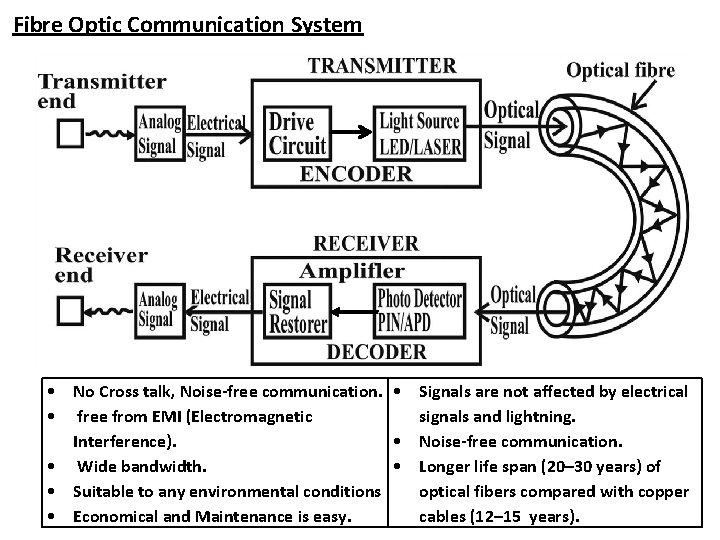
Fibre Optic Communication System • No Cross talk, Noise-free communication. • Signals are not affected by electrical • free from EMI (Electromagnetic signals and lightning. Interference). • Noise-free communication. • Wide bandwidth. • Longer life span (20– 30 years) of • Suitable to any environmental conditions optical fibers compared with copper • Economical and Maintenance is easy. cables (12– 15 years).
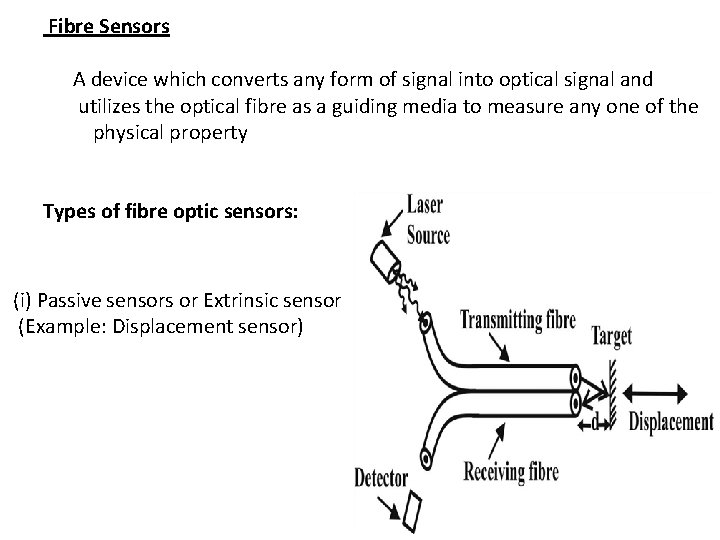
Fibre Sensors A device which converts any form of signal into optical signal and utilizes the optical fibre as a guiding media to measure any one of the physical property Types of fibre optic sensors: (i) Passive sensors or Extrinsic sensor (Example: Displacement sensor)
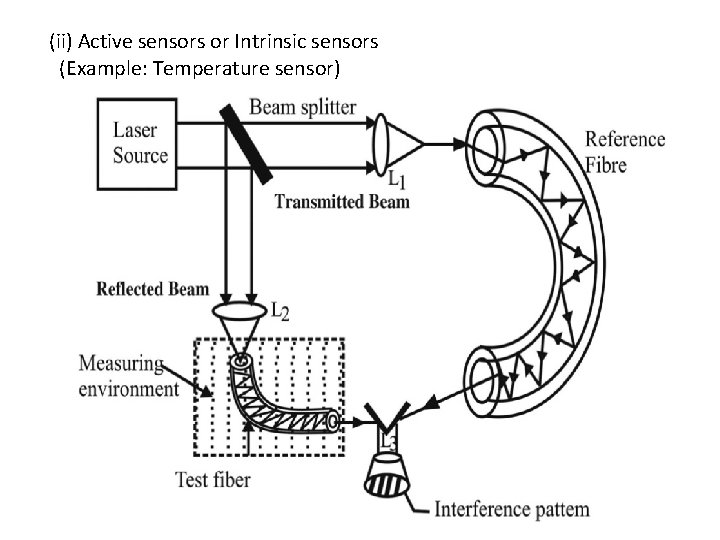
(ii) Active sensors or Intrinsic sensors (Example: Temperature sensor)
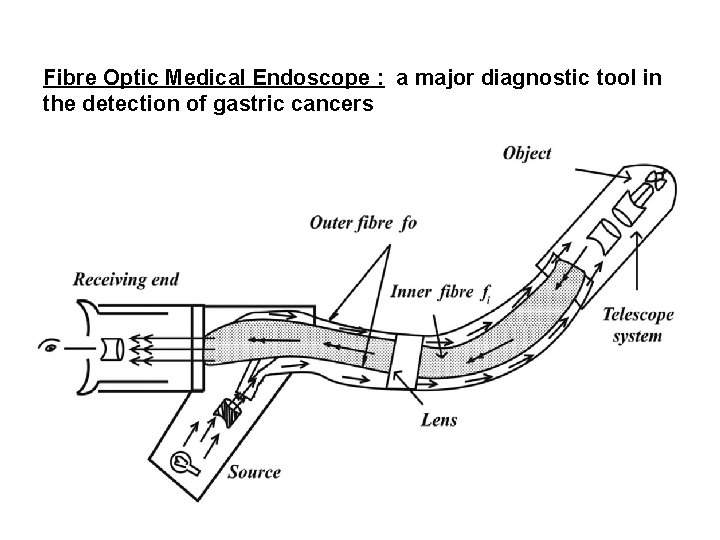
Fibre Optic Medical Endoscope : a major diagnostic tool in the detection of gastric cancers
- Slides: 54