
UNITIII MAC PROTOCOLS FOR WIRELESS SENSOR NETWORKS Contents
- Slides: 28
UNIT-III MAC PROTOCOLS FOR WIRELESS SENSOR NETWORKS Contents: v Issues in Designing a MAC protocol for Ad-hoc Wireless v Design goals of a MAC Protocol for Ad-hoc Wireless Networks v Classifications of MAC Protocols ü Contention-Based Protocols NAVEEN RAJA. V Networks ü Contention-Based Protocols with reservation Mechanisms ü Contention-Based MAC Protocols with Scheduling Mechanisms v MAC Protocols that use Directional Antennas, Other MAC 1
INTRODUCTION TO MAC: ü Access to this shared medium should be controlled in such a manner that all nodes receive a fair share of the available bandwidth, and that the bandwidth is utilized efficiently. ü Characteristics of the wireless medium are completely different from wired medium. ü So a different set of protocols is required for controlling access to the shared medium in such networks. This is achieved by using Medium Access Control (MAC) protocol. NAVEEN RAJA. V ü Nodes in an Ad-hoc wireless network share a common broadcast radio channel. Since the radio spectrum is limited, the bandwidth available for communication in such networks is also limited. 2
Ø Bandwidth Efficiency: § Since the radio spectrum is limited, the bandwidth available for communication is also very limited. The MAC protocol must be designed in such a way that to maximize this bandwidth efficiency (the ratio of the bandwidth used for actual data transmission to the total available bandwidth). § That is the uncommon bandwidth is utilized in an efficient manner. Ø Quality of Service Support(Qo. S): § Providing Qo. S support to data sessions in Ad-hoc networks is very difficult due to their characteristic nature of nodes mobility. § Most of the time, Bandwidth reservation made at one point of time may become invalid once the node moves out of the region. § The MAC protocol for Ad-hoc wireless networks that are to be used in such real-time applications must have resource reservation mechanism take care of nature of the wireless channel and the mobility of nodes. NAVEEN RAJA. V Issues in Designing MAC Protocol for Ad-hoc Wireless Networks: 3
Issues in Designing MAC Protocol for Ad-hoc Wireless Networks: Ø Hidden and Exposed Terminal Problems: § The hidden terminal problem refers to the collision of packets at a receiving node due to the simultaneous transmission of those nodes. § The exposed terminal problem refers to the inability of a node, which is blocked due to transmission by a nearby transmitting node, to transmit to another node. Ø Mobility of Nodes: § This is a very important factor affecting the performance (throughput) of the protocol. § The MAC protocol obviously has no role to play in influencing the mobility of the nodes. NAVEEN RAJA. V Ø Synchronization: § The MAC protocol must take into consideration the synchronization between nodes in the network. § Synchronization is very important for bandwidth (time slot) reservations by nodes achieved by exchange of control packets. 4
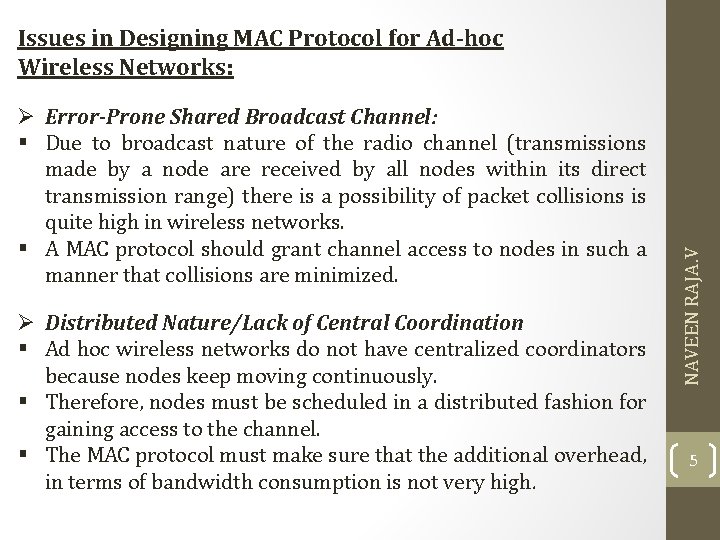
Ø Error-Prone Shared Broadcast Channel: § Due to broadcast nature of the radio channel (transmissions made by a node are received by all nodes within its direct transmission range) there is a possibility of packet collisions is quite high in wireless networks. § A MAC protocol should grant channel access to nodes in such a manner that collisions are minimized. Ø Distributed Nature/Lack of Central Coordination § Ad hoc wireless networks do not have centralized coordinators because nodes keep moving continuously. § Therefore, nodes must be scheduled in a distributed fashion for gaining access to the channel. § The MAC protocol must make sure that the additional overhead, in terms of bandwidth consumption is not very high. NAVEEN RAJA. V Issues in Designing MAC Protocol for Ad-hoc Wireless Networks: 5
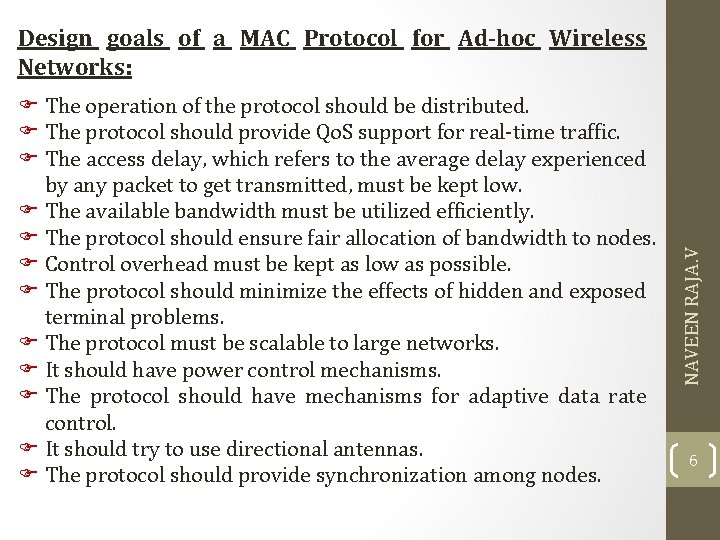
F The operation of the protocol should be distributed. F The protocol should provide Qo. S support for real-time traffic. F The access delay, which refers to the average delay experienced by any packet to get transmitted, must be kept low. F The available bandwidth must be utilized efficiently. F The protocol should ensure fair allocation of bandwidth to nodes. F Control overhead must be kept as low as possible. F The protocol should minimize the effects of hidden and exposed terminal problems. F The protocol must be scalable to large networks. F It should have power control mechanisms. F The protocol should have mechanisms for adaptive data rate control. F It should try to use directional antennas. F The protocol should provide synchronization among nodes. NAVEEN RAJA. V Design goals of a MAC Protocol for Ad-hoc Wireless Networks: 6
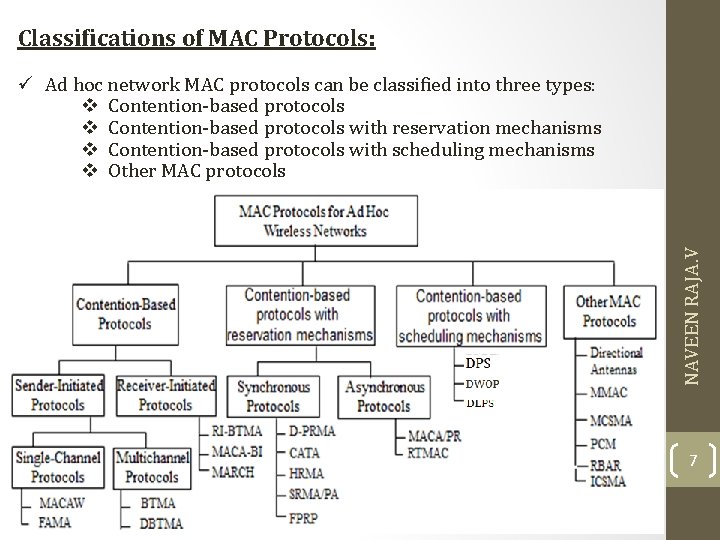
Classifications of MAC Protocols: NAVEEN RAJA. V ü Ad hoc network MAC protocols can be classified into three types: v Contention-based protocols with reservation mechanisms v Contention-based protocols with scheduling mechanisms v Other MAC protocols 7
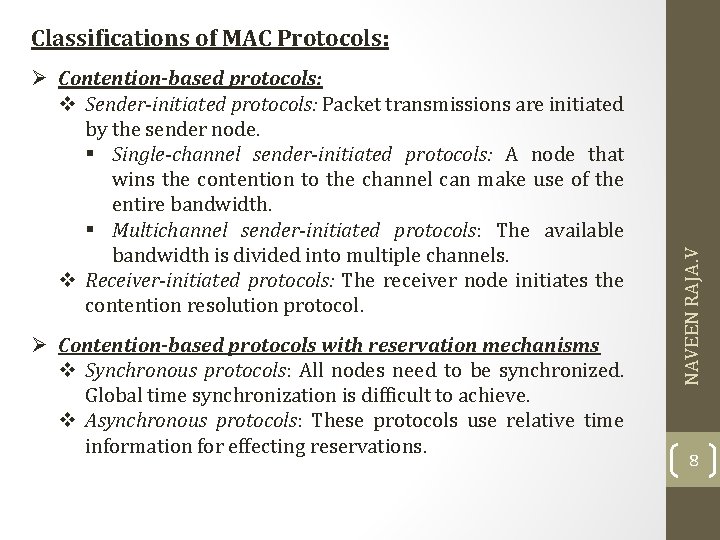
Ø Contention-based protocols: v Sender-initiated protocols: Packet transmissions are initiated by the sender node. § Single-channel sender-initiated protocols: A node that wins the contention to the channel can make use of the entire bandwidth. § Multichannel sender-initiated protocols: The available bandwidth is divided into multiple channels. v Receiver-initiated protocols: The receiver node initiates the contention resolution protocol. Ø Contention-based protocols with reservation mechanisms v Synchronous protocols: All nodes need to be synchronized. Global time synchronization is difficult to achieve. v Asynchronous protocols: These protocols use relative time information for effecting reservations. NAVEEN RAJA. V Classifications of MAC Protocols: 8
Classifications of MAC Protocols: Ø Contention-based protocols with scheduling mechanisms: § Node scheduling is done in a manner so that all nodes are treated fairly and no node is starved of bandwidth. priorities among flows whose packets are queued at nodes. § Some scheduling schemes also consider battery characteristics. Ø Other protocols are those MAC protocols : These are not NAVEEN RAJA. V § Scheduling-based schemes are also used for enforcing strictly fall under the above categories. 9
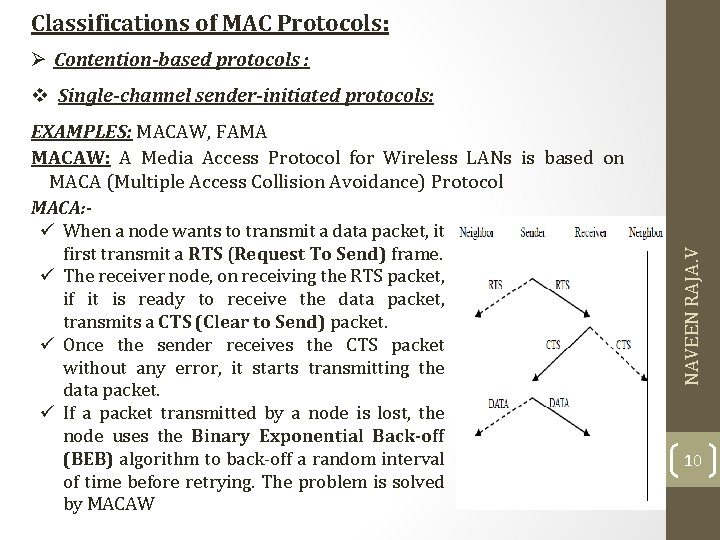
Classifications of MAC Protocols: Ø Contention-based protocols : v Single-channel sender-initiated protocols: MACA: ü When a node wants to transmit a data packet, it first transmit a RTS (Request To Send) frame. ü The receiver node, on receiving the RTS packet, if it is ready to receive the data packet, transmits a CTS (Clear to Send) packet. ü Once the sender receives the CTS packet without any error, it starts transmitting the data packet. ü If a packet transmitted by a node is lost, the node uses the Binary Exponential Back-off (BEB) algorithm to back-off a random interval of time before retrying. The problem is solved by MACAW NAVEEN RAJA. V EXAMPLES: MACAW, FAMA MACAW: A Media Access Protocol for Wireless LANs is based on MACA (Multiple Access Collision Avoidance) Protocol 10
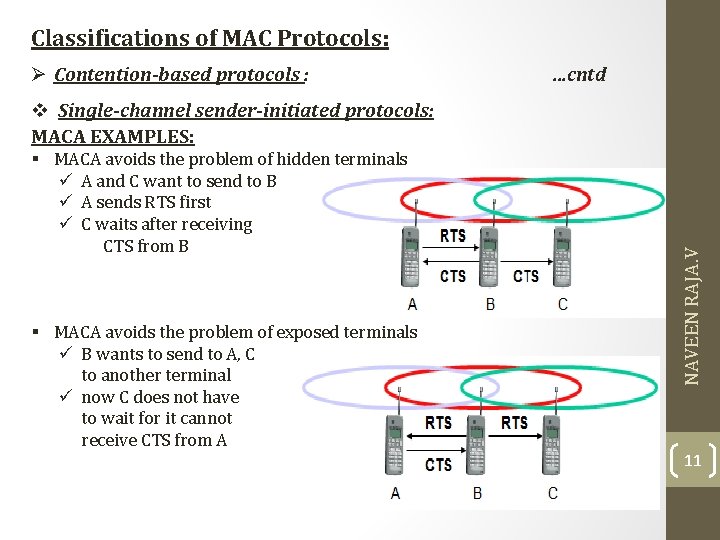
Classifications of MAC Protocols: Ø Contention-based protocols : …cntd § MACA avoids the problem of hidden terminals ü A and C want to send to B ü A sends RTS first ü C waits after receiving CTS from B § MACA avoids the problem of exposed terminals ü B wants to send to A, C to another terminal ü now C does not have to wait for it cannot receive CTS from A NAVEEN RAJA. V v Single-channel sender-initiated protocols: MACA EXAMPLES: 11
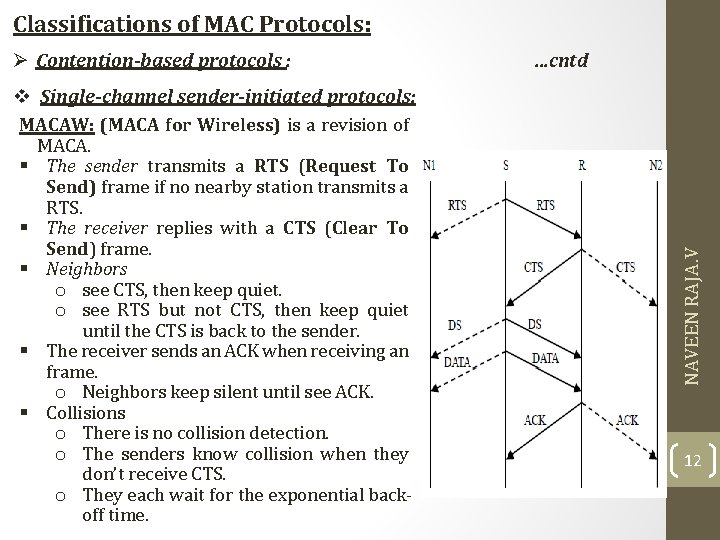
Classifications of MAC Protocols: Ø Contention-based protocols : …cntd MACAW: (MACA for Wireless) is a revision of MACA. § The sender transmits a RTS (Request To Send) frame if no nearby station transmits a RTS. § The receiver replies with a CTS (Clear To Send) frame. § Neighbors o see CTS, then keep quiet. o see RTS but not CTS, then keep quiet until the CTS is back to the sender. § The receiver sends an ACK when receiving an frame. o Neighbors keep silent until see ACK. § Collisions o There is no collision detection. o The senders know collision when they don’t receive CTS. o They each wait for the exponential backoff time. NAVEEN RAJA. V v Single-channel sender-initiated protocols: 12
Classifications of MAC Protocols: …cntd FAMA: Floor Acquisition Multiple Access Protocols. ü Channel access consists of a carrier-sensing operation and a collision avoidance ü Carrier-sensing by the sender, followed by the RTS-CTS control packet exchange. § Data transmission to be collision free, the duration of an RTS must be at least twice the maximum channel propagation delay ü Two FAMA protocol variants § RTS-CTS exchange with no carrier sensing (MACA) § RTS-CTS exchange with non-persistent carrier sensing (FAMA-NTR) FAMA-NTR(Non-persistent Transmit Request) § Before sending a packet, the sender senses the channel § If channel is busy, the sender back-off a random time and retries later § If the channel is free, the sender sends RTS and waits for a CTS packet § If the sender cannot receive a CTS, it takes a random back-off and retries later § If the sender receives a CTS, it can start transmission data packet § In order to allow the sender to send a burst of packets, the receiver is made to wait a time duration τ seconds after a packet is received. NAVEEN RAJA. V Ø Contention-based protocols : v Single-channel sender-initiated protocols: 13
Ø Contention-based protocols : …cntd v Multi-channel sender-initiated protocols: q Busy Tone Multiple Access Protocols (BTMA): ü The transmission channel is split into two parts: § a data channel for data packet transmissions § a control channel used to transmit the busy tone signal ü When a node is ready for transmission, it senses the channel to check whether the busy tone is active. § If not, it turns on the busy tone signal and starts data transmissions. § Otherwise, it reschedules the packet for transmission after some random rescheduling delay. q Dual Busy Tone Multiple Access Protocol (DBTMAP) is an extension of the BTMA scheme. § a data channel for data packet transmissions § a control channel used for control packet transmissions (RTS and CTS packets) and also for transmitting the busy tones. ü Use two busy tones on the control channel, BTt and BTr. § BTt : indicate that it is transmitting on the data channel § BTr: indicate that it is receiving on the data channel ü Two busy tone signals are two sine waves at different frequencies NAVEEN RAJA. V Classifications of MAC Protocols: 14
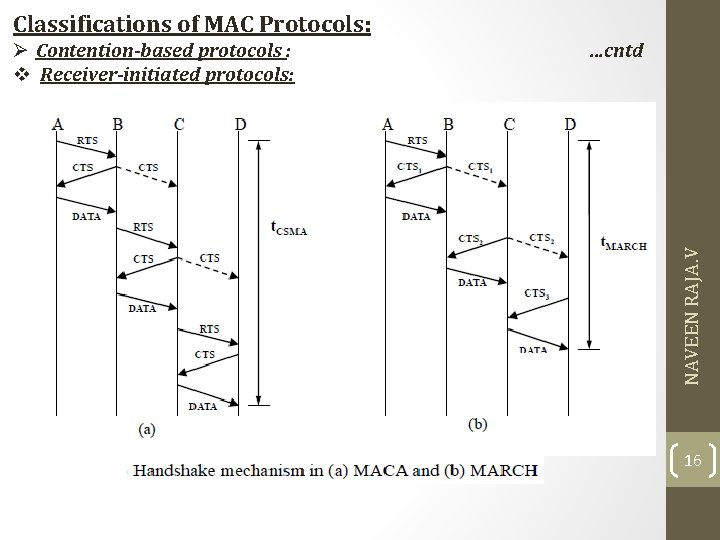
Classifications of MAC Protocols: …cntd q RI-BTMA: Receiver-Initiated Busy Tone Multiple Access Protocol ü The transmission channel is split into two: • a data channel for data packet transmissions • a control channel used for transmitting the busy tone signal ü A node can transmit on the data channel only if it finds the busy tone to be absent on the control channel. ü The data packet is divided into two portions: a preamble and the actual data packet. q MACA-BI: MACA-By Invitation ü By eliminating the need for the RTS packet it reduces the number of control packets used in the MACA protocol which uses the three-way handshake mechanism. q MARCH: Media Access with Reduced Handshake. NAVEEN RAJA. V Ø Contention-based protocols : v Receiver-initiated protocols: 15
Classifications of MAC Protocols: …cntd NAVEEN RAJA. V Ø Contention-based protocols : v Receiver-initiated protocols: 16
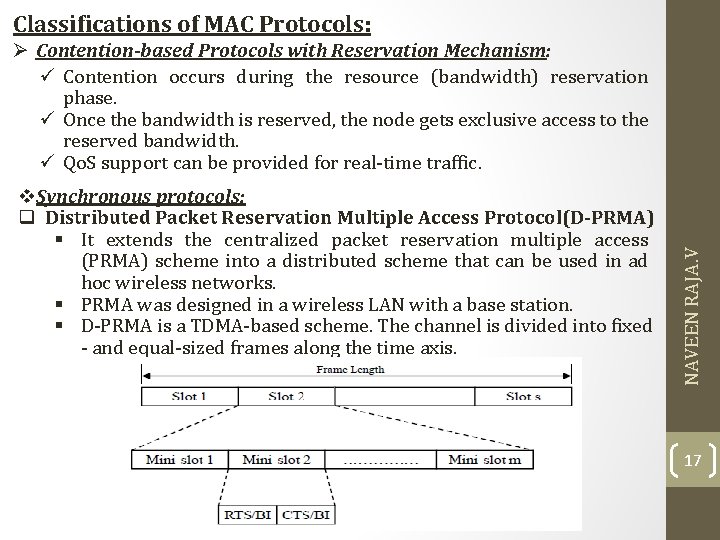
Classifications of MAC Protocols: v. Synchronous protocols: q Distributed Packet Reservation Multiple Access Protocol(D-PRMA) § It extends the centralized packet reservation multiple access (PRMA) scheme into a distributed scheme that can be used in ad hoc wireless networks. § PRMA was designed in a wireless LAN with a base station. § D-PRMA is a TDMA-based scheme. The channel is divided into fixed - and equal-sized frames along the time axis. NAVEEN RAJA. V Ø Contention-based Protocols with Reservation Mechanism: ü Contention occurs during the resource (bandwidth) reservation phase. ü Once the bandwidth is reserved, the node gets exclusive access to the reserved bandwidth. ü Qo. S support can be provided for real-time traffic. 17
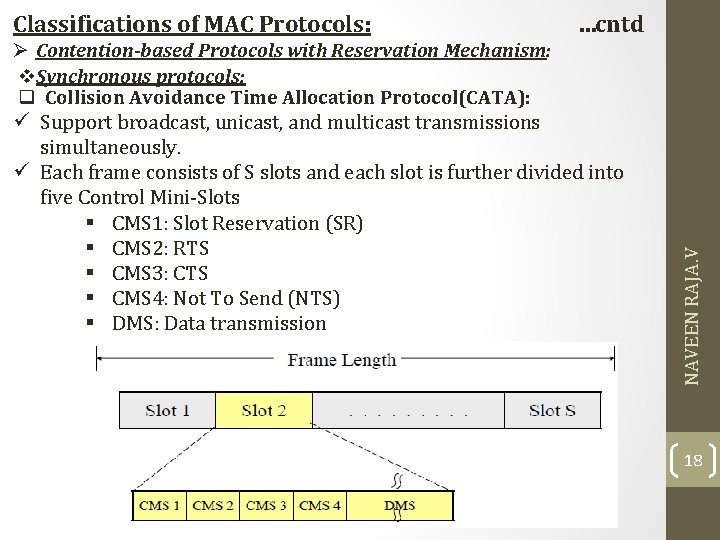
…cntd Ø Contention-based Protocols with Reservation Mechanism: v. Synchronous protocols: q Collision Avoidance Time Allocation Protocol(CATA): ü Support broadcast, unicast, and multicast transmissions simultaneously. ü Each frame consists of S slots and each slot is further divided into five Control Mini-Slots § CMS 1: Slot Reservation (SR) § CMS 2: RTS § CMS 3: CTS § CMS 4: Not To Send (NTS) § DMS: Data transmission NAVEEN RAJA. V Classifications of MAC Protocols: 18
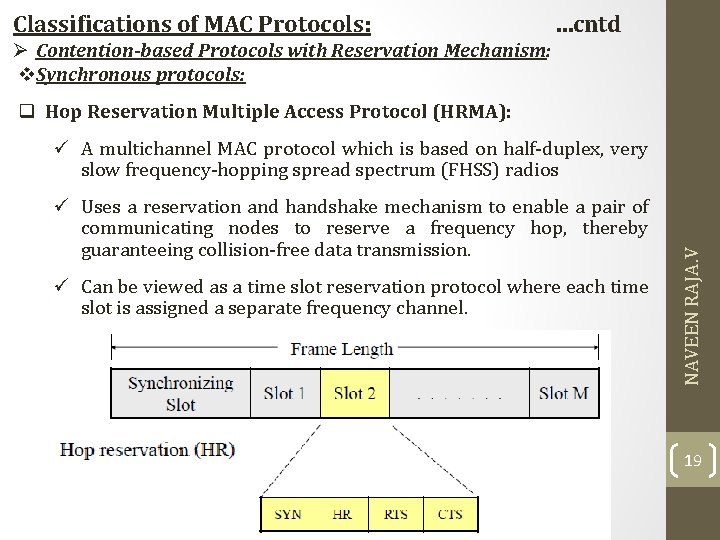
Classifications of MAC Protocols: …cntd Ø Contention-based Protocols with Reservation Mechanism: v. Synchronous protocols: q Hop Reservation Multiple Access Protocol (HRMA): ü Uses a reservation and handshake mechanism to enable a pair of communicating nodes to reserve a frequency hop, thereby guaranteeing collision-free data transmission. ü Can be viewed as a time slot reservation protocol where each time slot is assigned a separate frequency channel. NAVEEN RAJA. V ü A multichannel MAC protocol which is based on half-duplex, very slow frequency-hopping spread spectrum (FHSS) radios 19
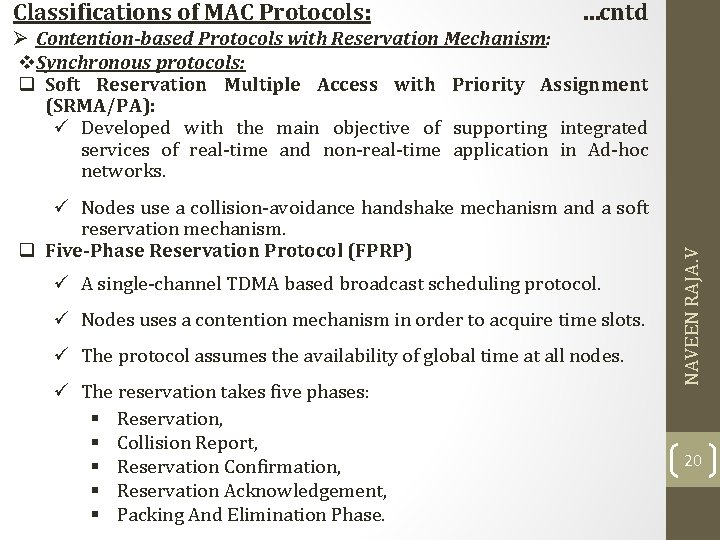
Classifications of MAC Protocols: …cntd ü Nodes use a collision-avoidance handshake mechanism and a soft reservation mechanism. q Five-Phase Reservation Protocol (FPRP) ü A single-channel TDMA based broadcast scheduling protocol. ü Nodes uses a contention mechanism in order to acquire time slots. ü The protocol assumes the availability of global time at all nodes. ü The reservation takes five phases: § Reservation, § Collision Report, § Reservation Confirmation, § Reservation Acknowledgement, § Packing And Elimination Phase. NAVEEN RAJA. V Ø Contention-based Protocols with Reservation Mechanism: v. Synchronous protocols: q Soft Reservation Multiple Access with Priority Assignment (SRMA/PA): ü Developed with the main objective of supporting integrated services of real-time and non-real-time application in Ad-hoc networks. 20
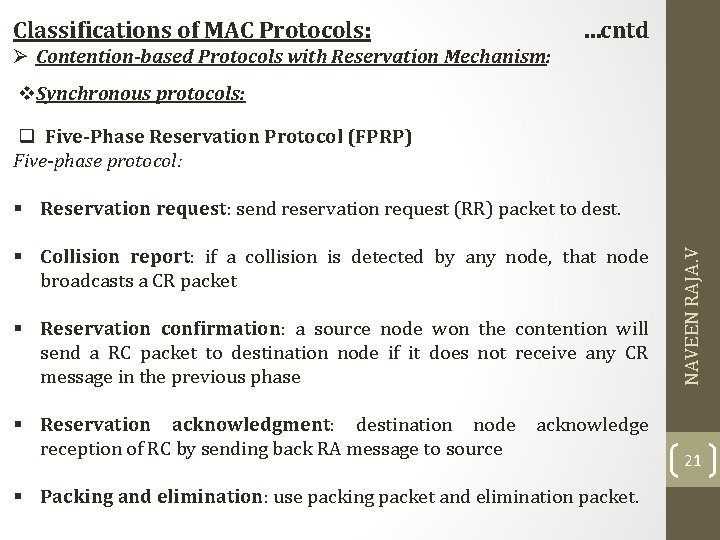
Classifications of MAC Protocols: …cntd Ø Contention-based Protocols with Reservation Mechanism: v. Synchronous protocols: q Five-Phase Reservation Protocol (FPRP) Five-phase protocol: § Collision report: if a collision is detected by any node, that node broadcasts a CR packet § Reservation confirmation: a source node won the contention will send a RC packet to destination node if it does not receive any CR message in the previous phase § Reservation acknowledgment: destination node acknowledge reception of RC by sending back RA message to source § Packing and elimination: use packing packet and elimination packet. NAVEEN RAJA. V § Reservation request: send reservation request (RR) packet to dest. 21
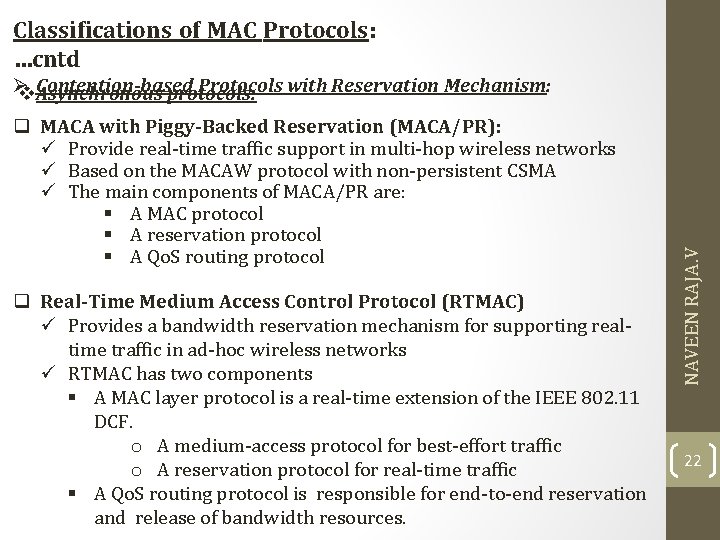
Classifications of MAC Protocols: …cntd q MACA with Piggy-Backed Reservation (MACA/PR): ü Provide real-time traffic support in multi-hop wireless networks ü Based on the MACAW protocol with non-persistent CSMA ü The main components of MACA/PR are: § A MAC protocol § A reservation protocol § A Qo. S routing protocol q Real-Time Medium Access Control Protocol (RTMAC) ü Provides a bandwidth reservation mechanism for supporting realtime traffic in ad-hoc wireless networks ü RTMAC has two components § A MAC layer protocol is a real-time extension of the IEEE 802. 11 DCF. o A medium-access protocol for best-effort traffic o A reservation protocol for real-time traffic § A Qo. S routing protocol is responsible for end-to-end reservation and release of bandwidth resources. NAVEEN RAJA. V Ø Protocols with Reservation Mechanism: v. Contention-based Asynchronous protocols: 22
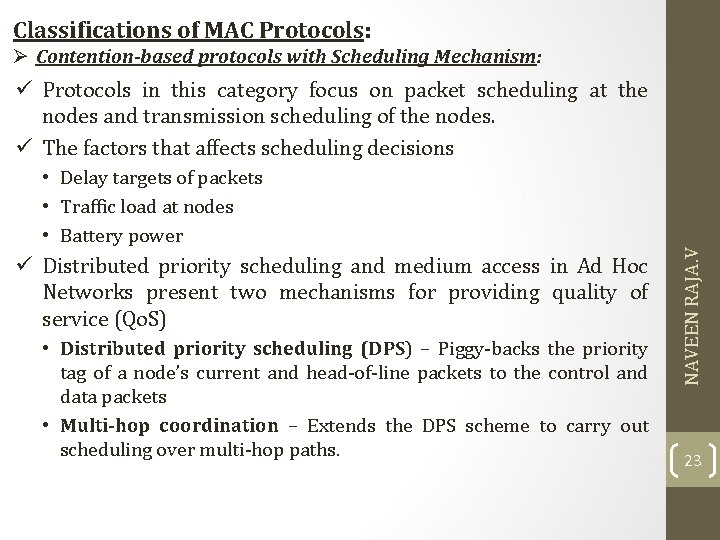
Classifications of MAC Protocols: Ø Contention-based protocols with Scheduling Mechanism: ü Protocols in this category focus on packet scheduling at the nodes and transmission scheduling of the nodes. ü The factors that affects scheduling decisions ü Distributed priority scheduling and medium access in Ad Hoc Networks present two mechanisms for providing quality of service (Qo. S) • Distributed priority scheduling (DPS) – Piggy-backs the priority tag of a node’s current and head-of-line packets to the control and data packets • Multi-hop coordination – Extends the DPS scheme to carry out scheduling over multi-hop paths. NAVEEN RAJA. V • Delay targets of packets • Traffic load at nodes • Battery power 23
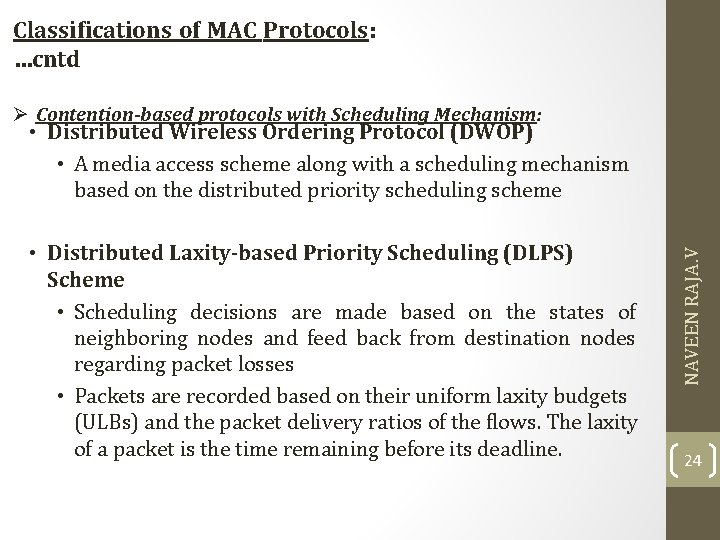
Classifications of MAC Protocols: …cntd Ø Contention-based protocols with Scheduling Mechanism: • Distributed Laxity-based Priority Scheduling (DLPS) Scheme • Scheduling decisions are made based on the states of neighboring nodes and feed back from destination nodes regarding packet losses • Packets are recorded based on their uniform laxity budgets (ULBs) and the packet delivery ratios of the flows. The laxity of a packet is the time remaining before its deadline. NAVEEN RAJA. V • Distributed Wireless Ordering Protocol (DWOP) • A media access scheme along with a scheduling mechanism based on the distributed priority scheduling scheme 24
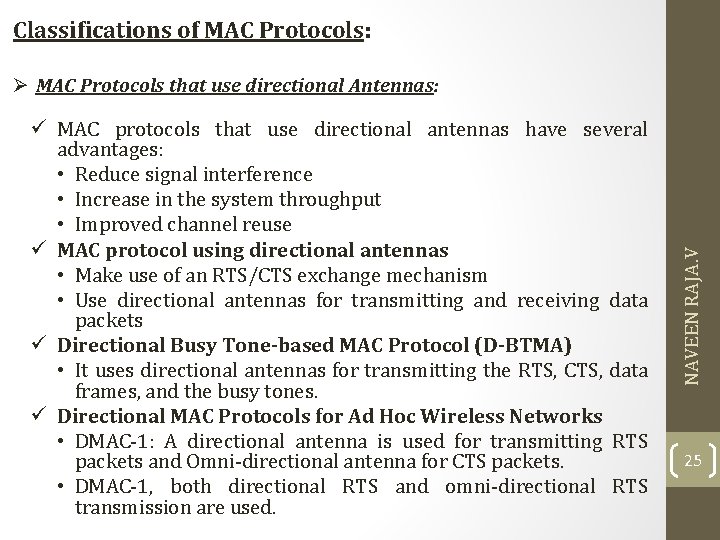
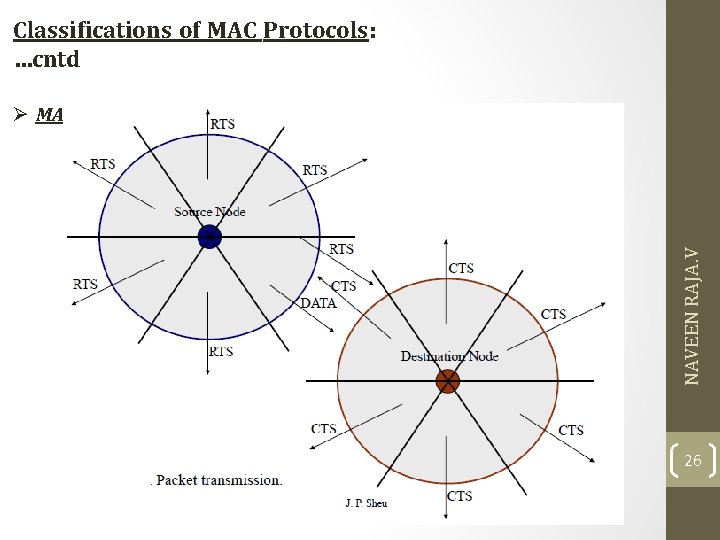
Classifications of MAC Protocols: ü MAC protocols that use directional antennas have several advantages: • Reduce signal interference • Increase in the system throughput • Improved channel reuse ü MAC protocol using directional antennas • Make use of an RTS/CTS exchange mechanism • Use directional antennas for transmitting and receiving data packets ü Directional Busy Tone-based MAC Protocol (D-BTMA) • It uses directional antennas for transmitting the RTS, CTS, data frames, and the busy tones. ü Directional MAC Protocols for Ad Hoc Wireless Networks • DMAC-1: A directional antenna is used for transmitting RTS packets and Omni-directional antenna for CTS packets. • DMAC-1, both directional RTS and omni-directional RTS transmission are used. NAVEEN RAJA. V Ø MAC Protocols that use directional Antennas: 25
Classifications of MAC Protocols: …cntd NAVEEN RAJA. V Ø MAC Protocols that use directional Antennas: 26
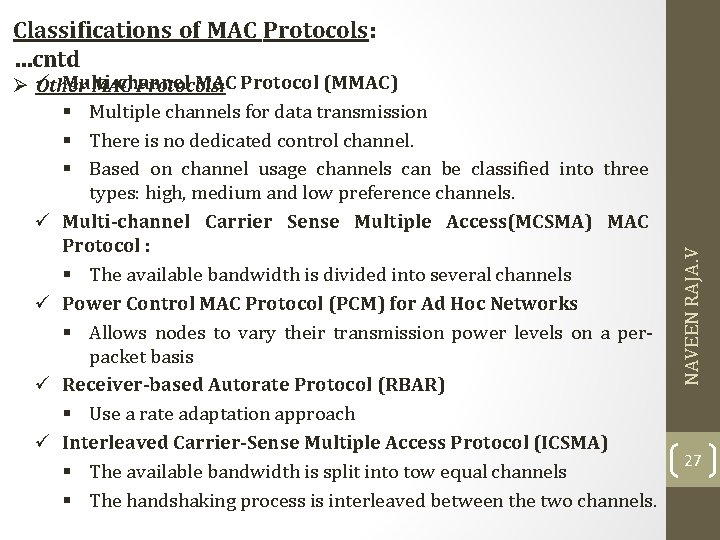
Multi-channel MAC Protocol (MMAC) Øü Other MAC Protocols: § Multiple channels for data transmission § There is no dedicated control channel. § Based on channel usage channels can be classified into three types: high, medium and low preference channels. ü Multi-channel Carrier Sense Multiple Access(MCSMA) MAC Protocol : § The available bandwidth is divided into several channels ü Power Control MAC Protocol (PCM) for Ad Hoc Networks § Allows nodes to vary their transmission power levels on a perpacket basis ü Receiver-based Autorate Protocol (RBAR) § Use a rate adaptation approach ü Interleaved Carrier-Sense Multiple Access Protocol (ICSMA) § The available bandwidth is split into tow equal channels § The handshaking process is interleaved between the two channels. NAVEEN RAJA. V Classifications of MAC Protocols: …cntd 27
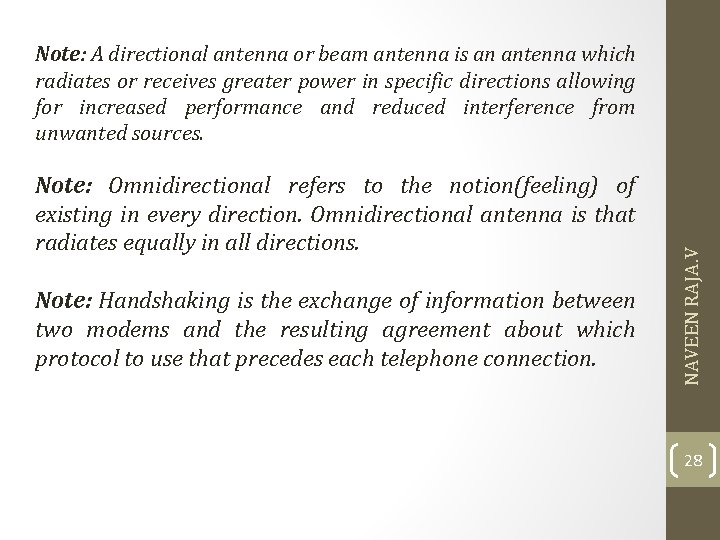
Note: Omnidirectional refers to the notion(feeling) of existing in every direction. Omnidirectional antenna is that radiates equally in all directions. Note: Handshaking is the exchange of information between two modems and the resulting agreement about which protocol to use that precedes each telephone connection. NAVEEN RAJA. V Note: A directional antenna or beam antenna is an antenna which radiates or receives greater power in specific directions allowing for increased performance and reduced interference from unwanted sources. 28