
UNITI SIGNALS SYSTEMS Introduction to Signals A Signal
- Slides: 54
UNIT-I SIGNALS & SYSTEMS
Introduction to Signals • A Signal is the function of one or more independent variables that carries some information to represent a physical phenomenon. e. g. ECG, EEG • Two Types of Signals 1. Continuous-time signals 2. Discrete-time signals
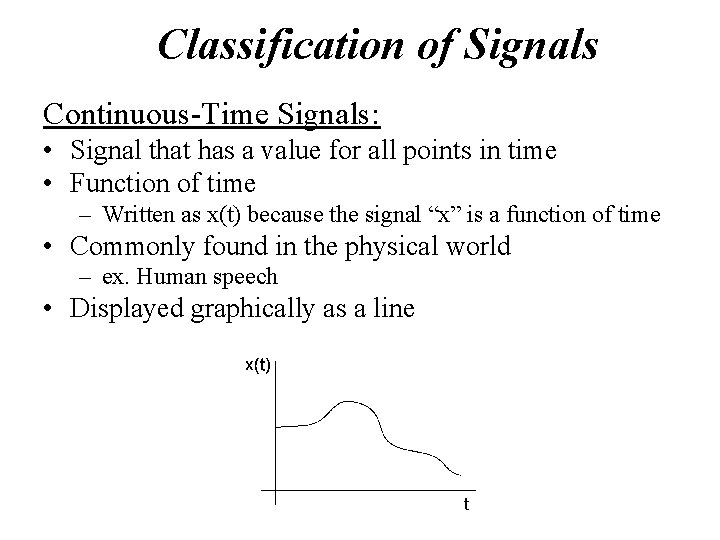
Classification of Signals Continuous-Time Signals: • Signal that has a value for all points in time • Function of time – Written as x(t) because the signal “x” is a function of time • Commonly found in the physical world – ex. Human speech • Displayed graphically as a line
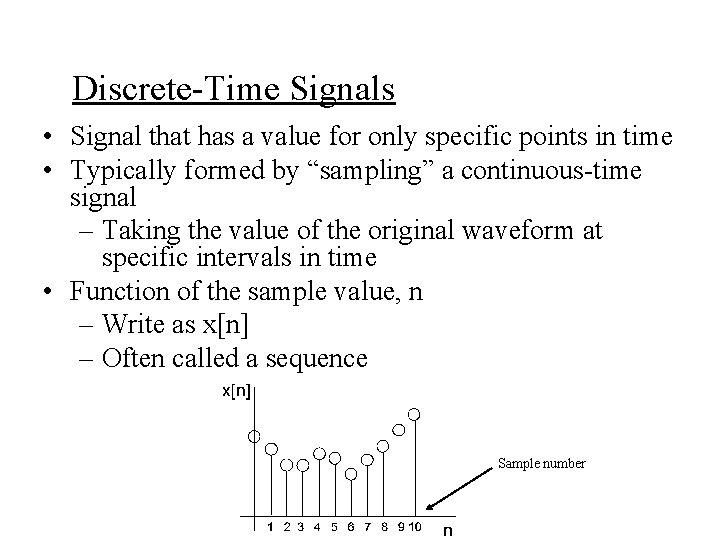
Discrete-Time Signals • Signal that has a value for only specific points in time • Typically formed by “sampling” a continuous-time signal – Taking the value of the original waveform at specific intervals in time • Function of the sample value, n – Write as x[n] – Often called a sequence Sample number
Both continuous & discrete time signals are classified into, • • Deterministic & Non-deterministic signals Periodic & Aperiodic signals Even & Odd signals Energy & Power signals
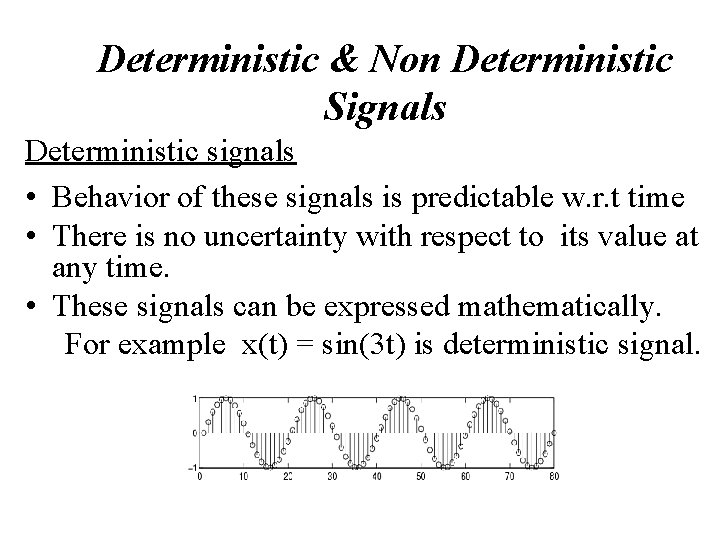
Deterministic & Non Deterministic Signals Deterministic signals • Behavior of these signals is predictable w. r. t time • There is no uncertainty with respect to its value at any time. • These signals can be expressed mathematically. For example x(t) = sin(3 t) is deterministic signal.
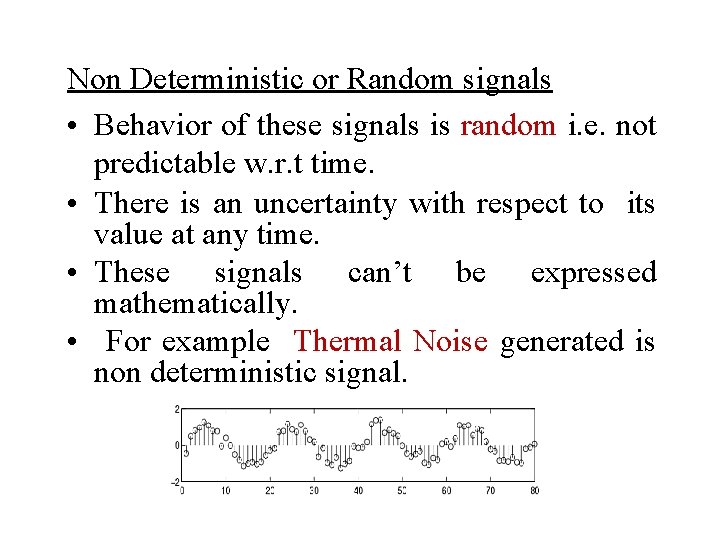
Non Deterministic or Random signals • Behavior of these signals is random i. e. not predictable w. r. t time. • There is an uncertainty with respect to its value at any time. • These signals can’t be expressed mathematically. • For example Thermal Noise generated is non deterministic signal.
Periodic and Non-periodic Signals Periodic Signals • Given x(t) is a continuous-time signal • x (t) is periodic if x(t) = x(t+Tₒ) for any T and any integer n • Given x(n) is a discrete time signal • x (n) is periodic if x(n) = x(n+N) for any N and any integer t
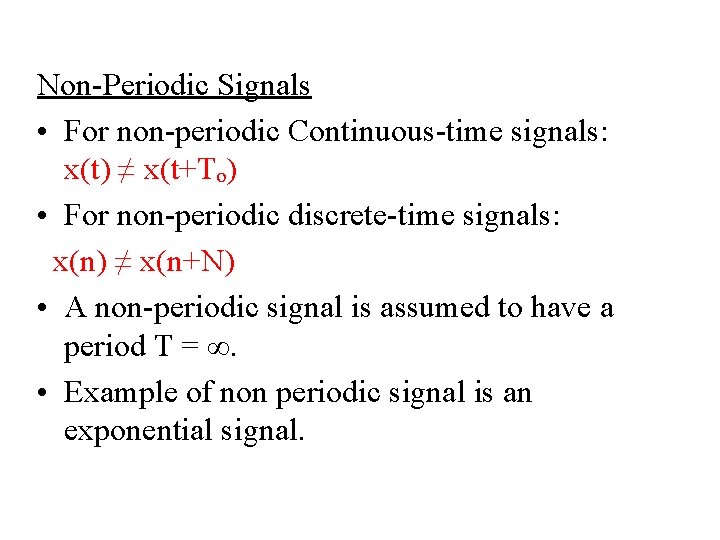
Non-Periodic Signals • For non-periodic Continuous-time signals: x(t) ≠ x(t+Tₒ) • For non-periodic discrete-time signals: x(n) ≠ x(n+N) • A non-periodic signal is assumed to have a period T = ∞. • Example of non periodic signal is an exponential signal.
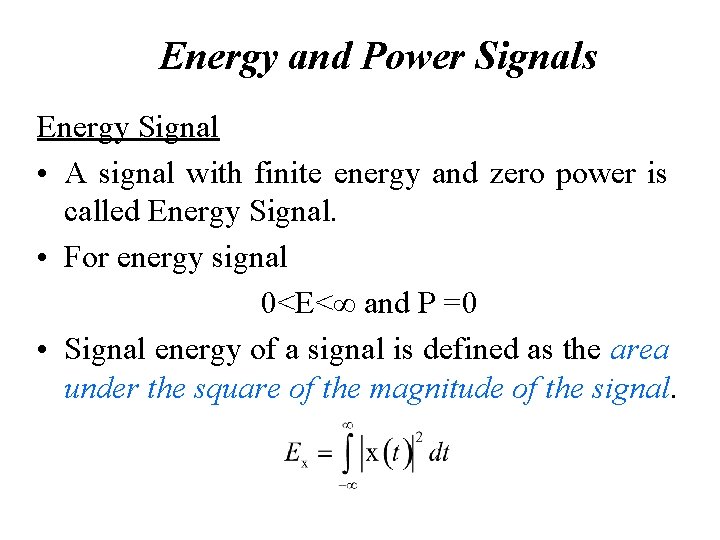
Energy and Power Signals Energy Signal • A signal with finite energy and zero power is called Energy Signal. • For energy signal 0<E<∞ and P =0 • Signal energy of a signal is defined as the area under the square of the magnitude of the signal.
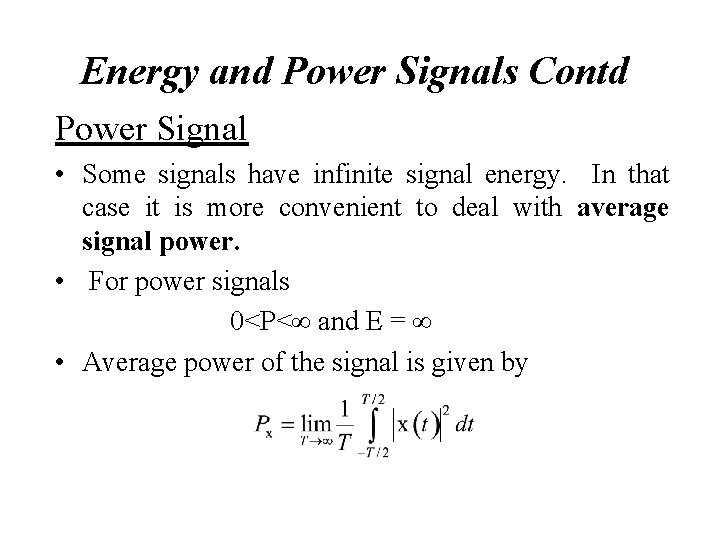
Energy and Power Signals Contd Power Signal • Some signals have infinite signal energy. In that case it is more convenient to deal with average signal power. • For power signals 0<P<∞ and E = ∞ • Average power of the signal is given by
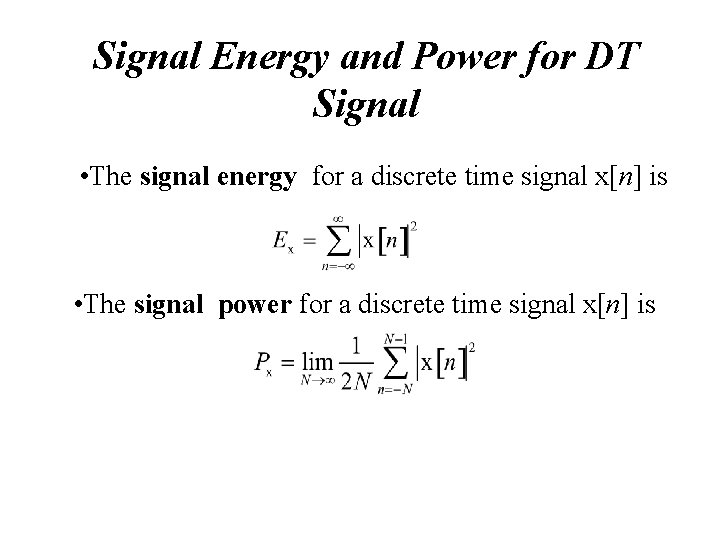
Signal Energy and Power for DT Signal • The signal energy for a discrete time signal x[n] is • The signal power for a discrete time signal x[n] is
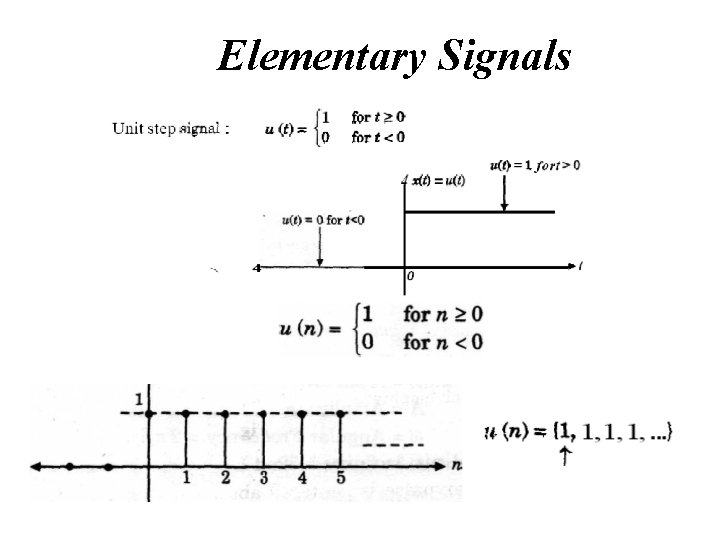
Elementary Signals
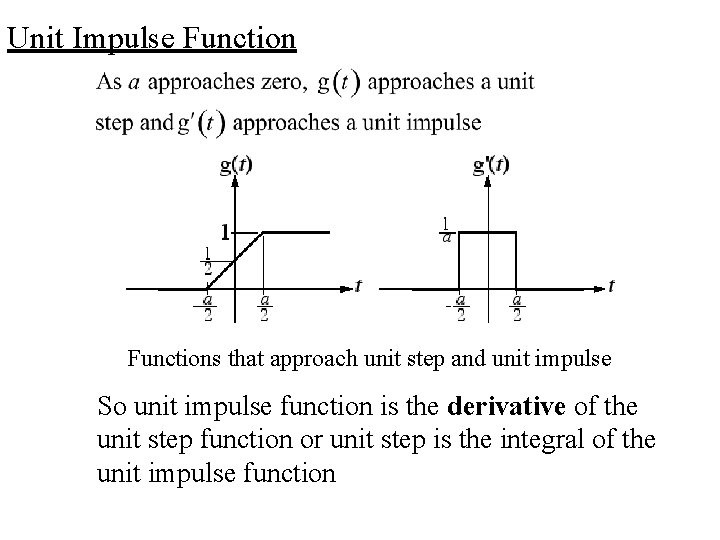
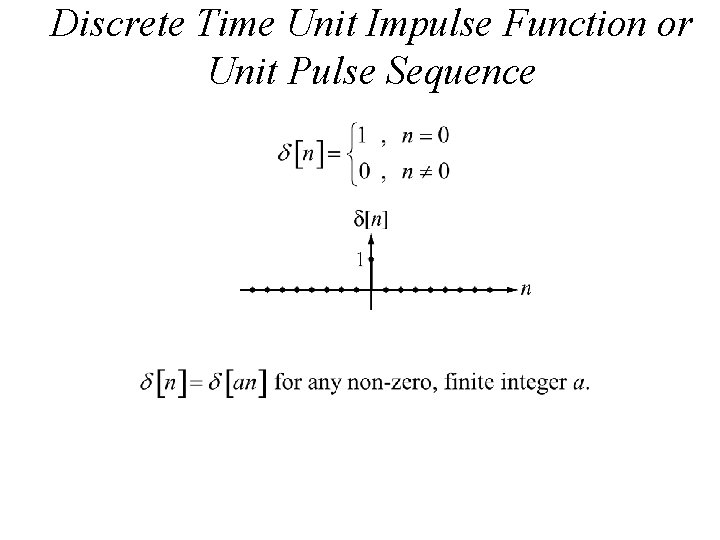
Unit Impulse Functions that approach unit step and unit impulse So unit impulse function is the derivative of the unit step function or unit step is the integral of the unit impulse function
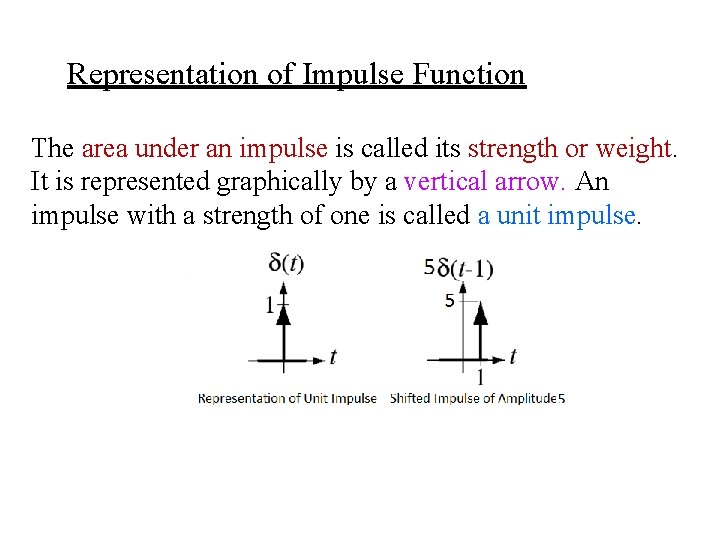
Representation of Impulse Function The area under an impulse is called its strength or weight. It is represented graphically by a vertical arrow. An impulse with a strength of one is called a unit impulse.
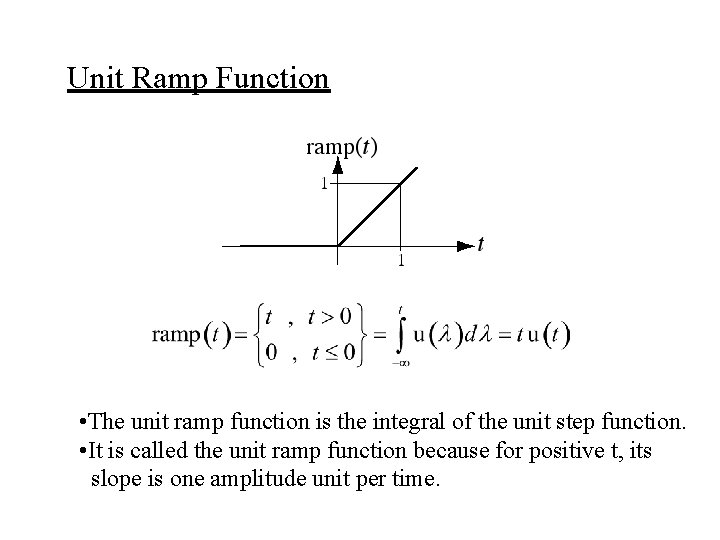
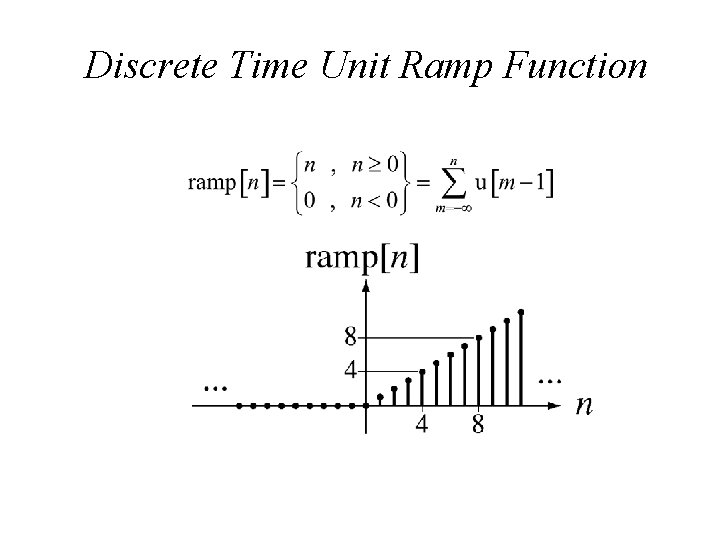
Unit Ramp Function • The unit ramp function is the integral of the unit step function. • It is called the unit ramp function because for positive t, its slope is one amplitude unit per time.
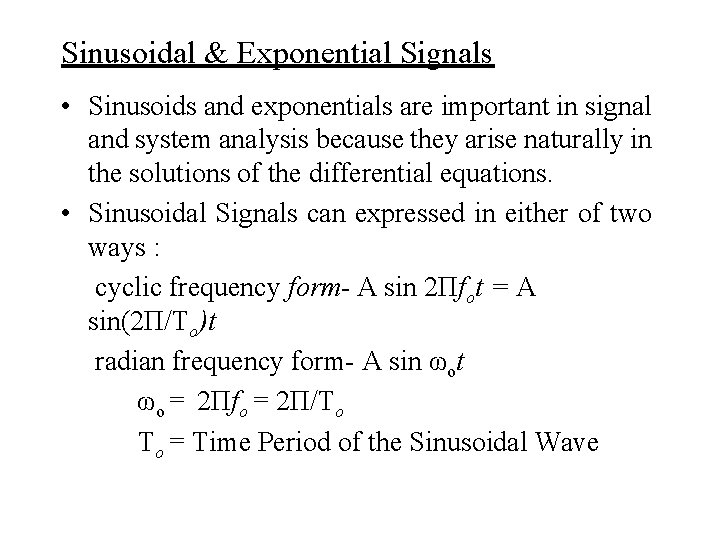
Sinusoidal & Exponential Signals • Sinusoids and exponentials are important in signal and system analysis because they arise naturally in the solutions of the differential equations. • Sinusoidal Signals can expressed in either of two ways : cyclic frequency form- A sin 2 Пfot = A sin(2 П/To)t radian frequency form- A sin ωot ωo = 2 Пfo = 2 П/To To = Time Period of the Sinusoidal Wave
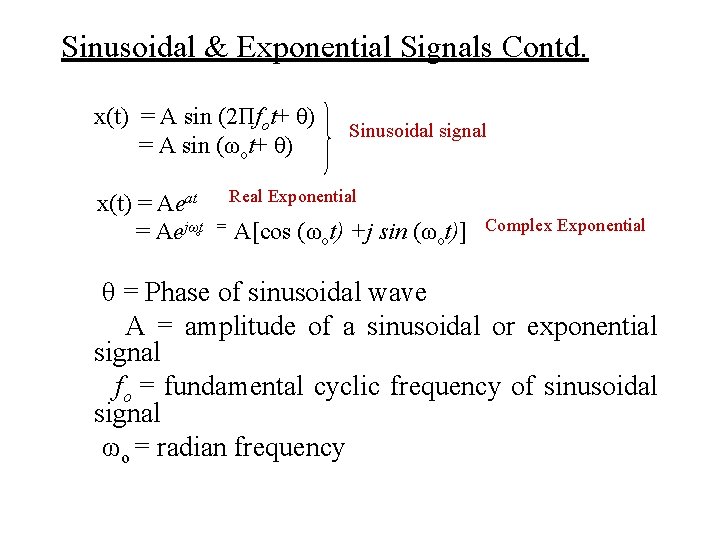
Sinusoidal & Exponential Signals Contd. x(t) = A sin (2 Пfot+ θ) = A sin (ωot+ θ) x(t) = Aeat = Aejω t Sinusoidal signal Real Exponential = A[cos (ωot) +j sin (ωot)] Complex Exponential θ = Phase of sinusoidal wave A = amplitude of a sinusoidal or exponential signal fo = fundamental cyclic frequency of sinusoidal signal ωo = radian frequency
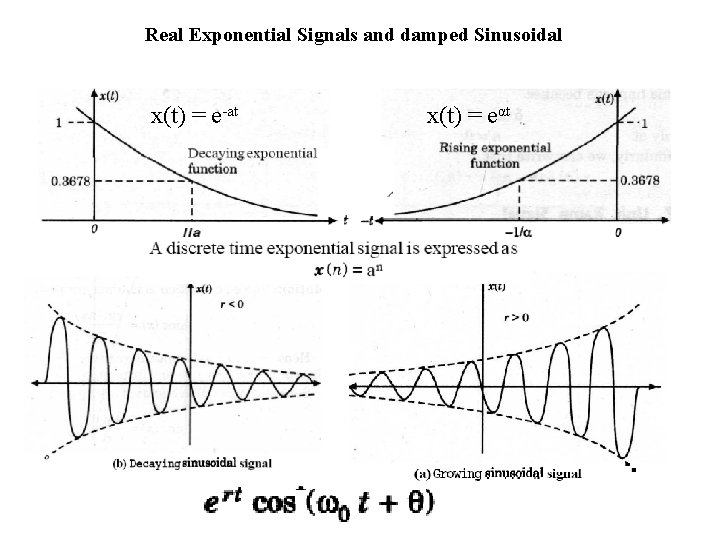
Real Exponential Signals and damped Sinusoidal x(t) = e-at x(t) = eαt
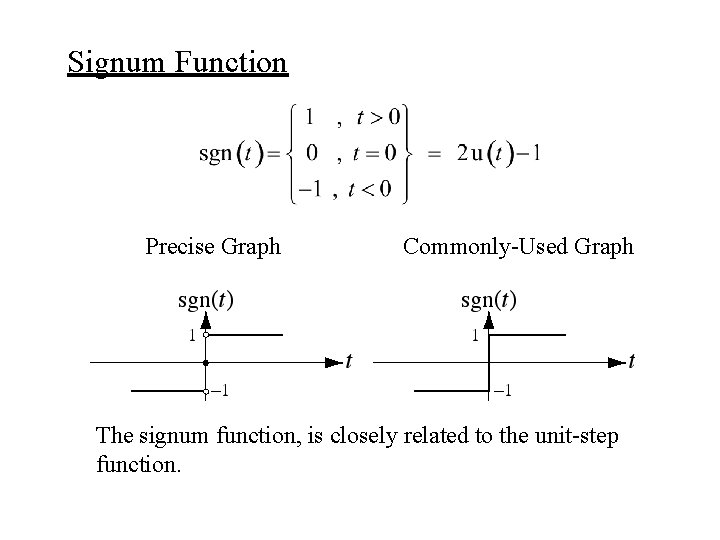
Signum Function Precise Graph Commonly-Used Graph The signum function, is closely related to the unit-step function.
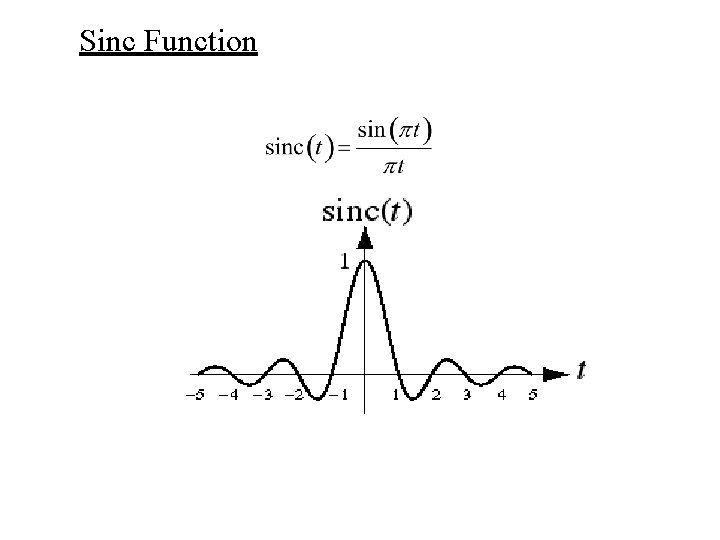
Sinc Function
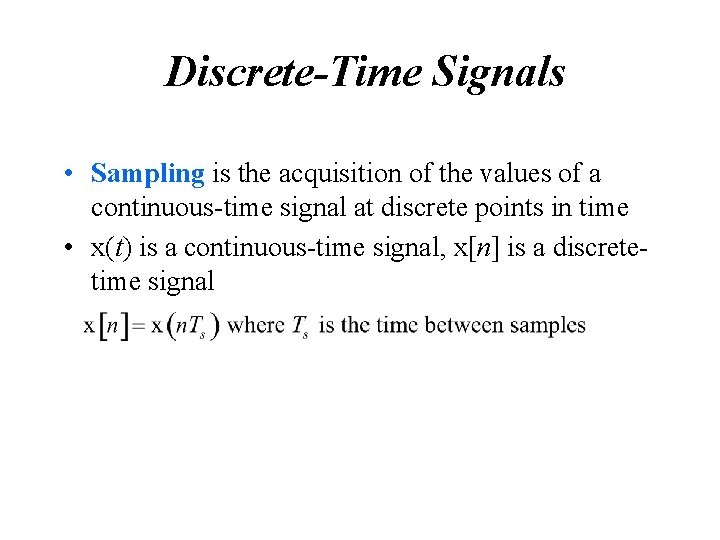
Discrete-Time Signals • Sampling is the acquisition of the values of a continuous-time signal at discrete points in time • x(t) is a continuous-time signal, x[n] is a discretetime signal
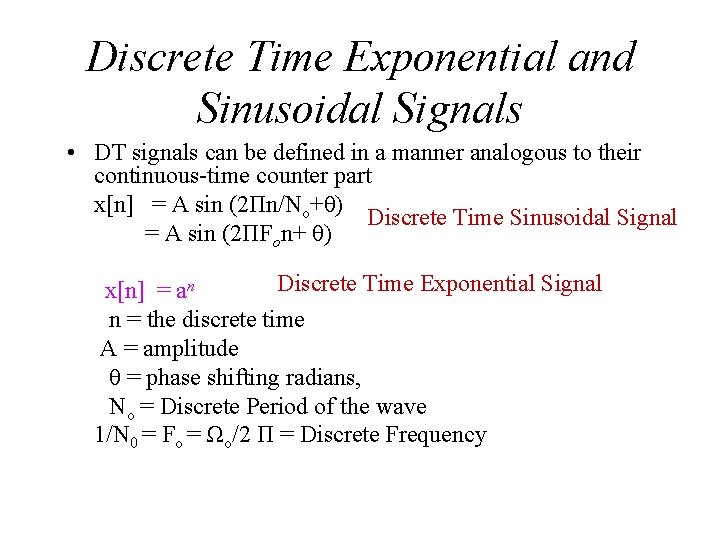
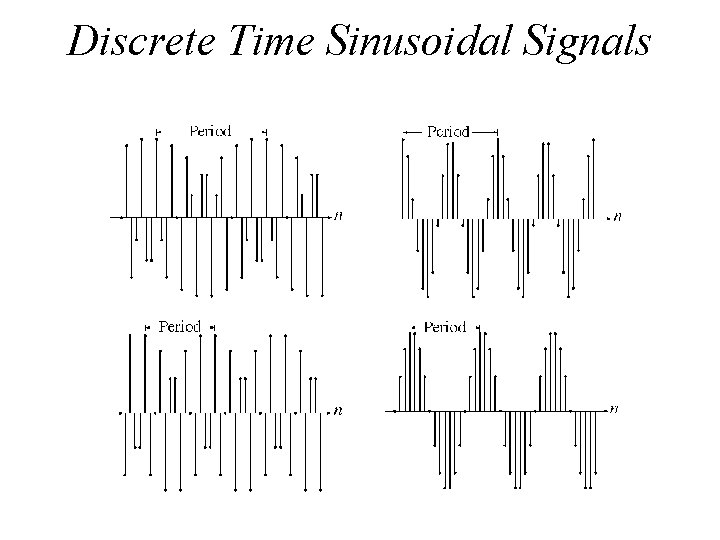
Discrete Time Exponential and Sinusoidal Signals • DT signals can be defined in a manner analogous to their continuous-time counter part x[n] = A sin (2 Пn/No+θ) Discrete Time Sinusoidal Signal = A sin (2 ПFon+ θ) Discrete Time Exponential Signal x[n] = an n = the discrete time A = amplitude θ = phase shifting radians, No = Discrete Period of the wave 1/N 0 = Fo = Ωo/2 П = Discrete Frequency
Discrete Time Sinusoidal Signals
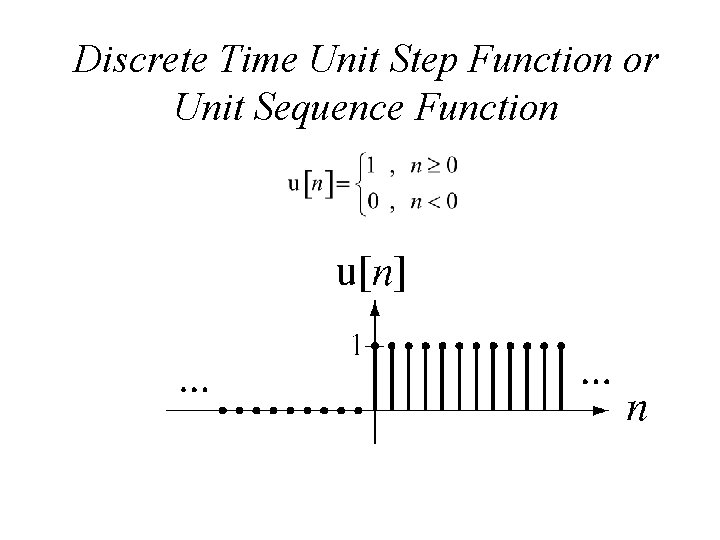
Discrete Time Unit Step Function or Unit Sequence Function
Discrete Time Unit Ramp Function
Discrete Time Unit Impulse Function or Unit Pulse Sequence
Operations of Signals • Sometime a given mathematical function may completely describe a signal. • Different operations are required for different purposes of arbitrary signals. • The operations on signals can be Time Shifting Time Scaling Time Inversion or Time Folding
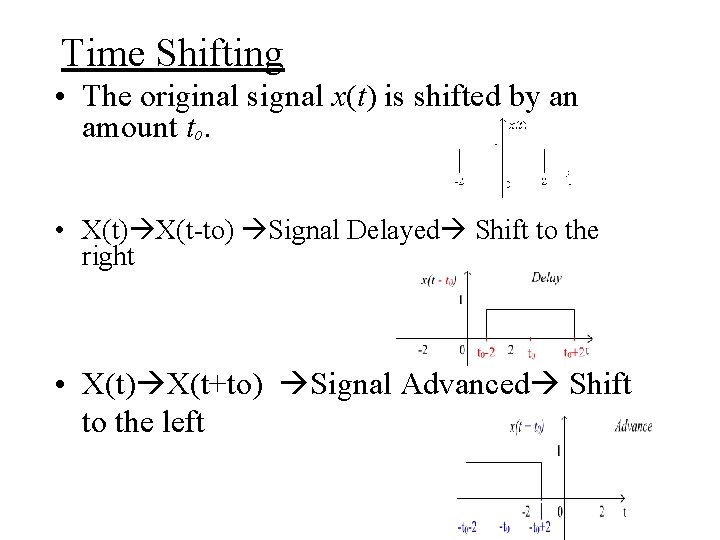
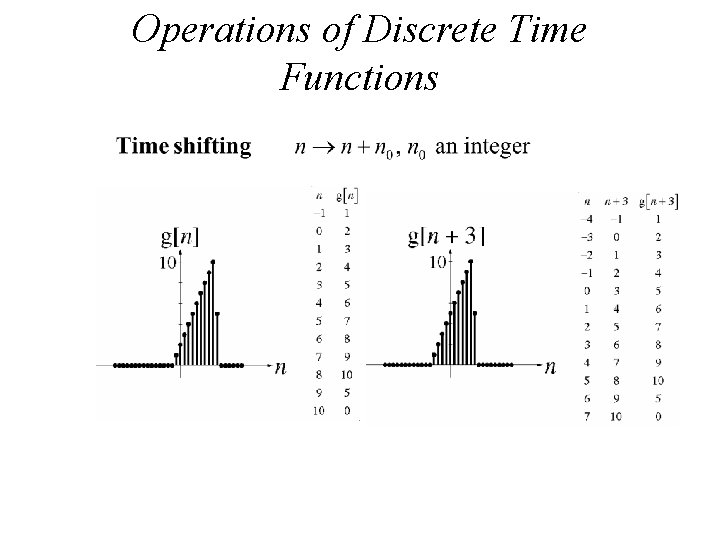
Time Shifting • The original signal x(t) is shifted by an amount tₒ. • X(t) X(t-to) Signal Delayed Shift to the right • X(t) X(t+to) Signal Advanced Shift to the left
Time Scaling • For the given function x(t), x(at) is the time scaled version of x(t) • For a ˃ 1, period of function x(t) reduces and function speeds up. Graph of the function shrinks. • For a ˂ 1, the period of the x(t) increases and the function slows down. Graph of the function expands.
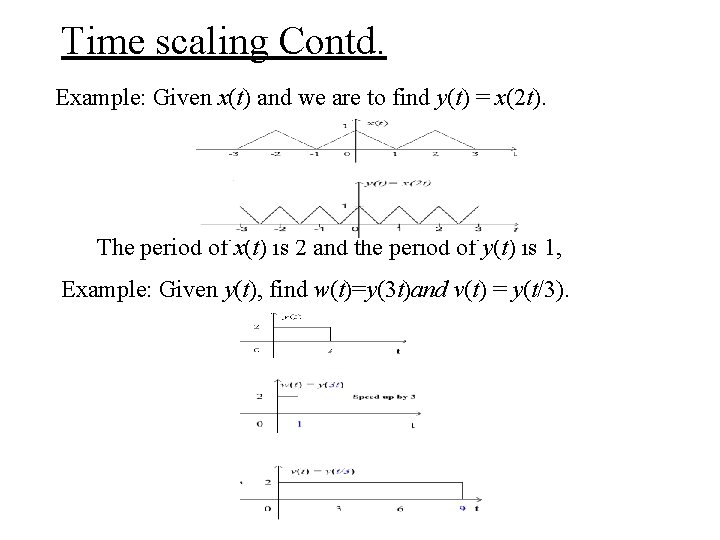
Time scaling Contd. Example: Given x(t) and we are to find y(t) = x(2 t). The period of x(t) is 2 and the period of y(t) is 1, Example: Given y(t), find w(t)=y(3 t)and v(t) = y(t/3).
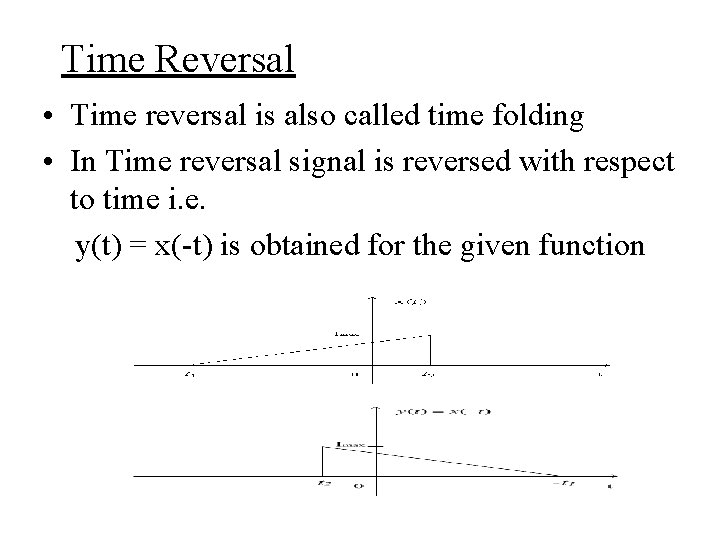
Time Reversal • Time reversal is also called time folding • In Time reversal signal is reversed with respect to time i. e. y(t) = x(-t) is obtained for the given function
Operations of Discrete Time Functions
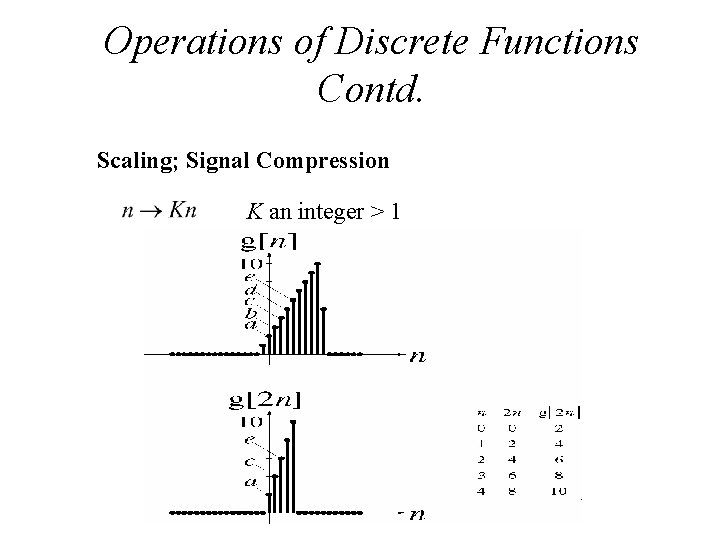
Operations of Discrete Functions Contd. Scaling; Signal Compression K an integer > 1
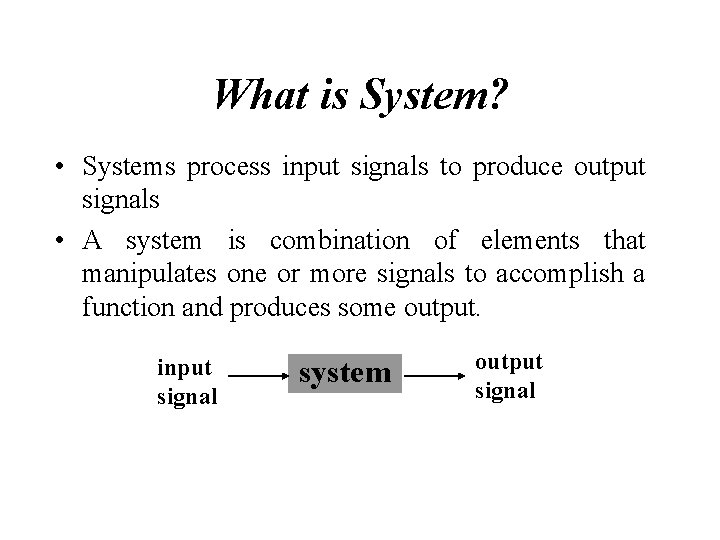
What is System? • Systems process input signals to produce output signals • A system is combination of elements that manipulates one or more signals to accomplish a function and produces some output. input signal system output signal
Types of Systems • • • Causal & Anticausal Linear & Non Linear Time Variant &Time-invariant Stable & Unstable Static & Dynamic Invertible & Inverse Systems
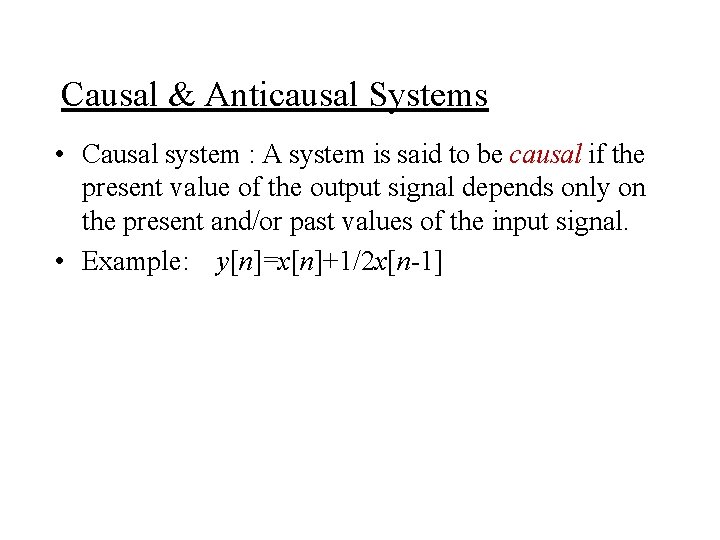
Causal & Anticausal Systems • Causal system : A system is said to be causal if the present value of the output signal depends only on the present and/or past values of the input signal. • Example: y[n]=x[n]+1/2 x[n-1]
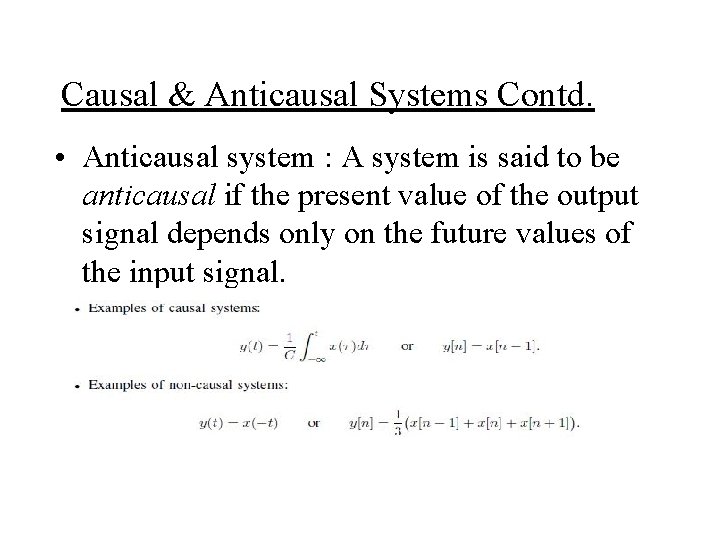
Causal & Anticausal Systems Contd. • Anticausal system : A system is said to be anticausal if the present value of the output signal depends only on the future values of the input signal.
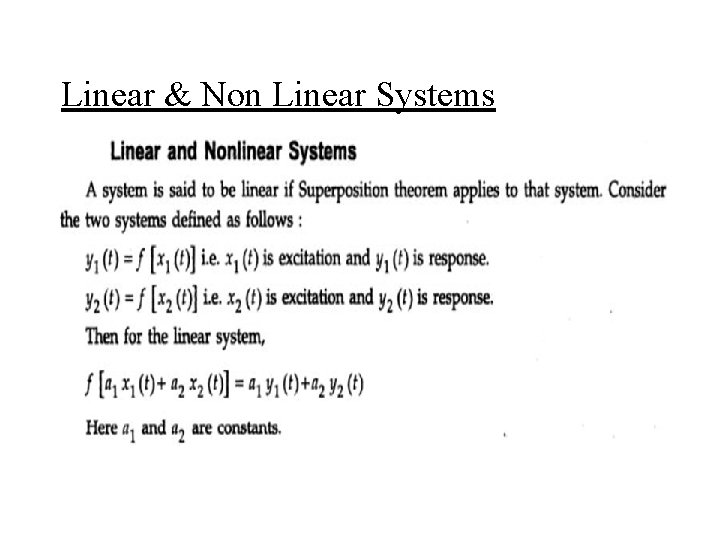
Linear & Non Linear Systems
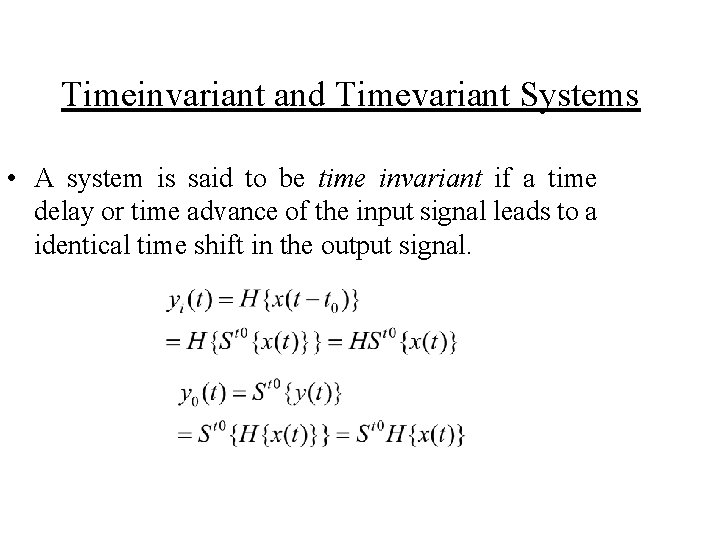
Timeinvariant and Timevariant Systems • A system is said to be time invariant if a time delay or time advance of the input signal leads to a identical time shift in the output signal.
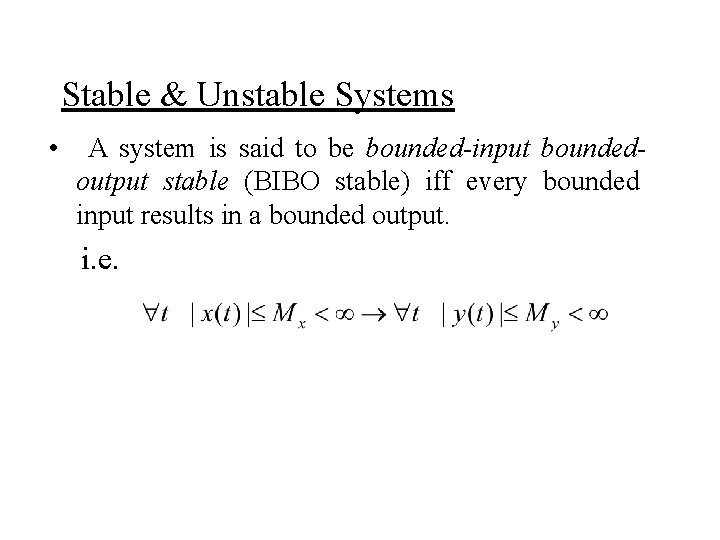
Stable & Unstable Systems • A system is said to be bounded-input boundedoutput stable (BIBO stable) iff every bounded input results in a bounded output. i. e.
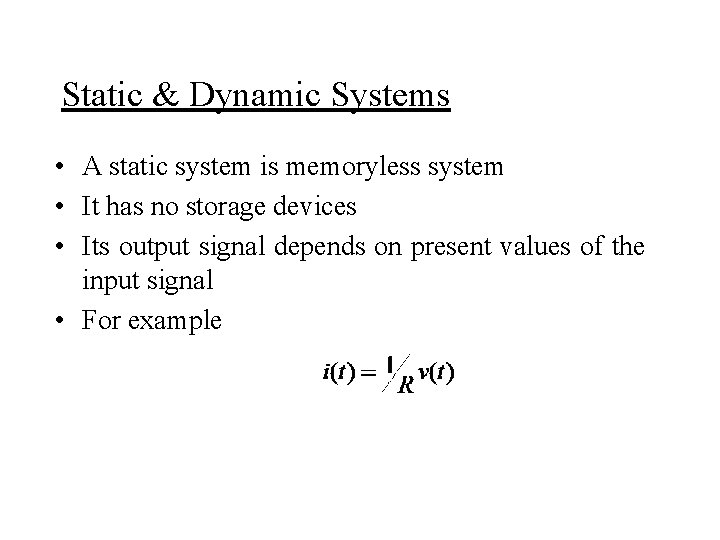
Static & Dynamic Systems • A static system is memoryless system • It has no storage devices • Its output signal depends on present values of the input signal • For example
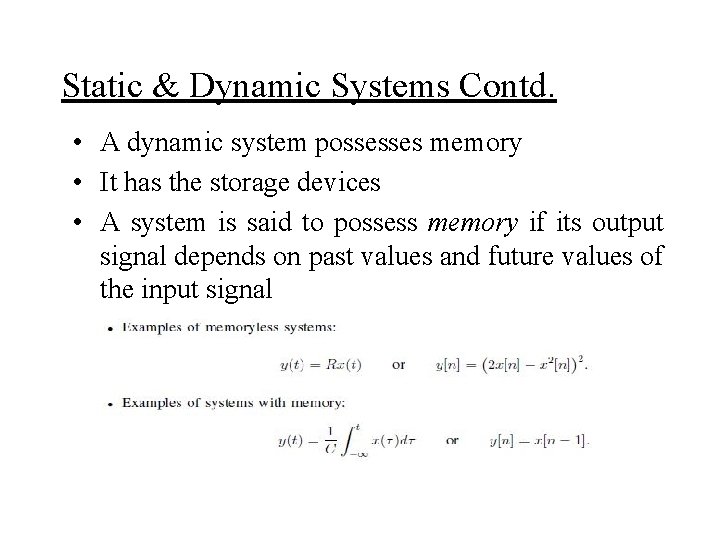
Static & Dynamic Systems Contd. • A dynamic system possesses memory • It has the storage devices • A system is said to possess memory if its output signal depends on past values and future values of the input signal
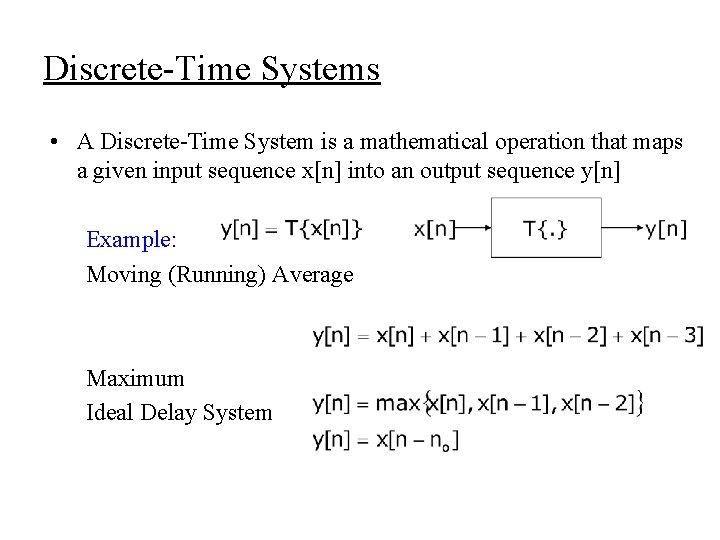
Discrete-Time Systems • A Discrete-Time System is a mathematical operation that maps a given input sequence x[n] into an output sequence y[n] Example: Moving (Running) Average Maximum Ideal Delay System
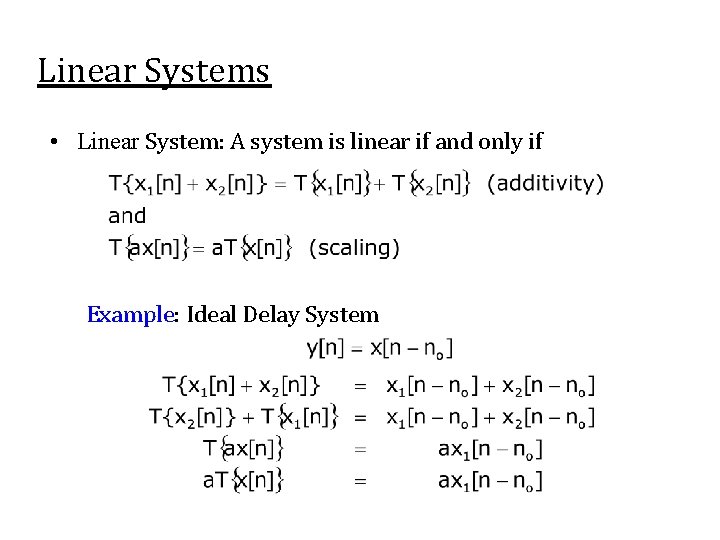
Linear Systems • Linear System: A system is linear if and only if Example: Ideal Delay System
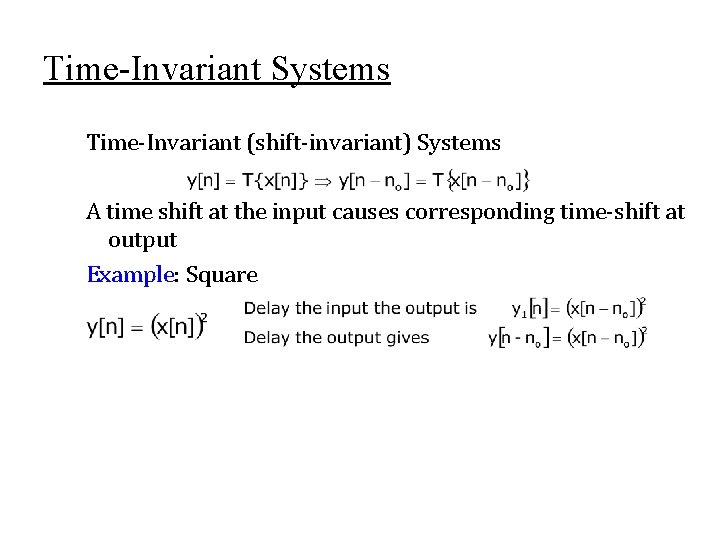
Time-Invariant Systems Time-Invariant (shift-invariant) Systems A time shift at the input causes corresponding time-shift at output Example: Square
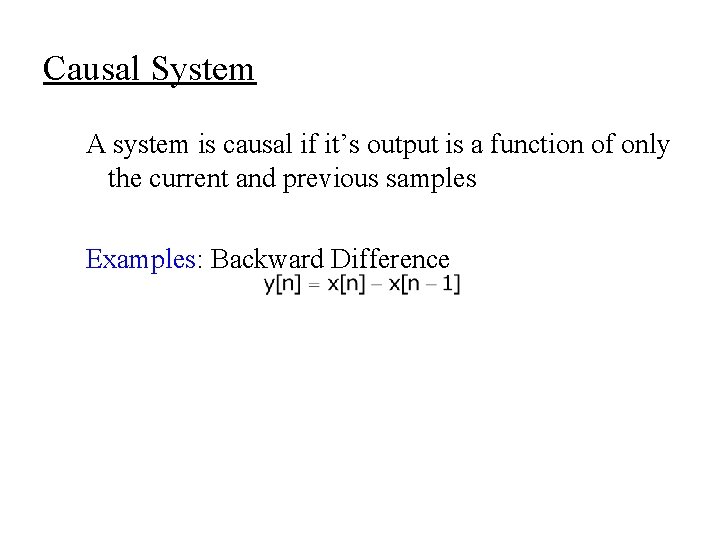
Causal System A system is causal if it’s output is a function of only the current and previous samples Examples: Backward Difference
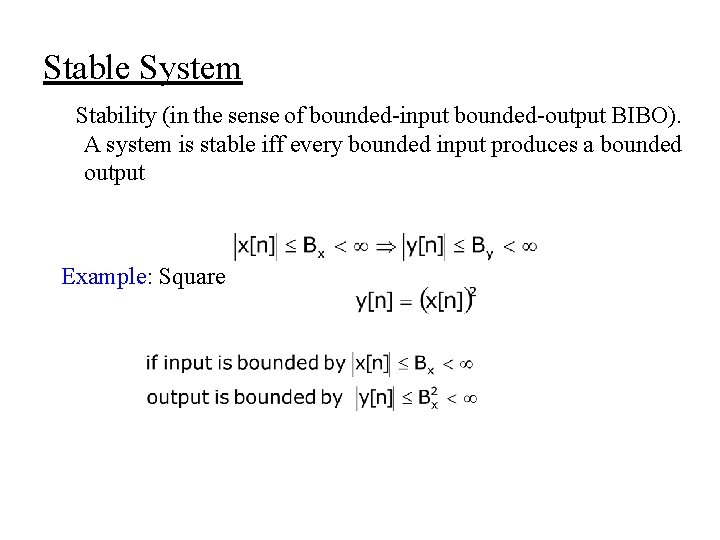
Stable System Stability (in the sense of bounded-input bounded-output BIBO). A system is stable iff every bounded input produces a bounded output Example: Square
Fourier Series Definition: • A Fourier Series is an accurate representation of a periodic signal and consists of the sum of sinusoids at the fundamental and harmonic frequencies. • Fourier Series are classified into, 1. Trignometric Fourier Series 2. Exponential Fourier Series
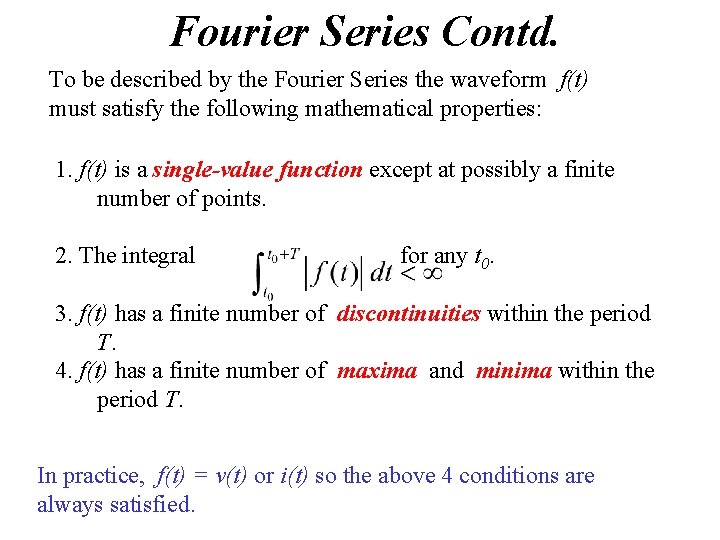
Fourier Series Contd. To be described by the Fourier Series the waveform f(t) must satisfy the following mathematical properties: 1. f(t) is a single-value function except at possibly a finite number of points. 2. The integral for any t 0. 3. f(t) has a finite number of discontinuities within the period T. 4. f(t) has a finite number of maxima and minima within the period T. In practice, f(t) = v(t) or i(t) so the above 4 conditions are always satisfied.
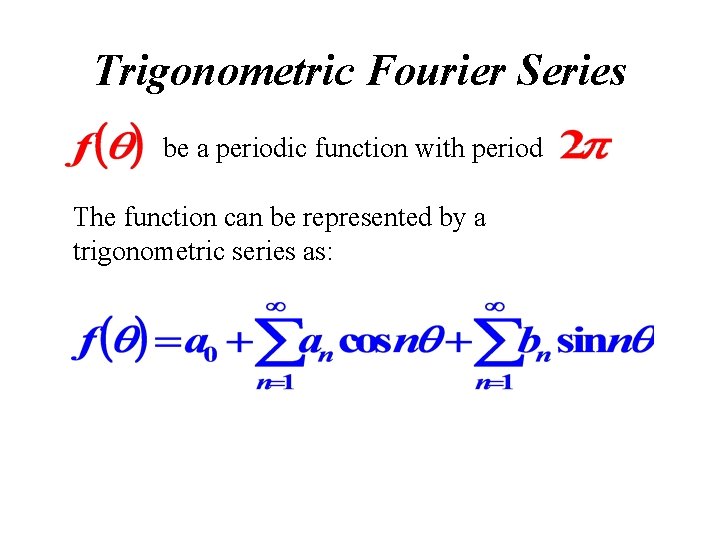
Trigonometric Fourier Series be a periodic function with period The function can be represented by a trigonometric series as:
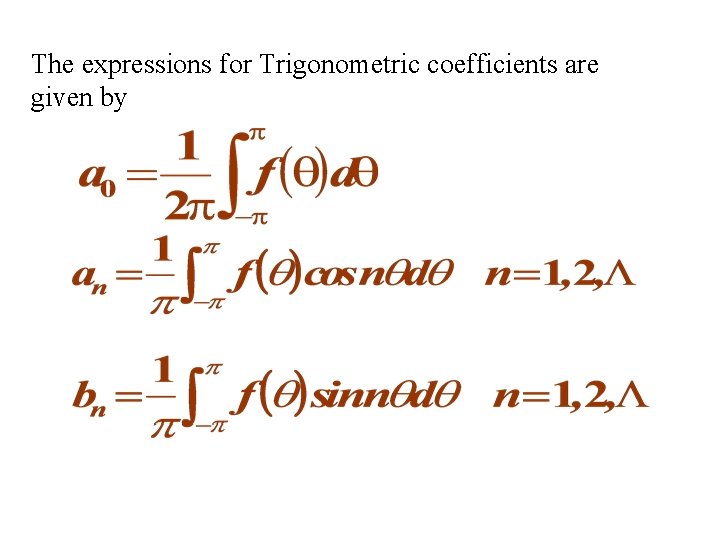
The expressions for Trigonometric coefficients are given by
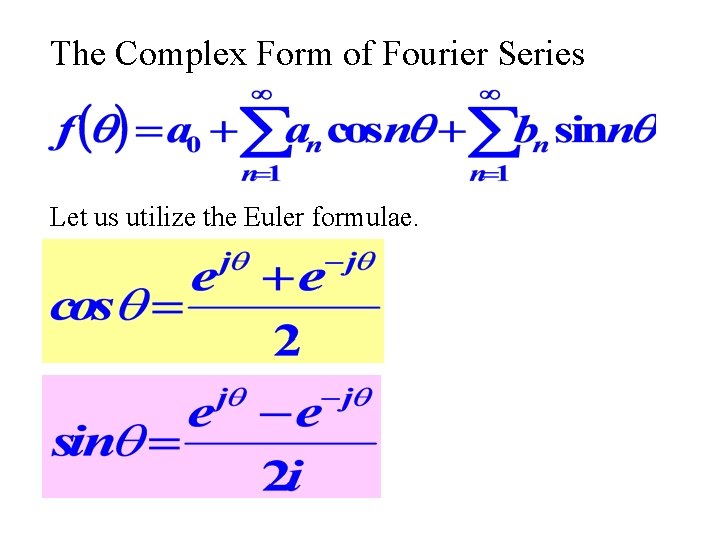
The Complex Form of Fourier Series Let us utilize the Euler formulae.
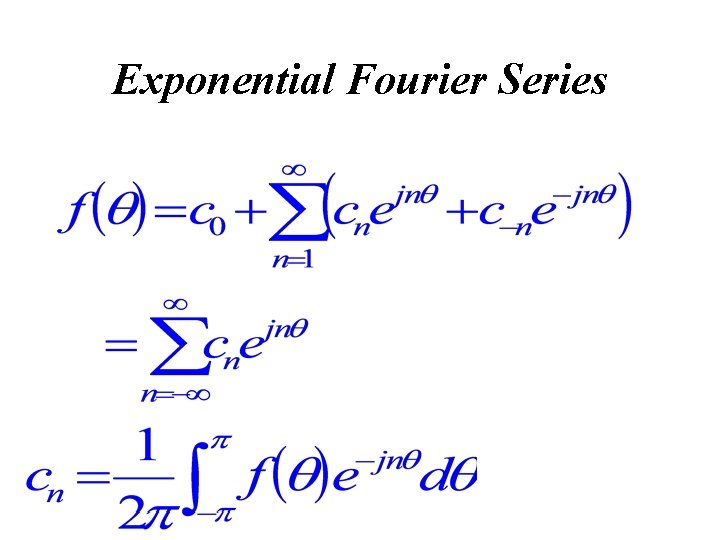
Exponential Fourier Series