
United States Since 1945 Unit One 1950 s
- Slides: 55
+ United States Since 1945 Unit One
+ 1950 s: Truman & Eisenhower Section One
+ Setting the Stage The detonation of the atomic bomb and the end of World War II led to disagreements in global policy, and a shift in American attitudes toward the Soviet Union. Shortly before the end of the war, US President Franklin Delano Roosevelt died from a stroke, and his vice president, Harry S. Truman, became president during that difficult time and oversaw the end of World War II and the start of the Cold War. Truman was active in foreign policy in his first 5 years in office. He made the decision to drop the atomic bombs on Hiroshima and Nagasaki and he helped to found the United Nations. Truman was strongly anti-communist and suspicious of Stalin in the Soviet Union and his implementation of the Truman Doctrine and Marshall Plan, as well as his decision to enter into the Korean War, were examples of his willingness to help support anti-communist efforts.
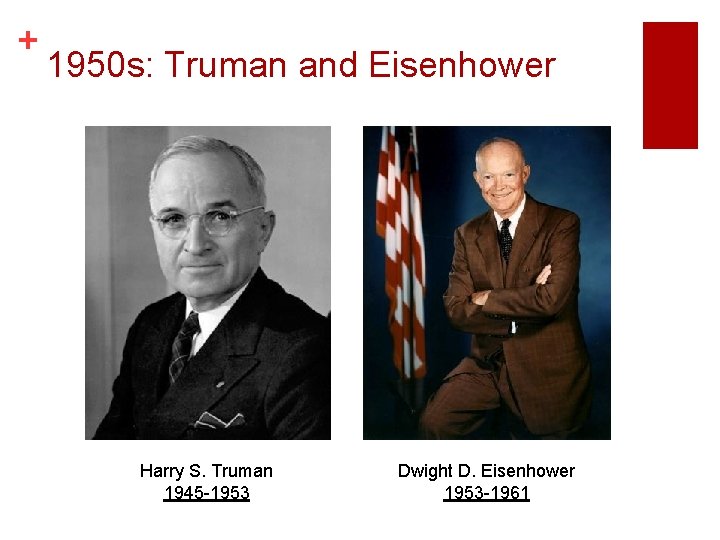
+ 1950 s: Truman and Eisenhower Harry S. Truman 1945 -1953 Dwight D. Eisenhower 1953 -1961
+ Truman’s Foreign Policy n Truman took office in April 1945, just before Germany surrendered in World War II n In August 1945, Truman made the decision to drop two atomic bombs – on Hiroshima and Nagasaki n As World War II ended, the Cold War began, and the majority of Truman’s foreign policy centered around fighting communism TRUMAN DOCTRINE: promise by Truman to help any country resisting Communism MARSHALL PLAN: European assistance program to help rebuild n In 1950, Truman sent US troops into Korea to fight the Korean War in order to stop communism from spreading further
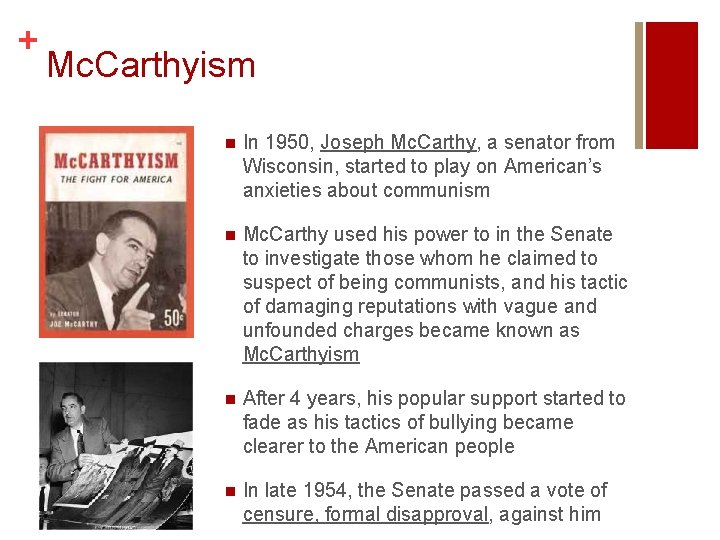
+ Mc. Carthyism n In 1950, Joseph Mc. Carthy, a senator from Wisconsin, started to play on American’s anxieties about communism n Mc. Carthy used his power to in the Senate to investigate those whom he claimed to suspect of being communists, and his tactic of damaging reputations with vague and unfounded charges became known as Mc. Carthyism n After 4 years, his popular support started to fade as his tactics of bullying became clearer to the American people n In late 1954, the Senate passed a vote of censure, formal disapproval, against him
+ Truman’s Domestic Policy n Truman was a democrat who faced significant opposition from a conservative Congress n Domestically, Truman worked to continue FDR’s New Deal Policies FAIR DEAL: program set forth by Truman to provide every American a fair deal from the government n Under the Fair Deal, Congress raised the legal minimum wage to $0. 75/hour, expanded Social Security and passed the National Housing Act of 1949, which provided for the construction of more than 800, 000 units of low-income housing
+ Eisenhower’s Foreign Policy n By the end of 1952, many Americans were ready for a change in leadership n Dwight D. Eisenhower, the general who had organized the D-Day Invasion, became President in 1953 n Eisenhower ended the Korean War n He formed a “New Look” defense policy to avoid spending too much money on costly wars in which he stockpiled nuclear weapons n He used hidden operations conducted by the CIA to fight communism in developing nations – including Iran and Guatemala n Under his leadership, Congress created NASA to coordinate research in rocket science and space exploration NASA: National Aeronautics and Space Administration
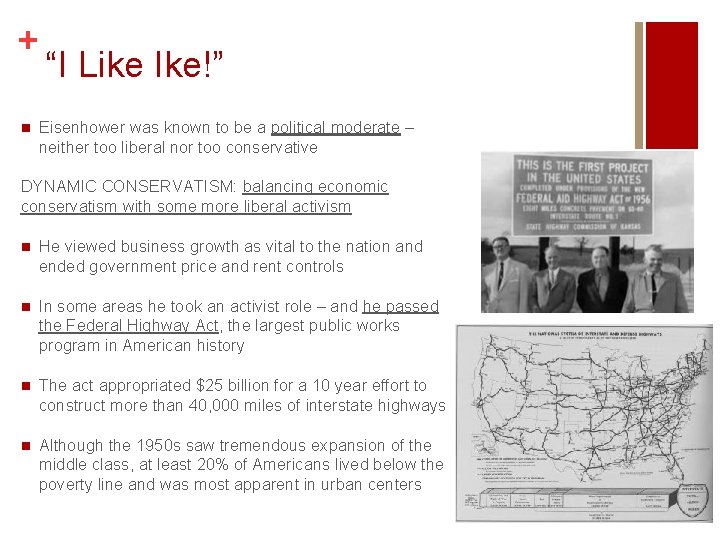
+ n “I Like Ike!” Eisenhower was known to be a political moderate – neither too liberal nor too conservative DYNAMIC CONSERVATISM: balancing economic conservatism with some more liberal activism n He viewed business growth as vital to the nation and ended government price and rent controls n In some areas he took an activist role – and he passed the Federal Highway Act, the largest public works program in American history n The act appropriated $25 billion for a 10 year effort to construct more than 40, 000 miles of interstate highways n Although the 1950 s saw tremendous expansion of the middle class, at least 20% of Americans lived below the poverty line and was most apparent in urban centers
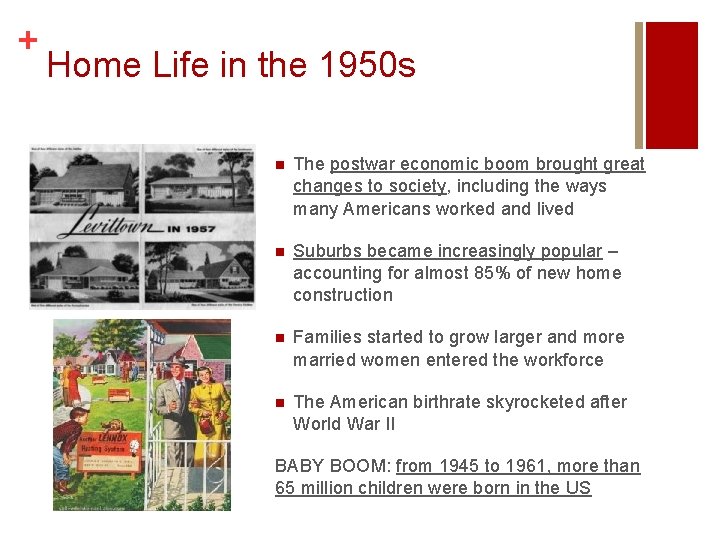
+ Home Life in the 1950 s n The postwar economic boom brought great changes to society, including the ways many Americans worked and lived n Suburbs became increasingly popular – accounting for almost 85% of new home construction n Families started to grow larger and more married women entered the workforce n The American birthrate skyrocketed after World War II BABY BOOM: from 1945 to 1961, more than 65 million children were born in the US
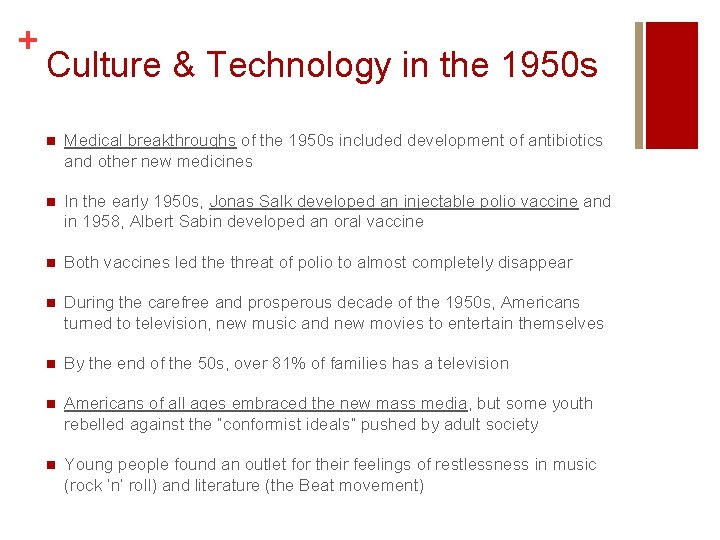
+ Culture & Technology in the 1950 s n Medical breakthroughs of the 1950 s included development of antibiotics and other new medicines n In the early 1950 s, Jonas Salk developed an injectable polio vaccine and in 1958, Albert Sabin developed an oral vaccine n Both vaccines led the threat of polio to almost completely disappear n During the carefree and prosperous decade of the 1950 s, Americans turned to television, new music and new movies to entertain themselves n By the end of the 50 s, over 81% of families has a television n Americans of all ages embraced the new mass media, but some youth rebelled against the “conformist ideals” pushed by adult society n Young people found an outlet for their feelings of restlessness in music (rock ’n’ roll) and literature (the Beat movement)
+ 1960 s: Kennedy & Johnson Section Two
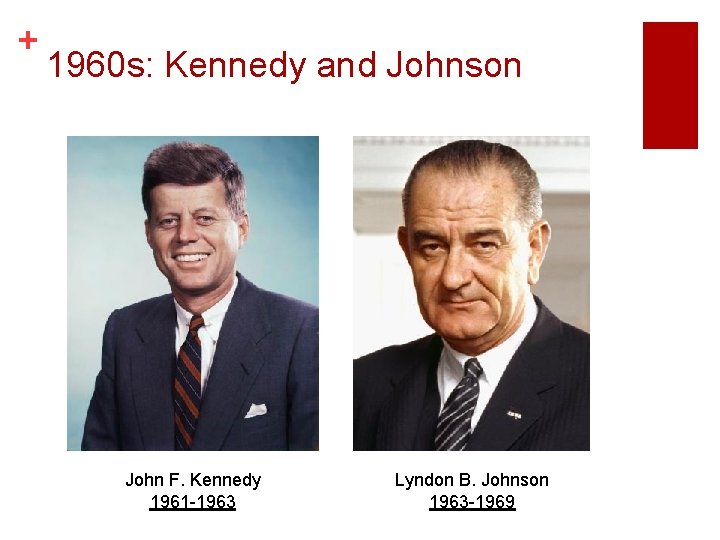
+ 1960 s: Kennedy and Johnson John F. Kennedy 1961 -1963 Lyndon B. Johnson 1963 -1969
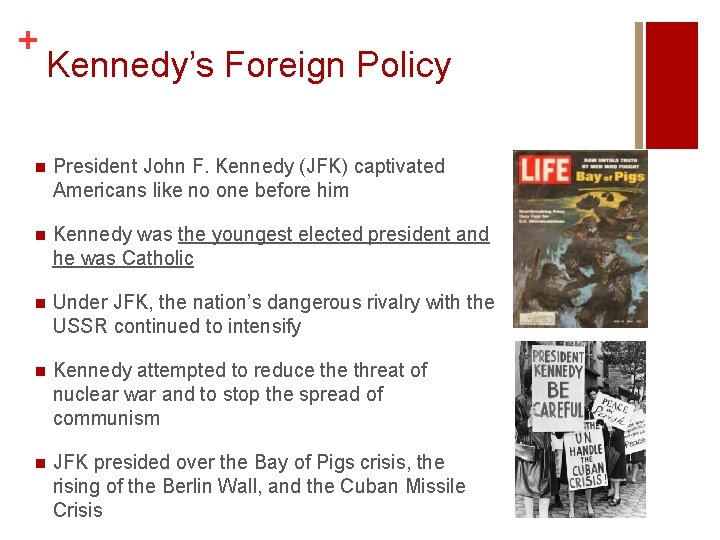
+ Kennedy’s Foreign Policy n President John F. Kennedy (JFK) captivated Americans like no one before him n Kennedy was the youngest elected president and he was Catholic n Under JFK, the nation’s dangerous rivalry with the USSR continued to intensify n Kennedy attempted to reduce threat of nuclear war and to stop the spread of communism n JFK presided over the Bay of Pigs crisis, the rising of the Berlin Wall, and the Cuban Missile Crisis
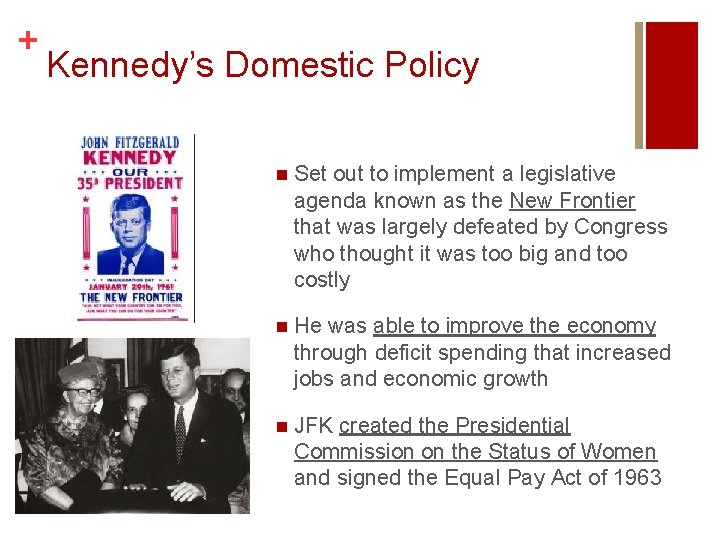
+ Kennedy’s Domestic Policy n Set out to implement a legislative agenda known as the New Frontier that was largely defeated by Congress who thought it was too big and too costly n He was able to improve the economy through deficit spending that increased jobs and economic growth n JFK created the Presidential Commission on the Status of Women and signed the Equal Pay Act of 1963
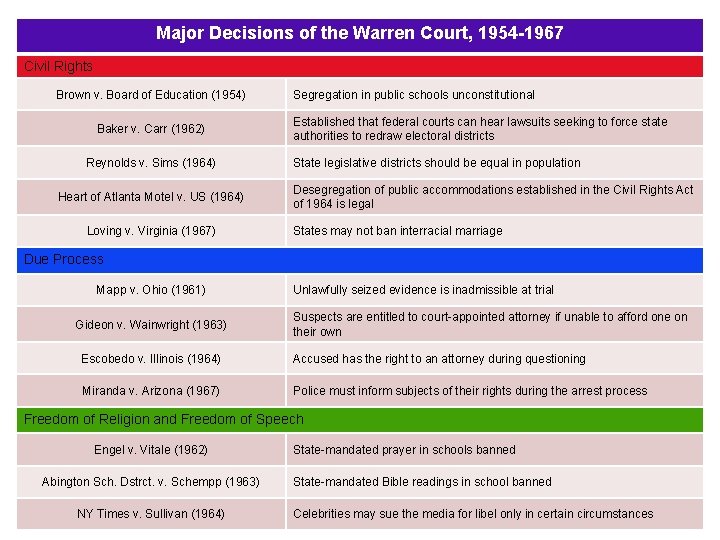
+ Major Decisions of the Warren Court, 1954 -1967 Civil Rights Brown v. Board of Education (1954) Baker v. Carr (1962) Reynolds v. Sims (1964) Heart of Atlanta Motel v. US (1964) Loving v. Virginia (1967) Segregation in public schools unconstitutional Established that federal courts can hear lawsuits seeking to force state authorities to redraw electoral districts State legislative districts should be equal in population Desegregation of public accommodations established in the Civil Rights Act of 1964 is legal States may not ban interracial marriage Due Process Mapp v. Ohio (1961) Gideon v. Wainwright (1963) Unlawfully seized evidence is inadmissible at trial Suspects are entitled to court-appointed attorney if unable to afford one on their own Escobedo v. Illinois (1964) Accused has the right to an attorney during questioning Miranda v. Arizona (1967) Police must inform subjects of their rights during the arrest process Freedom of Religion and Freedom of Speech Engel v. Vitale (1962) Abington Sch. Dstrct. v. Schempp (1963) NY Times v. Sullivan (1964) State-mandated prayer in schools banned State-mandated Bible readings in school banned Celebrities may sue the media for libel only in certain circumstances
+ Assassination of JFK n On November 22, 1963, JFK and his wife Jacqueline Kennedy traveled to Texas for a series of political appearances n As the presidential motorcade rode slowly through the crowded streets of Dallas, gunfire rang out n Someone shot JFK twice – once in the throat and once in the head n Lee Harvey Oswald was arrested for the crime, but was killed by Jack Ruby two days later n A report was commissioned by Chief Justice Earl Warren, known as the Warren Commission, to investigate what had happened, but the report left many questions unanswered and theories about a conspiracy to kill JFK have persisted
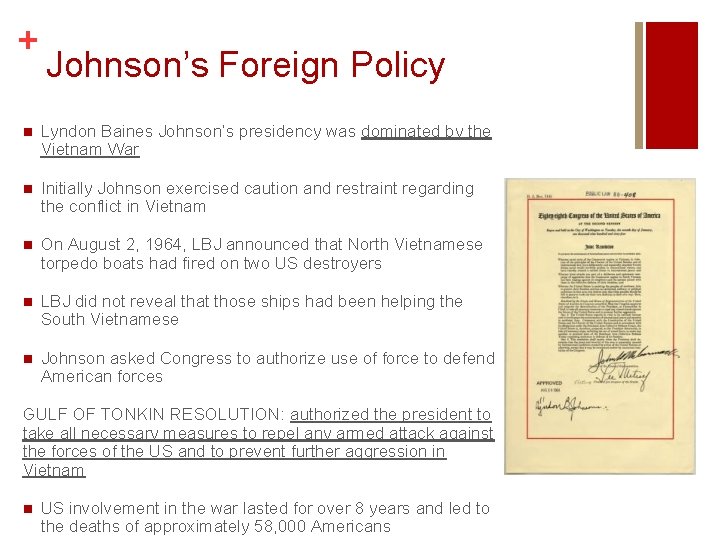
+ Johnson’s Foreign Policy n Lyndon Baines Johnson’s presidency was dominated by the Vietnam War n Initially Johnson exercised caution and restraint regarding the conflict in Vietnam n On August 2, 1964, LBJ announced that North Vietnamese torpedo boats had fired on two US destroyers n LBJ did not reveal that those ships had been helping the South Vietnamese n Johnson asked Congress to authorize use of force to defend American forces GULF OF TONKIN RESOLUTION: authorized the president to take all necessary measures to repel any armed attack against the forces of the US and to prevent further aggression in Vietnam n US involvement in the war lasted for over 8 years and led to the deaths of approximately 58, 000 Americans
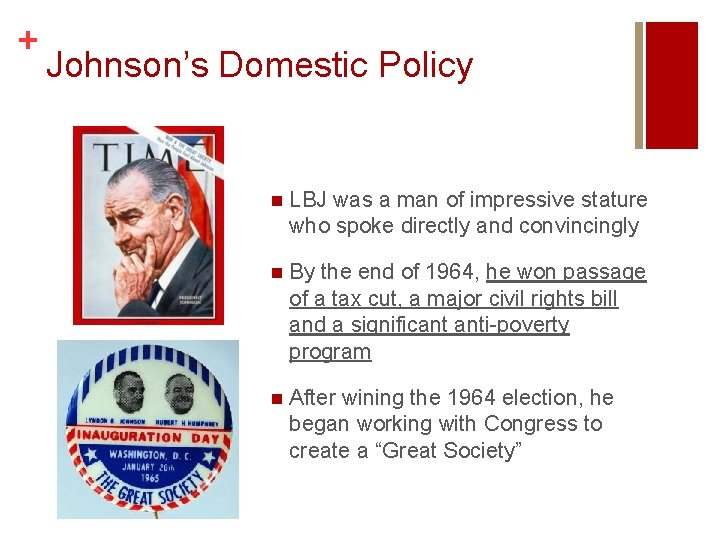
+ Johnson’s Domestic Policy n LBJ was a man of impressive stature who spoke directly and convincingly n By the end of 1964, he won passage of a tax cut, a major civil rights bill and a significant anti-poverty program n After wining the 1964 election, he began working with Congress to create a “Great Society”
+ The Great Society GREAT SOCIETY: Johnson’s vision of the more perfect and equitable society the US could and should become n The Great Society focused on health and welfare, education, the war on poverty and consumer and environmental protection n Medicare and Medicaid were among the most significant programs of the Great Society MEDICARE: established a comprehensive health insurance program for all elderly people; financed through Social Security MEDICAID: provided health and medical assistance to low-income families; funded by federal and state governments n Project Head Start funded preschool programs and the Office of Economic Opportunity oversaw programs to improve life in inner cities n The Great Society programs touched nearly every aspect of American life and improved thousands if not millions of lives
+ Civil Rights Movement Section Three
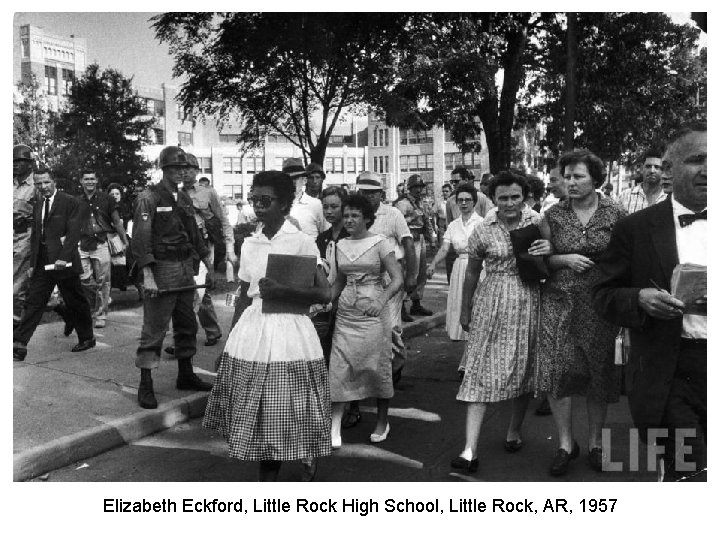
+ Elizabeth Eckford, Little Rock High School, Little Rock, AR, 1957
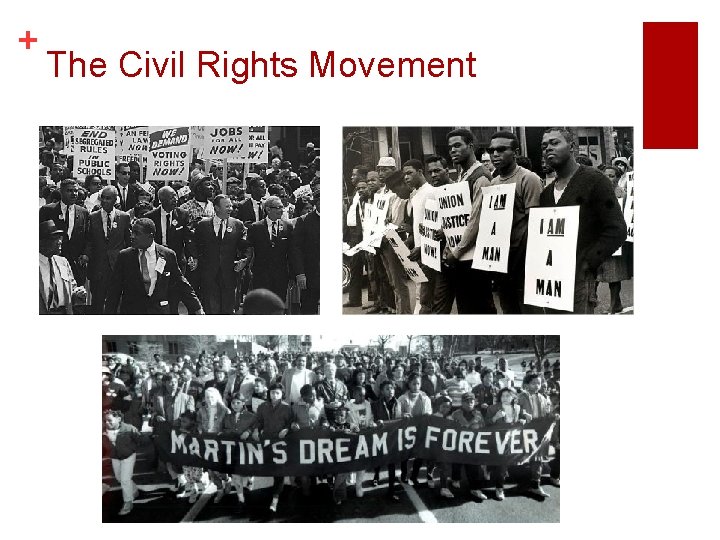
+ The Civil Rights Movement
+ Setting the Stage n After World War II, African Americans and other supporters of civil rights challenged segregation in the United States n Struggle against segregation and inequality was not easy n In 1896, in Plessy v. Ferguson, the Supreme Court declared segregation to be constitutional under the “separate-but-equal” doctrine n Areas without laws requiring segregation often had de facto segregation – segregation by custom and traditions
+ Key Groups in the Movement n Founded in 1909, the NAACP supported court cases intended to overturn segregations NAACP: National Association for the Advancement of Colored People n Over the years, the NAACP achieved some key victories including keeping juries from excluding African Americans and making it illegal for state law schools to deny admission to qualified African American applicants n Founded in 1942, CORE worked to help desegregate public facilities CORE: Congress of Racial Equality n Over the years, CORE used sit-ins to successfully integrate any public facilities including restaurants and theaters in Chicago, Detroit, Denver and Syracuse
+ Key Civil Rights Movement Vocab FREEDOM RIDERS: name given to group of people who traveled to the South in 1961 to protest South’s refusal to integrate bus terminals FILIBUSTER: attempt to kill a bill by having a group of senators take turns speaking continuously so that the vote cannot take place CLOTURE: motion that ends debate and calls for an immediate vote, possible in the US Senate by a vote of 60/100 POLL TAX: tax paid in order to vote in an election PREJUDICE: preconceived judgment or opinion, usually based on limited information RACISM: system of advantage based on race BLACK POWER: mobilization of the political and economic power of African Americans, especially to compel respect for their rights and improve their condition
+ 1970 s: Nixon, Ford & Carter Section Four
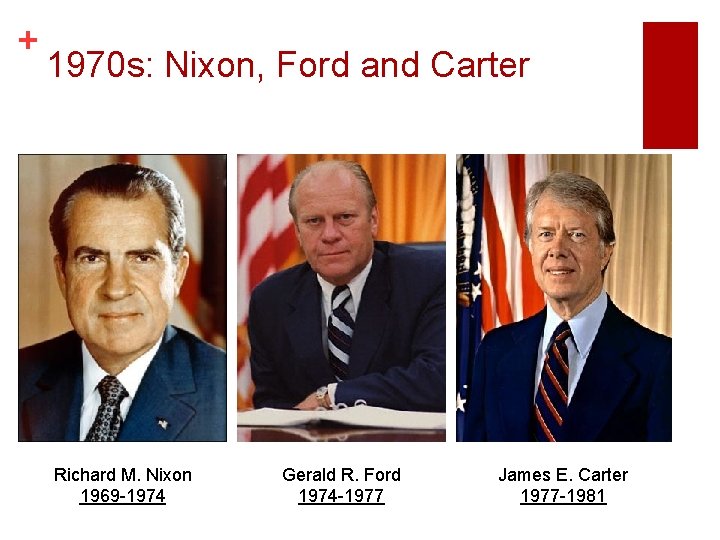
+ 1970 s: Nixon, Ford and Carter Richard M. Nixon 1969 -1974 Gerald R. Ford 1974 -1977 James E. Carter 1977 -1981
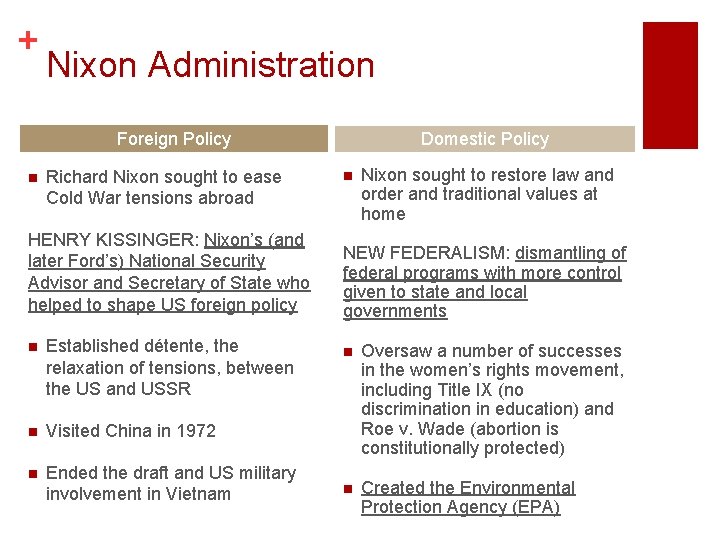
+ Nixon Administration Foreign Policy n Richard Nixon sought to ease Cold War tensions abroad HENRY KISSINGER: Nixon’s (and later Ford’s) National Security Advisor and Secretary of State who helped to shape US foreign policy n Established détente, the relaxation of tensions, between the US and USSR n Visited China in 1972 n Ended the draft and US military involvement in Vietnam Domestic Policy n Nixon sought to restore law and order and traditional values at home NEW FEDERALISM: dismantling of federal programs with more control given to state and local governments n Oversaw a number of successes in the women’s rights movement, including Title IX (no discrimination in education) and Roe v. Wade (abortion is constitutionally protected) n Created the Environmental Protection Agency (EPA)
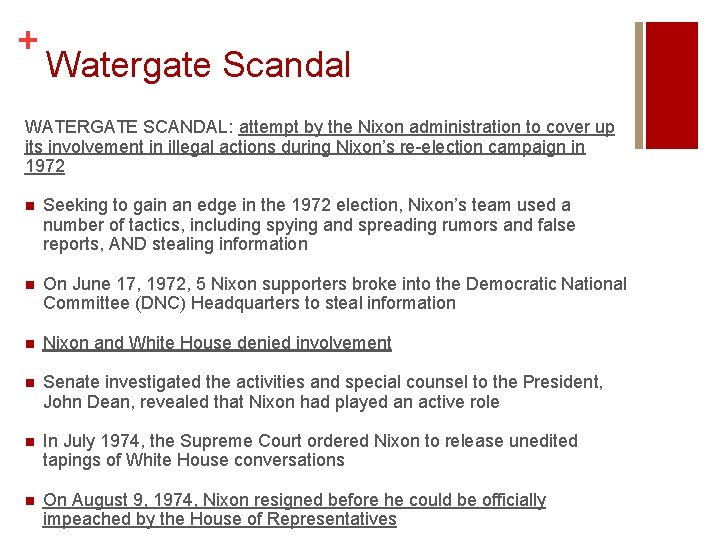
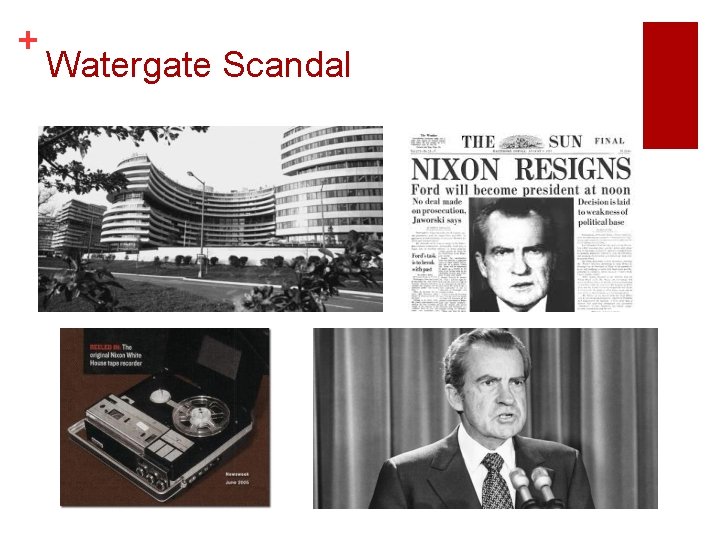
+ Watergate Scandal WATERGATE SCANDAL: attempt by the Nixon administration to cover up its involvement in illegal actions during Nixon’s re-election campaign in 1972 n Seeking to gain an edge in the 1972 election, Nixon’s team used a number of tactics, including spying and spreading rumors and false reports, AND stealing information n On June 17, 1972, 5 Nixon supporters broke into the Democratic National Committee (DNC) Headquarters to steal information n Nixon and White House denied involvement n Senate investigated the activities and special counsel to the President, John Dean, revealed that Nixon had played an active role n In July 1974, the Supreme Court ordered Nixon to release unedited tapings of White House conversations n On August 9, 1974, Nixon resigned before he could be officially impeached by the House of Representatives
+ Watergate Scandal
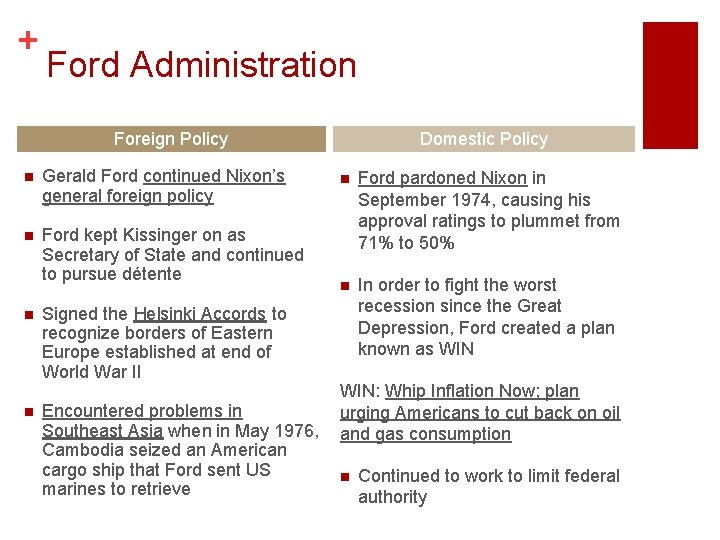
+ Ford Administration Foreign Policy n Gerald Ford continued Nixon’s general foreign policy n Ford kept Kissinger on as Secretary of State and continued to pursue détente n n Signed the Helsinki Accords to recognize borders of Eastern Europe established at end of World War II Encountered problems in Southeast Asia when in May 1976, Cambodia seized an American cargo ship that Ford sent US marines to retrieve Domestic Policy n Ford pardoned Nixon in September 1974, causing his approval ratings to plummet from 71% to 50% n In order to fight the worst recession since the Great Depression, Ford created a plan known as WIN: Whip Inflation Now; plan urging Americans to cut back on oil and gas consumption n Continued to work to limit federal authority
+ Carter Administration Foreign Policy n Jimmy Carter’s foreign policy was clearly defined n Moved control of the Panama Canal to the Panamanians through 2 Panama Canal treaties n Détente collapsed under Carter as he strongly condemned the USSR for violation of human rights n In 1978, Carter helped to broker a historic Middle East peace treaty, the Camp David Accords n Unfortunately, just months after the CDA, Carter encountered a major crisis in Iran – the Iran Hostage Crisis Domestic Policy n Carter devoted most of his domestic agenda to trying to fix the economy n He tried a number of different strategies, but ultimately none of his efforts succeeded n Carter created the Department of Energy as part of a national energy program to conserve oil and to promote the use of coal and renewable energy sources n Also created the Department of Education
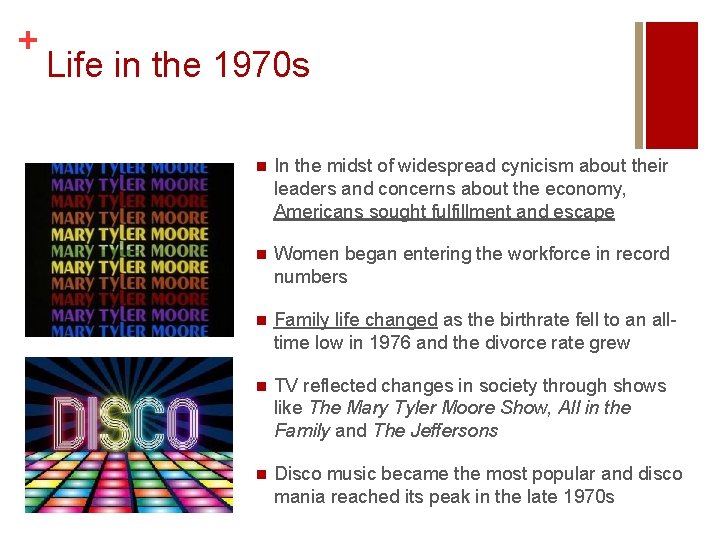
+ Life in the 1970 s n In the midst of widespread cynicism about their leaders and concerns about the economy, Americans sought fulfillment and escape n Women began entering the workforce in record numbers n Family life changed as the birthrate fell to an alltime low in 1976 and the divorce rate grew n TV reflected changes in society through shows like The Mary Tyler Moore Show, All in the Family and The Jeffersons n Disco music became the most popular and disco mania reached its peak in the late 1970 s
+ 1980 s: Reagan Section Five
+ The New Conservatism n Today, people who identify as liberal generally believe that the government should regulate the economy to protect people from power of large corporations and should play a large role in helping disadvantaged Americans, but feel that the government should not regular social behavior n Unlike liberals, conservatives today generally distrust the power of government – especially the federal government – and believes that government should not regulate the economy and generally oppose government programs that transfer wealth from the rich to those who have less, and many conservatives today believe that religious faith is vitally important in sustaining society n Conservatives gained support during the 1960 s and 1970 s, especially in suburban areas and in the South n By the end of the 1970 s, the new conservative coalition of voters had begun to come together and for some, new conservatism’s most prominent spokesperson, Ronald Reagan, offered hope to a nation in distress
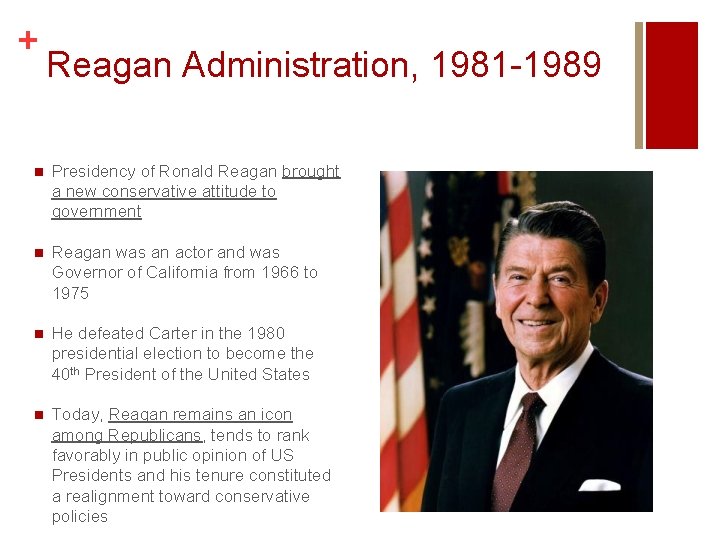
+ Reagan Administration, 1981 -1989 n Presidency of Ronald Reagan brought a new conservative attitude to government n Reagan was an actor and was Governor of California from 1966 to 1975 n He defeated Carter in the 1980 presidential election to become the 40 th President of the United States n Today, Reagan remains an icon among Republicans, tends to rank favorably in public opinion of US Presidents and his tenure constituted a realignment toward conservative policies
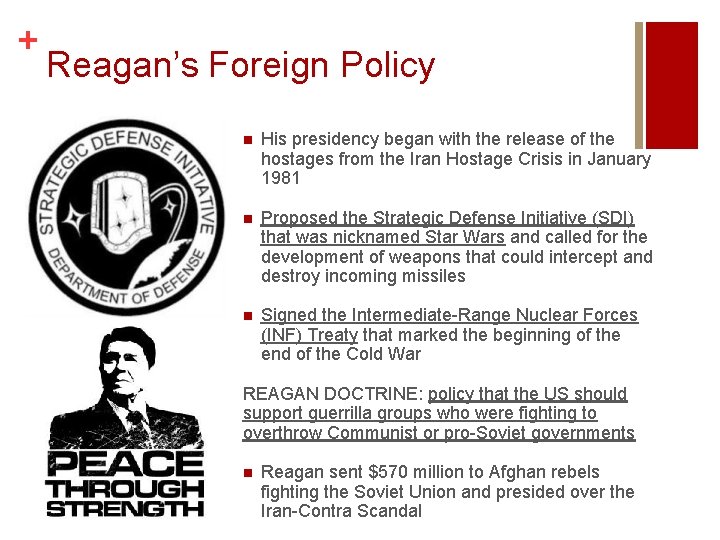
+ Reagan’s Foreign Policy n His presidency began with the release of the hostages from the Iran Hostage Crisis in January 1981 n Proposed the Strategic Defense Initiative (SDI) that was nicknamed Star Wars and called for the development of weapons that could intercept and destroy incoming missiles n Signed the Intermediate-Range Nuclear Forces (INF) Treaty that marked the beginning of the end of the Cold War REAGAN DOCTRINE: policy that the US should support guerrilla groups who were fighting to overthrow Communist or pro-Soviet governments n Reagan sent $570 million to Afghan rebels fighting the Soviet Union and presided over the Iran-Contra Scandal
+ Iran-Contra Affair n Political scandal in the US that occurred during Reagan’s 2 nd term n Senior officials secretly organized the sale of weapons to Iran (which was the subject of an arms embargo at the time) n The goal was for Iran to release hostages and to fund the Contras in Nicaragua n The plan was that Israel would ship weapons to Iran, then the US would resupply Israel and receive the Israeli payment n Iran would then work to release US hostages and a portion of the proceeds from the sale would be diverted to fund the Contras n Information was revealed to the public in 1986 & Reagan took responsibility for it in 1987 n Later, Reagan was found to have approved the sale of arms to Iran, but to not have known the full extent of the program
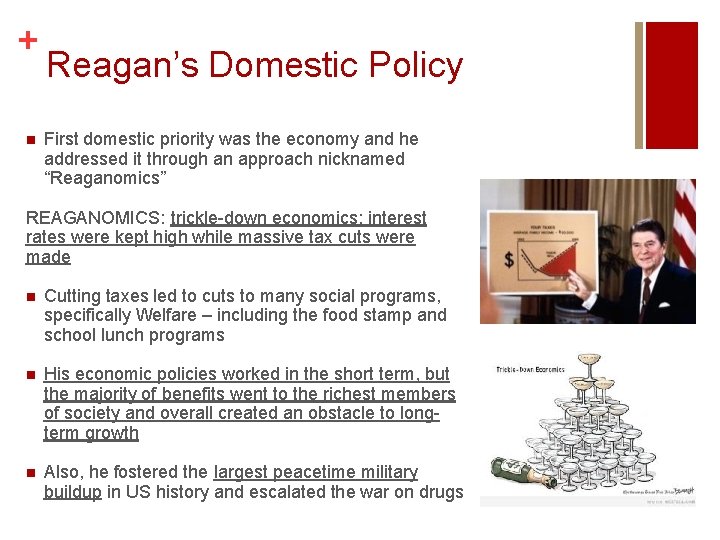
+ n Reagan’s Domestic Policy First domestic priority was the economy and he addressed it through an approach nicknamed “Reaganomics” REAGANOMICS: trickle-down economics; interest rates were kept high while massive tax cuts were made n Cutting taxes led to cuts to many social programs, specifically Welfare – including the food stamp and school lunch programs n His economic policies worked in the short term, but the majority of benefits went to the richest members of society and overall created an obstacle to longterm growth n Also, he fostered the largest peacetime military buildup in US history and escalated the war on drugs
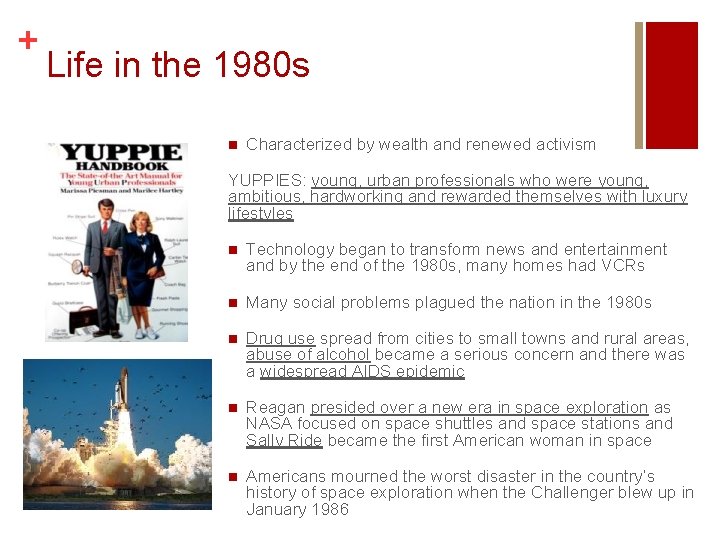
+ Life in the 1980 s n Characterized by wealth and renewed activism YUPPIES: young, urban professionals who were young, ambitious, hardworking and rewarded themselves with luxury lifestyles n Technology began to transform news and entertainment and by the end of the 1980 s, many homes had VCRs n Many social problems plagued the nation in the 1980 s n Drug use spread from cities to small towns and rural areas, abuse of alcohol became a serious concern and there was a widespread AIDS epidemic n Reagan presided over a new era in space exploration as NASA focused on space shuttles and space stations and Sally Ride became the first American woman in space n Americans mourned the worst disaster in the country’s history of space exploration when the Challenger blew up in January 1986
+ 1990 s: Bush and Clinton Section Six
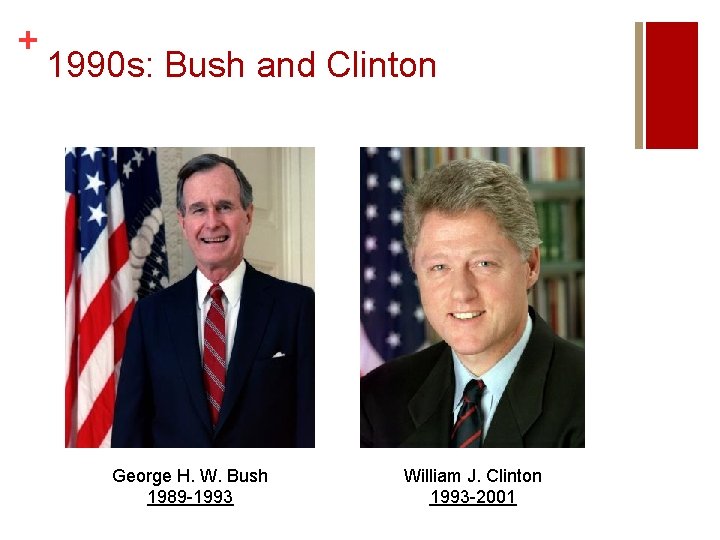
+ 1990 s: Bush and Clinton George H. W. Bush 1989 -1993 William J. Clinton 1993 -2001
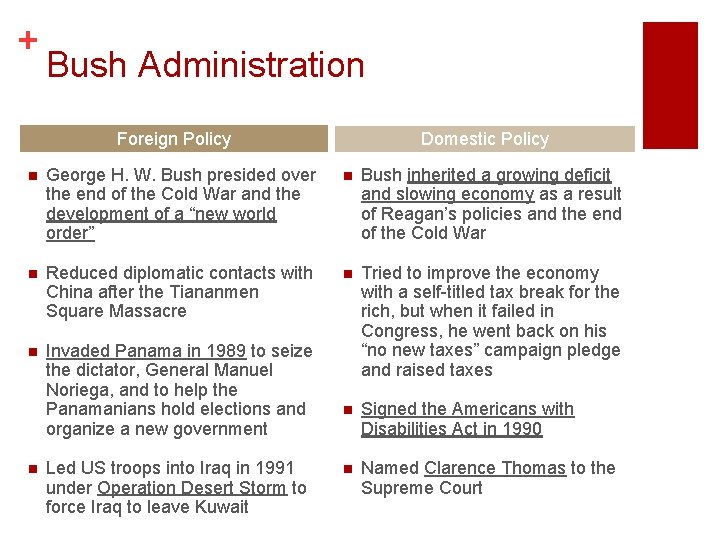
+ Bush Administration Foreign Policy Domestic Policy n George H. W. Bush presided over the end of the Cold War and the development of a “new world order” n Bush inherited a growing deficit and slowing economy as a result of Reagan’s policies and the end of the Cold War n Reduced diplomatic contacts with China after the Tiananmen Square Massacre n n Invaded Panama in 1989 to seize the dictator, General Manuel Noriega, and to help the Panamanians hold elections and organize a new government Tried to improve the economy with a self-titled tax break for the rich, but when it failed in Congress, he went back on his “no new taxes” campaign pledge and raised taxes n Signed the Americans with Disabilities Act in 1990 n Named Clarence Thomas to the Supreme Court n Led US troops into Iraq in 1991 under Operation Desert Storm to force Iraq to leave Kuwait
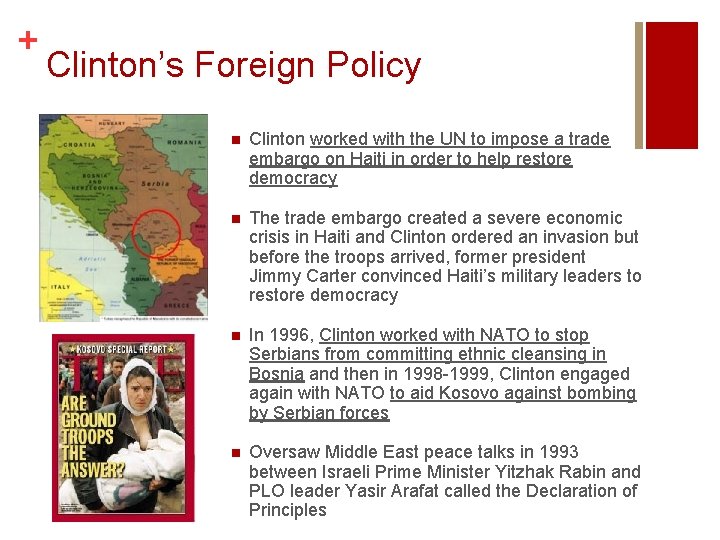
+ Clinton’s Foreign Policy n Clinton worked with the UN to impose a trade embargo on Haiti in order to help restore democracy n The trade embargo created a severe economic crisis in Haiti and Clinton ordered an invasion but before the troops arrived, former president Jimmy Carter convinced Haiti’s military leaders to restore democracy n In 1996, Clinton worked with NATO to stop Serbians from committing ethnic cleansing in Bosnia and then in 1998 -1999, Clinton engaged again with NATO to aid Kosovo against bombing by Serbian forces n Oversaw Middle East peace talks in 1993 between Israeli Prime Minister Yitzhak Rabin and PLO leader Yasir Arafat called the Declaration of Principles
+ Clinton’s Domestic Policy n Clinton put forth an ambitious program to focus on 5 major areas: economy, family, education, crime and health care n To better the economy, Clinton worked to lower interest rates in order to reduce the federal deficit and to do this without cutting entitlement programs, Clinton raised taxes on middle- and upper-income Americans n Clinton’s economic plan worked to erase the deficit and better the economy n Bill Clinton, with the help of his wife, Hillary Clinton, worked to create a plan for universal health care but it did not pass in Congress n Clinton was able to pass the Family Medical Leave Act and to create the Americorps program n Worked to pass the Brady Bill – gun control legislation that imposed a waiting period before people could buy handguns and required a background check
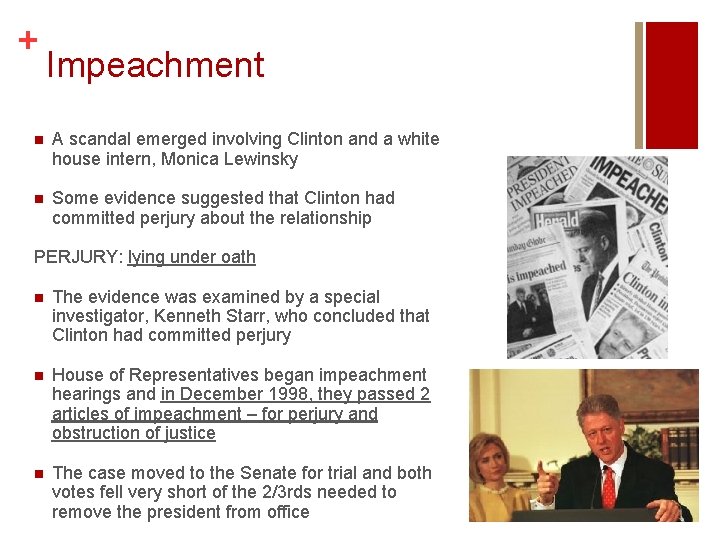
+ Impeachment n A scandal emerged involving Clinton and a white house intern, Monica Lewinsky n Some evidence suggested that Clinton had committed perjury about the relationship PERJURY: lying under oath n The evidence was examined by a special investigator, Kenneth Starr, who concluded that Clinton had committed perjury n House of Representatives began impeachment hearings and in December 1998, they passed 2 articles of impeachment – for perjury and obstruction of justice n The case moved to the Senate for trial and both votes fell very short of the 2/3 rds needed to remove the president from office
+ 2000 s – Today: Bush & Obama Section Seven
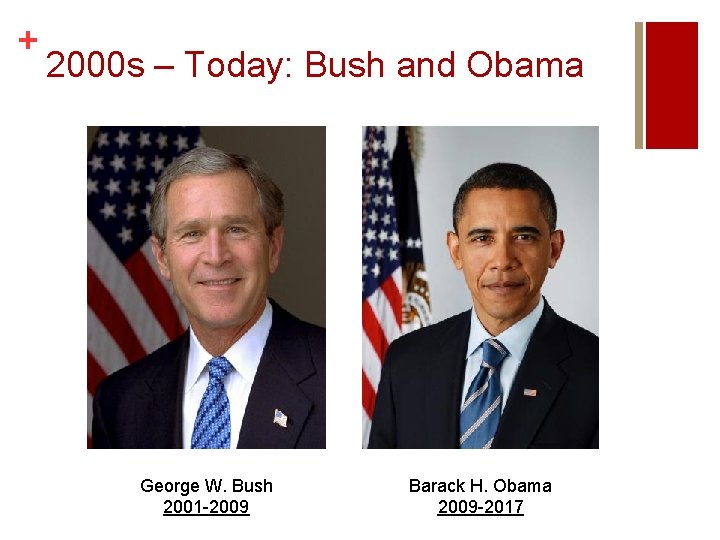
+ 2000 s – Today: Bush and Obama George W. Bush 2001 -2009 Barack H. Obama 2009 -2017
+ Bush v. Gore The 2000 presidential election was very close. Al Gore narrowly won the popular vote, but neither he nor George W. Bush won the over 270 electoral votes needed to win the election. The results in Florida were so close that ballots had to be recounted and thousands of ballots had to be thrown out because they were unclear when recounted by the vote counting machines. After counting, Bush was declared the winner by 537 votes, but Gore’s lawyers headed to court to argue that thousands of ballots were still uncounted. The Florida Supreme Court ordered all Florida counties to begin a hand recount of ballots rejected by the counting machines. During this time, Bush had requested the US Supreme Court to intervene. As the hand recounting began, the US Supreme Court came to a decision on Bush v. Gore. On December 12, 2000, the court ruled that the hand recounts in Florida violated the equal protection clause of the constitution because different vote counters used different standards, the recount did not treat all voters equally and, further, the court ruled that there was not enough time left to recount the votes by hand within the deadline. This ruling left Bush the certified winner in Florida, and gave him the electoral votes that he needed to win the presidential election. And so, on January 20, 2001, George W. Bush became the 43 rd president of the United States.
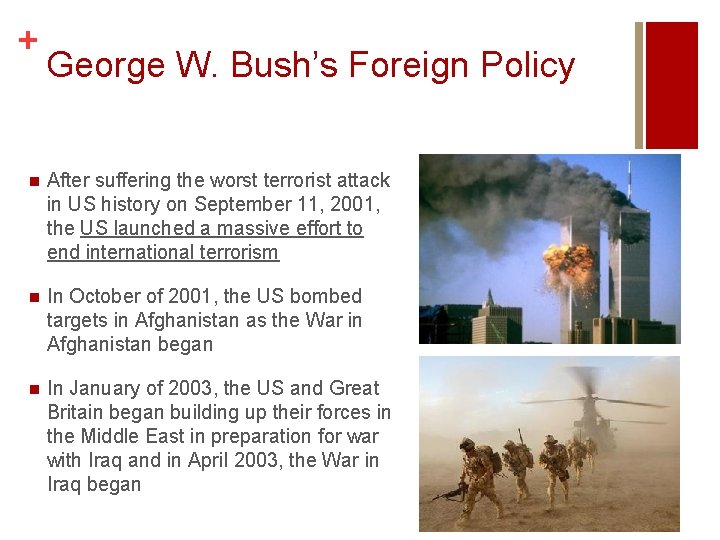
+ George W. Bush’s Foreign Policy n After suffering the worst terrorist attack in US history on September 11, 2001, the US launched a massive effort to end international terrorism n In October of 2001, the US bombed targets in Afghanistan as the War in Afghanistan began n In January of 2003, the US and Great Britain began building up their forces in the Middle East in preparation for war with Iraq and in April 2003, the War in Iraq began
+ George W. Bush’s Domestic Policy n Bush had begun working on reviewing the nation’s military programs when the attacks on September 11, 2001 changed everything and began a new war on terrorism n Bush signed an antiterrorism bill into law in October 2001 – the USA Patriot Act n Worked to pass a large $1. 35 trillion tax cut to try to prevent a recession n Proposed major educational reforms and worked to pass legislation to require public schools to hold annual standardized tests n He signed into law a number of initiatives during his 8 years, including the No Child Left Behind Act, a Partial-Birth Abortion Ban, Medicare prescription drug benefits for seniors, and funding for AIDS relief n Bush was met with economic crisis at the end of 2007, when the United States entered its longest post-WW 2 recession – known as the “Great Recession” – and Bush was faced with this, as well as the 2008 Financial Crisis – the largest depression since the 1930 s
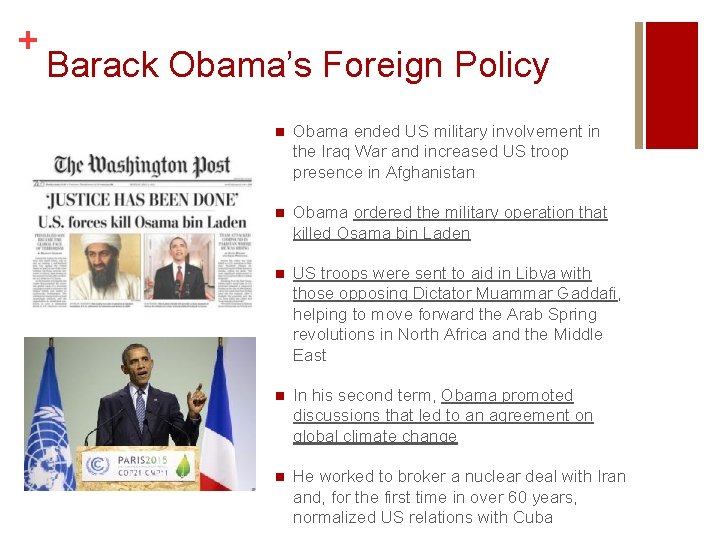
+ Barack Obama’s Foreign Policy n Obama ended US military involvement in the Iraq War and increased US troop presence in Afghanistan n Obama ordered the military operation that killed Osama bin Laden n US troops were sent to aid in Libya with those opposing Dictator Muammar Gaddafi, helping to move forward the Arab Spring revolutions in North Africa and the Middle East n In his second term, Obama promoted discussions that led to an agreement on global climate change n He worked to broker a nuclear deal with Iran and, for the first time in over 60 years, normalized US relations with Cuba
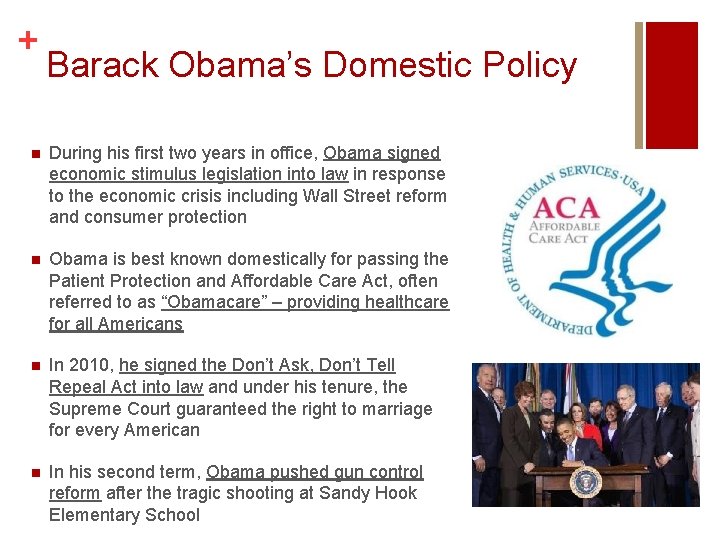
+ Barack Obama’s Domestic Policy n During his first two years in office, Obama signed economic stimulus legislation into law in response to the economic crisis including Wall Street reform and consumer protection n Obama is best known domestically for passing the Patient Protection and Affordable Care Act, often referred to as “Obamacare” – providing healthcare for all Americans n In 2010, he signed the Don’t Ask, Don’t Tell Repeal Act into law and under his tenure, the Supreme Court guaranteed the right to marriage for every American n In his second term, Obama pushed gun control reform after the tragic shooting at Sandy Hook Elementary School
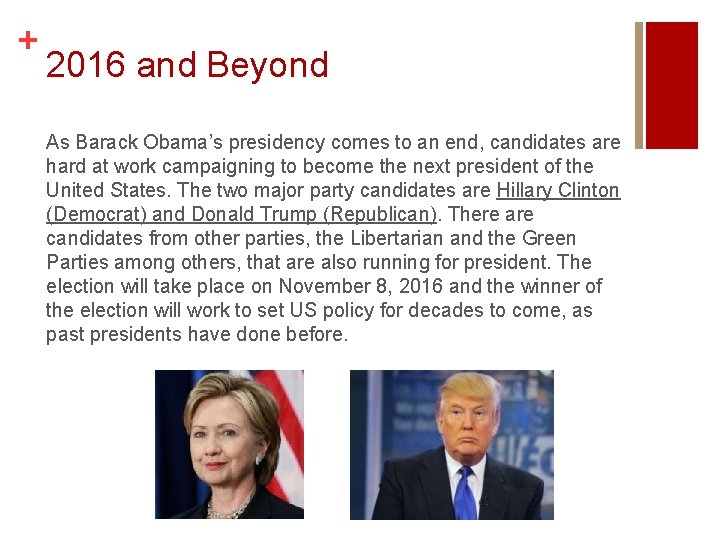
+ 2016 and Beyond As Barack Obama’s presidency comes to an end, candidates are hard at work campaigning to become the next president of the United States. The two major party candidates are Hillary Clinton (Democrat) and Donald Trump (Republican). There are candidates from other parties, the Libertarian and the Green Parties among others, that are also running for president. The election will take place on November 8, 2016 and the winner of the election will work to set US policy for decades to come, as past presidents have done before.