
United States Preventive Services Task Force Recommendations for
- Slides: 13
United States Preventive Services Task Force: Recommendations for ABPM Michael A. Weber, MD State University of New York Downstate Medical Center
Michael Weber, MD Disclosures Consulting: Boston scientific, Medtronics, Ablative Solutions, Re. Cor, Novartis Research: Medtronics, Boston Scientific, Re. Cor, Ablative Solutions, Novartis, Boehringer Ingelheim
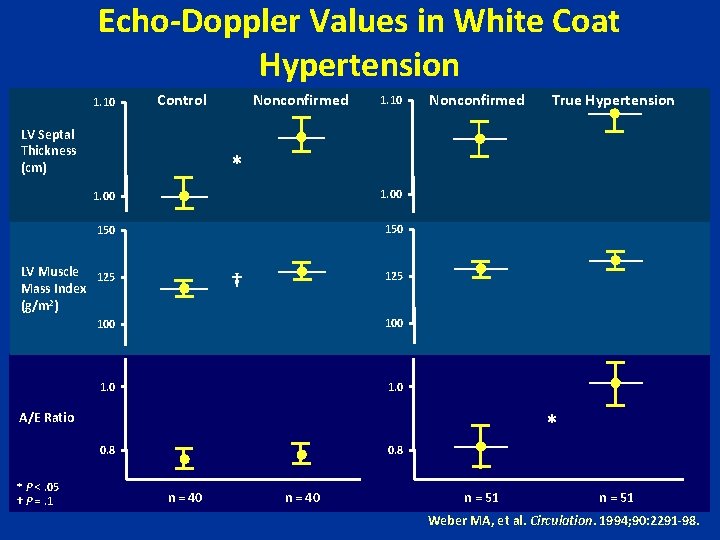
Echo-Doppler Values in White Coat Hypertension 1. 10 Control LV Septal Thickness (cm) Nonconfirmed 1. 10 Nonconfirmed * 1. 00 150 LV Muscle 125 Mass Index (g/m 2) † 125 100 1. 0 A/E Ratio * 0. 8 * P <. 05 † P =. 1 True Hypertension 0. 8 n = 40 n = 51 Weber MA, et al. Circulation. 1994; 90: 2291 -98. 1994;
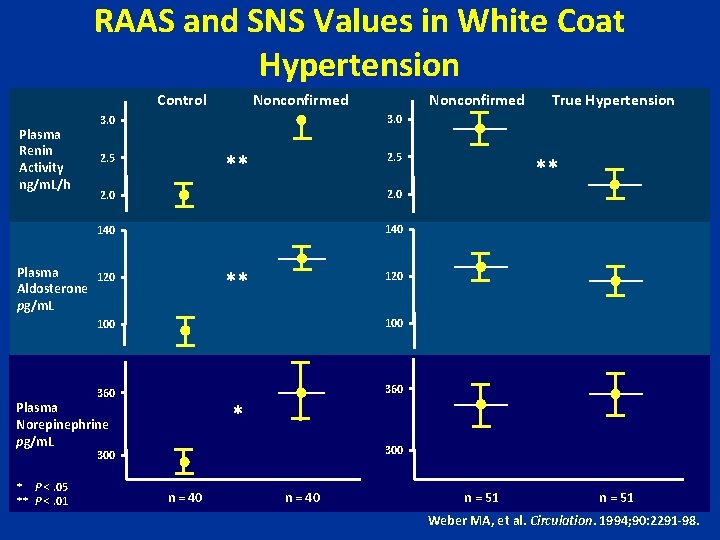
RAAS and SNS Values in White Coat Hypertension Control Plasma Renin Activity ng/m. L/h True Hypertension 3. 0 ** 2. 5 2. 0 140 Plasma 120 Aldosterone pg/m. L ** ** 120 100 360 * Plasma Norepinephrine pg/m. L 300 * P <. 05 ** P <. 01 Nonconfirmed n = 40 n = 51 Weber MA, et al. Circulation. 1994; 90: 2291 -98. 1994;
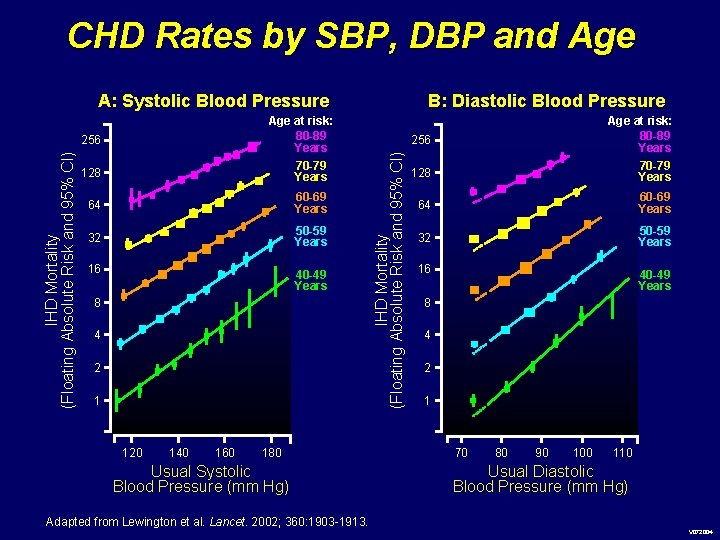
CHD Rates by SBP, DBP and Age A: Systolic Blood Pressure IHD Mortality (Floating Absolute Risk and 95% CI) 256 128 64 60 -69 Years 32 50 -59 Years 16 40 -49 Years 8 4 2 1 120 140 160 180 Usual Systolic Blood Pressure (mm Hg) Adapted from Lewington et al. Lancet. 2002; 360: 1903 -1913. 128 Age at risk: 80 -89 Years 70 -79 Years 64 60 -69 Years 32 50 -59 Years 256 IHD Mortality (Floating Absolute Risk and 95% CI) Age at risk: 80 -89 Years 70 -79 Years B: Diastolic Blood Pressure 16 40 -49 Years 8 4 2 1 70 80 90 100 110 Usual Diastolic Blood Pressure (mm Hg) V 072004
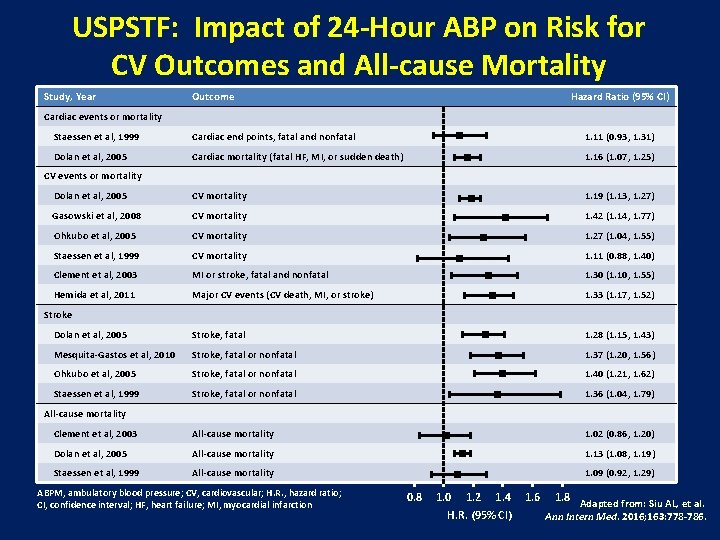
USPSTF: Impact of 24 -Hour ABP on Risk for CV Outcomes and All-cause Mortality Study, Year Outcome Hazard Ratio (95% CI) Cardiac events or mortality Staessen et al, 1999 Cardiac end points, fatal and nonfatal 1. 11 (0. 93, 1. 31) Dolan et al, 2005 Cardiac mortality (fatal HF, MI, or sudden death) 1. 16 (1. 07, 1. 25) Dolan et al, 2005 CV mortality 1. 19 (1. 13, 1. 27) Gasowski et al, 2008 CV mortality 1. 42 (1. 14, 1. 77) Ohkubo et al, 2005 CV mortality 1. 27 (1. 04, 1. 55) Staessen et al, 1999 CV mortality 1. 11 (0. 88, 1. 40) Clement et al, 2003 MI or stroke, fatal and nonfatal 1. 30 (1. 10, 1. 55) Hemida et al, 2011 Major CV events (CV death, MI, or stroke) 1. 33 (1. 17, 1. 52) Dolan et al, 2005 Stroke, fatal 1. 28 (1. 15, 1. 43) Mesquita-Gastos et al, 2010 Stroke, fatal or nonfatal 1. 37 (1. 20, 1. 56) Ohkubo et al, 2005 Stroke, fatal or nonfatal 1. 40 (1. 21, 1. 62) Staessen et al, 1999 Stroke, fatal or nonfatal 1. 36 (1. 04, 1. 79) Clement et al, 2003 All-cause mortality 1. 02 (0. 86, 1. 20) Dolan et al, 2005 All-cause mortality 1. 13 (1. 08, 1. 19) Staessen et al, 1999 All-cause mortality 1. 09 (0. 92, 1. 29) CV events or mortality Stroke All-cause mortality ABPM, ambulatory blood pressure; CV, cardiovascular; H. R. , hazard ratio; CI, confidence interval; HF, heart failure; MI, myocardial infarction 0. 8 1. 0 1. 2 1. 4 H. R. (95% CI) 1. 6 1. 8 Adapted from: Siu AL, et al. Ann Intern Med. 2016; 163: 778 -786.
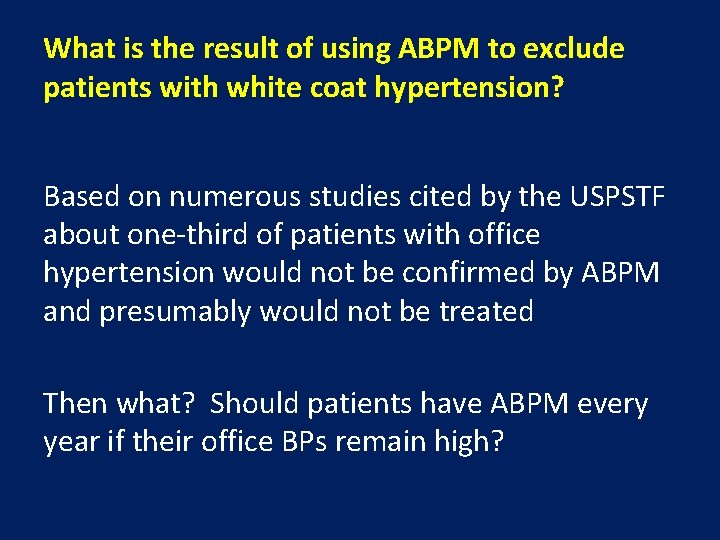
What is the result of using ABPM to exclude patients with white coat hypertension? Based on numerous studies cited by the USPSTF about one-third of patients with office hypertension would not be confirmed by ABPM and presumably would not be treated Then what? Should patients have ABPM every year if their office BPs remain high?
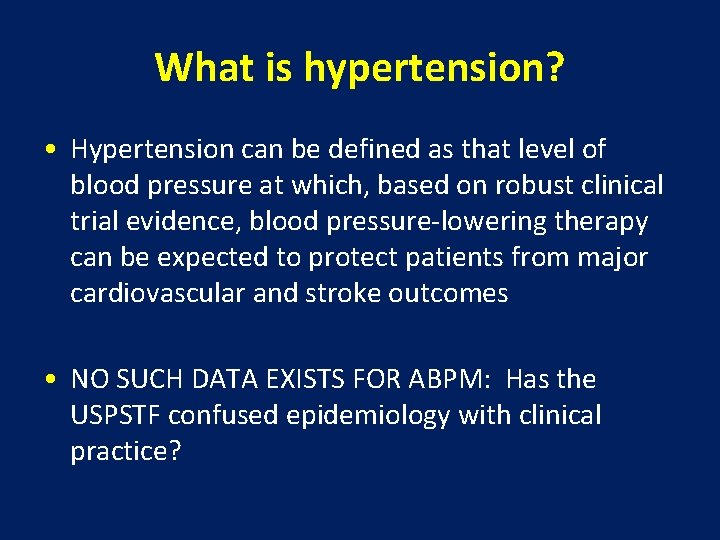
What is hypertension? • Hypertension can be defined as that level of blood pressure at which, based on robust clinical trial evidence, blood pressure-lowering therapy can be expected to protect patients from major cardiovascular and stroke outcomes • NO SUCH DATA EXISTS FOR ABPM: Has the USPSTF confused epidemiology with clinical practice?
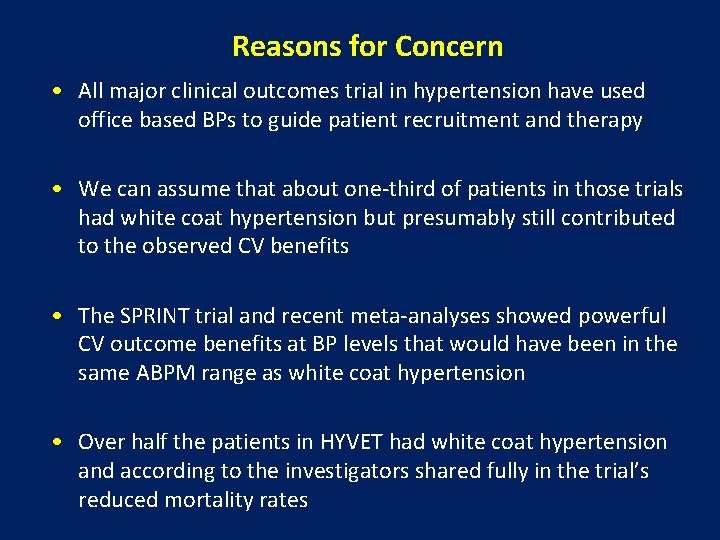
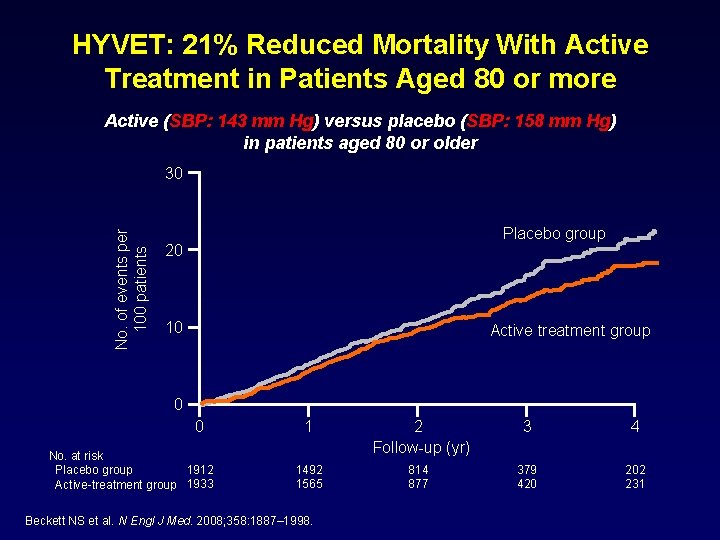
Reasons for Concern • All major clinical outcomes trial in hypertension have used office based BPs to guide patient recruitment and therapy • We can assume that about one-third of patients in those trials had white coat hypertension but presumably still contributed to the observed CV benefits • The SPRINT trial and recent meta-analyses showed powerful CV outcome benefits at BP levels that would have been in the same ABPM range as white coat hypertension • Over half the patients in HYVET had white coat hypertension and according to the investigators shared fully in the trial’s reduced mortality rates
HYVET: 21% Reduced Mortality With Active Treatment in Patients Aged 80 or more Active (SBP: 143 mm Hg) versus placebo (SBP: 158 mm Hg) in patients aged 80 or older No. of events per 100 patients 30 Placebo group 20 10 Active treatment group 0 0 No. at risk 1912 Placebo group Active-treatment group 1933 1 2 Follow-up (yr) 3 4 1492 1565 814 877 379 420 202 231 Beckett NS et al. N Engl J Med. 2008; 358: 1887– 1998.
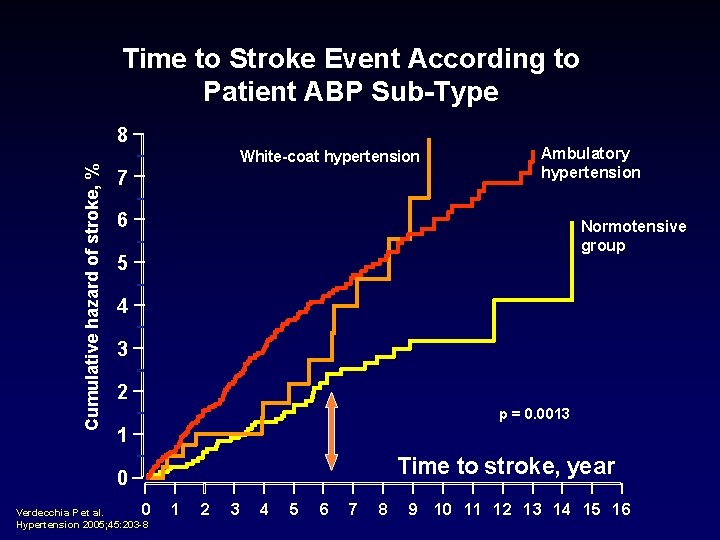
Time to Stroke Event According to Patient ABP Sub-Type Cumulative hazard of stroke, % 8 White-coat hypertension 7 Ambulatory hypertension 6 Normotensive group 5 4 3 2 p = 0. 0013 1 Time to stroke, year 0 0 Verdecchia P et al. Hypertension 2005; 45: 203 -8 1 2 3 4 5 6 7 8 9 10 11 12 13 14 15 16
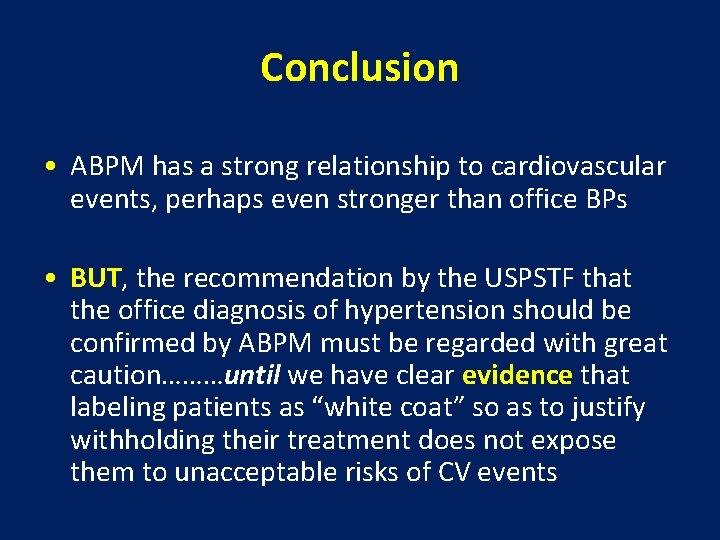
Conclusion • ABPM has a strong relationship to cardiovascular events, perhaps even stronger than office BPs • BUT, the recommendation by the USPSTF that the office diagnosis of hypertension should be confirmed by ABPM must be regarded with great caution………until we have clear evidence that labeling patients as “white coat” so as to justify withholding their treatment does not expose them to unacceptable risks of CV events