
United States Power Squadrons Certifier Training 1 BOC
United States Power Squadrons Certifier Training >> 1
BOC Overview Module Title 1 Introduction to BOC 2 Certification Levels & Endorsements 3 Passport, Wallet Card, Certificate 4 Skill Demonstrations & Equivalencies 5 The Certifier 6 BOC Policies 7 Skill Demonstration Instructions 8 BOC Website 9 Insurance, Equipment, Logistics 2
Module 1 Introduction to BOC 3
BOC Objectives n n Certify recreational boat operators at various levels of proficiency Provide internationally recognized credential (all levels UN 40 compliant*) n * requires European rule training for full compliance 4
Advantages of BOC n On-the-water (OTW) training adds a new dimension to USPS training. n n n Imagine as a new boater, instead of just learning boating in a classroom, you can also have a qualified person come on board your boat and teach you skills in the environment you will be operating in! What if you want to improve your skills for coastal or offshore boating? Or charter a boat in a foreign country? >> 5
Advantages to Members n n n n n Obtaining insurance Reducing some boating insurance rates Speaking in public Testifying as an expert witness Serving on an advisory panel Being quoted in the media Being introduced in a public setting Publishing articles or books Build your confidence in your own abilities First step in learning to teach others OTW >> 6
General Requirements* n 16 years of age n Mentally and physically capable of operating a boat safely n Sufficient visual and auditory sensory ability _____ * Same for driver’s license. >> 7
Certifier’s Manual n n Explains BOC program Includes: Procedures & Policies n Certifier qualifications & duties n Available online n Certifier’s Manual © 2007 - 2011 United States Power Squadrons >> 8
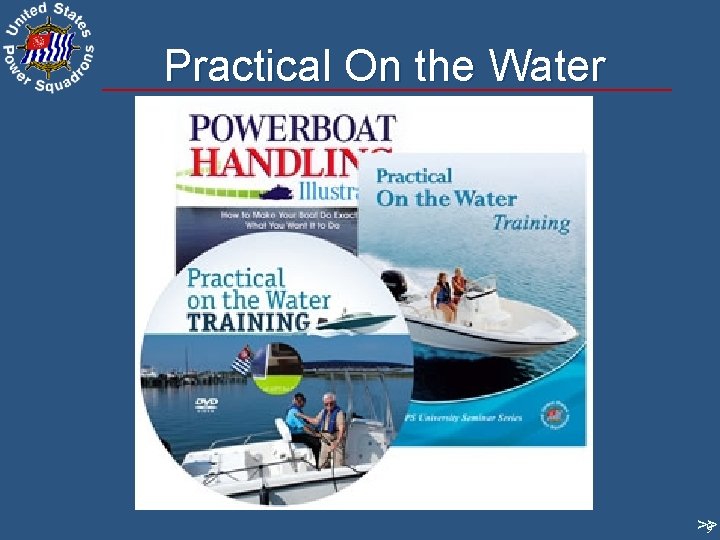
Practical On the Water >> 9
Practical On the Water Seminar, not one of the BOC levels n Uses BOC Certifier training and qualifications n Classroom may be taught by any ID qualified USPS instructor n OTW may be taught by a POTW Certifier or IN Certifier n You are an instructor or trainer as well as a judge for POTW n >> 10
Practical On the Water Similar to IN OTW skills n Completion of seminar gets you credit for the seminar n Successful demonstration of OTW skills gets you OTW credit for IN (skill is called BPH) n n http: //www. usps. org/e_stuff/seminars/potw. ht m >> 11
Module 2 Certification Levels and Endorsements 12
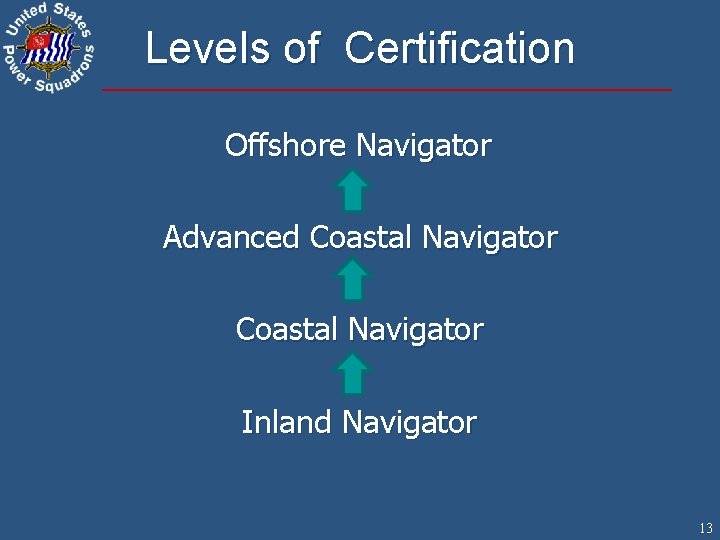
Levels of Certification Offshore Navigator Advanced Coastal Navigator Inland Navigator 13
Endorsements n n Endorsements can be added at any certification level (some exceptions) Regional type: for a geographic region; covers radio regulations, rules of road, charts, aids to navigation, customs & immigration regulations, etc. >> 14
Endorsements n n n CAN – Canadian regulations EURO – European regulations (under development) IW – Inland Waterways PAD – Paddle boats (canoes & kayaks) SA - Sailboats (two levels) n n n Inland Navigation and Coastal Navigation Advanced Coastal Navigation and Offshore Navigation (under development) More endorsements planned >> 15
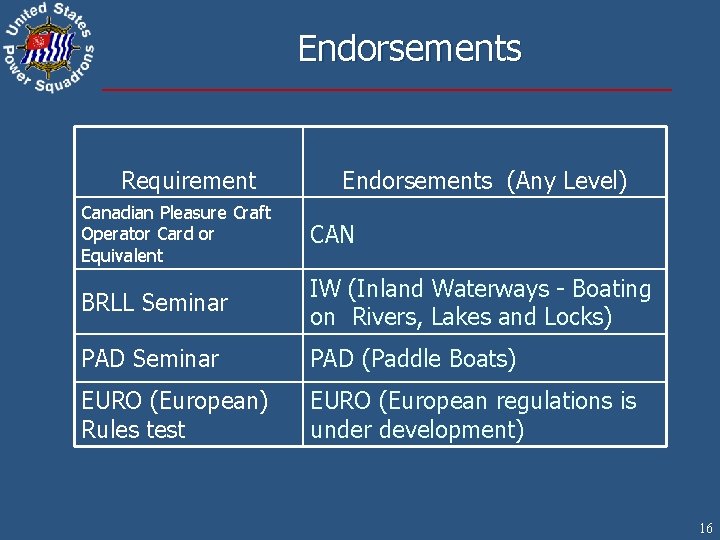
Endorsements Requirement Endorsements (Any Level) Canadian Pleasure Craft Operator Card or Equivalent CAN BRLL Seminar IW (Inland Waterways - Boating on Rivers, Lakes and Locks) PAD Seminar PAD (Paddle Boats) EURO (European) Rules test EURO (European regulations is under development) 16
Module 3 Candidate's Passport, Wallet Card, and Certificate 17
Candidate’s Passport 18
Candidate’s Passport 19
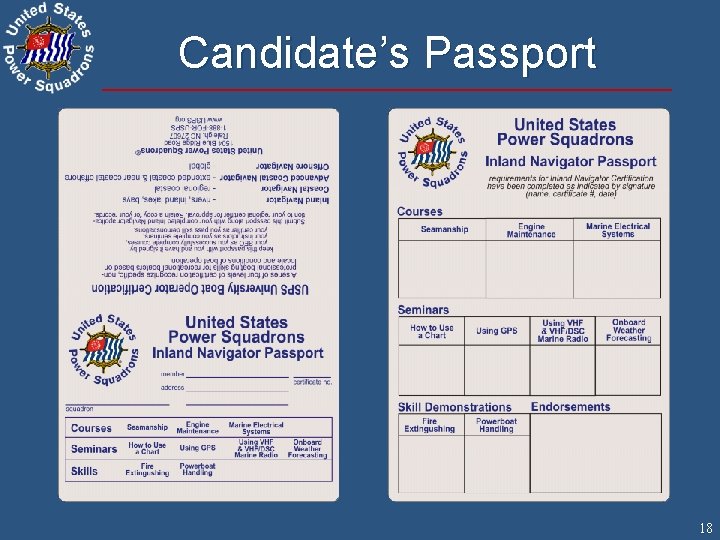
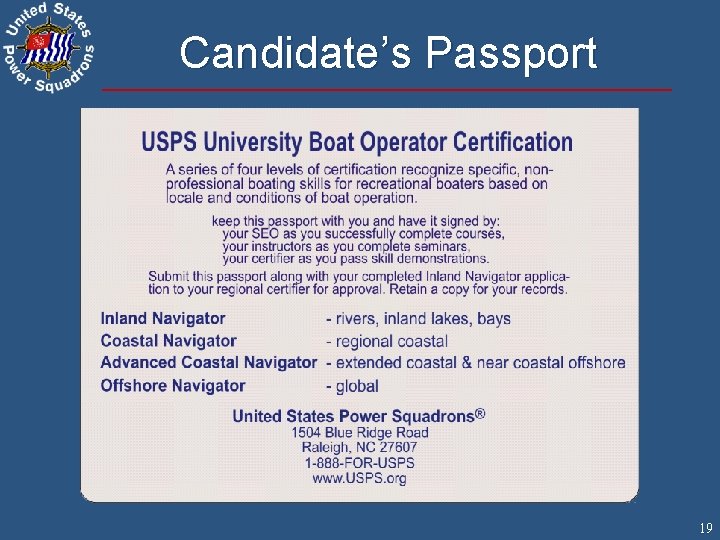
Candidate’s Passport n n n Each completion should be entered in members passport SEO, instructor or certifier signs, as appropriate Submitted electronically using BOC Tools 20
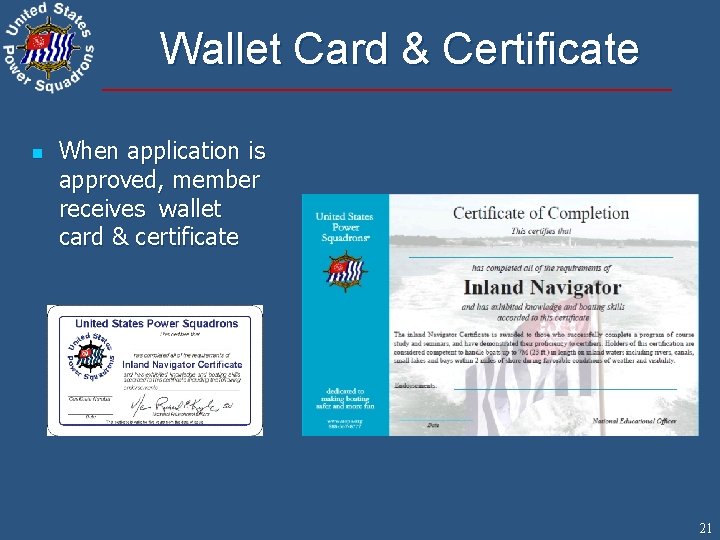
Wallet Card & Certificate n When application is approved, member receives wallet card & certificate 21
Module 4 Skill Demonstrations & Equivalencies 22
Candidate’s Role For on-the-water skills, the candidate (skipper) and crew must handle the boat and navigate safely. 23
Certifier’s Role § If the skipper is not able to demonstrate the skill and the certifier can provide instruction. § If at any time, or for any reason, the certifier feels a dangerous situation is developing, the certifier has the authority to terminate the demonstration. § The Certifier may teach or instruct during the skill demonstration, but the candidate must perform all the skills without assistance. 24
Certifier’s Role § Skill criteria is in each guide § Reasonable confidence the skill can be repeated when requested or needed § If not able to perform the skill; § instruct or §Suggest practice/experience §Refer to another certifier or CT 25
Module 4 (Cont. ) Certification Levels Detailed 26
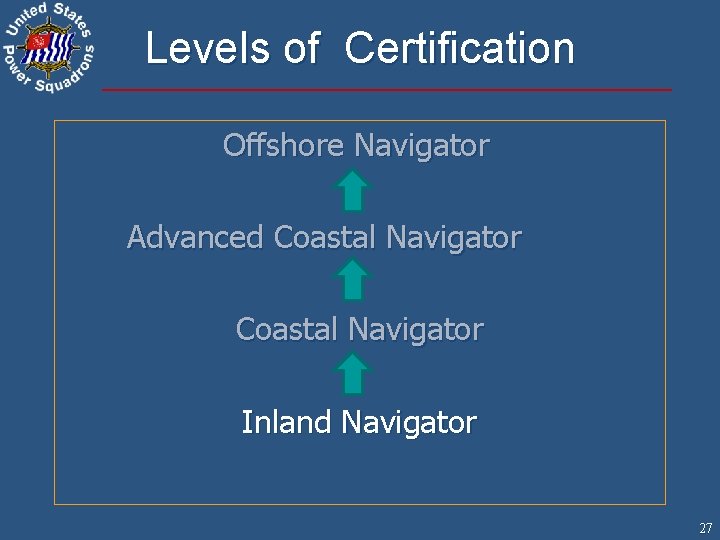
Levels of Certification Offshore Navigator Advanced Coastal Navigator Inland Navigator 27
Inland Navigator Skill Demonstrations: n n Power Boat Handling Skill Demonstration Fire Extinguisher Skill Demonstration Classes: n NASBLA approved Boating Course n Seamanship n Engine Maintenance n Marine Electrical Systems 28
Inland Navigator (cont. ) Seminars: n How to Use a Chart (or P) n Onboard Weather (or Weather Course) n Using VHF & VHF/DSC Marine Radio n GPS (or new - 2004 P or 2006 AP) 29
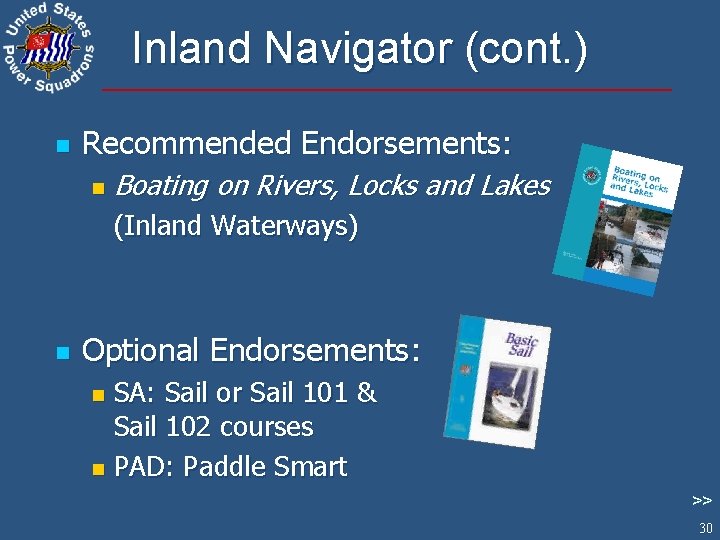
Inland Navigator (cont. ) n Recommended Endorsements: n Boating on Rivers, Locks and Lakes (Inland Waterways) n Optional Endorsements: SA: Sail or Sail 101 & Sail 102 courses n PAD: Paddle Smart n >> 30
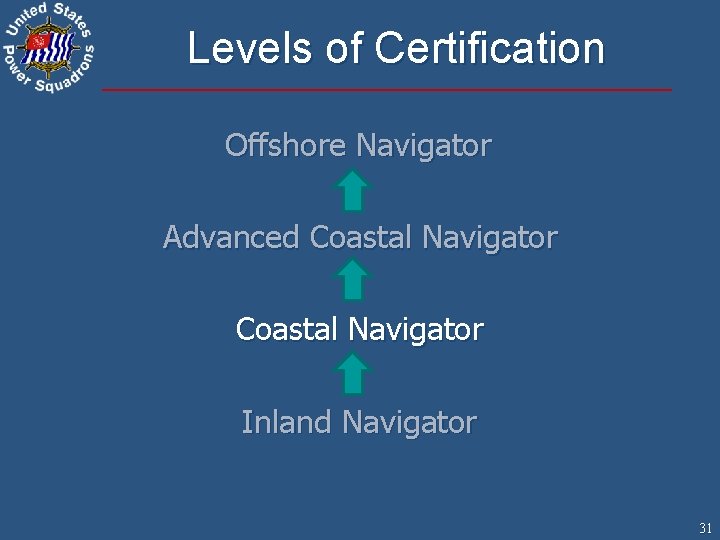
Levels of Certification Offshore Navigator Advanced Coastal Navigator Inland Navigator 31
Coastal Navigator n Candidates having an IN Passport and completed the on-the-water skill demonstration may participate in Coastal Navigator on-the-water skill demonstrations n Inland Navigator Certification must be completed before Coastal Navigator Certificate is granted. 32
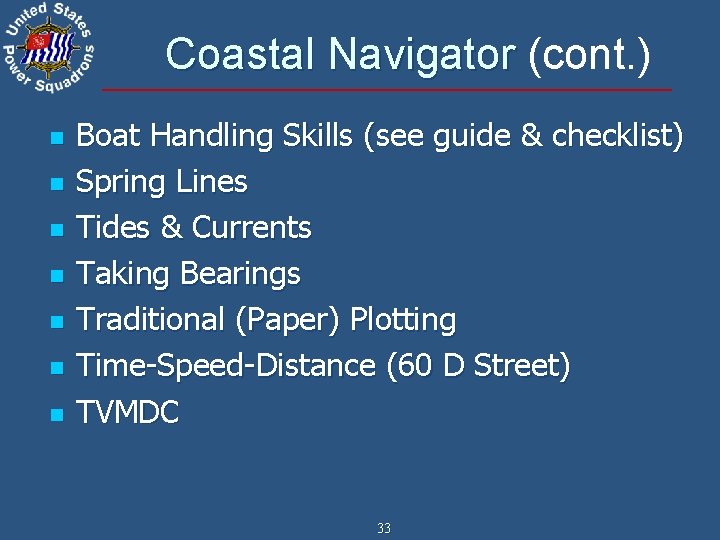
Coastal Navigator (cont. ) n n n n Boat Handling Skills (see guide & checklist) Spring Lines Tides & Currents Taking Bearings Traditional (Paper) Plotting Time-Speed-Distance (60 D Street) TVMDC 33
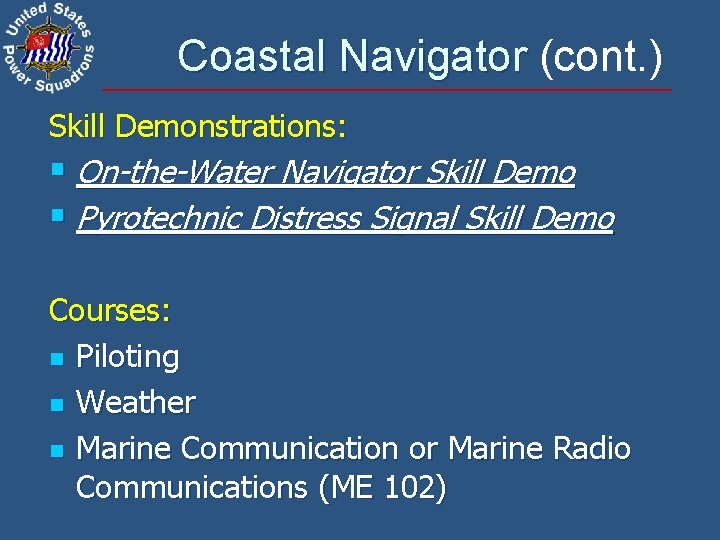
Coastal Navigator (cont. ) Skill Demonstrations: § On-the-Water Navigator Skill Demo § Pyrotechnic Distress Signal Skill Demo Courses: n Piloting n Weather n Marine Communication or Marine Radio Communications (ME 102)
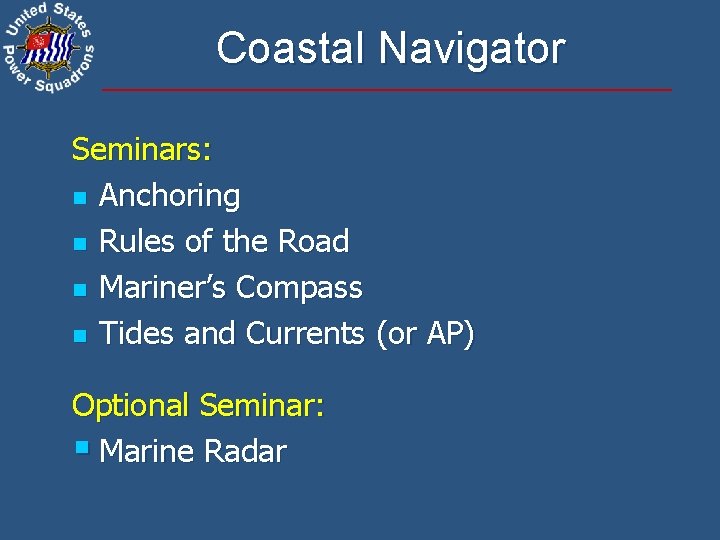
Coastal Navigator Seminars: n Anchoring n Rules of the Road n Mariner’s Compass n Tides and Currents (or AP) Optional Seminar: § Marine Radar
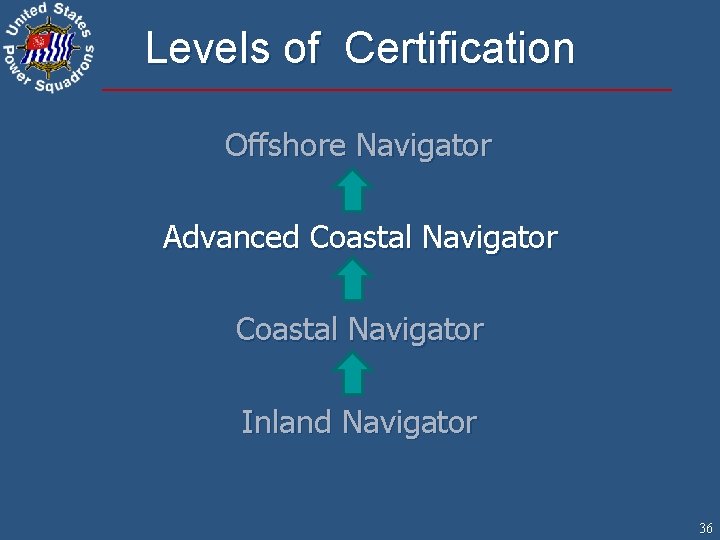
Levels of Certification Offshore Navigator Advanced Coastal Navigator Inland Navigator 36
Advanced Coastal Navigator expands on the skills from CN Prepare a longer cruise with meals and watch standing Navigation with GPS and without, including night navigation Running fix Navigate harbor opening and open water 37
Advanced Coastal Navigator Skill Demonstrations: Advanced Coastal Navigation Boat Handling Skill Demonstration – (ADN) First Aid (FA ‐ Offered by American Red Cross or American Heart Association) Classes: n n n Advanced Piloting Marine Navigation Systems or (ME 103) Cruise Planning 38
Advanced Coastal Navigator Required Seminars: • • Emergencies on Board (EO) Marine Radar Recommended But Not Required • CPR/AED (Offered by American Red Cross or American Heart Association) 39
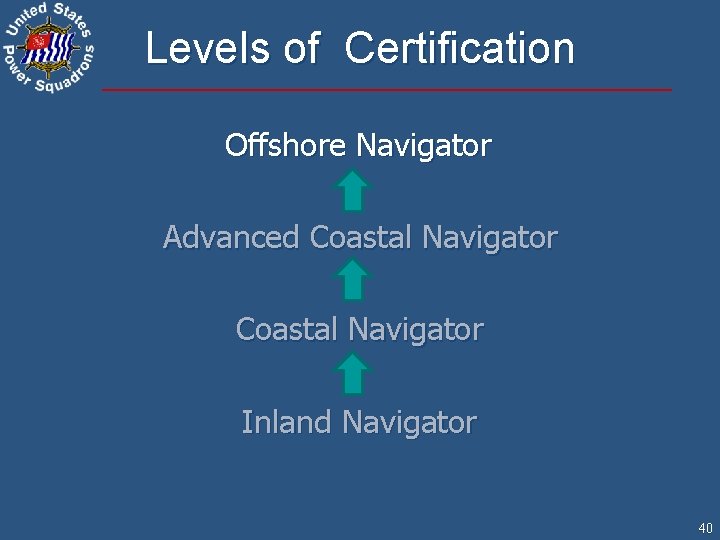
Levels of Certification Offshore Navigator Advanced Coastal Navigator Inland Navigator 40
Offshore Navigator In development - may include the following: n n Offshore Navigator Boat Handling Skill Demonstration Classes: (subject to change): n n n Junior Navigation and Navigation Seminars : TBD Limitations: TBD 41
USPS Equivalencies n Schools and Associations n n US Coast Guard Licenses n n NEO Recommendation & USPS BOD Approval Refer to EDN-89 USCG Auxiliary Courses n Refer to EDN-89 42
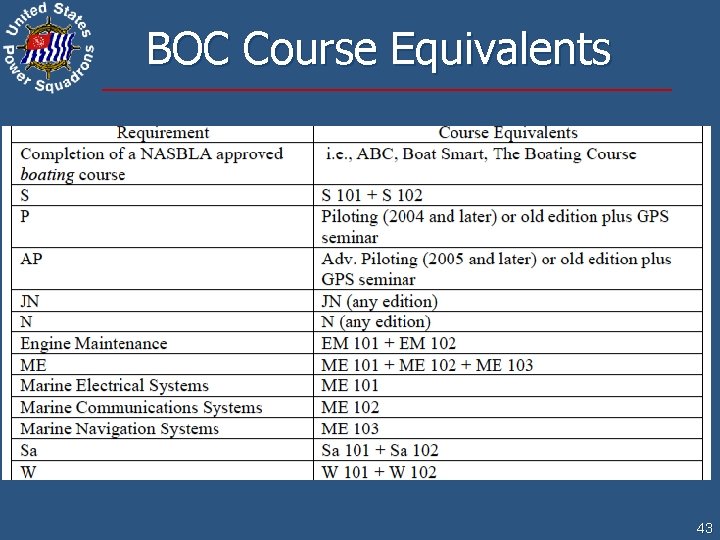
BOC Course Equivalents 43
BOC Equivalencies (Cont. ) n Not encouraged, but Those with other training may apply for an equivalency n Equivalency process for: n n Skills – use ED-C 2 and follow instructions n OTW skills must be demonstrated Seminars – use ED-C 3 and follow instructions Use BOC Tools for submittal if possible >> 44
FAQs – Skill Equivalencies Q: How do I decide if an Equivalency for a skill should be approved? A: Acceptable Equivalencies will be approved by the NEO or designee. The Equivalency must be submitted to the Assistant or Regional Director who will submit to the R/C BOC&OTW COM for consideration of approval. Feel free to consult with other certifiers or your Regional Director. 45
Checklists (all levels) n n n Checklists are in the Candidate’s Guide/Manual for each level Helps candidate plan and track all requirements Passport documents completed items; it’s a checklist for members planning 46
Module 5 The Certifier 47
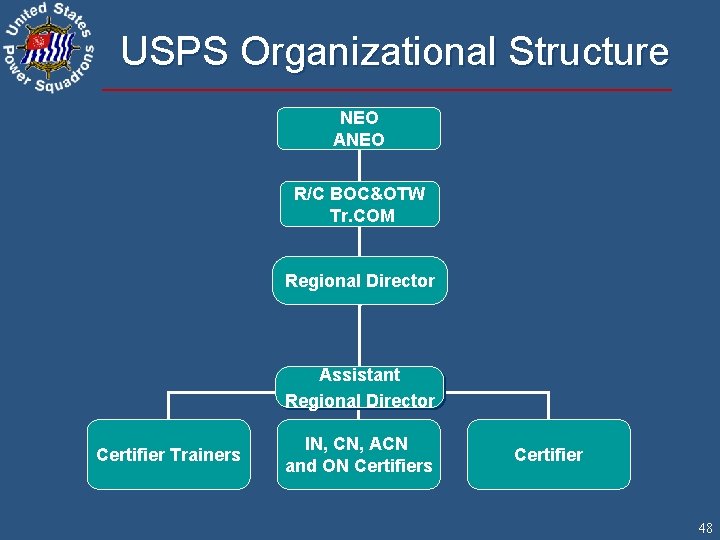
USPS Organizational Structure NEO ANEO R/C BOC&OTW Tr. COM Regional Director Assistant Regional Director Certifier Trainers IN, CN, ACN and ON Certifiers Certifier 48
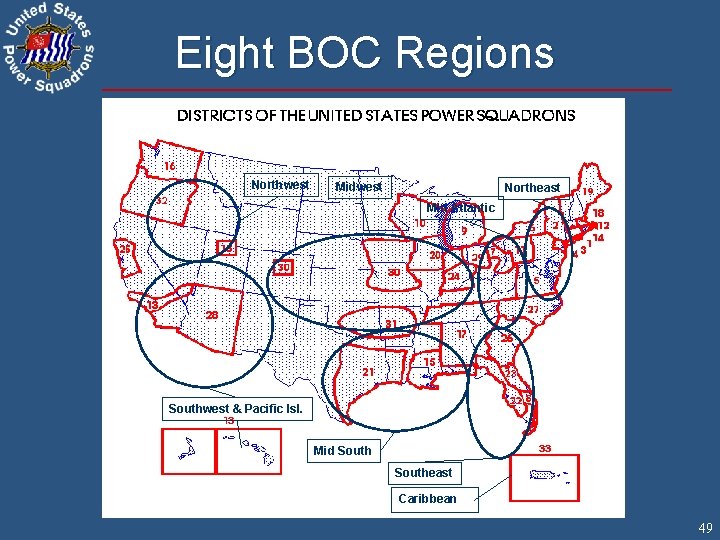
Eight BOC Regions Northwest Midwest Northeast Mid Atlantic Southwest & Pacific Isl. Mid Southeast Caribbean 49
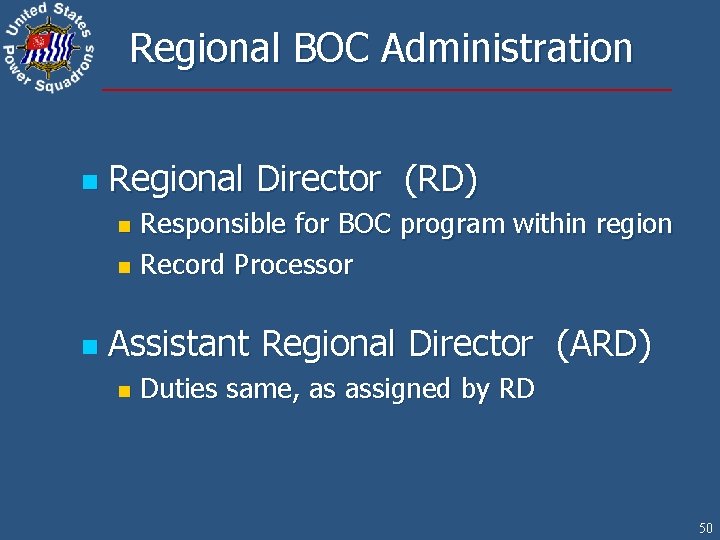
Regional BOC Administration n Regional Director (RD) Responsible for BOC program within region n Record Processor n n Assistant Regional Director (ARD) n Duties same, as assigned by RD 50
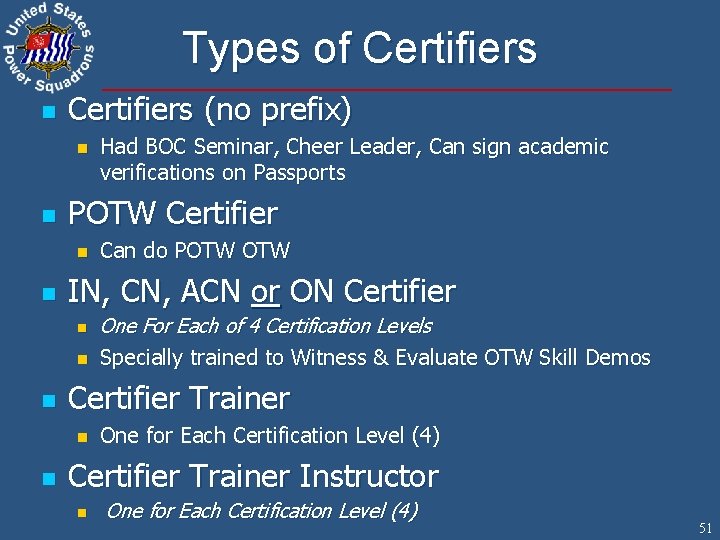
Types of Certifiers n Certifiers (no prefix) n n POTW Certifier n n n One For Each of 4 Certification Levels Specially trained to Witness & Evaluate OTW Skill Demos Certifier Trainer n n Can do POTW IN, CN, ACN or ON Certifier n n Had BOC Seminar, Cheer Leader, Can sign academic verifications on Passports One for Each Certification Level (4) Certifier Trainer Instructor n One for Each Certification Level (4) 51
What it means to be a Certifier n If you make the grade: n You are the face of USPS n Personable n Standard bearer Competent n Steadfast n Fair n n Instructor and evaluator 52
Certifiers – Keystone of BOC n n n Success of BOC largely depends on certifiers Your enthusiasm will be contagious You are the: n n n n Cheerleaders Sales force Promotion team Implementers Teachers Administrators Your energy and talent will create success 53
Certifiers – Keystone of BOC n You must balance your roles as: n Standard Bearer and Gatekeepers: n Do not certify someone who is not competent, - for his/her safety and - the integrity of the program n Advocates: n Want our members to succeed in BOC, - must be reasonable, - encouraging and helpful 54
Becoming a Certifier n To become a certifier: n Meet all requirements n See BOC Manual for Certifiers Be nominated by Certifiers, the RD, SEO or DEO, or assistants n Be approved by Regional Director n n (or n assistant) Complete this seminar 55
POTW Certifier Requirements POTW Certifier must: 1) be a USPS member. 2) be nominated by a RD, ARD, Certifier, SEO, ADEO or DEO and approved by the Regional Director or ARD. 3) be a current USPS Certified Instructor when appointed and maintain that status. 4) have completed a NASBLA approved course, Seamanship and BPH. 5) have completed the Certifier’s Seminar. 6) have substantial and verifiable on-the-water experience. 7) be willing and able to observe on-water skill demonstrations and document same. 8) have Internet access and an e-mail address. 9) use the electronic database system. >> 56
Certifier Requirements Certifier (IN, CN, ACN and ON) must: 1) be a USPS member. 2) be nominated by a RD, ARD, Certifier, SEO, ADEO or DEO and approved by the Regional Director or ARD. 3) be a current USPS Certified Instructor when appointed and maintain that status. 4) have completed the Level (e. g. IN, CN, etc. ) they will be certifying. 5) hold the grade of AP or above (SN is required to certify at ON level). 6) have completed the Certifier’s Seminar. 7) have substantial and verifiable on-the-water experience. >> 57
Certifier’s Qualifications Certifiers Must (continued): 8) have some boating experience with night or restricted visibility operations for ACN and ON Certifier. 9) have been specifically trained and familiar with the requirements and procedures for the level they are certifying. Have operated at night or in restricted visibility for ACN and ON Certifier 10) be willing and able to observe on-water skill demonstrations and document same. 11) have Internet access and an e-mail address. 12) use the electronic database system. 13) for CN Certifier and above, maintain their CPR/FA certification. 14) having experience in both power and sail boats is a plus. >> 58
Maintaining Certification n To maintain your certifier credentials: Active Certifier n Periodic refresher training n n n every 5 years Possible update training n Most likely read and sign Random sampling of certifier performance n Maintain ID n Maintain CPR/FA for CN Certifier and above n 59
Certifier’s Duties Certifier (all levels) shall: Serve as local experts n Stay on national e-mail list to stay up-to-date n Respond promptly to requests for certifying n If unable to certify, identify another certifier who can n Help prepare & process certification applications and Equivalencies n >> 60
Certifier’s Duties (Cont. ) Certifiers (all levels) shall: Meet all applicable certifier qualifications n Make members aware of availability to certify n Make members aware of program and benefits n Encourage members to be certified n Become thoroughly familiar with program n >> 61
Certifier’s Duties (Cont. ) Certifiers (all levels) shall: Cooperate with and take direction from Regional Director (and Assistant Regional Director) n Follow all certification policies n >> 62
Certifier’s Duties (Cont. ) IN, CN, ACN and ON Certifiers shall: Maintain competencies in areas certifying n Ensure skill demonstrations are done safely n Promptly submit skill demonstration documentation via BOC Tools online n Sign member’s passport n Maintain records of skill demos (paper or computer image) n Teach members who do not pass skill demo - to a reasonable extent n >> 63
Certifier’s Duties (Cont. ) IN, CN, ACN and ON Certifiers may: n Teach members who do not pass skill demo - to a reasonable extent >> 64
Certifier Trainer’s Duties Certifier Trainers shall: n Train OTW Certifiers, as needed >> 65
Module 6 BOC Policies 66
Certification Policies n Certifiers are volunteers n No one can certify himself or herself n If certifier’s seminar is completed but a qualification is not met, the candidate will be certified upon completion of requirement >> 67
Certification Policies (Cont. ) n n Members are responsible to periodically recertify themselves for non-USPS seminars (e. g. , CPR/AED, First Aid) to maintain qualifications USPS membership must be maintained >> 68
Certification Policies (Cont. ) n n Skill demonstrations must be done in good weather and during daylight except for nighttime components On-the-water demos are normally done on boat provided by candidate >> 69
Certification Policies (Cont. ) n n Certain skill demos must be done ashore An Assistant Regional Director is authorized to perform the functions of a Regional Director, within their District or as otherwise authorized. >> 70
Certification Policies (Cont. ) n n n Manual & Forms are on web site Certifier can certify candidates in any region Certifiers must maintain their USPS Instructor Certification >> 71
Module 7 Skill Demonstrations Instructions 72
Skill Demonstrations Instructions SAFETY IS YOUR #1 VALUE AND PRIORITY! >> 73
Skill Demonstrations Instructions n n OTW demonstrations inherently have more hazards than classroom instruction Students should: Ensure boat is loaded within capacity n Ensure all equipment is stowed n Ensure passengers have life jackets on n Ensure passengers are prepared for maneuvers n >> 74
Skill Demonstrations Instructions n n Maneuvers can throw people and equipment around or even out of the boat so everyone needs to be seated/holding on and ‘stuff’ needs to be stowed/secured. Backing maneuvers can cause water to backwash over the stern. Body parts need to be kept inside the boat. A lighter load generally will handle better >> 75
Skill Demonstrations Instructions If the students do not take the appropriate safety measures, the Certifier needs to teach the appropriate safety aspects of boating >> 76
Skill Demonstrations: Instructions n n If boat type unfamiliar, you may suggest another certifier Candidate should have instructions in advance Equipment needed n Know what is expected n Discuss with candidate beforehand n >> 77
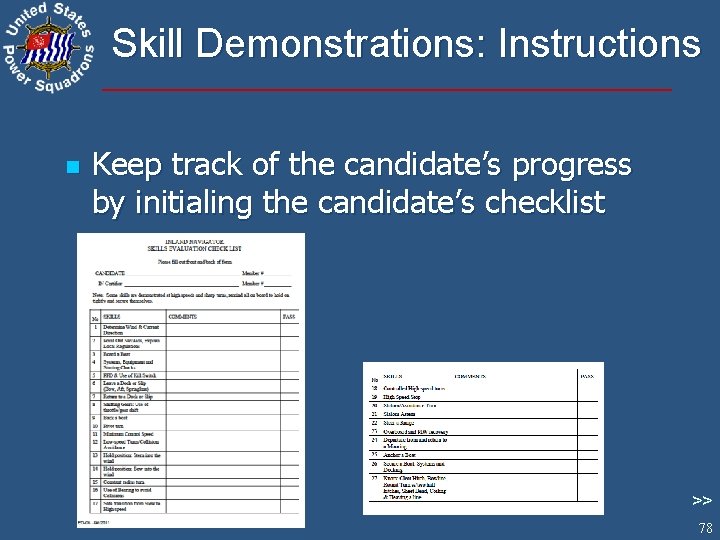
Skill Demonstrations: Instructions n Keep track of the candidate’s progress by initialing the candidate’s checklist >> 78
Skill Demonstrations Instructions n n Skipper & crew handle the boat; certifier only gets involved in an emergency Demo is unsuccessful, if: Accident n Dangerous action n Repeated inability to perform a step n >> 79
Skill Demonstrations Instructions n Some demos must be done ashore, e. g. n n n Fire extinguisher Distress signal (pyrotechnics) On the water: n n If candidate cannot complete OTW skill demo, recommend additional practice Candidate must have competent crew member(s) to be responsible for safe boat operation while skipper is demonstrating Coastal Navigator skills >> 80
Skill Demonstrations FAQs Q: How do I decide when the skill demonstrated is acceptable? A: Although there are some criteria given, sometimes this is a judgment call; you want to maintain the integrity of the program so the certification is an achievement member can be proud of; however, must be reasonable in allowing for conditions. You need reasonable confidence the candidate can consistently repeat the skill. >> 81
Skill Demonstrations FAQs Q: What do I do if it becomes clear candidate cannot perform the skill acceptably? A: You should take the opportunity to do some teaching and suggest the candidate practice and then reschedule the demonstration. >> 82
Skill Demonstrations FAQs Q: What do I do if I feel an unsafe condition is developing? A: You have the authority to end the demonstration for safety reasons at any time based on weather, boat condition, candidate’s performance, etc. and reschedule when appropriate. >> 83
Alternate Skill Demonstrations Record n n Form ED-C 1 Skill Demonstration Record n Use to record data during demo if original Passport or checklist is not available n Form has instructions n See sample filled-out form Submit via BOC Tools (with successfully completed demonstration) >> 84
Module 8 BOC Website 85
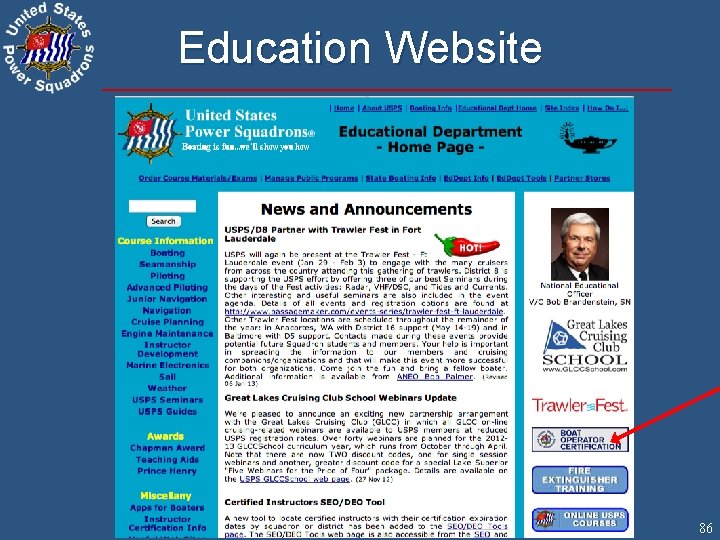
Education Website 86
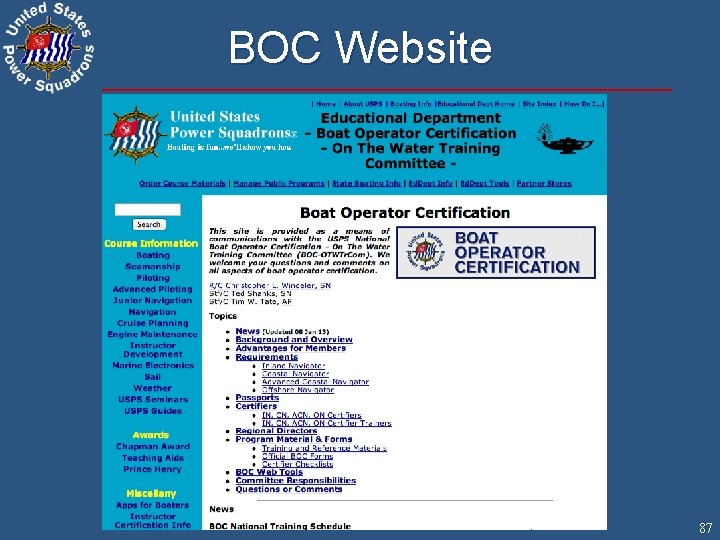
BOC Website 87
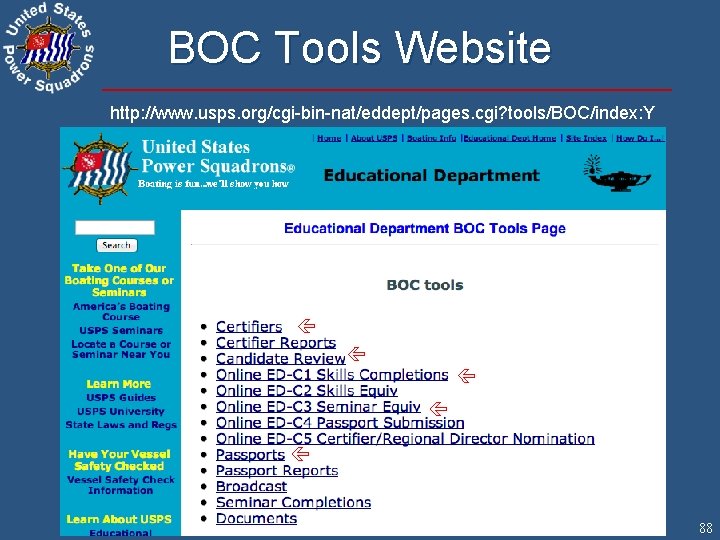
BOC Tools Website http: //www. usps. org/cgi-bin-nat/eddept/pages. cgi? tools/BOC/index: Y 88
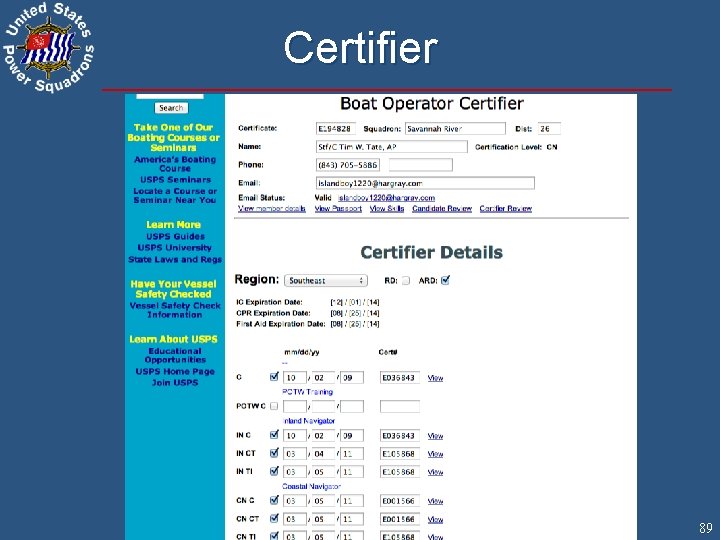
Certifier 89
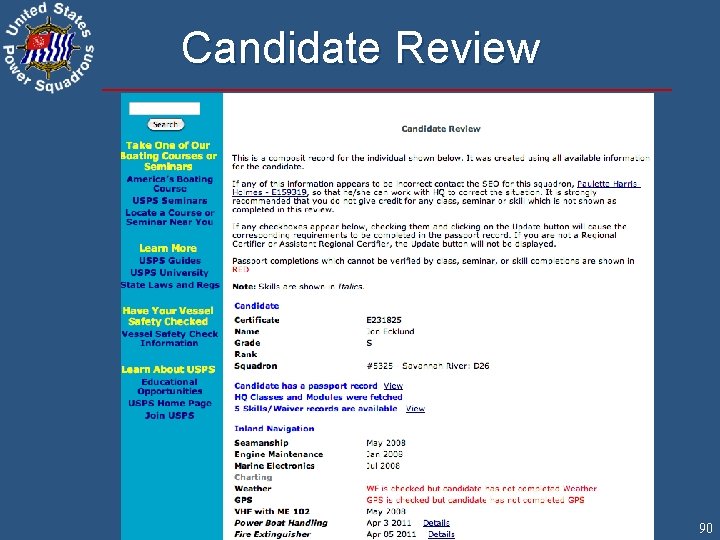
Candidate Review 90
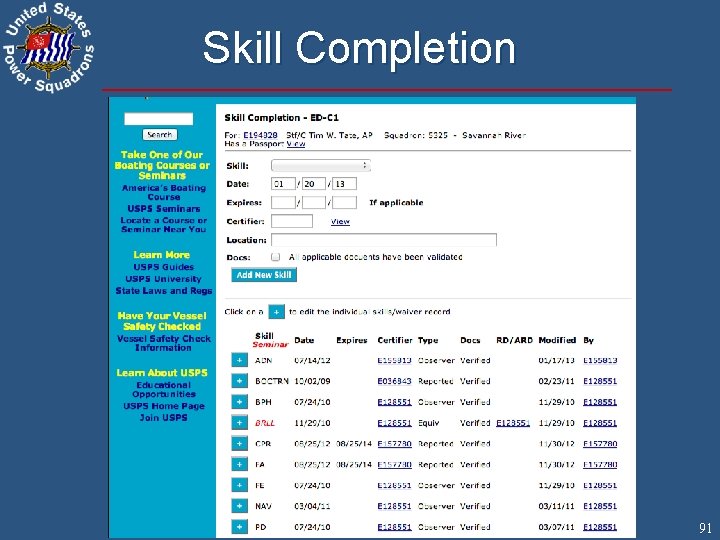
Skill Completion 91
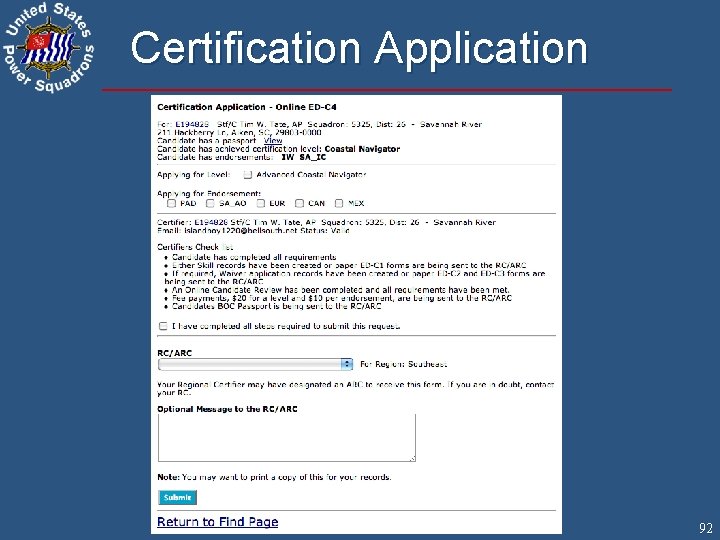
Certification Application 92
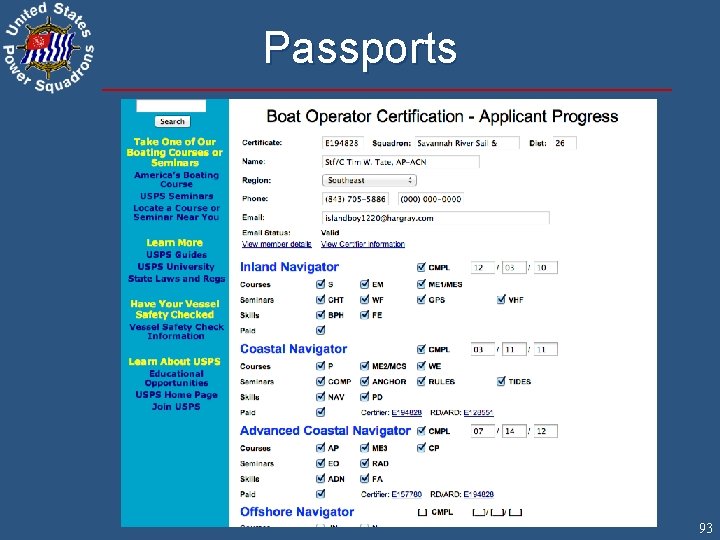
Passports 93
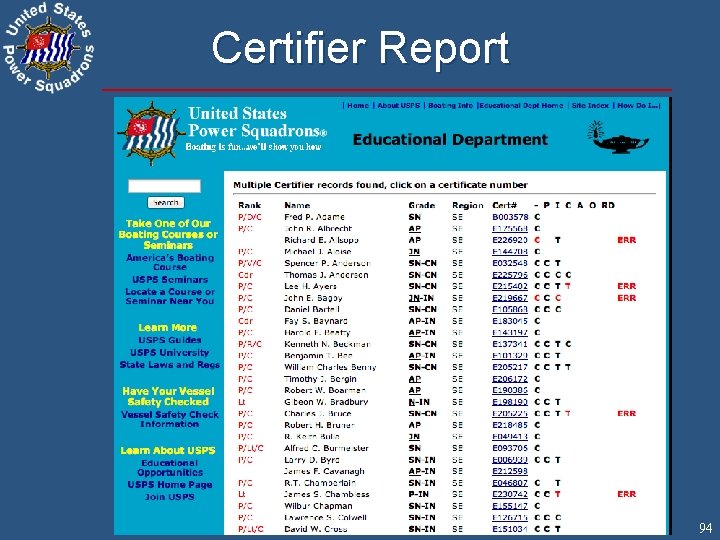
Certifier Report 94
Web Site Addresses Education Department Home Page http: //www. usps. org/national/eddept/main. htm n n Ed Dept BOC On-the-Water Training Com http: //www. usps. org/eddept/boc/main. htm Ed Dept BOC Tools Page http: //www. usps. org/cgi-bin-nat/eddept/ pages. cgi? tools/BOC/index: Y n 95
Seminar Modules 1. 2. 3. 4. 5. 6. BOC description Certifier – role, duties & qualifications Detailed look at IN and CN plus Overview of other levels Skill demonstrations & Equivalencies Policies, Equivalences & references Insurance, Equipment and Logistics 96
Exclusions We will not certify operations in certain extreme conditions, including: n Arctic or Antarctic regions n Only between 70 N and 70 S Latitude Areas with large icebergs or ice fields n Waters near or in tidal bores, whirlpools or waterfalls n Waters where currents approach the cruising speed of the boat n Class III or higher rapids n 97
Certificate Fee Schedule n Current Cost for IN, CN or ACN Kit is $40 (cost to the squadron plus handling and shipping and squadron markup) n n n Includes the cost of the certificate and initial endorsements. Future endorsements cost $10 ON TBD 98
Module 9 Insurance, Equipment & Logistics 99
Insurance As BOC Certifiers, USPS provides extensive insurance coverage: n n n n n General Liability Liquor Liability Marine General Liability Marina Operators Legal Liability Hull/Protection and Indemnity Directors and Officers Liability Umbrella and Bumbershoot policies Media Liability Professional Liability 100
Insurance For District and Squadron Event Insurance http: //www. usps. org/x/x. pl/x/x. cgi? natsec/ins urance. htm Mr. Steve Prime, CIC, VP Tel: (401) 846 -5130 stevep@gowrie. com Ms. Mary Diaz Tel: (800) 262 -8911 maryd@gowrie. com 101
Equipment and Logistics Life Jacket on everyone – no exceptions n Life Jackets are absolutely required for all USPS sanctioned events. n Insurance Reasons n Set an example n Just the smart thing to do! 102
Equipment and Logistics n Support Equipment n n Buoys, Docks, Boats, Photos Buoys Simple, Tested in area, Spares on hand n Discrete Recognition colors n n Ground Tackle n Simple, Scope 103
Equipment and Logistics n Safe Water n n n Check depth, hazards for course and surrounding area Current and wind – will course markers stay in place? Boat and conditions compatible? 104
Equipment and Logistics n Staffing n Consider additional staff to support paperwork, transportation, boat launching, etc. n Right Level of Certifier n Student to Certifier ratio Allow 2 hours OTW per student for IN skill demos n 4 Hours for CN OTW per student n 105
Equipment and Logistics n Food and water n Communications n Cell and VHF preferred n Restrooms n Each student has their checklist 106
Equipment and Logistics n n n Registrar w/ Checklists pre-prepared Access to DB 2000 or BOC Tools at Registration for Education Equivalencies Document all Additional Qualifications 107
Equipment and Logistics n Certifier Must follow up with Each student n n Individually assess qualifications & “extras” Input candidate completions in BOC Tools to maintain record of progress Distribute ED-C 1, 2, 3, 4, 5 as needed – Use electronic distribution via BOC Tools whenever possible Verify student receives certification 108
Questions ? … Comments >> 109
- Slides: 109