
United States Department of Agriculture Natural Resources Conservation

- Slides: 55
United States Department of Agriculture Natural Resources Conservation Service Wisconsin NRCS May 29, 2014 (Webinar)
United States Department of Agriculture Natural Resources Conservation Service RCPP OVERVIEW 2
United States Department of Agriculture Natural Resources Conservation Service What is RCPP? The Regional Conservation Partnership Program (RCPP) is a new program that mobilizes partnerships to multiply investments to reach common conservation goals. 3
United States Department of Agriculture Natural Resources Conservation Service RCPP is a new 2014 Farm Bill conservation program that: • Furthers the conservation on a regional scale • Encourages partners to cooperate with producers • Provides assistance through o Partnership agreements o Program contracts or easement agreements • Combines the purpose and functions of previous regional programs • Utilizes new and existing programs 4
United States Department of Agriculture Natural Resources Conservation Service RCPP Vision RCPP offers new opportunities for NRCS to work with partners to encourage: • • • locally driven innovation create high-performing solutions accelerate the conservation mission launch bold ideas demonstrate the value and efficacy of voluntary, private lands conservation 5
United States Department of Agriculture Natural Resources Conservation Service Measures of Success NRCS will measure the environmental successes of RCPP through the following four criteria: 1. 2. 3. 4. Solutions Contributions Innovation Participation 6
United States Department of Agriculture Natural Resources Conservation Service Measures of Success 1. Solutions. NRCS will invest in projects that generate near-term results that are measurable from environmental, economic, and social perspectives. Both partners and NRCS staff will be involved with documenting the outcomes of these conservation investments. 7
United States Department of Agriculture Natural Resources Conservation Service Measures of Success 2. Contributions. NRCS specifically will promote leveraging of other Federal and non-federal resources. The agency goal is to at least double the total investment in conservation, including cash and in-kind contributions from both Federal and non-Federal sources. USDA plans to invest up to $1. 2 billion over the next 5 years. USDA Goal: Partners match investment to equal $2. 4 billion. 8
United States Department of Agriculture Natural Resources Conservation Service Measures of Success 3. Innovation. NRCS will select innovative projects that integrate multiple conservation approaches to deliver comprehensive and measurable solutions. 9
United States Department of Agriculture Natural Resources Conservation Service Measures of Success 4. Participation. NRCS will seek to maximize the number of organizations that participate in and contribute to projects as compared with predecessor programs (such as the Cooperative Conservation Partnership Initiative). 10
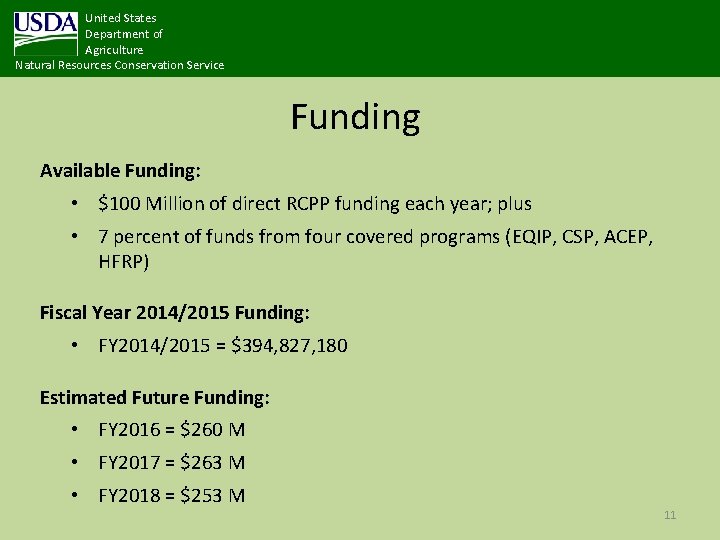
United States Department of Agriculture Natural Resources Conservation Service Funding Available Funding: • $100 Million of direct RCPP funding each year; plus • 7 percent of funds from four covered programs (EQIP, CSP, ACEP, HFRP) Fiscal Year 2014/2015 Funding: • FY 2014/2015 = $394, 827, 180 Estimated Future Funding: • FY 2016 = $260 M • FY 2017 = $263 M • FY 2018 = $253 M 11
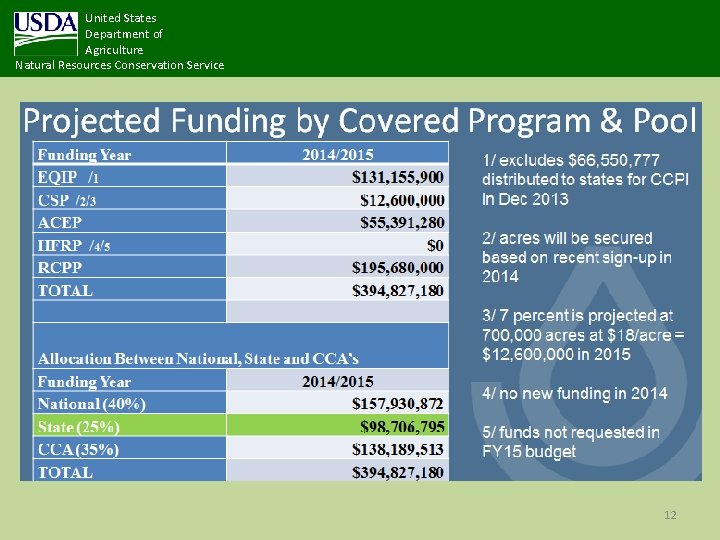
United States Department of Agriculture Natural Resources Conservation Service 12
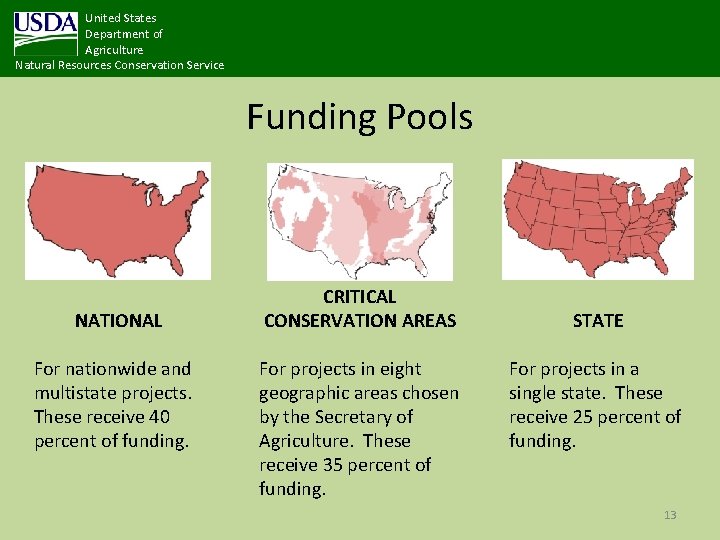
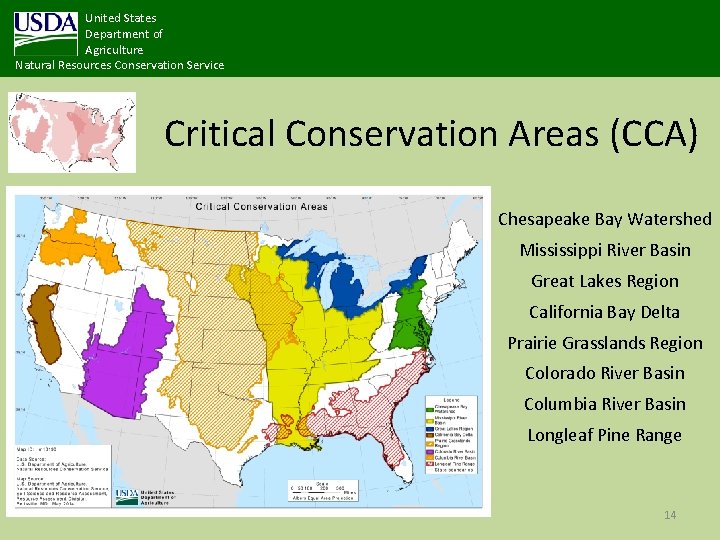
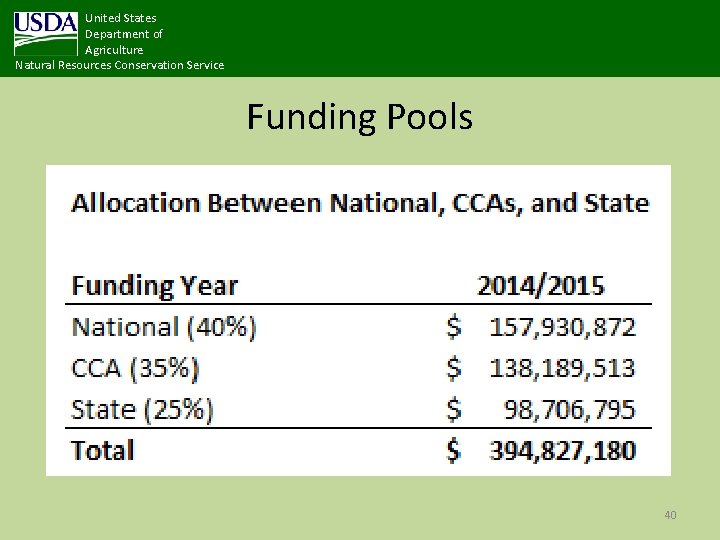
United States Department of Agriculture Natural Resources Conservation Service Funding Pools NATIONAL For nationwide and multistate projects. These receive 40 percent of funding. CRITICAL CONSERVATION AREAS For projects in eight geographic areas chosen by the Secretary of Agriculture. These receive 35 percent of funding. STATE For projects in a single state. These receive 25 percent of funding. 13
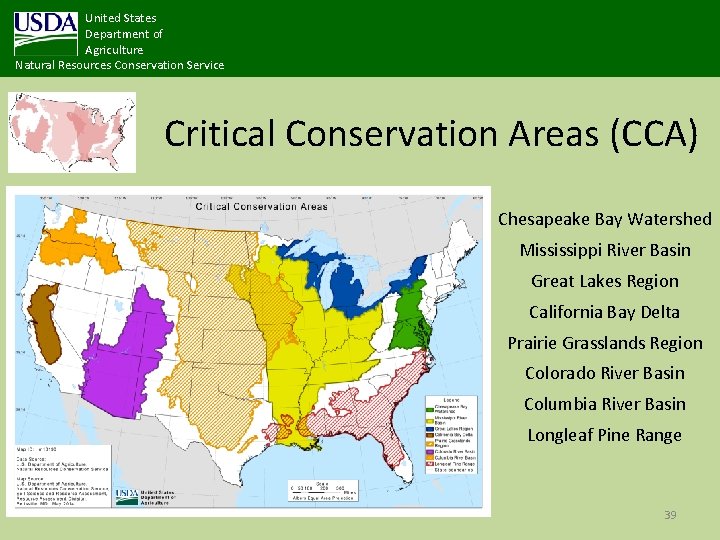
United States Department of Agriculture Natural Resources Conservation Service Critical Conservation Areas (CCA) Chesapeake Bay Watershed Mississippi River Basin Great Lakes Region California Bay Delta Prairie Grasslands Region Colorado River Basin Columbia River Basin Longleaf Pine Range 14
United States Department of Agriculture Natural Resources Conservation Service Authorities RCCP combines the authorizes of four former conservation programs: • • Agricultural Water Enhancement Program (AWEP) Chesapeake Bay Watershed Program (CBWI) Cooperative Conservation Partnership Initiative (CCPI) Great Lakes Basin Program RCPP assistance is delivered in accordance with the rules of these “covered programs”: • • • Environmental Quality Incentives Program (EQIP) Conservation Stewardship Program (CSP) Agricultural Conservation Easement Program (ACEP) Healthy Forests Reserve Program (HFRP) *Watershed Protection and Flood Prevention Act *available in Critical Conservation Areas only 15
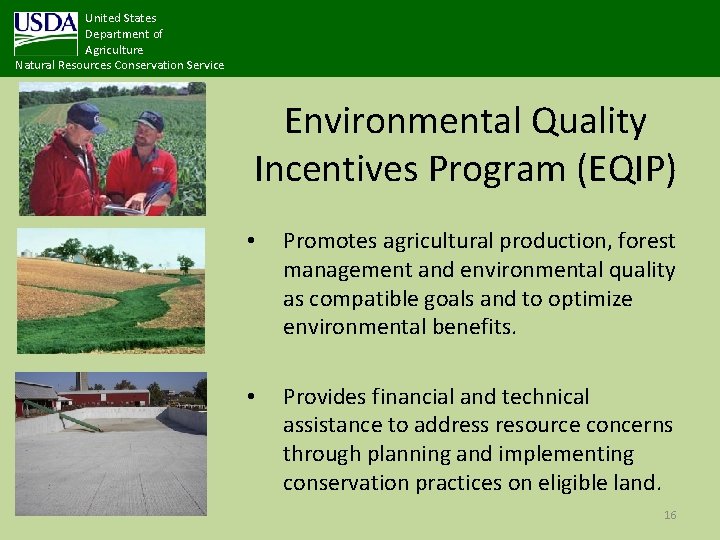
United States Department of Agriculture Natural Resources Conservation Service Environmental Quality Incentives Program (EQIP) • Promotes agricultural production, forest management and environmental quality as compatible goals and to optimize environmental benefits. • Provides financial and technical assistance to address resource concerns through planning and implementing conservation practices on eligible land. 16
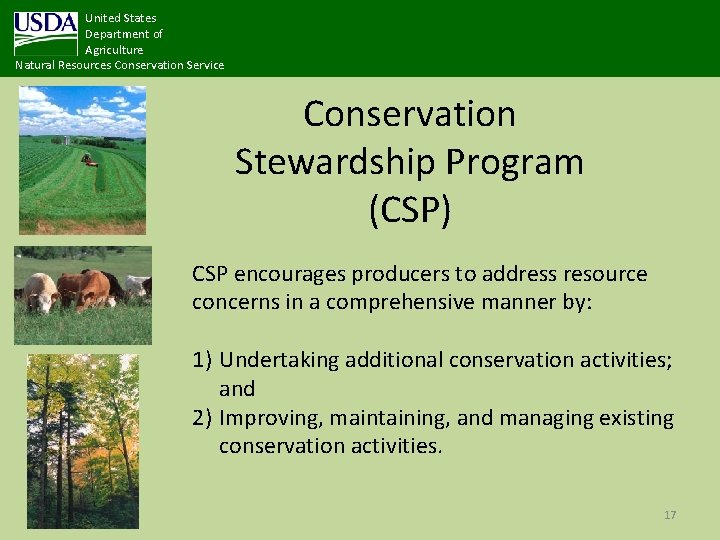
United States Department of Agriculture Natural Resources Conservation Service Conservation Stewardship Program (CSP) CSP encourages producers to address resource concerns in a comprehensive manner by: 1) Undertaking additional conservation activities; and 2) Improving, maintaining, and managing existing conservation activities. 17
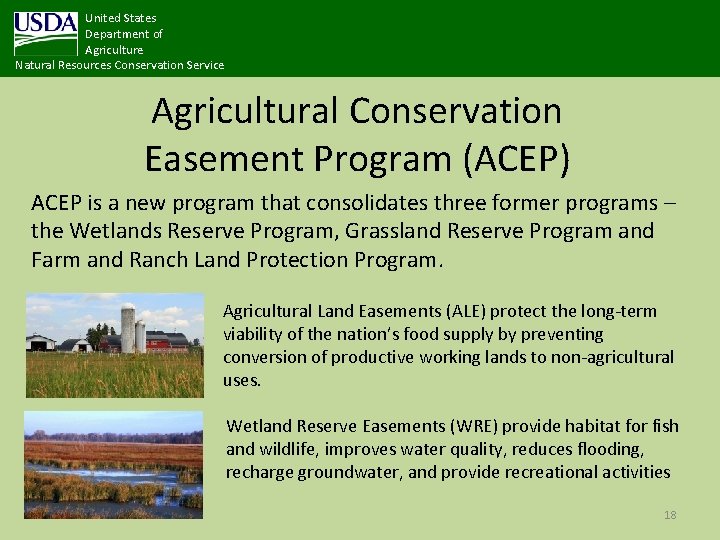
United States Department of Agriculture Natural Resources Conservation Service Agricultural Conservation Easement Program (ACEP) ACEP is a new program that consolidates three former programs – the Wetlands Reserve Program, Grassland Reserve Program and Farm and Ranch Land Protection Program. Agricultural Land Easements (ALE) protect the long-term viability of the nation’s food supply by preventing conversion of productive working lands to non-agricultural uses. Wetland Reserve Easements (WRE) provide habitat for fish and wildlife, improves water quality, reduces flooding, recharge groundwater, and provide recreational activities 18
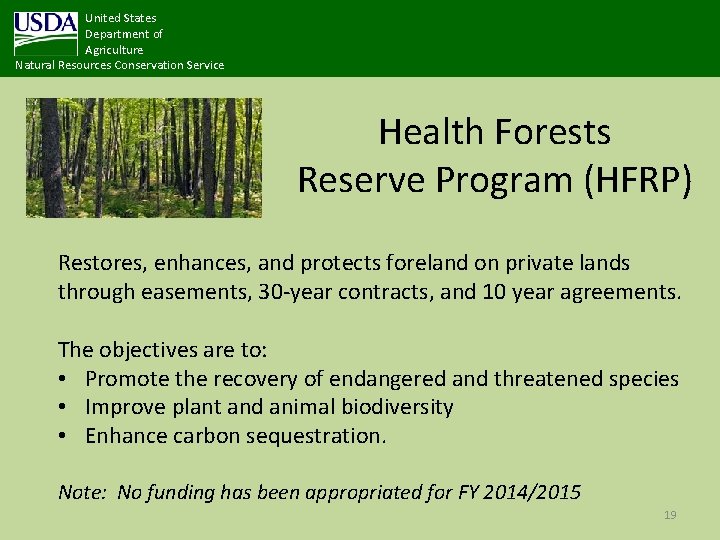
United States Department of Agriculture Natural Resources Conservation Service Health Forests Reserve Program (HFRP) Restores, enhances, and protects foreland on private lands through easements, 30 -year contracts, and 10 year agreements. The objectives are to: • Promote the recovery of endangered and threatened species • Improve plant and animal biodiversity • Enhance carbon sequestration. Note: No funding has been appropriated for FY 2014/2015 19
United States Department of Agriculture Natural Resources Conservation Service Watershed Protection and Flood Prevention Act Conduct investigation and surveys to: Determine the extent of watershed problems and needs; and set forth viable alternative solutions consistent with local, regional, and national objectives. Note: Only available in RCPP Critical Conservation Areas 20
United States Department of Agriculture Natural Resources Conservation Service Program Authorities and Adjustment of Terms • RCPP allows some flexibility in covered program rules in order to achieve high priority outcomes. • Partners may request that program adjustments provided they are within the scope of the statutory and regulatory program authorities. • Questions regarding proposed requests for RCPP flexibility may be directed to: RCPP@wdc. usda. gov 21
United States Department of Agriculture Natural Resources Conservation Service ANNOUNCEMENT FOR PROGRAM FUNDING (APF) 22
United States Department of Agriculture Natural Resources Conservation Service Announcement for Program Funding (APF) Nearly $400 million in funding (2014/2015 funds) is available for RCPP. NRCS anticipates publishing an annual APF to award new projects each year. 23
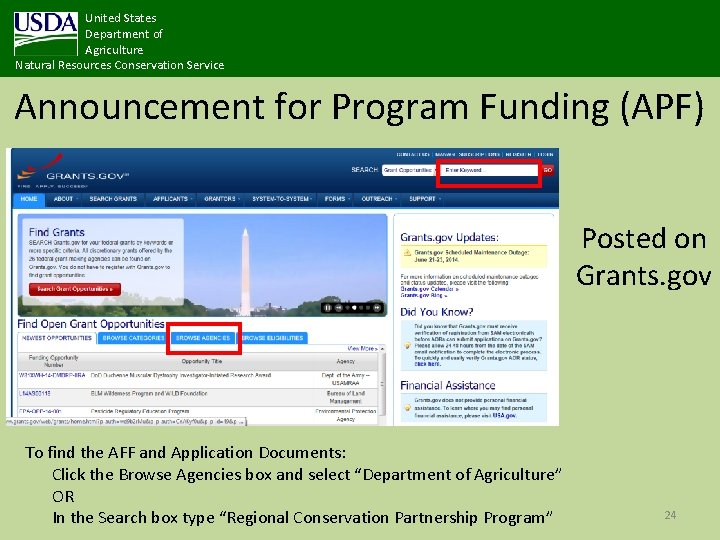
United States Department of Agriculture Natural Resources Conservation Service Announcement for Program Funding (APF) Posted on Grants. gov To find the AFF and Application Documents: Click the Browse Agencies box and select “Department of Agriculture” OR In the Search box type “Regional Conservation Partnership Program” 24
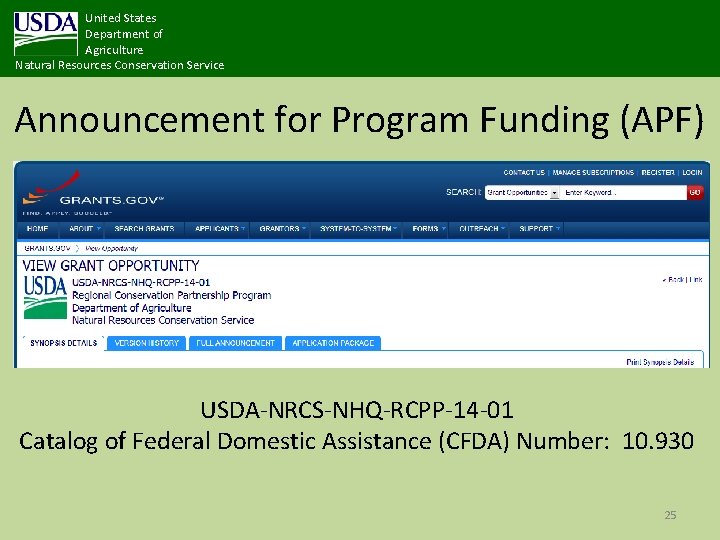
United States Department of Agriculture Natural Resources Conservation Service Announcement for Program Funding (APF) USDA-NRCS-NHQ-RCPP-14 -01 Catalog of Federal Domestic Assistance (CFDA) Number: 10. 930 25
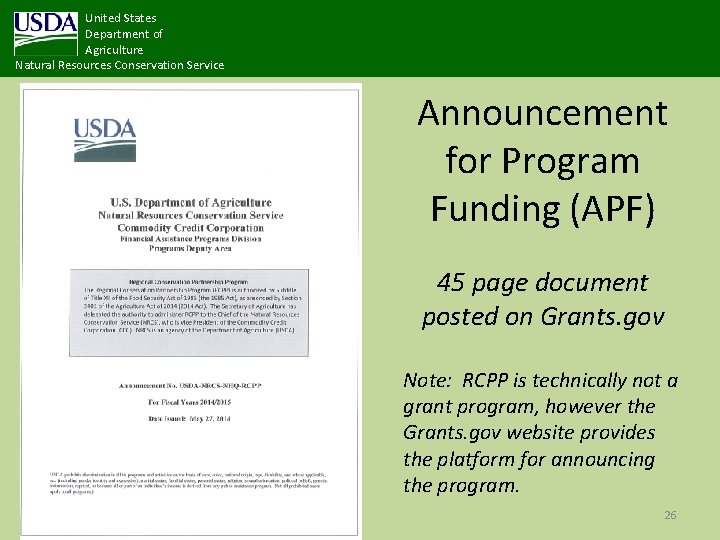
United States Department of Agriculture Natural Resources Conservation Service Announcement for Program Funding (APF) 45 page document posted on Grants. gov Note: RCPP is technically not a grant program, however the Grants. gov website provides the platform for announcing the program. 26
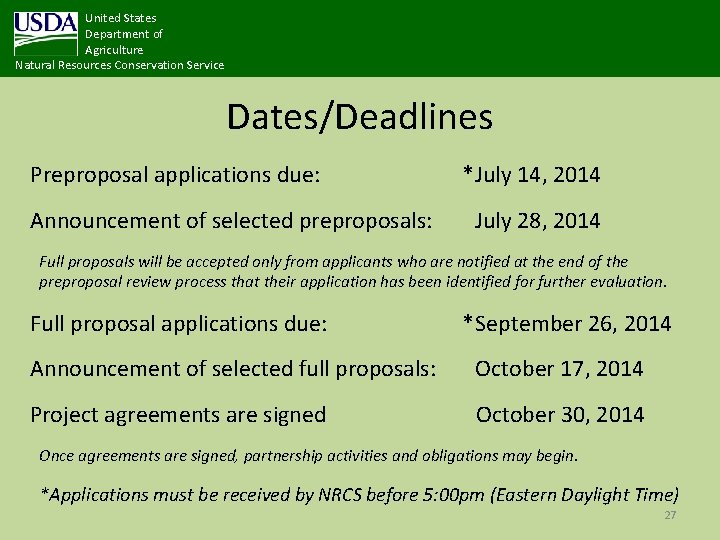
United States Department of Agriculture Natural Resources Conservation Service Dates/Deadlines Preproposal applications due: Announcement of selected preproposals: *July 14, 2014 July 28, 2014 Full proposals will be accepted only from applicants who are notified at the end of the preproposal review process that their application has been identified for further evaluation. Full proposal applications due: *September 26, 2014 Announcement of selected full proposals: October 17, 2014 Project agreements are signed October 30, 2014 Once agreements are signed, partnership activities and obligations may begin. *Applications must be received by NRCS before 5: 00 pm (Eastern Daylight Time) 27
United States Department of Agriculture Natural Resources Conservation Service Preproposal & Full Proposal Application Requirements Following the instructions as stated in the Announcement for Program Funding (APF). o Follow the format instructions o Include in the proposal all of the requested information as stated in the APF. 28
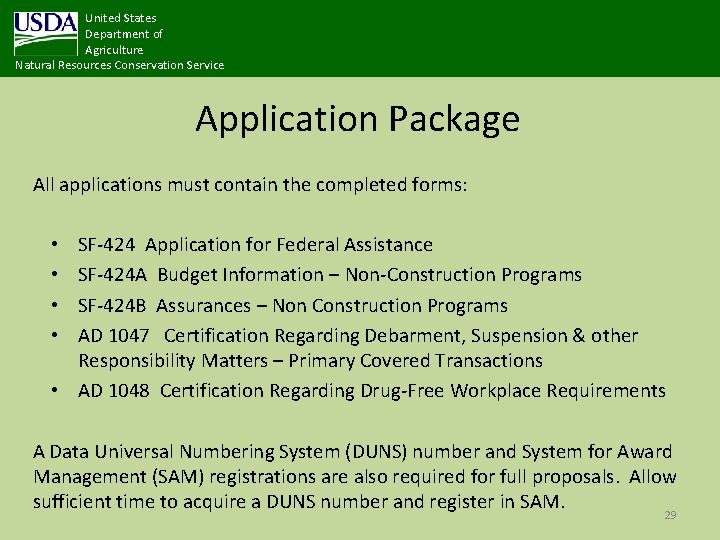
United States Department of Agriculture Natural Resources Conservation Service Application Package All applications must contain the completed forms: SF-424 Application for Federal Assistance SF-424 A Budget Information – Non-Construction Programs SF-424 B Assurances – Non Construction Programs AD 1047 Certification Regarding Debarment, Suspension & other Responsibility Matters – Primary Covered Transactions • AD 1048 Certification Regarding Drug-Free Workplace Requirements • • A Data Universal Numbering System (DUNS) number and System for Award Management (SAM) registrations are also required for full proposals. Allow sufficient time to acquire a DUNS number and register in SAM. 29
United States Department of Agriculture Natural Resources Conservation Service Application Submissions All applications must be sent to NRCS National Headquarters. Partners may submit applications using ONE of the three methods described below. Partners should not send applications using more than one method. • The preferred method of submission is by email to RCPP@wdc. usda. gov • Applicants may send a paper copy to: Mark A. Rose, Director Financial Assistance Programs Division Department of Agriculture Natural Resources Conservation Service RCPP Application P. O. Box 2890 Washington, D. C. 20013 -2890 • Applicants may submit the application electronically on Grants. gov For applicants submitting an application for the State funding pool, the applicant must also 30 provide a copy of the application to the appropriate State Conservationist.
United States Department of Agriculture Natural Resources Conservation Service Eligible Partners Eligible partnering organizations include: An agricultural or silvicultural producer association or other group of producers; A state or unit of local government; An Indian Tribe; A farmer cooperative; A water district, irrigation district, rural water district or association or other organization with specific water delivery authority to producers on agricultural land; • A municipal water or wastewater treatment entity; • An institution of higher education; • An organization or entity with an established history of working cooperatively with producers on agricultural land, as determined by NRCS, to address – o Local conservation priorities related to agricultural production, wildlife habitat development, or nonindustrial private forest land management, or o Critical watershed-scale soil erosion, water quality, sediment reduction, or other natural resource issues 31 • • •
United States Department of Agriculture Natural Resources Conservation Service Land Eligibility The following land, including Tribal land, is eligible for enrollment in the RCPP: • • • Cropland Grassland Rangeland Pastureland Nonindustrial private forest land Other land incidental to agricultural production (including wetlands and riparian buffers) on which significant natural resource issues could be addressed under the program. 32
United States Department of Agriculture Natural Resources Conservation Service Leveraging Funds • RCPP requires significant contributions from the partners. • The "significant contribution" that partners must bring to selected projects can include in-kind contributions, such as outreach, monitoring, conservation planning, and producer assistance. Partners may also include administrative services that they provide in the calculation of their contribution to the project. Partners should consider the total benefit they expect to bring to the project. • Priority will be given to those applications that significantly leverage non-Federal financial and technical resources. NRCS has a goal of leveraging an amount equal to the Federal investment; therefore, partner applications that meet or exceed the amount requested 33 from NRCS (direct or in-kind) will be the most competitive.
United States Department of Agriculture Natural Resources Conservation Service Proposals • Project areas may be defined by geo-political boundaries, watershed boundaries, agricultural land uses, or regional natural resource concerns. • The project area does not need to be contiguous, but the geographic boundaries need to be described. • The project must address at least one identified priority. • All projects will be equally evaluated, regardless of size. 34
United States Department of Agriculture Natural Resources Conservation Service Proposals • Applicants must identify one specific funding pool (i. e. National, Critical Conservation Area, State) in which to compete in accordance with the criteria established in this notice. • Only one application is to be submitted per project. However, applicants may submit more than one application, as long as the proposals are for distinctly different projects. If an applicant wishes to submit multiple applications, the applicant must identify and provide clear evidence that project activities under one application are distinct from any other application. 35
United States Department of Agriculture Natural Resources Conservation Service Funding Through APF will be provided to Eligible: • Partners for the provision of financial assistance (FA) and technical assistance (TA) or both • Producers or landowners through program contracts or easement agreements; • Entities through agreements for the purchase of ACEP Agricultural Land Easements; • Partners for the provision of TA; • Partners through alternative funding arrangements with multistate water resource agency or authorities. These funds will be paid to producers and landowners through program contracts or easement agreements in accordance with program requirements. They may also be paid to partners to provide TA to implement the RCPP project. 36
United States Department of Agriculture Natural Resources Conservation Service Funding NRCS funds may not be used for the partner's administrative expenses (for example, rent, utilities, space used by staff, copies, phones, IT support, etc. , that are used by all staff and not directly related to the project). 37
United States Department of Agriculture Natural Resources Conservation Service National Funding Pool Priority will be given to multistate projects. National priorities for Fiscal Year 2014/2015: 1. 2. 3. 4. 5. Water quantity Water quality Soil health At risk species habitat Air quality 38
United States Department of Agriculture Natural Resources Conservation Service Critical Conservation Areas (CCA) Chesapeake Bay Watershed Mississippi River Basin Great Lakes Region California Bay Delta Prairie Grasslands Region Colorado River Basin Columbia River Basin Longleaf Pine Range 39
United States Department of Agriculture Natural Resources Conservation Service Funding Pools 40
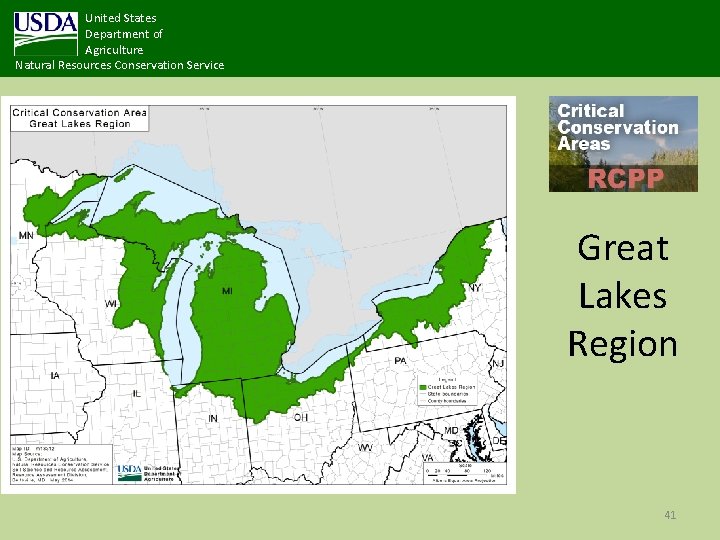
United States Department of Agriculture Natural Resources Conservation Service Great Lakes Region 41
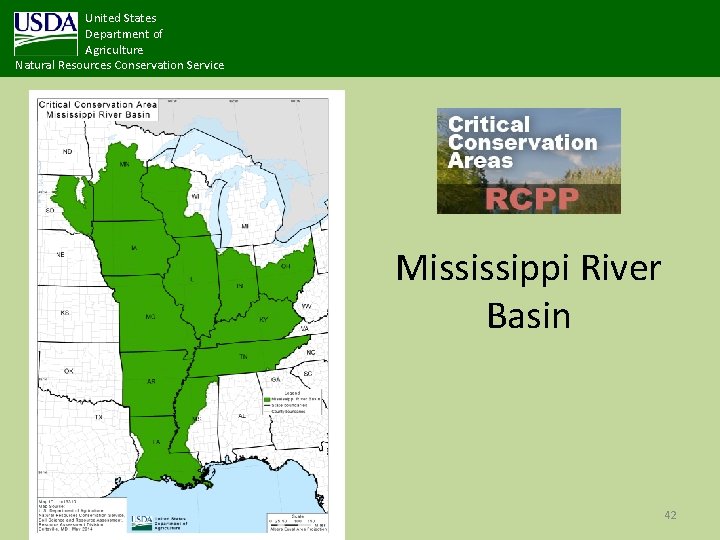
United States Department of Agriculture Natural Resources Conservation Service Mississippi River Basin 42
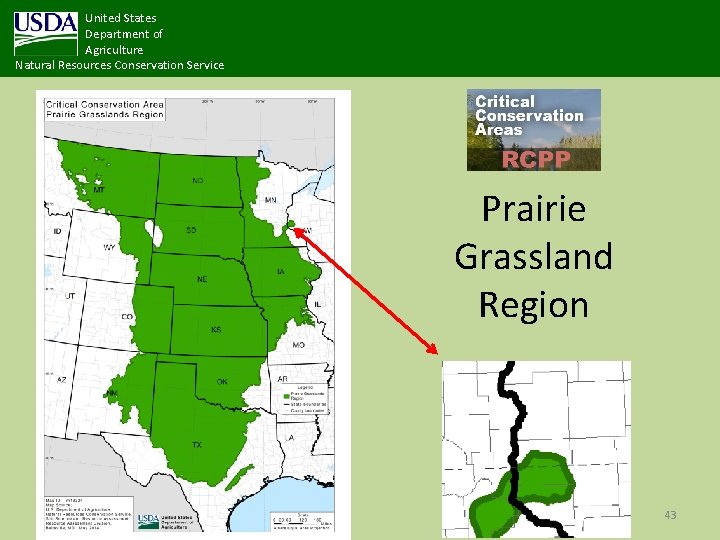
United States Department of Agriculture Natural Resources Conservation Service Prairie Grassland Region 43
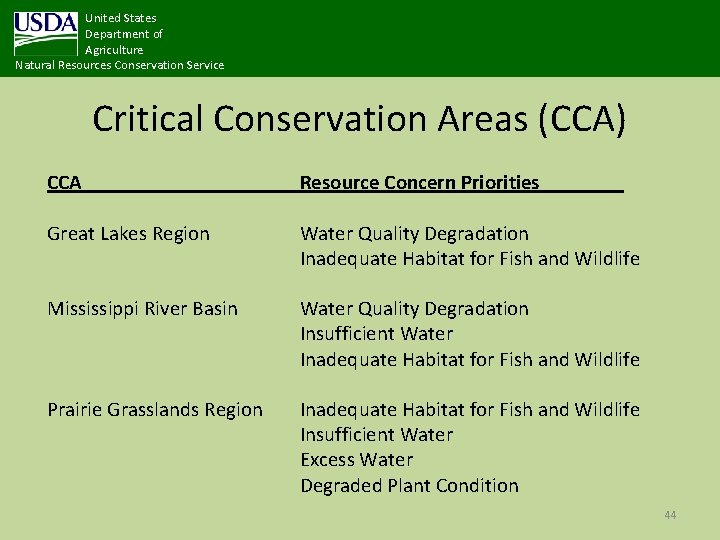
United States Department of Agriculture Natural Resources Conservation Service Critical Conservation Areas (CCA) CCA Resource Concern Priorities Great Lakes Region Water Quality Degradation Inadequate Habitat for Fish and Wildlife Mississippi River Basin Water Quality Degradation Insufficient Water Inadequate Habitat for Fish and Wildlife Prairie Grasslands Region Inadequate Habitat for Fish and Wildlife Insufficient Water Excess Water Degraded Plant Condition 44
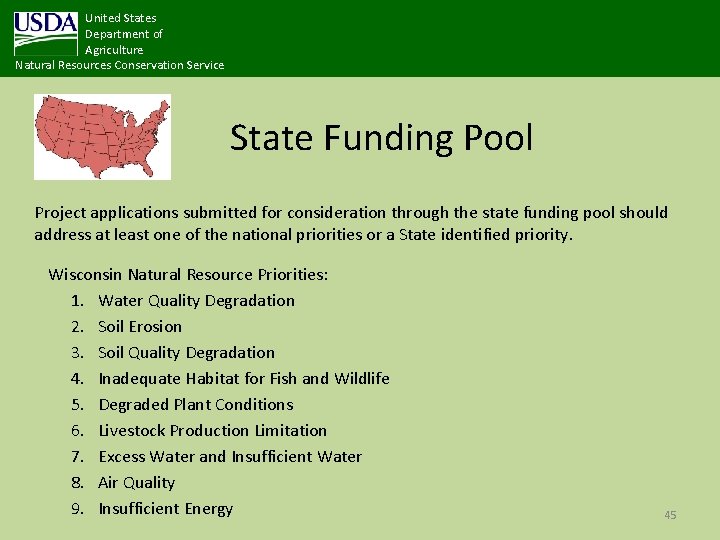
United States Department of Agriculture Natural Resources Conservation Service State Funding Pool Project applications submitted for consideration through the state funding pool should address at least one of the national priorities or a State identified priority. Wisconsin Natural Resource Priorities: 1. Water Quality Degradation 2. Soil Erosion 3. Soil Quality Degradation 4. Inadequate Habitat for Fish and Wildlife 5. Degraded Plant Conditions 6. Livestock Production Limitation 7. Excess Water and Insufficient Water 8. Air Quality 9. Insufficient Energy 45
United States Department of Agriculture Natural Resources Conservation Service State Funding Pool Preproposal applications for the State funding pool must also provide a copy of the preproposal application and, if selected, the full proposal to NRCS State Conservationist by email (preferred) or U. S. Postal mail. Jimmy Bramblett State Conservationist 8030 Excelsior Drive, Suite 200 Madison, WI 53717 Jimmy. bramblett@wi. usda. gov 608 -662 -4422 ext. 222 46
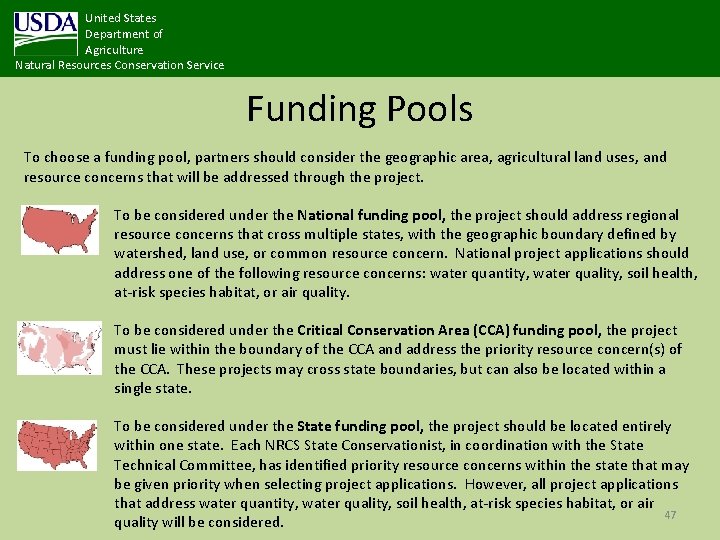
United States Department of Agriculture Natural Resources Conservation Service Funding Pools To choose a funding pool, partners should consider the geographic area, agricultural land uses, and resource concerns that will be addressed through the project. To be considered under the National funding pool, the project should address regional resource concerns that cross multiple states, with the geographic boundary defined by watershed, land use, or common resource concern. National project applications should address one of the following resource concerns: water quantity, water quality, soil health, at-risk species habitat, or air quality. To be considered under the Critical Conservation Area (CCA) funding pool, the project must lie within the boundary of the CCA and address the priority resource concern(s) of the CCA. These projects may cross state boundaries, but can also be located within a single state. To be considered under the State funding pool, the project should be located entirely within one state. Each NRCS State Conservationist, in coordination with the State Technical Committee, has identified priority resource concerns within the state that may be given priority when selecting project applications. However, all project applications that address water quantity, water quality, soil health, at-risk species habitat, or air 47 quality will be considered.
United States Department of Agriculture Natural Resources Conservation Service Partnership Agreements Partnership agreements may be in duration from 1 to 5 years in length; as identified by the partner in their proposal application. 48
United States Department of Agriculture Natural Resources Conservation Service Partnership Agreements • NRCS will conduct a competitive process to select applications for partnership agreements. • The criteria used in evaluating project proposals is listed in the APF and will be on the website. • Multistate projects will have a lead state selected for each project to develop and enter into the partnership agreements, using a national template. 49
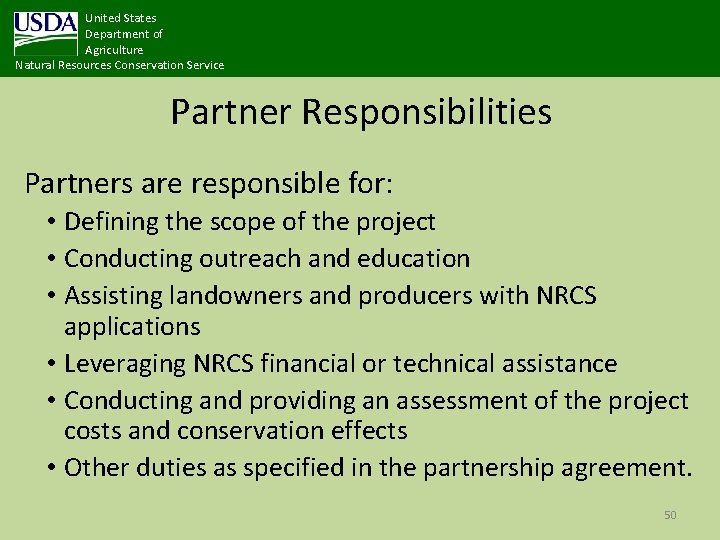
United States Department of Agriculture Natural Resources Conservation Service Partner Responsibilities Partners are responsible for: • Defining the scope of the project • Conducting outreach and education • Assisting landowners and producers with NRCS applications • Leveraging NRCS financial or technical assistance • Conducting and providing an assessment of the project costs and conservation effects • Other duties as specified in the partnership agreement. 50
United States Department of Agriculture Natural Resources Conservation Service RCPP RESOURCES 51
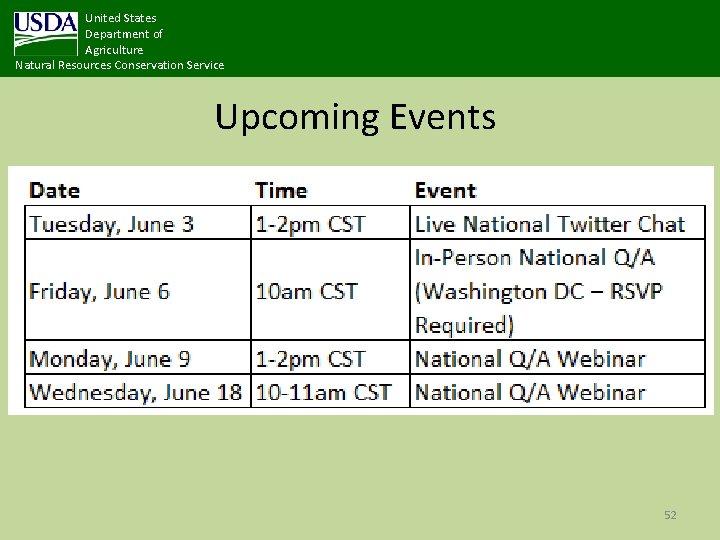
United States Department of Agriculture Natural Resources Conservation Service Upcoming Events 52
United States Department of Agriculture Natural Resources Conservation Service Wisconsin NRCS RCPP Contacts Jimmy Bramblett State Conservationist jimmy. bramblett@wi. usda. gov 608 -662 -4422 ext. 222 Renae Anderson Public Affairs Specialist renae. Anderson@wi. usda. gov 608 -662 -4422 ext. 227 Eric Allness Resource Conservationist eric. allness@wi. usda. gov 608 -662 -4422 ext. 246 Tom Krapf Assistant State Conservationist – Financial Assistance Programs tom. krapf@wi. usda. gov 608 -662 -4422 ext. 232 Ron Howard Assistant State Conservationist Easements ron. howard@wi. usda. gov 608 -662 -4422 ext. 252 53
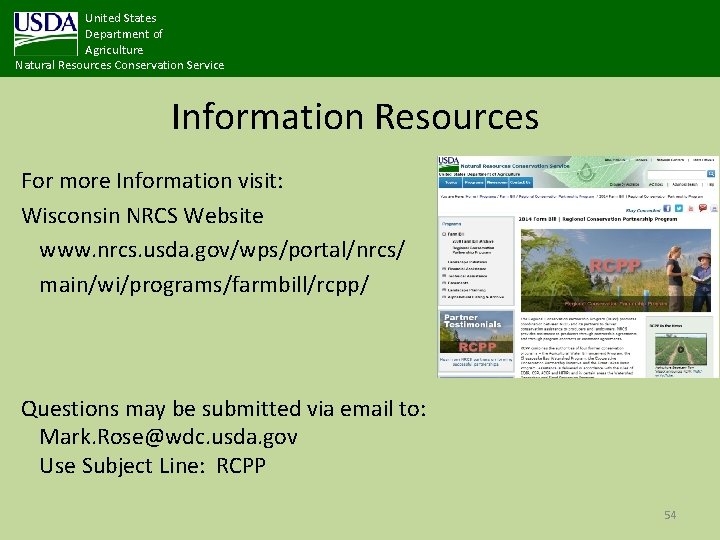
United States Department of Agriculture Natural Resources Conservation Service Information Resources For more Information visit: Wisconsin NRCS Website www. nrcs. usda. gov/wps/portal/nrcs/ main/wi/programs/farmbill/rcpp/ Questions may be submitted via email to: Mark. Rose@wdc. usda. gov Use Subject Line: RCPP 54
United States Department of Agriculture Natural Resources Conservation Service Questions USDA is an equal opportunity provider and employer. 55