
United States Department of Agriculture Food Safety and
- Slides: 21
United States Department of Agriculture Food Safety and Inspection Service Recordkeeping: A Public Health Vulnerability 1
United States Department of Agriculture Food Safety and Inspection Service BACKGROUND • FSIS is the public health agency in the U. S. Department of Agriculture responsible for ensuring that the nation's commercial supply of meat, poultry, and egg products is safe, wholesome, and correctly labeled and packaged 2
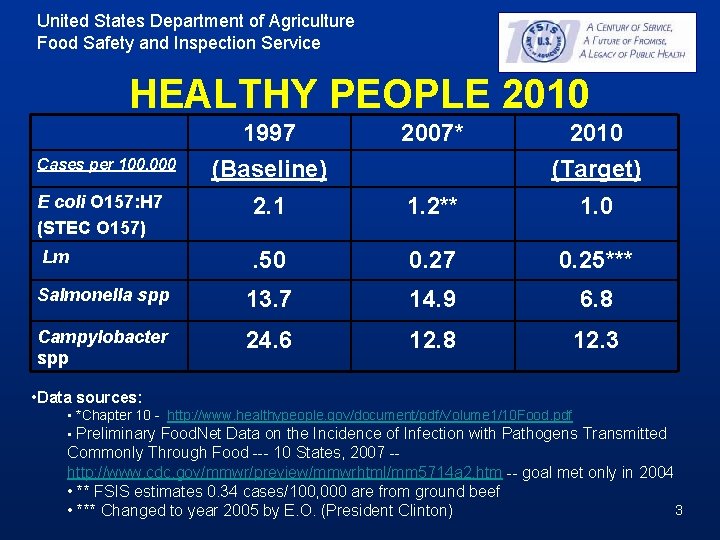
United States Department of Agriculture Food Safety and Inspection Service HEALTHY PEOPLE 2010 1997 Cases per 100, 000 2007* (Baseline) 2010 (Target) E coli O 157: H 7 (STEC O 157) 2. 1 1. 2** 1. 0 Lm . 50 0. 27 0. 25*** Salmonella spp 13. 7 14. 9 6. 8 Campylobacter spp 24. 6 12. 8 12. 3 • Data sources: • *Chapter 10 - http: //www. healthypeople. gov/document/pdf/Volume 1/10 Food. pdf • Preliminary Food. Net Data on the Incidence of Infection with Pathogens Transmitted Commonly Through Food --- 10 States, 2007 -http: //www. cdc. gov/mmwr/preview/mmwrhtml/mm 5714 a 2. htm -- goal met only in 2004 • ** FSIS estimates 0. 34 cases/100, 000 are from ground beef 3 • *** Changed to year 2005 by E. O. (President Clinton)
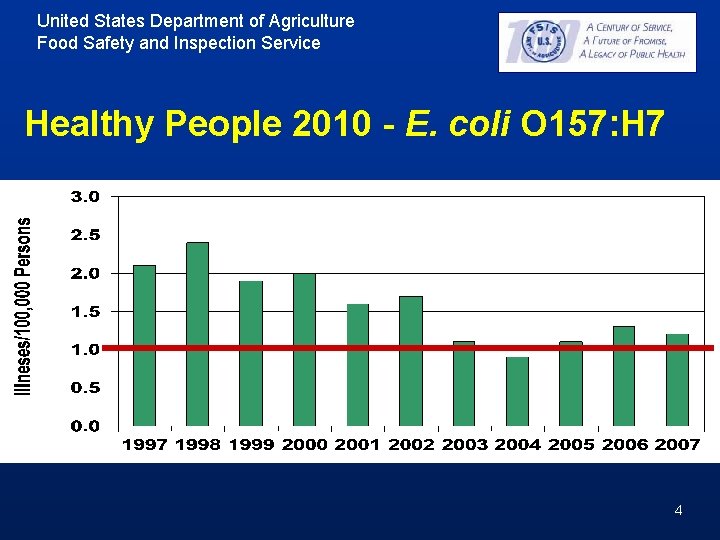
United States Department of Agriculture Food Safety and Inspection Service Healthy People 2010 - E. coli O 157: H 7 4
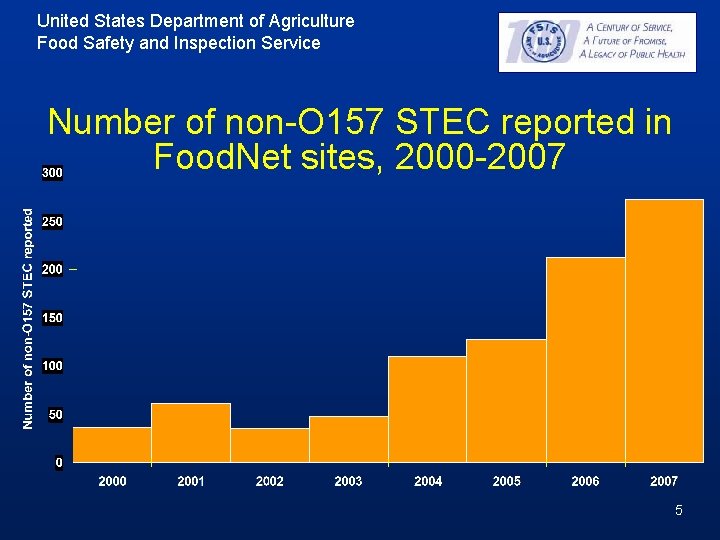
United States Department of Agriculture Food Safety and Inspection Service Number of non-O 157 STEC reported in Food. Net sites, 2000 -2007 5
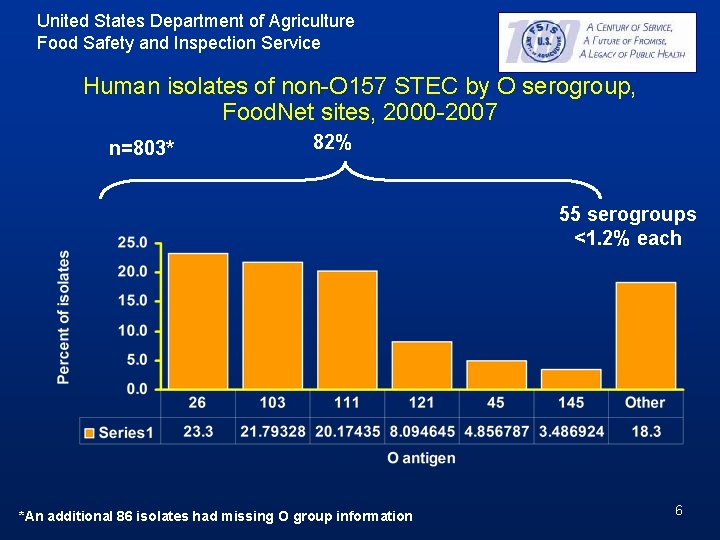
United States Department of Agriculture Food Safety and Inspection Service Human isolates of non-O 157 STEC by O serogroup, Food. Net sites, 2000 -2007 n=803* 82% 55 serogroups <1. 2% each *An additional 86 isolates had missing O group information 6
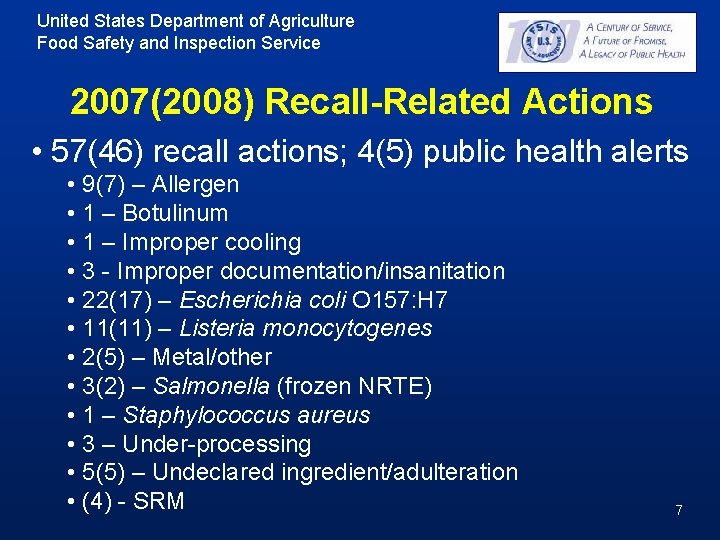
United States Department of Agriculture Food Safety and Inspection Service 2007(2008) Recall-Related Actions • 57(46) recall actions; 4(5) public health alerts • 9(7) – Allergen • 1 – Botulinum • 1 – Improper cooling • 3 - Improper documentation/insanitation • 22(17) – Escherichia coli O 157: H 7 • 11(11) – Listeria monocytogenes • 2(5) – Metal/other • 3(2) – Salmonella (frozen NRTE) • 1 – Staphylococcus aureus • 3 – Under-processing • 5(5) – Undeclared ingredient/adulteration • (4) - SRM 7
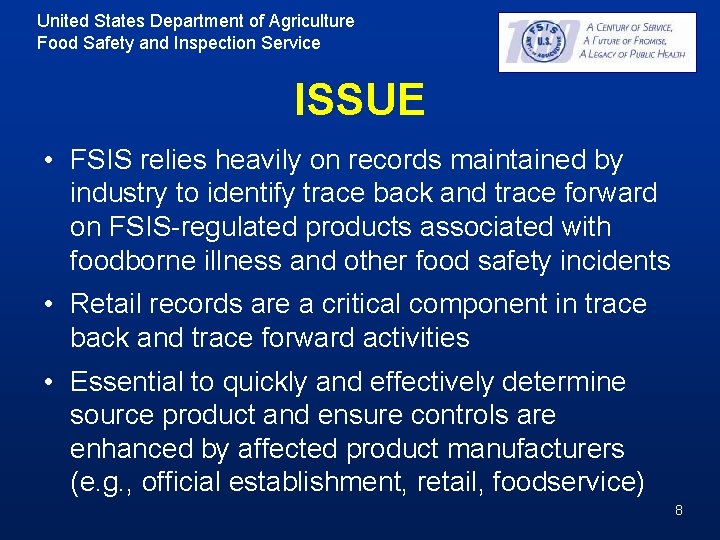
United States Department of Agriculture Food Safety and Inspection Service ISSUE • FSIS relies heavily on records maintained by industry to identify trace back and trace forward on FSIS-regulated products associated with foodborne illness and other food safety incidents • Retail records are a critical component in trace back and trace forward activities • Essential to quickly and effectively determine source product and ensure controls are enhanced by affected product manufacturers (e. g. , official establishment, retail, foodservice) 8
United States Department of Agriculture Food Safety and Inspection Service Statutes & Regulations • 21 U. S. C. 621 authorizes Secretary to make rules and regulations necessary for the efficient execution of the statutes • 21 U. S. C. 642 requires firms to keep and make available full and correct business records of transactions in food • 9 CFR 320. 1 specifies businesses and types of records required, such as bills of sale, bills of lading, receiving and shipping papers • Similar authorities for poultry 9
United States Department of Agriculture Food Safety and Inspection Service Agency Responsibilities • OPHS epi-officers lead agency illness outbreak investigations • OPEER investigators conduct trace back and trace forward investigations for outbreak investigations & other public health activities • OPEER investigators conduct periodic surveillance in-commerce, including at retail, and collect ground beef samples to enhance public health protection and decision making 10
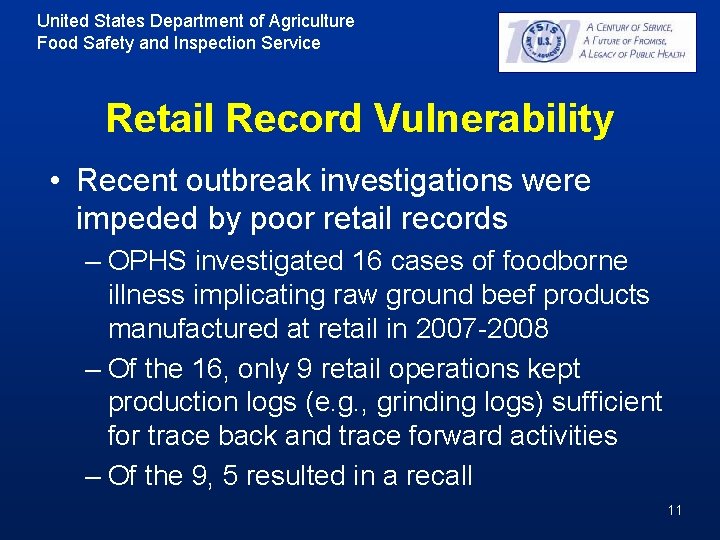
United States Department of Agriculture Food Safety and Inspection Service Retail Record Vulnerability • Recent outbreak investigations were impeded by poor retail records – OPHS investigated 16 cases of foodborne illness implicating raw ground beef products manufactured at retail in 2007 -2008 – Of the 16, only 9 retail operations kept production logs (e. g. , grinding logs) sufficient for trace back and trace forward activities – Of the 9, 5 resulted in a recall 11
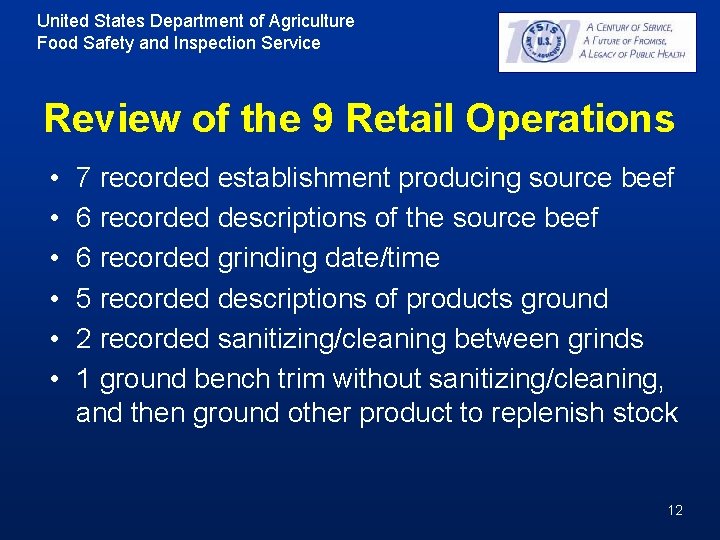
United States Department of Agriculture Food Safety and Inspection Service Review of the 9 Retail Operations • • • 7 recorded establishment producing source beef 6 recorded descriptions of the source beef 6 recorded grinding date/time 5 recorded descriptions of products ground 2 recorded sanitizing/cleaning between grinds 1 ground bench trim without sanitizing/cleaning, and then ground other product to replenish stock 12
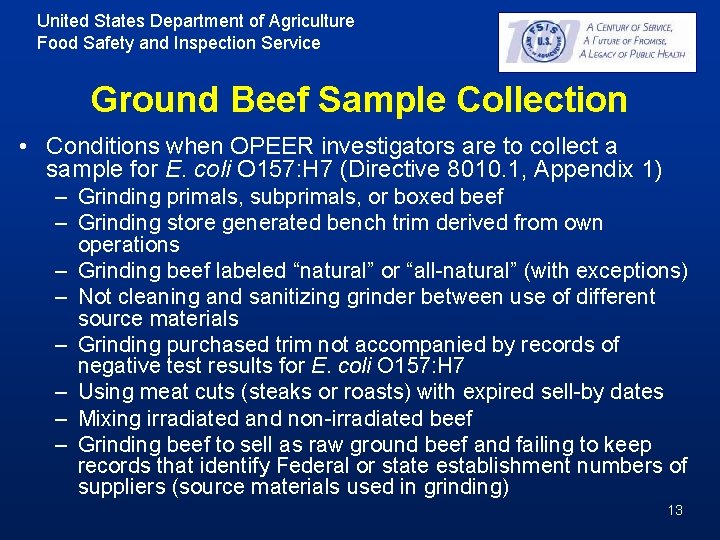
United States Department of Agriculture Food Safety and Inspection Service Ground Beef Sample Collection • Conditions when OPEER investigators are to collect a sample for E. coli O 157: H 7 (Directive 8010. 1, Appendix 1) – Grinding primals, subprimals, or boxed beef – Grinding store generated bench trim derived from own operations – Grinding beef labeled “natural” or “all-natural” (with exceptions) – Not cleaning and sanitizing grinder between use of different source materials – Grinding purchased trim not accompanied by records of negative test results for E. coli O 157: H 7 – Using meat cuts (steaks or roasts) with expired sell-by dates – Mixing irradiated and non-irradiated beef – Grinding beef to sell as raw ground beef and failing to keep records that identify Federal or state establishment numbers of suppliers (source materials used in grinding) 13
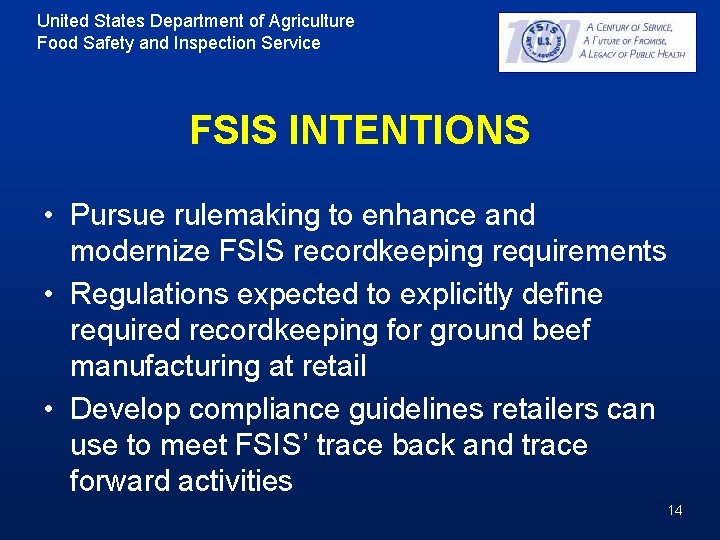
United States Department of Agriculture Food Safety and Inspection Service FSIS INTENTIONS • Pursue rulemaking to enhance and modernize FSIS recordkeeping requirements • Regulations expected to explicitly define required recordkeeping for ground beef manufacturing at retail • Develop compliance guidelines retailers can use to meet FSIS’ trace back and trace forward activities 14
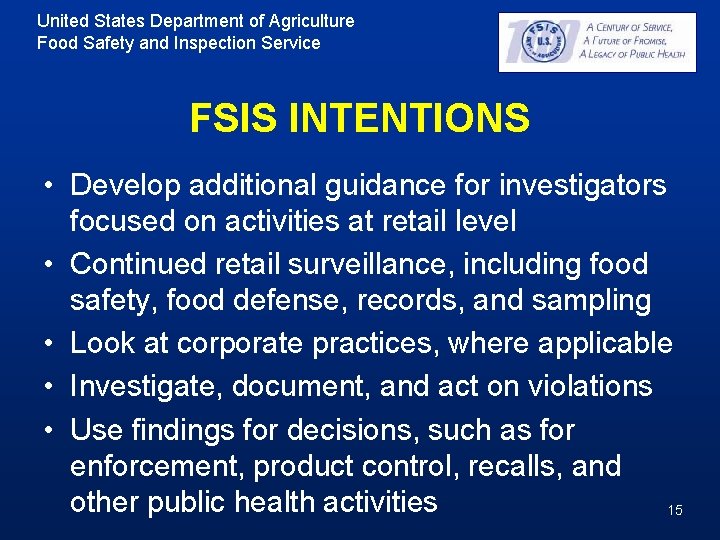
United States Department of Agriculture Food Safety and Inspection Service FSIS INTENTIONS • Develop additional guidance for investigators focused on activities at retail level • Continued retail surveillance, including food safety, food defense, records, and sampling • Look at corporate practices, where applicable • Investigate, document, and act on violations • Use findings for decisions, such as for enforcement, product control, recalls, and other public health activities 15
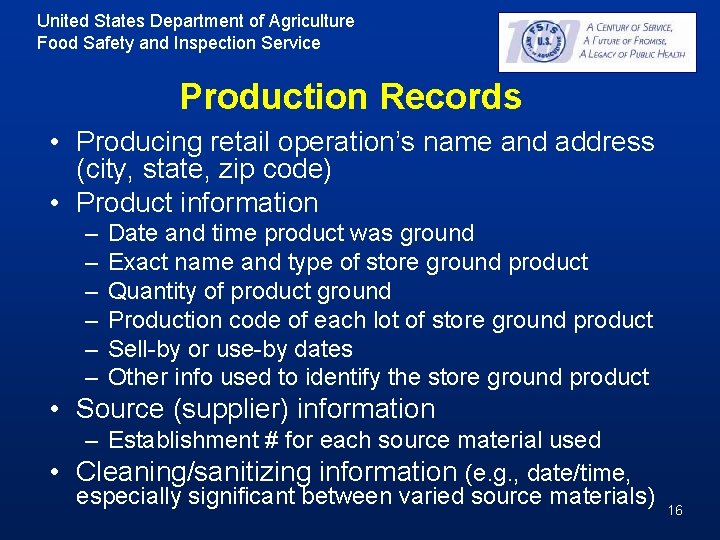
United States Department of Agriculture Food Safety and Inspection Service Production Records • Producing retail operation’s name and address (city, state, zip code) • Product information – – – Date and time product was ground Exact name and type of store ground product Quantity of product ground Production code of each lot of store ground product Sell-by or use-by dates Other info used to identify the store ground product • Source (supplier) information – Establishment # for each source material used • Cleaning/sanitizing information (e. g. , date/time, especially significant between varied source materials) 16
United States Department of Agriculture Food Safety and Inspection Service Other Information • Telephone numbers of retail store • Store contact person and phone # • Number of outside/shipping containers of each source product • Club Card information (if applicable) • Retail store’s pull-date policy • Retail store’s rework policy • Retail store’s cleaning and sanitizing policy 17
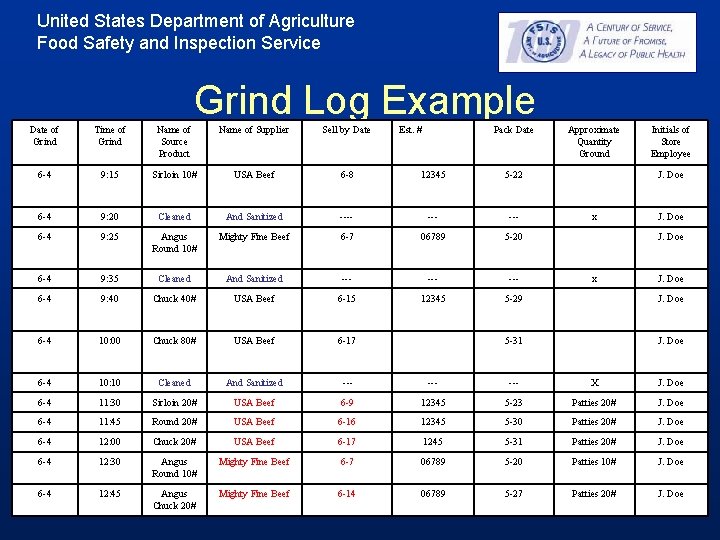
United States Department of Agriculture Food Safety and Inspection Service Grind Log Example Date of Grind Time of Grind Name of Source Product Name of Supplier Sell by Date Est. # Pack Date Approximate Quantity Ground Initials of Store Employee 6 -4 9: 15 Sirloin 10# USA Beef 6 -8 12345 5 -22 6 -4 9: 20 Cleaned And Sanitized ---- --- 6 -4 9: 25 Angus Round 10# Mighty Fine Beef 6 -7 06789 5 -20 6 -4 9: 35 Cleaned And Sanitized --- --- 6 -4 9: 40 Chuck 40# USA Beef 6 -15 12345 5 -29 J. Doe 6 -4 10: 00 Chuck 80# USA Beef 6 -17 5 -31 J. Doe 6 -4 10: 10 Cleaned And Sanitized --- --- X J. Doe 6 -4 11: 30 Sirloin 20# USA Beef 6 -9 12345 5 -23 Patties 20# J. Doe 6 -4 11: 45 Round 20# USA Beef 6 -16 12345 5 -30 Patties 20# J. Doe 6 -4 12: 00 Chuck 20# USA Beef 6 -17 1245 5 -31 Patties 20# J. Doe 6 -4 12: 30 Angus Round 10# Mighty Fine Beef 6 -7 06789 5 -20 Patties 10# J. Doe 6 -4 12: 45 Angus Chuck 20# Mighty Fine Beef 6 -14 06789 5 -27 Patties 20# J. Doe x J. Doe 18
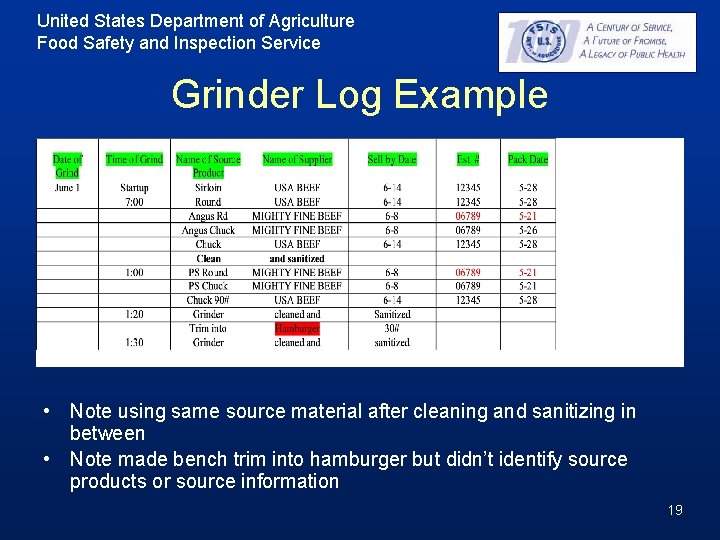
United States Department of Agriculture Food Safety and Inspection Service Grinder Log Example • Note using same source material after cleaning and sanitizing in between • Note made bench trim into hamburger but didn’t identify source products or source information 19
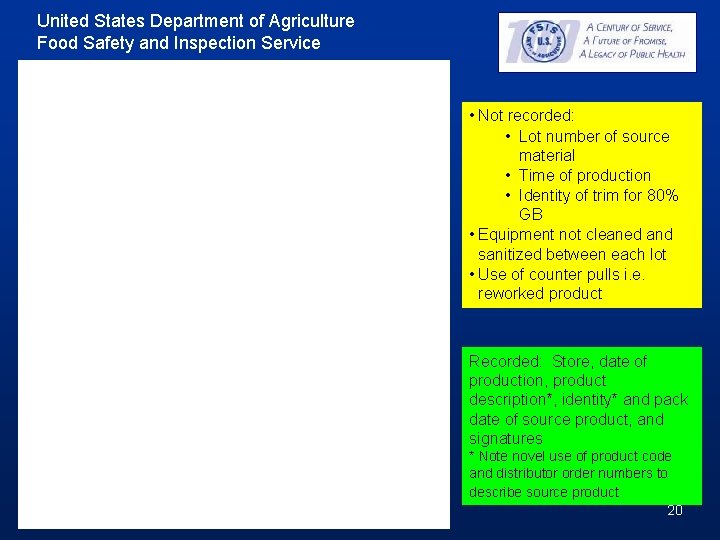
United States Department of Agriculture Food Safety and Inspection Service • Not recorded: • Lot number of source material • Time of production • Identity of trim for 80% GB • Equipment not cleaned and sanitized between each lot • Use of counter pulls i. e. reworked product Recorded: Store, date of production, product description*, identity* and pack date of source product, and signatures * Note novel use of product code and distributor order numbers to describe source product 20
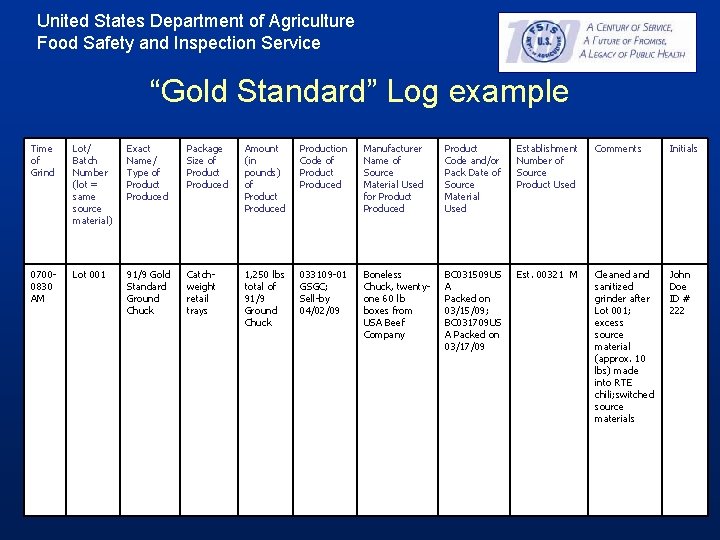
United States Department of Agriculture Food Safety and Inspection Service “Gold Standard” Log example Time of Grind Lot/ Batch Number (lot = same source material) Exact Name/ Type of Product Produced Package Size of Product Produced Amount (in pounds) of Product Produced Production Code of Product Produced Manufacturer Name of Source Material Used for Product Produced Product Code and/or Pack Date of Source Material Used Establishment Number of Source Product Used Comments Initials 07000830 AM Lot 001 91/9 Gold Standard Ground Chuck Catchweight retail trays 1, 250 lbs total of 91/9 Ground Chuck 033109 -01 GSGC; Sell-by 04/02/09 Boneless Chuck, twentyone 60 lb boxes from USA Beef Company BC 031509 US A Packed on 03/15/09; BC 031709 US A Packed on 03/17/09 Est. 00321 M Cleaned and sanitized grinder after Lot 001; excess source material (approx. 10 lbs) made into RTE chili; switched source materials John Doe ID # 222 21