
United States Department of Agriculture Assisted Migration Intentionally


- Slides: 15
United States Department of Agriculture Assisted Migration: Intentionally moving species or populations to mitigate changes in climate R. Kasten Dumroese and Mary I. Williams U. S. Forest Service IUFRO ― International Conference on Forest Landscape Restoration under Global Change, San Juan, Puerto Rico, 6 -9 June 2017
Summary • AM provides another option in our climate mitigation toolbox • Move populations of a species, expand a species range, or long-distance as a last resort • Pros and cons depend on the context
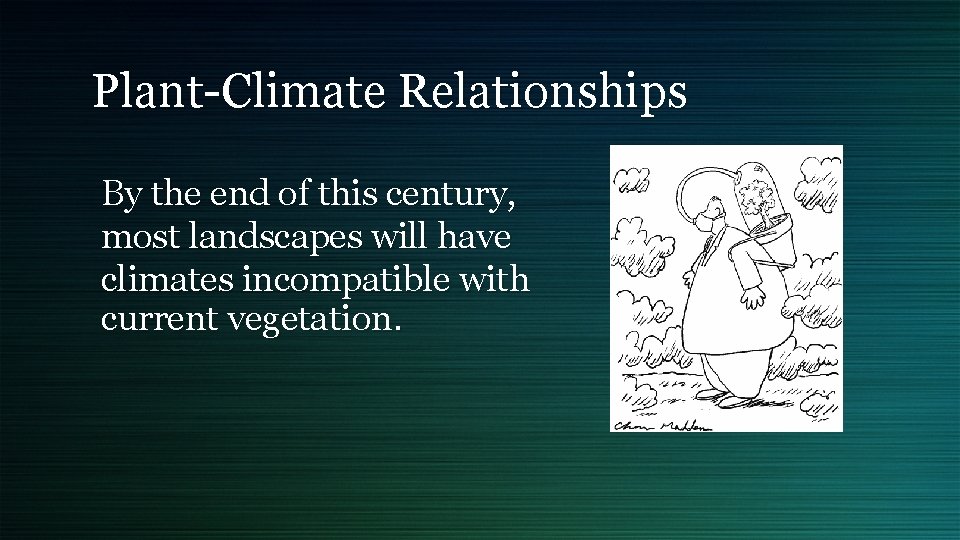
Plant-Climate Relationships By the end of this century, most landscapes will have climates incompatible with current vegetation.
Plants will need to adapt or move to avoid maladaptation Observed rates: 10 to 50 m/year Expected rates: 300 to 500 m/year
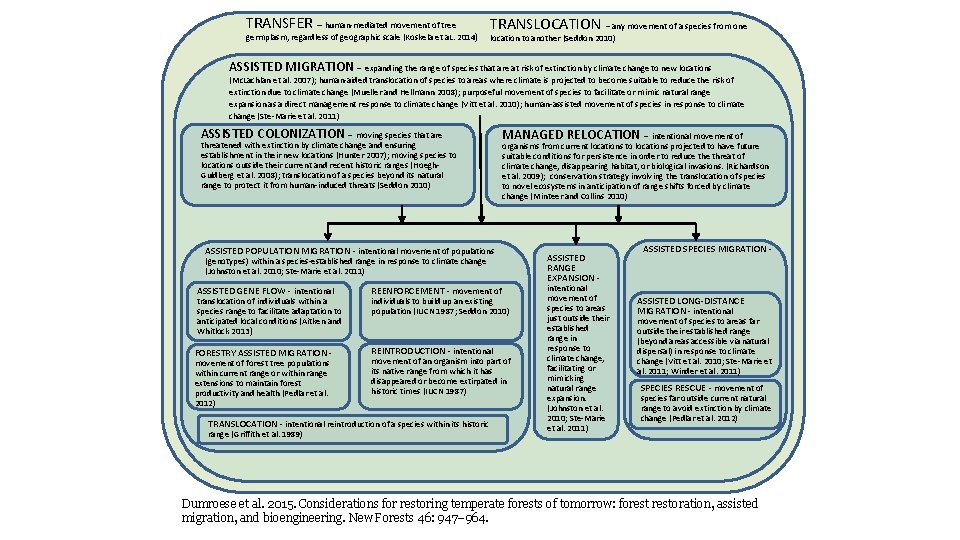
Assisted Migration Human-assisted movement of species in response to climate change Ste-Marie et al. 2011. Assisted migration: Intro-duction to a multifaceted concept. Forestry Chronicle 87: 724 – 730.
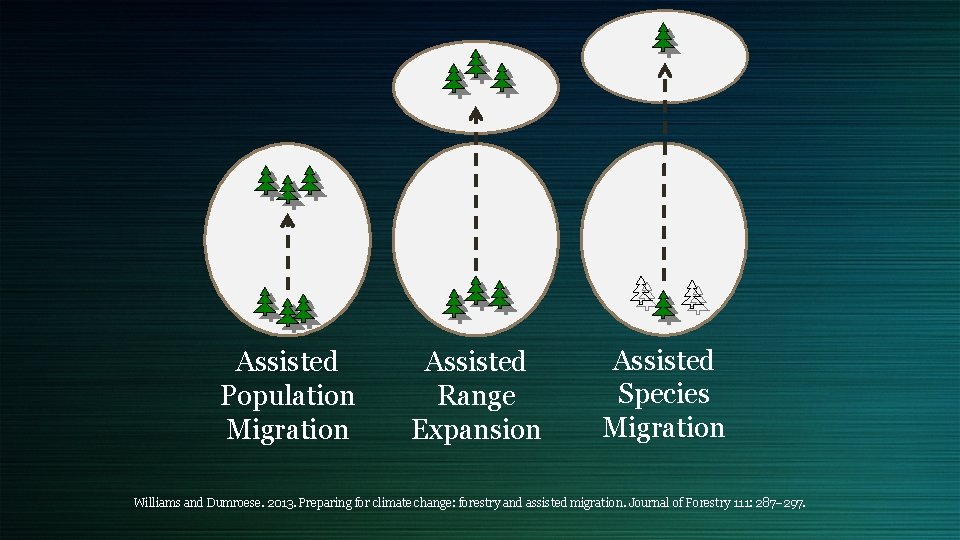
TRANSFER – human-mediated movement of tree germplasm, regardless of geographic scale (Koskela et a. L. 2014) TRANSLOCATION – any movement of a species from one location to another (Seddon 2010) ASSISTED MIGRATION – expanding the range of species that are at risk of extinction by climate change to new locations (Mc. Lachlan et al. 2007); human-aided translocation of species to areas where climate is projected to become suitable to reduce the risk of extinction due to climate change (Mueller and Hellmann 2008); purposeful movement of species to facilitate or mimic natural range expansion as a direct management response to climate change (Vitt et al. 2010); human-assisted movement of species in response to climate change (Ste-Marie et al. 2011) ASSISTED COLONIZATION – moving species that are threatened with extinction by climate change and ensuring establishment in their new locations (Hunter 2007); moving species to locations outside their current and recent historic ranges (Hoegh. Guldberg et al. 2008); translocation of a species beyond its natural range to protect it from human-induced threats (Seddon 2010) MANAGED RELOCATION – intentional movement of organisms from current locations to locations projected to have future suitable conditions for persistence in order to reduce threat of climate change, disappearing habitat, or biological invasions. (Richardson et al. 2009); conservation strategy involving the translocation of species to novel ecosystems in anticipation of range shifts forced by climate change (Minteer and Collins 2010) ASSISTED POPULATION MIGRATION - intentional movement of populations (genotypes) within a species-established range in response to climate change (Johnston et al. 2010; Ste-Marie et al. 2011) ASSISTED GENE FLOW - intentional translocation of individuals within a species range to facilitate adaptation to anticipated local conditions (Aitken and Whitlock 2013) FORESTRY ASSISTED MIGRATION movement of forest tree populations within current range or within range extensions to maintain forest productivity and health (Pedlar et al. 2012) REENFORCEMENT - movement of individuals to build up an existing population (IUCN 1987; Seddon 2010) REINTRODUCTION - intentional movement of an organism into part of its native range from which it has disappeared or become extirpated in historic times (IUCN 1987) TRANSLOCATION - intentional reintroduction of a species within its historic range (Griffith et al. 1989) ASSISTED RANGE EXPANSION - intentional movement of species to areas just outside their established range in response to climate change, facilitating or mimicking natural range expansion. (Johnston et al. 2010; Ste-Marie et al. 2011) ASSISTED SPECIES MIGRATION - ASSISTED LONG-DISTANCE MIGRATION - intentional movement of species to areas far outside their established range (beyond areas accessible via natural dispersal) in response to climate change (Vitt et al. 2010; Ste-Marie et al. 2011; Winder et al. 2011) SPECIES RESCUE - movement of species far outside current natural range to avoid extinction by climate change (Pedlar et al. 2012) Dumroese et al. 2015. Considerations for restoring temperate forests of tomorrow: forestoration, assisted migration, and bioengineering. New Forests 46: 947– 964.
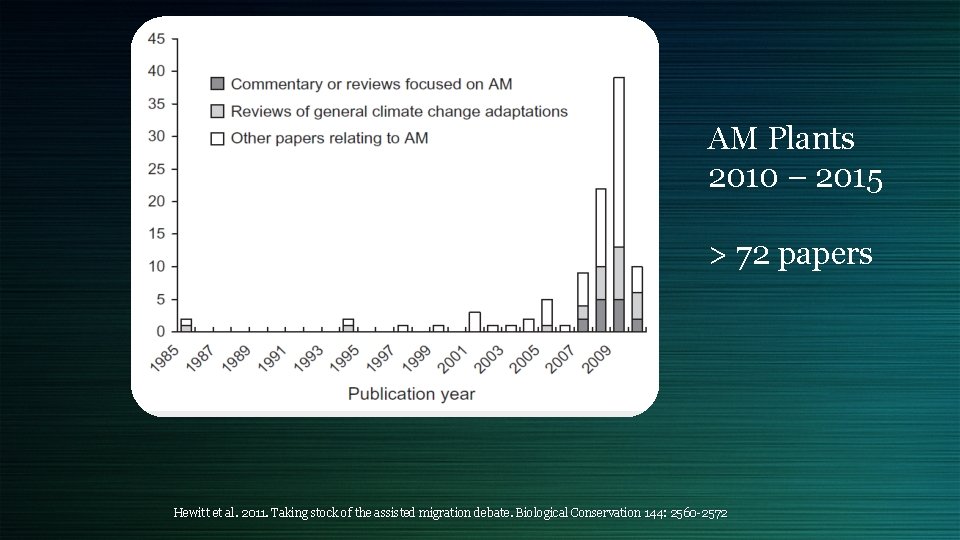
AM Plants 2010 – 2015 > 72 papers Hewitt et al. 2011. Taking stock of the assisted migration debate. Biological Conservation 144: 2560 -2572
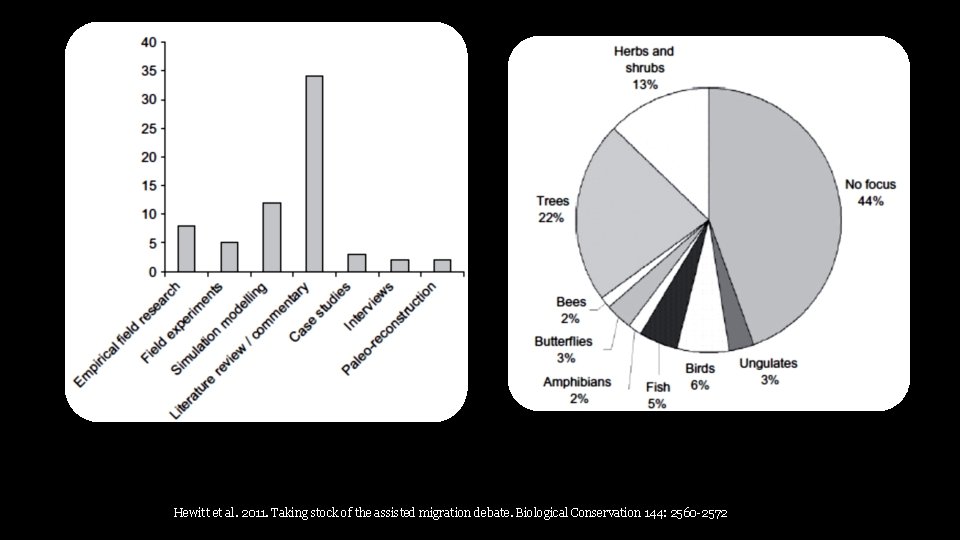
Hewitt et al. 2011. Taking stock of the assisted migration debate. Biological Conservation 144: 2560 -2572
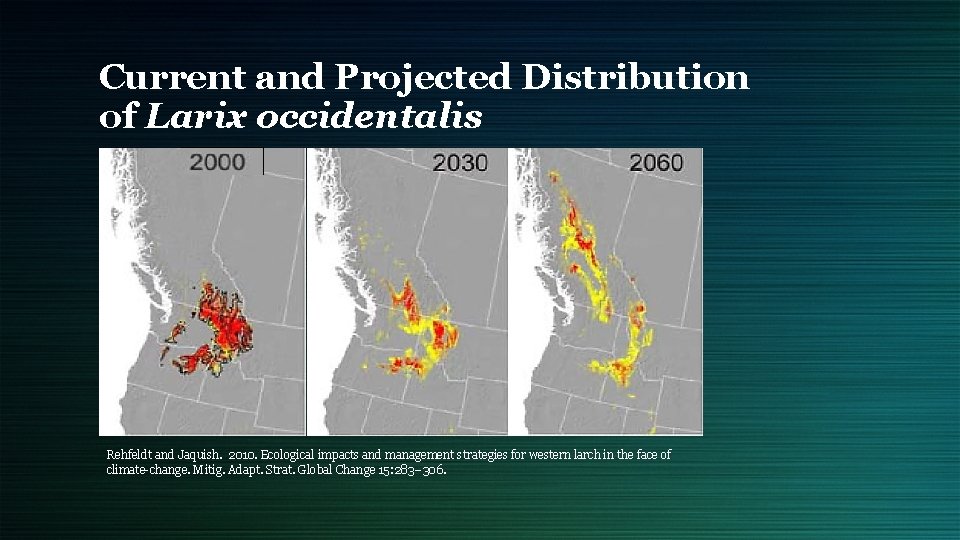
Current and Projected Distribution of Larix occidentalis Rehfeldt and Jaquish. 2010. Ecological impacts and management strategies for western larch in the face of climate-change. Mitig. Adapt. Strat. Global Change 15: 283– 306.
Assisted Population Migration Assisted Range Expansion Assisted Species Migration Williams and Dumroese. 2013. Preparing for climate change: forestry and assisted migration. Journal of Forestry 111: 287– 297.
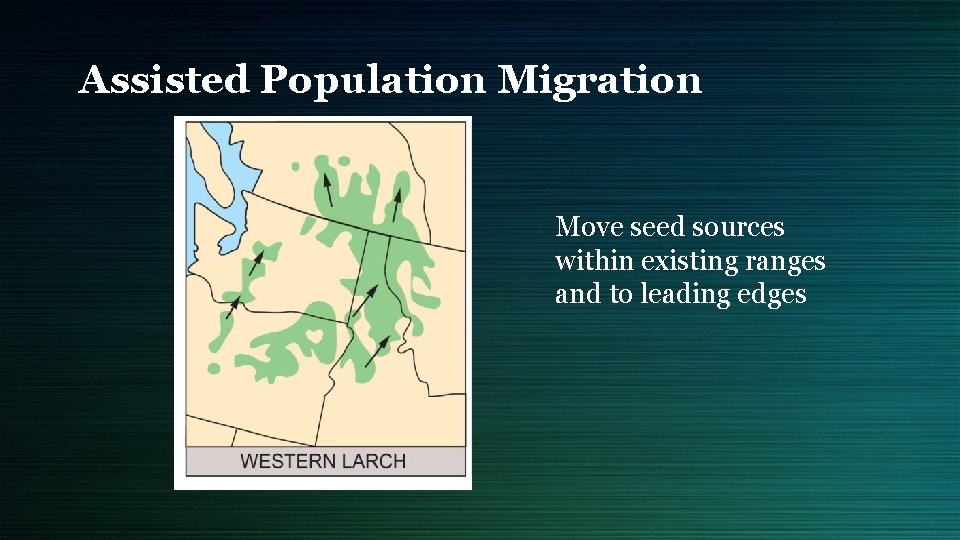
Assisted Population Migration Move seed sources within existing ranges and to leading edges
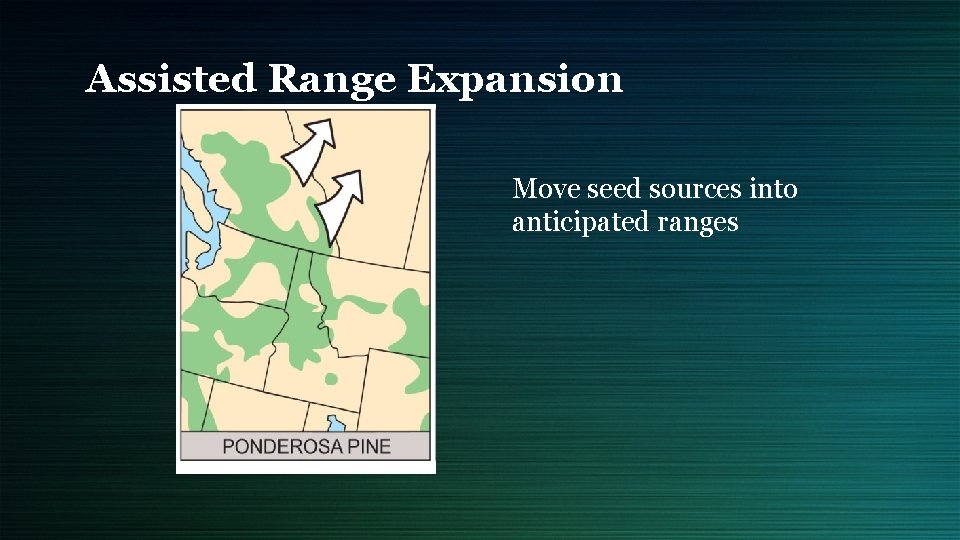
Assisted Range Expansion Move seed sources into anticipated ranges
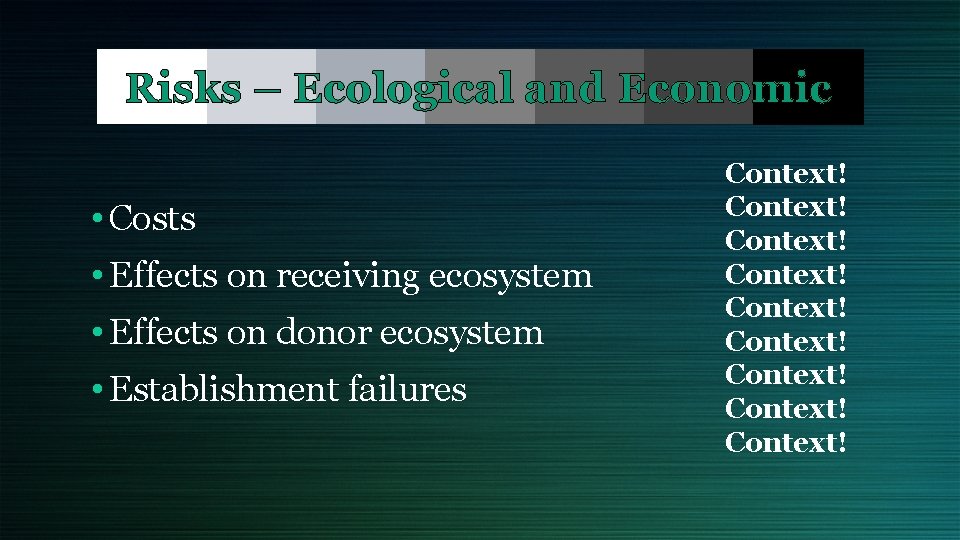
Risks – Ecological and Economic • Costs • Effects on receiving ecosystem • Effects on donor ecosystem • Establishment failures Context! Context! Context!
Summary • AM provides another option in our climate mitigation toolbox • Move populations of a species, expand a species range, or long-distance as a last resort • Pros and cons depend on the context
Thank you! kdumroese@fs. fed. us The views expressed were strictly those of the author and do not necessarily represent the positions or policy of the U. S. Department of Agriculture.