
UNITED STATES ANTARCTIC PROGRAM Photo Kris Perry South
- Slides: 18
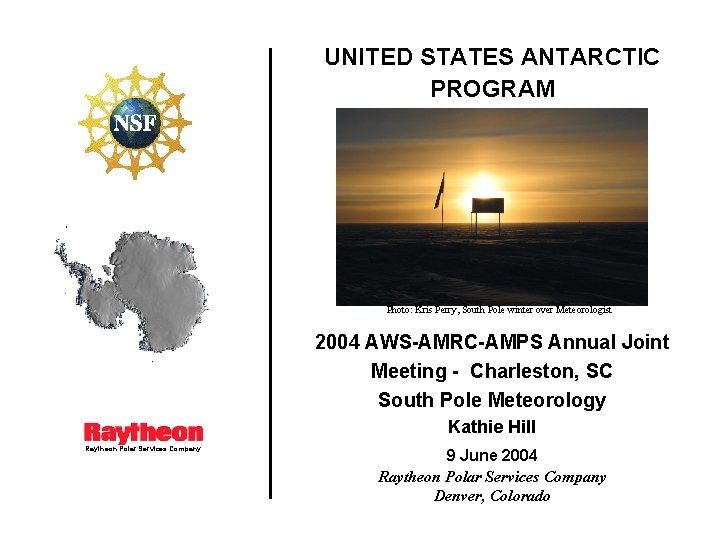
UNITED STATES ANTARCTIC PROGRAM Photo: Kris Perry, South Pole winter over Meteorologist 2004 AWS-AMRC-AMPS Annual Joint Meeting - Charleston, SC South Pole Meteorology Kathie Hill Raytheon Polar Services Company 9 June 2004 Raytheon Polar Services Company Denver, Colorado
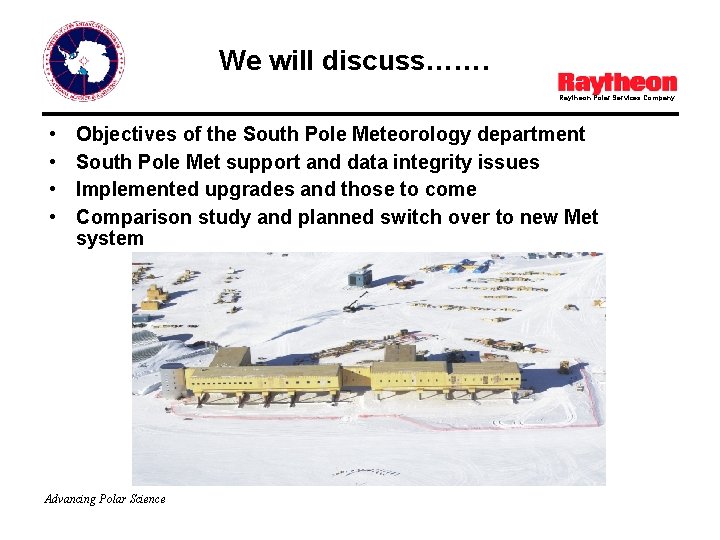
We will discuss……. Raytheon Polar Services Company • • Objectives of the South Pole Meteorology department South Pole Met support and data integrity issues Implemented upgrades and those to come Comparison study and planned switch over to new Met system Advancing Polar Science
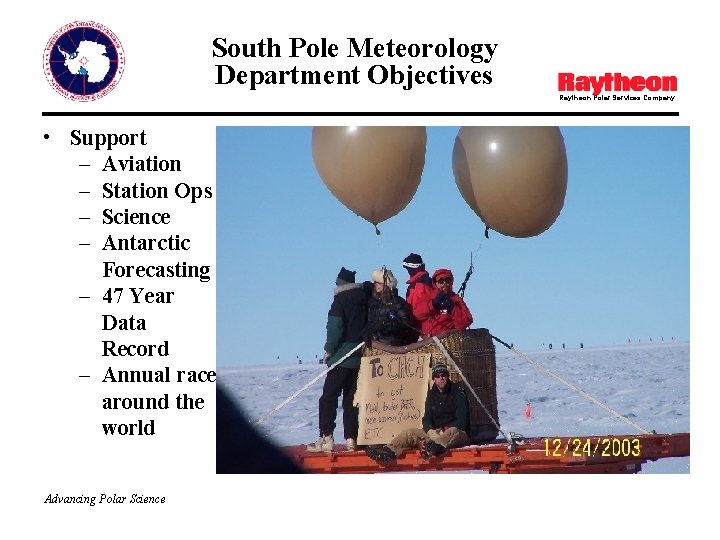
South Pole Meteorology Department Objectives Raytheon Polar Services Company • Support – Aviation – Station Ops – Science – Antarctic Forecasting – 47 Year Data Record – Annual race around the world Advancing Polar Science
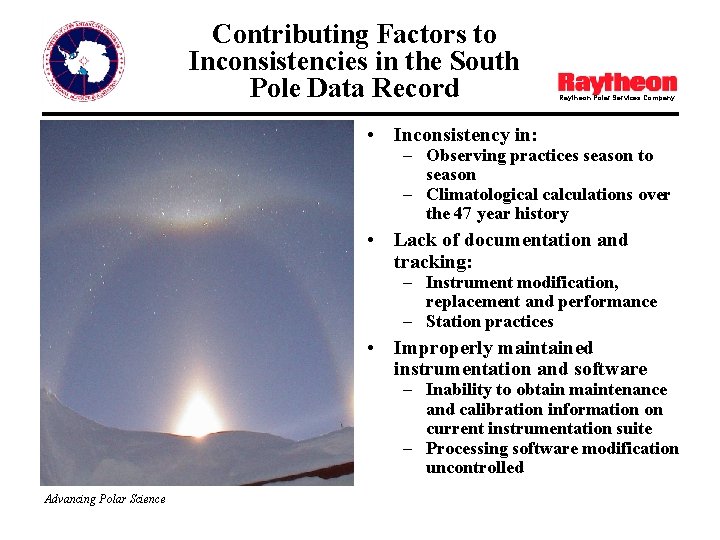
Contributing Factors to Inconsistencies in the South Pole Data Record Raytheon Polar Services Company • Inconsistency in: – Observing practices season to season – Climatological calculations over the 47 year history • Lack of documentation and tracking: – Instrument modification, replacement and performance – Station practices • Improperly maintained instrumentation and software – Inability to obtain maintenance and calibration information on current instrumentation suite – Processing software modification uncontrolled Advancing Polar Science
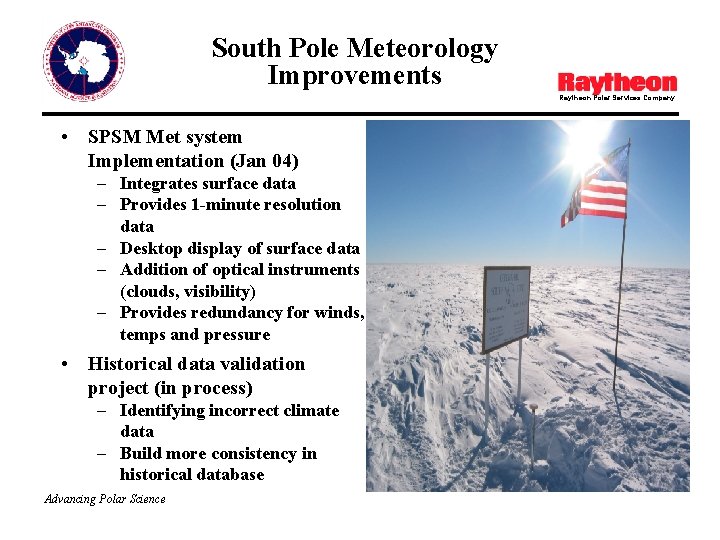
South Pole Meteorology Improvements Raytheon Polar Services Company • SPSM Met system Implementation (Jan 04) – Integrates surface data – Provides 1 -minute resolution data – Desktop display of surface data – Addition of optical instruments (clouds, visibility) – Provides redundancy for winds, temps and pressure • Historical data validation project (in process) – Identifying incorrect climate data – Build more consistency in historical database Advancing Polar Science
South Pole Meteorology Improvements Raytheon Polar Services Company • Instrumentation tracking database (FY 05) – Provides reporting on instrument maintenance, calibration and performance to researchers – Ensures maintenance and calibration schedules are maintained • Station observer practices defined and documented (FY 04) – Builds consistency in surface data season to season • DIGI-Cora III Upper Air System Installation (FY 04) – Improved radiosonde technology and reporting capabilities – Sonde calibration prior to launch • Version controlled surface observation processing software (FY 04) – Ensure consistency in climate data processing • Published data comparison study (FY 05) – Clean switch over with documented comparison between the old and new systems Advancing Polar Science
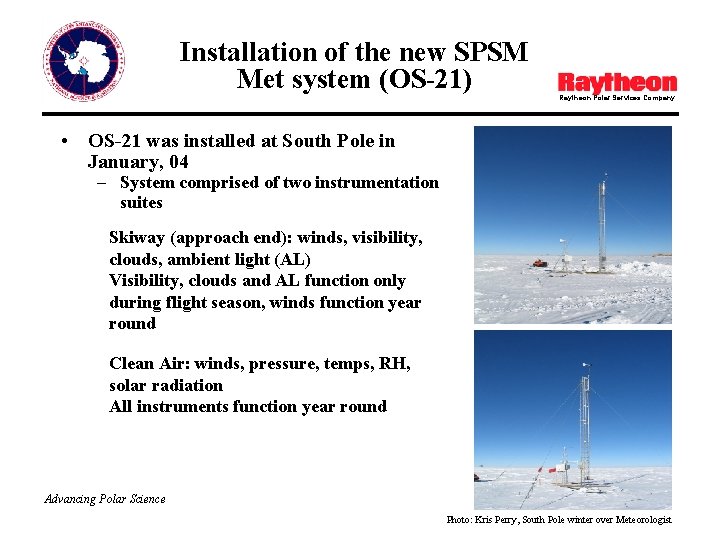
Installation of the new SPSM Met system (OS-21) Raytheon Polar Services Company • OS-21 was installed at South Pole in January, 04 – System comprised of two instrumentation suites Skiway (approach end): winds, visibility, clouds, ambient light (AL) Visibility, clouds and AL function only during flight season, winds function year round Clean Air: winds, pressure, temps, RH, solar radiation All instruments function year round Advancing Polar Science Photo: Kris Perry, South Pole winter over Meteorologist
Sensor suite and systems for OS -21 Raytheon Polar Services Company • • • Visibility sensor: Belfort, model 95000 -1 Ambient light sensor: Belfort, model 6300 Ceilometer: Eliasson, CBME-40 A Solar Radiation sensor: Li-Cor pyranometer, LI-200 SA Barometers: Druck, RPT-410 Temp/RH sensors: RM Young, 43440 Windbirds: RM Young, 05103 SQL 2000 Server and database Visual displays in Met office and Comms Advancing Polar Science
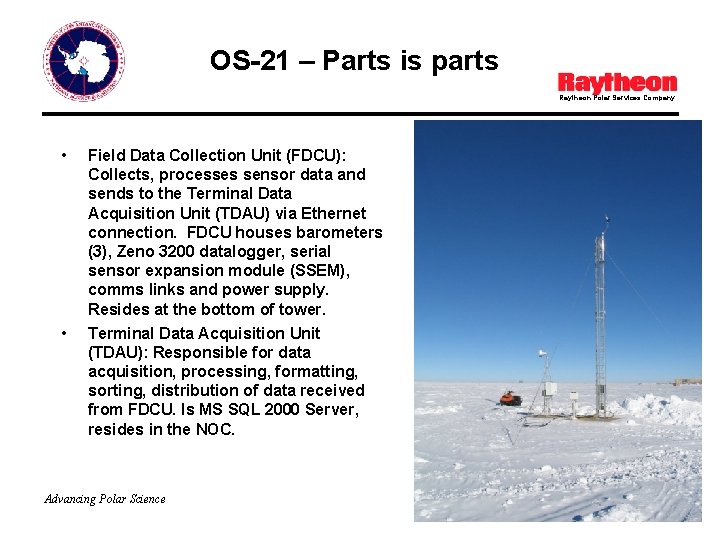
OS-21 – Parts is parts Raytheon Polar Services Company • • Field Data Collection Unit (FDCU): Collects, processes sensor data and sends to the Terminal Data Acquisition Unit (TDAU) via Ethernet connection. FDCU houses barometers (3), Zeno 3200 datalogger, serial sensor expansion module (SSEM), comms links and power supply. Resides at the bottom of tower. Terminal Data Acquisition Unit (TDAU): Responsible for data acquisition, processing, formatting, sorting, distribution of data received from FDCU. Is MS SQL 2000 Server, resides in the NOC. Advancing Polar Science
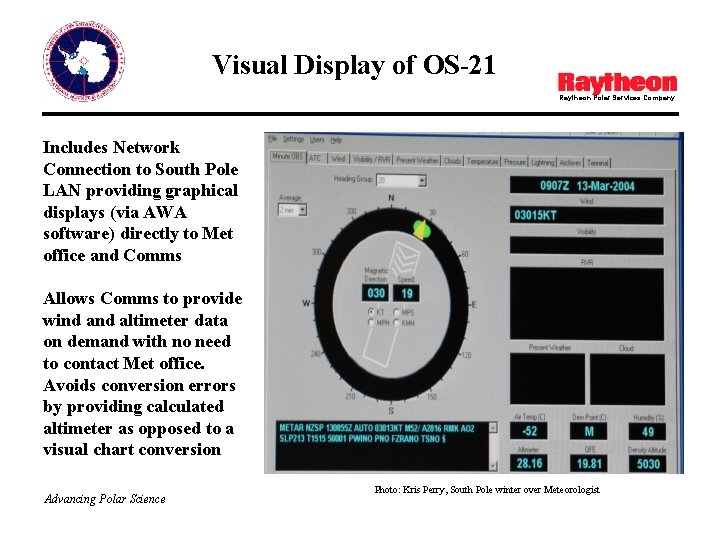
Visual Display of OS-21 Raytheon Polar Services Company Includes Network Connection to South Pole LAN providing graphical displays (via AWA software) directly to Met office and Comms Allows Comms to provide wind altimeter data on demand with no need to contact Met office. Avoids conversion errors by providing calculated altimeter as opposed to a visual chart conversion Advancing Polar Science Photo: Kris Perry, South Pole winter over Meteorologist
Initial OS-21 Comparisons Visibility Raytheon Polar Services Company Limitations – provided by Coastal Environmental Systems • Isolated fog causes the most problems: Lower visibility if fog is localized to sensor Fog confined to skiway may go unreported • When visibility changes rapidly, OS-21 observation will lag actual weather (several minutes). Algorithm responds more quickly to rapidly decreasing visibility than rapidly increasing visibility. • On bright, sunny days with haze, sensor will report higher visibility than observer. NWS advises: Reduce reported vis 50% if it’s bright enough to wear sunglasses and there’s haze or thin fog with clear sky above (a typical day during the South Pole summer). Advancing Polar Science
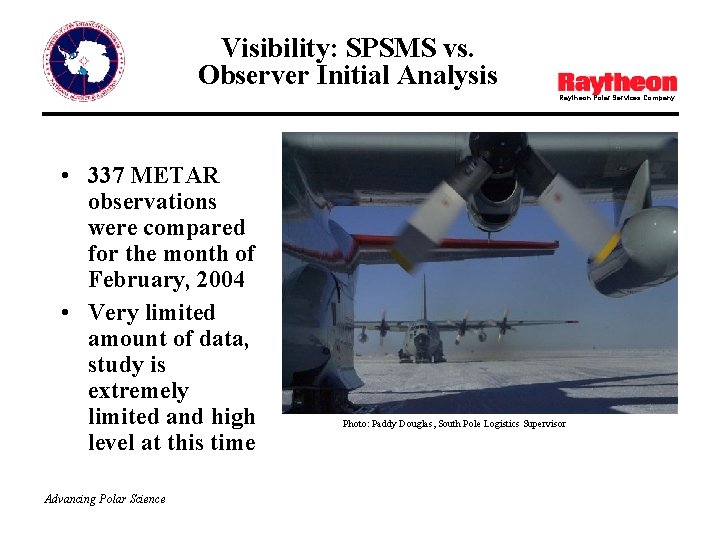
Visibility: SPSMS vs. Observer Initial Analysis Raytheon Polar Services Company • 337 METAR observations were compared for the month of February, 2004 • Very limited amount of data, study is extremely limited and high level at this time Advancing Polar Science Photo: Paddy Douglas, South Pole Logistics Supervisor
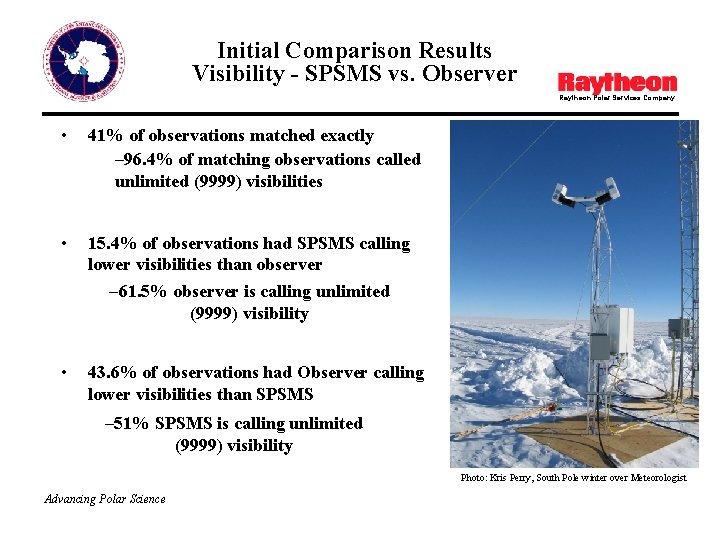
Initial Comparison Results Visibility - SPSMS vs. Observer Raytheon Polar Services Company • 41% of observations matched exactly – 96. 4% of matching observations called unlimited (9999) visibilities • 15. 4% of observations had SPSMS calling lower visibilities than observer – 61. 5% observer is calling unlimited (9999) visibility • 43. 6% of observations had Observer calling lower visibilities than SPSMS – 51% SPSMS is calling unlimited (9999) visibility Photo: Kris Perry, South Pole winter over Meteorologist Advancing Polar Science
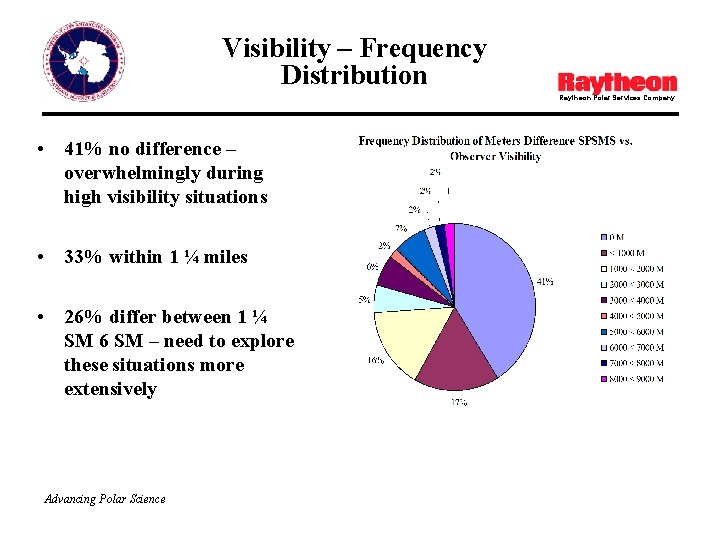
Visibility – Frequency Distribution Raytheon Polar Services Company • 41% no difference – overwhelmingly during high visibility situations • 33% within 1 ¼ miles • 26% differ between 1 ¼ SM 6 SM – need to explore these situations more extensively Advancing Polar Science
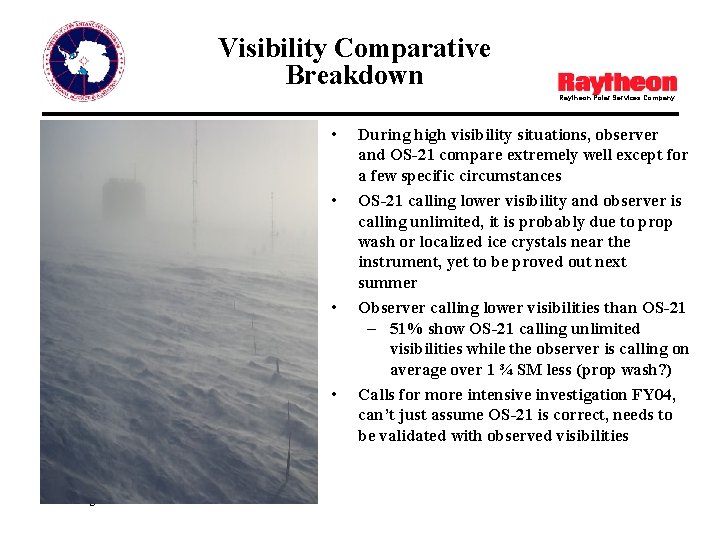
Visibility Comparative Breakdown Raytheon Polar Services Company • • Advancing Polar Science During high visibility situations, observer and OS-21 compare extremely well except for a few specific circumstances OS-21 calling lower visibility and observer is calling unlimited, it is probably due to prop wash or localized ice crystals near the instrument, yet to be proved out next summer Observer calling lower visibilities than OS-21 – 51% show OS-21 calling unlimited visibilities while the observer is calling on average over 1 ¾ SM less (prop wash? ) Calls for more intensive investigation FY 04, can’t just assume OS-21 is correct, needs to be validated with observed visibilities
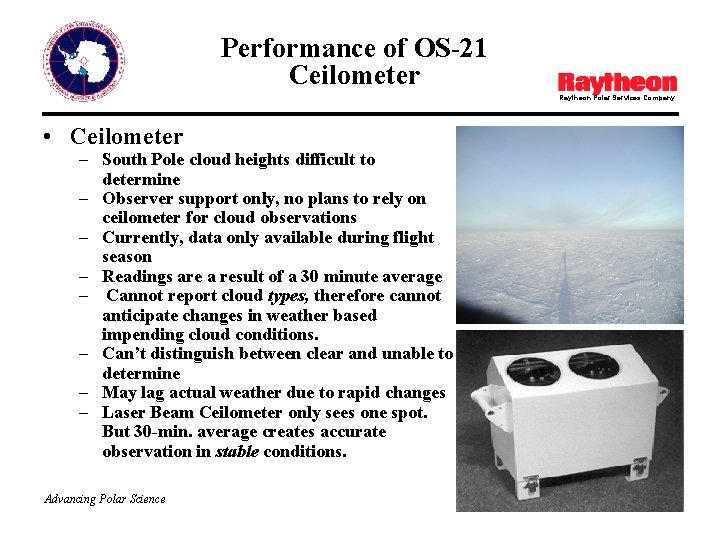
Performance of OS-21 Ceilometer Raytheon Polar Services Company • Ceilometer – South Pole cloud heights difficult to determine – Observer support only, no plans to rely on ceilometer for cloud observations – Currently, data only available during flight season – Readings are a result of a 30 minute average – Cannot report cloud types, therefore cannot anticipate changes in weather based impending cloud conditions. – Can’t distinguish between clear and unable to determine – May lag actual weather due to rapid changes – Laser Beam Ceilometer only sees one spot. But 30 -min. average creates accurate observation in stable conditions. Advancing Polar Science
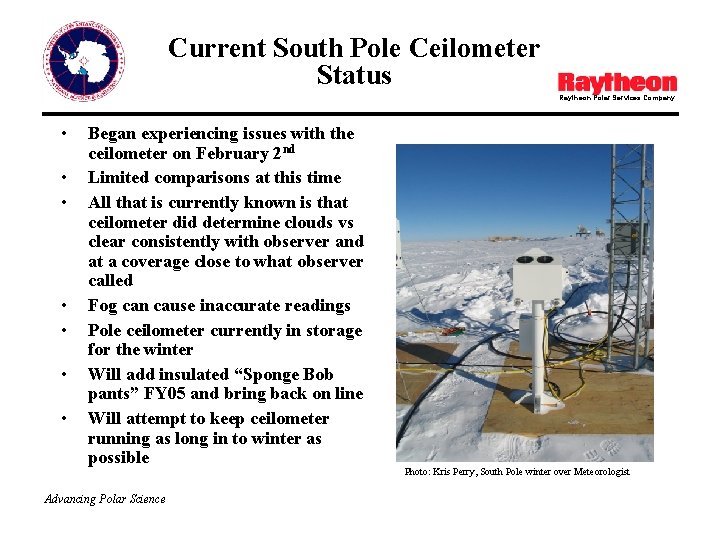
Current South Pole Ceilometer Status Raytheon Polar Services Company • • Began experiencing issues with the ceilometer on February 2 nd Limited comparisons at this time All that is currently known is that ceilometer did determine clouds vs clear consistently with observer and at a coverage close to what observer called Fog can cause inaccurate readings Pole ceilometer currently in storage for the winter Will add insulated “Sponge Bob pants” FY 05 and bring back on line Will attempt to keep ceilometer running as long in to winter as possible Advancing Polar Science Photo: Kris Perry, South Pole winter over Meteorologist
Outstanding Issues Raytheon Polar Services Company • Report file formats will be changing (surface and upper air) • Difference in calculation of climatological averages – NCDC method – WMO method – Re-issue of previous years climate files • Corrected climate data files • Disparate data records existing within different organizations (NCDC, AMRC, BAS) • Need published comprehensive comparison study Advancing Polar Science