
Unit5 Communication System Introduction Communication is the process

![Concept of Bandwidth [Is a measure of frequency range, measured in hertz. ] Ø](https://slidetodoc.com/presentation_image_h2/51ce50b3126a034cd6502034cd2c03b6/image-5.jpg "Concept of Bandwidth [Is a measure of frequency range, measured in hertz. ] Ø")



![NEED FOR MODULATION Ø Base band signal transmission [i. e] in the process of](https://slidetodoc.com/presentation_image_h2/51ce50b3126a034cd6502034cd2c03b6/image-14.jpg "NEED FOR MODULATION Ø Base band signal transmission [i. e] in the process of")


![Sine wave representation Derivation of AM V[t]=Em Sin(ωt +Ф) { v[t]--- voltage as a](https://slidetodoc.com/presentation_image_h2/51ce50b3126a034cd6502034cd2c03b6/image-18.jpg "Sine wave representation Derivation of AM V[t]=Em Sin(ωt +Ф) { v[t]--- voltage as a")




- Slides: 23
Unit-5 Communication System
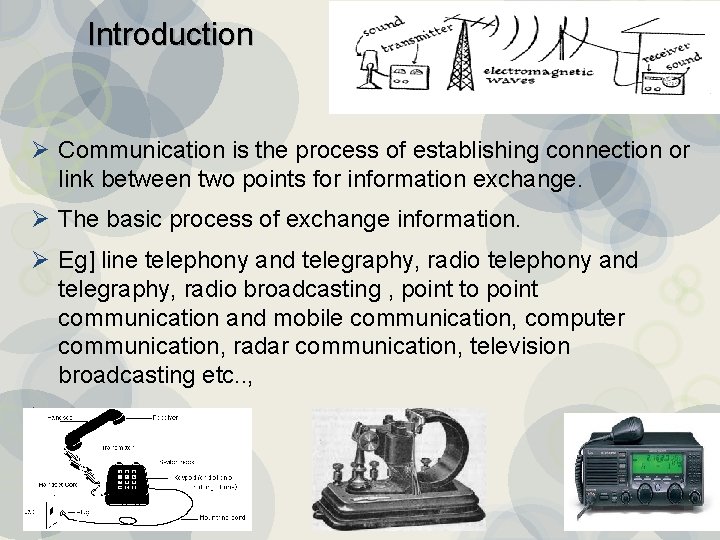
Introduction Ø Communication is the process of establishing connection or link between two points for information exchange. Ø The basic process of exchange information. Ø Eg] line telephony and telegraphy, radio broadcasting , point to point communication and mobile communication, computer communication, radar communication, television broadcasting etc. . , Ø
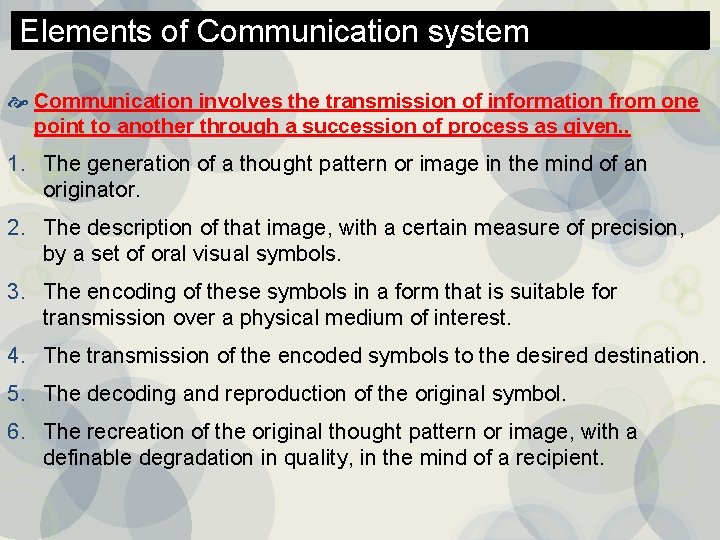
Elements of Communication system Communication involves the transmission of information from one point to another through a succession of process as given. . 1. The generation of a thought pattern or image in the mind of an originator. 2. The description of that image, with a certain measure of precision, by a set of oral visual symbols. 3. The encoding of these symbols in a form that is suitable for transmission over a physical medium of interest. 4. The transmission of the encoded symbols to the desired destination. 5. The decoding and reproduction of the original symbol. 6. The recreation of the original thought pattern or image, with a definable degradation in quality, in the mind of a recipient.
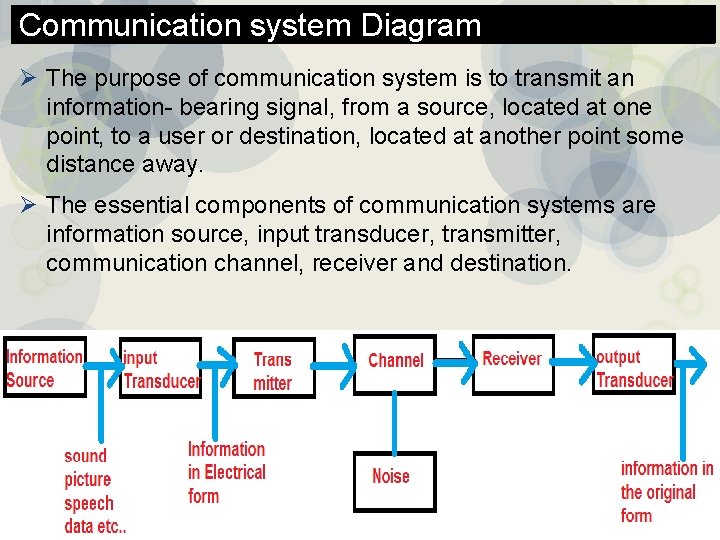
Communication system Diagram Ø The purpose of communication system is to transmit an information- bearing signal, from a source, located at one point, to a user or destination, located at another point some distance away. Ø The essential components of communication systems are information source, input transducer, transmitter, communication channel, receiver and destination. Ø
Concept of Bandwidth [Is a measure of frequency range, measured in hertz. ] Ø Bandwidth may be defined as the portion of the electromagnetic spectrum occupied by a signal. Ø The bandwidth is the frequency range over which an information signal is transmitted. If greater the width, larger the amount of data that can flow through it [transmitted]. Ø The bandwidth of a signal composed of components of various frequencies (complex signal) is the difference between its highest and lowest frequency components, and is expressed in Hertz (Hz) - the same as frequency. Ø FC = F 2 – F 1
Carrier Wave Ø carrier wave is a waveform (usually sinusoidal) that is modulated (modified) with an input signal for the purpose of conveying information. Ø The carrier wave is usually a much higher frequency than the input signal. Ø The purpose of the carrier is usually either to transmit the information through space as an electromagnetic wave (as in radio communication), [or] Ø To allow several carriers at different frequencies to share a common physical transmission medium by frequency division multiplexing (as, for example, a cable television system). The term is also used for an unmodulated emission in the absence of any modulating signal.
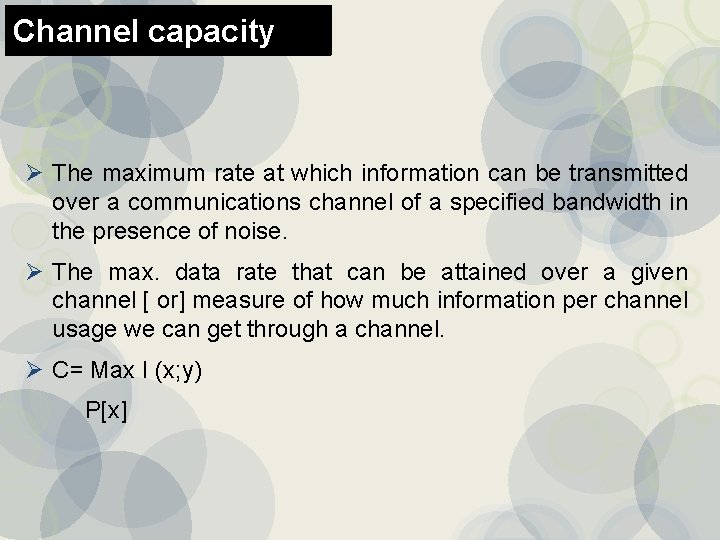
Channel capacity Ø The maximum rate at which information can be transmitted over a communications channel of a specified bandwidth in the presence of noise. Ø The max. data rate that can be attained over a given channel [ or] measure of how much information per channel usage we can get through a channel. Ø C= Max I (x; y) P[x]
channel bandwidth: The bandwidth of a channel (medium) is defined to be the range of frequencies that the medium can support. Bandwidth is measured in Hz With each transmission medium, there is a frequency range of electromagnetic waves that can be transmitted: Twisted pair cable: 0 to 109 Hz (Bandwidth : 109 Hz) Coax cable: 0 to 1010 Hz (Bandwidth : 1010 Hz) Optical fiber: 1014 to 1016 Hz (Bandwidth : 1016 -1014 = 9. 9 x 10¹⁵ Hz) Optical fibers have the highest bandwidth (they can support electromagnetic waves with very high frequencies, such as light waves) The bandwidth of the channel dictates the information carrying capacity of the channel This is calculated using Shannon’s channel capacity formula
Shannon’s Theorem (Shannon’s Limit for Information Capacity Claude Shannon at Bell Labs figured out how much information a channel could theoretically carry: I = B log 2 (1 + S/N) Where I is Information Capacity in bits per second (bps) B is the channel bandwidth in Hz S/N is Signal-to-Noise ratio
Signal-to-Noise Ratio S/N is normally measured in d. B (decibel). It is a relationship between the signal we want versus the noise that we do not want, which is in the medium. It can be thought of as a fractional relationship (that is, before we take the logarithm): If the incoming signal strength in microvolts is Vs, and the noise level, also in microvolts, is Vn, then the signal-to-noise ratio, S/N, in decibels is given by the formula S/N = 20 log 10 [VS / Vn ]
Ø Signal to noise ratio is a specification that measures the level of the audio signal compared to the level of noise present in the signal. Ø Signal to noise ratio specifications are common in many components, including amplifiers, phonograph players, CD/DVD players, tape decks and others. Ø Since noise can not be eliminated (it is random), we are more interested in the S/N ratio than the intensity of the noise
MODULATION Ø Modulation is the process of varying one or more properties of a high-frequency periodic waveform, called the carrier signal, with a modulating signal which typically contains information to be transmitted. The three key parameters of a periodic waveform are its amplitude (volume), its phase (timing) and its frequency (pitch). Ø Modulation is the process of conveying a message signal, for example a digital bit stream or an analog audio signal, inside another signal that can be physically transmitted. Modulation of a sine waveform is used to transform a baseband message into a passband signal, for example low-frequency audio signal into a radio-frequency signal (RF signal)
Ø modulation The technique of superimposing the message signal on the carrier is known as modulation. Ø That is, modulation is the process by which a parameter of one signal (carrier) is varied in proportion to the second signal (message signal). Ø Let m(t) = message (or information) signal c(t) = carrier signal s(t) = modulated signal (transmitted signal) m(t) s(t) Modulating Modulated c(t) Carrier Modulator
NEED FOR MODULATION Ø Base band signal transmission [i. e] in the process of modulation the base band signal is shifted from the low frequency to high frequency. This freq shift is proportional to the freq carrier. Ø Advantages: - 1. Reduction in the height of the antenna 2. Avoid mixing of Signals 3. Increases the range of communication. 4. Multiplexing is possible. 5. Improves the quality of reception.
TYPES
AMPLITUDE MODULATION Ø Amplitude modulation (AM) is a modulation technique used in electronic communication, most commonly for transmitting information via a radio carrier wave. keeping its frequency and time constant…… Ø AM, the information signal varies the amplitude of the carrier sine wave. ‘‘ the instantaneous value of the carrier amplitude changes in accordance with the Phase and frequency variation of the modulating signal’’.
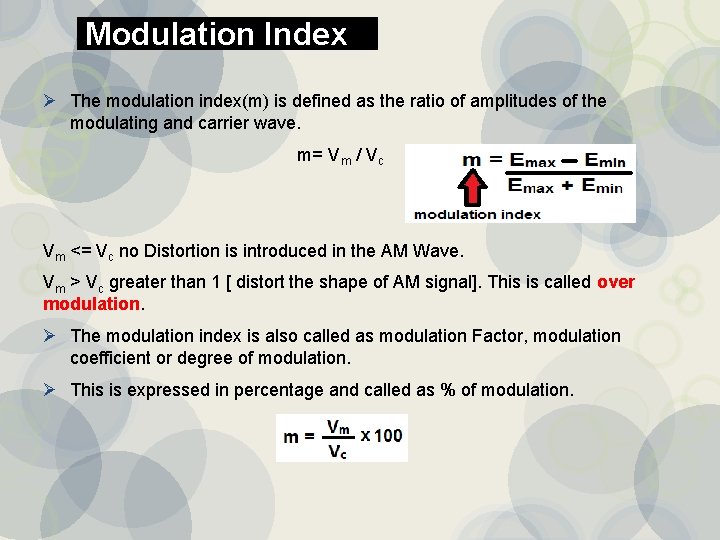
Modulation Index Ø The modulation index(m) is defined as the ratio of amplitudes of the modulating and carrier wave. m= V m / Vc Vm <= Vc no Distortion is introduced in the AM Wave. Vm > Vc greater than 1 [ distort the shape of AM signal]. This is called over modulation. Ø The modulation index is also called as modulation Factor, modulation coefficient or degree of modulation. Ø This is expressed in percentage and called as % of modulation.
Sine wave representation Derivation of AM V[t]=Em Sin(ωt +Ф) { v[t]--- voltage as a function of time; Em----peak voltage; f---freq in Hz; ω---radian freq[ω=2 pi f] ; t= time; Ф---phase angle} Modulation index (m)= Vm / Vc A = VC + vm [ vc = Vc Sin ωc t & vm =Vm Sin ωm t ] = Vc + Vm Sin ωm t A= vc (1 + m Sin ωm t ) The instantaneous voltage of the resulting Amp-modulation is VAM = A Sin θ [θ= ωc t ] = A Sin ωc t [ apply the function of A] VAM = vc (1 + m Sin ωm t ). Sin ωc t [ Expressed in Trigonometry relation] Sin x. Sin y = ½ { cos [ x-y] – cos [ x+y]} VAM = Vc. Sin ωc t + m Vc / 2. Cos [ωc - ωm ]t - m Vc / 2. Cos [ωc + ωm ]t In this AM wave contains 3 terms
1. Identical to the equ. vc = Vc. Sin ωc t represents the unmodulated carrier wave. 2. The frequency of Lower side band [ωc - ωm ] = LSB 3. The frequency of upper side band [ωc + ωm ] = USB The bandwidth required for AM is twice the frequency of the modulating signal. BAM = [ωc - ωm ] - [ωc + ωm ] = 2ωm
FEATURES & APPLICATION OF AM Ø AM Transmitter are less complex Ø AM Receivers are simple, detection is easy Ø AM Receivers are less cost Ø AM travels through a long Distance Ø LOW bandwidth. APPLICATION Radio Broadcasting Picture transmission in TV system.
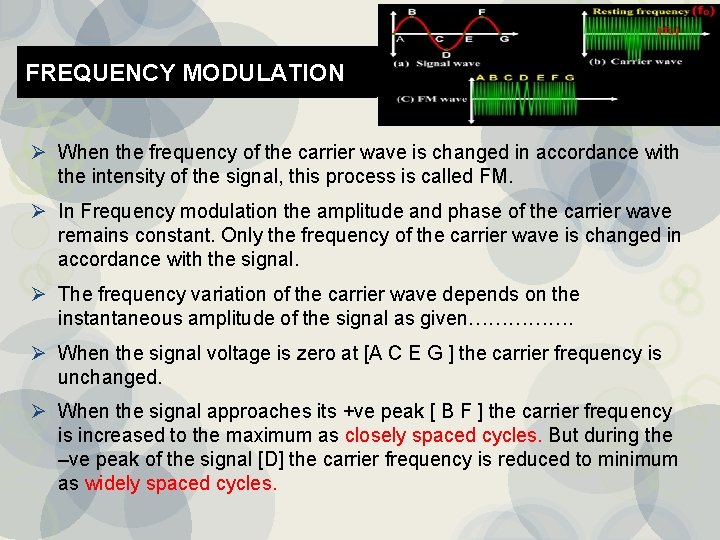
FREQUENCY MODULATION Ø When the frequency of the carrier wave is changed in accordance with the intensity of the signal, this process is called FM. Ø In Frequency modulation the amplitude and phase of the carrier wave remains constant. Only the frequency of the carrier wave is changed in accordance with the signal. Ø The frequency variation of the carrier wave depends on the instantaneous amplitude of the signal as given……………. Ø When the signal voltage is zero at [A C E G ] the carrier frequency is unchanged. Ø When the signal approaches its +ve peak [ B F ] the carrier frequency is increased to the maximum as closely spaced cycles. But during the –ve peak of the signal [D] the carrier frequency is reduced to minimum as widely spaced cycles.
Ø The louder signal vs greater frequency change in modulated carrier as indicated by increased bunching and speeding of the waves as compared with relatively weaker signal. Ø The frequency of an FM transmitter, with out the signal input is called resting frequency or center frequency [f 0] is allotted freq of the transmitter. Ø When the signal is applied the carrier freq is deviates up and down from its resting value [f 0]. The change or shift either above or below the resting freq is called freq deviation [ΔF]. Ø The total variation in the freq from the lowest to the highest is called carrier swing [CS]. Ø Carrier swing = 2 X ΔF.
Difference between FM & AM FM AM Amplitude of FM wave is constant. It is independent to modulation index. Amplitude of AM wave will change with the modulating voltage. Transmitted power remains constant. Power is dependent on the modulation index. FM receivers are immune to noise AM receivers are not immune to noise Bandwidth is larger, wide channel is required Bandwidth is much less than FM Possible to operate several transmitters Not possible on same frequency Equipment's are more complex Equipment's are less complex