
Unit4 Selenium Tool Prof M T Jagtap PVGs






- Slides: 22
Unit-4 Selenium Tool Prof. M. T. Jagtap PVG’s COE Nashik
Syllabus �Introducing Selenium, �Brief History of The Selenium Project, �Selenium‟s Tool Suite, � Selenium. IDE, �Selenium RC, � Selenium Webdriver, � Selenium Grid, �Test Design Considerations
�What is Selenium? �SELENIUM is a free (open-source) automated testing framework used to validate web applications across different browsers and platforms. You can use multiple programming languages like Java, C#, Python etc to create Selenium Test Scripts. Testing done using the Selenium tool is usually referred to as Selenium Testing. �Selenium Software is not just a single tool but a suite of software, each piece catering to different testing needs of an organization. Here is the list of tools �Selenium Integrated Development Environment (IDE
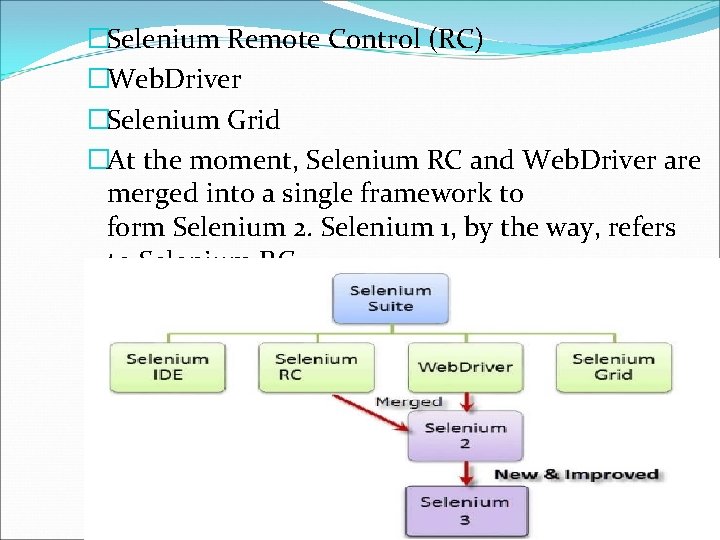
�Selenium Remote Control (RC) �Web. Driver �Selenium Grid �At the moment, Selenium RC and Web. Driver are merged into a single framework to form Selenium 2. Selenium 1, by the way, refers to Selenium RC.
v. W
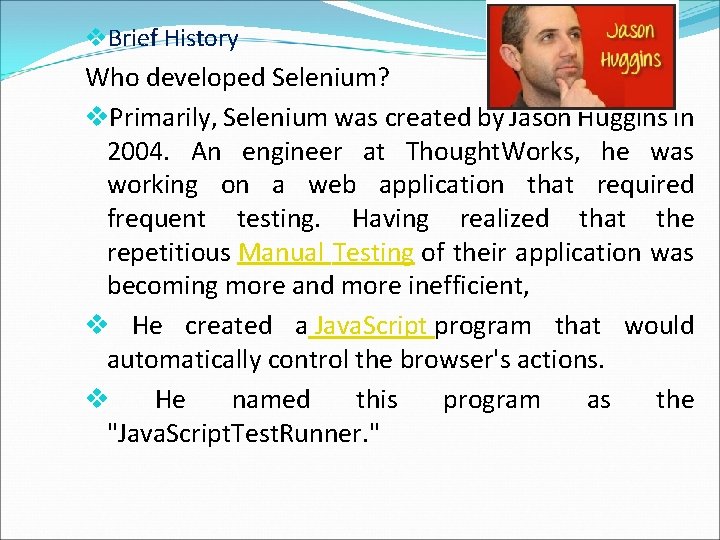
v. Brief History Who developed Selenium? v. Primarily, Selenium was created by Jason Huggins in 2004. An engineer at Thought. Works, he was working on a web application that required frequent testing. Having realized that the repetitious Manual Testing of their application was becoming more and more inefficient, v He created a Java. Script program that would automatically control the browser's actions. v He named this program as the "Java. Script. Test. Runner. "
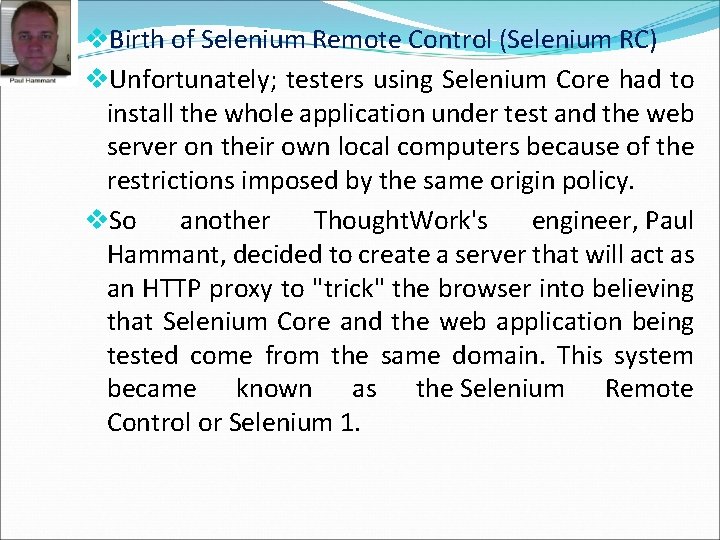
v. Birth of Selenium Remote Control (Selenium RC) v. Unfortunately; testers using Selenium Core had to install the whole application under test and the web server on their own local computers because of the restrictions imposed by the same origin policy. v. So another Thought. Work's engineer, Paul Hammant, decided to create a server that will act as an HTTP proxy to "trick" the browser into believing that Selenium Core and the web application being tested come from the same domain. This system became known as the Selenium Remote Control or Selenium 1.
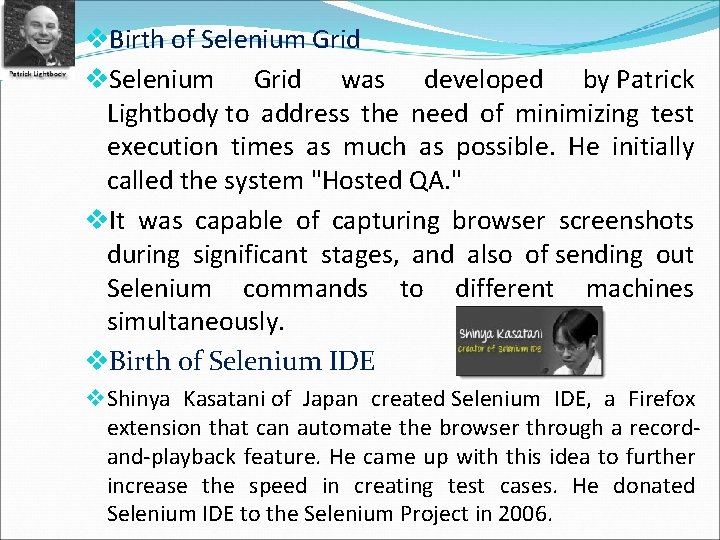
v. Birth of Selenium Grid v. Selenium Grid was developed by Patrick Lightbody to address the need of minimizing test execution times as much as possible. He initially called the system "Hosted QA. " v. It was capable of capturing browser screenshots during significant stages, and also of sending out Selenium commands to different machines simultaneously. v. Birth of Selenium IDE v Shinya Kasatani of Japan created Selenium IDE, a Firefox extension that can automate the browser through a recordand-playback feature. He came up with this idea to further increase the speed in creating test cases. He donated Selenium IDE to the Selenium Project in 2006.
v. Birth of Web. Driver v. Simon Stewart created Web. Driver circa 2006 when browsers and web applications were becoming more powerful and more restrictive with Java. Script programs like Selenium Core. v It was the first cross-platform testing framework that could control the browser from the OS level. v. Birth of Selenium 2 �In 2008, the whole Selenium Team decided to merge Web. Driver and Selenium RC to form a more powerful tool called Selenium 2, with Web. Driver being the core. Currently, Selenium RC is still being developed but only in maintenance mode. Most of the Selenium Project's efforts are now focused on Selenium 2
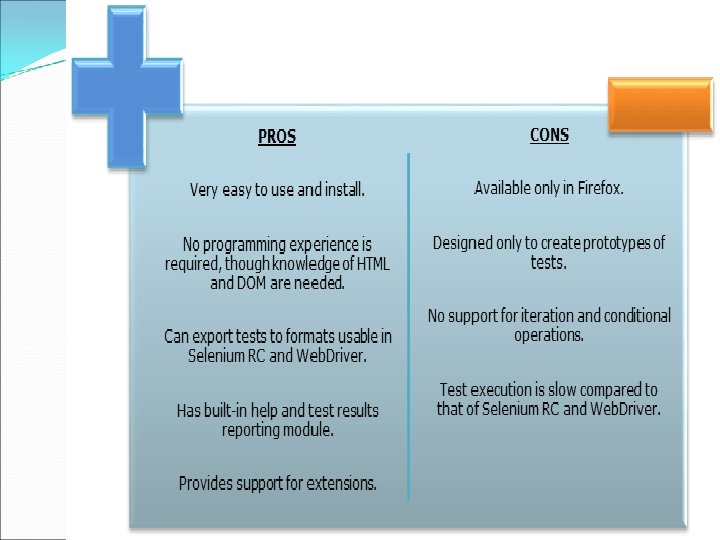
v. Brief Introduction Selenium IDE �Selenium Integrated Development Environment (IDE) is the simplest framework in the Selenium suite and is the easiest one to learn. It is a Firefox plugin that you can install as easily as you can with other plugins. �However, because of its simplicity, Selenium IDE should only be used as a prototyping tool. If you want to create more advanced test cases, you will need to use either Selenium RC or Web. Driver
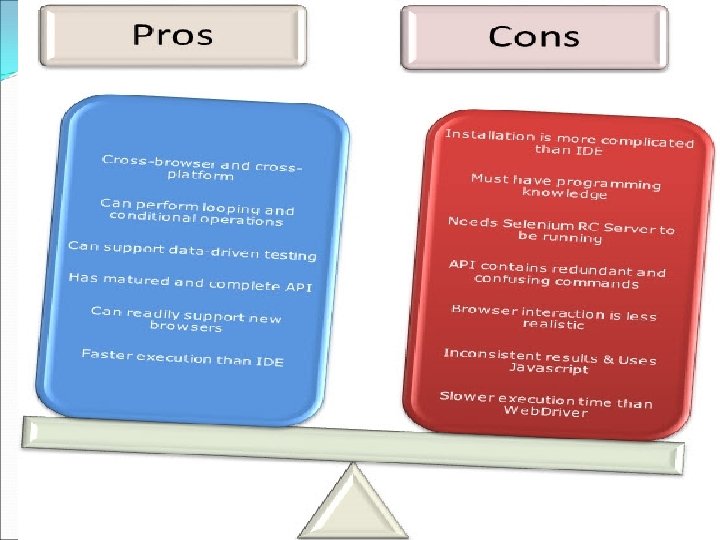
v. Brief Introduction Selenium Remote Control (Selenium RC) �Selenium RC was the flagship testing framework of the whole Selenium project for a long time. This is the first automated web testing tool that allowed users to use a programming language they prefer. As of version 2. 25. 0, RC can support the following programming languages: �Java �C# �PHP �Python �Perl �Ruby �
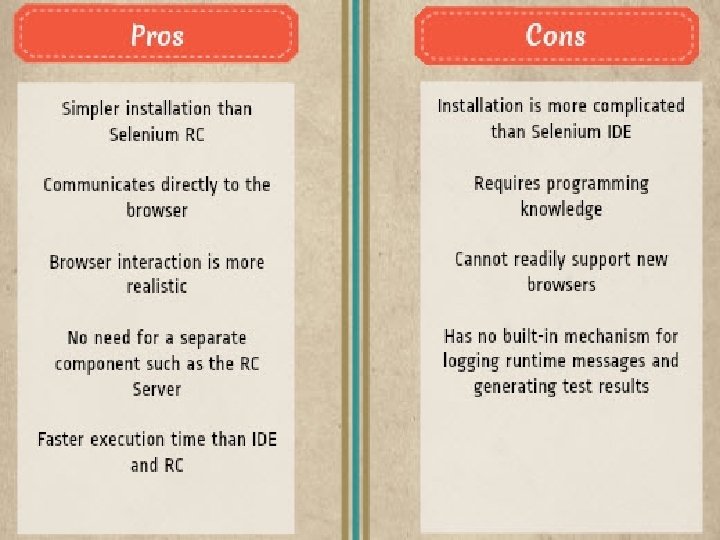
�WBrief Introduction Web. Driver �The Web. Driver proves itself to be better than both Selenium IDE and Selenium RC in many aspects. It implements a more modern and stable approach in automating the browser's actions. Web. Driver, unlike Selenium RC, does not rely on Java. Script for Automation. It controls the browser by directly communicating with it. �The supported languages are the same as those in Selenium RC. �Java �C# �PHP �Python �Perl �Ruby
v. Selenium Grid �Selenium Grid is a tool used together with Selenium RC to run parallel tests across different machines and different browsers all at the same time. Parallel execution means running multiple tests at once. �Features: �Enables simultaneous running of tests in multiple browsers and environments. �Saves time enormously. �Utilizes the hub-and-nodes concept. The hub acts as a central source of Selenium commands to each node connected to it.
v. How to Choose the Right Selenium Tool for Your Need v. Selenium IDE �To learn about concepts on automated testing and Selenium, including: �Selenese commands such as type, open, click. And. Wait, assert, verify, etc. �Locators such as id, name, xpath, css selector, etc. �Executing customized Java. Script code using run. Script �Exporting test cases in various formats. �To create tests with little or no prior knowledge in programming. �To create simple test cases and test suites that you can export later to RC or Web. Driver. �To test a web application against Firefox and Chrome only.
v. Selenium RC �To design a test using a more expressive language than Selenese �To run your test against different browsers (except Html. Unit) on different operating systems. �To deploy your tests across multiple environments using Selenium Grid. �To test your application against a new browser that supports Java. Script. �To test web applications with complex AJAX-based scenarios.
v. Selenium Web. Driver �To use a certain programming language in designing your test case. �To test applications that are rich in AJAX-based functionalities. �To execute tests on the Html. Unit browser. �To create customized test results. v. Selenium Grid �To run your Selenium RC scripts in multiple browsers and operating systems simultaneously. �To run a huge test suite, that needs to complete in the soonest time possible.
THANK YOU