
Unit2 INDEX NUMBRERS Definition Index numbers are statistical
Unit-2

INDEX NUMBRERS Definition: Index numbers are statistical devices designed to measure the relative changes in the level of a phenomenon with respect to time, income, profession, geographical location etc… Eg: the sales of an item in 2015 as compared to 2000 is 160 means the sales has increased 60% in 2015 compared to 2000. Base year: The year selected for comparison. Current Year: The year for which comparison is required. In the above example 2015 is the current year and 2000 is the base year. Simple Index number: Index number used for variation in the level of a single item. Composite Index number: Index number used for variation in the level of a group of items.
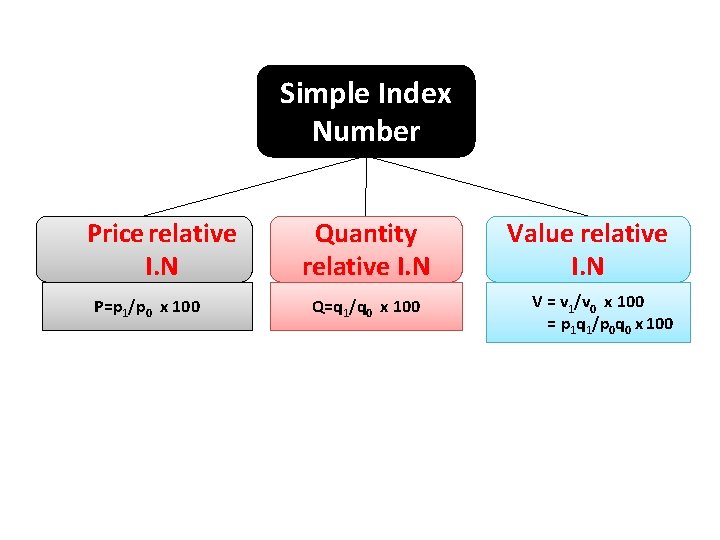
Simple Index Number Price relative I. N P=p 1/p 0 x 100 Quantity relative I. N Q=q 1/q 0 x 100 Value relative I. N V = v 1/v 0 x 100 = p 1 q 1/p 0 q 0 x 100
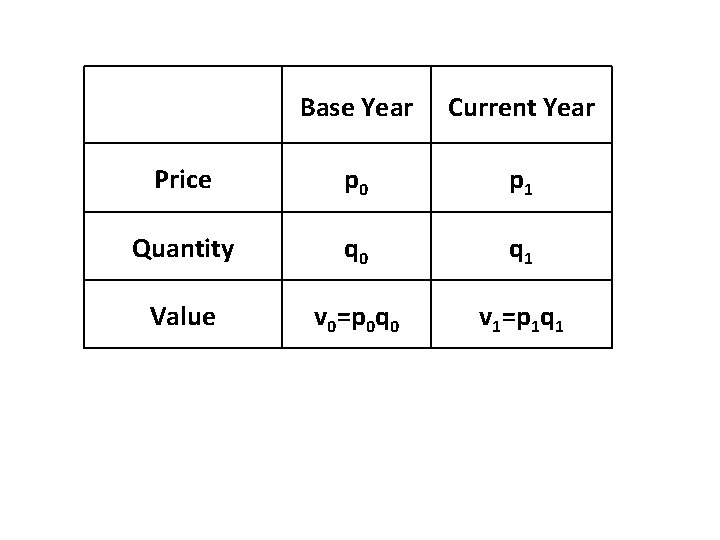
Base Year Current Year Price p 0 p 1 Quantity q 0 q 1 Value v 0=p 0 q 0 v 1=p 1 q 1
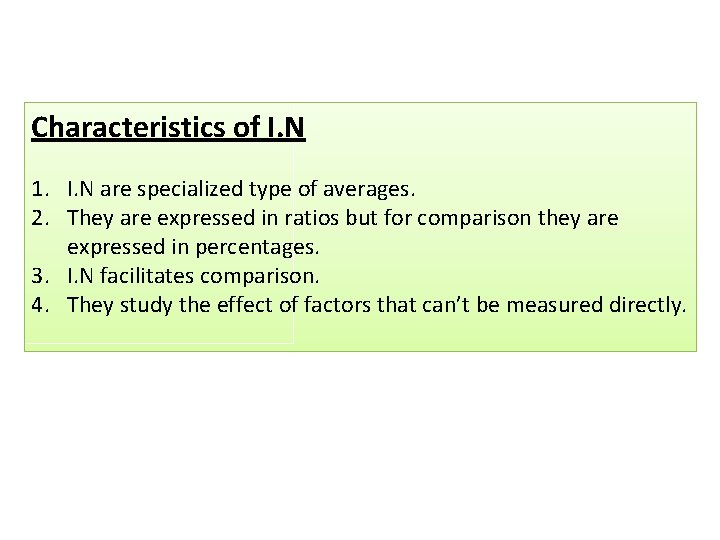
Characteristics of I. N 1. I. N are specialized type of averages. 2. They are expressed in ratios but for comparison they are expressed in percentages. 3. I. N facilitates comparison. 4. They study the effect of factors that can’t be measured directly.
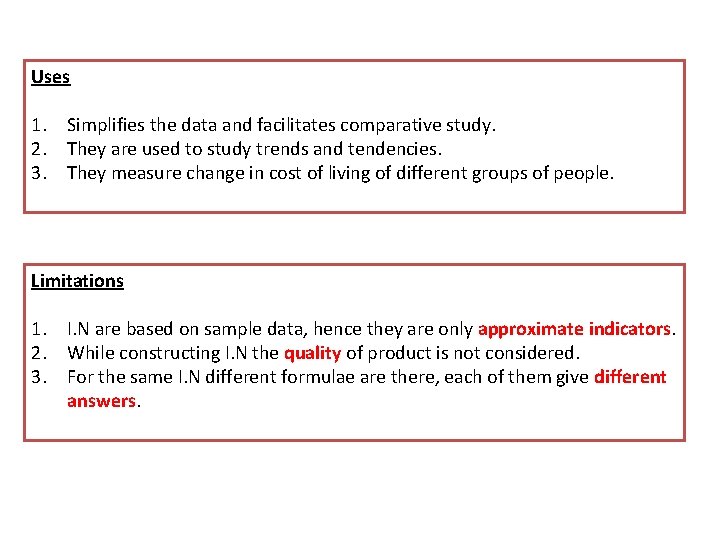
Uses 1. Simplifies the data and facilitates comparative study. 2. They are used to study trends and tendencies. 3. They measure change in cost of living of different groups of people. Limitations 1. I. N are based on sample data, hence they are only approximate indicators. 2. While constructing I. N the quality of product is not considered. 3. For the same I. N different formulae are there, each of them give different answers.
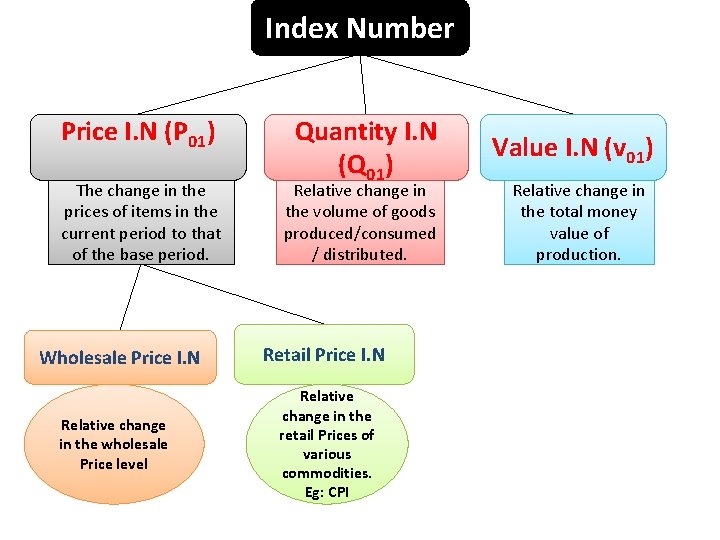
Index Number Price I. N (P 01) The change in the prices of items in the current period to that of the base period. Wholesale Price I. N Relative change in the wholesale Price level Quantity I. N (Q 01) Relative change in the volume of goods produced/consumed / distributed. Retail Price I. N Relative change in the retail Prices of various commodities. Eg: CPI Value I. N (v 01) Relative change in the total money value of production.
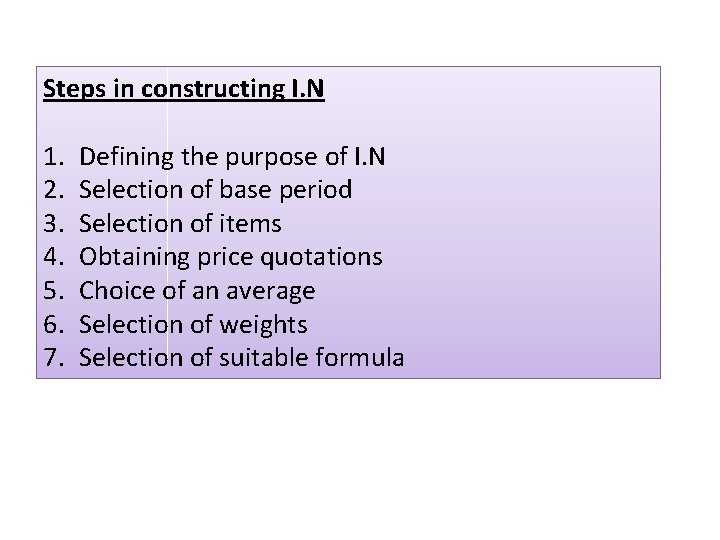
Steps in constructing I. N 1. 2. 3. 4. 5. 6. 7. Defining the purpose of I. N Selection of base period Selection of items Obtaining price quotations Choice of an average Selection of weights Selection of suitable formula
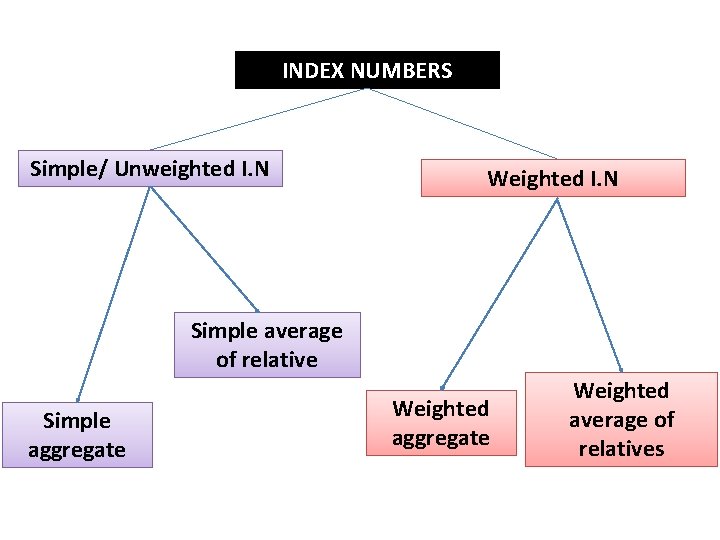
INDEX NUMBERS Simple/ Unweighted I. N Weighted I. N Simple average of relative Simple aggregate Weighted average of relatives
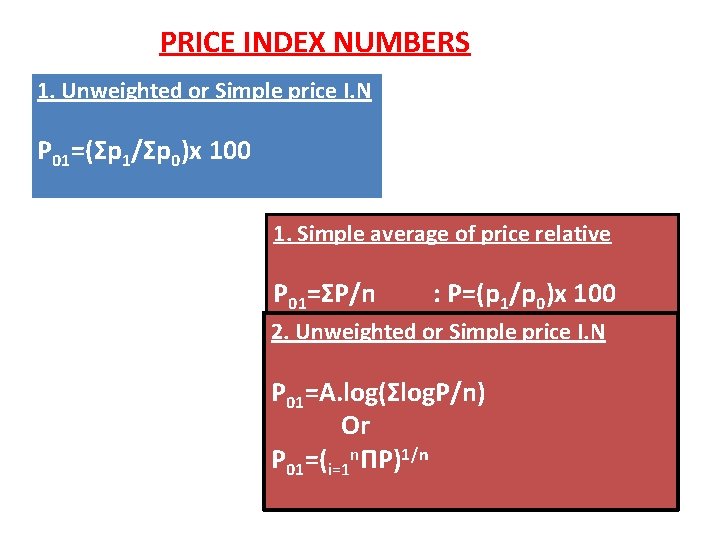
PRICE INDEX NUMBERS 1. Unweighted or Simple price I. N P 01=(Σp 1/Σp 0)x 100 1. Simple average of price relative P 01=ΣP/n : P=(p 1/p 0)x 100 2. Unweighted or Simple price I. N P 01=A. log(Σlog. P/n) Or P 01=(i=1 nΠP)1/n
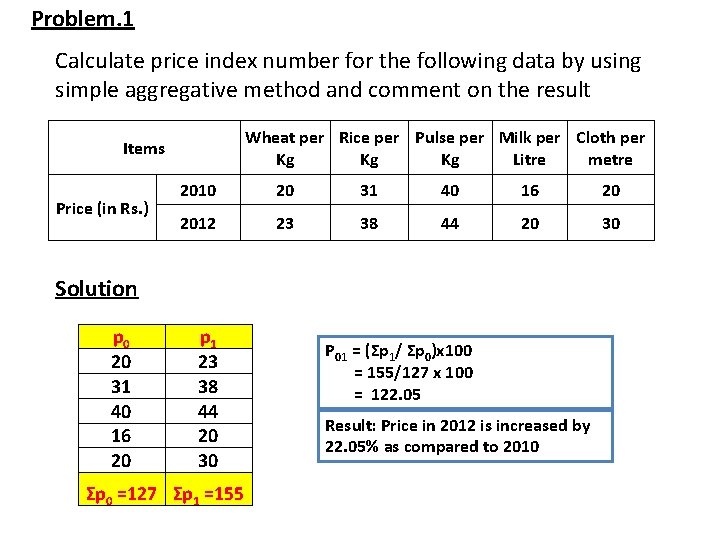
Problem. 1 Calculate price index number for the following data by using simple aggregative method and comment on the result Wheat per Rice per Pulse per Milk per Cloth per Kg Kg Kg Litre metre Items Price (in Rs. ) 2010 20 31 40 16 20 2012 23 38 44 20 30 Solution p 0 20 31 40 16 20 p 1 23 38 44 20 30 Σp 0 =127 Σp 1 =155 P 01 = (Σp 1/ Σp 0)x 100 = 155/127 x 100 = 122. 05 Result: Price in 2012 is increased by 22. 05% as compared to 2010
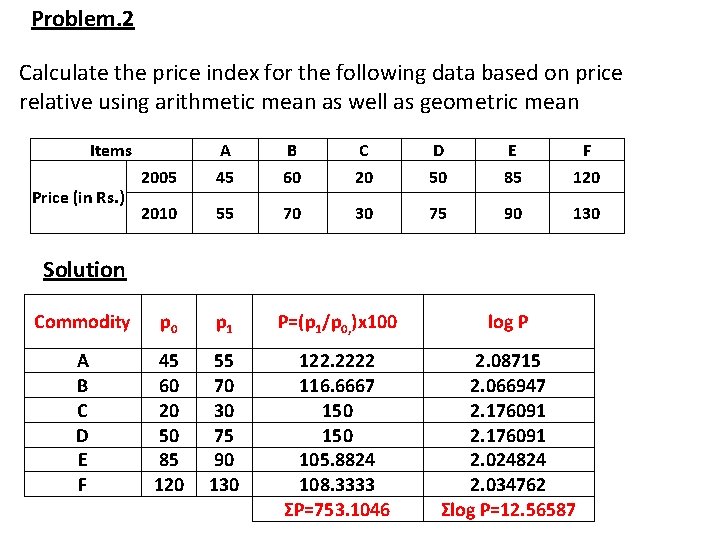
Problem. 2 Calculate the price index for the following data based on price relative using arithmetic mean as well as geometric mean Items 2005 A 45 B 60 C 20 D 50 E 85 F 120 2010 55 70 30 75 90 130 Commodity p 0 p 1 P=(p 1/p 0, )x 100 log P A B C D E F 45 60 20 50 85 120 55 70 30 75 90 130 122. 2222 116. 6667 150 105. 8824 108. 3333 ΣP=753. 1046 2. 08715 2. 066947 2. 176091 2. 024824 2. 034762 Σlog P=12. 56587 Price (in Rs. ) Solution
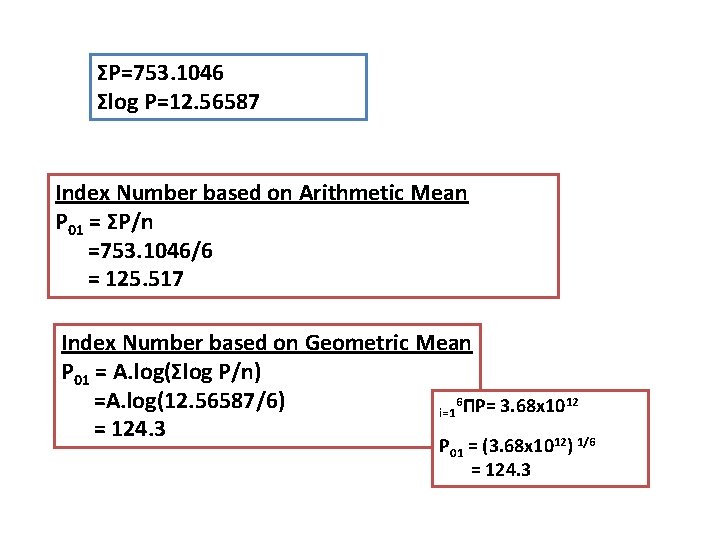
ΣP=753. 1046 Σlog P=12. 56587 Index Number based on Arithmetic Mean P 01 = ΣP/n =753. 1046/6 = 125. 517 Index Number based on Geometric Mean P 01 = A. log(Σlog P/n) 6 12 =A. log(12. 56587/6) i=1 ΠP= 3. 68 x 10 = 124. 3 12 1/6 P 01 = (3. 68 x 10 ) = 124. 3
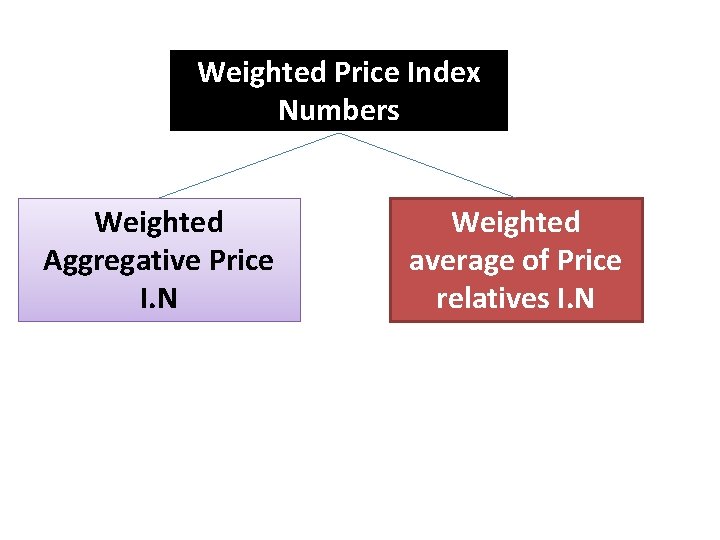
Weighted Price Index Numbers Weighted Aggregative Price I. N Weighted average of Price relatives I. N
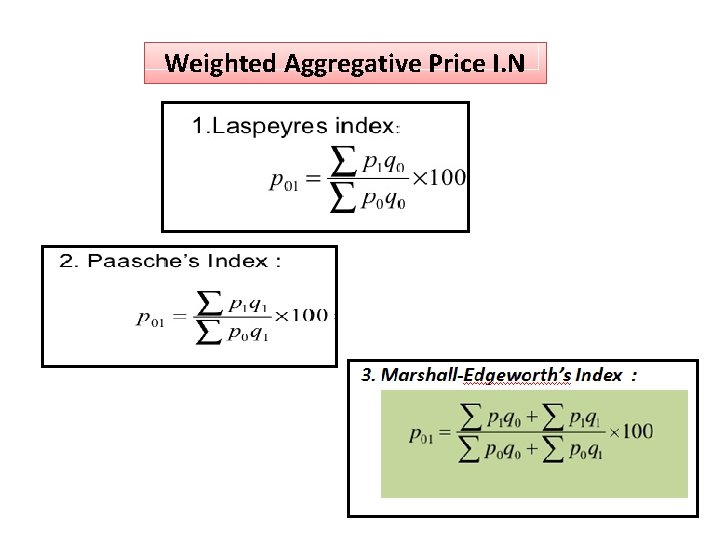
Weighted Aggregative Price I. N
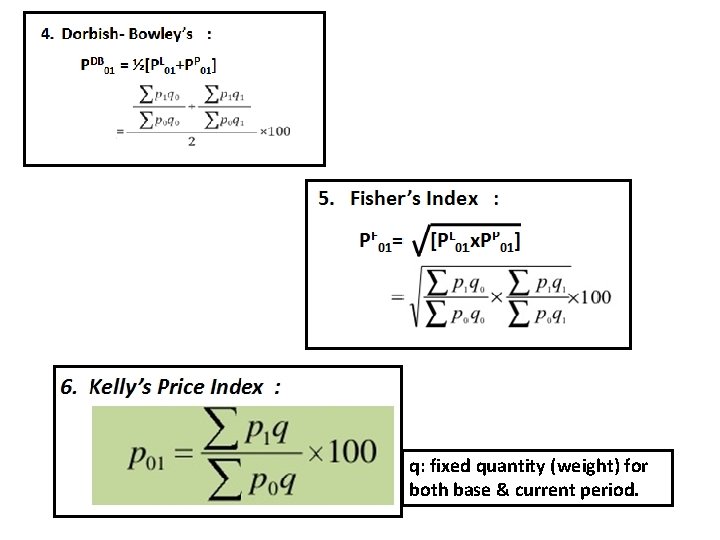
q: fixed quantity (weight) for both base & current period.
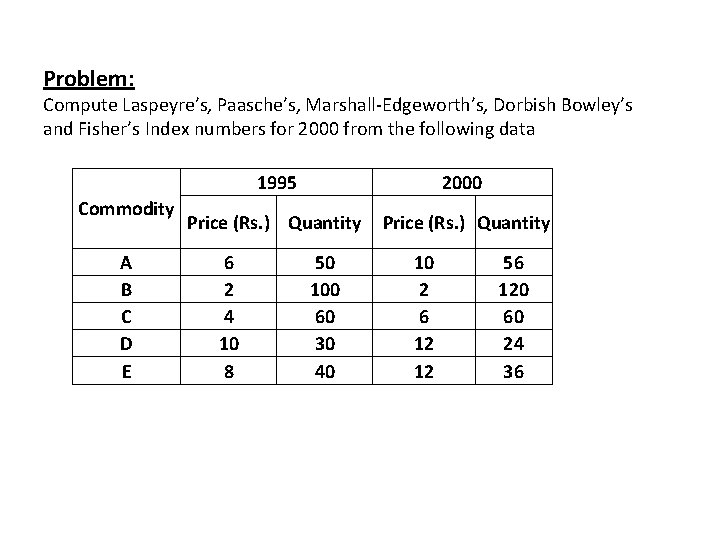
Problem: Compute Laspeyre’s, Paasche’s, Marshall-Edgeworth’s, Dorbish Bowley’s and Fisher’s Index numbers for 2000 from the following data Commodity A B C D E 1995 2000 Price (Rs. ) Quantity 6 2 4 10 8 50 100 60 30 40 10 2 6 12 12 56 120 60 24 36
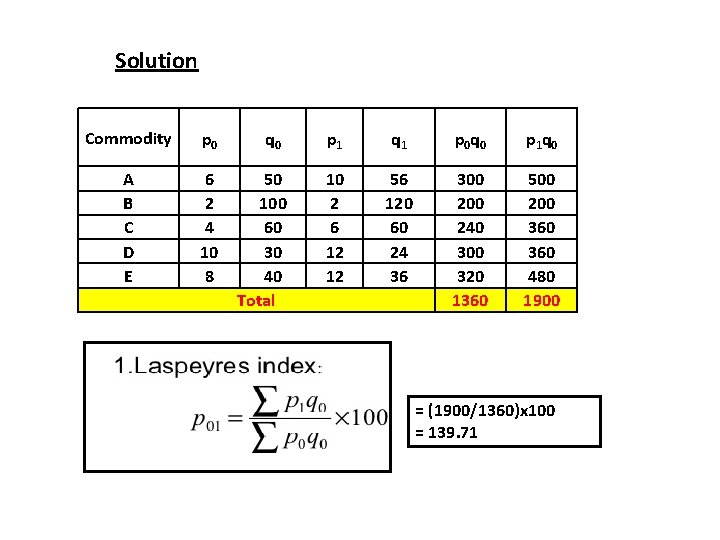
Solution Commodity p 0 A B C D E 6 2 4 10 8 q 0 50 100 60 30 40 Total p 1 q 1 p 0 q 0 p 1 q 0 10 2 6 12 12 56 120 60 24 36 300 240 300 320 1360 500 200 360 480 1900 = (1900/1360)x 100 = 139. 71
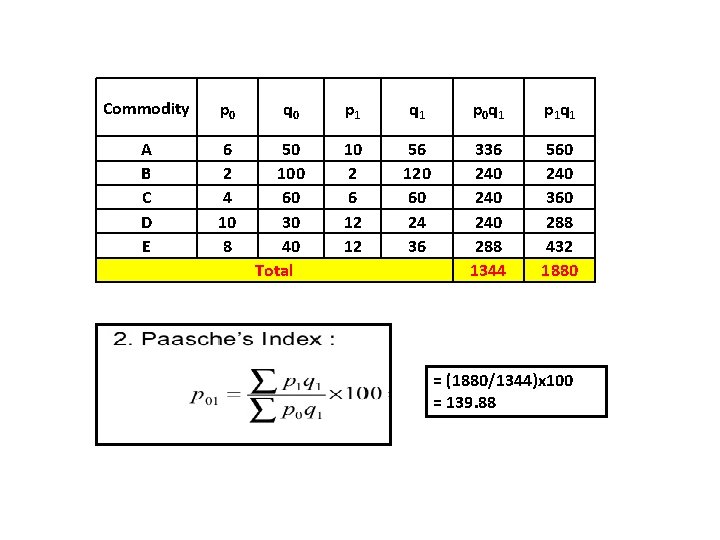
Commodity p 0 A B C D E 6 2 4 10 8 q 0 50 100 60 30 40 Total p 1 q 1 p 0 q 1 p 1 q 1 10 2 6 12 12 56 120 60 24 36 336 240 240 288 1344 560 240 360 288 432 1880 = (1880/1344)x 100 = 139. 88
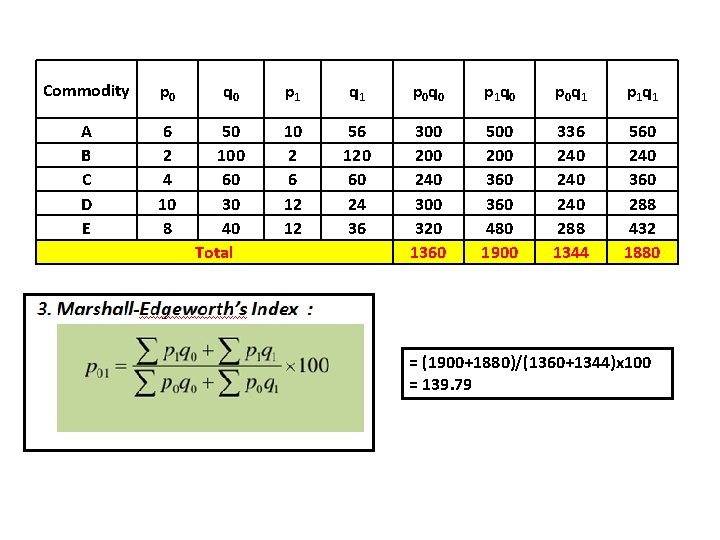
Commodity p 0 A B C D E 6 2 4 10 8 q 0 50 100 60 30 40 Total p 1 q 1 p 0 q 0 p 1 q 0 p 0 q 1 p 1 q 1 10 2 6 12 12 56 120 60 24 36 300 240 300 320 1360 500 200 360 480 1900 336 240 240 288 1344 560 240 360 288 432 1880 = (1900+1880)/(1360+1344)x 100 = 139. 79
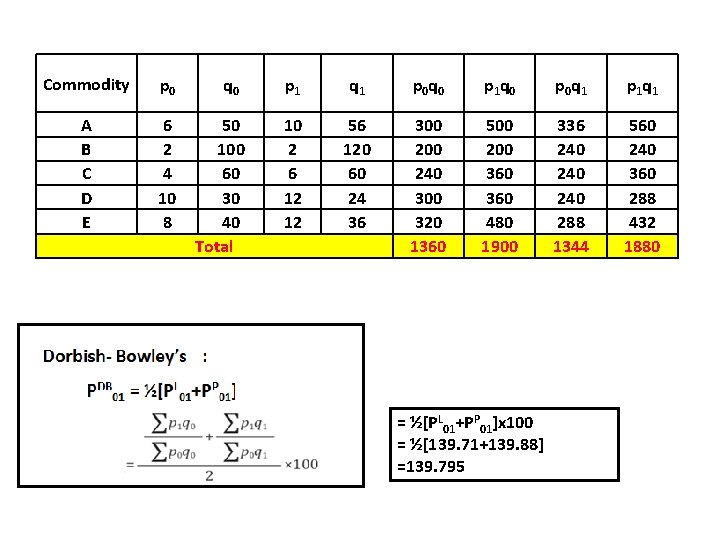
Commodity p 0 A B C D E 6 2 4 10 8 q 0 50 100 60 30 40 Total p 1 q 1 p 0 q 0 p 1 q 0 p 0 q 1 p 1 q 1 10 2 6 12 12 56 120 60 24 36 300 240 300 320 1360 500 200 360 480 1900 336 240 240 288 1344 560 240 360 288 432 1880 = ½[PL 01+PP 01]x 100 = ½[139. 71+139. 88] =139. 795
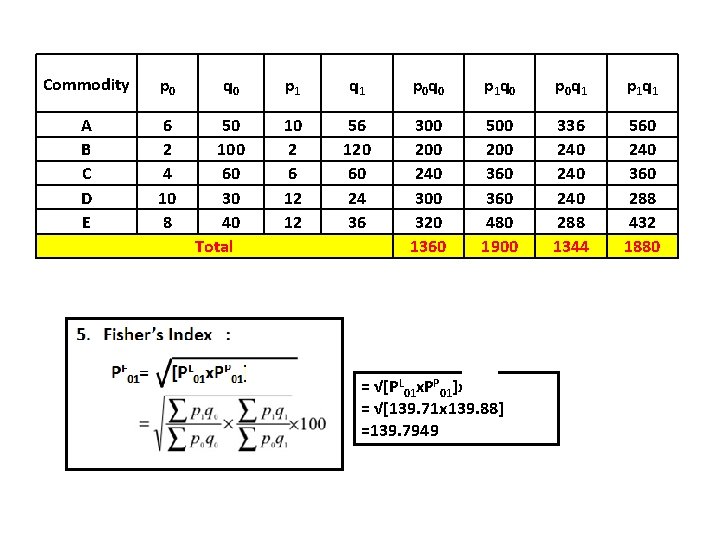
Commodity p 0 A B C D E 6 2 4 10 8 q 0 50 100 60 30 40 Total p 1 q 1 p 0 q 0 p 1 q 0 p 0 q 1 p 1 q 1 10 2 6 12 12 56 120 60 24 36 300 240 300 320 1360 500 200 360 480 1900 336 240 240 288 1344 560 240 360 288 432 1880 = √[PL 01 x. PP 01]x 100 = √[139. 71 x 139. 88] =139. 7949
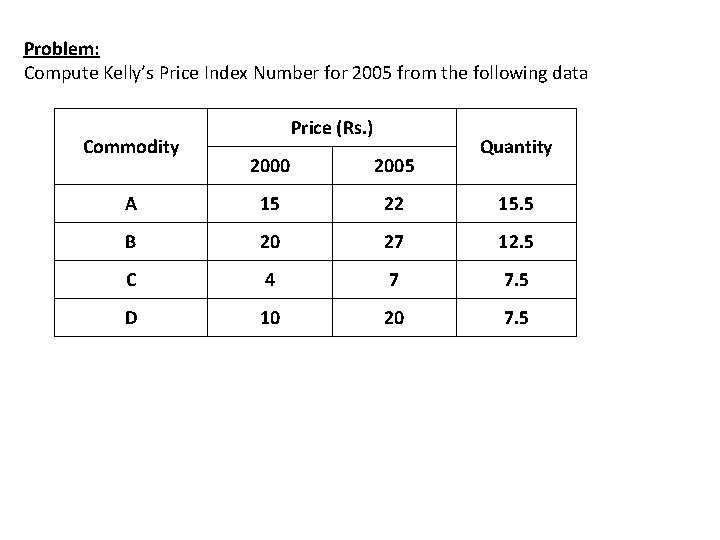
Problem: Compute Kelly’s Price Index Number for 2005 from the following data Commodity Price (Rs. ) Quantity 2000 2005 A 15 22 15. 5 B 20 27 12. 5 C 4 7 7. 5 D 10 20 7. 5
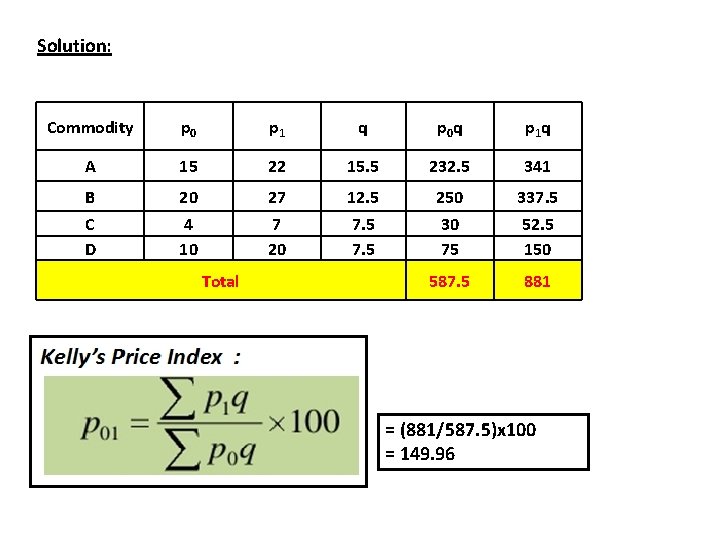
Solution: Commodity p 0 p 1 q p 0 q p 1 q A 15 22 15. 5 232. 5 341 B 20 27 12. 5 250 337. 5 C D 4 10 7 20 7. 5 30 75 52. 5 150 587. 5 881 Total = (881/587. 5)x 100 = 149. 96
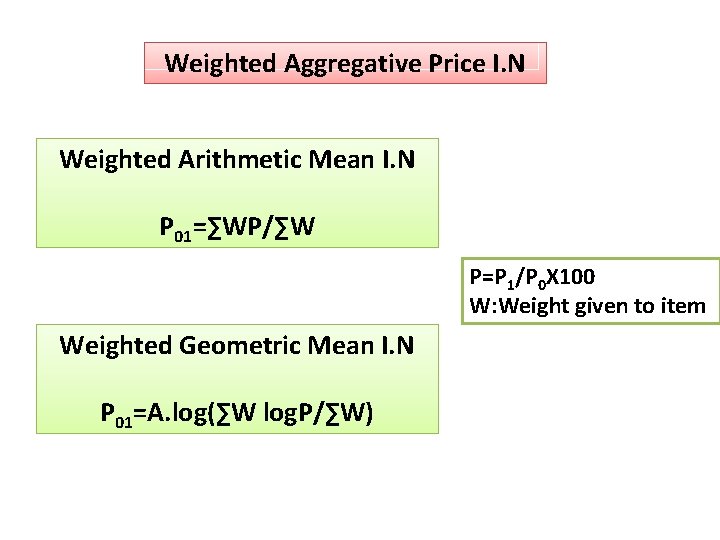
Weighted Aggregative Price I. N Weighted Arithmetic Mean I. N P 01=∑WP/∑W P=P 1/P 0 X 100 W: Weight given to item Weighted Geometric Mean I. N P 01=A. log(∑W log. P/∑W)
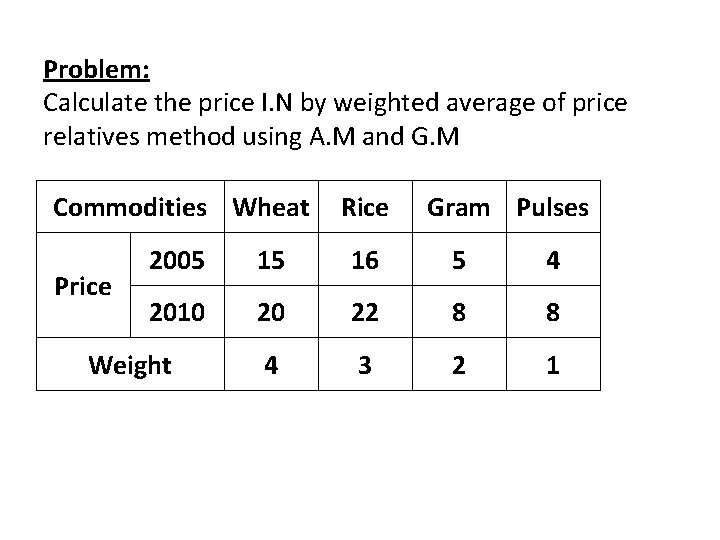
Problem: Calculate the price I. N by weighted average of price relatives method using A. M and G. M Commodities Wheat Rice 2005 15 16 5 4 2010 20 22 8 8 4 3 2 1 Price Weight Gram Pulses
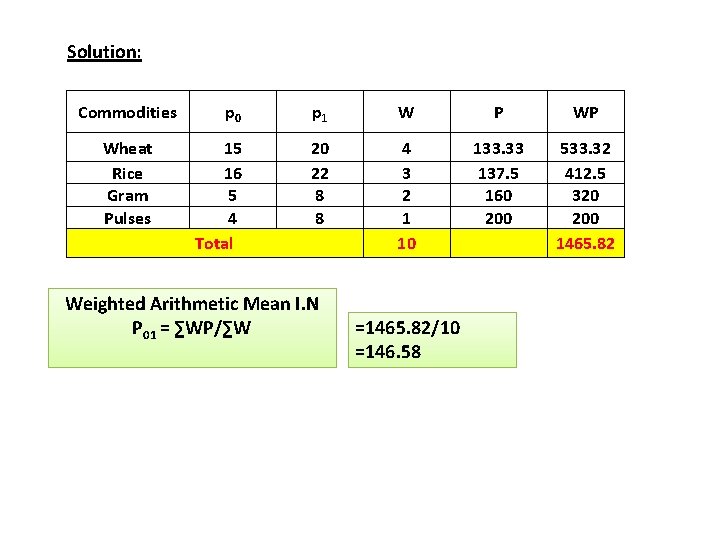
Solution: Commodities Wheat Rice Gram Pulses p 0 p 1 W P WP 15 16 5 4 Total 20 22 8 8 4 3 2 1 10 133. 33 137. 5 160 200 533. 32 412. 5 320 200 1465. 82 Weighted Arithmetic Mean I. N P 01 = ∑WP/∑W =1465. 82/10 =146. 58
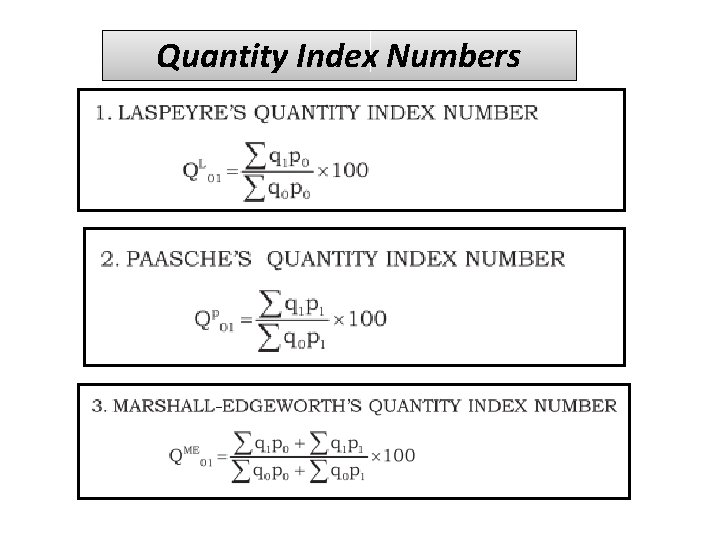
Quantity Index Numbers
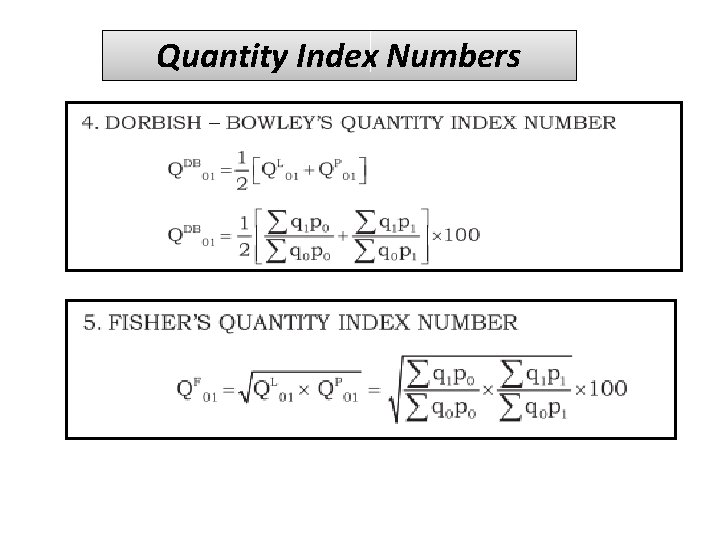
Quantity Index Numbers
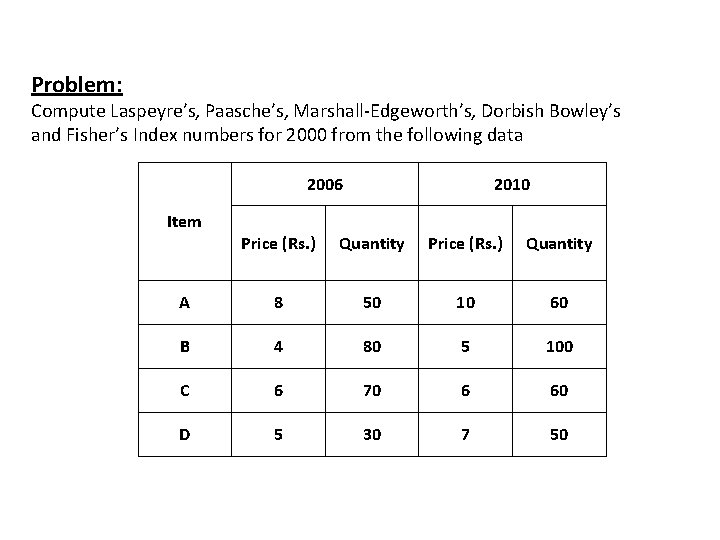
Problem: Compute Laspeyre’s, Paasche’s, Marshall-Edgeworth’s, Dorbish Bowley’s and Fisher’s Index numbers for 2000 from the following data 2006 Item 2010 Price (Rs. ) Quantity A 8 50 10 60 B 4 80 5 100 C 6 70 6 60 D 5 30 7 50
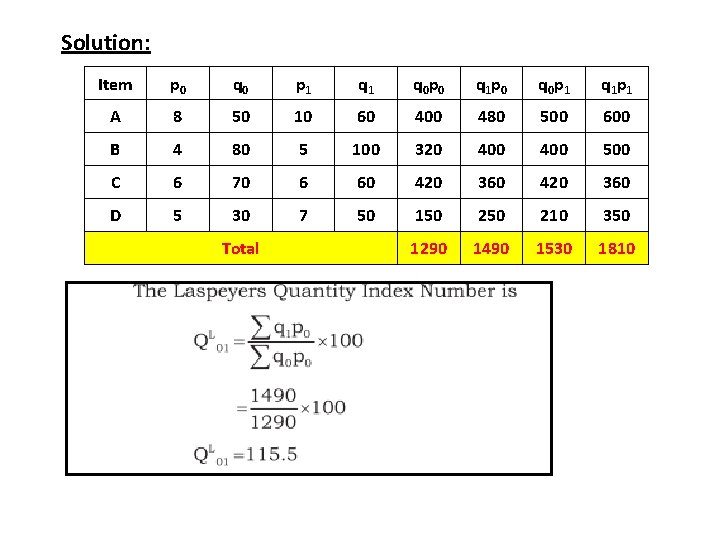
Solution: Item p 0 q 0 p 1 q 0 p 0 q 1 p 0 q 0 p 1 q 1 p 1 A 8 50 10 60 400 480 500 600 B 4 80 5 100 320 400 500 C 6 70 6 60 420 360 D 5 30 7 50 150 210 350 1290 1490 1530 1810 Total
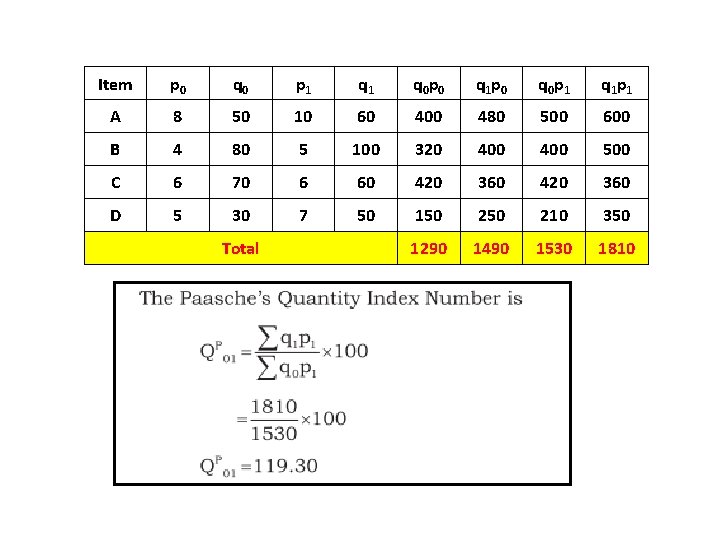
Item p 0 q 0 p 1 q 0 p 0 q 1 p 0 q 0 p 1 q 1 p 1 A 8 50 10 60 400 480 500 600 B 4 80 5 100 320 400 500 C 6 70 6 60 420 360 D 5 30 7 50 150 210 350 1290 1490 1530 1810 Total
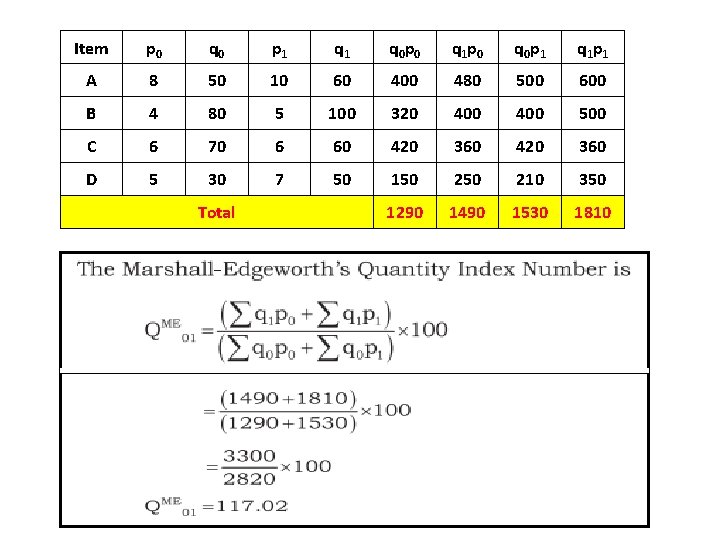
Item p 0 q 0 p 1 q 0 p 0 q 1 p 0 q 0 p 1 q 1 p 1 A 8 50 10 60 400 480 500 600 B 4 80 5 100 320 400 500 C 6 70 6 60 420 360 D 5 30 7 50 150 210 350 1290 1490 1530 1810 Total
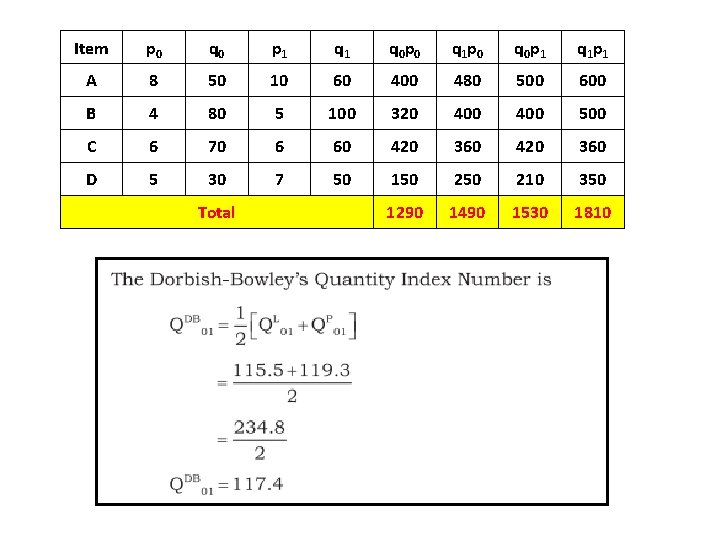
Item p 0 q 0 p 1 q 0 p 0 q 1 p 0 q 0 p 1 q 1 p 1 A 8 50 10 60 400 480 500 600 B 4 80 5 100 320 400 500 C 6 70 6 60 420 360 D 5 30 7 50 150 210 350 1290 1490 1530 1810 Total
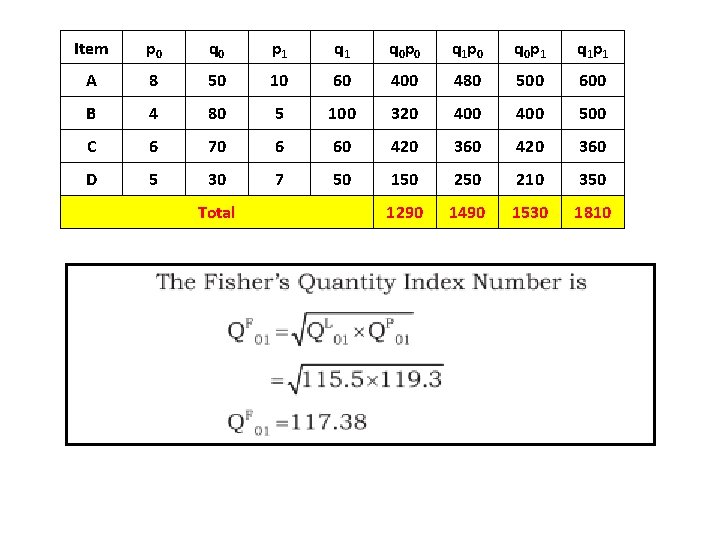
Item p 0 q 0 p 1 q 0 p 0 q 1 p 0 q 0 p 1 q 1 p 1 A 8 50 10 60 400 480 500 600 B 4 80 5 100 320 400 500 C 6 70 6 60 420 360 D 5 30 7 50 150 210 350 1290 1490 1530 1810 Total
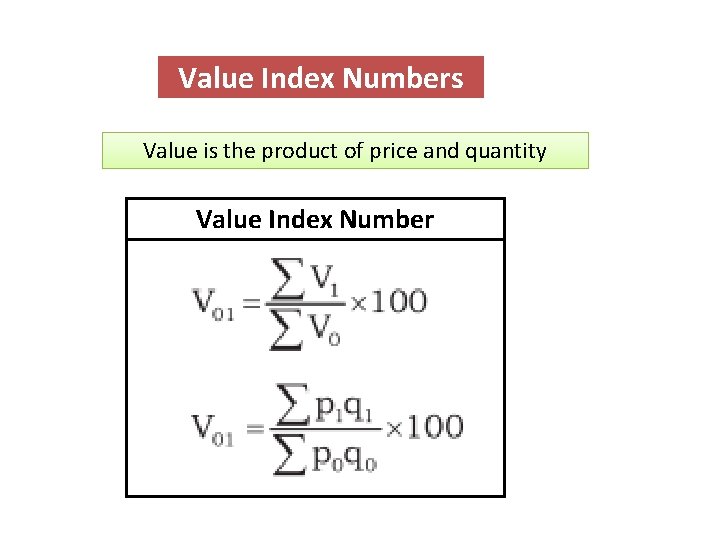
Value Index Numbers Value is the product of price and quantity Value Index Number
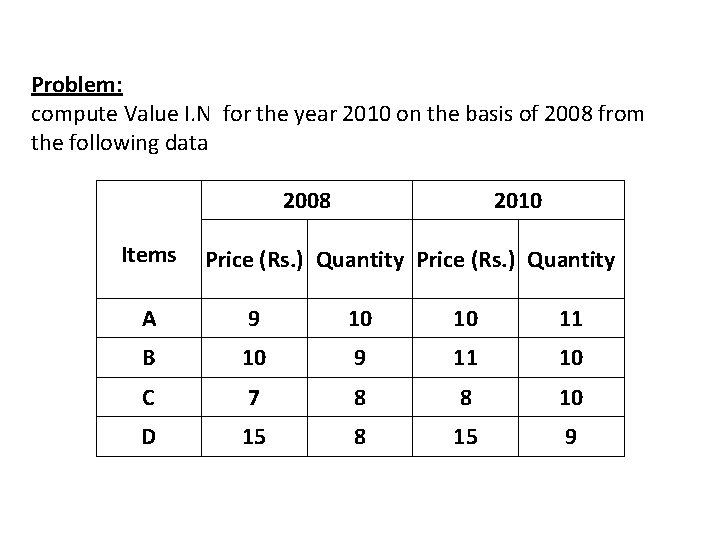
Problem: compute Value I. N for the year 2010 on the basis of 2008 from the following data 2008 Items 2010 Price (Rs. ) Quantity A 9 10 10 11 B 10 9 11 10 C 7 8 8 10 D 15 8 15 9
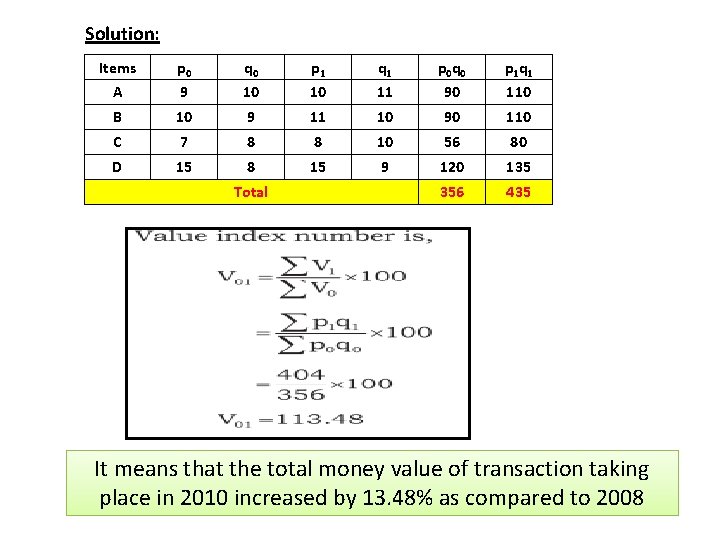
Solution: Items p 0 q 0 p 1 q 1 A 9 10 10 11 90 110 B 10 9 11 10 90 110 C 7 8 8 10 56 80 D 15 8 15 9 120 135 356 435 Total It means that the total money value of transaction taking place in 2010 increased by 13. 48% as compared to 2008
- Slides: 38