
Unit1 Parallel Computing Platforms Prepared BY H M

Unit-1 Parallel Computing Platforms Prepared BY: -H. M. Patel

Topic Overview • • Implicit Parallelism: Trends in Microprocessor Architectures Limitations of Memory System Performance Parallel Computing Platforms Communication Model of Parallel Platforms Physical Organization of Parallel Platforms Communication Costs in Parallel Machines Messaging Cost Models and Routing Mechanisms Mapping Techniques
What is Parallel Processing • A mode of operation in which a process is split into parts, which are executed simultaneously on different processors attached to the same computer
Scope of Parallelism • Each of these components present significant performance bottlenecks. • Parallelism addresses each of these components in significant ways. • Different applications utilize different aspects of parallelism - e. g. , data intensive applications utilize high aggregate throughput, server applications utilize high aggregate network bandwidth, and scientific applications typically utilize high processing and memory system performance. • It is important to understand each of these performance bottlenecks and their interacting effect

Implicit Parallelism: Trends in Microprocessor Architectures • Higher levels of device integration have made available a large number of tradition. • The question of how best to utilize these resources is an important one. • Current processors use these resources in multiple functional units and execute multiple instructions in the same cycle. • Out of this architectures we have to select which one is the best. • Current processors use these resources in multiple functional units E. g. : Add R 1, R 2 (i) Instruction Fetch, (ii) Instruction Decode, (iii) Instruction Execute Consider these two instructions: Add R 1, R 2 • The precise manner in which these instructions are selected and executed provides impressive diversity in architectures with different performance and for different purpose. (Each architecture has its own merits pitfalls. )
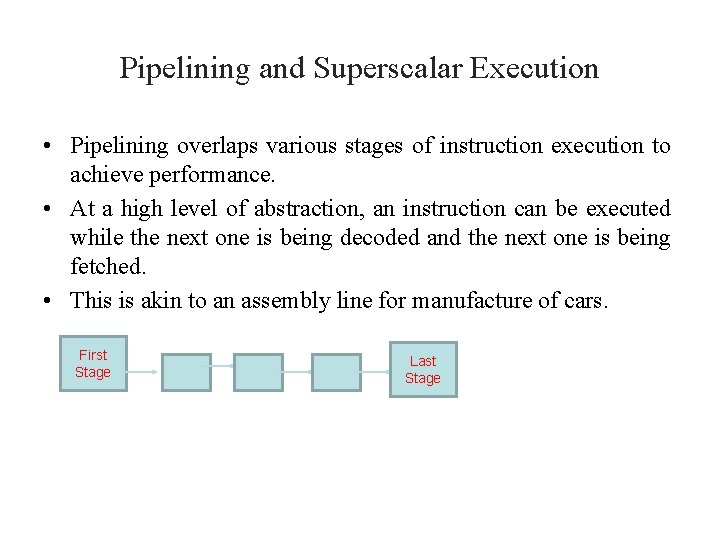
Pipelining and Superscalar Execution • Pipelining overlaps various stages of instruction execution to achieve performance. • At a high level of abstraction, an instruction can be executed while the next one is being decoded and the next one is being fetched. • This is akin to an assembly line for manufacture of cars. First Stage Last Stage
Pipelining and Superscalar Execution • Pipelining, however, has several limitations. • The speed of a pipeline is eventually limited by the slowest stage. • For this reason, conventional processors rely on very deep pipelines (Ex: -20 stage pipelines in state-of-the-art Pentium processors). • However, in typical program traces, for example every 5 -6 th instruction is a conditional jump! This requires very accurate branch prediction. • The penalty of a misprediction grows with the depth of the pipeline, since a larger number of instructions will have to be flushed.
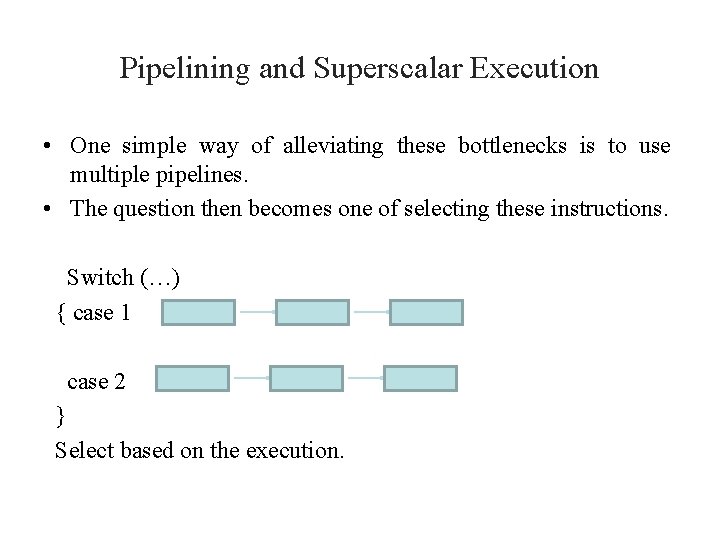
Pipelining and Superscalar Execution • One simple way of alleviating these bottlenecks is to use multiple pipelines. • The question then becomes one of selecting these instructions. Switch (…) { case 1 case 2 } Select based on the execution.
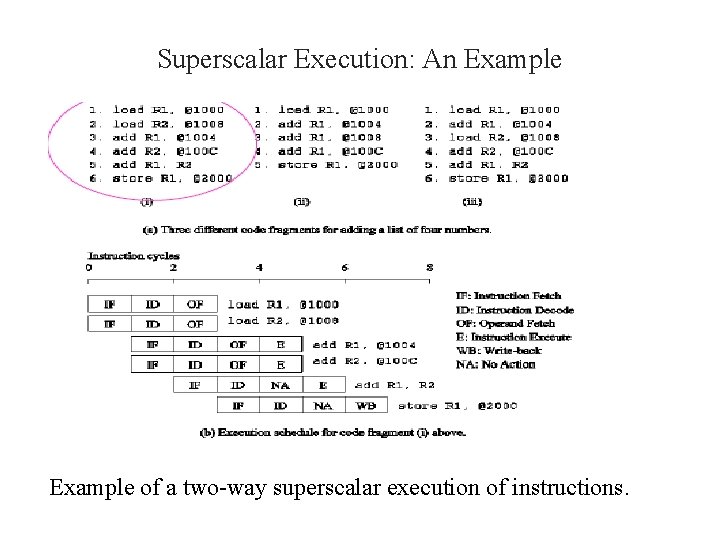
Superscalar Execution: An Example of a two-way superscalar execution of instructions.
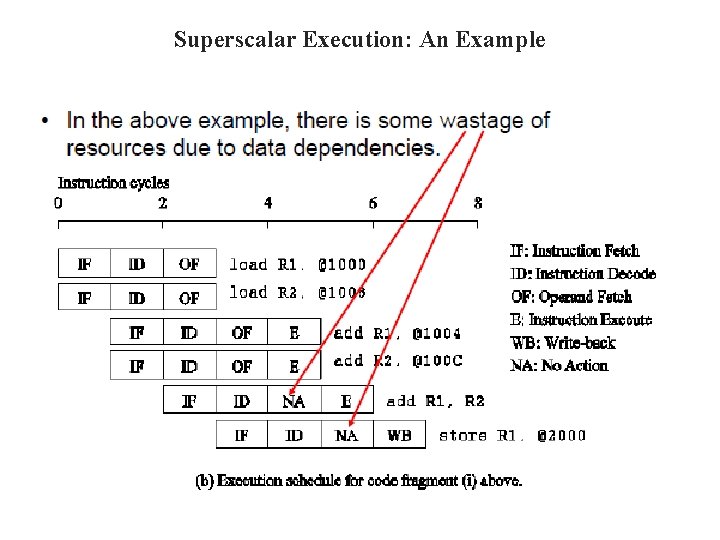
Superscalar Execution: An Example
Superscalar Execution • Scheduling of instructions is determined by a number of factors: – True Data Dependency: The result of one operation is an input to the next. E. g. , A = B+C; D = A+E; – Resource Dependency: Two operations require the same resource. E. g. , fprintf (indata, “%d”, a); fprintf (indata, “%d”, b); – Branch Dependency: Scheduling instructions across conditional branch statements cannot be done deterministically a-priori. – The scheduler, a piece of hardware looks at a large number of instructions in an instruction queue and selects appropriate number of instructions to execute concurrently based on these factors. – The complexity of this hardware is an important constraint on superscalar processors.
Superscalar Execution: Issue Mechanisms • In the simpler model, instructions can be issued only in the order. That is, if the second instruction cannot be issued because it has a data dependency with the first, only one instruction is issued in the cycle. This is called in-order issue. • In a more aggressive model, instructions can be issued out of order. In this case, if the second instruction has data dependencies with the first, but the third instruction does not, the first and third instructions can be co-scheduled. This is also called dynamic issue. • Performance of in-order issue is generally limited.
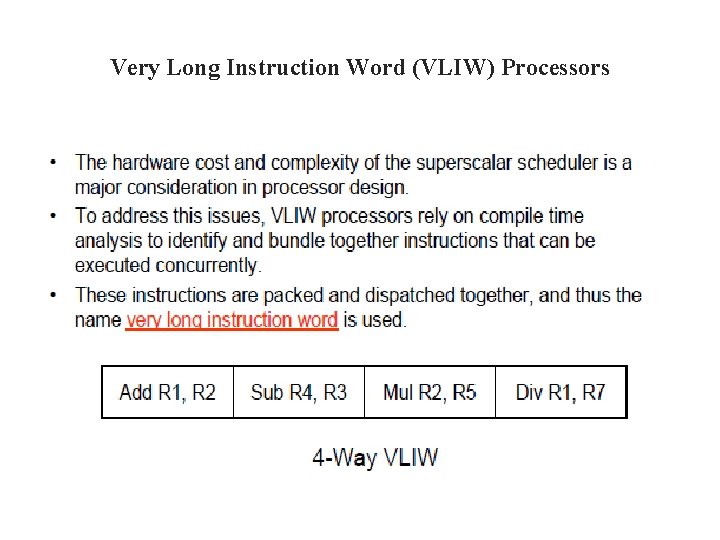
Very Long Instruction Word (VLIW) Processors
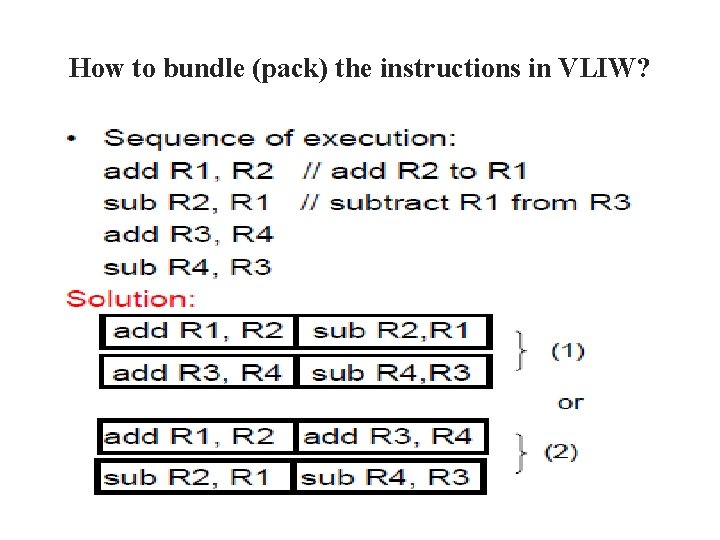
How to bundle (pack) the instructions in VLIW?
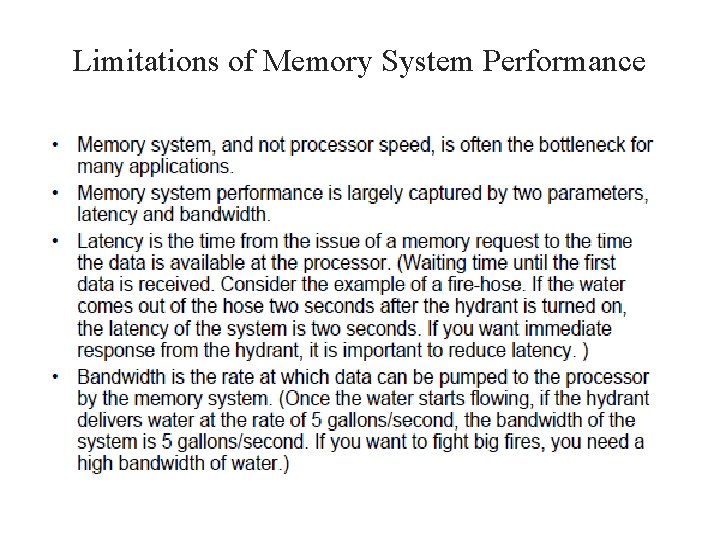
Limitations of Memory System Performance
Memory System Performance: Bandwidth and Latency • It is very important to understand the difference between latency and bandwidth. • Consider the example of e-mail sending and receiving to sender and receiver.
Improving Effective Memory Latency Using Caches • Caches are small and fast memory elements between the processor and DRAM. • This memory acts as a low-latency high-bandwidth storage. • If a piece of data is repeatedly used, the effective latency of this memory system can be reduced by the cache. • The fraction of data references satisfied by the cache is called the cache hit ratio of the computation on the system. • Ex: -A hit is a request to a web server for a file, like a web page, image, Java. Script, or Cascading Style Sheet. When a web page is uploaded from a server the number of "hits" or "page hits" is equal to the number of files requested. .
Impact of Caches: Example Consider the architecture from the previous example. In this case, we introduce a cache of size 32 KB with a latency of 1 ns or one cycle. We use this setup to multiply two matrices A and B of dimensions 32 × 32. We have carefully chosen these numbers so that the cache is large enough to store matrices A and B, as well as the result matrix C.
Impact of Caches: Example (continued) • The following observations can be made about the problem: – Fetching the two matrices into the cache corresponds to fetching 2 K words, which takes approximately 200 µs. – Multiplying two n × n matrices takes 2 n 3 operations. For our problem, this corresponds to 64 K operations, which can be performed in 16 K cycles (or 16 µs) at four instructions per cycle. – The total time for the computation is therefore approximately the sum of time for load/store operations and the time for the computation itself, i. e. , 200 + 16 µs. – This corresponds to a peak computation rate of 64 K/216.
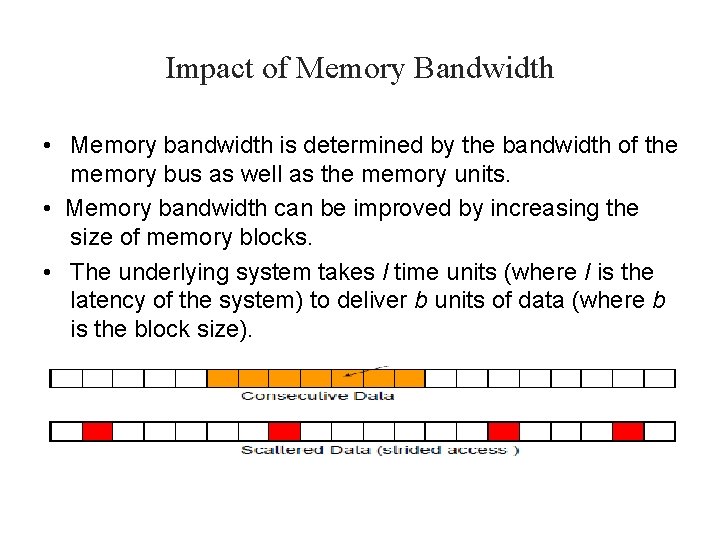
Impact of Memory Bandwidth • Memory bandwidth is determined by the bandwidth of the memory bus as well as the memory units. • Memory bandwidth can be improved by increasing the size of memory blocks. • The underlying system takes l time units (where I is the latency of the system) to deliver b units of data (where b is the block size).
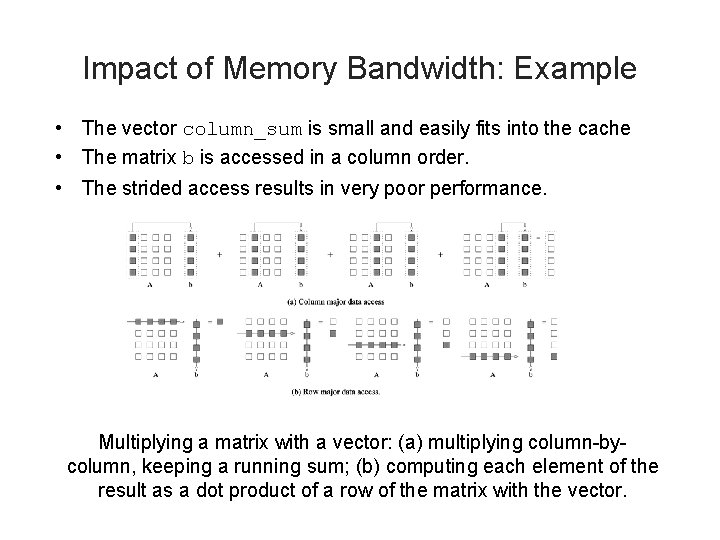
Impact of Memory Bandwidth: Example • The vector column_sum is small and easily fits into the cache • The matrix b is accessed in a column order. • The strided access results in very poor performance. Multiplying a matrix with a vector: (a) multiplying column-bycolumn, keeping a running sum; (b) computing each element of the result as a dot product of a row of the matrix with the vector.
Impact of Memory Bandwidth: Example We can fix the above example as follows: for (i = 0; i < n; i++) c[i] = dot_product(get_row(a, i), b); ][i]; • Each dot-product is independent of the other, and therefore represents a concurrent unit of execution. We can safely rewrite the above code segment as: for (i = 0; i < n; i++) c[i] = create_thread(dot_product, get_Col(a, i), b); .
Memory System Performance: Summary • The series of examples presented in this section show the following concepts: – Exploiting spatial and temporal locality in applications is critical for amortizing memory latency and increasing effective memory bandwidth. – The ratio of the number of operations to number of memory accesses is a good indicator of anticipated tolerance to memory bandwidth. – Memory layouts and organizing computation appropriately can make a significant impact on the spatial and temporal locality.

Alternate Approaches for Hiding Memory Latency • Consider the problem of browsing the web on a very slow network connection. We deal with the problem in one of three possible ways: – we expect which pages we are going to browse ahead of time and issue requests for them in advance; – we open multiple browsers and access different pages in each browser, thus while we are waiting for one page to load, we could be reading others; or – we access a whole bunch of pages in one go - amortizing the latency across various accesses. • The first approach is called perfecting, the second multithreading, and the third one corresponds to spatial area in accessing memory words.
Multithreading for Latency Hiding A thread is a single stream of control in the flow of a program. We show threads with a simple example: for (i = 0; i < n; i++) c[i] = dot_product(get_row(a, i), b); Each dot-product is independent of the other, and therefore represents a concurrent unit of execution. We can safely rewrite the above code segment as: for (i = 0; i < n; i++) c[i] = create_thread(dot_product, get_col(a, i), b);
Multithreading for Latency Hiding: Example • In the code, the first instance of this function accesses a pair of vector elements and waits for them. • In the mean time, the second instance of this function can access two other vector elements in the next cycle, and so on. • After l units of time, where l is the latency of the memory system, the first function instance gets the requested data from memory and can perform the required computation. • In the next cycle, the data items for the next function instance arrive, and so on. In this way, in every clock cycle, we can perform a computation.
Multithreading for Latency Hiding • The execution schedule in the previous example is predicated upon two assumptions: the memory system is capable of servicing multiple outstanding requests, and the processor is capable of switching threads at every cycle. • It also requires the program to have an explicit specification of concurrency in the form of threads. • Machines such as the Tera(Unit of measurement) rely on multithreaded processors that can switch the context of execution in every cycle. Consequently, they are able to hide latency effectively.
Perfecting for Latency Hiding • In typical program a data item is loaded and used by processor in a small time windows. • If the result is load then cache programs to stop • Why not advance the loads so that by the time the data is actually needed, it is already there! • In advance the load we are trying to identify independent threads of execution that have no resource dependency • The only drawback is that you might need more space to store advanced loads. • However, if the advanced loads are overwritten, we are no worse than before!
Tradeoffs of Multithreading and Perfecting • Multithreading and perfecting are critically impacted by the memory bandwidth. Consider the following example: – Consider a computation running on a machine with a 1 GHz clock, 4 word cache line, single cycle access to the cache, and 100 ns latency to DRAM. The computation has a cache hit ratio at 1 KB of 25% and at 32 KB of 90%. Consider two cases: first, a single threaded execution in which the entire cache is available to the serial context, and second, a multithreaded execution with 32 threads where each thread has a cache residency of 1 KB. – If the computation makes one data request in every cycle of 1 ns, you may notice that the first scenario requires 400 MB/s of memory bandwidth and the second, 3 GB/s.
Dichotomy of Parallel Computing Platforms • An explicitly parallel program must specify concurrency and interaction between concurrent subtasks. • The former is sometimes also referred to as the control structure and the latter as the communication model.
SIMD and MIMD Processors A typical SIMD architecture (a) and a typical MIMD architecture (b).
SIMD PROCESSORS • Single Instruction Multiple Data is part of Flynn's taxonomy. • Performs same instruction on multiple data points concurrently • Takes advantage of data level parallelism within an algorithm Commonly used in image and signal processing applications Large number of samples or pixels calculated with the same instruction • Disadvantages: 1. Larger registers and functional units use more chip area and power 2. Difficult to parallelize some algorithms (Amdahl's Law) 3. Parallelization requires explicit instructions from the programmer
Conditional Execution in SIMD Processors Executing a conditional statement on an SIMD computer with four processors: (a) the conditional statement; (b) the execution of the statement in two steps.
MIMD Processors • In contrast to SIMD processors, MIMD processors can execute different programs on different processors. • A variant of this, called single program multiple data streams (SPMD) executes the same program on different processors. • It is easy to see that SPMD and MIMD are closely related in terms of programming flexibility and underlying architectural support. • Examples of such platforms include current generation Sun Ultra Servers, SGI Origin Servers, multiprocessor PCs, workstation clusters, and the IBM SP.

SIMD-MIMD Comparison • SIMD computers require less hardware than MIMD computers (single control unit). • However, since SIMD processors are specially designed, they tend to be expensive and have long design cycles. • Not all applications are naturally suited to SIMD processors. • In SIMD cost is Low compare to MIMD
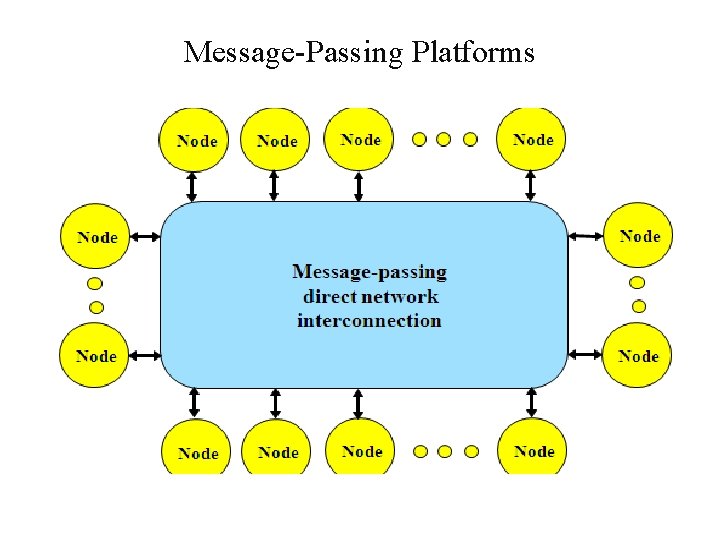
Communication Model of Parallel Platforms • There are two primary forms of data exchange between parallel tasks - accessing a shared data space and exchanging messages. • Platforms that provide a shared data space are called shared-address-space machines or multiprocessors. • Platforms that support messaging are also called message passing platforms or multi computers.
Shared-Address-Space Platforms • Part (or all) of the memory is accessible to all processors. • Processors interact by modifying data objects stored in this shared-address-space. • If the time taken by a processor to access any memory word in the system global or local is identical, the platform is classified as a uniform memory access (UMA), else, a non-uniform memory access (NUMA) machine.
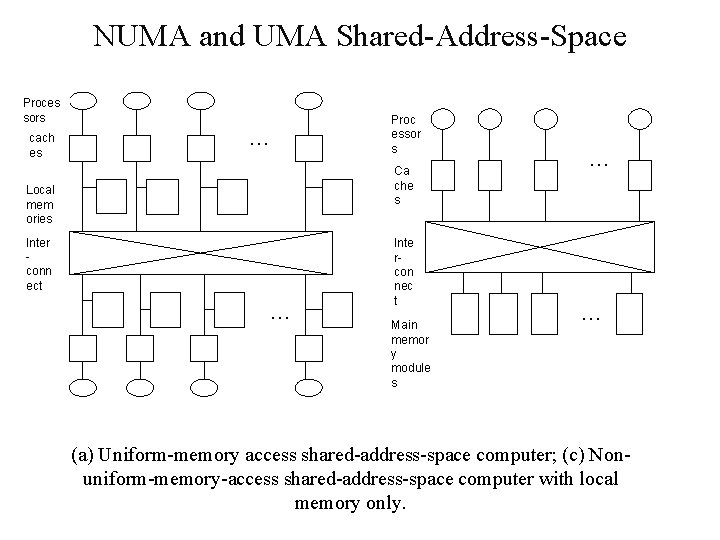
NUMA and UMA Shared-Address-Space Proces sors cach es … Proc essor s Ca che s Local mem ories Inter conn ect … Inte rcon nec t Main memor y module s … … (a) Uniform-memory access shared-address-space computer; (c) Nonuniform-memory-access shared-address-space computer with local memory only.
NUMA and UMA Shared-Address-Space Platforms Non-uniform memory access (NUMA): -It is a computer memory design used in multiprocessing, where the memory access time depends on the memory location relative to the processor. NUMA, a processor can access its own local memory faster than non-local memory The benefits of NUMA are limited to particular workloads, notably on servers where the data are often associated strongly with certain tasks or users. Uniform memory access (UMA): - It is a shared memory architecture used in parallel computers. All the processors in the UMA model share the physical memory uniformly in a UMA architecture, access time to a memory location is independent of which processor makes the request or which memory chip contains the transferred data
Shared-Address-Space vs. Shared Memory Machines • It is important to note the difference between the terms shared address space and shared memory. • We refer to the former as a programming abstraction and to the latter as a physical machine attribute. • It is possible to provide a shared address space using a physically distributed memory.
Message-Passing Platforms
Message Passing conti. . • Programmer has a simplified view of the target machine • Single processor has access certain amount of memory • May be implemented in time-sharing environment, where other processes share the processor and memory • When the data moves from variable in one hub to another hub through message transfer. • Sending and receiving process cooperate required information for message transfer.
Message passing system provides following Information to specify the message transfer • • – Which processor is sending the message – Where is the data on the sending processor – What kind of data is being sent – How much data is there – Which processor(s) are receiving the message – Where should the data be left on the receiving processor – How much data is receiving processor prepared to accept
Architecture of an Ideal Parallel Computer • A natural extension of the Random Access Machine (RAM) serial architecture is the Parallel Random Access Machine, or PRAM. • PRAMs consist of p processors and a global memory of unbounded size that is uniformly accessible to all processors. • Processors share a common clock but may execute different instructions in each cycle.
Architecture of an Ideal Parallel Computer • Depending on how simultaneous memory accesses are handled, PRAMs can be divided into four subclasses. – – Exclusive-read, exclusive-write (EREW) PRAM. Concurrent-read, exclusive-write (CREW) PRAM. Exclusive-read, concurrent-write (ERCW) PRAM. Concurrent-read, concurrent-write (CRCW) PRAM.
Interconnection Networks for Parallel Computers • Interconnection networks carry data between processors and to memory. • Interconnects are made of switches and links (wires, fiber). • Interconnects are classified as static or dynamic. • Static networks consist of point-to-point communication links among processing nodes and are also referred to as direct networks. • Dynamic networks are built using switches and communication links. Dynamic networks are also referred to as indirect networks.
Static and Dynamic Interconnection Networks Classification of interconnection networks: (a) a static network; and (b) a dynamic network.
Interconnection Networks • Switches map a fixed number of inputs to outputs. • The total number of ports on a switch is the degree of the switch 2 n. • The cost of a switch grows as the square of the degree of the switch, the peripheral hardware linearly as the degree, and the packaging costs linearly as the number of pins. • Processors talk to the network via a network interface. • The network interface may hang off the I/O bus or the memory bus.
Network Topologies • A variety of network topologies have been proposed and implemented. • These topologies exchange performance for cost. • Commercial machines often implement hybrids of multiple topologies for reasons of packaging, cost, and available components.
Network Topologies: Buses • Some of the simplest and earliest parallel machines used buses. • All processors access a common bus for exchanging data. • The distance between any two nodes is O(1) in a bus. The bus also provides a suitable data for broadcast media. • However, the bandwidth of the shared bus is a major bottleneck. • Typical bus based machines are limited to of nodes. Sun Enterprise servers and Intel Pentium based shared-bus multiprocessors are examples of such architectures.
Network Topologies: Buses Bus-based interconnects (a) with no local caches; (b) with local memory/caches.
Network Topologies: Crossbars A crossbar network uses an p×m grid of switches to connect p inputs to m outputs in this case switch is connected multiple I/O. It is one of the principal of switch architectures
Network Topologies: Crossbars • The cost of a crossbar of p processors grows as O(p 2). • This is generally difficult to scale for large values of p. • Examples of machines that employ crossbars include the Sun Ultra HPC 10000 and the Fujitsu VPP 500.
Network Topologies: Multistage Networks • Crossbars have excellent performance scalability but poor cost scalability. • Buses have excellent cost scalability, but poor performance scalability. • Multistage interconnects strike a compromise between these extremes. • In computer networking, multicast is the delivery of a message or information to a group of destination computers simultaneously in a single transmission from the source.
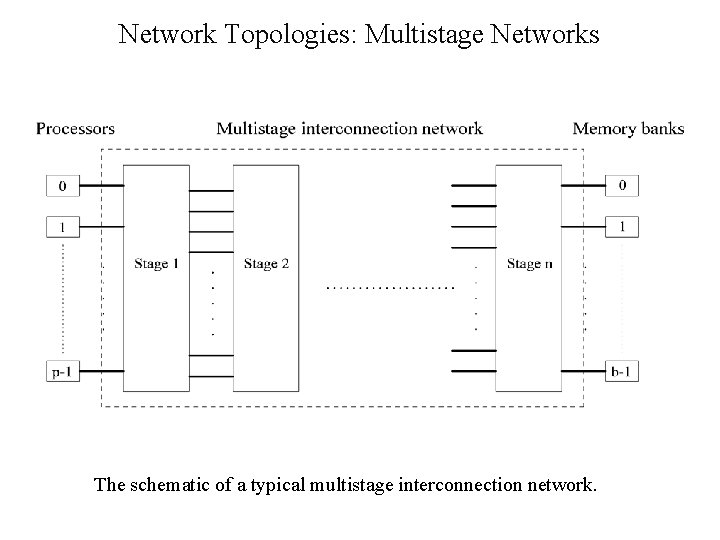
Network Topologies: Multistage Networks The schematic of a typical multistage interconnection network.
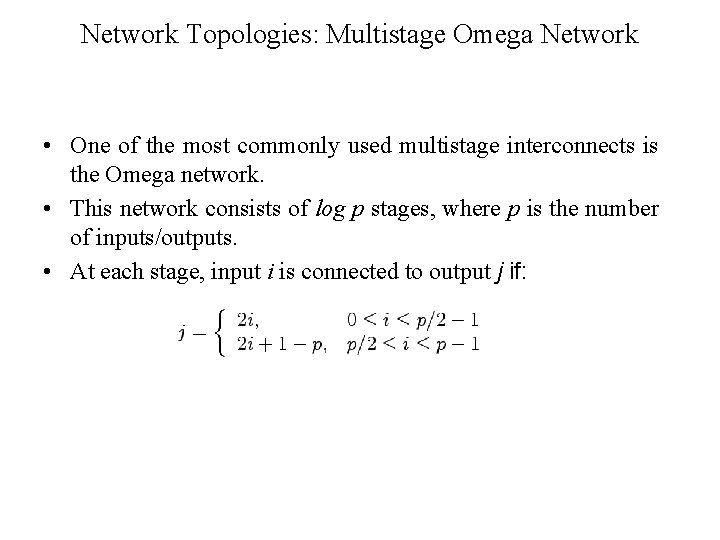
Network Topologies: Multistage Omega Network • One of the most commonly used multistage interconnects is the Omega network. • This network consists of log p stages, where p is the number of inputs/outputs. • At each stage, input i is connected to output j if:
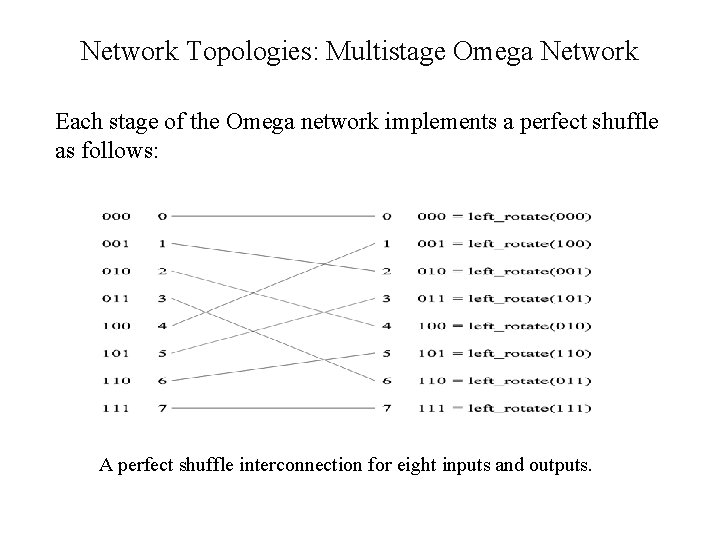
Network Topologies: Multistage Omega Network Each stage of the Omega network implements a perfect shuffle as follows: A perfect shuffle interconnection for eight inputs and outputs.
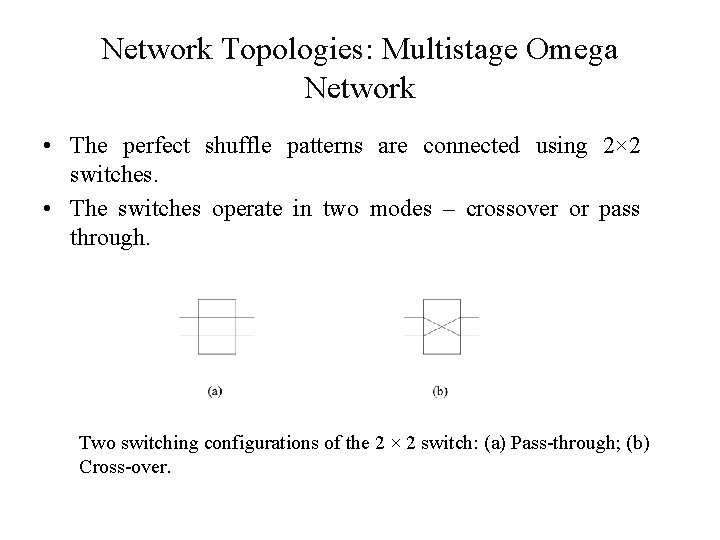
Network Topologies: Multistage Omega Network • The perfect shuffle patterns are connected using 2× 2 switches. • The switches operate in two modes – crossover or pass through. Two switching configurations of the 2 × 2 switch: (a) Pass-through; (b) Cross-over.
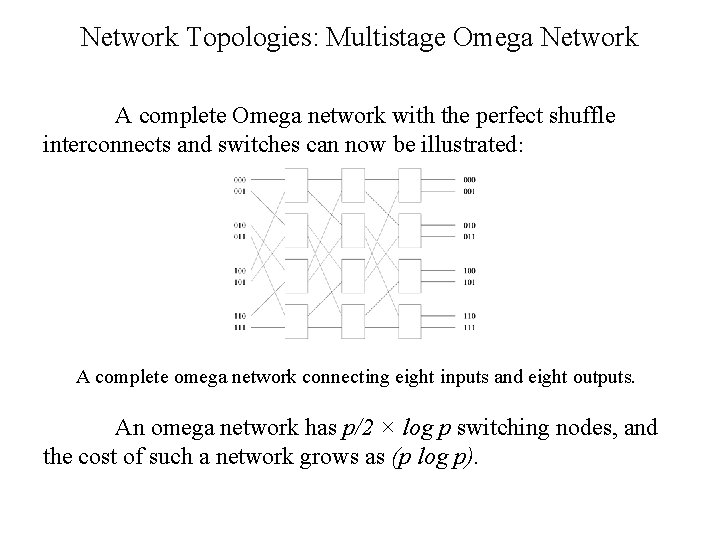
Network Topologies: Multistage Omega Network A complete Omega network with the perfect shuffle interconnects and switches can now be illustrated: A complete omega network connecting eight inputs and eight outputs. An omega network has p/2 × log p switching nodes, and the cost of such a network grows as (p log p).
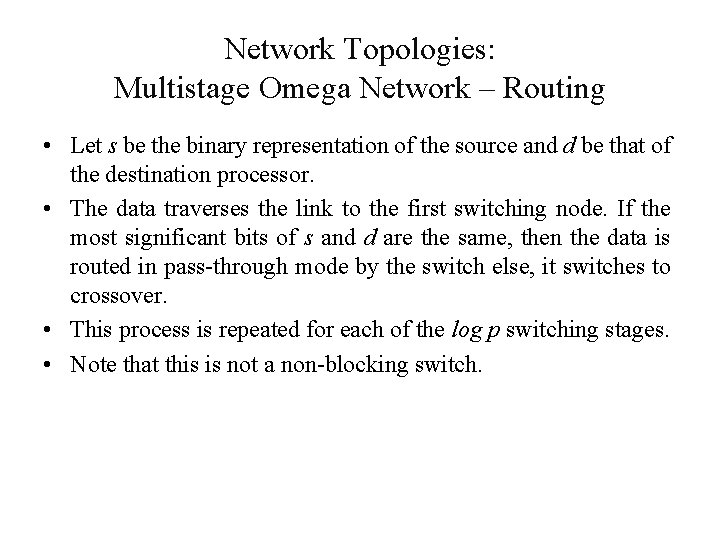
Network Topologies: Multistage Omega Network – Routing • Let s be the binary representation of the source and d be that of the destination processor. • The data traverses the link to the first switching node. If the most significant bits of s and d are the same, then the data is routed in pass-through mode by the switch else, it switches to crossover. • This process is repeated for each of the log p switching stages. • Note that this is not a non-blocking switch.
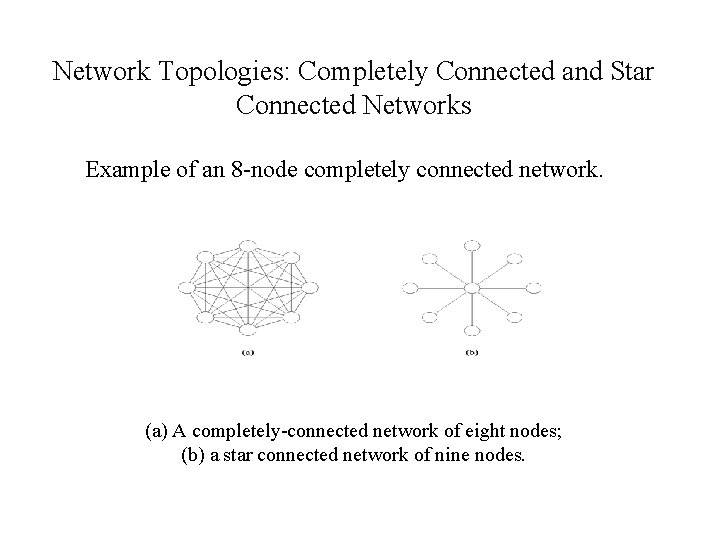
Network Topologies: Completely Connected and Star Connected Networks Example of an 8 -node completely connected network. (a) A completely-connected network of eight nodes; (b) a star connected network of nine nodes.
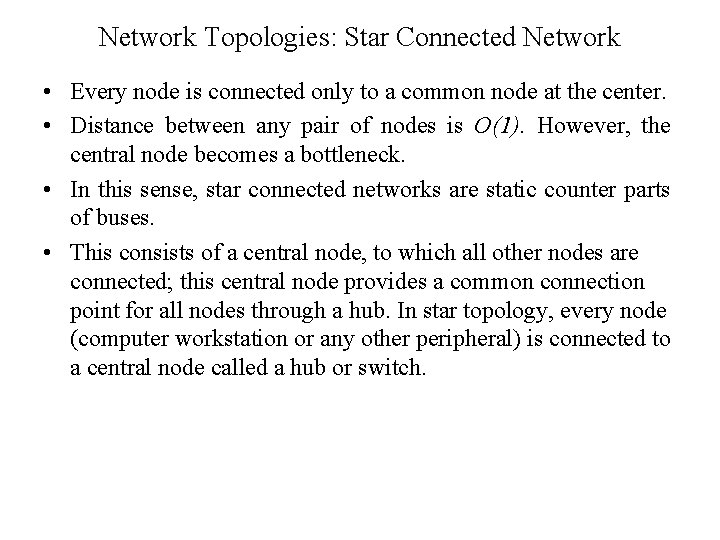
Network Topologies: Star Connected Network • Every node is connected only to a common node at the center. • Distance between any pair of nodes is O(1). However, the central node becomes a bottleneck. • In this sense, star connected networks are static counter parts of buses. • This consists of a central node, to which all other nodes are connected; this central node provides a common connection point for all nodes through a hub. In star topology, every node (computer workstation or any other peripheral) is connected to a central node called a hub or switch.
Network Topologies: Linear Arrays, Meshes, and k-d Meshes • In a linear array, each node has two neighbors, one to its left and one to its right. If the nodes at either end are connected, we refer to it as a 1 -D torus or a ring. • A generalization to 2 dimensions has nodes with 4 neighbors, to the north, south, east, and west. • A further generalization to d dimensions has nodes with 2 d neighbors. • A special case of a d-dimensional mesh is a hypercube. Here, d = log p, where p is the total number of nodes.
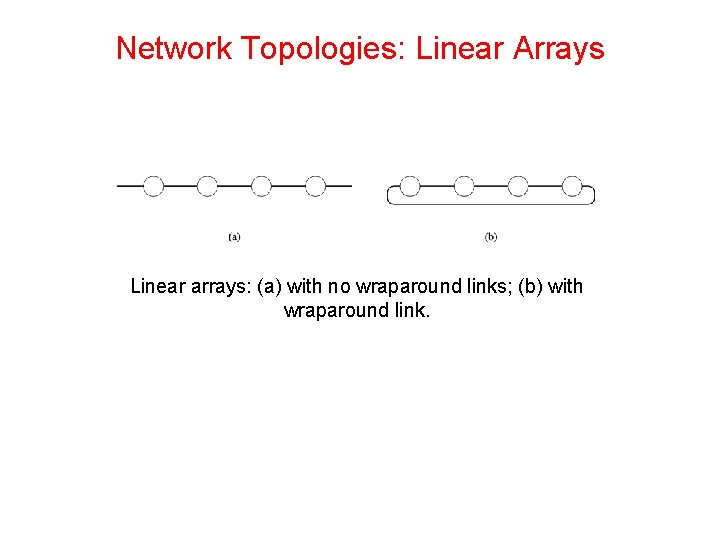
Network Topologies: Linear Arrays Linear arrays: (a) with no wraparound links; (b) with wraparound link.
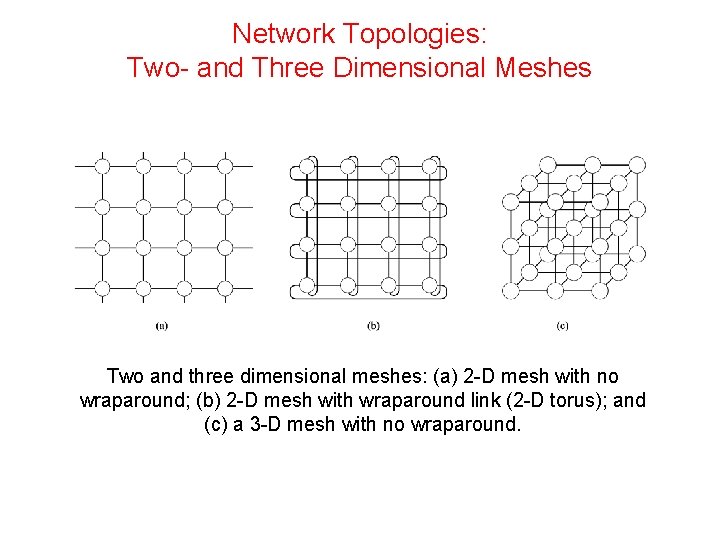
Network Topologies: Two- and Three Dimensional Meshes Two and three dimensional meshes: (a) 2 -D mesh with no wraparound; (b) 2 -D mesh with wraparound link (2 -D torus); and (c) a 3 -D mesh with no wraparound.
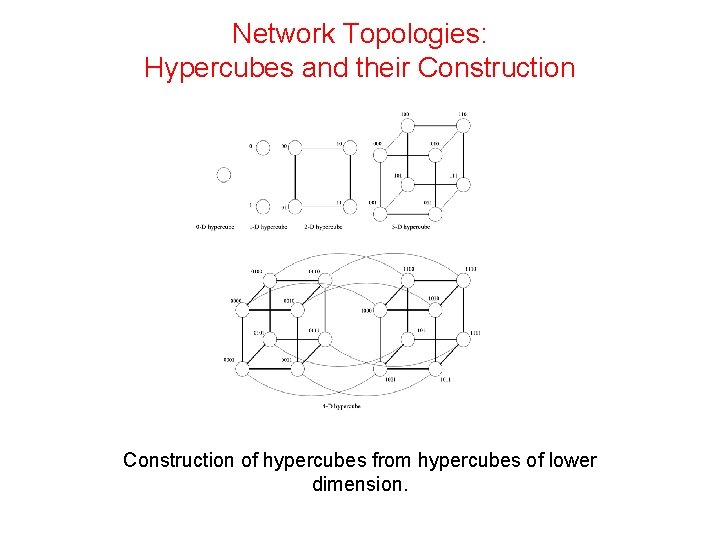
Network Topologies: Hypercubes and their Construction of hypercubes from hypercubes of lower dimension.
Network Topologies: Properties of Hypercubes • The distance between any two nodes is at most log p. • Each node has log p neighbors. • The distance between two nodes is given by the number of bit positions at which the two nodes differ.
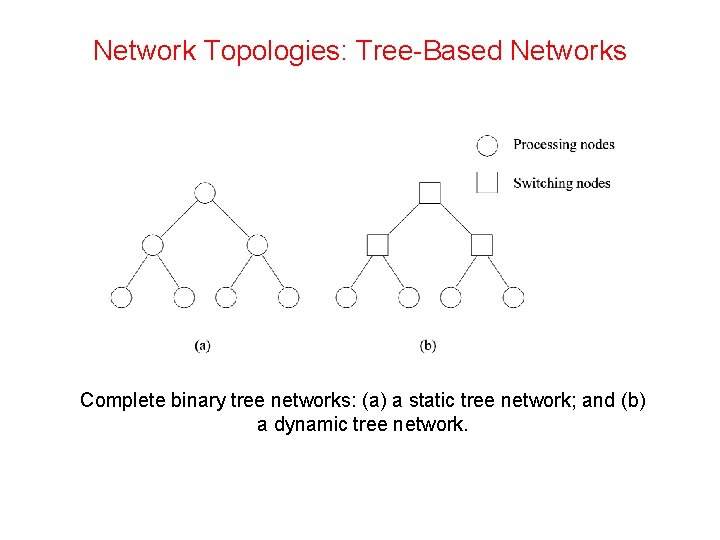
Network Topologies: Tree-Based Networks Complete binary tree networks: (a) a static tree network; and (b) a dynamic tree network.
Network Topologies: Tree Properties • The distance between any two nodes is no more than 2 logp. • Links higher up the tree potentially carry more traffic than those at the lower levels. • For this reason, a variant called a fat-tree, fattens the links as we go up the tree. • Trees can be laid out in 2 D with no wire crossings. This is an attractive property of trees.
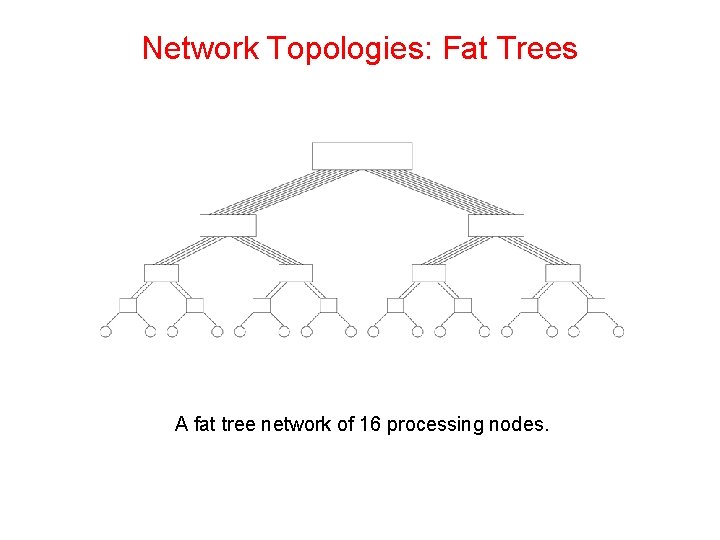
Network Topologies: Fat Trees A fat tree network of 16 processing nodes.
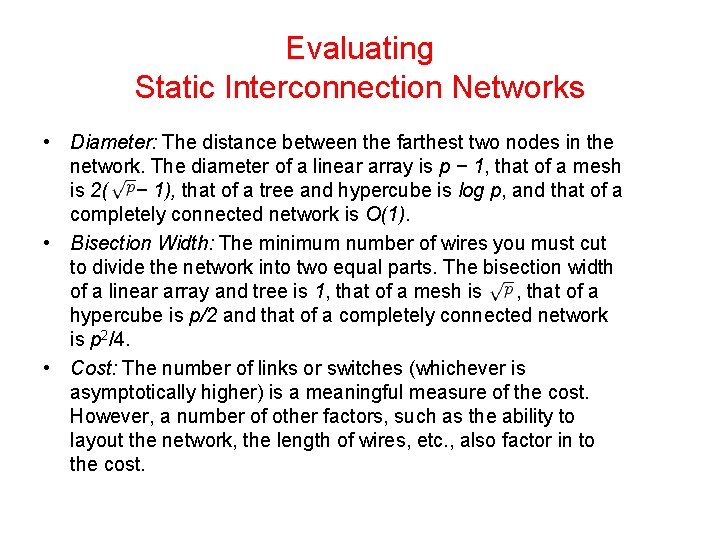
Evaluating Static Interconnection Networks • Diameter: The distance between the farthest two nodes in the network. The diameter of a linear array is p − 1, that of a mesh is 2( − 1), that of a tree and hypercube is log p, and that of a completely connected network is O(1). • Bisection Width: The minimum number of wires you must cut to divide the network into two equal parts. The bisection width of a linear array and tree is 1, that of a mesh is , that of a hypercube is p/2 and that of a completely connected network is p 2/4. • Cost: The number of links or switches (whichever is asymptotically higher) is a meaningful measure of the cost. However, a number of other factors, such as the ability to layout the network, the length of wires, etc. , also factor in to the cost.
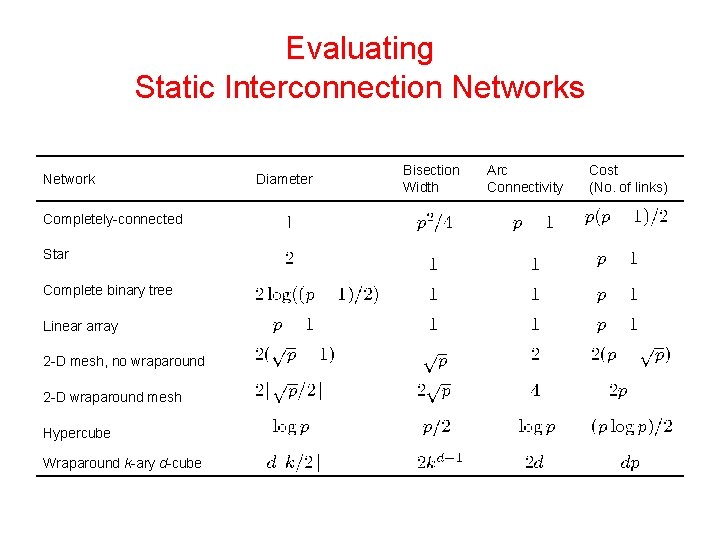
Evaluating Static Interconnection Networks Network Completely-connected Star Complete binary tree Linear array 2 -D mesh, no wraparound 2 -D wraparound mesh Hypercube Wraparound k-ary d-cube Diameter Bisection Width Arc Connectivity Cost (No. of links)
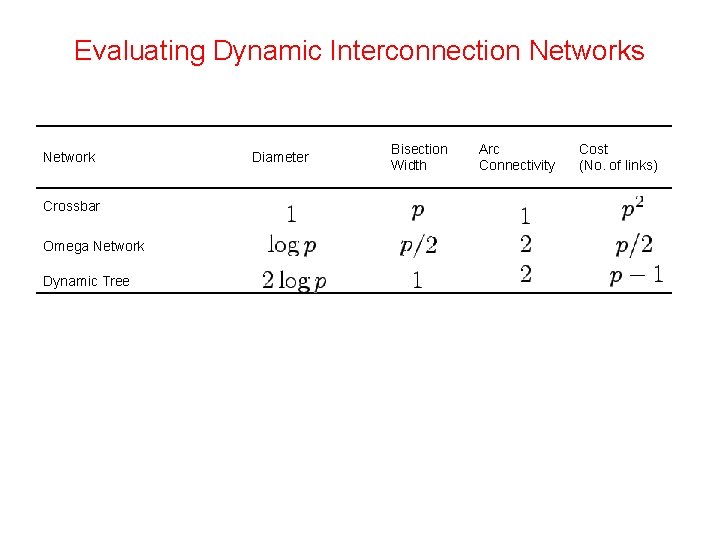
Evaluating Dynamic Interconnection Networks Network Crossbar Omega Network Dynamic Tree Diameter Bisection Width Arc Connectivity Cost (No. of links)
Cache Coherence in Multiprocessor Systems • Interconnects provide basic mechanisms for data transfer. • In the case of shared address space machines, additional hardware is required to coordinate access to data that might have multiple copies in the network. • The underlying technique must provide some guarantees on the semantics. • This guarantee is generally one of serializability, i. e. , there exists some serial order of instruction execution that corresponds to the parallel schedule.
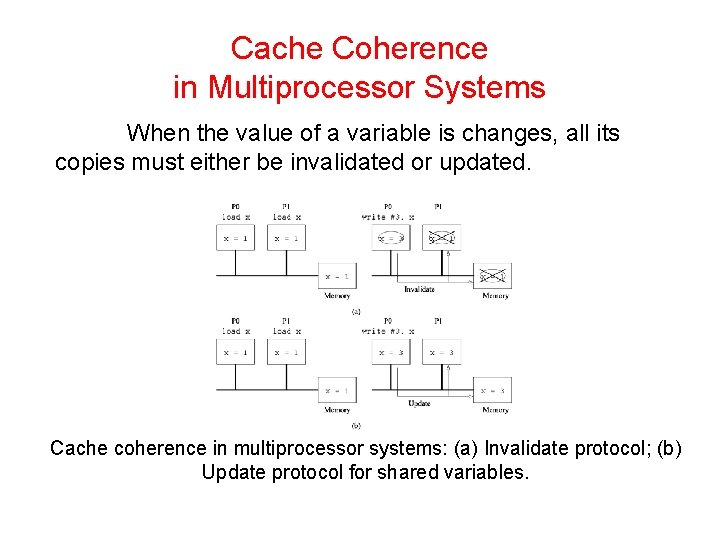
Cache Coherence in Multiprocessor Systems When the value of a variable is changes, all its copies must either be invalidated or updated. Cache coherence in multiprocessor systems: (a) Invalidate protocol; (b) Update protocol for shared variables.
Cache Coherence: Update and Invalidate Protocols • If a processor just reads a value once and does not need it again, an update protocol may generate significant overhead. • If two processors make interleaved test and updates to a variable, an update protocol is better. • Both protocols suffer from false sharing overheads (two words that are not shared, however, they lie on the same cache line). • Most current machines use invalidate protocols.
Maintaining Coherence Using Invalidate Protocols • Each copy of a data item is associated with a state. • One example of such a set of states is, shared, invalid, or dirty. • In shared state, there are multiple valid copies of the data item (and therefore, an invalidate would have to be generated on an update). • In dirty state, only one copy exists and therefore, no invalidates need to be generated. • In invalid state, the data copy is invalid, therefore, a read generates a data request (and associated state changes).
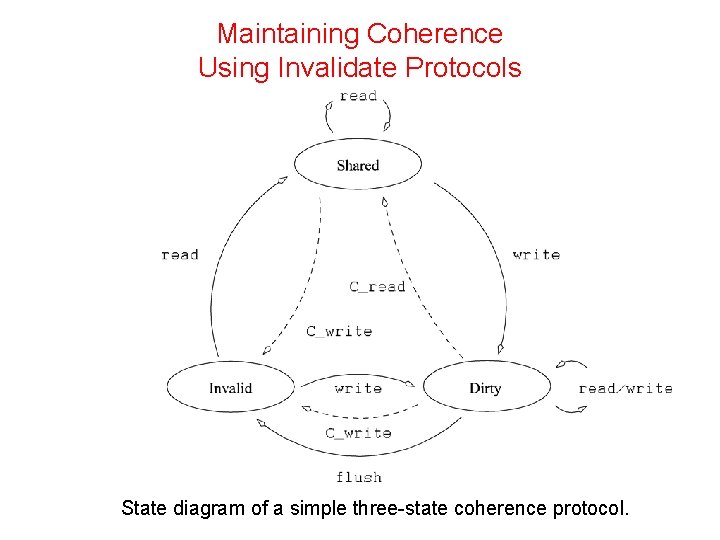
Maintaining Coherence Using Invalidate Protocols State diagram of a simple three-state coherence protocol.
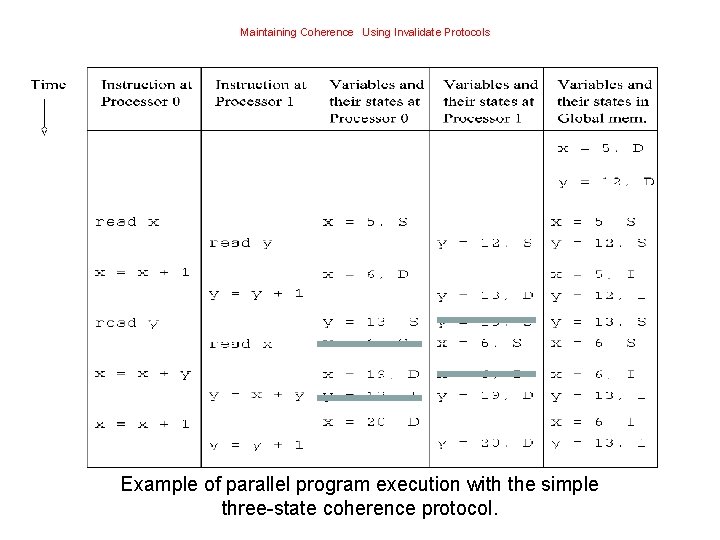
Maintaining Coherence Using Invalidate Protocols Example of parallel program execution with the simple three-state coherence protocol.
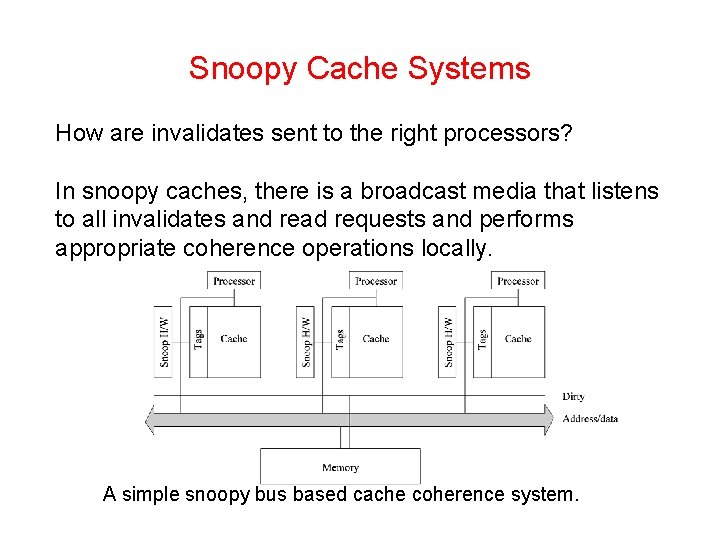
Snoopy Cache Systems How are invalidates sent to the right processors? In snoopy caches, there is a broadcast media that listens to all invalidates and read requests and performs appropriate coherence operations locally. A simple snoopy bus based cache coherence system.

Performance of Snoopy Caches • Once copies of data are tagged dirty, all subsequent operations can be performed locally on the cache without generating external traffic. • If a data item is read by a number of processors, it transitions to the shared state in the cache and all subsequent read operations become local. • If processors read and update data at the same time, they generate coherence requests on the bus - which is ultimately bandwidth limited.
Directory Based Systems • In snoopy caches, each coherence operation is sent to all processors. This is an inherent limitation. • Why not send coherence requests to only those processors that need to be notified? • This is done using a directory, which maintains a presence vector for each data item (cache line) along with its global state.
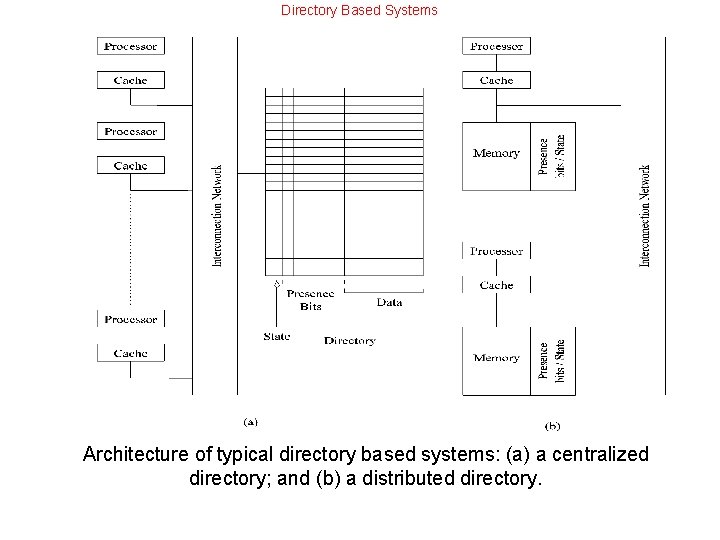
Directory Based Systems Architecture of typical directory based systems: (a) a centralized directory; and (b) a distributed directory.
Performance of Directory Based Schemes • The need for a broadcast media is replaced by the directory. • The additional bits to store the directory may add significant overhead. • The underlying network must be able to carry all the coherence requests. • The directory is a point of contention, therefore, distributed directory schemes must be used.
Communication Costs in Parallel Machines • Along with idling and contention, communication is a major overhead in parallel programs. • The cost of communication is dependent on a variety of features including the programming model semantics, the network topology, data handling and routing, and associated software protocols.

Message Passing Costs in Parallel Computers • The total time to transfer a message over a network comprises of the following: – Startup time (ts): Time spent at sending and receiving nodes (executing the routing algorithm, programming routers, etc. ). – Per-hop time (th): This time is a function of number of hops and includes factors such as switch latencies, network delays, etc. – Per-word transfer time (tw): This time includes all overheads that are determined by the length of the message. This includes bandwidth of links, error checking and correction, etc.
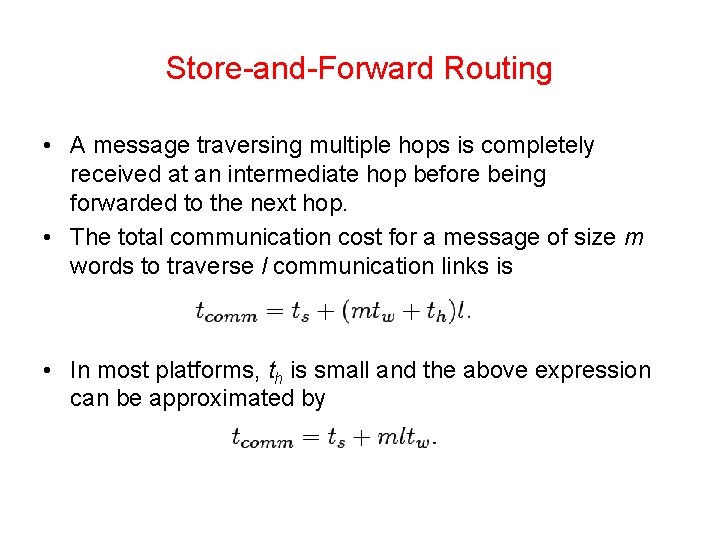
Store-and-Forward Routing • A message traversing multiple hops is completely received at an intermediate hop before being forwarded to the next hop. • The total communication cost for a message of size m words to traverse l communication links is • In most platforms, th is small and the above expression can be approximated by
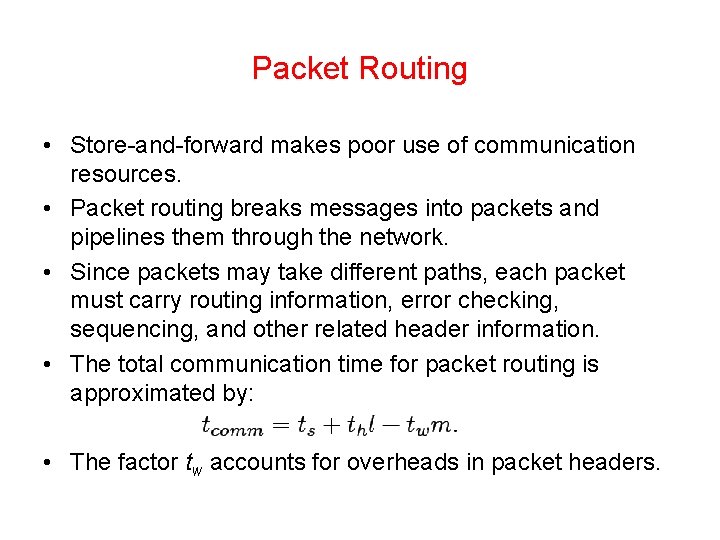
Packet Routing • Store-and-forward makes poor use of communication resources. • Packet routing breaks messages into packets and pipelines them through the network. • Since packets may take different paths, each packet must carry routing information, error checking, sequencing, and other related header information. • The total communication time for packet routing is approximated by: • The factor tw accounts for overheads in packet headers.
Cut-Through Routing • Takes the concept of packet routing to an extreme by further dividing messages into basic units called flits. • Since flits are typically small, the header information must be minimized. • This is done by forcing all flits to take the same path, in sequence. • A tracer message first programs all intermediate routers. All flits then take the same route. • Error checks are performed on the entire message, as opposed to flits. • No sequence numbers are needed.
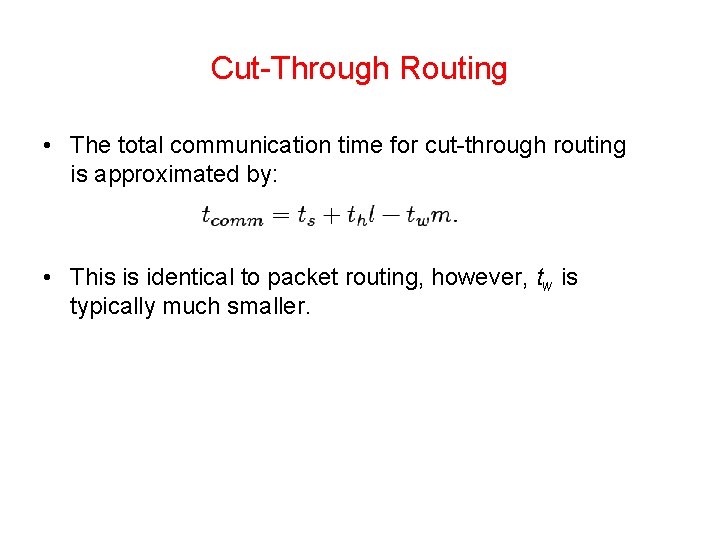
Cut-Through Routing • The total communication time for cut-through routing is approximated by: • This is identical to packet routing, however, tw is typically much smaller.

Simplified Cost Model for Communicating Messages • The cost of communicating a message between two nodes l hops away using cut-through routing is given by • In this expression, th is typically smaller than ts and tw. For this reason, the second term in the RHS does not show, particularly, when m is large. • Furthermore, it is often not possible to control routing and placement of tasks. • For these reasons, we can approximate the cost of message transfer by

Simplified Cost Model for Communicating Messages • It is important to note that the original expression for communication time is valid for only uncongested networks. • If a link takes multiple messages, the corresponding tw term must be scaled up by the number of messages. • Different communication patterns congest different networks to varying extents. • It is important to understand account for this in the communication time accordingly.

Cost Models for Shared Address Space Machines • While the basic messaging cost applies to these machines as well, a number of other factors make accurate cost modeling more difficult. • Memory layout is typically determined by the system. • Finite cache sizes can result in cache thrashing. • Overheads associated with invalidate and update operations are difficult to quantify. • Spatial locality is difficult to model. • Prefetching can play a role in reducing the overhead associated with data access. • False sharing and contention are difficult to model.
Routing Mechanisms for Interconnection Networks • How does one compute the route that a message takes from source to destination? – Routing must prevent deadlocks - for this reason, we use dimension-ordered or e-cube routing. – Routing must avoid hot-spots - for this reason, two-step routing is often used. In this case, a message from source s to destination d is first sent to a randomly chosen intermediate processor i and then forwarded to destination d.
Mapping Techniques for Graphs • Often, we need to embed a known communication pattern into a given interconnection topology. • We may have an algorithm designed for one network, which we are porting to another topology. For these reasons, it is useful to understand mapping between graphs.
Mapping Techniques for Graphs: Metrics • When mapping a graph G(V, E) into G’(V’, E’), the following metrics are important: • The maximum number of edges mapped onto any edge in E’ is called the congestion of the mapping. • The maximum number of links in E’ that any edge in E is • mapped onto is called the dilation of the mapping. • The ratio of the number of nodes in the set V’ to that in set V is called the expansion of the mapping.
- Slides: 96