
Unit VII Genetics Basic Genetics Modern Genetics Understanding
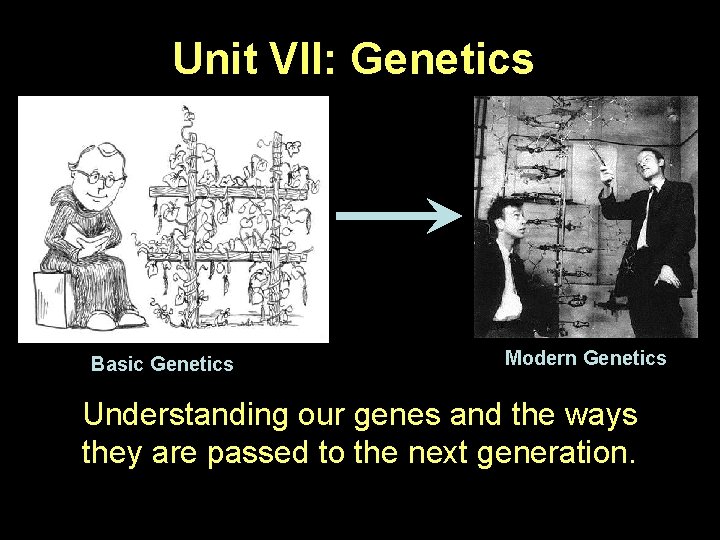
Unit VII: Genetics Basic Genetics Modern Genetics Understanding our genes and the ways they are passed to the next generation.
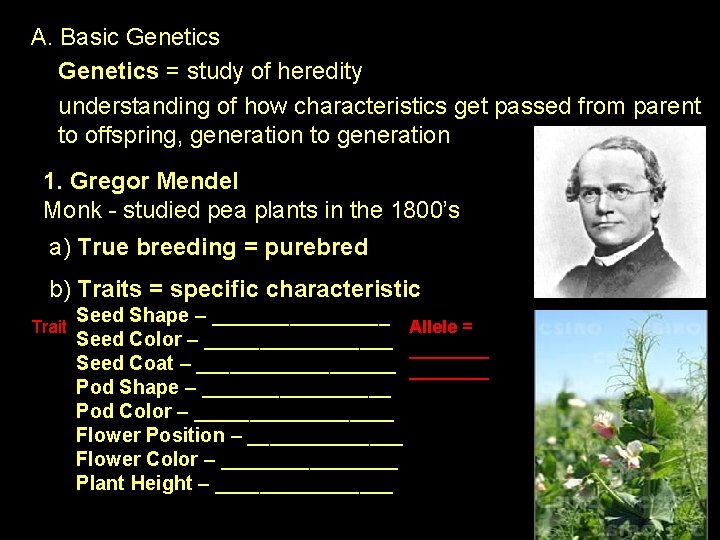
A. Basic Genetics = study of heredity understanding of how characteristics get passed from parent to offspring, generation to generation 1. Gregor Mendel Monk - studied pea plants in the 1800’s a) True breeding = purebred b) Traits = specific characteristic Trait Seed Shape – ________ Allele = Seed Color – _________ Seed Coat – _________ Pod Shape – _________ Pod Color – _________ Flower Position – _______ Flower Color – ________ Plant Height – ________
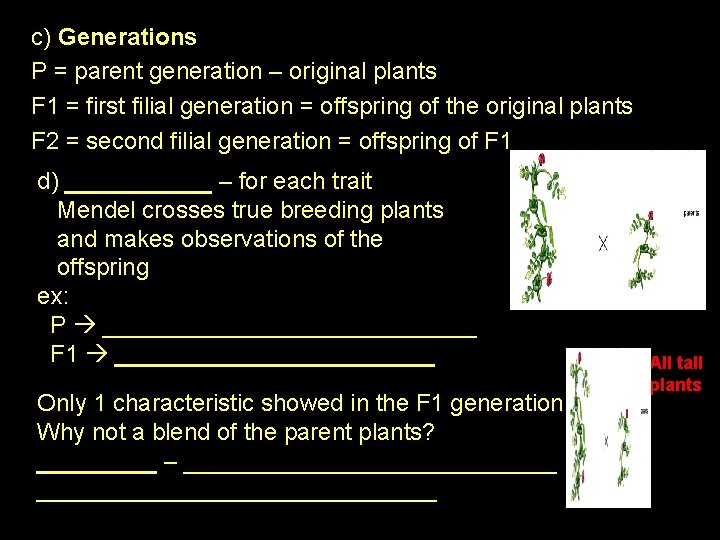
c) Generations P = parent generation – original plants F 1 = first filial generation = offspring of the original plants F 2 = second filial generation = offspring of F 1 d) ______ – for each trait Mendel crosses true breeding plants and makes observations of the offspring ex: P ______________ F 1 ____________ Only 1 characteristic showed in the F 1 generation Why not a blend of the parent plants? _____ – ______________________________ All tall plants
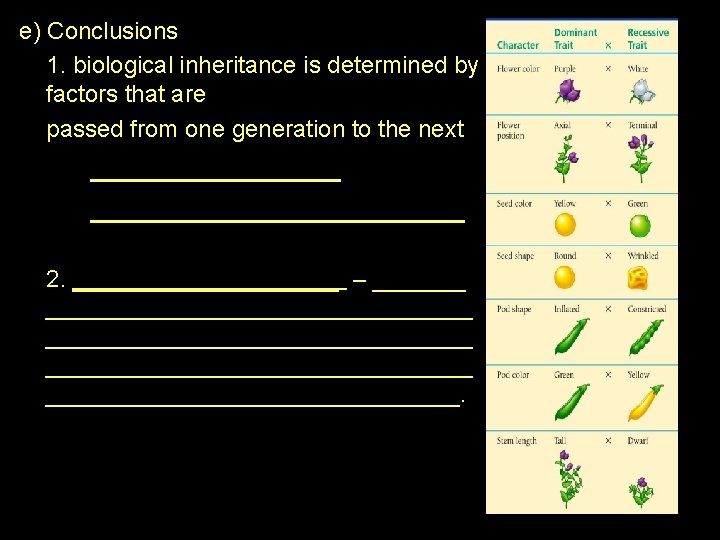
e) Conclusions 1. biological inheritance is determined by factors that are passed from one generation to the next ____________________ 2. __________ – ________________________________ ________________.
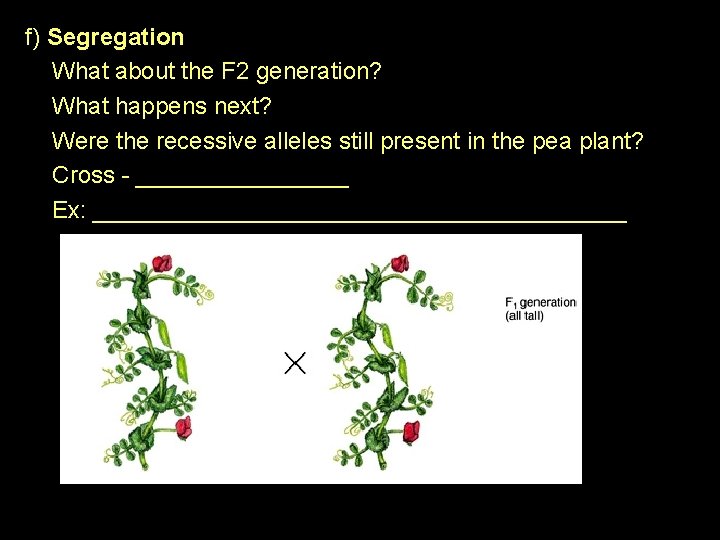
f) Segregation What about the F 2 generation? What happens next? Were the recessive alleles still present in the pea plant? Cross - ________ Ex: ____________________
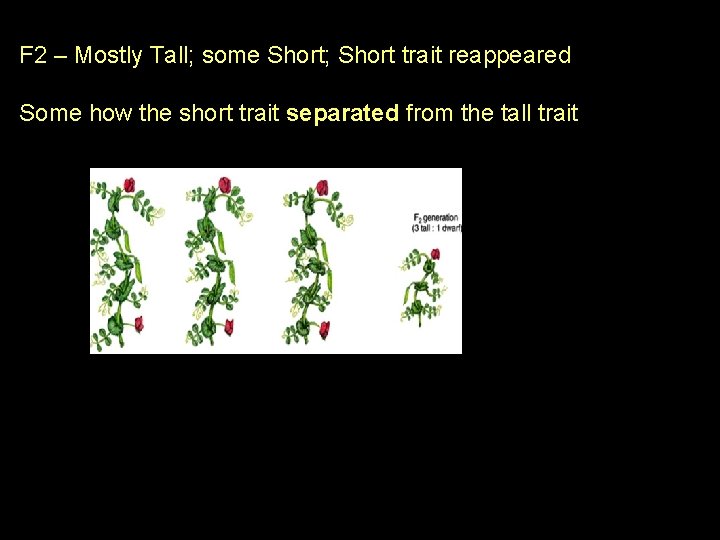
F 2 – Mostly Tall; some Short; Short trait reappeared Some how the short trait separated from the tall trait
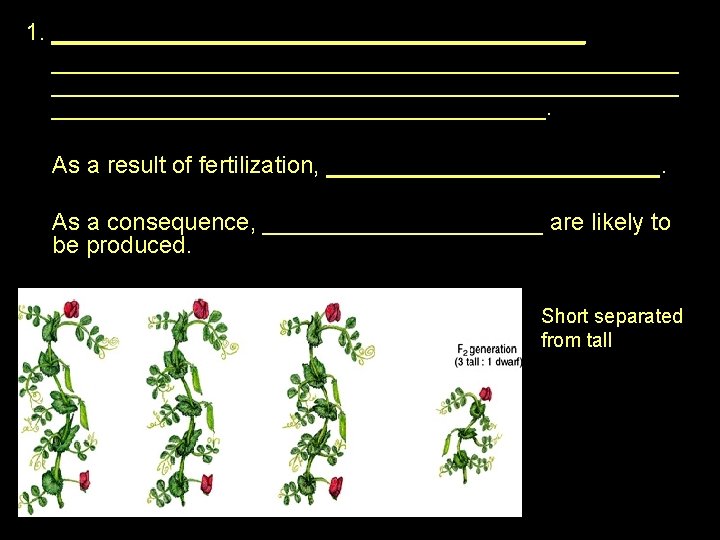
1. _______________________________________________ ___________________. As a result of fertilization, _____________. As a consequence, ___________ are likely to be produced. Short separated from tall
2. Probability and Inheritance a) ____ = __________________ = same alleles (TT or tt) _______ = different alleles (Tt) = Hybrid b) ______ = __________ (Tall or Short) Usually determined by the genotype – _____________________________. Can two organisms have the same phenotype but different genotypes? Phenotype = Tall __________ How could the genotype be determined? ____________________
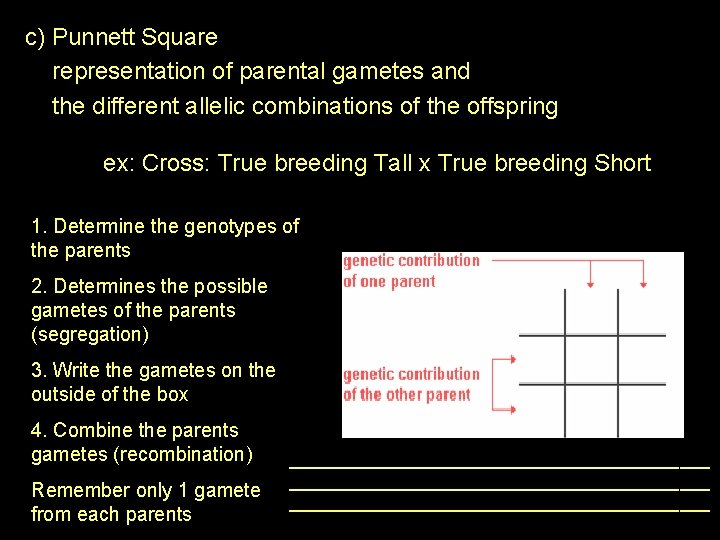
c) Punnett Square representation of parental gametes and the different allelic combinations of the offspring ex: Cross: True breeding Tall x True breeding Short 1. Determine the genotypes of the parents 2. Determines the possible gametes of the parents (segregation) 3. Write the gametes on the outside of the box 4. Combine the parents gametes (recombination) Remember only 1 gamete from each parents __________________________________________
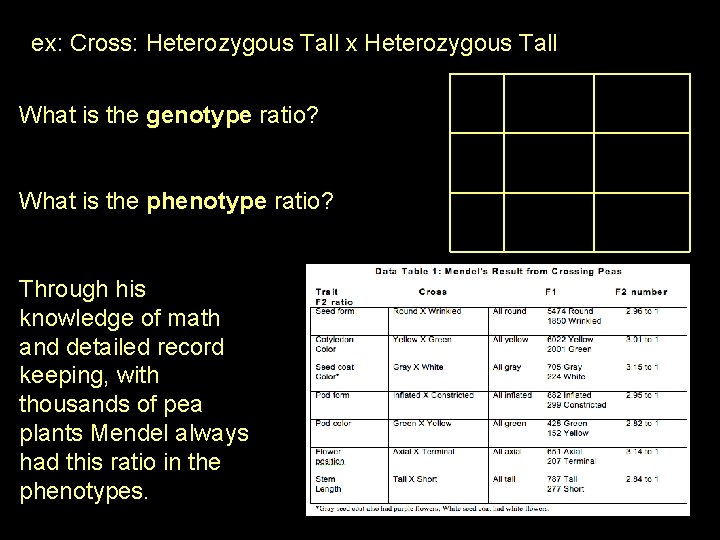
ex: Cross: Heterozygous Tall x Heterozygous Tall What is the genotype ratio? What is the phenotype ratio? Through his knowledge of math and detailed record keeping, with thousands of pea plants Mendel always had this ratio in the phenotypes.
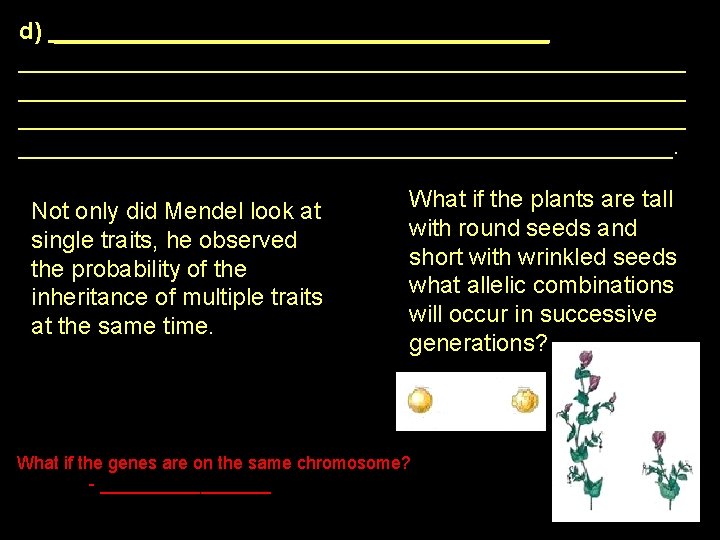
d) __________________________________________________ _________________________. Not only did Mendel look at single traits, he observed the probability of the inheritance of multiple traits at the same time. What if the plants are tall with round seeds and short with wrinkled seeds what allelic combinations will occur in successive generations? What if the genes are on the same chromosome? - _________
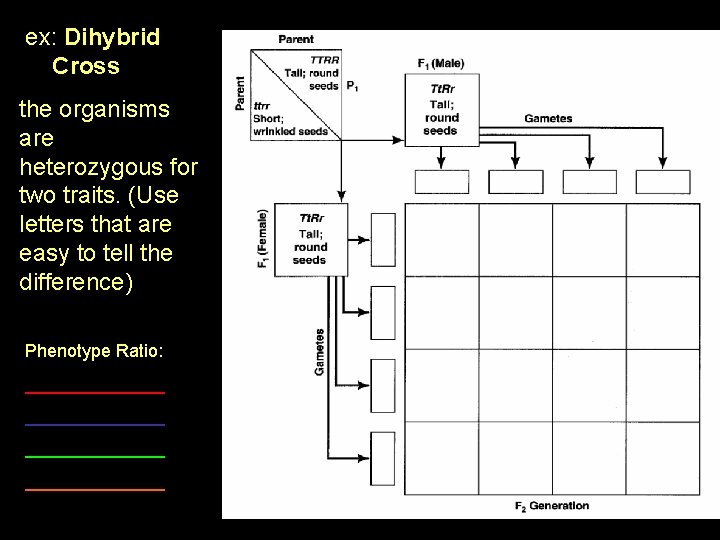
ex: Dihybrid Cross the organisms are heterozygous for two traits. (Use letters that are easy to tell the difference) Phenotype Ratio: ______________
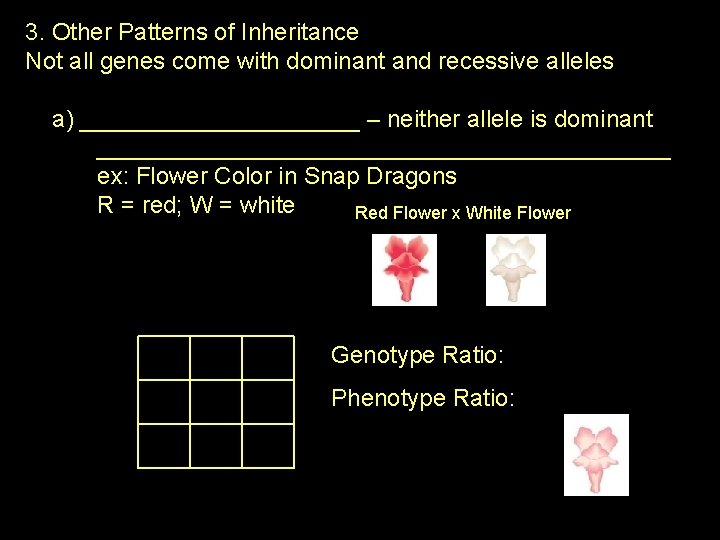
3. Other Patterns of Inheritance Not all genes come with dominant and recessive alleles a) ___________ – neither allele is dominant ______________________ ex: Flower Color in Snap Dragons R = red; W = white Red Flower x White Flower Genotype Ratio: Phenotype Ratio:
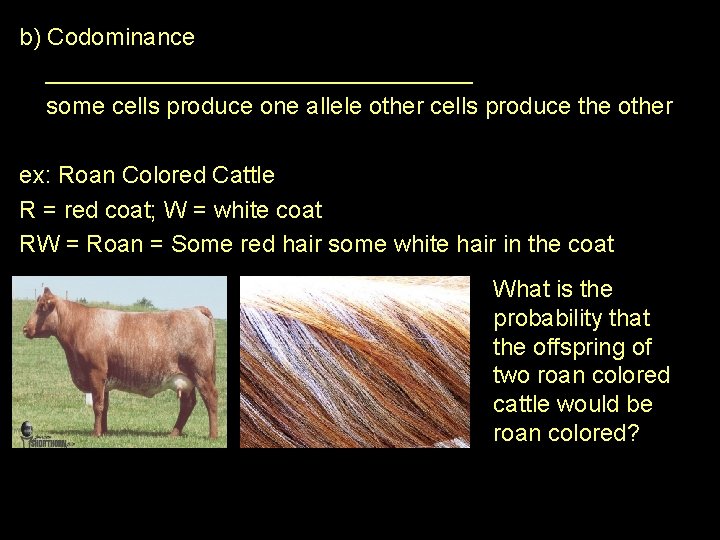
b) Codominance ________________ some cells produce one allele other cells produce the other ex: Roan Colored Cattle R = red coat; W = white coat RW = Roan = Some red hair some white hair in the coat What is the probability that the offspring of two roan colored cattle would be roan colored?
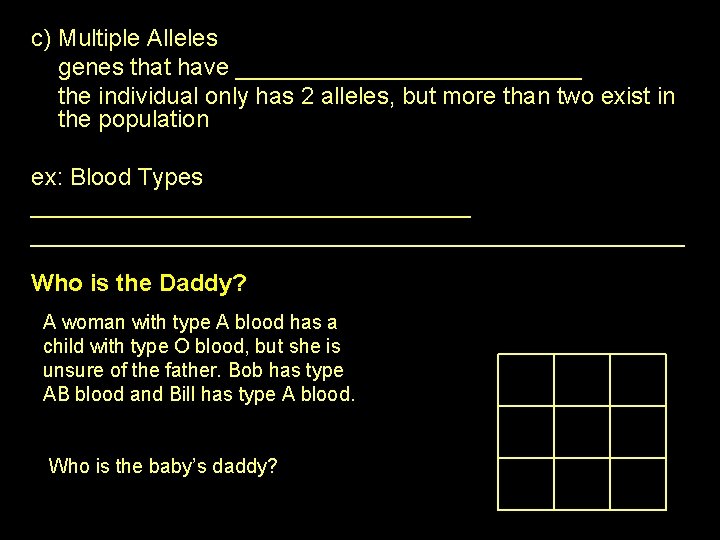
c) Multiple Alleles genes that have _____________ the individual only has 2 alleles, but more than two exist in the population ex: Blood Types _________________________________________ Who is the Daddy? A woman with type A blood has a child with type O blood, but she is unsure of the father. Bob has type AB blood and Bill has type A blood. Who is the baby’s daddy?
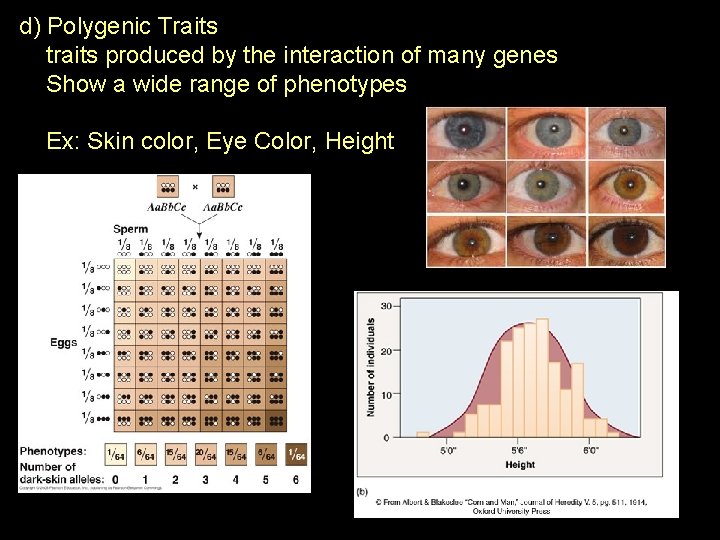
d) Polygenic Traits traits produced by the interaction of many genes Show a wide range of phenotypes Ex: Skin color, Eye Color, Height
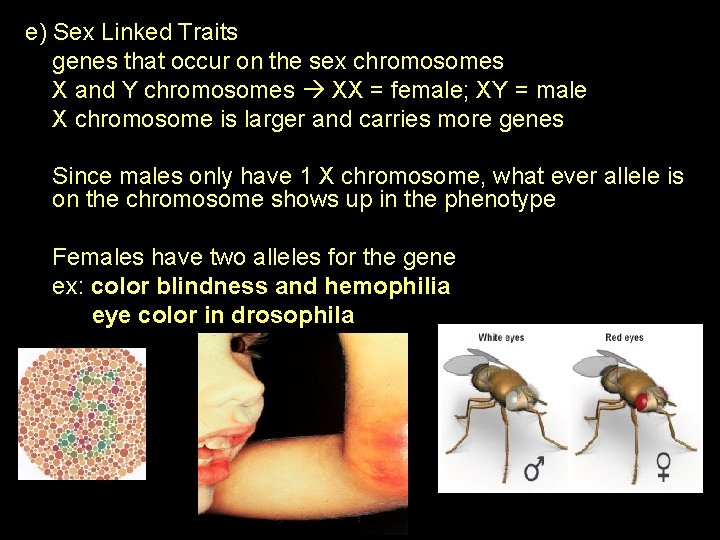
e) Sex Linked Traits genes that occur on the sex chromosomes X and Y chromosomes XX = female; XY = male X chromosome is larger and carries more genes Since males only have 1 X chromosome, what ever allele is on the chromosome shows up in the phenotype Females have two alleles for the gene ex: color blindness and hemophilia eye color in drosophila
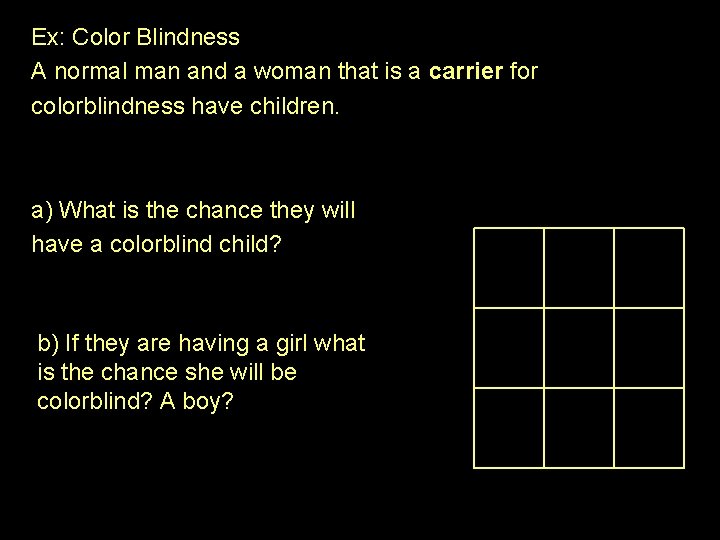
Ex: Color Blindness A normal man and a woman that is a carrier for colorblindness have children. a) What is the chance they will have a colorblind child? b) If they are having a girl what is the chance she will be colorblind? A boy?
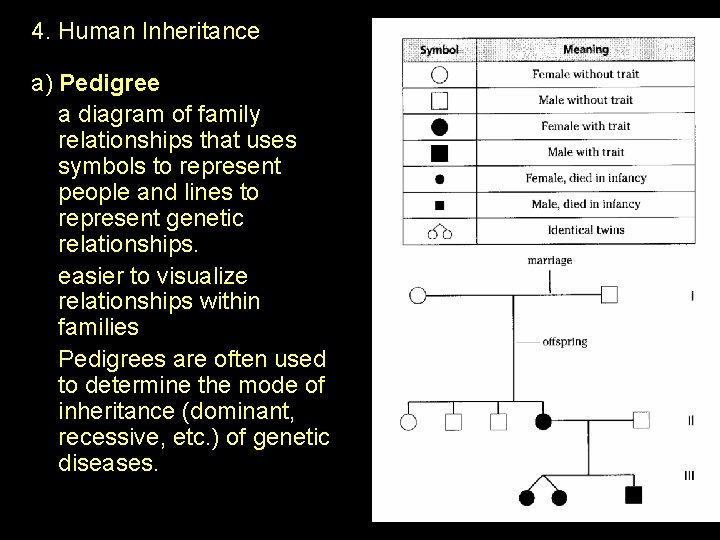
4. Human Inheritance a) Pedigree a diagram of family relationships that uses symbols to represent people and lines to represent genetic relationships. easier to visualize relationships within families Pedigrees are often used to determine the mode of inheritance (dominant, recessive, etc. ) of genetic diseases.
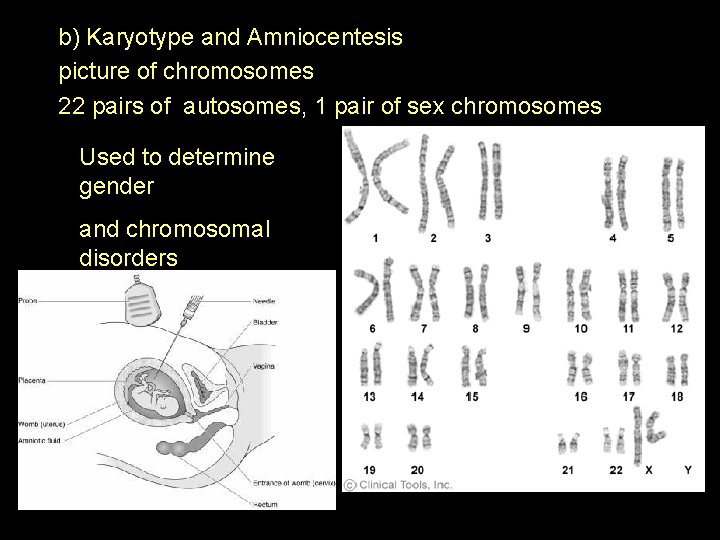
b) Karyotype and Amniocentesis picture of chromosomes 22 pairs of autosomes, 1 pair of sex chromosomes Used to determine gender and chromosomal disorders
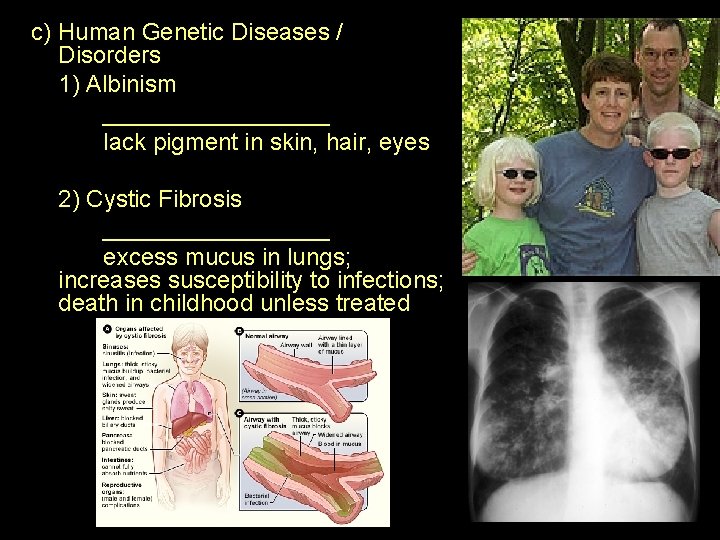
c) Human Genetic Diseases / Disorders 1) Albinism _________ lack pigment in skin, hair, eyes 2) Cystic Fibrosis _________ excess mucus in lungs; increases susceptibility to infections; death in childhood unless treated
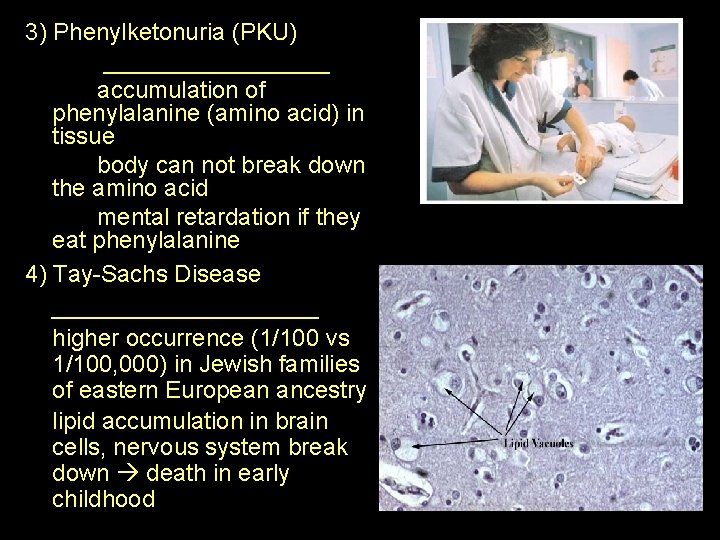
3) Phenylketonuria (PKU) _________ accumulation of phenylalanine (amino acid) in tissue body can not break down the amino acid mental retardation if they eat phenylalanine 4) Tay-Sachs Disease __________ higher occurrence (1/100 vs 1/100, 000) in Jewish families of eastern European ancestry lipid accumulation in brain cells, nervous system break down death in early childhood
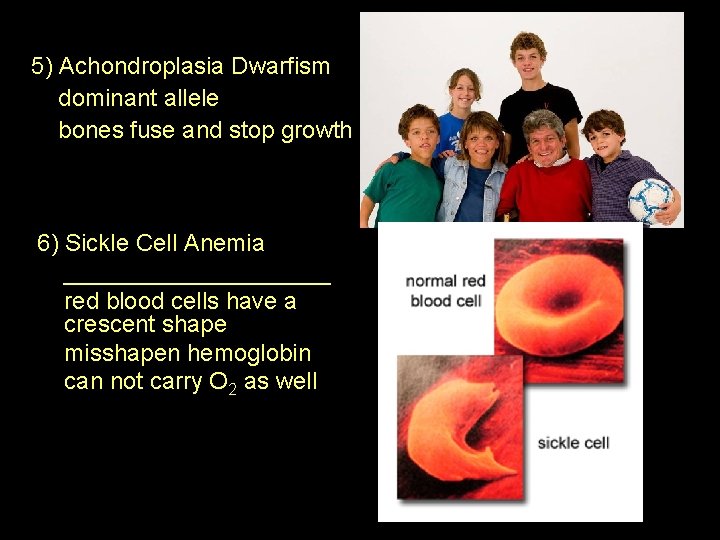
5) Achondroplasia Dwarfism dominant allele bones fuse and stop growth 6) Sickle Cell Anemia __________ red blood cells have a crescent shape misshapen hemoglobin can not carry O 2 as well
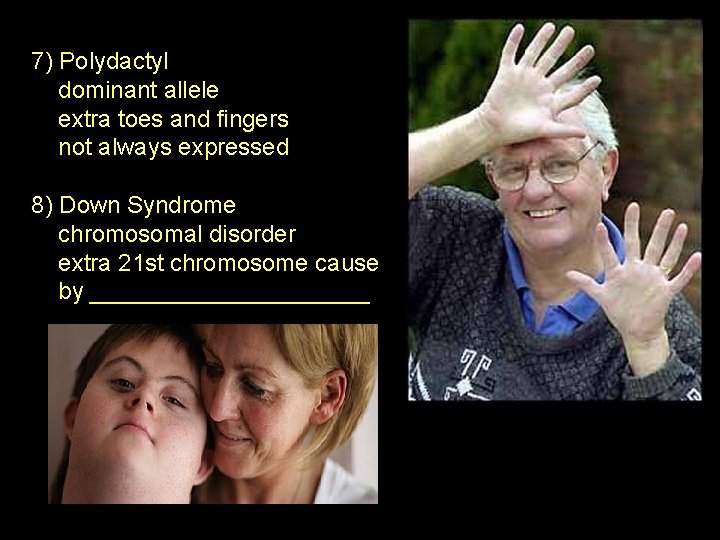
7) Polydactyl dominant allele extra toes and fingers not always expressed 8) Down Syndrome chromosomal disorder extra 21 st chromosome cause by ___________
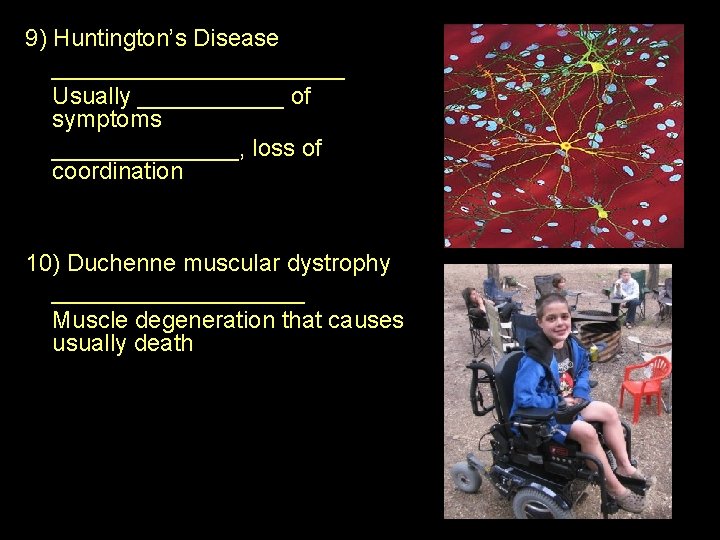
9) Huntington’s Disease ___________ Usually ______ of symptoms _______, loss of coordination 10) Duchenne muscular dystrophy __________ Muscle degeneration that causes usually death
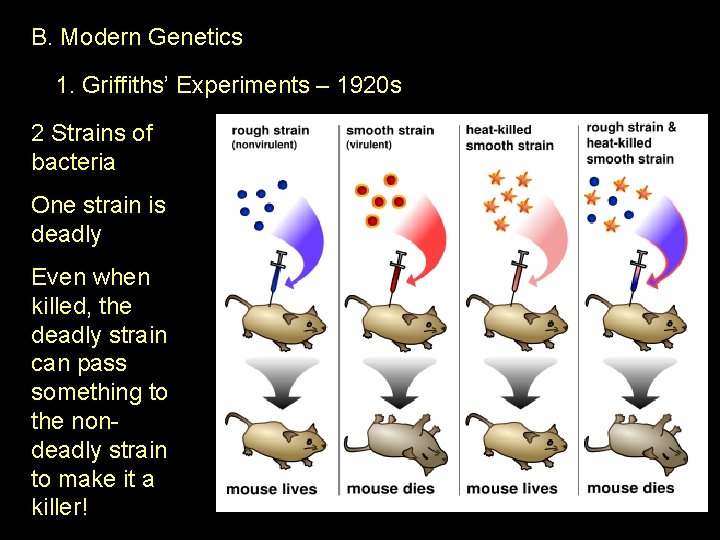
B. Modern Genetics 1. Griffiths’ Experiments – 1920 s 2 Strains of bacteria One strain is deadly Even when killed, the deadly strain can pass something to the nondeadly strain to make it a killer!
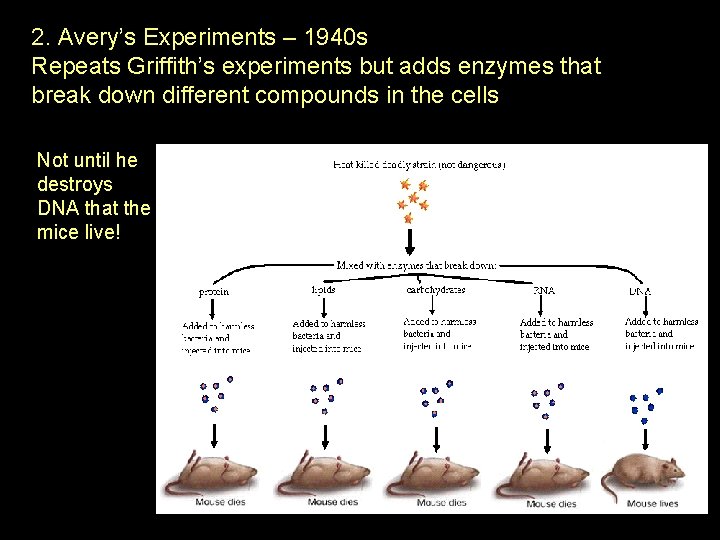
2. Avery’s Experiments – 1940 s Repeats Griffith’s experiments but adds enzymes that break down different compounds in the cells Not until he destroys DNA that the mice live!
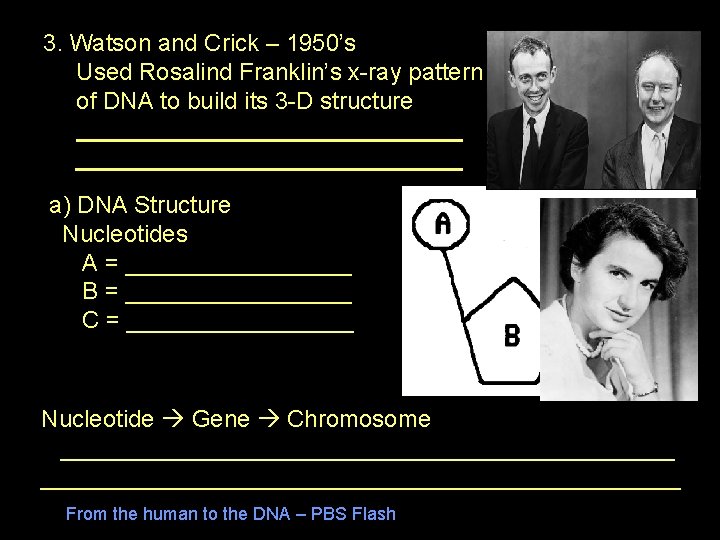
3. Watson and Crick – 1950’s Used Rosalind Franklin’s x-ray pattern of DNA to build its 3 -D structure _____________________________ a) DNA Structure Nucleotides A = _________ B = _________ C = _________ Nucleotide Gene Chromosome ________________________________________________ From the human to the DNA – PBS Flash
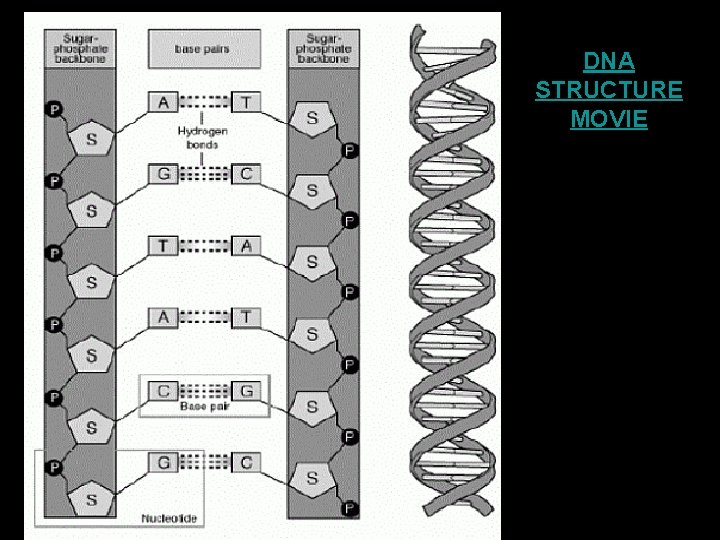
DNA STRUCTURE MOVIE
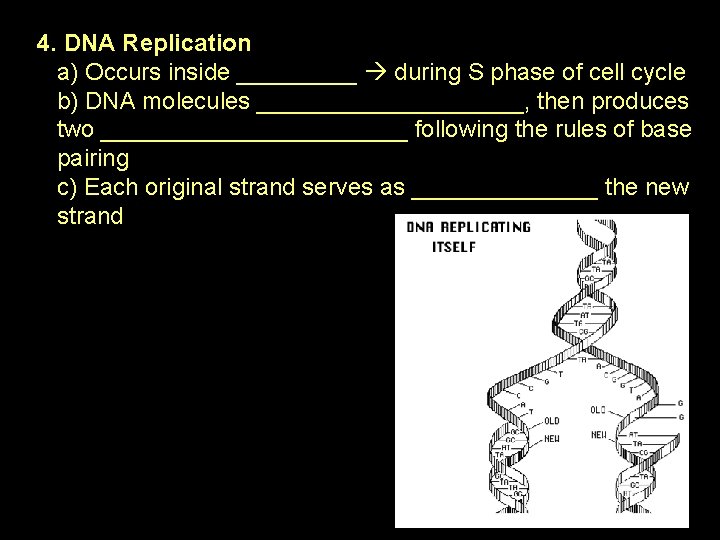
4. DNA Replication a) Occurs inside _____ during S phase of cell cycle b) DNA molecules __________, then produces two ____________ following the rules of base pairing c) Each original strand serves as _______ the new strand

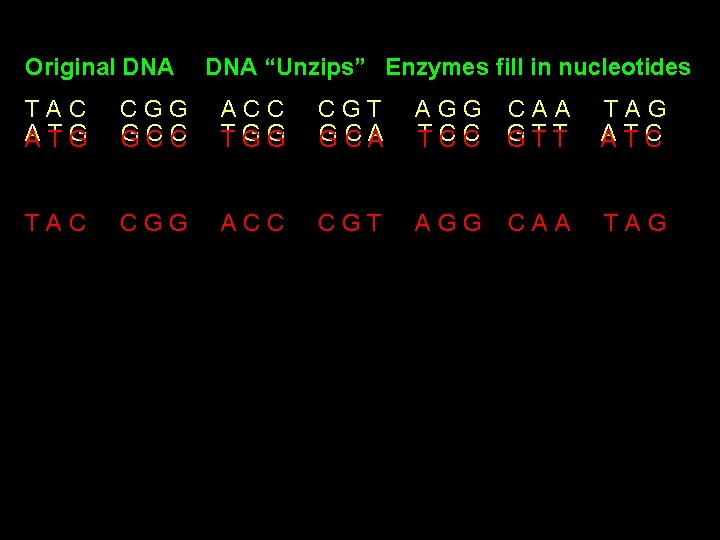
Original DNA “Unzips” Enzymes fill in nucleotides TAC A AT TG G CGG G GC CC C ACC T TG GG G CGT G GC CA A AGG T TC CC C CAA G GT TT T TAG A AT TC C TAC CGG ACC CGT AGG CAA TAG
Easy Version of DNA Replication Check out this site on your own for a more detailed explantation More Complicated but explains the process really well. http: //207. 4. 198/pub/flash/24/menu. swf
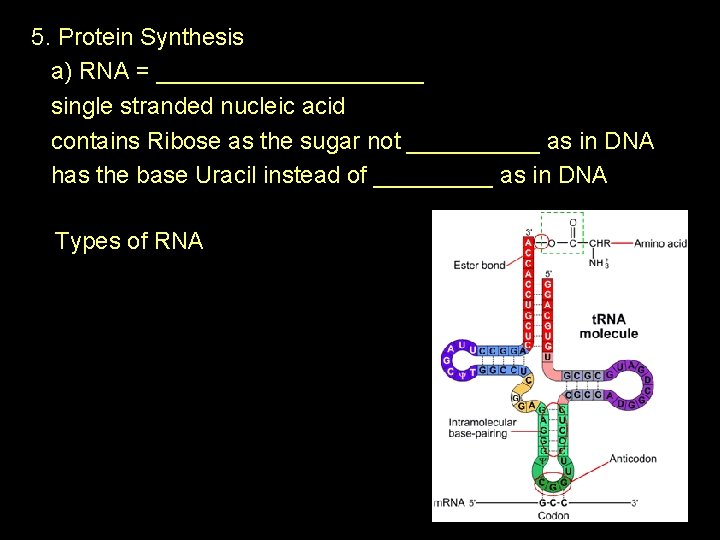
5. Protein Synthesis a) RNA = __________ single stranded nucleic acid contains Ribose as the sugar not _____ as in DNA has the base Uracil instead of _____ as in DNA Types of RNA
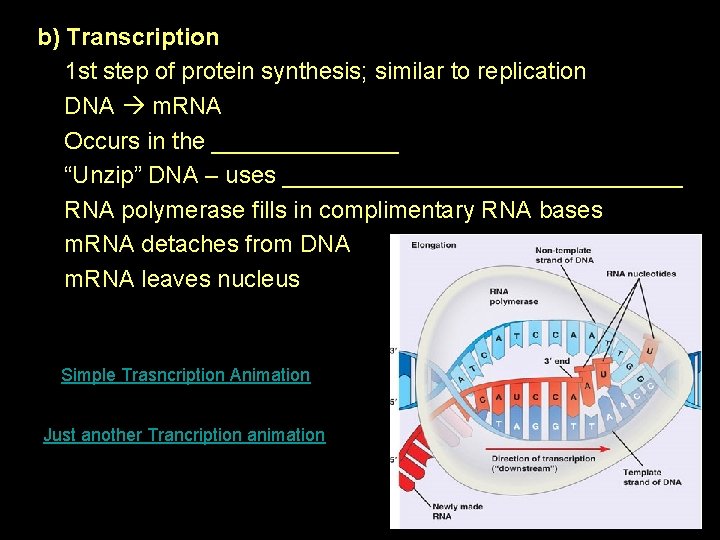
b) Transcription 1 st step of protein synthesis; similar to replication DNA m. RNA Occurs in the _______ “Unzip” DNA – uses _______________ RNA polymerase fills in complimentary RNA bases m. RNA detaches from DNA m. RNA leaves nucleus Simple Trasncription Animation Just another Trancription animation
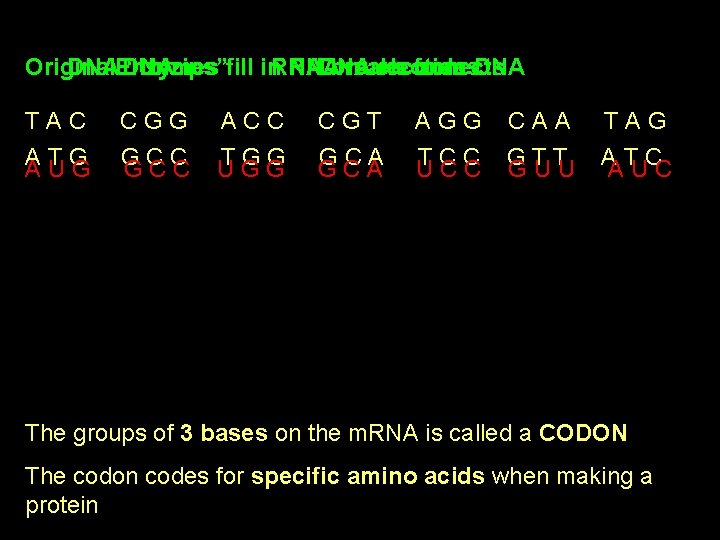
Original DNAEnzymes DNA “Unzips”fill in. RNA DNA breaks nucleotides reconnects from DNA TAC CGG ACC CGT AGG CAA TAG A AT UG G G GC CC C TG GG G U GC CA A G TC U CC C G GT U TU AATUCC The groups of 3 bases on the m. RNA is called a CODON The codon codes for specific amino acids when making a protein
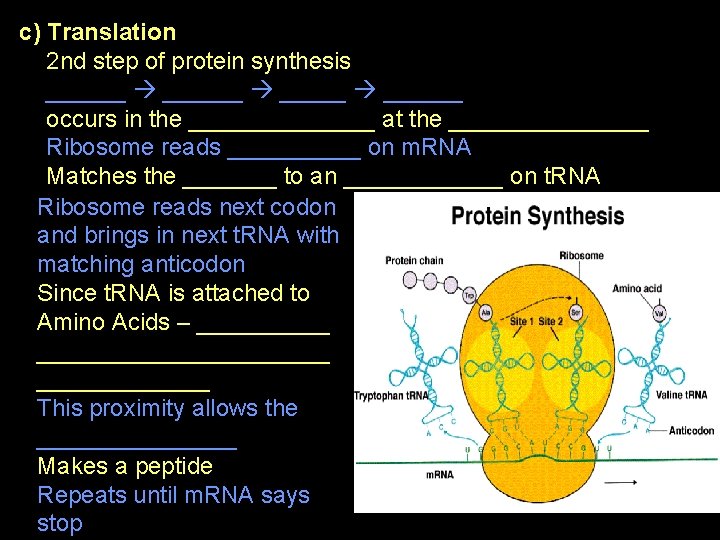
c) Translation 2 nd step of protein synthesis ______ ______ occurs in the _______ at the ________ Ribosome reads _____ on m. RNA Matches the _______ to an ______ on t. RNA Ribosome reads next codon and brings in next t. RNA with matching anticodon Since t. RNA is attached to Amino Acids – ________________ This proximity allows the ________ Makes a peptide Repeats until m. RNA says stop
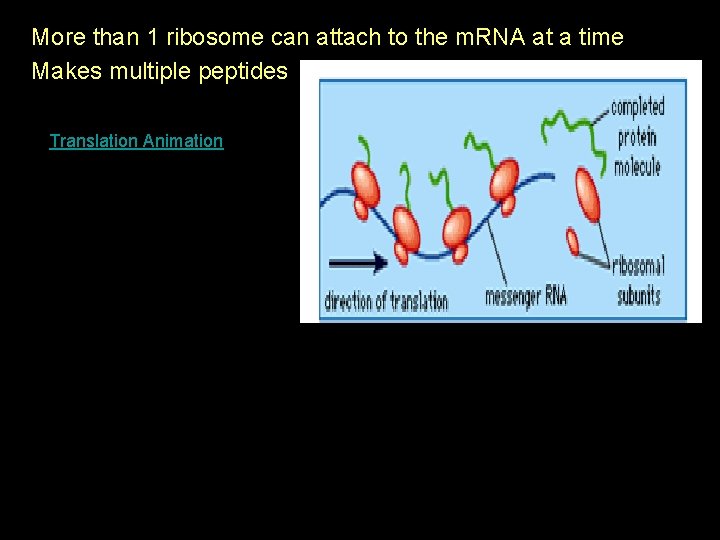
More than 1 ribosome can attach to the m. RNA at a time Makes multiple peptides Translation Animation

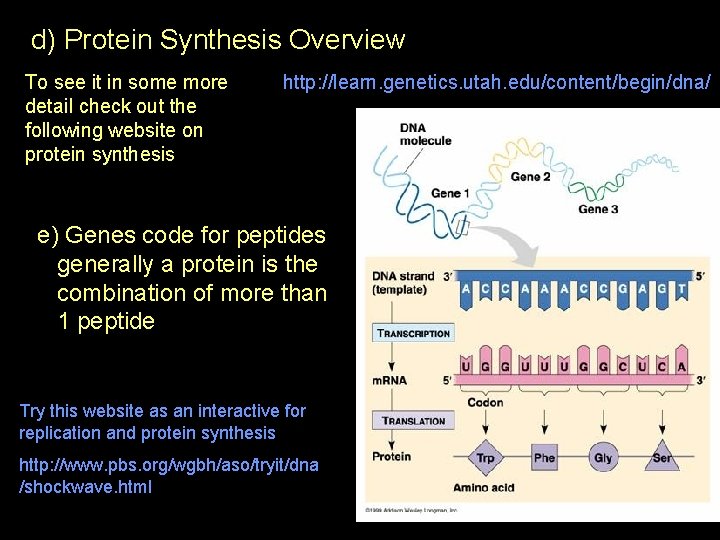
d) Protein Synthesis Overview To see it in some more detail check out the following website on protein synthesis http: //learn. genetics. utah. edu/content/begin/dna/ e) Genes code for peptides generally a protein is the combination of more than 1 peptide Try this website as an interactive for replication and protein synthesis http: //www. pbs. org/wgbh/aso/tryit/dna /shockwave. html
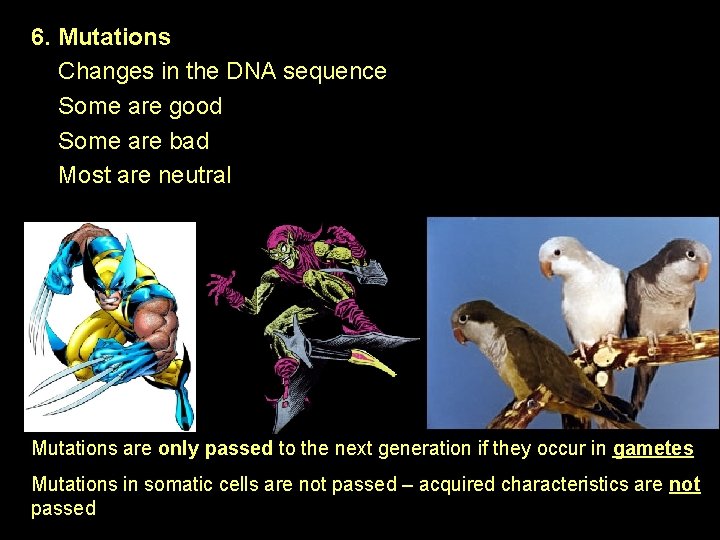
6. Mutations Changes in the DNA sequence Some are good Some are bad Most are neutral Mutations are only passed to the next generation if they occur in gametes Mutations in somatic cells are not passed – acquired characteristics are not passed
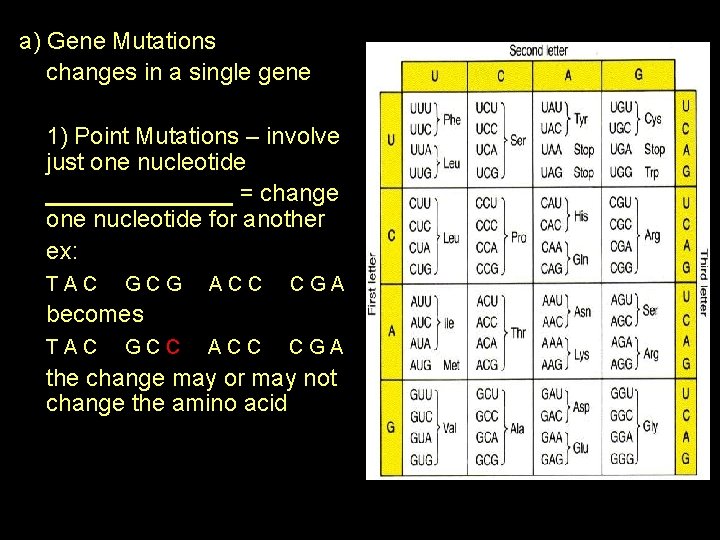
a) Gene Mutations changes in a single gene 1) Point Mutations – involve just one nucleotide _______ = change one nucleotide for another ex: TAC GCG ACC CGA becomes TAC GCC the change may or may not change the amino acid
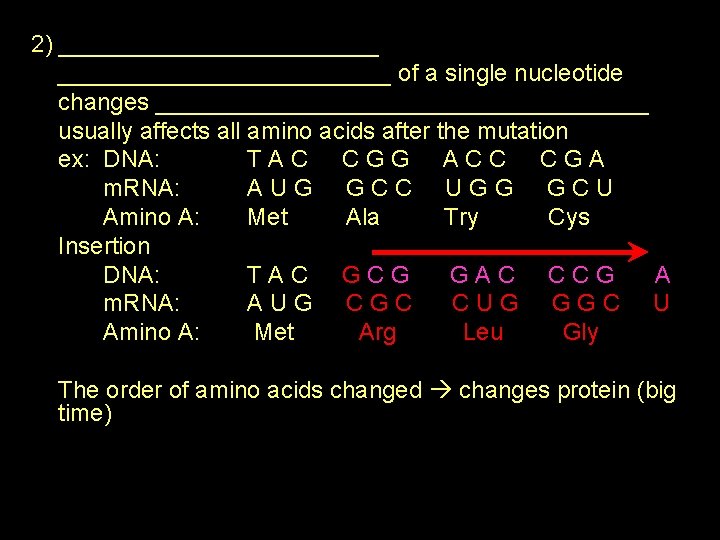
2) _________________________ of a single nucleotide changes ___________________ usually affects all amino acids after the mutation ex: DNA: TAC CGG ACC CGA m. RNA: AUG GCC UGG GCU Amino A: Met Ala Try Cys Insertion DNA: TAC GCG GAC CCG A m. RNA: AUG CGC CUG GGC U Amino A: Met Arg Leu Gly The order of amino acids changed changes protein (big time)
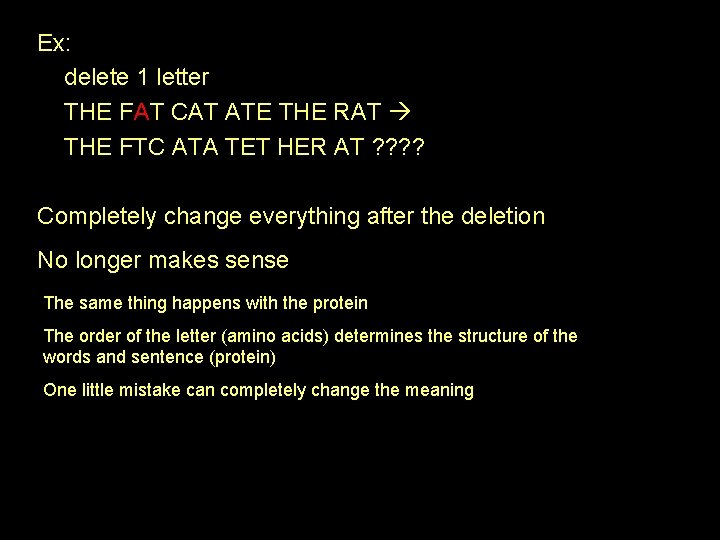
Ex: delete 1 letter THE FAT CAT ATE THE RAT THE FTC ATA TET HER AT ? ? Completely change everything after the deletion No longer makes sense The same thing happens with the protein The order of the letter (amino acids) determines the structure of the words and sentence (protein) One little mistake can completely change the meaning
b) Chromosomal Mutations changes the structure of a chromosome rearrange the genes on a chromosome 1) _________ 2) _________ 3) ________________ 4) ______________________________________ Chromosomal Mutations
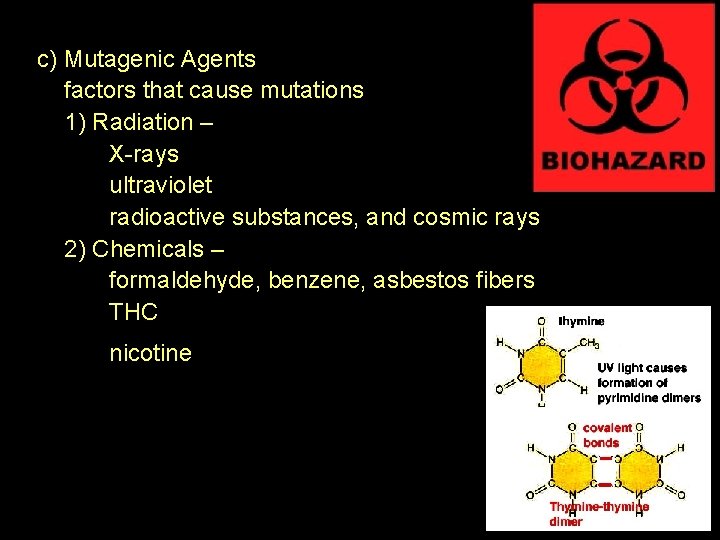
c) Mutagenic Agents factors that cause mutations 1) Radiation – X-rays ultraviolet radioactive substances, and cosmic rays 2) Chemicals – formaldehyde, benzene, asbestos fibers THC nicotine
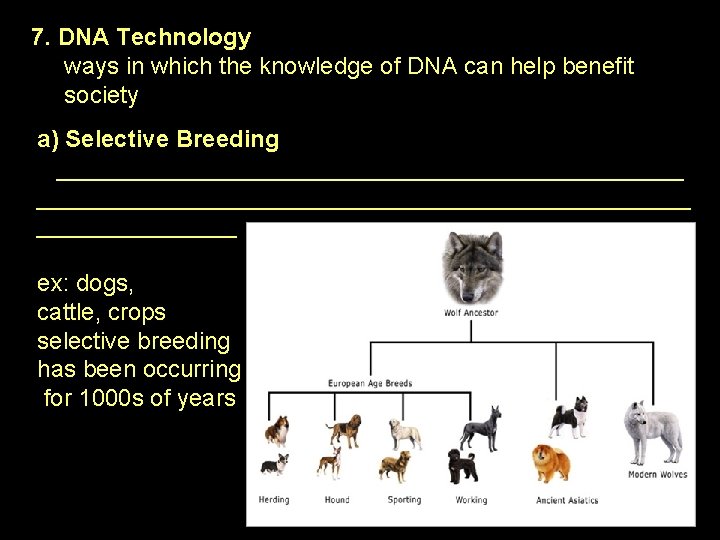
7. DNA Technology ways in which the knowledge of DNA can help benefit society a) Selective Breeding _________________________________________________ ex: dogs, cattle, crops selective breeding has been occurring for 1000 s of years
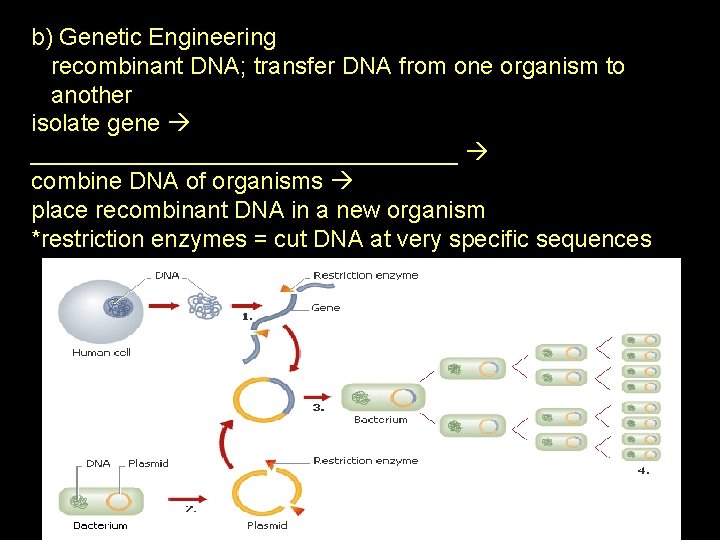
b) Genetic Engineering recombinant DNA; transfer DNA from one organism to another isolate gene ________________ combine DNA of organisms place recombinant DNA in a new organism *restriction enzymes = cut DNA at very specific sequences
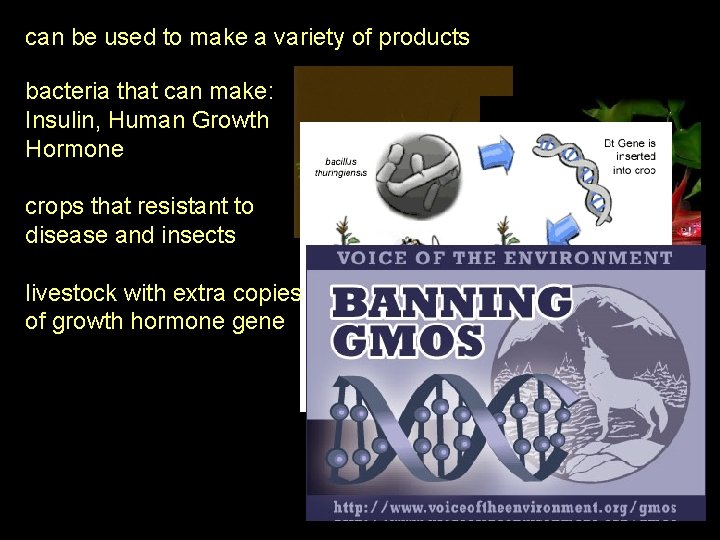
can be used to make a variety of products bacteria that can make: Insulin, Human Growth Hormone crops that resistant to disease and insects livestock with extra copies of growth hormone gene
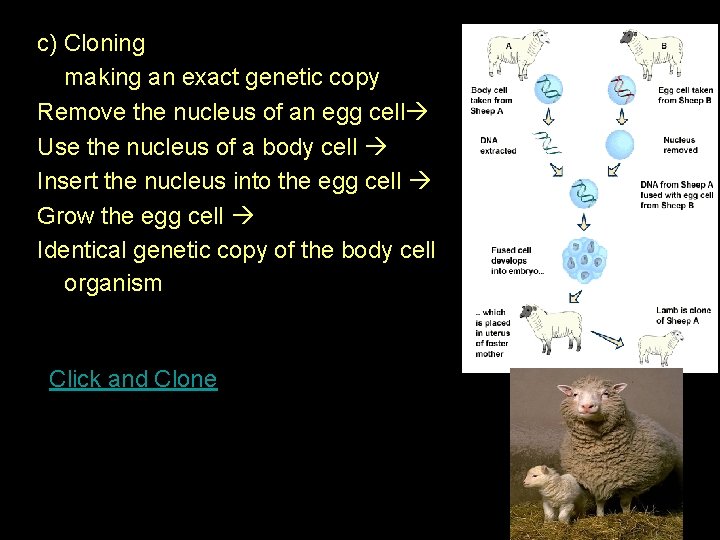
c) Cloning making an exact genetic copy Remove the nucleus of an egg cell Use the nucleus of a body cell Insert the nucleus into the egg cell Grow the egg cell Identical genetic copy of the body cell organism Click and Clone
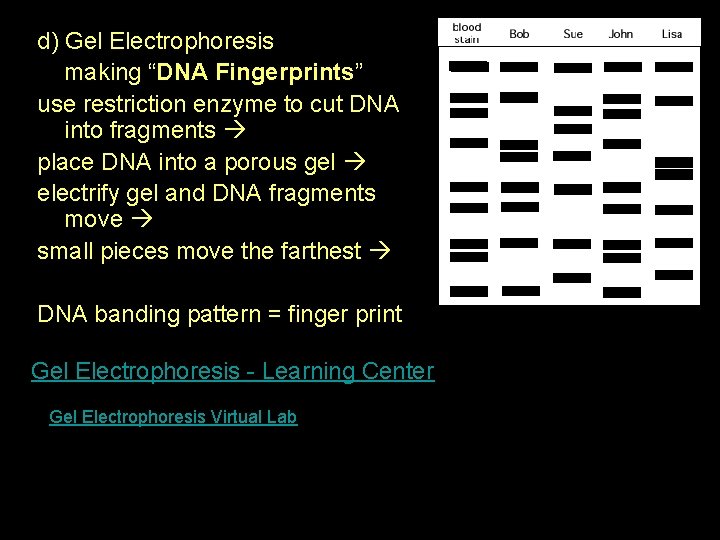
d) Gel Electrophoresis making “DNA Fingerprints” use restriction enzyme to cut DNA into fragments place DNA into a porous gel electrify gel and DNA fragments move small pieces move the farthest DNA banding pattern = finger print Gel Electrophoresis - Learning Center Gel Electrophoresis Virtual Lab
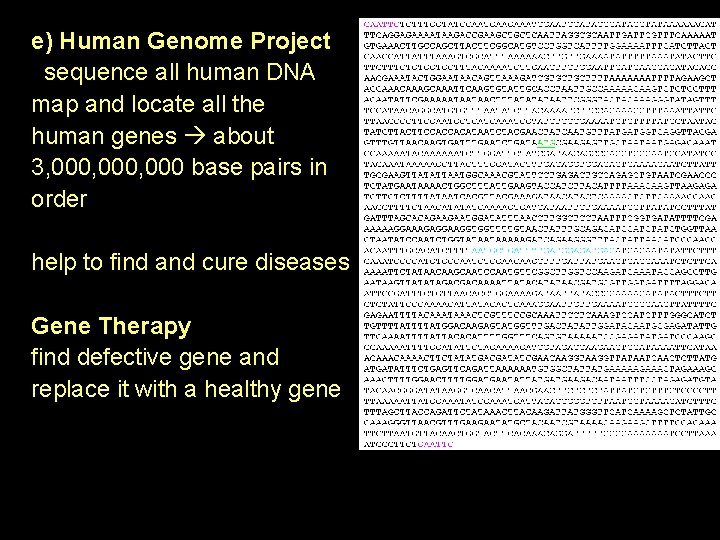
e) Human Genome Project sequence all human DNA map and locate all the human genes about 3, 000, 000 base pairs in order help to find and cure diseases Gene Therapy find defective gene and replace it with a healthy gene
- Slides: 52