
UNIT VI Voltage Regulator Contents Block diagram of
UNIT VI Voltage Regulator
Contents • Block diagram of an adjustable three terminal positive and negative regulators (317, 337). • Typical connection diagram, current boosting. Low drop out voltage regulators. • Introduction to Switch Mode Power supply (SMPS), Block diagram of SMPS, Types of SMPS. • Comparison of Linear Power supply and SMPS.
Introduction Batteries are often shown on a schematic diagram as the source of DC voltage but usually the actual DC voltage source is a power supply. Unregulated P. S : Vo = not constant Regulated P. S: Vo = Constant
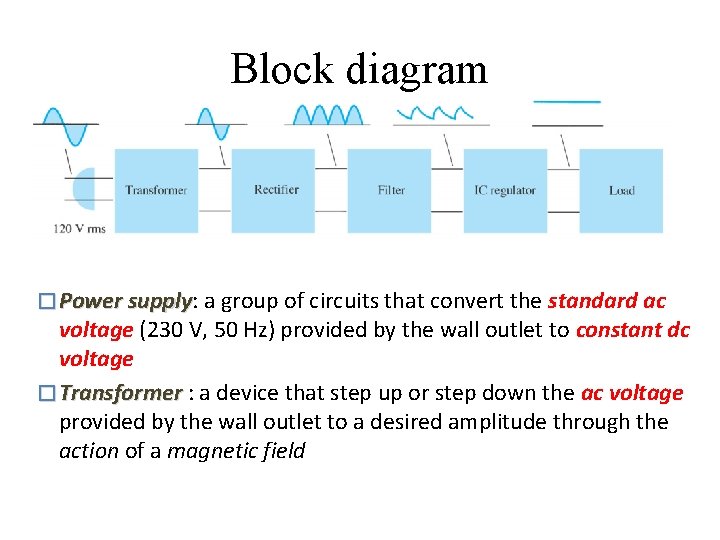
Block diagram � Power supply: supply a group of circuits that convert the standard ac voltage (230 V, 50 Hz) provided by the wall outlet to constant dc voltage � Transformer : a device that step up or step down the ac voltage provided by the wall outlet to a desired amplitude through the action of a magnetic field
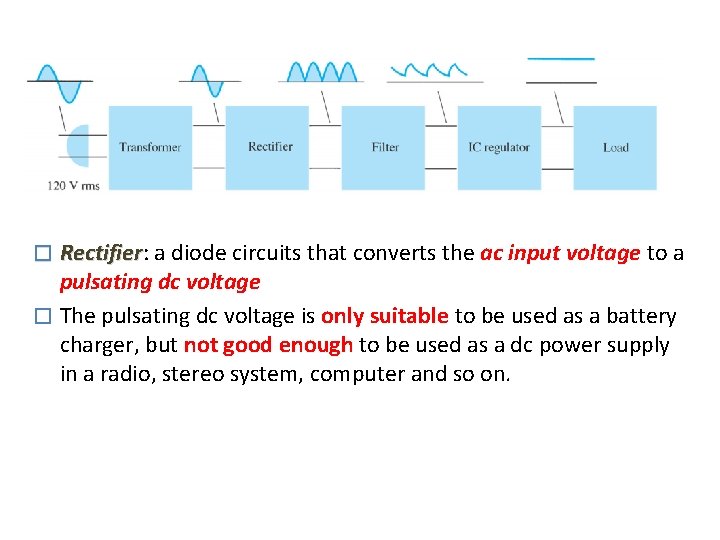
� Rectifier: Rectifier a diode circuits that converts the ac input voltage to a pulsating dc voltage � The pulsating dc voltage is only suitable to be used as a battery charger, but not good enough to be used as a dc power supply in a radio, stereo system, computer and so on.
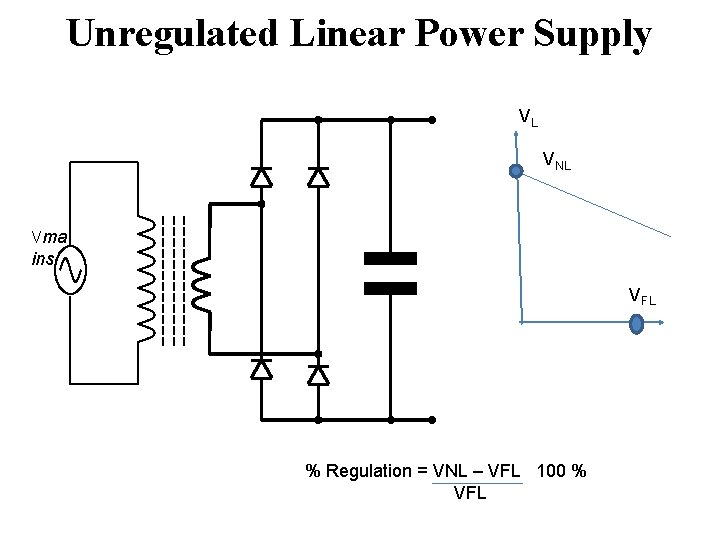
Unregulated Linear Power Supply VL VNL Vma ins VFL % Regulation = VNL – VFL 100 % VFL
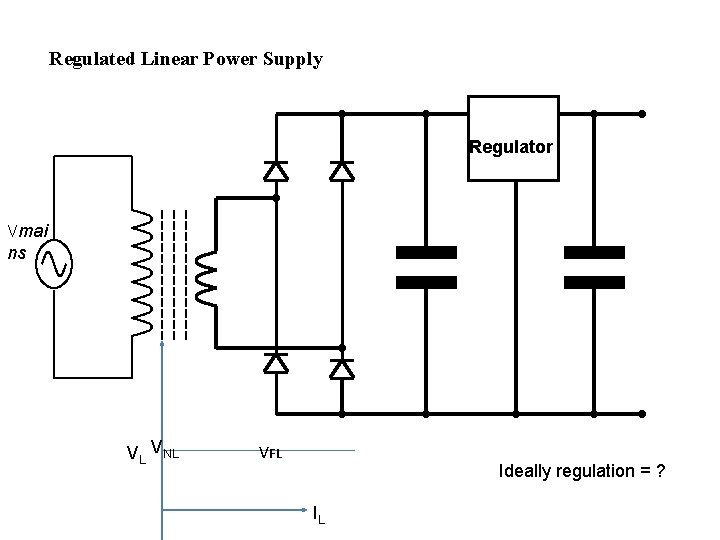
Regulated Linear Power Supply Regulator Vmai ns VL VNL VFL Ideally regulation = ? IL
• A voltage regulator is a circuit or device that provides a constant voltage to a load. • The output voltage is controlled by the internal circuitry and is relatively independent of the load current supplied by the regulator. • A voltage regulator is a component of power supply which not only removes the ripple contents to make the output smooth but also keeps the output voltage constant irrespective of the changes in the load or the line voltage.
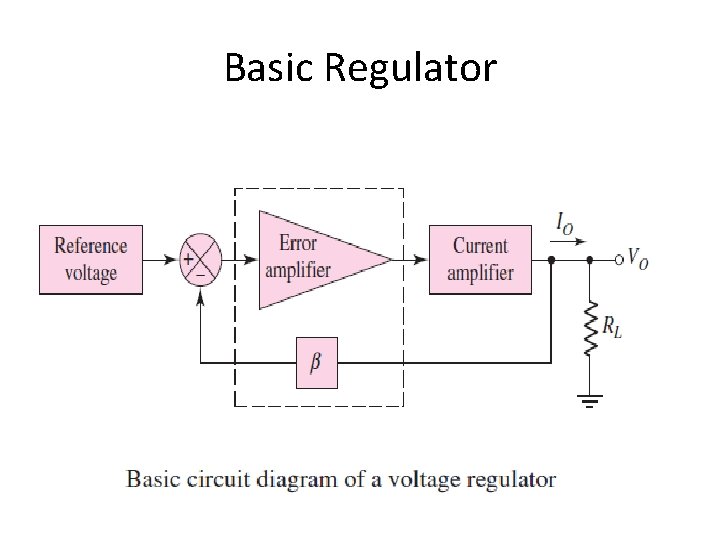
Basic Regulator
• It consists of three basic parts: a reference voltage circuit; an error amplifier, which is part of a feedback circuit; and a current amplifier, which supplies the required load current. • The reference voltage circuit produces a voltage that is essentially independent of both supply voltage V+ and temperature.
• A fraction of the output voltage is fed back to the error amplifier which, through negative feedback, maintains the feedback voltage at a value equal to the reference voltage. • Since the regulator output voltage is derived from the reference voltage, any variation in that reference voltage, as the power supply voltage V+ changes, also affects the output voltage.
Performance Parameters line regulation load regulation: Temperature Stability: � Line regulation is to maintain a nearly constant output voltage when the input voltage varies. � Load regulation is to maintain a nearly constant output voltage when the load Current varies. � Temperature Stability is to maintain a nearly constant output voltage when the temperature varies.
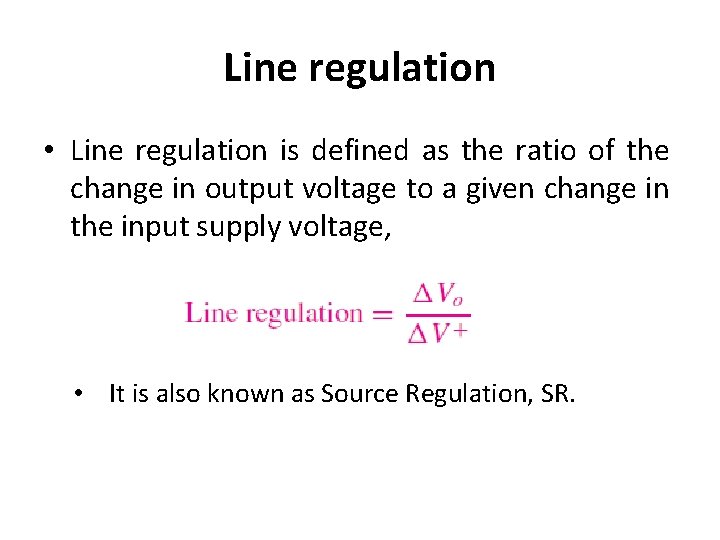
Line regulation • Line regulation is defined as the ratio of the change in output voltage to a given change in the input supply voltage, • It is also known as Source Regulation, SR.
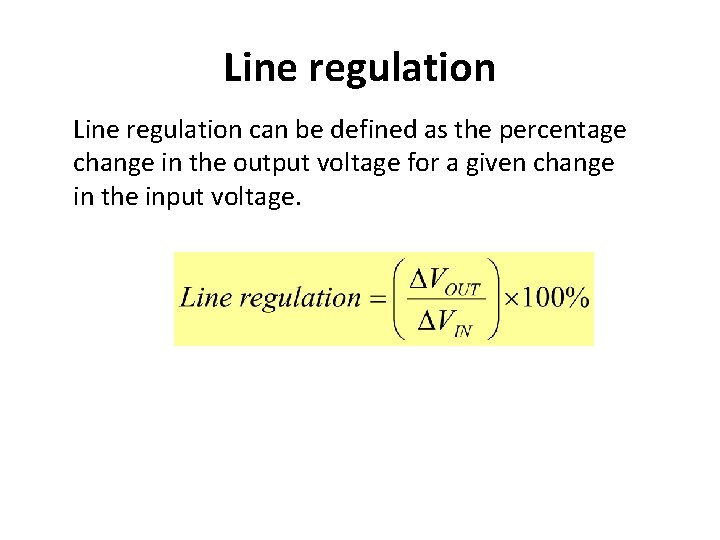
Line regulation can be defined as the percentage change in the output voltage for a given change in the input voltage.
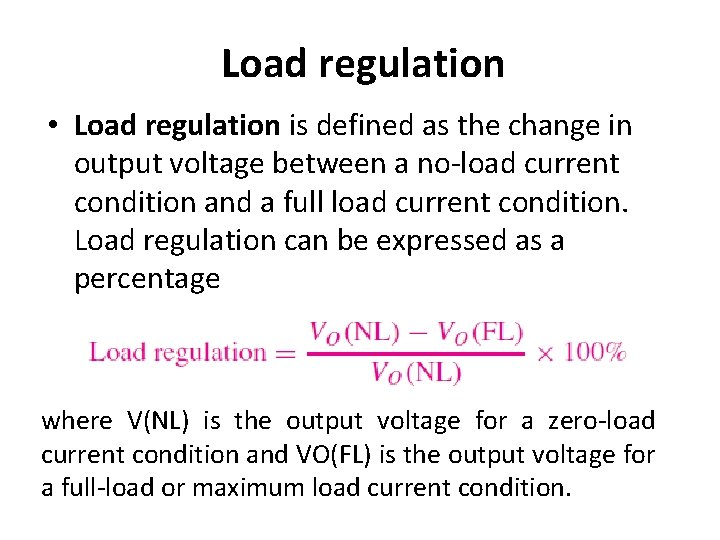
Load regulation • Load regulation is defined as the change in output voltage between a no-load current condition and a full load current condition. Load regulation can be expressed as a percentage where V(NL) is the output voltage for a zero-load current condition and VO(FL) is the output voltage for a full-load or maximum load current condition.
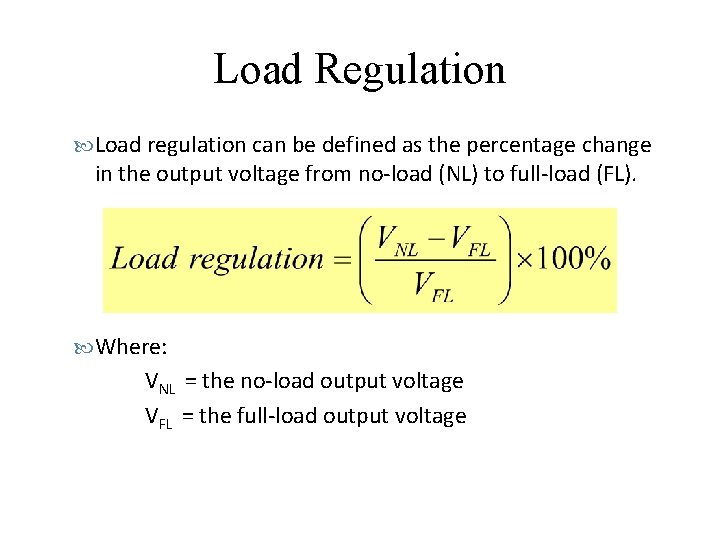
Load Regulation Load regulation can be defined as the percentage change in the output voltage from no-load (NL) to full-load (FL). Where: VNL = the no-load output voltage VFL = the full-load output voltage
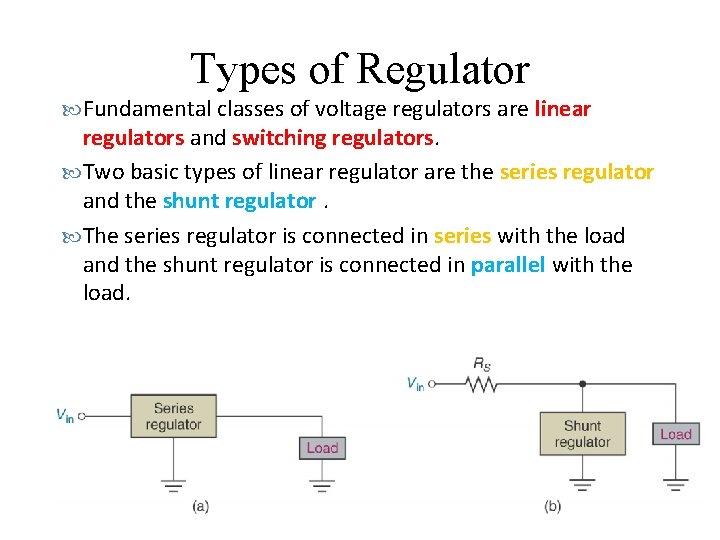
Types of Regulator Fundamental classes of voltage regulators are linear regulators and switching regulators. Two basic types of linear regulator are the series regulator and the shunt regulator. The series regulator is connected in series with the load and the shunt regulator is connected in parallel with the load.
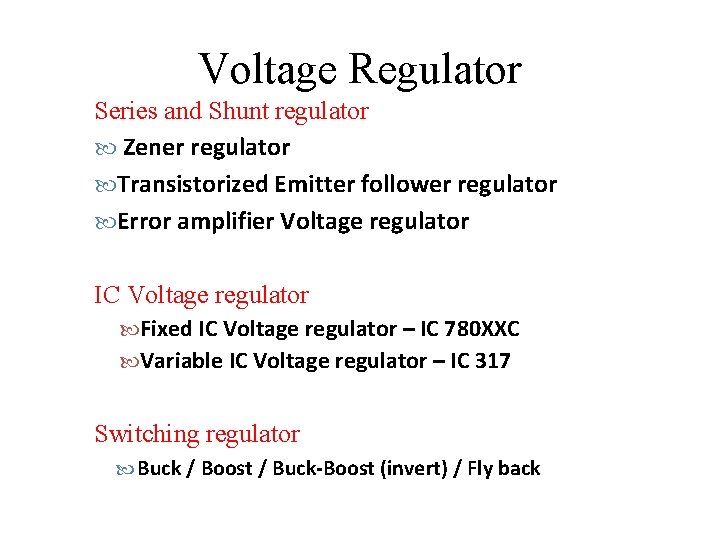
Voltage Regulator Series and Shunt regulator Zener regulator Transistorized Emitter follower regulator Error amplifier Voltage regulator IC Voltage regulator Fixed IC Voltage regulator – IC 780 XXC Variable IC Voltage regulator – IC 317 Switching regulator Buck / Boost / Buck-Boost (invert) / Fly back
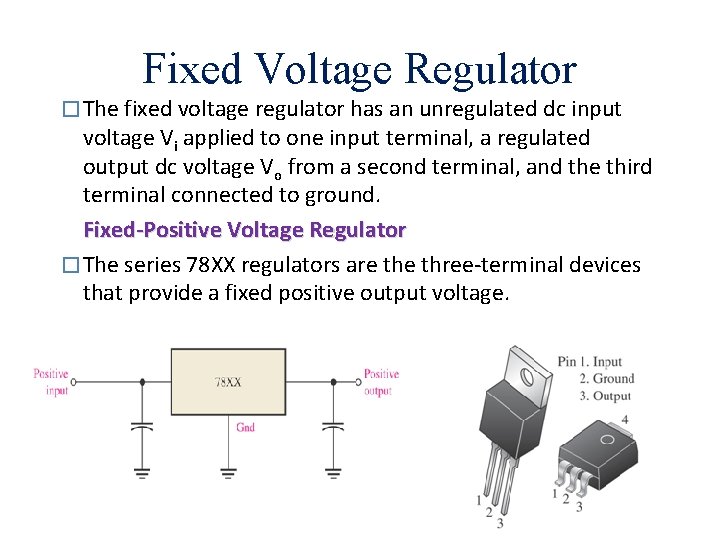
Fixed Voltage Regulator � The fixed voltage regulator has an unregulated dc input voltage Vi applied to one input terminal, a regulated output dc voltage Vo from a second terminal, and the third terminal connected to ground. Fixed-Positive Voltage Regulator � The series 78 XX regulators are three-terminal devices that provide a fixed positive output voltage.
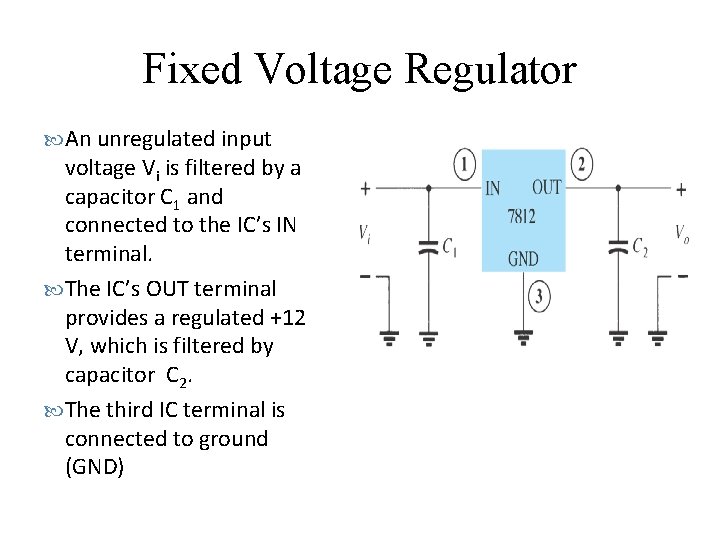
Fixed Voltage Regulator An unregulated input voltage Vi is filtered by a capacitor C 1 and connected to the IC’s IN terminal. The IC’s OUT terminal provides a regulated +12 V, which is filtered by capacitor C 2. The third IC terminal is connected to ground (GND)
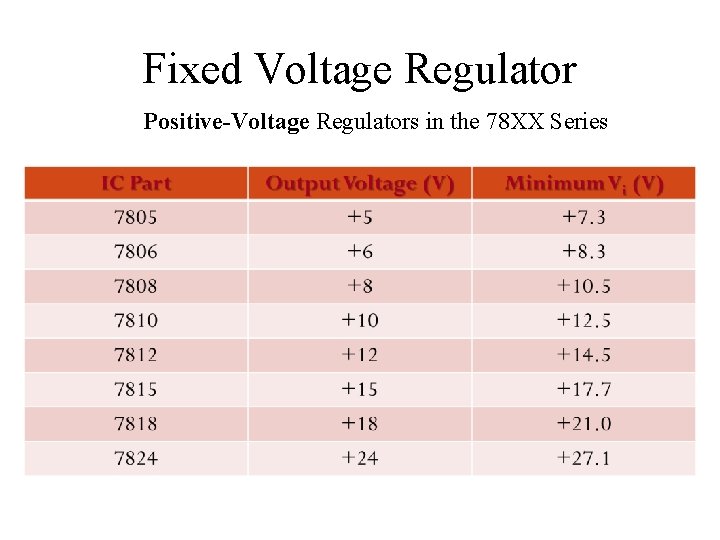
Fixed Voltage Regulator Positive-Voltage Regulators in the 78 XX Series
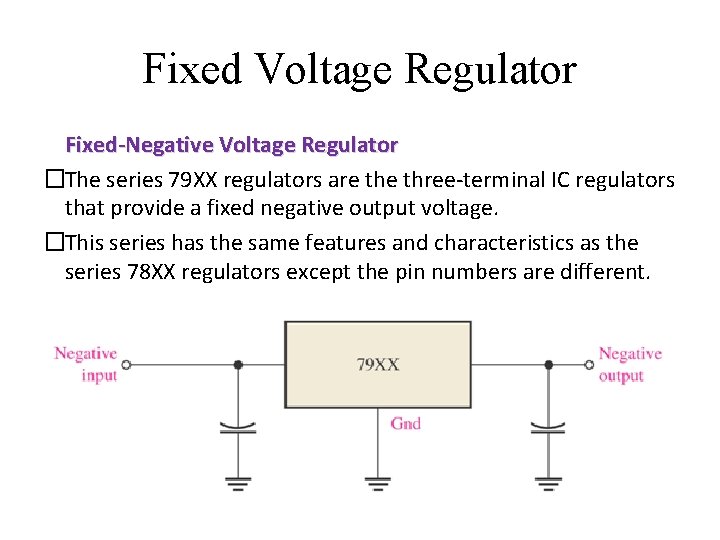
Fixed Voltage Regulator Fixed-Negative Voltage Regulator �The series 79 XX regulators are three-terminal IC regulators that provide a fixed negative output voltage. �This series has the same features and characteristics as the series 78 XX regulators except the pin numbers are different.
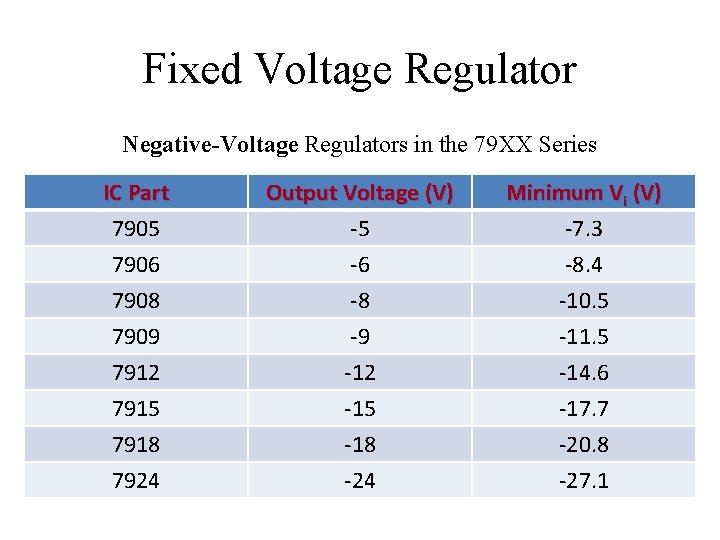
Fixed Voltage Regulator Negative-Voltage Regulators in the 79 XX Series IC Part 7905 7906 7908 Output Voltage (V) -5 -6 -8 Minimum Vi (V) -7. 3 -8. 4 -10. 5 7909 7912 7915 7918 7924 -9 -12 -15 -18 -24 -11. 5 -14. 6 -17. 7 -20. 8 -27. 1
Three Terminal Adjustable Regulator : LM 317 • The LM 317 series is the most commonly used three terminal adjustable regulators. • It allows the adjustment of the output voltage. • The output voltage can be adjusted from 1. 2 V to as high as 57 V with the help of such regulators. • In such regulator ICs the common terminal plays the role of control in out and hence called as ADJUSTMENT (ADJ) terminal.
• These devices are available in a variety of packages which can be easily mounted and handled. • The current rating of such regulators is 1. 5 A. • The maximum input voltage of LM 317 is 40 V.
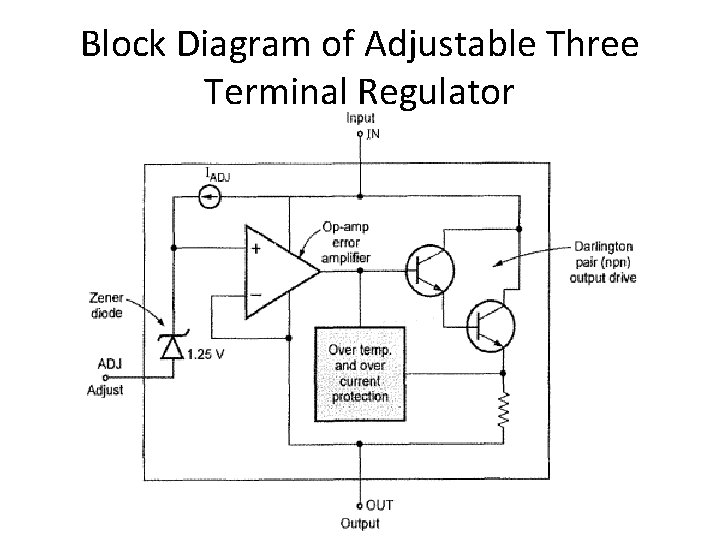
Block Diagram of Adjustable Three Terminal Regulator
• It has three terminals namely input (IN), output (OUT) and adjust (ADJ). • The op-amp with 1. 25 V offset input at the ADJ terminals provides facility to adjust output voltage or current. Two external resistors are used to have adjustable output voltage. • The darlington pair with npn transistors is used as an output drive. This provides low output impedance. Output capacitor is optional which may be used for filtering purpose.
• The recommended voltage which is the minimum voltage that must exist between input and output terminals is 3 V. This is also called head room. • The block temperature over current shutdown protection circuit which protects the devices against overloads and from the damages due to excessive heat.
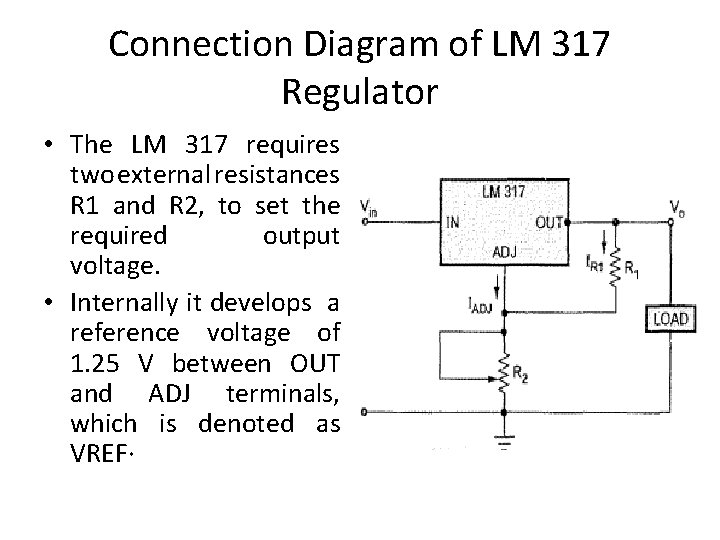
Connection Diagram of LM 317 Regulator • The LM 317 requires two external resistances R 1 and R 2, to set the required output voltage. • Internally it develops a reference voltage of 1. 25 V between OUT and ADJ terminals, which is denoted as VREF·
• This voltage is impressed across the resistance R 1. So for constant VREF and R 1 the current IR 1 is also constant. • The resistance R 1 which sets the current IR 1 is called current set resistor or program resistor. • The current IADJ flows out from the ADJ terminal and is similar to the quiescent Current IQ in the fixed voltage regulators.
• This current, along with IR 1, flow through the resistance R 2. • The design of LM 317 is such that the current l. ADJ is very small and remains constant with line and load changes. The maximum value of IADJ is 100 µA which is very small.
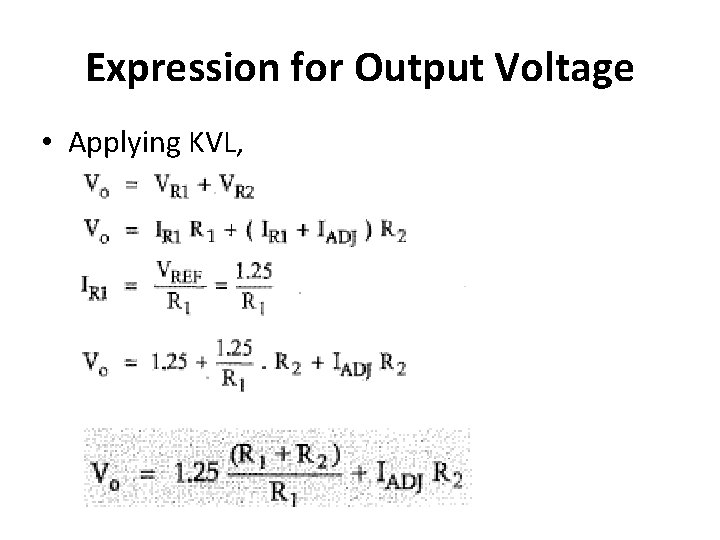
Expression for Output Voltage • Applying KVL,
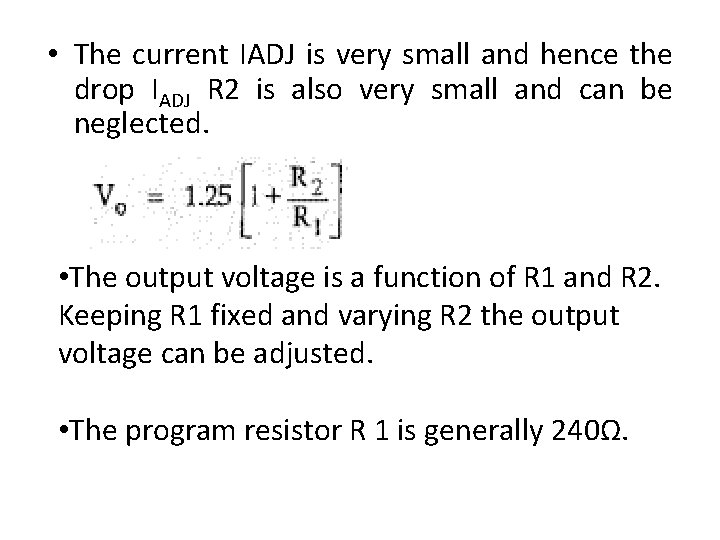
• The current IADJ is very small and hence the drop IADJ R 2 is also very small and can be neglected. • The output voltage is a function of R 1 and R 2. Keeping R 1 fixed and varying R 2 the output voltage can be adjusted. • The program resistor R 1 is generally 240Ω.
• Generally no capacitors are required. But if LM 317 is located far from the power supply filter then the capacitors and C 1 and C 2 are required. • The input capacitor C 1 is generally 0. 1µf disc or 1 µF tantalum while the output capacitor is in the range of 1 to 1000 µF. • To get high rejection, the capacitor C 3 is used.
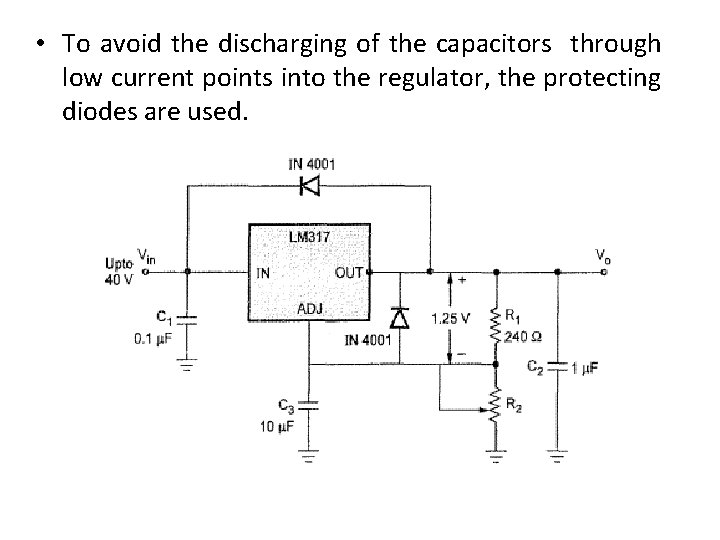
• To avoid the discharging of the capacitors through low current points into the regulator, the protecting diodes are used.
LM 337 Voltage Regulator • The LM 337 voltage regulator IC is counter part of LM 317 having output voltage range from -1. 2 to- 47 V. • The output current capacity : excess of 1. 5 A. • It is widely used negative voltage regulator IC which can be used as adjustable voltage regulator.
• It is very easy to use and require only two external resistors to design the required output voltage. • Both line and load regulations are excellent compared to standard fixed voltage regulator ICs. • The various protections such as thermal, overload, short circuit current limit are internally provided.
Features 1) Output current capacity in excess of 1. 5 A. 2) Output voltage range is - 1. 2 V to -47 V. 3) Typical load regulation of 0. 3 %/V. 4) Typical line regulation of O. 01 %/V. 5) High ripple rejection of about 77 d. B. 6) Internal thermal and overload protection is provided. 7) Internal short circuit current limiting is provided.
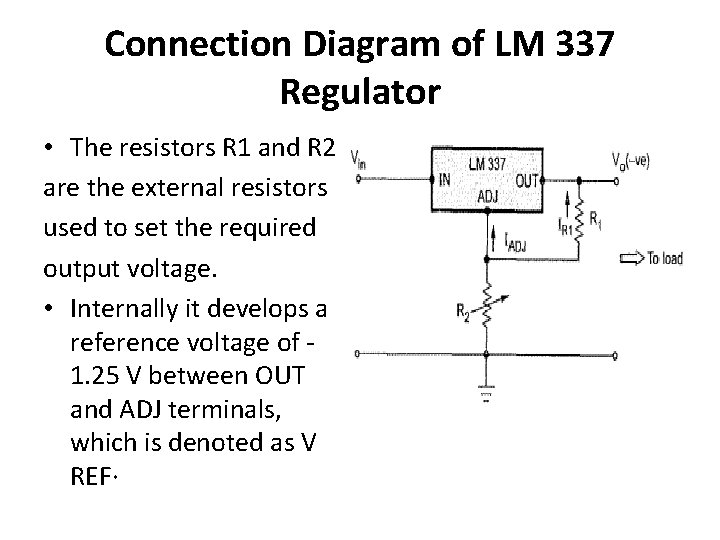
Connection Diagram of LM 337 Regulator • The resistors R 1 and R 2 are the external resistors used to set the required output voltage. • Internally it develops a reference voltage of 1. 25 V between OUT and ADJ terminals, which is denoted as V REF·
• The resistor R 1 is current set resistor or program resistor. • The current through R 1 is IR 1· • The current I ADJ flows into the ADJ terminal and along with IR 1 flows through R 2. • The IADJ is practically very small. Its maximum value is 100 µA·
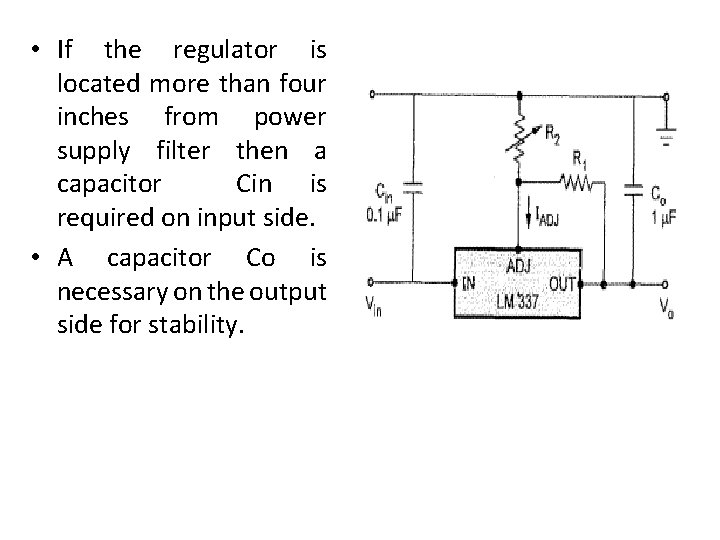
• If the regulator is located more than four inches from power supply filter then a capacitor Cin is required on input side. • A capacitor Co is necessary on the output side for stability.
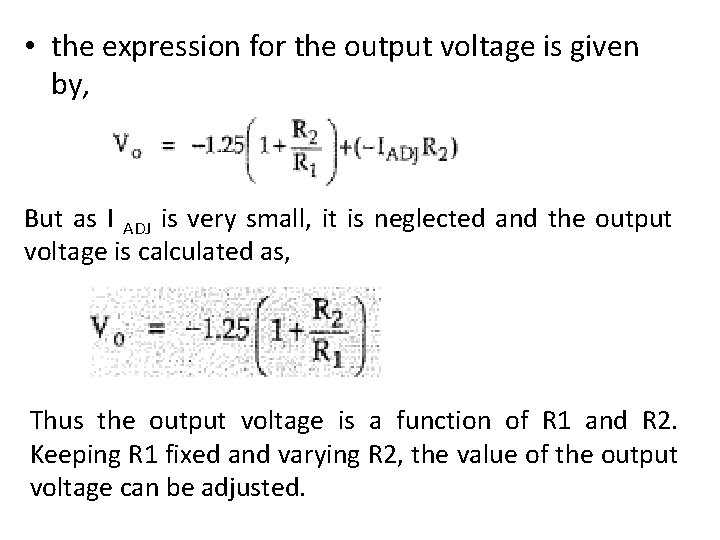
• the expression for the output voltage is given by, But as I ADJ is very small, it is neglected and the output voltage is calculated as, Thus the output voltage is a function of R 1 and R 2. Keeping R 1 fixed and varying R 2, the value of the output voltage can be adjusted.
Applications 1) Adjustable negative voltage regulators. 2) Current regulator circuits. 3) Programmable regulators
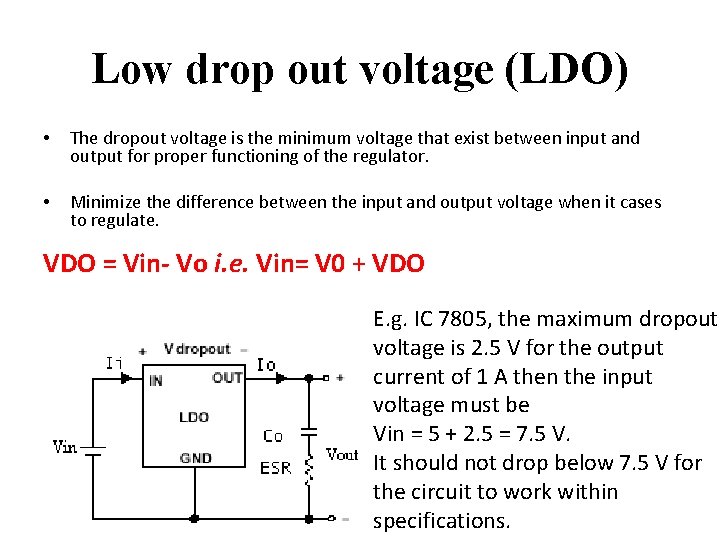
Low drop out voltage (LDO) • The dropout voltage is the minimum voltage that exist between input and output for proper functioning of the regulator. • Minimize the difference between the input and output voltage when it cases to regulate. VDO = Vin- Vo i. e. Vin= V 0 + VDO E. g. IC 7805, the maximum dropout voltage is 2. 5 V for the output current of 1 A then the input voltage must be Vin = 5 + 2. 5 = 7. 5 V. It should not drop below 7. 5 V for the circuit to work within specifications.
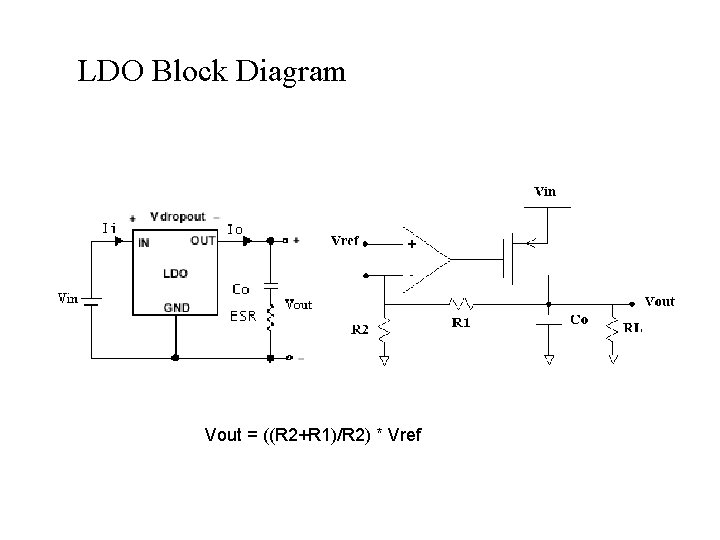
LDO Block Diagram Vout = ((R 2+R 1)/R 2) * Vref
Key Parameters Dropout Voltage Load Regulation Line Regulation Power Supply Rejection Ratio Output voltage is controlled by the resistive negative feedback • Input voltage must be greater than the output voltage • • •
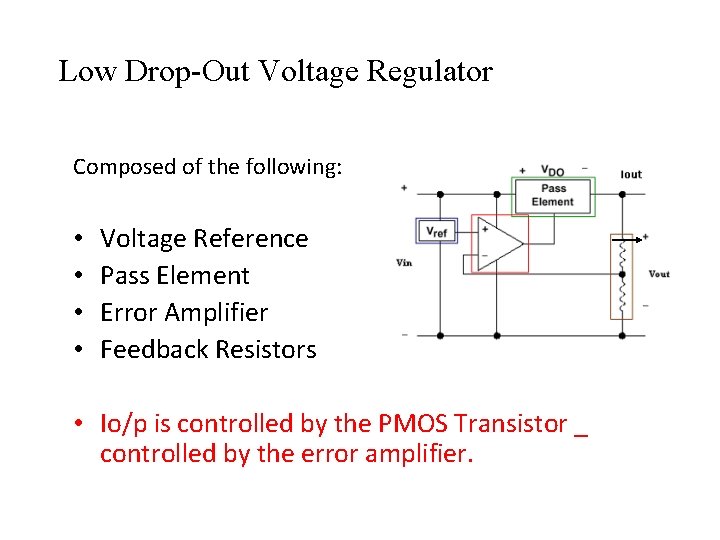
Low Drop-Out Voltage Regulator Composed of the following: • • Voltage Reference Pass Element Error Amplifier Feedback Resistors • Io/p is controlled by the PMOS Transistor _ controlled by the error amplifier.
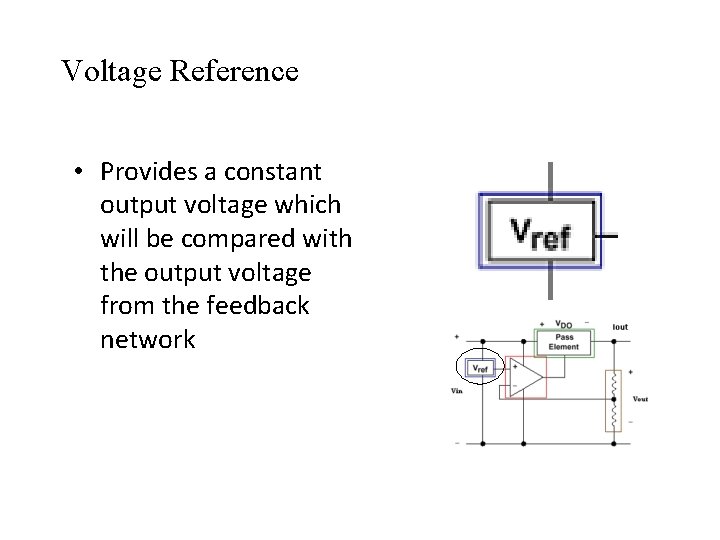
Voltage Reference • Provides a constant output voltage which will be compared with the output voltage from the feedback network
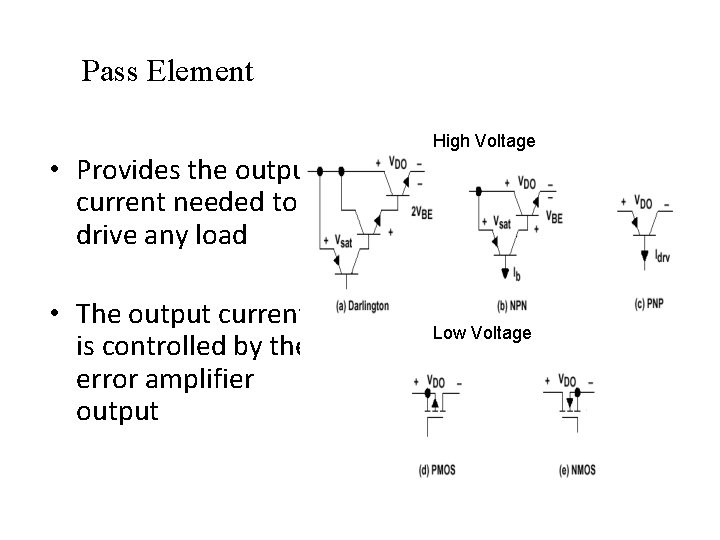
Pass Element • Provides the output current needed to drive any load • The output current is controlled by the error amplifier output High Voltage Low Voltage
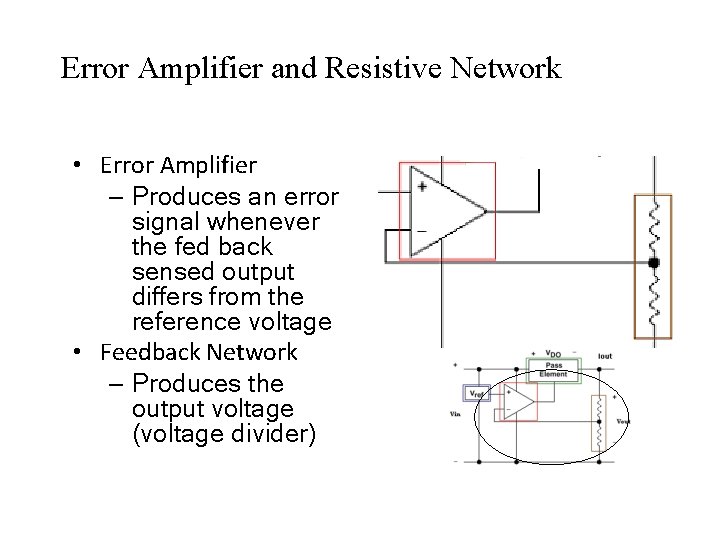
Error Amplifier and Resistive Network • Error Amplifier – Produces an error signal whenever the fed back sensed output differs from the reference voltage • Feedback Network – Produces the output voltage (voltage divider)
• The amplifier compares Vref with f/b voltage from o/p & amplifies the difference. • If Vf/b < Vref__ Gate of PMOS pulled lower allowing more current to pass & increasing Vo. • If Vf/b > Vref__ Gate of PMOS pulled higher allowing less current to pass & decreasing Vo.
Switching Regulator (SMPS) • The switching regulators are also called switched mode regulators or switch mode power supply. • Switching regulator requires an external transistor and a choke. The series pass transistor in such a regulator is used as a controlled switch and is operated in cut-off region or saturation region. • Hence the power transmitted across such a transistor is in the form of discrete pulses rather than a steady flow of current.
• When the transistor is operated in the cut-off region, there is no current and dissipates no power. • While when it is operated in the saturation region, a negligible voltage drop appears across it and hence dissipates very small power, providing maximum current to load. • In any case, the power dissipated in the transistor is very small. • Almost the entire power gets transmitted to the load. • Hence the efficiency of the switching regulators is always very high.
• The pulse width modulation is the basic principle of the switching regulators. • The average value of repetitive pulse waveform is proportional to the area under the waveform. • So switching regulators use the fact that if duty cycle of the pulse waveform is varied, the average value of the voltage also changes proportionally. • The duty cycle of the pulse waveform is the ratio of the on time ton to the period T of the pulse waveform.
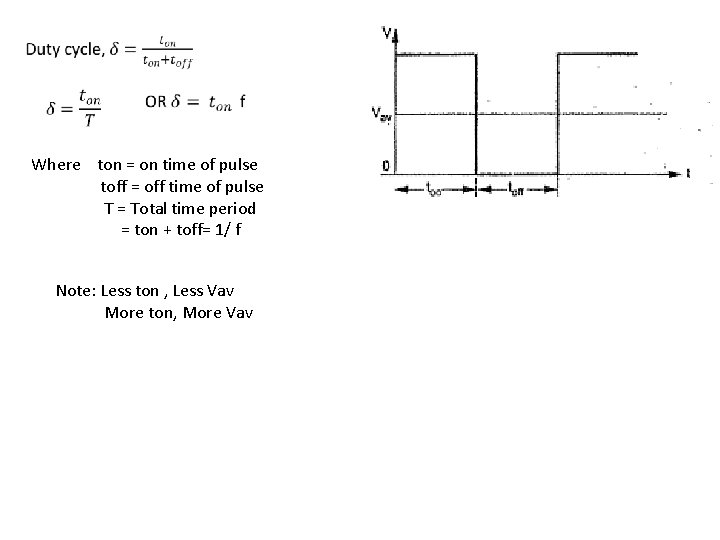
Where ton = on time of pulse toff = off time of pulse T = Total time period = ton + toff= 1/ f Note: Less ton , Less Vav More ton, More Vav
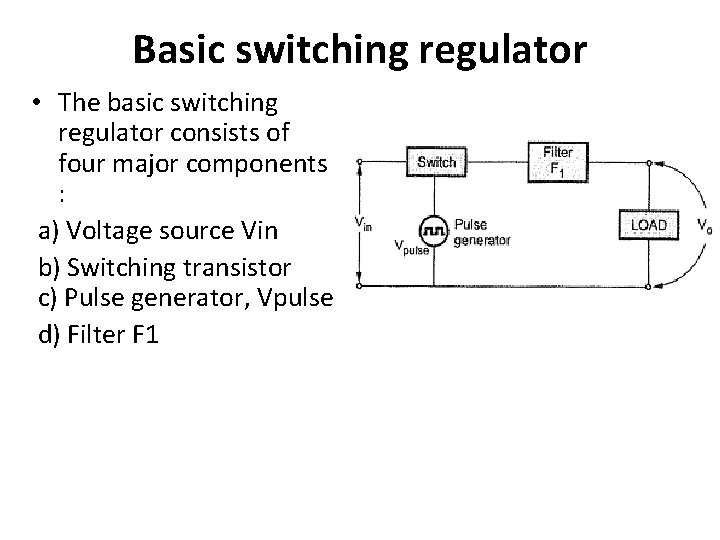
Basic switching regulator • The basic switching regulator consists of four major components : a) Voltage source Vin b) Switching transistor c) Pulse generator, Vpulse d) Filter F 1
• A voltage source Vin is a d. c. supply which is a battery, unregulated or regulated voltage. • It has to satisfy the requirements as : i) It has to supply required power and the losses associated with the regulator. ii) It must be high to satisfy the minimum requirements of the regulator. ill) It must be large to supply sufficient dynamic range of line and load changes.
• The switch is generally a transistor. The pulse generator output makes it on and off. • The pulse generator produces a required pulse waveform. The most effective range of pulse waveform frequency is 20 k. Hz. The typical operating frequency range is 10 to 50 k. Hz. • The filter F 1 may be RC, RL or RLC. Most commonly used filter is RLC. It converts the pulse waveforms obtained from the switch into a d. c. output voltage.
Block Diagram of SMPS • It consists of a BJT switch(Q 1), an oscillator, a voltage comparator, a voltage reference source, a diode (D 1), and a filter. • The switch, oscillator and reference source are all usually contained within an integrated circuit controller. • The filter usually consists of an inductor and capacitor.
• The input voltage (Vi)is converted into a pulse waveform (VA) by the action of switch (Q 1) turning on and off. • The oscillator switches Q 1 on, causing current to flow to the filter and the output voltage to rise. • The voltage comparator compares the output voltage to the reference voltage, and it holds Q 1 on untill VR 2 equals Vref. Then Q 1 is turned off again.
• A pulse waveform (VA)is produced at the input of the filter by Q 1 turning on and off. • The filter smooths the pulse waveform to produce a dc output voltage (Vo) with a ripple waveform (Vr). • The ripple waveform is the result of the filter capacitor charging via the inductor during ton, and then discharging to the load during toff via D 1.
Types of Switching Regulators • Switched mode regulator circuit takes d. c. input( unregulated) and provides single or multiple d. c. outputs, of same or opposite polarity and of a lower or higher voltage. • There are three basic configurations of the switching regulators. 1) Step down or Buck switching regulator 2) Step up or Boost switching regulator. 3) Inverting type switching regulator or Buckboost switching regulator.
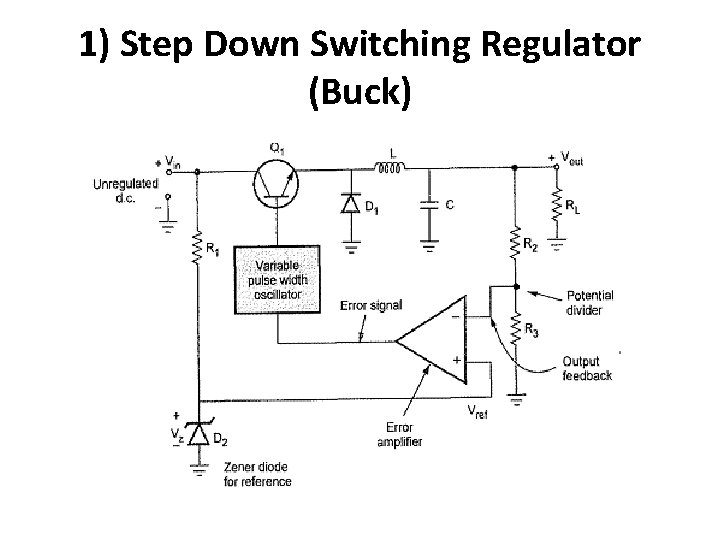
1) Step Down Switching Regulator (Buck)
• It uses an inductor L and series transistor Q 1 which acts as a switch. • The reference for error amplifier is provided by zener voltage Vz. • The output is fed back to error amplifier through potential divider. • The pulse width oscillator controls the operation of Q 1 as on or off, depending on the load requirements.
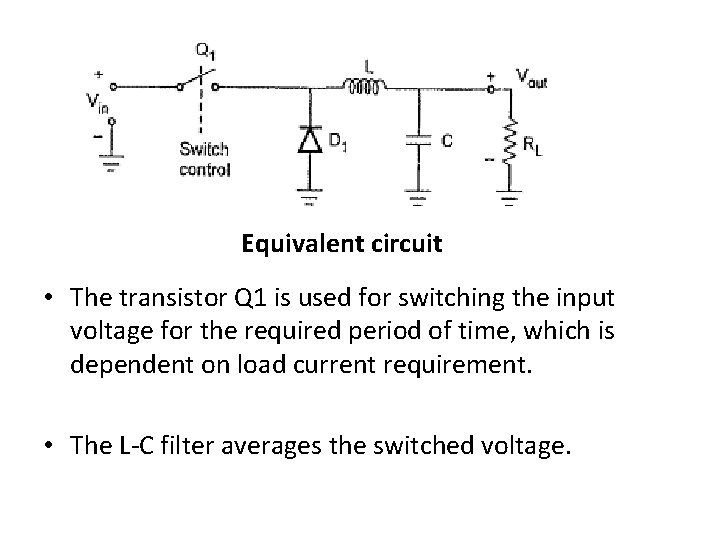
Equivalent circuit • The transistor Q 1 is used for switching the input voltage for the required period of time, which is dependent on load current requirement. • The L-C filter averages the switched voltage.
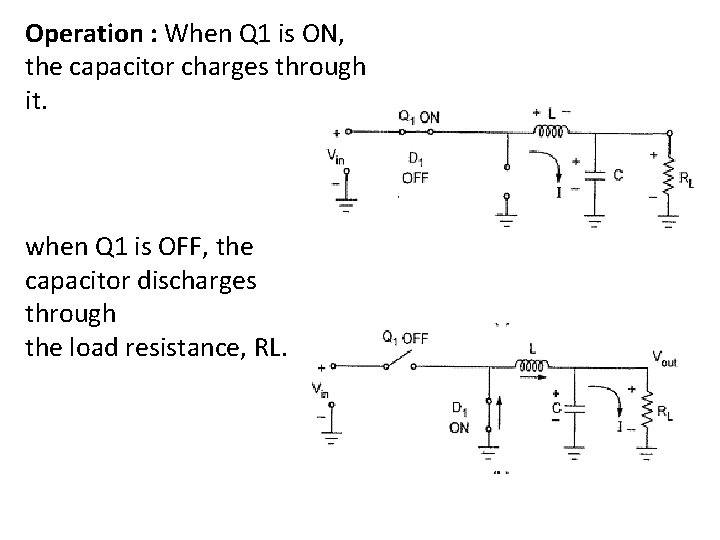
Operation : When Q 1 is ON, the capacitor charges through it. when Q 1 is OFF, the capacitor discharges through the load resistance, RL.
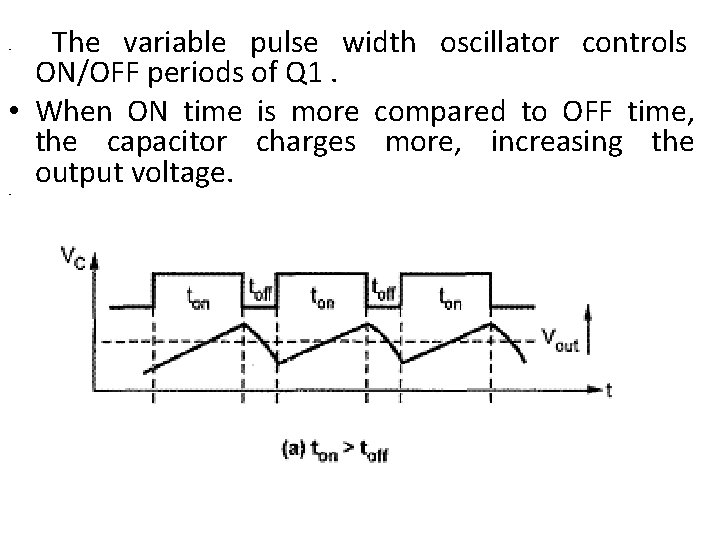
The variable pulse width oscillator controls ON/OFF periods of Q 1. • When ON time is more compared to OFF time, the capacitor charges more, increasing the output voltage. • •
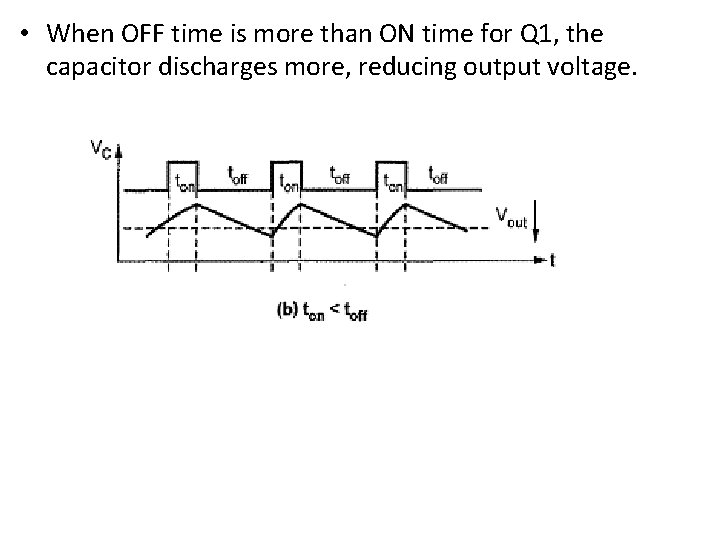
• When OFF time is more than ON time for Q 1, the capacitor discharges more, reducing output voltage.
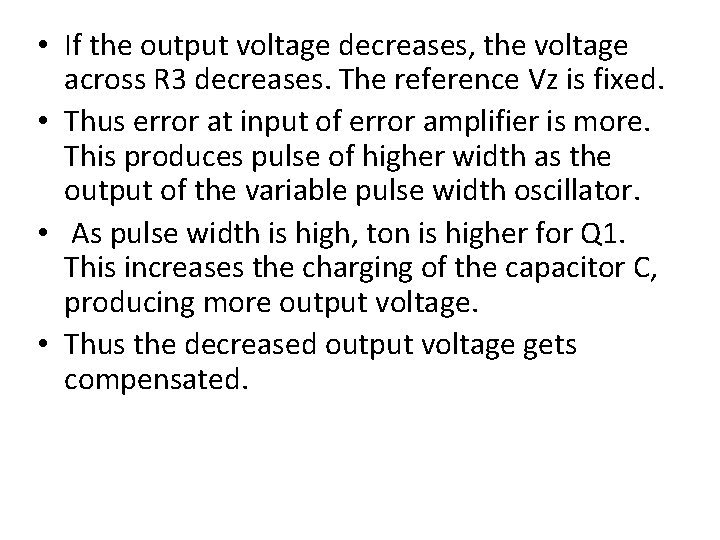
• If the output voltage decreases, the voltage across R 3 decreases. The reference Vz is fixed. • Thus error at input of error amplifier is more. This produces pulse of higher width as the output of the variable pulse width oscillator. • As pulse width is high, ton is higher for Q 1. This increases the charging of the capacitor C, producing more output voltage. • Thus the decreased output voltage gets compensated.
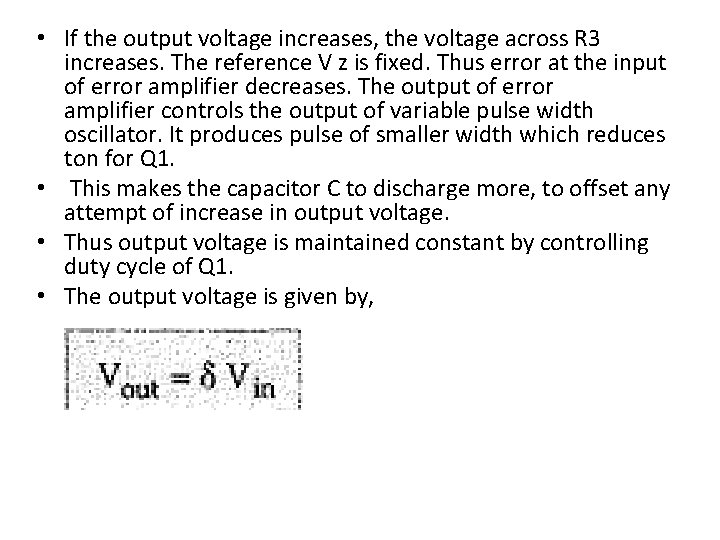
• If the output voltage increases, the voltage across R 3 increases. The reference V z is fixed. Thus error at the input of error amplifier decreases. The output of error amplifier controls the output of variable pulse width oscillator. It produces pulse of smaller width which reduces ton for Q 1. • This makes the capacitor C to discharge more, to offset any attempt of increase in output voltage. • Thus output voltage is maintained constant by controlling duty cycle of Q 1. • The output voltage is given by,
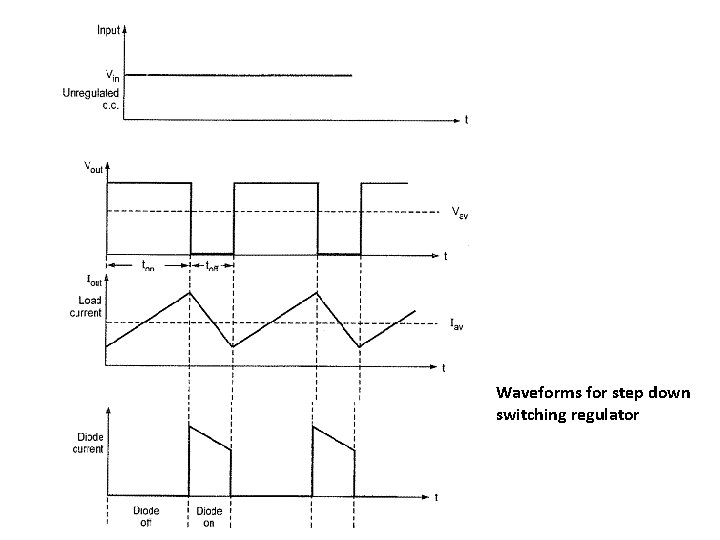
Waveforms for step down switching regulator
Advantages • • Higher efficiency. Simple to design. Low ripple content. Small output filter. Low switch stress. Large tolerance of line voltage regulation. Low cost, size and weight.
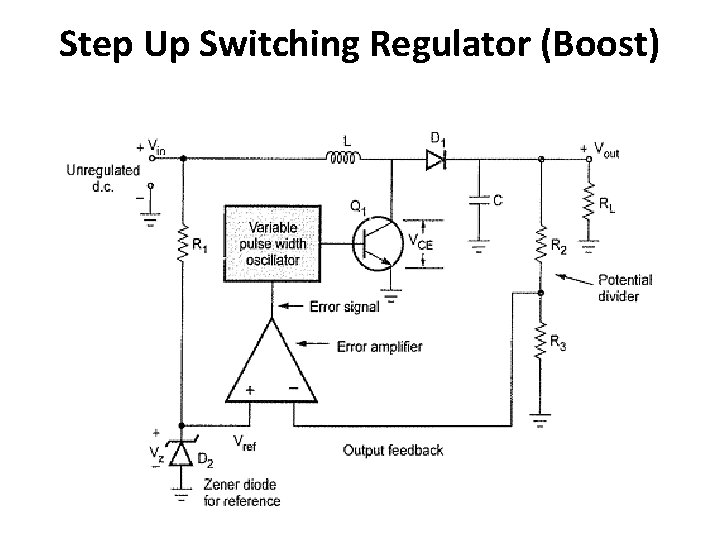
Step Up Switching Regulator (Boost)
Operation: • Case 1 : Let Q 1 is ON i. e. driven to saturation. : • When Q 1 is ON, VCE is denoted as VCE(sat) and the voltage across L suddenly becomes [Vin - VCE(sat)]. This expands the magnetic field around the inductor very quickly. This voltage across L can be obtained applying KVL to Vin, L, Q 1 and Vin closed path. • During the ON time (ton> of Q 1, the voltage across the inductor starts decreasing exponentially from its initial maximum value
- Slides: 74