
UNIT V PART II HASH TABLES By B

UNIT – V PART - II HASH TABLES By B VENKATESWARLU, CSE Dept. 1

Dictionary & Search ADTs � Operations � create � destroy � insert � find � delete � insert • kohlrabi - upscale tuber � spicy cabbage � kreplach � tasty stuffed dough � find(kreplach) kim chi kiwi � Australian fruit • kreplach - tasty stuffed dough � Dictionary: Stores values associated with user- specified keys � keys may be any (homogenous) comparable type � values may be any (homogenous) type � implementation: data field is a struct with two parts � Search ADT: keys = values 2

Implementations So Far unsorted list sorted array Trees BST – average AVL – worst case splay – amortized insert find+ (1) (n) (log n) find (n) (log n) delete find+ (1) (n) Array of size n where keys are 0, …, n-1 (log n) 3

Hash Tables: Basic Idea �Use a key (arbitrary string or number) to index directly into an array – O(1) time to access records � A[“kreplach”] = “tasty stuffed dough” � Need a hash function to convert the key to an integer Key Data 0 kim chi spicy cabbage 1 kreplach tasty stuffed dough 2 kiwi Australian fruit 4

Applications �When log(n) is just too big… � Symbol tables in interpreters � Real-time databases (in core or on disk) �air traffic control �packet routing �When associative memory is needed… � Dynamic programming �cache results of previous computation f(x) if ( Find(x) ) then Find(x) else f(x) �Chess endgames � Many text processing applications – e. g. Web $Status{$Last. URL} = “visited”; 5

How could you use hash tables to… �Implement a linked list of unique elements? �Create an index for a book? �Convert a document to a Sparse Boolean Vector (where each index represents a different word)? 6

Properties of Good Hash Functions �Must return number 0, …, tablesize �Should be efficiently computable – O(1) time �Should not waste space unnecessarily � For every index, there is at least one key that hashes to it � Load factor lambda = (number of keys / Table. Size) �Should minimize collisions = different keys hashing to same index 7

Integer Keys �Hash(x) = x % Table. Size �Good idea to make Table. Size prime. Why? 8

Integer Keys �Hash(x) = x % Table. Size �Good idea to make Table. Size prime. Why? � Because keys are typically not randomly distributed, but usually have some pattern �mostly even �mostly multiples of 10 �in general: mostly multiples of some k � If k is a factor of Table. Size, then only (Table. Size/k) slots will ever be used! � Since the only factor of a prime number is itself, this phenomena only hurts in the (rare) case where k=Table. Size 9

Strings as Keys �If keys are strings, can get an integer by adding up ASCII values of characters in key for (i=0; i<key. length(); i++) hash. Val += key. char. At(i); �Problem 1: What if Table. Size is 10, 000 and all keys are 8 or less characters long? �Problem 2: What if keys often contain the same characters (“abc”, “bca”, etc. )? 10
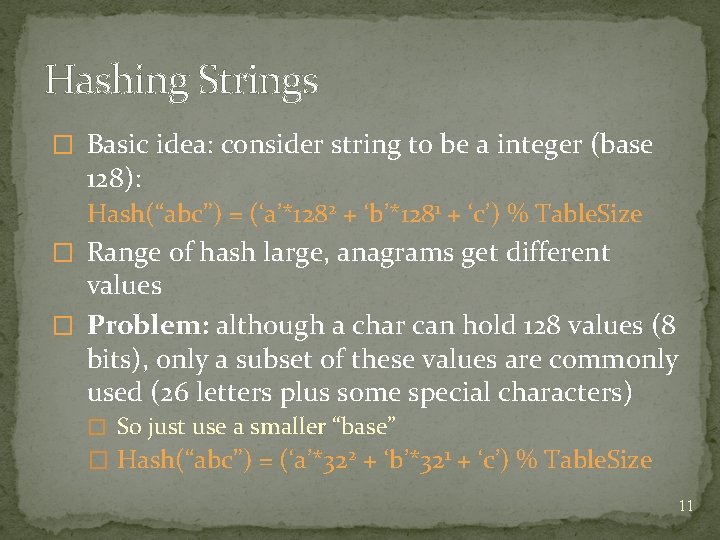
Hashing Strings � Basic idea: consider string to be a integer (base 128): Hash(“abc”) = (‘a’*1282 + ‘b’*1281 + ‘c’) % Table. Size � Range of hash large, anagrams get different values � Problem: although a char can hold 128 values (8 bits), only a subset of these values are commonly used (26 letters plus some special characters) � So just use a smaller “base” � Hash(“abc”) = (‘a’*322 + ‘b’*321 + ‘c’) % Table. Size 11

Making the String Hash Easy to Compute �Horner’s Rule int hash(String s) { h = 0; for (i = s. length() - 1; i >= 0; i--) { h = (s. key. At(i) + h<<5) % table. Size; } return h; �Advantages: What is } happening here? ? ? 12

How Can You Hash… �A set of values – (name, birthdate) ? �An arbitrary pointer in C? �An arbitrary reference to an object in Java? 13

How Can You Hash… �A set of values – (name, birthdate) ? (Hash(name) ^ Hash(birthdate))% tablesize �An arbitrary pointer in C? What’s this? ((int)p) % tablesize �An arbitrary reference to an object in Java? Hash(obj. to. String()) or just obj. hash. Code() % tablesize 14

Optimal Hash Function �The best hash function would distribute keys as evenly as possible in the hash table �“Simple uniform hashing” � Maps each key to a (fixed) random number � Idealized gold standard � Simple to analyze � Can be closely approximated by best hash functions 15

Collisions and their Resolution � A collision occurs when two different keys hash to the same value � E. g. For Table. Size = 17, the keys 18 and 35 hash to the same value � 18 mod 17 = 1 and 35 mod 17 = 1 � Cannot store both data records in the same slot in array! � Two different methods for collision resolution: � Separate Chaining: Use a dictionary data structure (such as a linked list) to store multiple items that hash to the same slot � Closed Hashing (or probing): search for empty slots using a second function and store item in first empty slot that is found 16

A Rose by Any Other Name… �Separate chaining = Open hashing �Closed hashing = Open addressing 17

Hashing with Separate Chaining � Put a little dictionary at each entry � choose type as appropriate � common case is unordered linked list (chain) � Properties � performance degrades with length of chains � can be greater than 1 What was ? ? h(a) = h(d) h(e) = h(b) 0 1 a d e b 2 3 4 5 c 6 18

Load Factor with Separate Chaining �Search cost � unsuccessful search: �Optimal load factor: 19

Load Factor with Separate Chaining �Search cost (assuming simple uniform hashing) � unsuccessful search: Whole list – average length � successful search: Half the list – average length /2+1 �Optimal load factor: � Zero! But between ½ and 1 is fast and makes good use of memory. 20

Alternative Strategy: Closed Hashing Problem with separate chaining: Memory consumed by pointers – 32 (or 64) bits per key! What if we only allow one Key at each entry? � two objects that hash to the same spot can’t both go there � first one there gets the spot � next one must go in another spot � Properties � 1 � performance degrades with difficulty of finding right spot h(a) = h(d) h(e) = h(b) 0 1 2 3 4 5 a d e b c 6 21

Collision Resolution by Closed Hashing �Given an item X, try cells h 0(X), h 1(X), h 2(X), …, hi(X) �hi(X) = (Hash(X) + F(i)) mod Table. Size �Define F(0) = 0 �F is the collision resolution function. Some possibilities: �Linear: F(i) = i �Quadratic: F(i) = i 2 �Double Hashing: F(i) = i Hash 2(X) 22

Closed Hashing I: Linear Probing �Main Idea: When collision occurs, scan down the array one cell at a time looking for an empty cell �hi(X) = (Hash(X) + i) mod Table. Size (i = 0, 1, 2, …) �Compute hash value and increment it until a free cell is found 23

Linear Probing Example insert(14) insert(8) insert(21) insert(2) 14%7 = 0 8%7 = 1 21%7 =0 2%7 = 2 0 probes: 0 14 1 1 8 1 8 2 21 2 12 3 3 2 4 4 5 5 6 6 14 1 1 3 2 24

Drawbacks of Linear Probing � Works until array is full, but as number of items N approaches Table. Size ( 1), access time approaches O(N) � Very prone to cluster formation (as in our example) � If a key hashes anywhere into a cluster, finding a free cell involves going through the entire cluster – and making it grow! � Primary clustering – clusters grow when keys hash to values close to each other � Can have cases where table is empty except for a few clusters � Does not satisfy good hash function criterion of distributing keys uniformly 25

Load Factor in Linear Probing �For any < 1, linear probing will find an empty slot �Search cost (assuming simple uniform hashing) � successful search: � unsuccessful search: �Performance quickly degrades for > 1/2 26

Optimal vs Linear 27

Closed Hashing II: Quadratic Probing �Main Idea: Spread out the search for an empty slot – Increment by i 2 instead of i �hi(X) = (Hash(X) + i 2) % Table. Size h 0(X) = Hash(X) % Table. Size h 1(X) = Hash(X) + 1 % Table. Size h 2(X) = Hash(X) + 4 % Table. Size h 3(X) = Hash(X) + 9 % Table. Size 28

Quadratic Probing Example insert(14) insert(8) insert(21) insert(2) 14%7 = 0 8%7 = 1 21%7 =0 2%7 = 2 0 probes: 0 14 1 1 8 1 8 2 2 2 3 3 4 4 5 5 6 6 14 1 1 21 3 21 1 29

Problem With Quadratic Probing insert(14) insert(8) insert(21) insert(2) insert(7) 14%7 = 0 8%7 = 1 21%7 =0 2%7 = 2 7%7 = 0 0 probes: 0 14 1 1 8 1 8 2 2 2 2 3 3 4 4 4 5 5 5 6 6 6 14 1 1 21 3 4 3 21 1 4 21 ? ? 30

Load Factor in Quadratic Probing �Theorem: If Table. Size is prime and ½, quadratic probing will find an empty slot; for greater , might not �With load factors near ½ the expected number of probes is empirically near optimal – no exact analysis known �Don’t get clustering from similar keys (primary clustering), still get clustering from identical keys (secondary clustering) 31

Closed Hashing III: Double Hashing �Idea: Spread out the search for an empty slot by using a second hash function � No primary or secondary clustering �hi(X) = (Hash 1(X) + i Hash 2(X)) mod Table. Size for i = 0, 1, 2, … �Good choice of Hash 2(X) can guarantee does not get “stuck” as long as < 1 �Integer keys: Hash 2(X) = R – (X mod R) where R is a prime smaller than Table. Size 32

Double Hashing Example insert(14) insert(8) insert(21) insert(2) insert(7) 14%7 = 0 8%7 = 1 21%7 =0 5 -(21%5)=4 2%7 = 2 7%7 = 0 5 -(21%5)=4 0 probes: 0 14 1 1 8 1 8 2 2 2 2 3 3 4 4 4 5 5 5 6 6 6 14 1 1 21 2 4 3 21 1 4 21 ? ? 33

Double Hashing Example insert(14) insert(8) insert(21) insert(2) insert(7) 14%7 = 0 8%7 = 1 21%7 =0 5 -(21%5)=4 2%7 = 2 7%7 = 0 5 -(21%5)=4 0 probes: 0 14 1 1 8 1 8 2 2 2 2 3 3 4 4 4 5 5 5 6 6 6 14 1 1 21 2 4 3 4 21 5 5 7 6 6 21 1 4 34

Load Factor in Double Hashing � For any < 1, double hashing will find an empty slot (given appropriate table size and hash 2) � Search cost approaches optimal (random re-hash): � successful search: � unsuccessful search: Note natural logarithm! � No primary clustering and no secondary clustering � Still becomes costly as nears 1. 35

Deletion with Separate Chaining Why is this slide blank? 36

Deletion in Closed Hashing delete(2) find(7) 0 0 1 1 2 2 2 3 7 3 4 4 5 5 6 6 Where is it? ! 7 What should we do instead? 37

Lazy Deletion delete(2) find(7) 0 0 1 1 2 2 2 # 3 7 4 4 5 5 6 6 Indicates deleted value: if you find it, probe again But now what is the problem? 38

The Squished Pigeon Principle �An insert using Closed Hashing cannot work with a load factor of 1 or more. � Quadratic probing can fail if > ½ � Linear probing and double hashing slow if > ½ � Lazy deletion never frees space �Separate chaining becomes slow once > 1 � Eventually becomes a linear search of long chains �How can we relieve the pressure on the pigeons? REHASH! 39

Rehashing Example Separate chaining h 1(x) = x mod 5 rehashes to h 2(x) = x mod 11 0 =1 1 25 2 3 37 52 0 1 4 83 98 2 3 4 25 37 5 6 7 8 9 10 =5/11 83 52 98 40

Rehashing Amortized Analysis � Consider sequence of n operations insert(3); insert(19); insert(2); … � What is the max number of rehashes? � What is the total time? log n � let’s say a regular hash takes time a, and rehashing an array contain k elements takes time bk. � Amortized time = (an+b(2 n-1))/n = O( 1 ) 41

Rehashing without Stretching �Suppose input is a mix of inserts and deletes � Never more than Table. Size/2 active keys � Rehash when =1 (half the table must be deletions) �Worst-case sequence: � T/2 inserts, T/2 deletes, T/2 inserts, Rehash, … �Rehashing at most doubles the amount of work – still O(1) 42

Case Study �Spelling dictionary � 50, 000 words � static � arbitrary(ish) preprocessing time �Goals � fast spell checking � minimal storage � Practical notes � almost all searches are Why? successful � words average about 8 characters in length � 50, 000 words at 8 bytes/word is 400 K � pointers are 4 bytes � there are many regularities in the structure of English words 43

Solutions � sorted array + binary search � separate chaining � open addressing + linear probing 44

Storage �Assume words are strings and entries are pointers to strings Array + binary search Separate chaining table size + 2 n pointers = n/ + 2 n … n pointers Closed hashing n/ pointers 45

Analysis 50 K words, 4 bytes @ pointer �Binary search � storage: n pointers + words = 200 K+400 K = 600 K � time: log 2 n 16 probes per access, worst case �Separate chaining - with = 1 � storage: n/ + 2 n pointers + words = 200 K+400 K = 1 GB � time: 1 + /2 probes per access on average = 1. 5 �Closed hashing - with = 0. 5 � storage: n/ pointers + words = 400 K + 400 K = 800 K � time: probes per access on average = 1. 5 46

Approximate Hashing �Suppose we want to reduce the space requirements for a spelling checker, by accepting the risk of once in a while overlooking a misspelled word �Ideas? 47

Approximate Hashing Strategy: � Do not store keys, just a bit indicating cell is in use � Keep low so that it is unlikely that a misspelled word hashes to a cell that is in use 48

Example � 50, 000 English words �Table of 500, 000 cells, each 1 bit � 8 bits per byte �Total memory: 500 K/8 = 62. 5 K � versus 800 K separate chaining, 600 K open addressing �Correctly spelled words will always hash to a used cell �What is probability a misspelled word hashes to a used cell? 49

Rough Error Calculation �Suppose hash function is optimal - hash is a random number �Load factor 0. 1 � Lower if several correctly spelled words hash to the same cell �So probability that a misspelled word hashes to a used cell is 10% 50

Exact Error Calculation �What is expected load factor? 51

A Random Hash… � Extensible hashing � Hash tables for disk-based databases – minimizes number disk accesses � Minimal perfect hash function � Hash a given set of n keys into a table of size n with no collisions � Might have to search large space of parameterized hash functions to find � Application: compilers � One way hash functions � Used in cryptography � Hard (intractable) to invert: given just the hash value, recover the key 52

Puzzler �Suppose you have a HUGE hash table, that you often need to re-initialize to “empty”. How can you do this in small constant time, regardless of the size of the table? 53

Databases �A database is a set of records, each a tuple of values � E. g. : [ name, ss#, dept. , salary ] �How can we speed up queries that ask for all employees in a given department? �How can we speed up queries that ask for all employees whose salary falls in a given range? 54
- Slides: 54