
Unit V Agriculture and Rural Land Use What


- Slides: 78
Unit V: Agriculture and Rural Land Use
What is Agriculture? • The modification of Earth’s surface through the cultivation of plants and rearing of animals to obtain subsistence or economic gain. • A crop is a plant cultivated by people.
Agriculture • 1/3 of all land area committed to agriculture use • Developing countries = 2/3 involved in agriculture • Employment in agriculture is declining in developing countries • < 2 Million
How does agriculture relate to geography? • Geographers study where agriculture is distributed. – LDCs: agricultural products are consumed near where they are produced – MDCs: agricultural products are sold and consumed away from where they are produced.
How does agriculture relate to geography? • Geographers study why farming practices vary around the world. – Elements of physical environment that limit agricultural production.
How does agriculture relate to geography? • Local diversity is shown in the environmental and cultural mix influencing agricultural practices. • Globalization influences farmers to grow profitable rather than practical crops.
Classification of Economic Activities • Primary • Secondary • Tertiary – Quaternary – Quinary
Economic Geography • Study of how people earn their living • How livelihood systems vary by area • And the spatial linkage between economic activities
Primary Activities • Harvesting or extracting something directly from the Earth • Humans in direct contract with the natural environment • Hunting & gathering, farming, livestock herding, fishing, forestry
Secondary Activities • Add value to material by changing their form or combining them into more useful/valuable commodities • Intermediate products • Manufacturing and processing industries • Energy and construction industries
Tertiary Activities • Consists of those business and labor specializations that provide services to the primary and secondary sectors, general community, and private individuals • “service industries” • Linkage between producer and consumer
2 types of Tertiary Activites • Quaternary: services performed by “white collar” professionals – Exchange of information, money, or capital • Quinary: high level decision making activities – Spheres of research and higher education
Primary Activities: Agriculture • Before farming hunting and gathering were the universal forms of primary production • Use of tools and fire enabled sustainable population growth in early communities • Cyclic Migration was the way of life
The First Agricultural Revolution • 12, 000 years ago • First conscious cultivation of plants • Increased the carrying capacity of the Earth • Caused changes in social organization and technology
The First Agricultural Revolution • • • Living in permanent settlements Land ownerships Modification of the natural environment Trading economies Developed much later in the Americas than in Southeast and Southwest Asia • Many agricultural hearths
Diffusion of Agriculture • Vegetative cultivation in S. E. Asia same time (root removal) – 14, 000 years ago • Agriculture diffused from agriculture centers through stimulus diffusion • Later through migration and colonialism
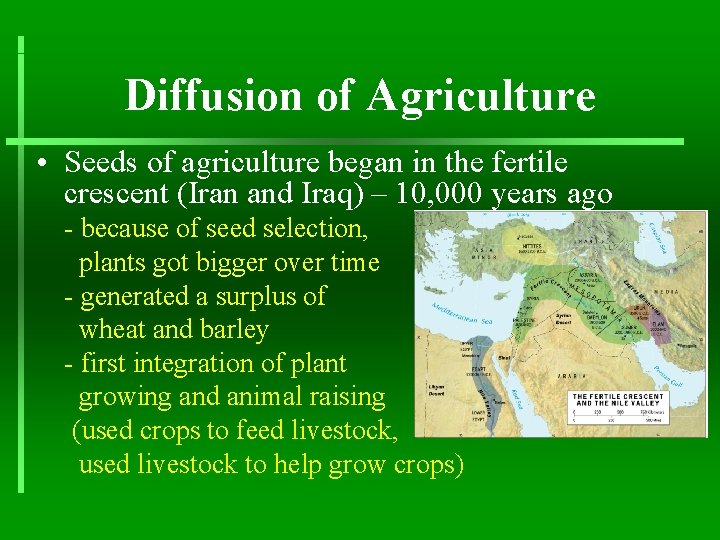
Diffusion of Agriculture • Seeds of agriculture began in the fertile crescent (Iran and Iraq) – 10, 000 years ago - because of seed selection, plants got bigger over time - generated a surplus of wheat and barley - first integration of plant growing and animal raising (used crops to feed livestock, used livestock to help grow crops)
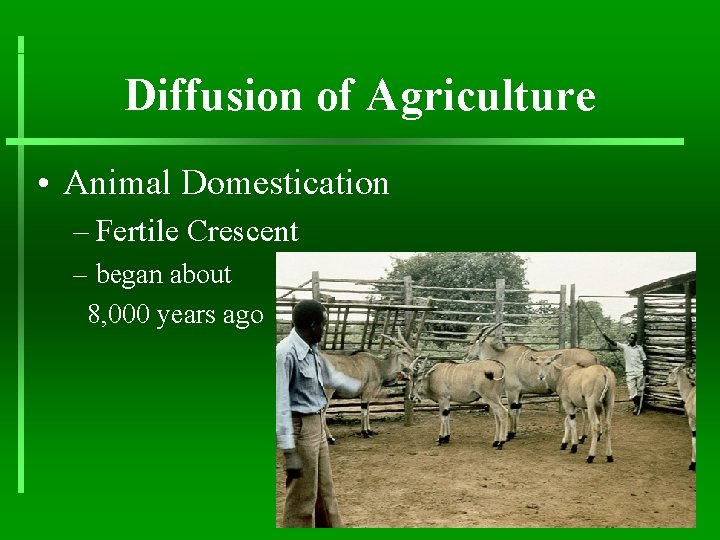
Diffusion of Agriculture • Animal Domestication – Fertile Crescent – began about 8, 000 years ago
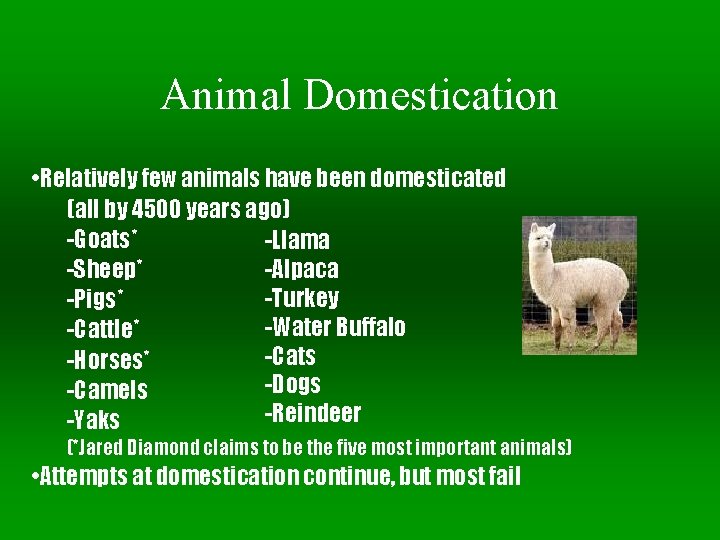
Animal Domestication • Relatively few animals have been domesticated (all by 4500 years ago) -Goats* -Llama -Sheep* -Alpaca -Turkey -Pigs* -Water Buffalo -Cattle* -Cats -Horses* -Dogs -Camels -Reindeer -Yaks (*Jared Diamond claims to be the five most important animals) • Attempts at domestication continue, but most fail
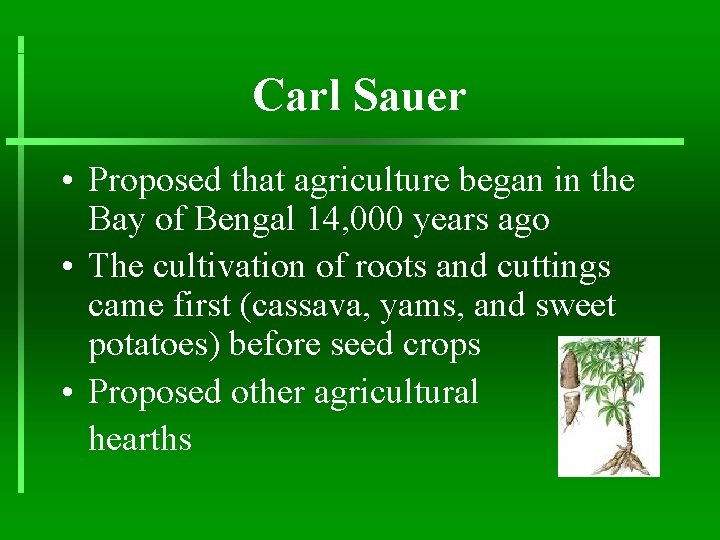
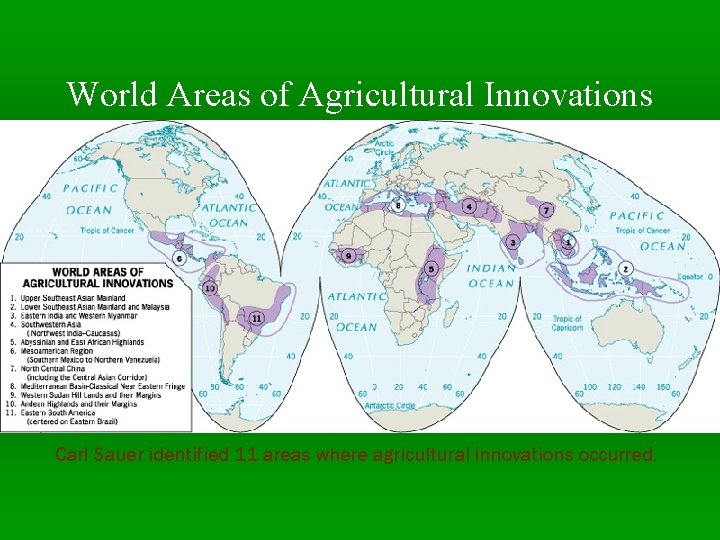
Carl Sauer • Proposed that agriculture began in the Bay of Bengal 14, 000 years ago • The cultivation of roots and cuttings came first (cassava, yams, and sweet potatoes) before seed crops • Proposed other agricultural hearths
World Areas of Agricultural Innovations Carl Sauer identified 11 areas where agricultural innovations occurred.
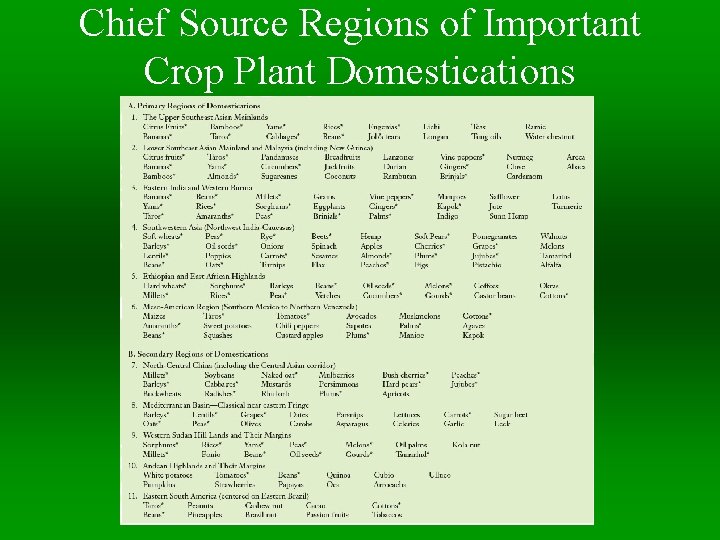
Chief Source Regions of Important Crop Plant Domestications
Subsistence Agriculture • Subsistence Agriculture – Agriculture in which people grow only enough food to survive. - farmers often hold land in common - Total self-sufficiency - some are sedentary, and some practice shifting cultivation
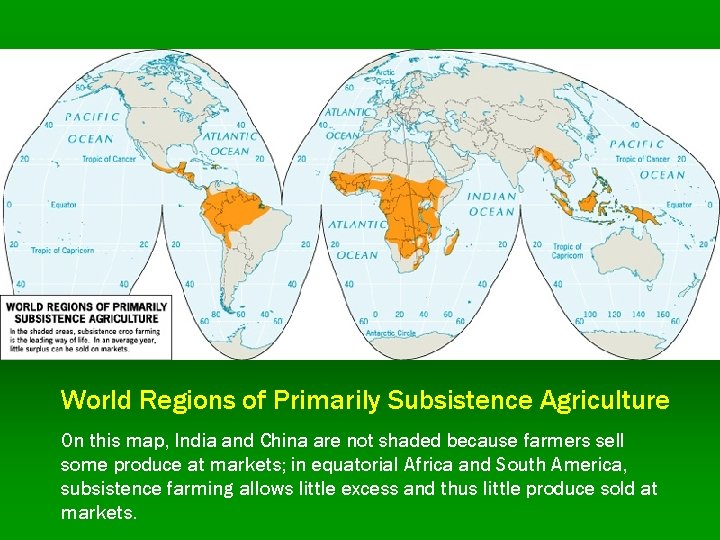
World Regions of Primarily Subsistence Agriculture On this map, India and China are not shaded because farmers sell some produce at markets; in equatorial Africa and South America, subsistence farming allows little excess and thus little produce sold at markets.
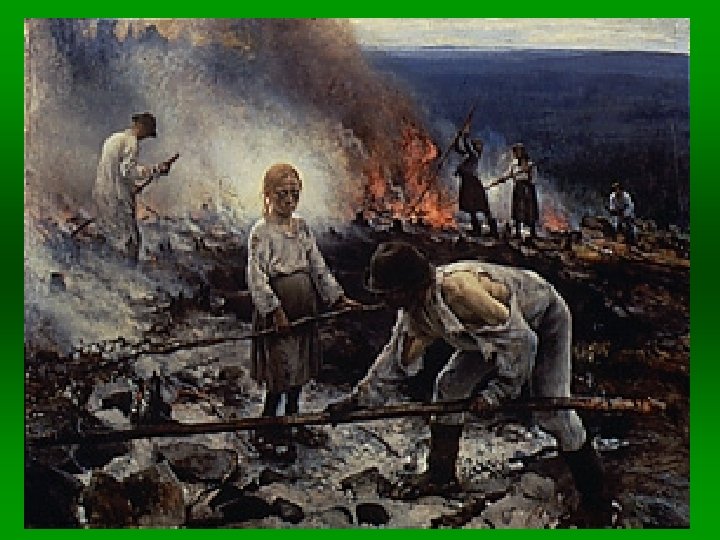
Shifting Cultivation • Clear land for planting by slash-andburn, cultivate crops for several years until it becomes infertile • Leave land to lie fallow so soil can recover • 5% of world pop. Still practice shifting cultivation
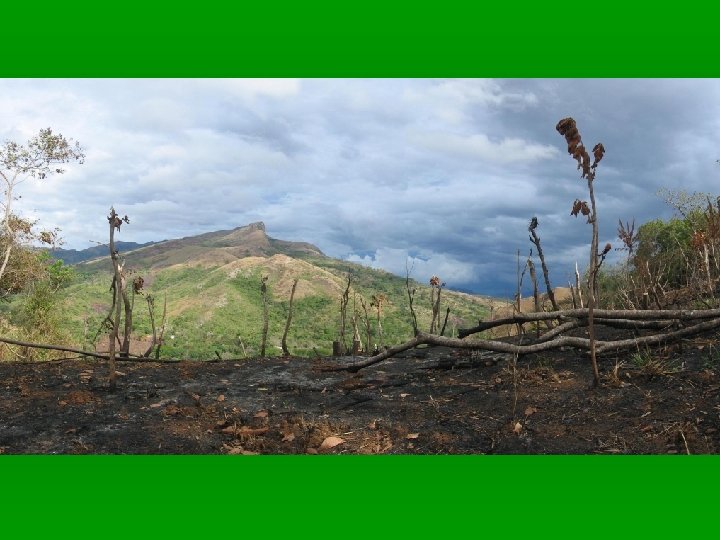
Slash and Burn • Swidden agriculture: areas of land cleared and vegetation burned off, layer of ash increases soil’s fertility • Very efficient with low pop/high land/ low tech
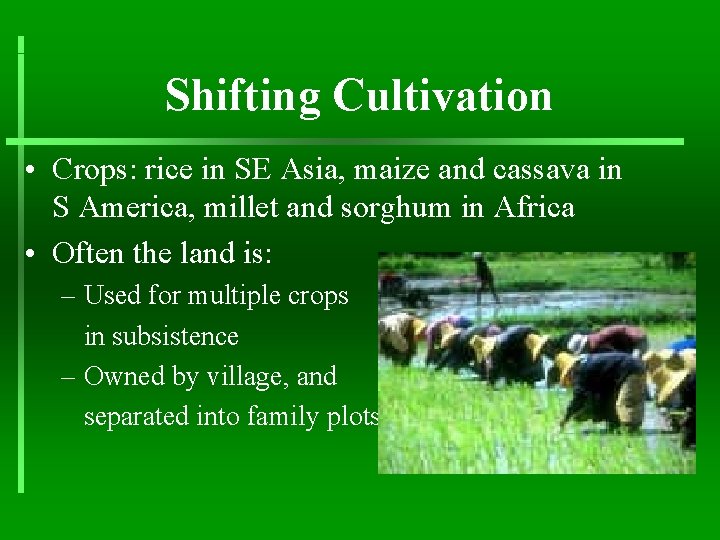
Shifting Cultivation • Crops: rice in SE Asia, maize and cassava in S America, millet and sorghum in Africa • Often the land is: – Used for multiple crops in subsistence – Owned by village, and separated into family plots
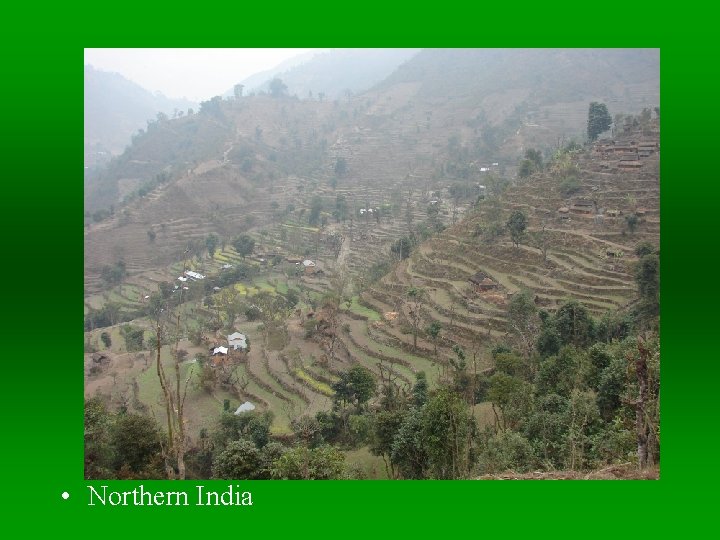
• Northern India
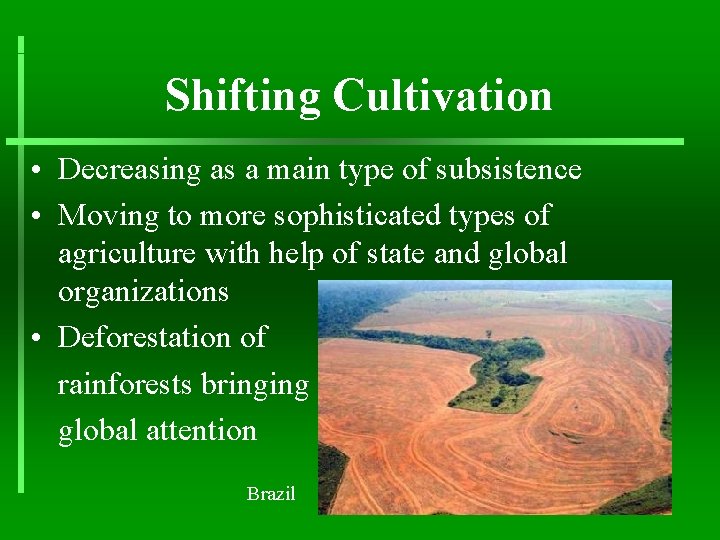
Shifting Cultivation • Decreasing as a main type of subsistence • Moving to more sophisticated types of agriculture with help of state and global organizations • Deforestation of rainforests bringing global attention Brazil
Boserup Thesis • Population increases necessitates increased inputs of labor and technology to compensate for reduction in the natural yields of swidden farming • Why?
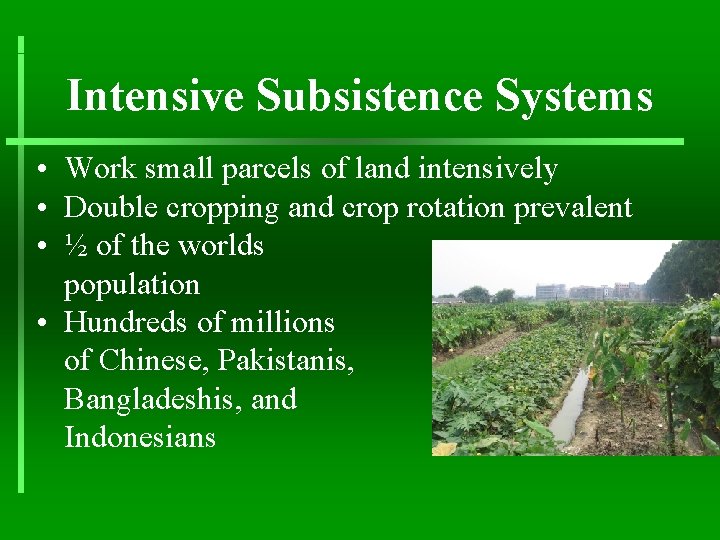
Intensive Subsistence Systems • Work small parcels of land intensively • Double cropping and crop rotation prevalent • ½ of the worlds population • Hundreds of millions of Chinese, Pakistanis, Bangladeshis, and Indonesians
Settling down in one place, a rising population, and the switch to agriculture are interrelated occurrences in human history. Hypothesize which of these three happened first, second, and third, and explain why.
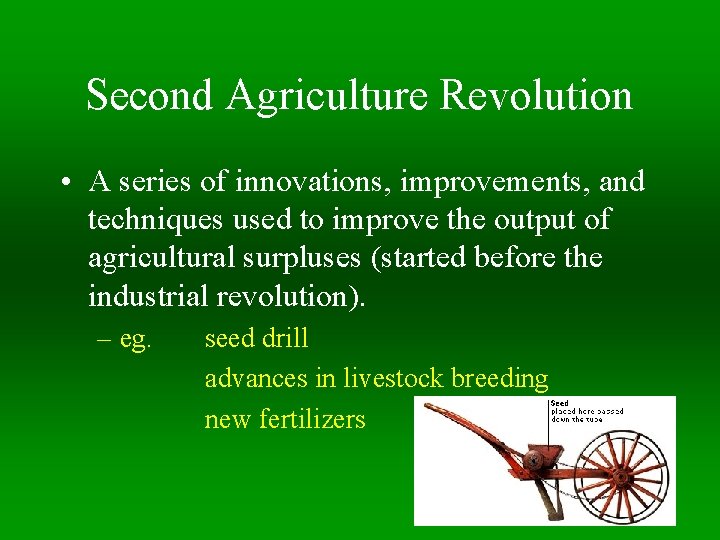
Second Agriculture Revolution • A series of innovations, improvements, and techniques used to improve the output of agricultural surpluses (started before the industrial revolution). – eg. seed drill advances in livestock breeding new fertilizers
Second Agricultural Revolution • Began slowly during the middle ages • Modification of tools and equipment of agriculture • Increased efficiency of food storage and distribution • Increased productivity • Aided in the growth of large urban areas
Industrial Revolution • Aided the Second Agricultural Revolution • Tractors and Machines • Changed the cultural landscape of agriculture…. how?
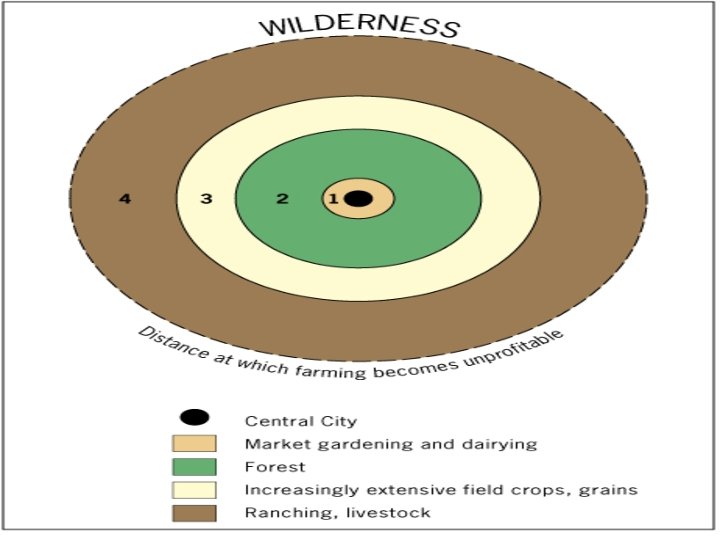
Von Thunen’s Model of Farming • The modification of farming culture created a desire for a spatial understanding of agricultural layout • Created in the 1800 s • Based on cities in Germany near Von Thunen’s farm
Reasons • Profitable options decrease with distance from the market • Rent differences reflects different values of distance • Production Costs + Transportation Costs = economic margin for a crop • Greater the transport cost the less rent a farmer can afford
Contemporary Variables • More efficient transportation • Transportation cost no longer proportional to costs • Firewood not a factor • Technology has reduced perishability
The Third Agricultural Revolution • Creation of the New World • Late 19 th Century and gained momentum through the 20 th Century • Big differences between the 2 nd and the 3 rd is degree
The Third Agricultural Revolution: 3 Phases • Mechanization, chemical farming with synthetic fertilizers, and globally widespread food manufacturing
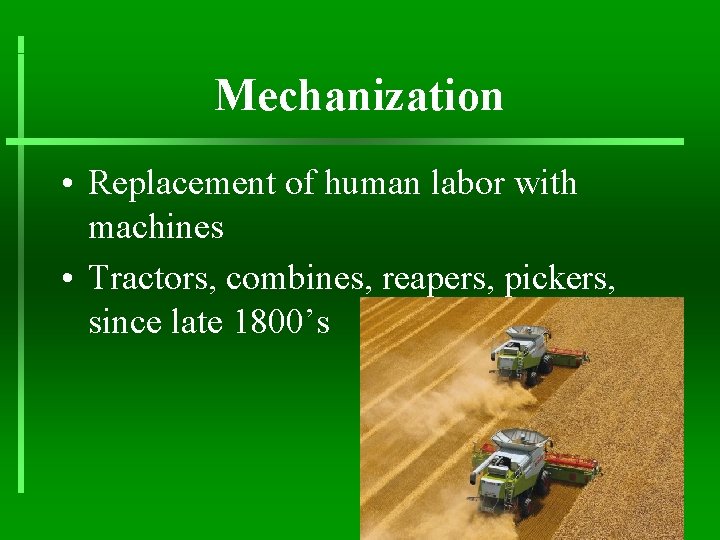
Mechanization • Replacement of human labor with machines • Tractors, combines, reapers, pickers, since late 1800’s
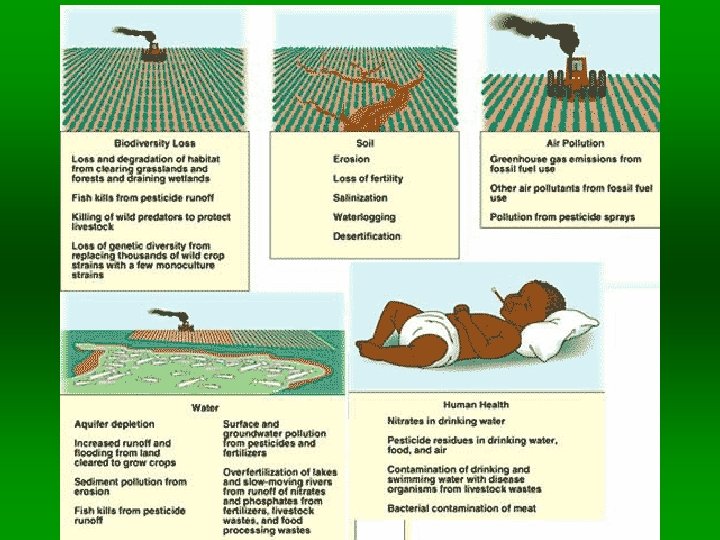
Chemical Farming • Application of synthetic fertilizers to the soil • Also herbicides, fungicides, and pesticides • Important environmental impact
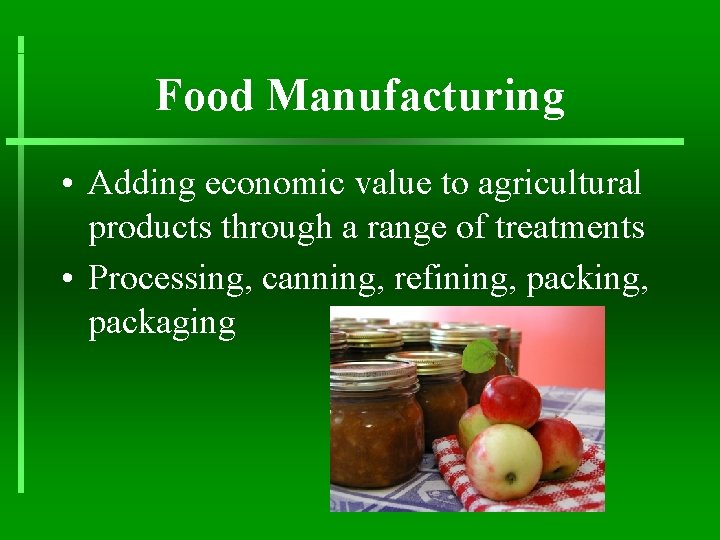
Food Manufacturing • Adding economic value to agricultural products through a range of treatments • Processing, canning, refining, packaging
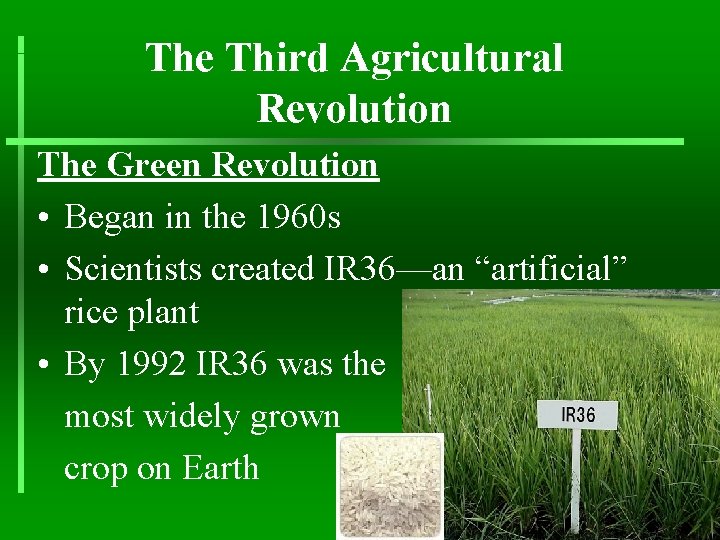
The Third Agricultural Revolution The Green Revolution • Began in the 1960 s • Scientists created IR 36—an “artificial” rice plant • By 1992 IR 36 was the most widely grown crop on Earth
The Green Revolution • New high-yield hybrid varieties of wheat and corn were developed and diffused • Disastrous famines of the past have been avoided • Asia saw a two-thirds increase in rice production
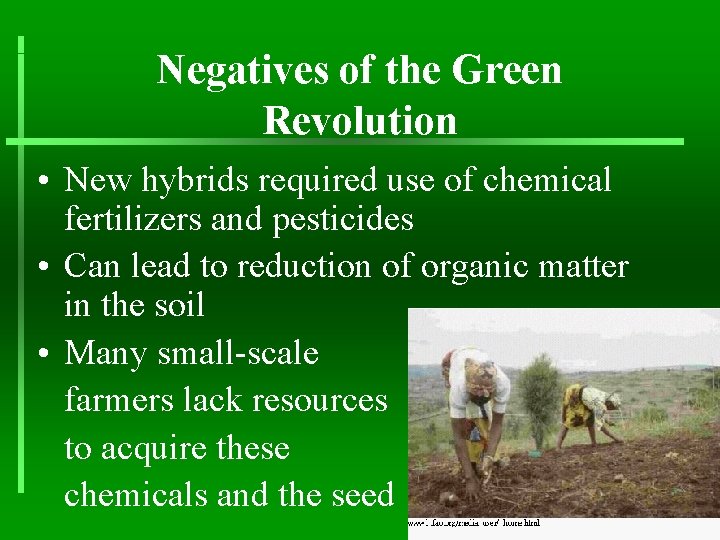
Negatives of the Green Revolution • New hybrids required use of chemical fertilizers and pesticides • Can lead to reduction of organic matter in the soil • Many small-scale farmers lack resources to acquire these chemicals and the seed
Agricultural Landscape • The agricultural imprint of cultivation on the land • The patterns of fields and properties created as people occupy land for the purpose of farming
Cadastral System • A system the delineates property lines • Adopted in places where settlement could be regulated by law • Main Type: Township-and-range system
Township-and-range system • Designed to facilitate the dispersal of settlers evenly across farmlands of the interior • Basic unit = section (1 sq. Mi of land) • Land frequently bought in half or quarter sections • Townships – (36 sq. mi) serve as political administrative subdistricts
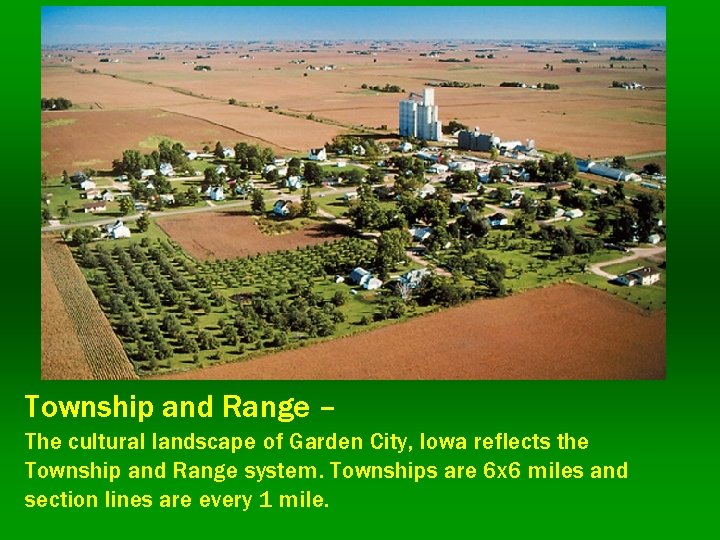
Township and Range – The cultural landscape of Garden City, Iowa reflects the Township and Range system. Townships are 6 x 6 miles and section lines are every 1 mile.
Metes and Bounds Survey • Natural features used to demarcate irregular parcels of land • Used commonly along the eastern seaboard • Rivers, lakes, streams, mountains
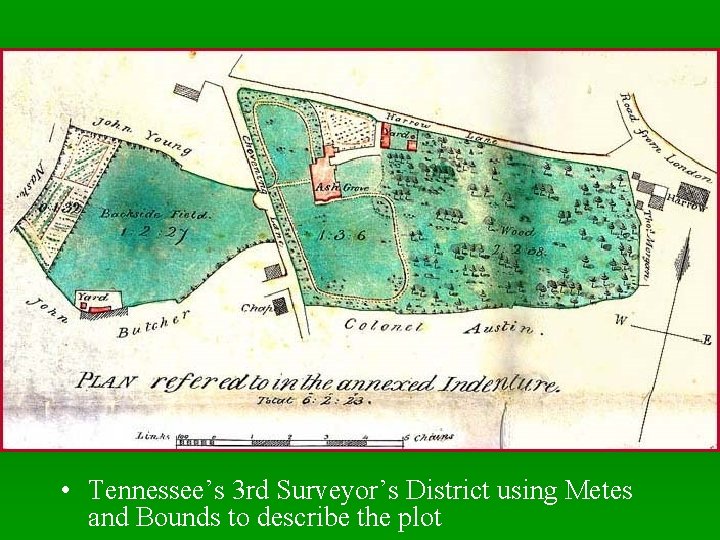
• Tennessee’s 3 rd Surveyor’s District using Metes and Bounds to describe the plot
Long-Lot Survey System • Long, narrow unit block stretching back from a road, river, or canal • Central and Western Europe, Brazil, Argentina, Southern Louisiana, Texas
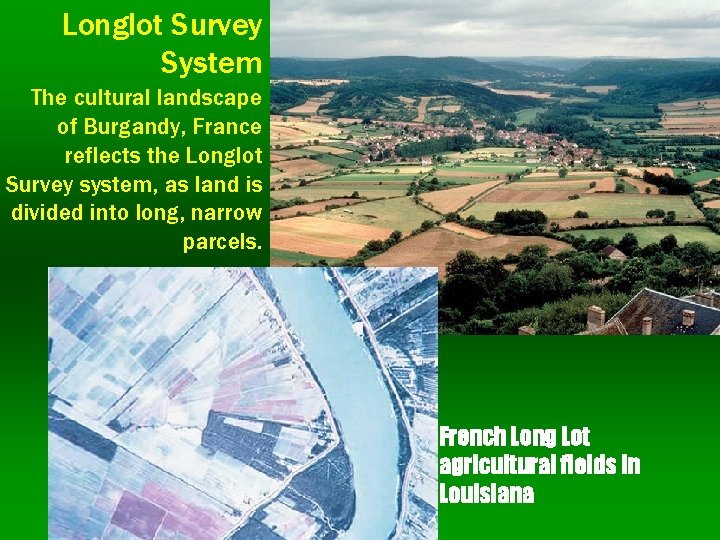
Longlot Survey System The cultural landscape of Burgandy, France reflects the Longlot Survey system, as land is divided into long, narrow parcels. French Long Lot agricultural fields in Louisiana
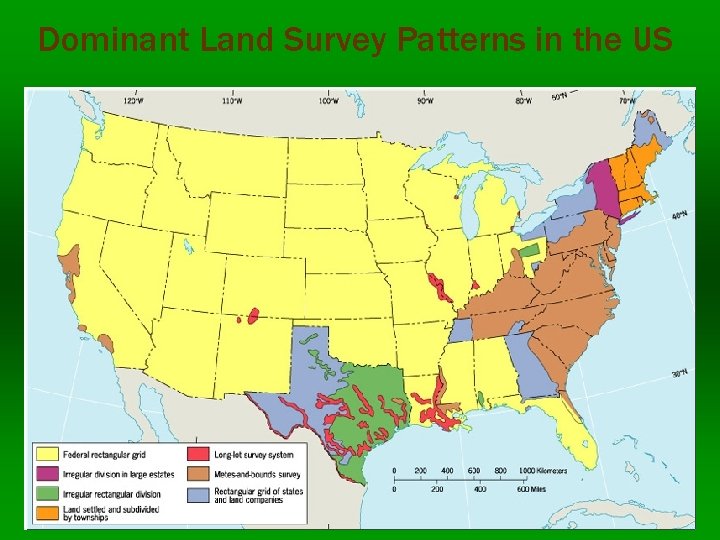
Dominant Land Survey Patterns in the US
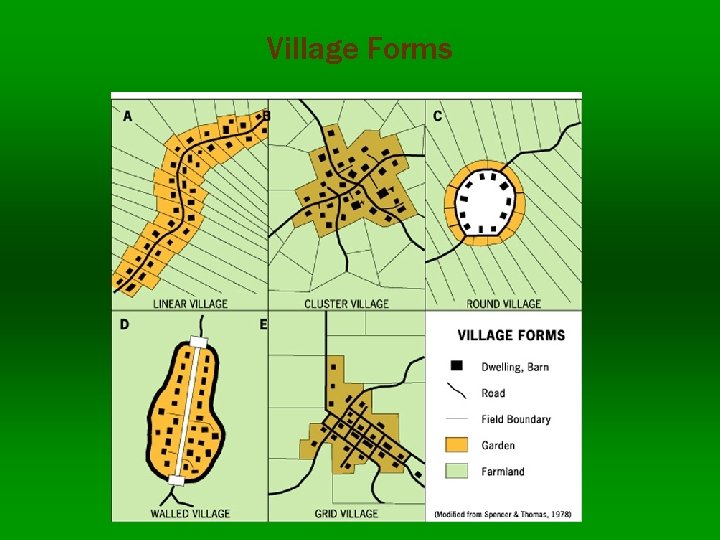
Agricultural Villages • Linear Village • Cluster Village (nucleated) • Round Village (rundling) • Walled Village • Grid Village
Village Forms
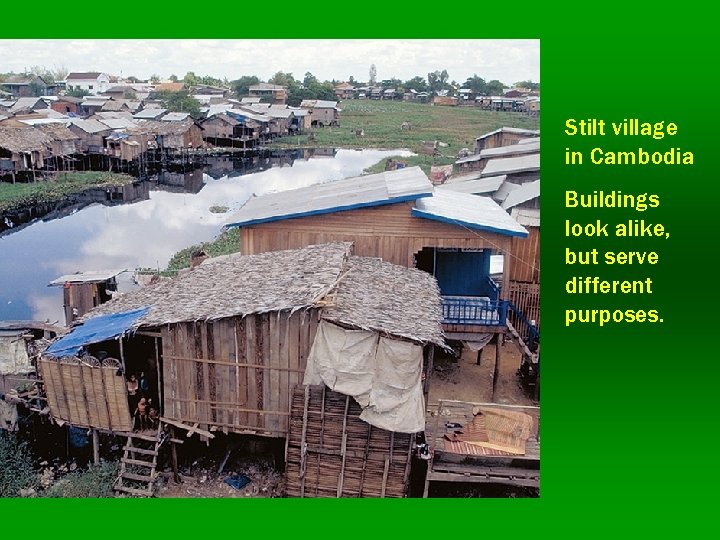
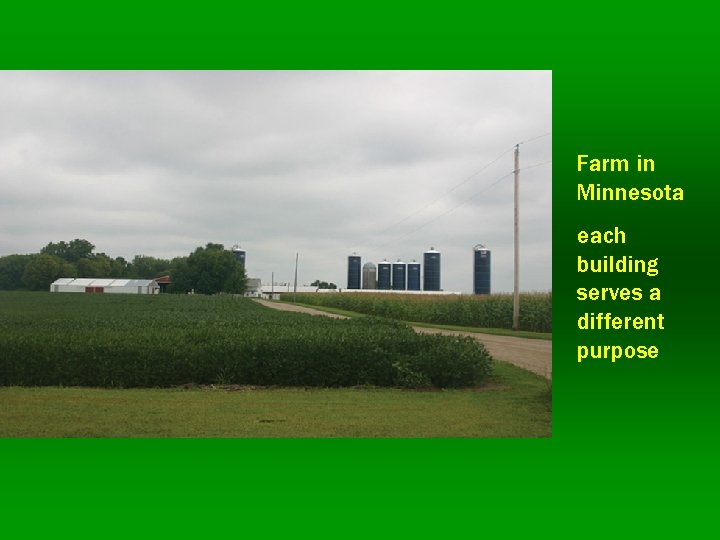
Functional Differentiation within Villages • Cultural landscape of a village reflects: – Social stratification – Differentiation of buildings – Cultural norms – Economic way of life – Levels of Interdependence
Stilt village in Cambodia Buildings look alike, but serve different purposes.
Farm in Minnesota each building serves a different purpose
Commercial Agriculture • Production primarily for sale to processing companies, not for individual consumption • MDC’s, semi-peripheral, core • Machinery and biotechnology • Dairying, grain farming, Livestock – higher costs
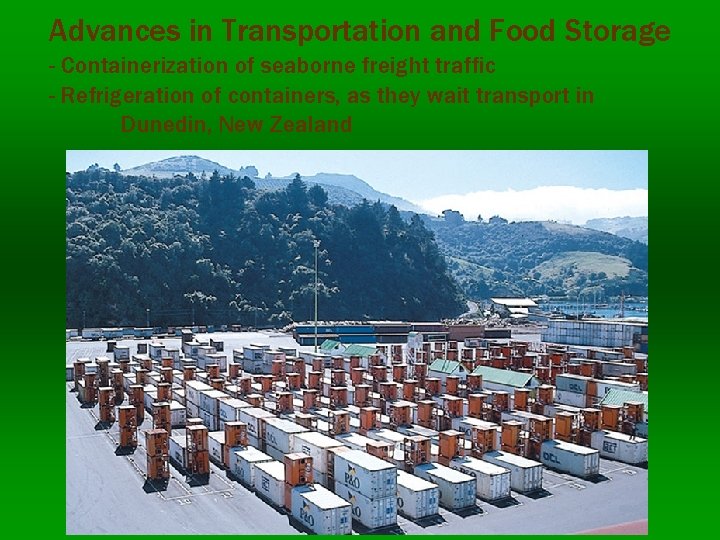
Commercial Agriculture • Roots = Plantation Farming – Latin America, Africa, and Asia – Specialization in one or two crops • ex: cotton, sugarcane, coffee, rubber, tea – Large labor force needed, often live on the plantation • Today = global production made possible by advances in transportation and food storage
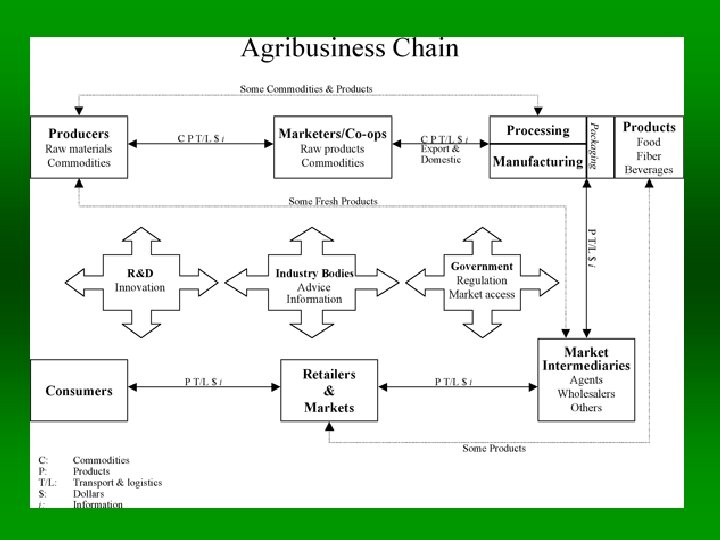
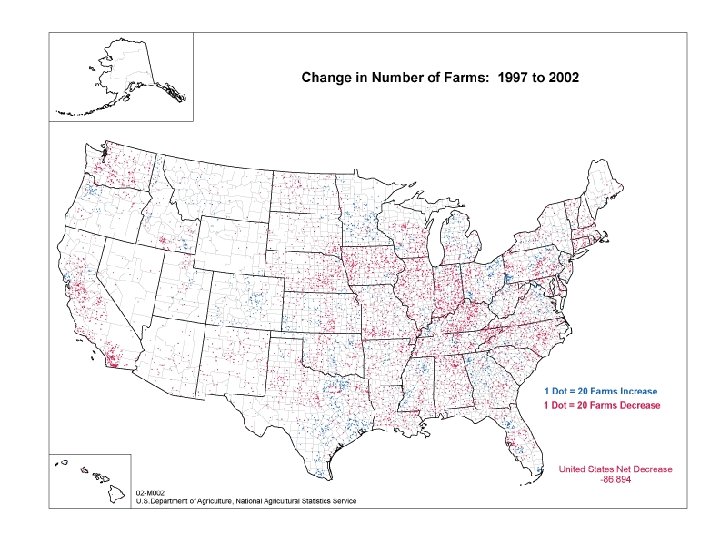
Commercial Agriculture • More land needed – why has the amount of farm land increased, while farms have decreased in the US? • Closely tied to other food processing business – chain called agribusiness employs 20% of US labor
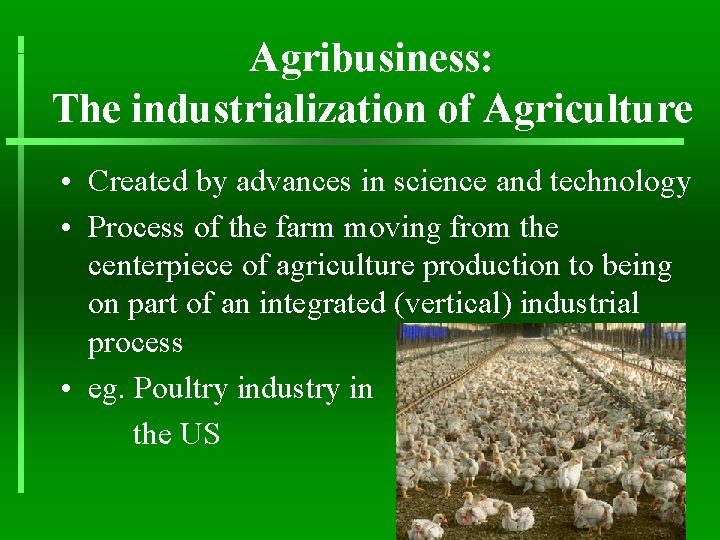
Agribusiness: The industrialization of Agriculture • Created by advances in science and technology • Process of the farm moving from the centerpiece of agriculture production to being on part of an integrated (vertical) industrial process • eg. Poultry industry in the US
Advances in Transportation and Food Storage - Containerization of seaborne freight traffic - Refrigeration of containers, as they wait transport in Dunedin, New Zealand
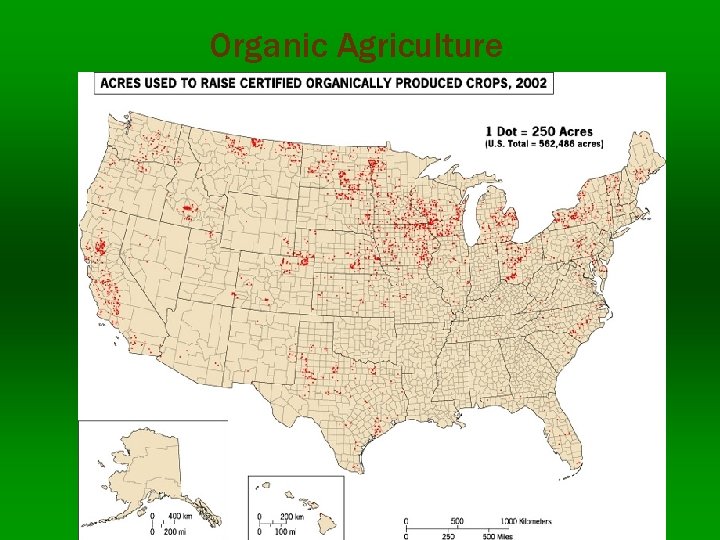
Organic Agriculture • Organic Agriculture – The production of crops without the use of synthetic or industrially produced pesticides and fertilizers or the raising of livestock without hormones, antibiotics, and synthetic feeds. - sales of organic foods on the rise - grown everywhere - demand in wealthier countries
Organic Agriculture
Fair Trade Agriculture • Fair Trade Coffee – shade grown coffee produced by certified fair trade farmers, who then sell the coffee directly to coffee importers. - guarantees a “fair trade price” - over 500, 000 farmers - produced in more than 20 countries - often organically produced
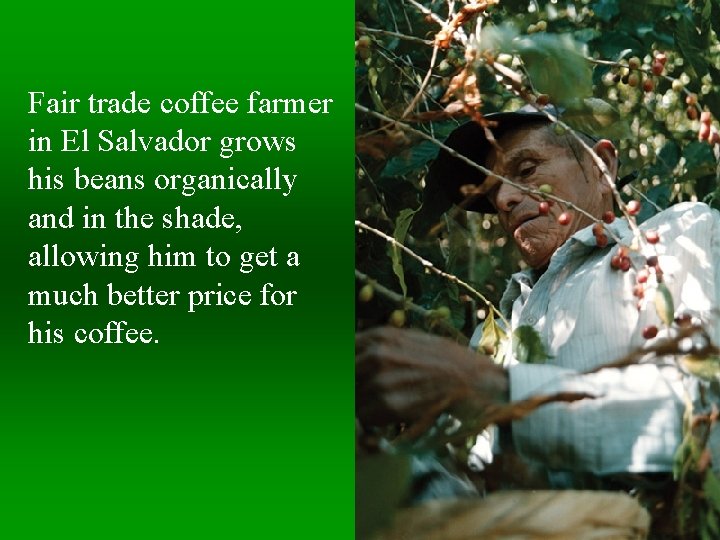
Fair trade coffee farmer in El Salvador grows his beans organically and in the shade, allowing him to get a much better price for his coffee.
Tragedy of the Commons "Therein is the tragedy. Each man is locked into a system that compels him to increase his herd without limit—in a world that is limited. Ruin is the destination toward which all men rush, each pursuing his own best interest in a society that believes in the freedom of the commons. Freedom in a commons brings ruin to all. ”