
Unit Two Literary Analysis Workshop Point of View

- Slides: 21
Unit Two Literary Analysis Workshop
Point of View: Key Term �The perspective from which a story is told is called point of view. �The voice that tells the story is called the narrator.
First-Person Point of View: 1. �A first-person point of view means the narrator is a character in the story.
First-Person Point of View: 2. �Some pronoun clues to this point of view: � I or me
First-Person Point of View: 3. �Limitations of first-person narrator: �No direct access to the thoughts and feelings of other characters �Understanding of a character is limited to what the narrator reveals
First-Person Point of View: 4. �Image or memory cue: STORY
First-Person Point of View: 5. �A first-person narrator can present his or her own thoughts and feelings.
First-Person Point of View: 6. �I want to remember that… �The story seems real, almost as if the narrator were talking to you. Hello BHS
Third-Person Point of View: 1. �A third-person point of view means that the narrator is not a character in the story.
Third-Person Point of View: 2. �Some pronoun clues to this point of view: �he, she, they, their
Third-Person Point of View: 3. �Limitations of a third-person narrator: �Not connected to the characters - story is told in a less personal way �May focus on the thoughts and feelings of one character
Third-Person Point of View: 4. � Image or memory cue: STORY
Third-Person Point of View: Go Bees! 5. �A third-person narrator can �Be an identifiable person or merely a voice. �Be omniscient if he or she knows all the characters’ thoughts and feelings.
Third-Person Point of View: 6. �I want to remember that… �You will learn more about characters and events than if the story were told by a first-person narrator.
Character Traits and Motivation Key Term �Athletic, shy, arrogant, and wise are examples of character traits. �Revealing a character indirectly is called characterization. �This means a writer shows you a character without telling you what kind of person he or she is.
Methods of Characterization �Physical Appearance �Descriptions of the character’s… �Gestures �Clothing �Physical characteristics �Body language and facial expressions �Mannerisms
Methods of Characterization Example - Physical Appearance �If a character is always smiling and making eye contact with others, you might infer that she is warm or friendly.
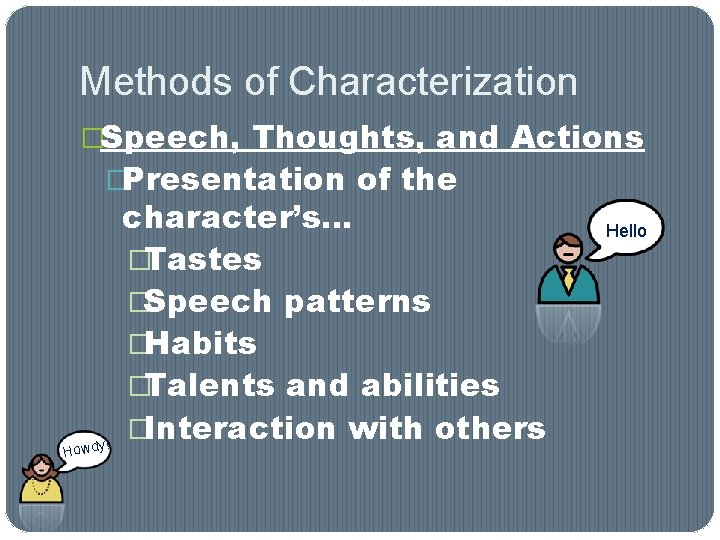
Methods of Characterization �Speech, Thoughts, and Actions �Presentation of the ! Howdy character’s… �Tastes �Speech patterns �Habits �Talents and abilities �Interaction with others Hello
Methods of Characterization Example- Speech, Thoughts, and Actions �You might infer that a character who repeatedly misses softball practice without telling the coach is irresponsible or unreliable.
Methods of Characterization �Other Characters �Presentation of other characters’… �Reactions to the character �Relationships with a character �Impression of the character’s reputation
Methods of Characterization Example- Other Characters �If people often confide their troubles to a character, you might conclude that he is trustworthy.