
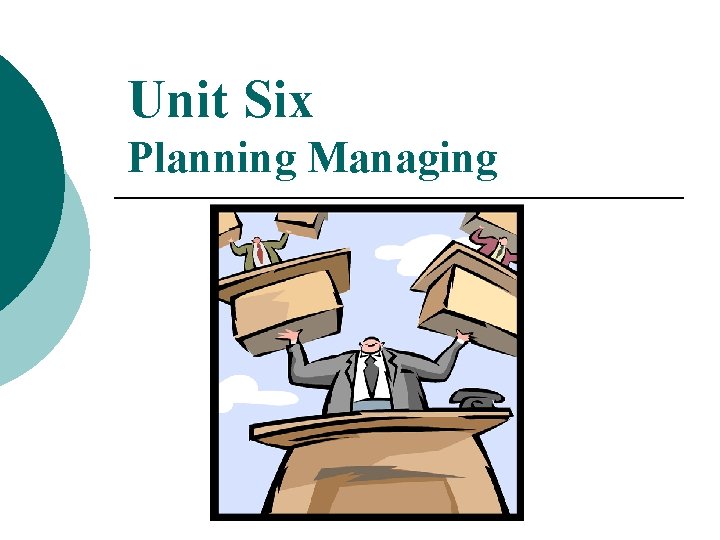
Unit Six Planning Managing How does this picture
- Slides: 59
Unit Six Planning Managing
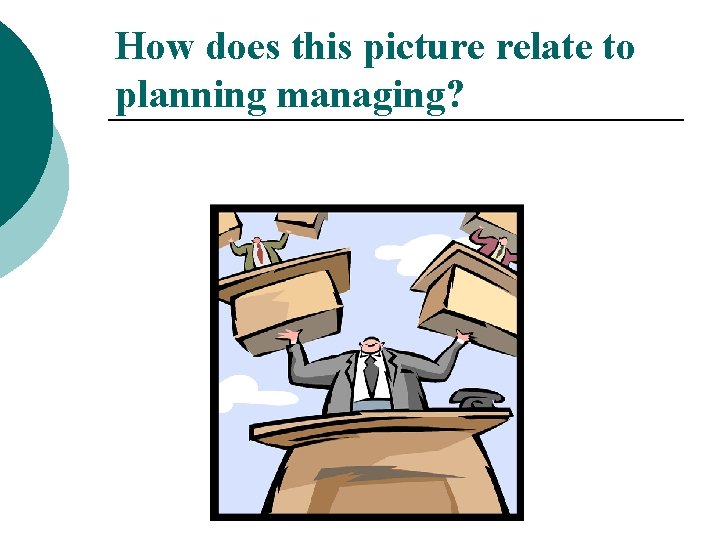
How does this picture relate to planning managing?
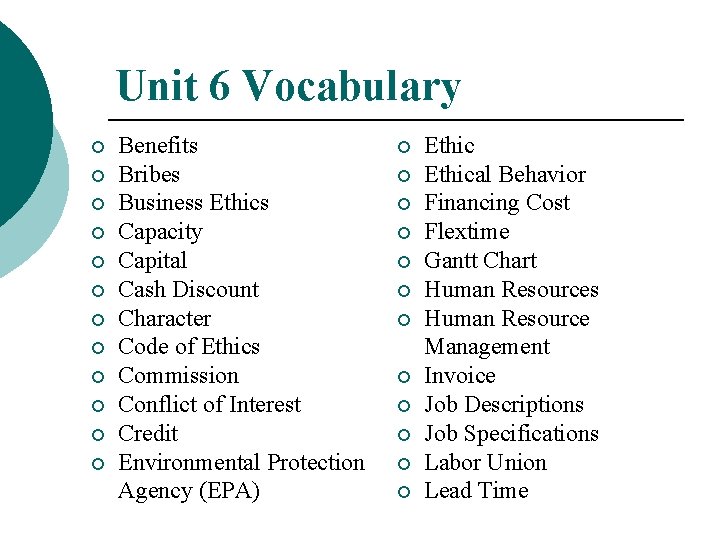
Unit 6 Vocabulary ¡ ¡ ¡ Benefits Bribes Business Ethics Capacity Capital Cash Discount Character Code of Ethics Commission Conflict of Interest Credit Environmental Protection Agency (EPA) ¡ ¡ ¡ Ethical Behavior Financing Cost Flextime Gantt Chart Human Resources Human Resource Management Invoice Job Descriptions Job Specifications Labor Union Lead Time
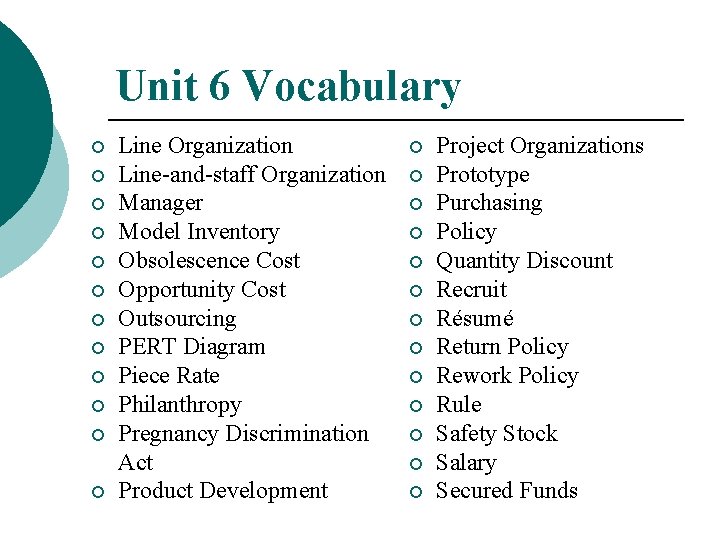
Unit 6 Vocabulary ¡ ¡ ¡ Line Organization Line-and-staff Organization Manager Model Inventory Obsolescence Cost Opportunity Cost Outsourcing PERT Diagram Piece Rate Philanthropy Pregnancy Discrimination Act Product Development ¡ ¡ ¡ ¡ Project Organizations Prototype Purchasing Policy Quantity Discount Recruit Résumé Return Policy Rework Policy Rule Safety Stock Salary Secured Funds
Unit 6 Vocabulary ¡ ¡ ¡ ¡ ¡ Shrinkage Cost Social Responsibility Staff Storage Cost Trade Discount Usage Rate Vendors Wages Warehousing
Unit 6 Essential Question 1 ¡ How are the day to day operations of production, purchasing, inventory, distribution, operations, and personnel conducted?
Essential Question 1 A • Why is planning purchasing important?
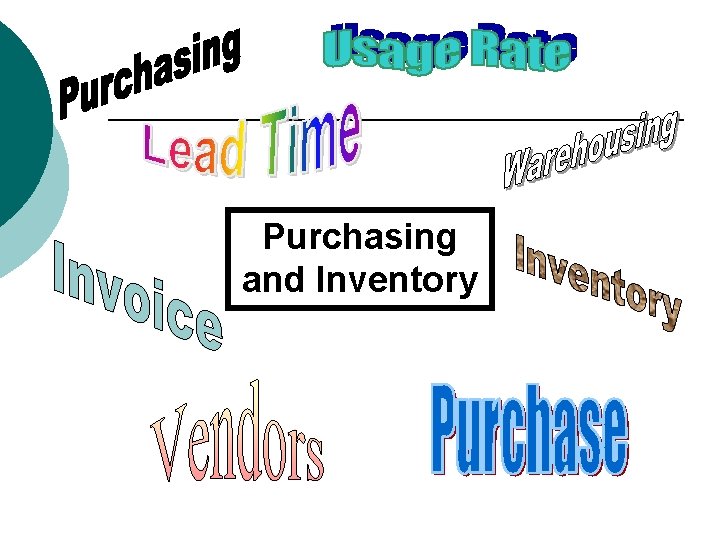
Purchasing and Inventory
Planning Purchases ¡ Planning purchasing means buying at a low price and then selling for a profit. ¡ Purchasing: Buying all the materials needed by an organization.
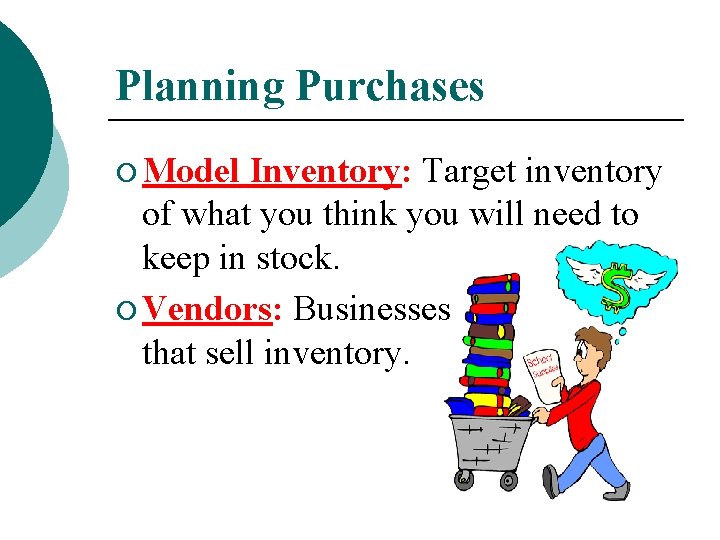
Planning Purchases ¡ Model Inventory: Target inventory of what you think you will need to keep in stock. ¡ Vendors: Businesses that sell inventory.
Managing Purchases ¡ Selecting the Right Quality ¡ Buying the Right Quantity ¡ Timing Your Purchases ¡ Choosing the Right Vendors Reliability l Distance l Service l Number of Vendors l
Managing Purchases ¡ Get the Right Price Discounts l Terms l Payment Methods l ¡ Receiving and Following Up on Purchases l Check the invoice: Itemized statement of money owed, with the purchase order and received shipment.
Essential Question 1 B • What considerations must be taken in to account regarding inventory?
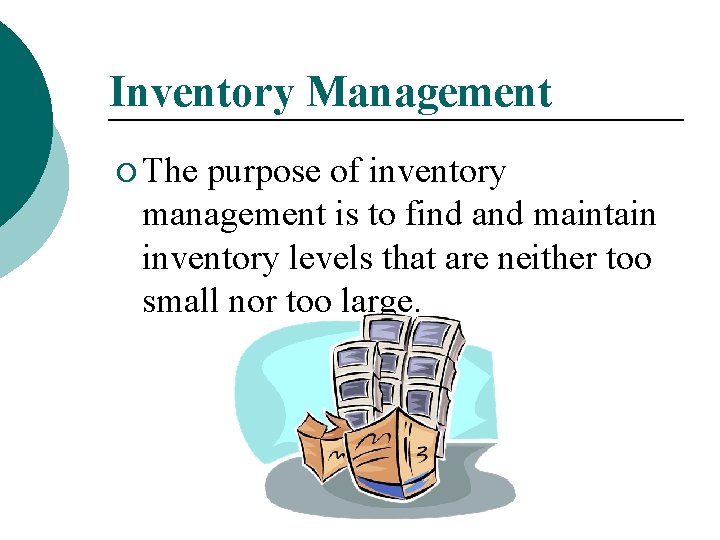
Inventory Management ¡ The purpose of inventory management is to find and maintain inventory levels that are neither too small nor too large.
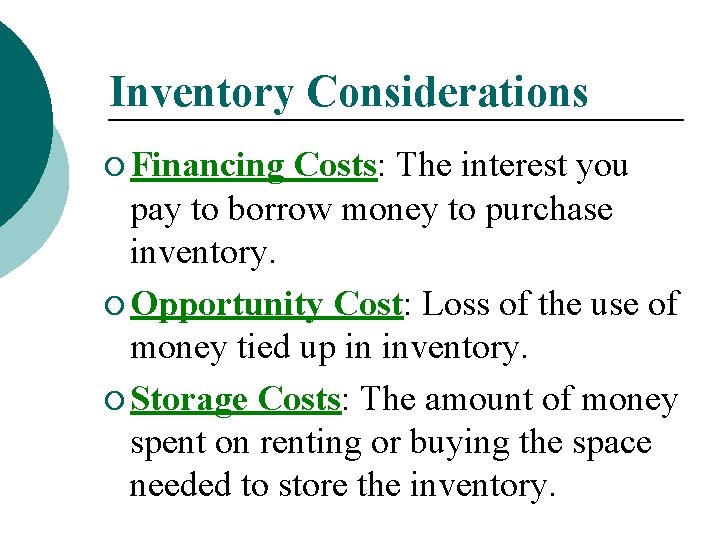
Inventory Considerations ¡ Financing Costs: The interest you pay to borrow money to purchase inventory. ¡ Opportunity Cost: Loss of the use of money tied up in inventory. ¡ Storage Costs: The amount of money spent on renting or buying the space needed to store the inventory.
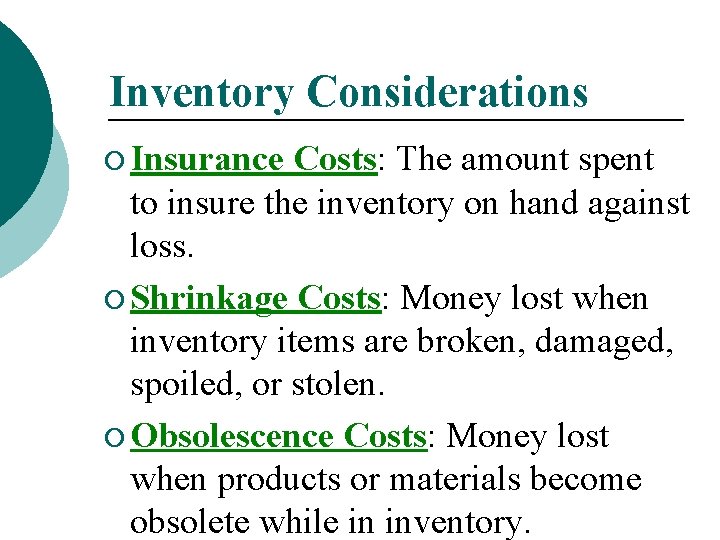
Inventory Considerations ¡ Insurance Costs: The amount spent to insure the inventory on hand against loss. ¡ Shrinkage Costs: Money lost when inventory items are broken, damaged, spoiled, or stolen. ¡ Obsolescence Costs: Money lost when products or materials become obsolete while in inventory.
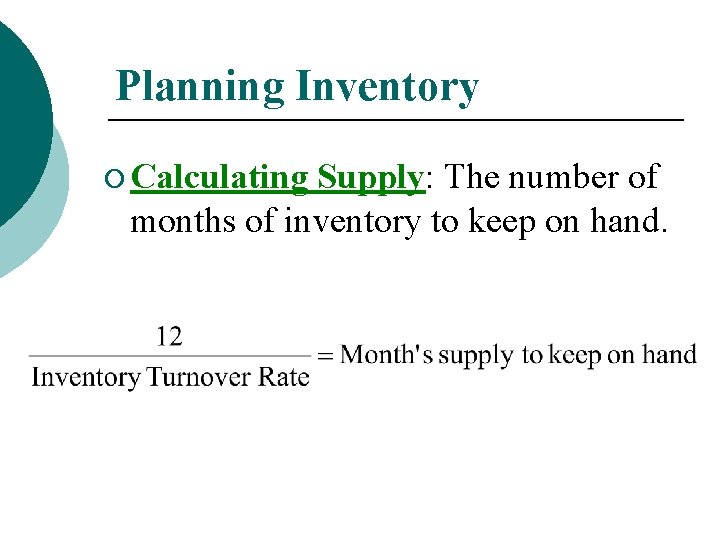
Planning Inventory ¡ Calculating Supply: The number of months of inventory to keep on hand.
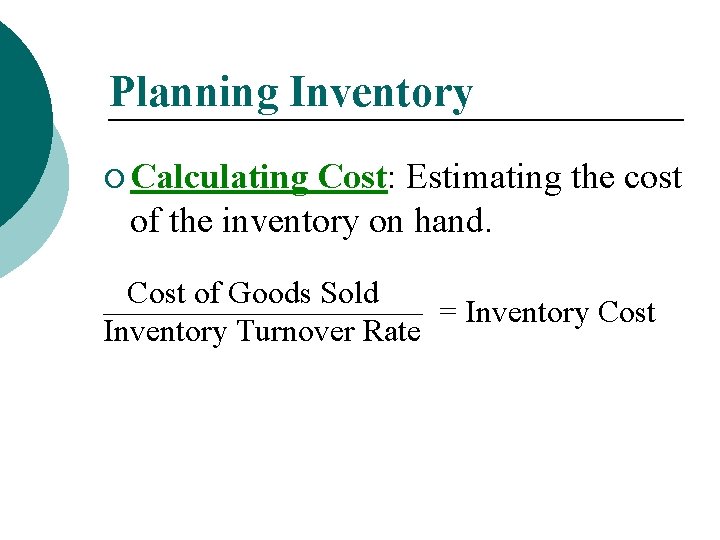
Planning Inventory ¡ Calculating Cost: Estimating the cost of the inventory on hand. Cost of Goods Sold ————— = Inventory Cost Inventory Turnover Rate
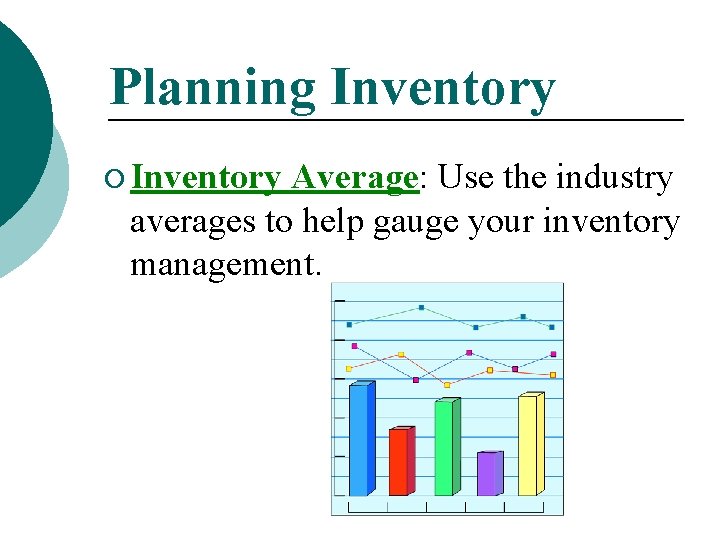
Planning Inventory ¡ Inventory Average: Use the industry averages to help gauge your inventory management.
Essential Question 1 C • How is inventory maintained?
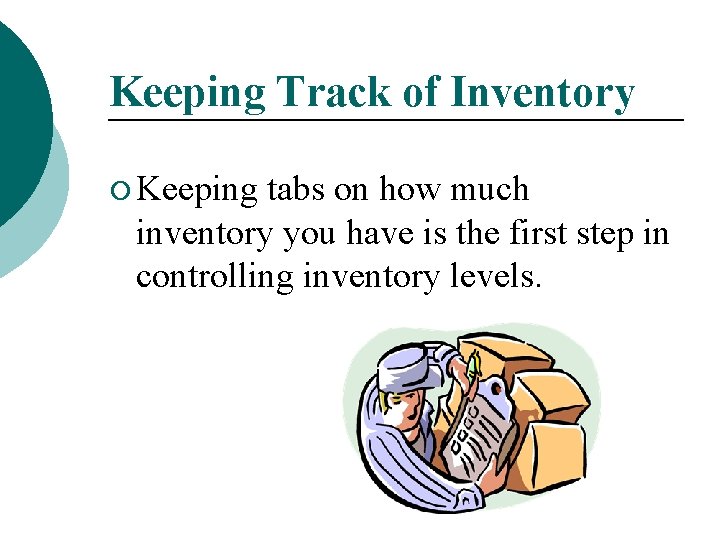
Keeping Track of Inventory ¡ Keeping tabs on how much inventory you have is the first step in controlling inventory levels.
Keeping Track of Inventory ¡ Visual Inventory Systems: Look at how much inventory is on hand compare it to what you want on hand. ¡ Perpetual Inventory Systems: As inventory is sold, it is subtracted from the inventory list. As new inventory arrives, it is added.
Keeping Track of Inventory ¡ Partial Inventory Systems: A combination of systems. A perpetual system is used only for those items that account for a large share of sales. ¡ Just-in-time (JIT) Inventory Systems: The responsibility of inventory is shifted to the vendor and is delivered just before it is used.
Keeping Track of Inventory ¡ Regardless of the inventory system used, a physical count will help evaluate your system as well as determine lost, stolen or bad items.
Reordering ¡ To maintain proper inventory levels, you will have to decide when and how much to reorder. ¡ Periodic Reordering: Goods or products that are used often and reordered every: day, week, other week, month, etc.
Reordering ¡ Non-periodic Reordering: Inventory that is reordered on an as needed basis. Lead Time: The gap in time between placing the order and receiving the order. l Usage Rate: How quickly the inventory will be used in a period of time. l Safety Stock: The cushion of products or materials that keeps you from running out of inventory. l
Essential Question 1 D • What other day to day operating policies need to be considered?
Definitions ¡ Policies: General statements of intent about how to run your business. ¡ Rules: Tell employees exactly what they should or should not do.
Operating Policies ¡ Return / Rework Policies: A fair policy regarding replacements, refunds, or repairs will help maintain customer goodwill. ¡ Delivery Policies: If you have a delivery policy, will there be charge? Will the area of delivery be limited? What does your competition do?
Operating Policies ¡ Handling Complaints: Most businesses use the policy, “The customer is always right. ” ¡ Servicing What You Sell: If something you sell stops working, within a certain time limit, you fix it. ¡ Courtesy to Customers: Asking departing customers, “Did you find everything you were looking for? ”
Operating Policies ¡ Shopping Climate: Maintaining certain lighting, air conditioning, or housekeeping standards. ¡ Provision of Restrooms: Will your restrooms be open to the public or locked and usable by customers only?
Operating Policies ¡ Response Time: How long is an acceptable amount of time required to fill a customer’s order? ¡ Warranties: Manufacturers usually guarantee the materials and workmanship that go into their products.
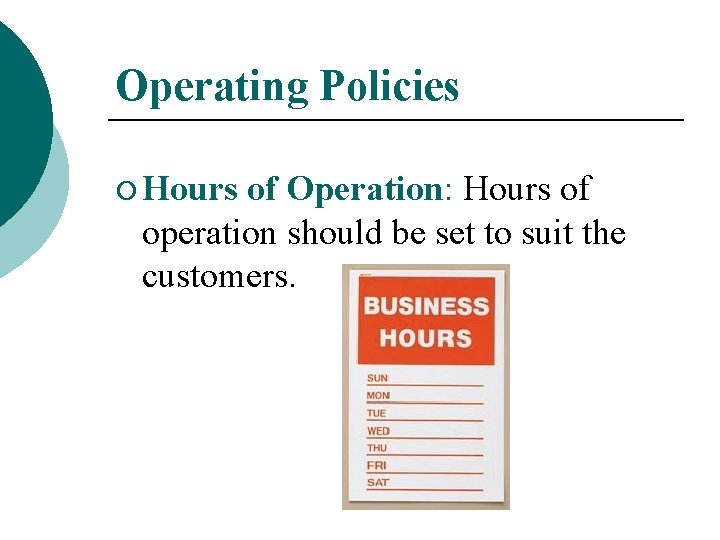
Operating Policies ¡ Hours of Operation: Hours of operation should be set to suit the customers.
Operating Policies ¡ Credit Policies: Credit: An arrangement in which a business or individual can obtain products in exchange for a promise to pay later. l Three Cs of Credit: l ¡ Character: Demonstrated responsibility in paying bills. ¡ Capacity: The ability to pay based on the customer’s income and expenses. ¡ Capital: Determination of the customer’s physical and financial assets.
Operating Policies ¡ Credit l Policies: Credit Plans: ¡ Bank Credit Cards: Businesses accept bank credit cards. Requires a merchant account. ¡ Charge Accounts: The business gets it own credit card. ¡ Installment Plans: Businesses offer payment over time such as layaway. ¡ Financing: Businesses provide on site financing for major purchases.
Unit 6 Essential Question 2 ¡ What are the ethical, social, and environmental responsibilities of businesses?
Essential Question 2 A • What are social obligations of a business?
Social Responsibility – Social responsibility: A business's contract with society to make safe products, treat customers and employees fairly, and conduct business honestly A company has a duty to protect its customers from unsafe products and misinformation § The Environmental Protection Agency (EPA), the media, and the public all promote environmentalism among businesses §
Social Responsibility – Entrepreneurs can contribute to the community by: Donating products or services § Encouraging employees to participate in community service § Joining other companies to work on community projects §
Essential Question 2 B • What is the ethical issues facing business and the ethical behavior needed to face them?
Ethics – Ethics: The moral code by which people live and conduct business – Ethical Behavior: Conduct that adheres to this moral code – An entrepreneur should develop a written code of ethics to reduce the chance of unethical behavior occurring in his or her business – Employees should be involved in developing the code of ethics
Ethics – Businesses often face ethical problems when: There are conflicts of interest: Clash between a person’s private interests and his or her responsibilities in a position of trust § When their economic survival is threatened § When doing business abroad (where ethical practices may differ) §
Essential Question 2 C • What are the environmental concerns and issues that relate to the operation of a business?
Environment Concerns – Environmental Protection Agency: An independent federal agency established to coordinate programs and enforce regulations aimed at reducing pollution and protecting the environment Toxic and hazardous waste disposal § Emissions and other pollutants § Consumer concerns about the environment §
Essential Question 2 D • What are the safety procedures and health procedures business operations need to be aware of?
Safety and Health Policies – Employee and Customer Safety: The financial costs of an on-site accident can ruin a small business – Train your employees in safety practices and procedures – Post warning signs to inform customers and keep them away from delicate or potentially damaging equipment
Safety and Health Policies – Make sure you are following regulatory practices from: OSHA § EPA § Health Department § Fire Department § - Check and test safety and security equipment regularly - Test company products under the most extreme conditions in which they will be used
Unit 6 Essential Question 3 ¡ What are the concepts, systems, and strategies needed to acquire and develop human resource needs for an entrepreneurial entity?
Essential Question 3 A • What are your business’ personnel procedures?
Organization Structure n Each position on the organization chart requires a job description: A statement describing the objectives of the job and its duties and responsibilities.
Organization Structure n Each job description requires a job specification: Description of abilities, skills, educational level, and experience needed by an employee to perform the described job.
Personnel Policies n n Employee Standards: An employment policy statement which qualifies the desired traits of the people you hire. Recruiting Employees: Recruits: Prospective employees, that can be reached by classified ads, employment agencies, placement offices, the internet, etc.
Personnel Policies n n Training and Development: New employees work better and more efficient if they receive training immediately. Personnel Records: Establish and maintain a record on each employee for contact, training, performance, etc. information.
Essential Question 3 B • What is your business’ hiring and training process?
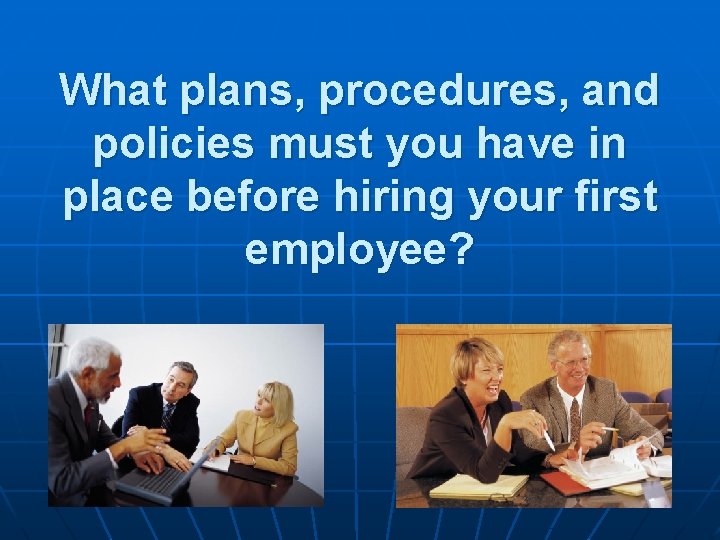
What plans, procedures, and policies must you have in place before hiring your first employee?
People Strategies n n Basic Hiring Criteria: You must hire the right people. Ensure your employees have the right qualifications and skill sets for the job. Developing Employees: • Orientation is conducted first. This introduces the employee to the companies vision, plans and expectations. • Second, provide training employees need for the skills to be successful now and in the future.
People Strategies n n Establish A Productive Environment: A place where employees are treated with respect and trust; empowered to make the right decisions; and made to feel a part of a productive team. Reward Your People: Recognize and reward employee contributions and achievements.
Essential Question 3 C • What are your business’ employee benefits?
Personnel Policies n Pay and Benefits: In order to attract and keep the kind of employees you want, you will have to do two things: • Pay a competitive wage, salary, or productivity rate. • Productivity Rates: n n Piece Rate: Pay based on number of units produced. Commission: Pay based on a percentage of sales. • Offer competitive employee benefits.