
Unit one Section 2 Nursing Process underlying In


- Slides: 28
Unit one Section 2: Nursing Process
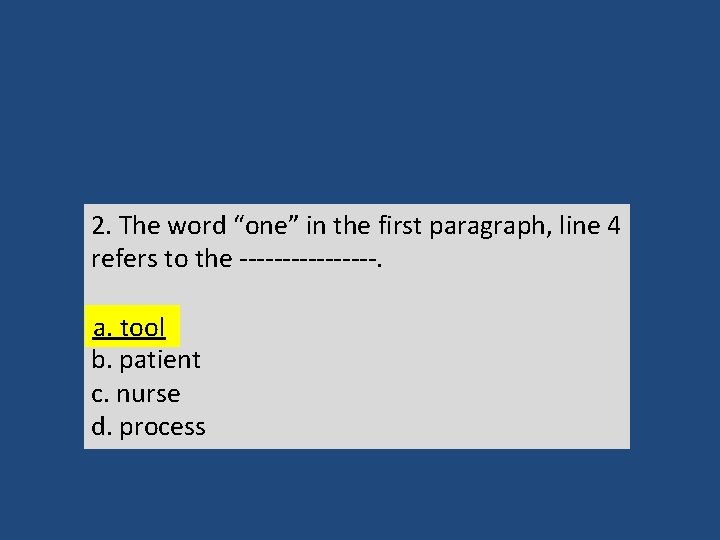
underlying In basis or principle What is the nursinganprocess? nursing, this process isbasic one of theunderlying foundations practice structure a system, of concept which offers a framework for thinking through problems and provides some organization to a nurse's critical thinking skills. It's important to not able to be changed or adapted; notisflexible point out that this process flexible and not rigid. It is a tool to use in nursing care, but one that should allow for creativity and thinking outside of the box. To think differently or unconventionally
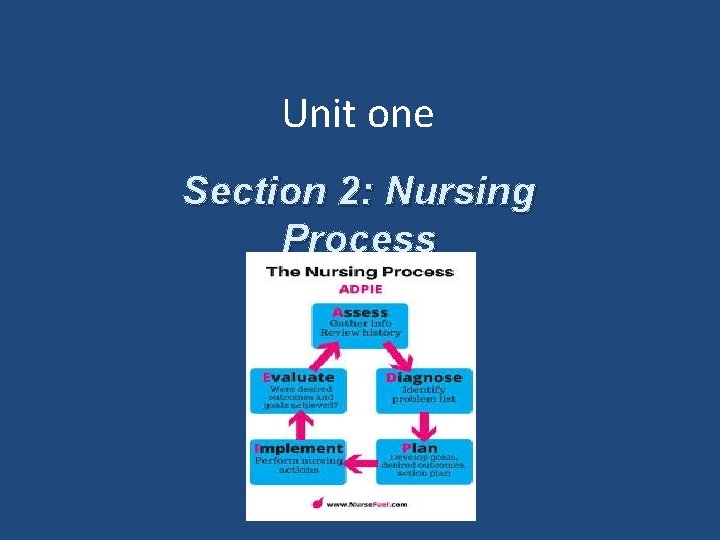
an abbreviation formed from the initial letters of other words and pronounced as a word ADPIE is an acronym used to describe the five different phases of the nursing process. These five phases Assessment, Diagnosis, put (a decision, plan, are agreement, etc. ) into effect, application Planning, Implementation/Intervention, and Evaluation. put For(athis lesson, we will be decision, plan, agreement, etc. )thinking into effect of each part of the process as a slice of pie. All of the pieces added together give you the whole pie, or ADPIE.
stepliving in the nursing process is assessing. a The groupfirst of people in the same place or having a particular In this characteristic in common phase, data is gathered about the client, family or community that the nurse is working with. A nurse uses a systematic, dynamic, rather than static way to collect and analyze provide, supply data about a client, the first step in delivering nursing care. Assessment includes not only physiological data, but also psychological, sociocultural, spiritual, economic, and life-style factors as well.
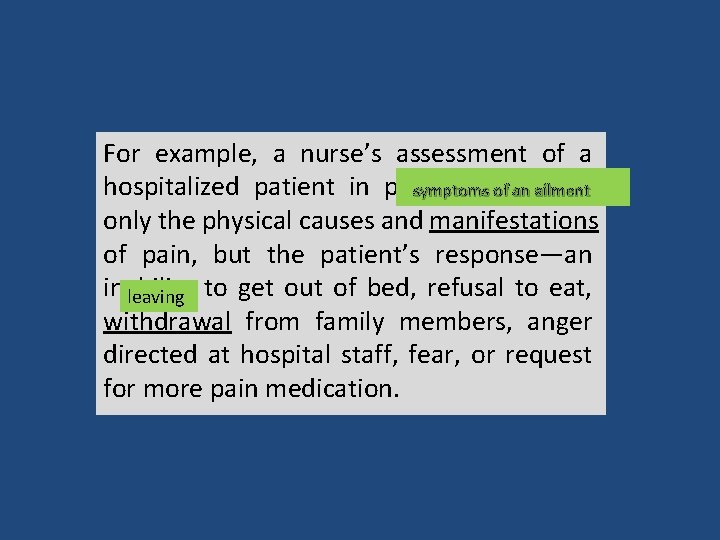
For example, a nurse’s assessment of a hospitalized patient in pain includes not symptoms of an ailment only the physical causes and manifestations of pain, but the patient’s response—an inability leaving to get out of bed, refusal to eat, withdrawal from family members, anger directed at hospital staff, fear, or request for more pain medication.
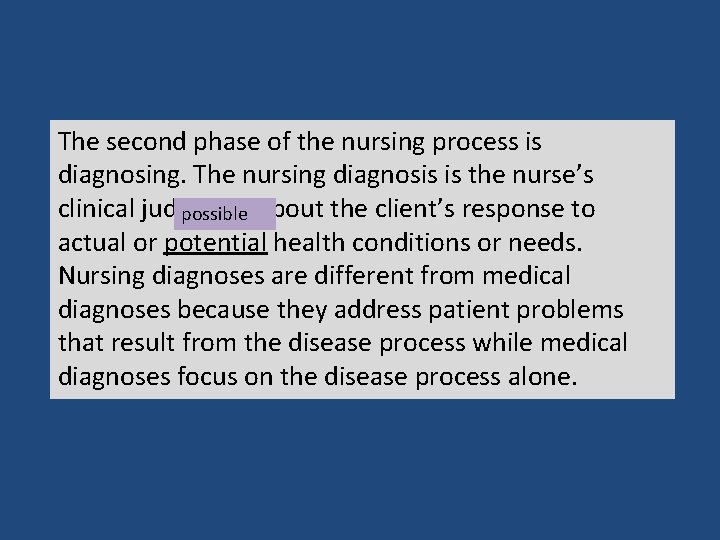
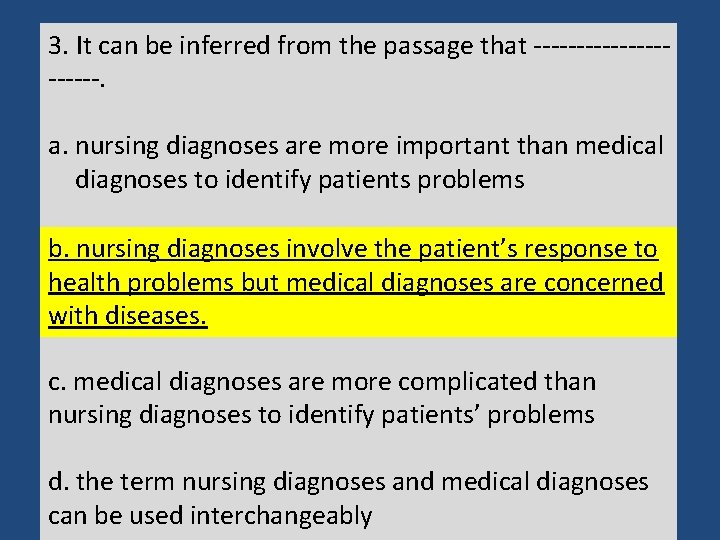
The second phase of the nursing process is diagnosing. The nursing diagnosis is the nurse’s clinical judgment possible about the client’s response to actual or potential health conditions or needs. Nursing diagnoses are different from medical diagnoses because they address patient problems that result from the disease process while medical diagnoses focus on the disease process alone.
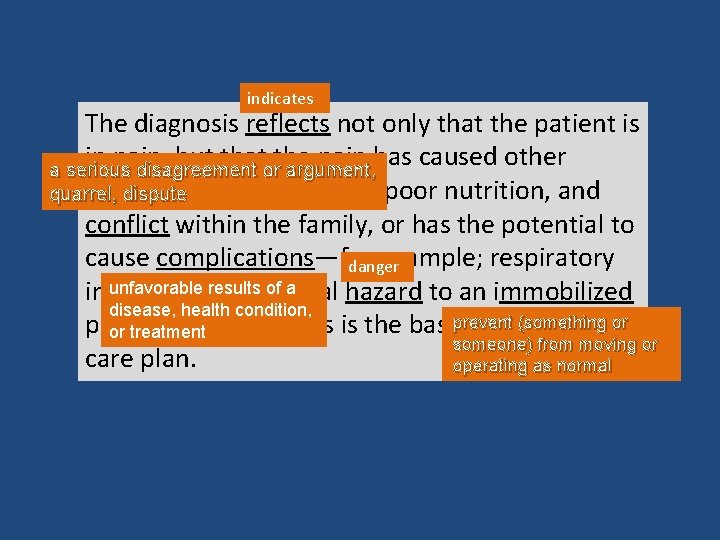
indicates The diagnosis reflects not only that the patient is in pain, but that the pain has caused other a serious disagreement or argument, problems quarrel, dispute such as anxiety, poor nutrition, and conflict within the family, or has the potential to cause complications—for example; respiratory danger unfavorable of a infection isresults a potential hazard to an immobilized disease, health condition, (something or patient. The diagnosis is the basisprevent for the nurse’s or treatment someone) from moving or care plan. operating as normal
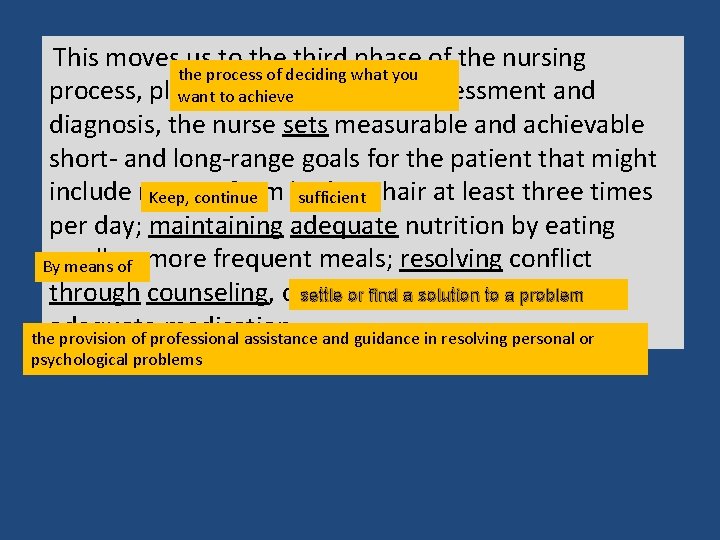
This moves us to the third phase of the nursing the process of deciding what you process, planning. Based on the assessment and want to achieve diagnosis, the nurse sets measurable and achievable short- and long-range goals for the patient that might include moving from bed to chair at least three times Keep, continue sufficient per day; maintaining adequate nutrition by eating smaller, By means of more frequent meals; resolving conflict through counseling, orsettle managing pain tothrough or find a solution a problem adequate medication. the provision of professional assistance and guidance in resolving personal or psychological problems
Assessment data, diagnosis, and goals are written in the patient’s care plan so that nurses as well as other health caring for the patient have theprofessionals state or quality of being approachable access to it.
put (a decision, plan, agreement, etc. ) into effect, apply Then nursing care is implemented according to the care plan, so continuity of care for the patient during hospitalization for discharge needs make certain to happenand in preparation recorded to be assured. Care is documented in the patient’s record. The final phase of the nursing process is called evaluating. Here, the nurse measures the patient’s progress toward the goals that were established in the planning phase
Perform, do Keep in mind that as the nurse carries out the planned interventions, he or she is constantly reassessing the patient, modifying diagnoses and adding to the care continuously over a period of time; always plan along the way as needed. This evaluation may settlethat or findthe a solution to a problem show patient’s goal has been met and the problem is resolved, or it may indicate the need for change.
If the patient is not responding to the plan of care, then the nurse has the bring to an endresponsibility to change the plan or even terminate it and start again. Remember the goal is improved patient’s outcomes. the focus is on outcomes important to patients such as quality of life. In other words, the care experience is viewed through the eyes of patients
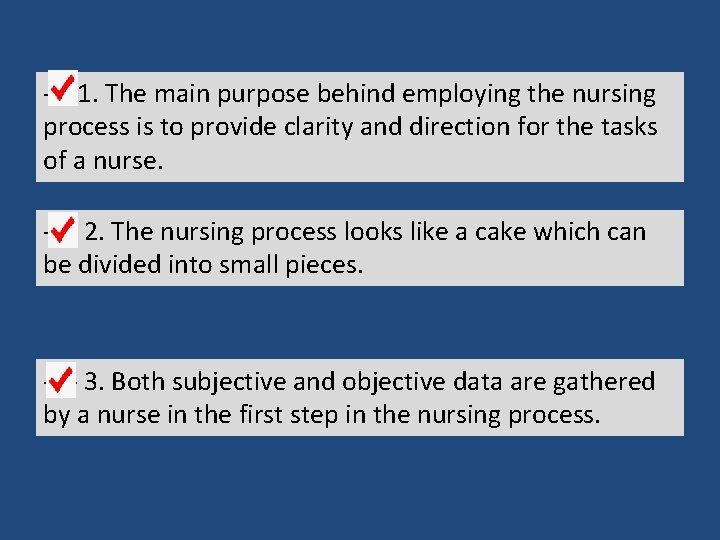
----1. The main purpose behind employing the nursing process is to provide clarity and direction for the tasks of a nurse. ---- 2. The nursing process looks like a cake which can be divided into small pieces. ---- 3. Both subjective and objective data are gathered by a nurse in the first step in the nursing process.
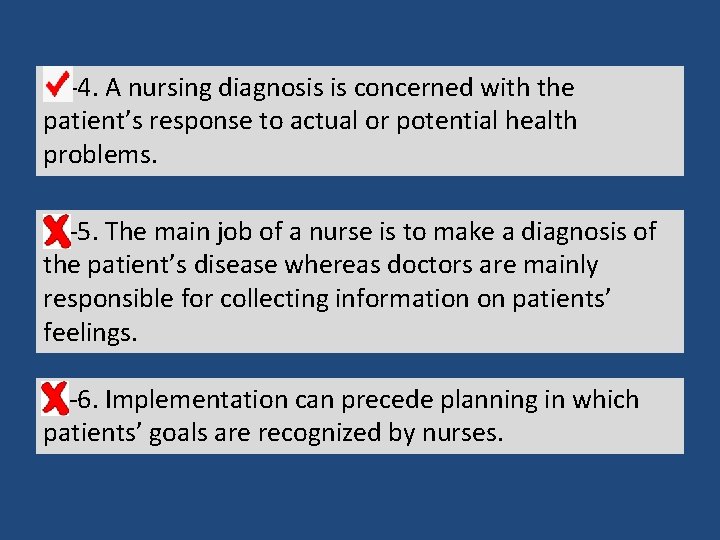
----4. A nursing diagnosis is concerned with the patient’s response to actual or potential health problems. ----5. The main job of a nurse is to make a diagnosis of the patient’s disease whereas doctors are mainly responsible for collecting information on patients’ feelings. ----6. Implementation can precede planning in which patients’ goals are recognized by nurses.
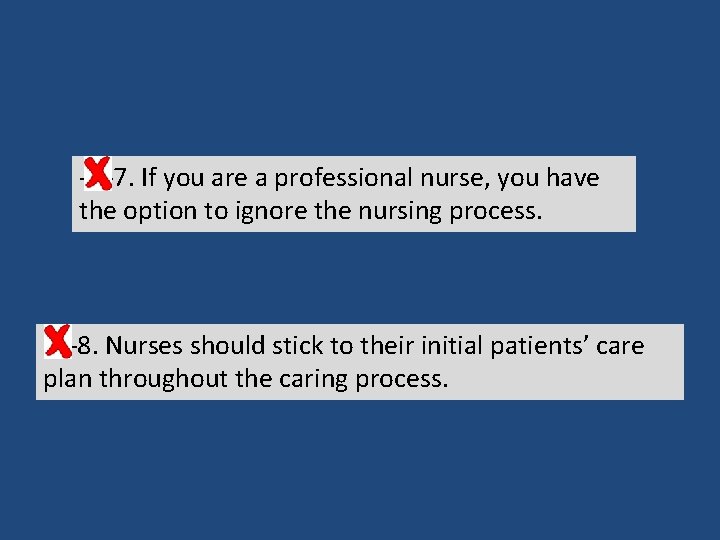
----7. If you are a professional nurse, you have the option to ignore the nursing process. ----8. Nurses should stick to their initial patients’ care plan throughout the caring process.
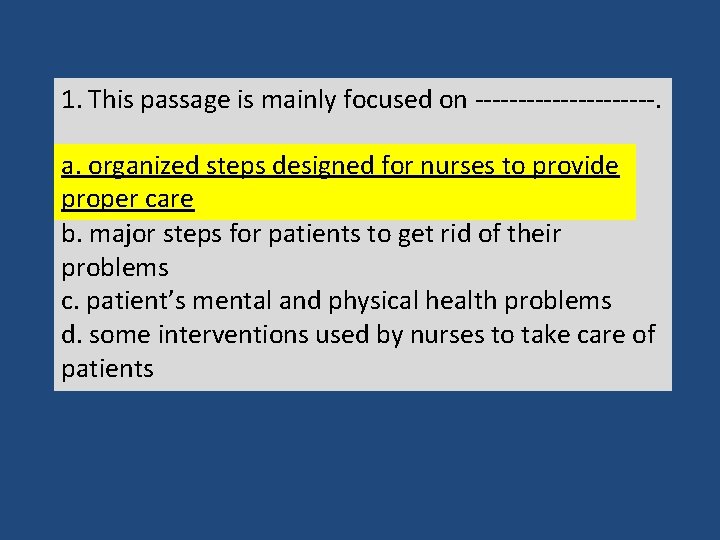
1. This passage is mainly focused on -----------. a. organized steps designed for nurses to provide proper care b. major steps for patients to get rid of their problems c. patient’s mental and physical health problems d. some interventions used by nurses to take care of patients
2. The word “one” in the first paragraph, line 4 refers to the --------. a. tool b. patient c. nurse d. process
3. It can be inferred from the passage that -----------. a. nursing diagnoses are more important than medical diagnoses to identify patients problems b. nursing diagnoses involve the patient’s response to health problems but medical diagnoses are concerned with diseases. c. medical diagnoses are more complicated than nursing diagnoses to identify patients’ problems d. the term nursing diagnoses and medical diagnoses can be used interchangeably
4. According to the passage, --------. a. nursing implementation should precede diagnosis b. nursing evaluation can be carried out before planning c. there is no obligation to perform assessing and implementation d. there is a need to prioritize the steps in the nursing process
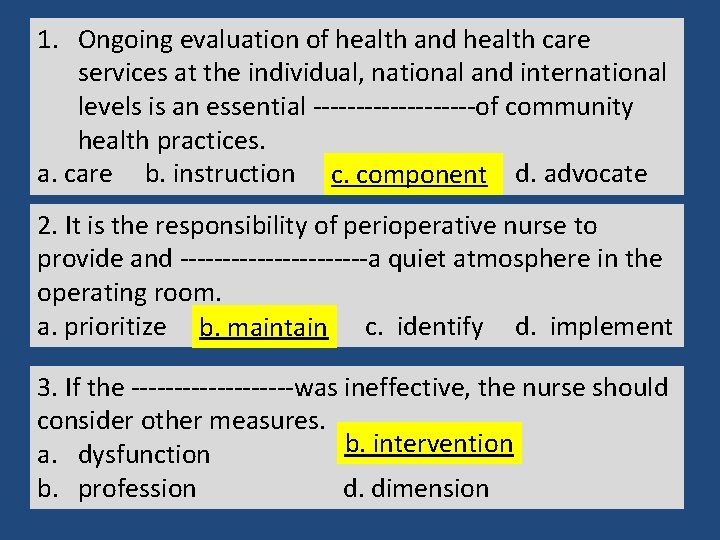
1. Ongoing evaluation of health and health care services at the individual, national and international levels is an essential ----------of community health practices. a. care b. instruction c. component d. advocate 2. It is the responsibility of perioperative nurse to provide and -----------a quiet atmosphere in the operating room. a. prioritize b. maintain c. identify d. implement 3. If the ----------was ineffective, the nurse should consider other measures. b. intervention a. dysfunction b. b. profession d. dimension
4. A biopsy is the removal of tissue for purposes of microscopic examination to -----a diagnosis, to follow a course of disease, or to determine the effectiveness of treatment. a. prevent b. confirm c. manage d. change b. 5. Those who -------euthanasia believe that the terminally ill patients do not have to suffer. a. discern b. direct c. advocate d. implement 6. A head nurse was appointed to ------ the state of the patients in the ward. a. oversee b. advocate c. expand d. empower
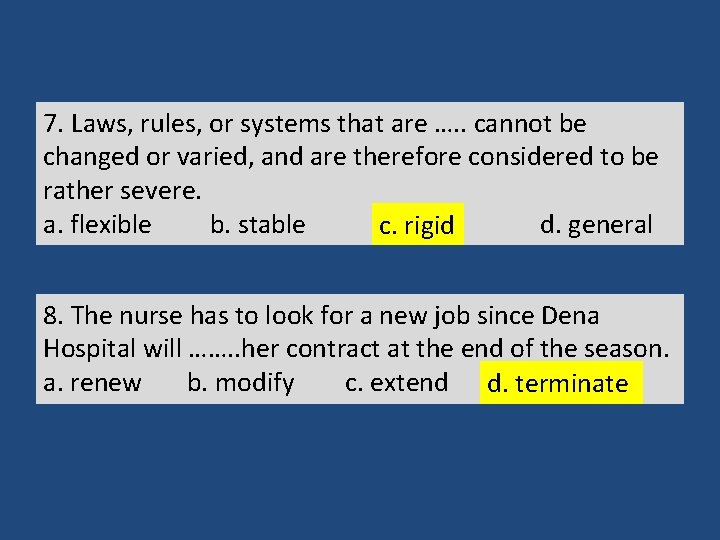
7. Laws, rules, or systems that are …. . cannot be changed or varied, and are therefore considered to be rather severe. a. flexible b. stable c. d. general c. rigid 8. The nurse has to look for a new job since Dena Hospital will ……. . her contract at the end of the season. a. renew b. modify c. extend d. d. terminate
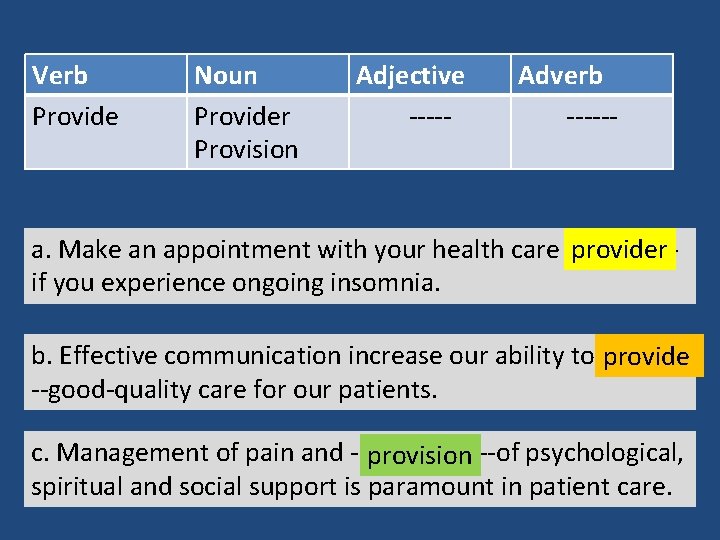
Verb Provide Noun Provider Provision Adjective ----- Adverb ------ a. Make an appointment with your health care ------provider if you experience ongoing insomnia. b. Effective communication increase our ability to -----provide --good-quality care for our patients. c. Management of pain and ---------of psychological, provision spiritual and social support is paramount in patient care.
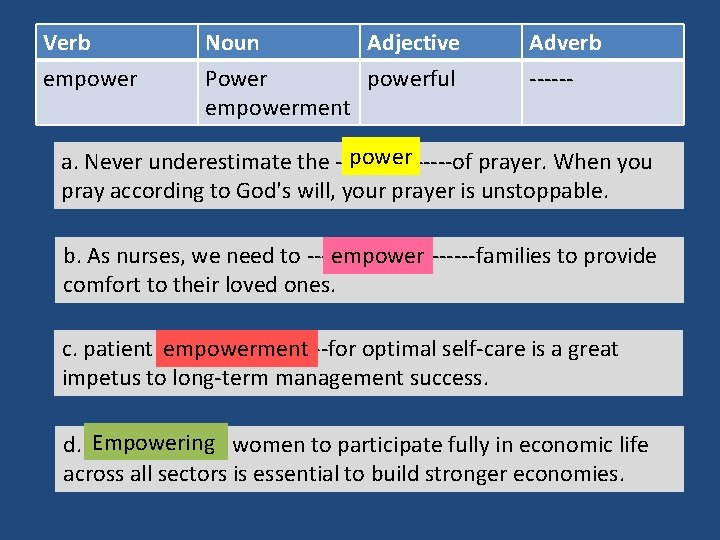
Verb empower Noun Adjective Power powerful empowerment Adverb ------ power a. Never underestimate the --------of prayer. When you pray according to God's will, your prayer is unstoppable. empower b. As nurses, we need to ------------families to provide comfort to their loved ones. c. patient ------------for empowerment optimal self-care is a great impetus to long-term management success. Empowering women to participate fully in economic life d. ---------across all sectors is essential to build stronger economies.
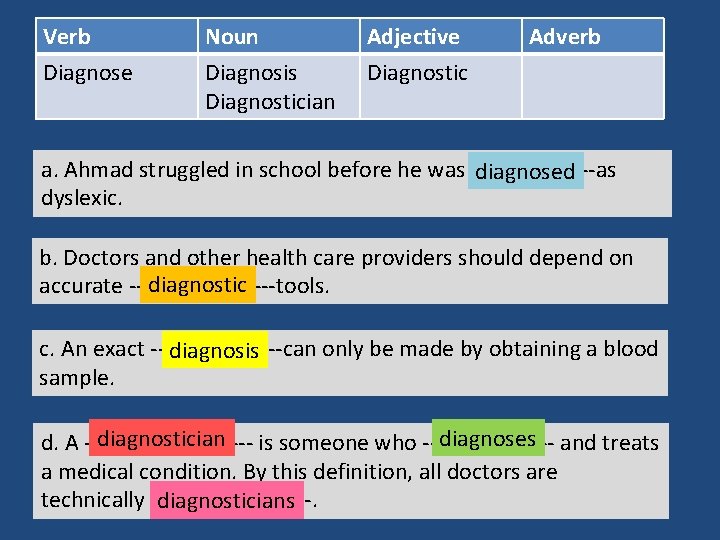
Verb Diagnose Noun Diagnosis Diagnostician Adjective Diagnostic Adverb a. Ahmad struggled in school before he was ---------as diagnosed dyslexic. b. Doctors and other health care providers should depend on diagnostic accurate ----------tools. c. An exact ---------can only be made by obtaining a blood diagnosis sample. diagnoses and treats diagnostician is someone who ---------d. A -----------a medical condition. By this definition, all doctors are technically -----------. diagnosticians
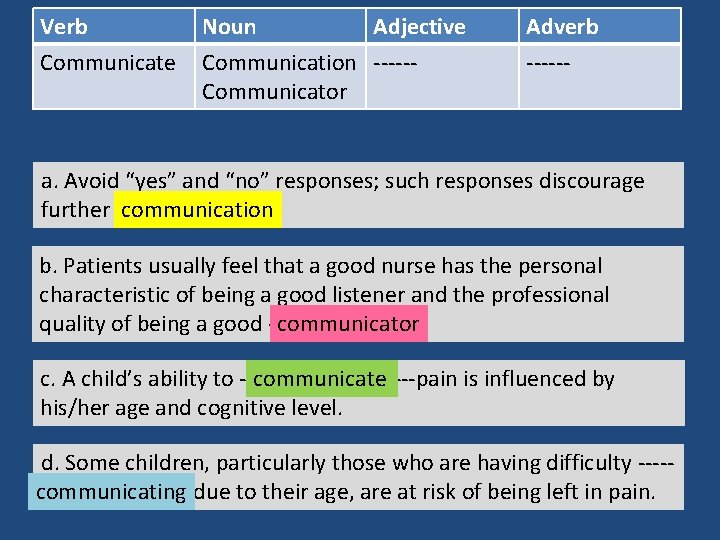
Verb Communicate Noun Adjective Communication -----Communicator Adverb ------ a. Avoid “yes” and “no” responses; such responses discourage further --------. communication b. Patients usually feel that a good nurse has the personal characteristic of being a good listener and the professional quality of being a good --------. communicator c. A child’s ability to ------------pain communicate is influenced by his/her age and cognitive level. d. Some children, particularly those who are having difficulty ------------ due to their age, are at risk of being left in pain. communicating
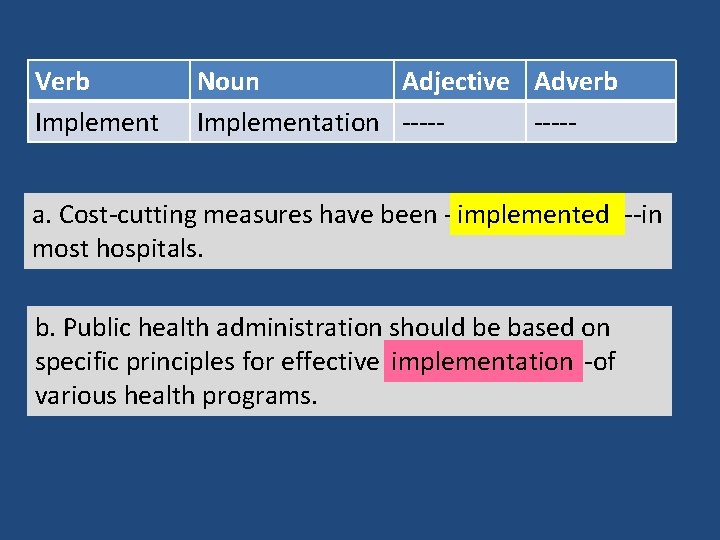
Verb Implement Noun Adjective Adverb Implementation ----- a. Cost-cutting measures have been ------------in implemented most hospitals. b. Public health administration should be based on specific principles for effective ------------of implementation various health programs.
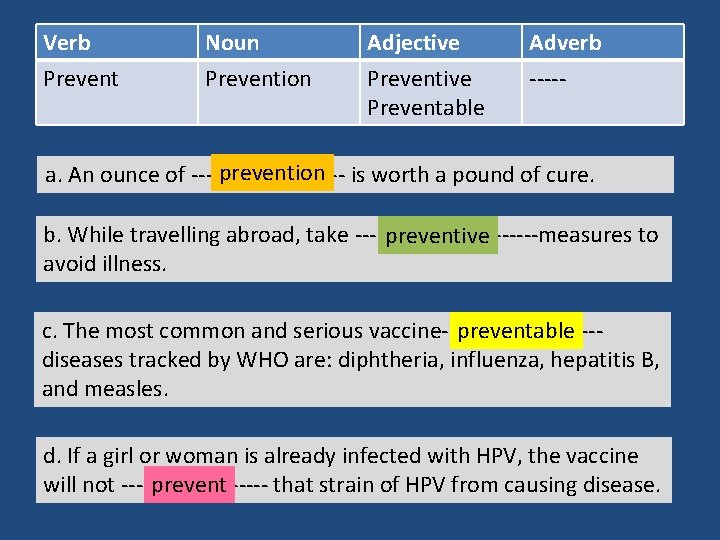
Verb Prevent Noun Prevention Adjective Preventable Adverb ----- prevention is worth a pound of cure. a. An ounce of ----------b. While travelling abroad, take -------------measures to preventive avoid illness. c. The most common and serious vaccine-----------preventable diseases tracked by WHO are: diphtheria, influenza, hepatitis B, and measles. d. If a girl or woman is already infected with HPV, the vaccine will not ----------that strain of HPV from causing disease. prevent