
Unit One Construction Technology Lesson 14 Superstructure walls
- Slides: 66
Unit One Construction Technology Lesson 14 Superstructure walls
Last lesson • You will have understanding of: – The function of floors – The different types of floors: solid and suspended – The materials used to make floors – The different types of floor finishes – Exam question practice
This lesson • You will have understanding of: – The functions of walls – Partition walls – The materials used to make external walls – Wall finishes and pointing – Components of wall openings and their functions – Exam question practice
Next lesson • You will have understanding of: – The function of roofs – The different types of roofs – The advantages and disadvantages of flat and pitched roofs – The components and materials used to make roofs – Exam question practice
Walls perform a number of functions • Resisting heat transfer https: //www. you tube. com/watch ? v=6 yiyx 2 Fhbn 8
Walls perform a number of functions • Reducing sound transmission https: //www. you tube. com/watch ? v=7 u. Xc. MDUire w
Walls perform a number of functions • Transferring loads to foundations https: //www. you tube. com/watch ? v=n. JSs. RVoy_U 0
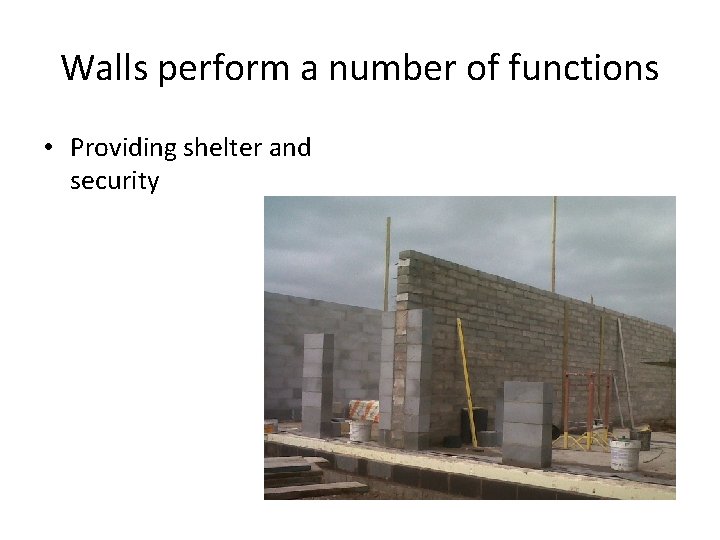
Walls perform a number of functions • Providing shelter and security
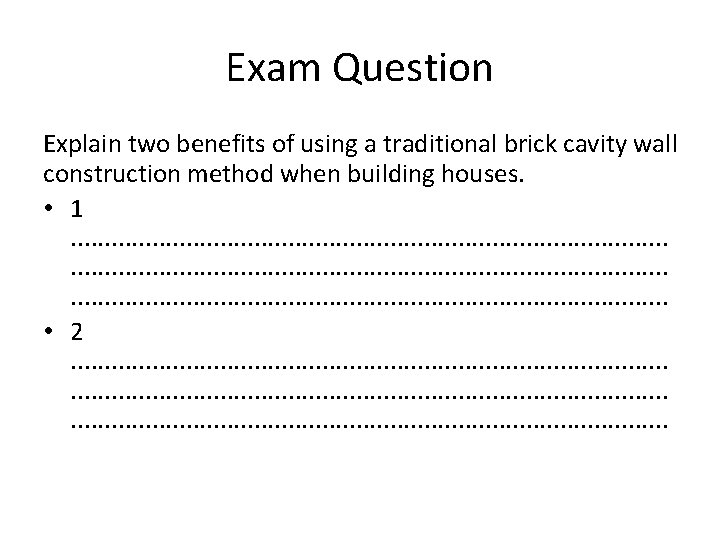
Exam Question Explain two benefits of using a traditional brick cavity wall construction method when building houses. • 1. . . . . . . . . . . . . . . . . • 2. . . . . . . . . . . . . . . . .
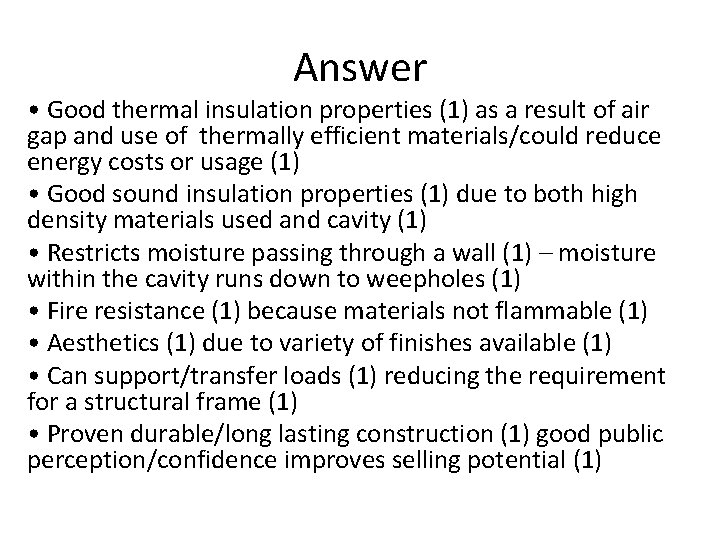
Answer • Good thermal insulation properties (1) as a result of air gap and use of thermally efficient materials/could reduce energy costs or usage (1) • Good sound insulation properties (1) due to both high density materials used and cavity (1) • Restricts moisture passing through a wall (1) – moisture within the cavity runs down to weepholes (1) • Fire resistance (1) because materials not flammable (1) • Aesthetics (1) due to variety of finishes available (1) • Can support/transfer loads (1) reducing the requirement for a structural frame (1) • Proven durable/long lasting construction (1) good public perception/confidence improves selling potential (1)
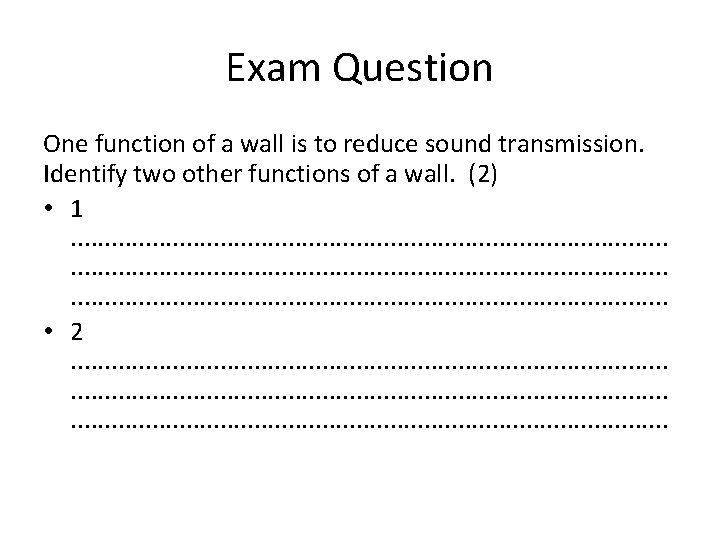
Exam Question One function of a wall is to reduce sound transmission. Identify two other functions of a wall. (2) • 1. . . . . . . . . . . . . . . . . • 2. . . . . . . . . . . . . . . . .
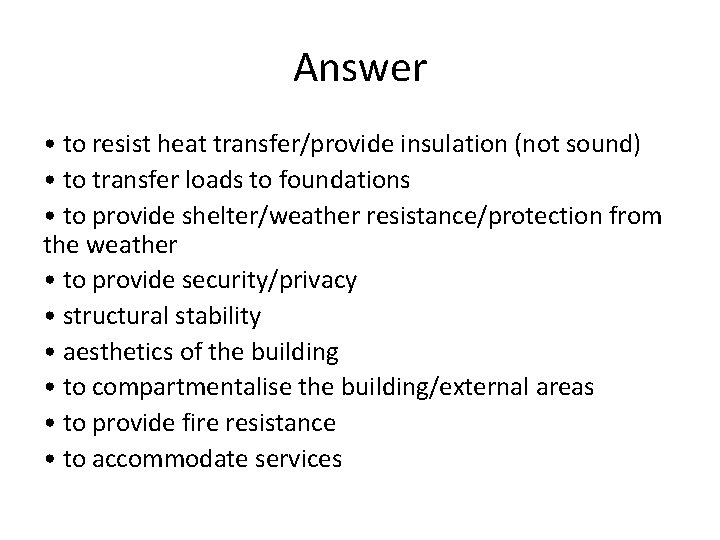
Answer • to resist heat transfer/provide insulation (not sound) • to transfer loads to foundations • to provide shelter/weather resistance/protection from the weather • to provide security/privacy • structural stability • aesthetics of the building • to compartmentalise the building/external areas • to provide fire resistance • to accommodate services
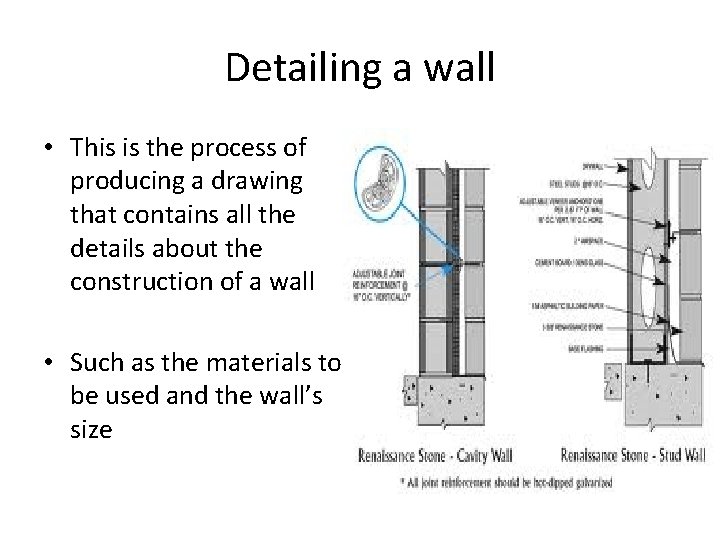
Detailing a wall • This is the process of producing a drawing that contains all the details about the construction of a wall • Such as the materials to be used and the wall’s size
Detailing a wall • Internal partitions are constructed to divide the floor area of a building into smaller and more useful spaces • For example; an ensuite bathroom https: //www. yo utube. com/wat ch? v=am. K 2 edm 20 ss
Detailing a wall • Internal walls can be constructed as timber studs which are similar to timber framed construction https: //www. youtube. co m/watch? v=z. PXRJUB 5 D QI https: //www. youtube. com /watch? v=h. Jlz 1 L_c. Yg. U
Detailing a wall • Internal walls can be constructed in solid blockwork where solid concrete blocks are laid in layers or courses https: //www. y outube. com/w atch? v=S 3 se. Ky GZI_A
Exam Question An architect is designing a new office building with internal partitions constructed of solid blockwork. Explain two disadvantages, other than cost, of using solid blockwork partitions. • 1. . . . . . . . . . . • 2. . . . . . . . . . .
Answer • Lack of flexibility in the ability to move or modify the partition once constructed (1) as heavy/solid form of construction (1) • Lack of ability to conceal wiring/ incorporate insulation within partition (1) because there are no voids within the construction form unlike metal or timber partition types (1) • Installation is slow/more time consuming/ labour intensive (1) because sections cannot be slotted/crimped or constructed together easily/ blockwork may require a finish (1) • Requires drying out time (1) unlike metal and stud partitions (1) • Increased dead load on the building (1) which requires substantial support (1) • Rigid form of construction (1) so more susceptible to movement/ cracking/ requires expansion joints (1)
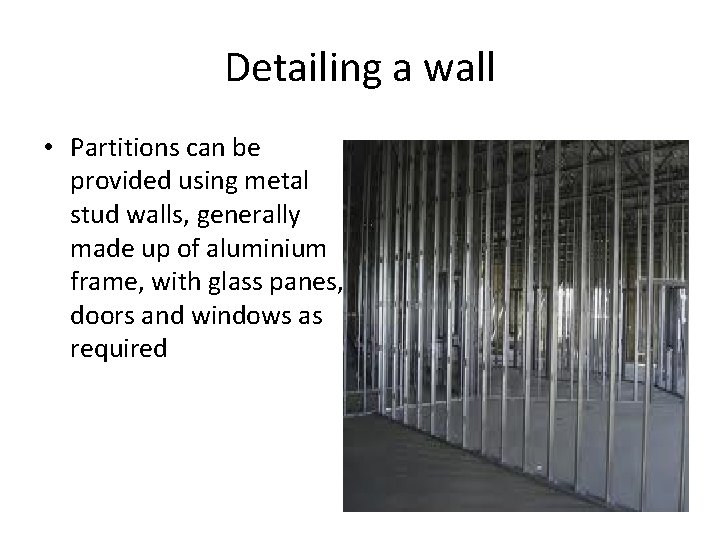
Detailing a wall • Partitions can be provided using metal stud walls, generally made up of aluminium frame, with glass panes, doors and windows as required
Exam Question Name one type of internal partition wall. (1) • . . . . . . . . . . . . . .
Answer 1 mark for any of: • timber (1) • timber stud/stud (1) • metal stud (1) • blockwork (solid) (1) • glazed (1) • clay block/brick (1) • paramount (1) • demountable (1)
Exam Question Explain two advantages of metal stud partitions compared to timber stud partitions. • 1. . . . . . . . . . . . . . . . . • 2. . . . . . . . . . . . . . . . .
Answer • Lightweight (1) therefore easier to handle/install/transport (1) • Reduction of storage requirements (1) because the sections stack inside one another (1) • Stability (1) because the metal studs do not warp or twist/not prone to take up moisture (1) • Increased durability (1) as not prone to insect attack (1) • Easier to install services (1) because the metal studs are perforated (1)
Exam Question Sections of a new build office building will be rented to different businesses. The internal partitions will be constructed using metal studs. Explain two reasons why metal studs are suitable for this office building. 1. . . . . . . . . . . . . . . 2. . . . . . . . . . . . . . .
Answer • can be easily/quickly/cheaply moved (1) because it does not require a foundation/is lightweight (1) • it allows for ease of concealment of wiring (1) because there is a void within the construction/studs are perforated to allow cables to pass through (1) • installation is easy/quick/cheap (1) because sections slot/crimp together/the building can be occupied earlier (1).
Exam Question Name two types of internal wall partition. (2) • 1. . . . . . . . . . . . . . . • 2. . . . . . . . . . . . . . .
Answer Up to a maximum of two marks • Stud • Timber/timber stud • Metal/metal stud • Glazed • Blockwork/solid blockwork • Paramount • Brickwork • Demountable • Clay blocks
Exam Question Explain two reasons why internal partition walls are often constructed using softwood. • 1. . . . . . . . . . . . . . . . . • 2. . . . . . . . . . . . . . . . .
Answer • They are economic/cost effective (1) due to speed of construction / lean lightweight construction / cheaper than hardwood (1) • They can be easily modified or altered (1) therefore gives flexibility if design changes required (1) • Timber is a sustainable material (1) therefore reducing carbon footprint (1)
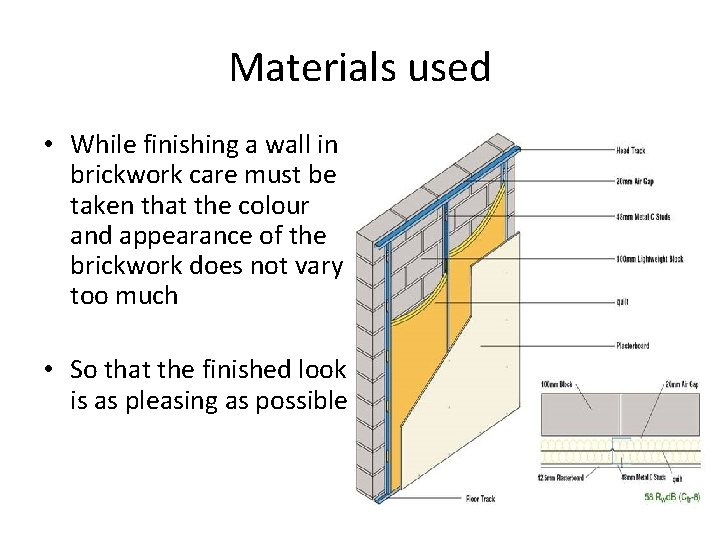
Materials used • While finishing a wall in brickwork care must be taken that the colour and appearance of the brickwork does not vary too much • So that the finished look is as pleasing as possible
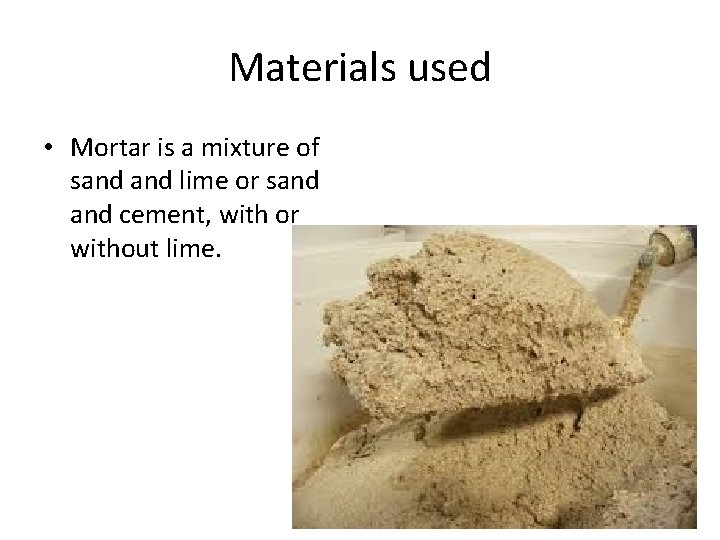
Materials used • Mortar is a mixture of sand lime or sand cement, with or without lime.
Materials used • Lime makes the mortar more workable • It is more porous which allows frost to penetrate and cause more damage https: //www. y outube. com/w atch? v=Wxc. Lcz 1 Ssx. I
Materials used • The joint masonry is a faster method of constructing walls https: //www. you tube. com/watch ? v=2 a. AD 4 R 52 Bts
Materials used • The joints between the various are thin compared with traditional methods • The joints are 2 to 3 mm thick https: //www. youtube. com/ watch? v=ZDN ab. Dke. VO 4
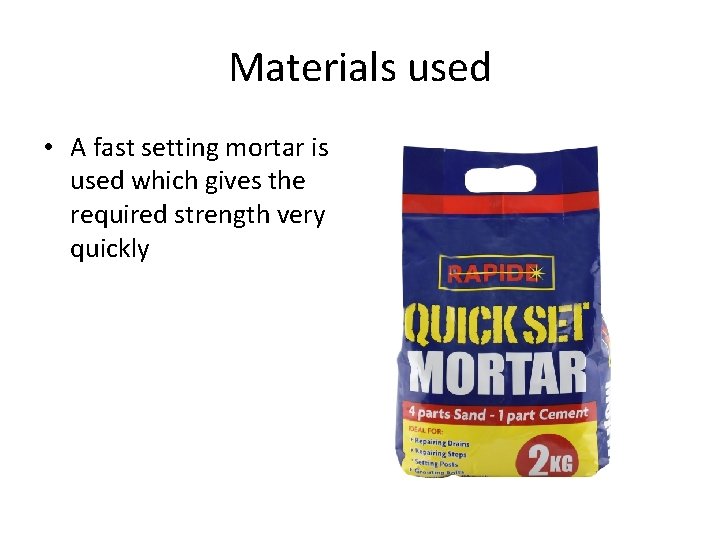
Materials used • A fast setting mortar is used which gives the required strength very quickly
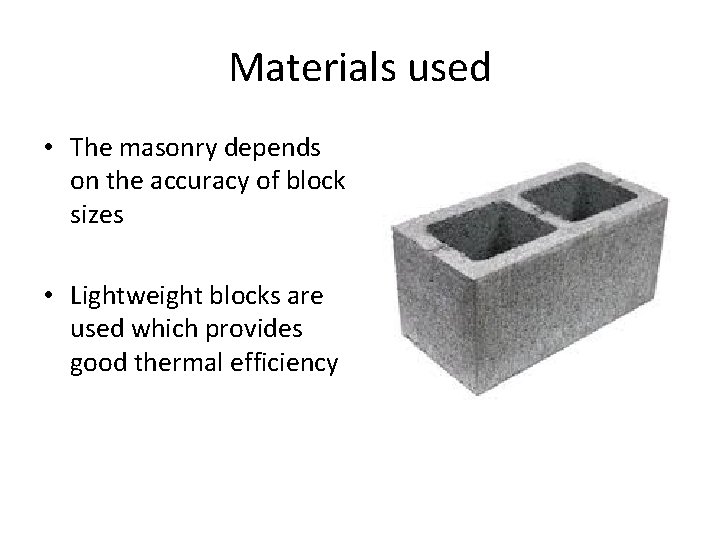
Materials used • The masonry depends on the accuracy of block sizes • Lightweight blocks are used which provides good thermal efficiency
Wall finishes • Rendering blockwork – Is a process similar to plastering – Render can be given different textures https: //www. yo utube. com/watc h? v=o. Uf 15 a. Mz. H 3 g
Exam Question Identify two types of external wall finish. (2) A Mineral wool B Chipboard C Facing brickwork D Wall plates E Rendered blockwork
Answer C-Facing brickwork E-Rendered blockwork
Exam Question Identify two types of wall finishes that could be used on a building. Put a cross in two boxes to indicate your answers. (2) A Metal stud B Rendered blockwork C Bitumen felt D Facing brickwork E Mineral wool
Answer 1 mark for each of: B — Rendered blockwork D — Facing brickwork
Materials used • Facing brickwork – Usually has various types of joints with pointing – Joints improve the weather-proofing and the appearance of the brickwork https: //www. y outube. com/w atch? v=w. Lq. H 0 K_B 20
Pointing • Filling the joints in brickwork with mortar to improve appearance and weather proofing https: //www. y outube. com/w atch? v=WRNh N 4 DECws
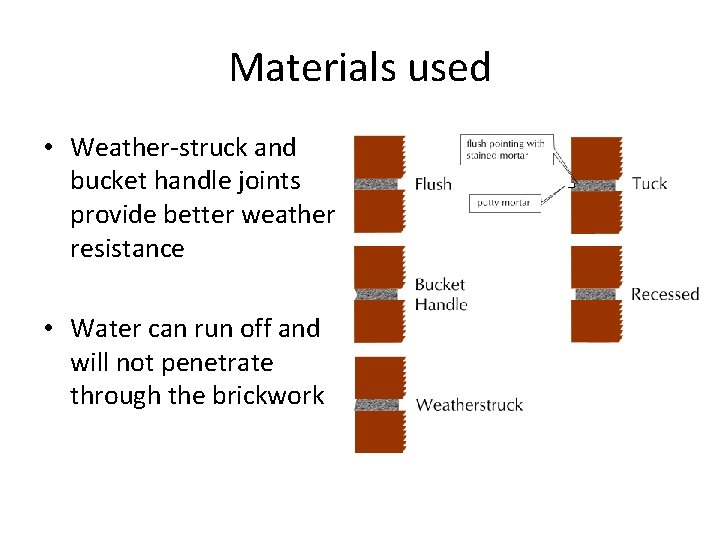
Materials used • Weather-struck and bucket handle joints provide better weather resistance • Water can run off and will not penetrate through the brickwork
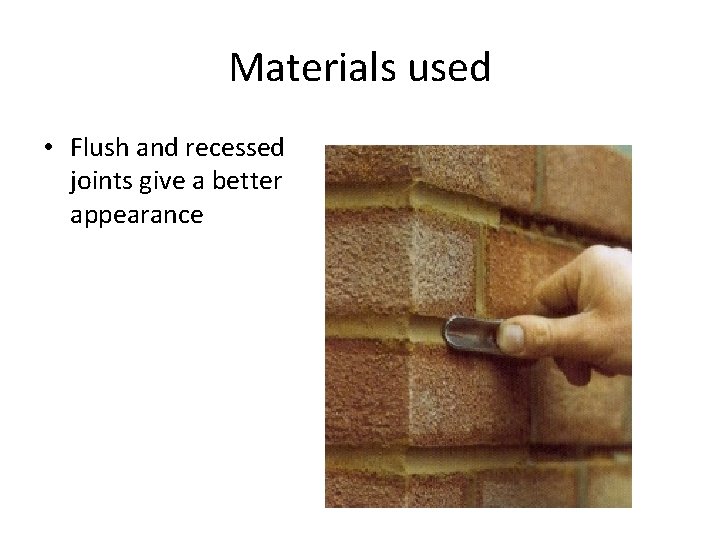
Materials used • Flush and recessed joints give a better appearance
Exam Question Identify two types of pointing used in facing brickwork. (2) A Recessed B Fascia C Eaves D Threshold E Flush
Answer One mark for each of: A – Recessed E – Flush
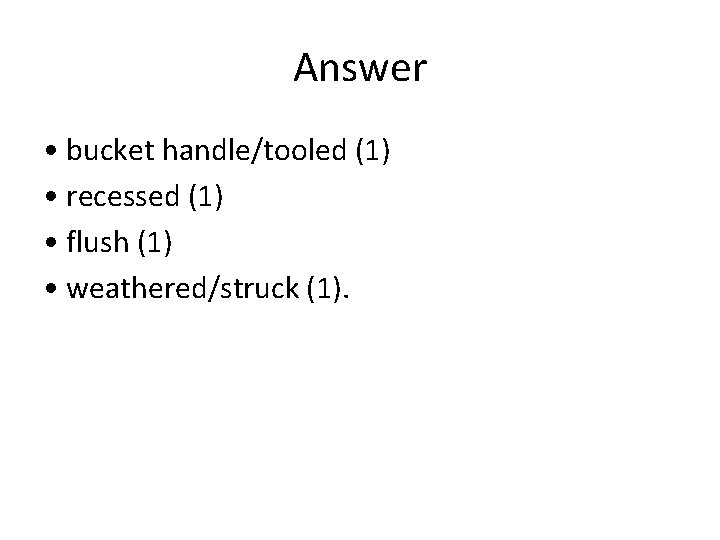
Exam Question Name two types of pointing used in facing brickwork. • 1. . . . . . . . . . . . . . . . . • 2. . . . . . . . . . . . . . . . .
Answer • bucket handle/tooled (1) • recessed (1) • flush (1) • weathered/struck (1).
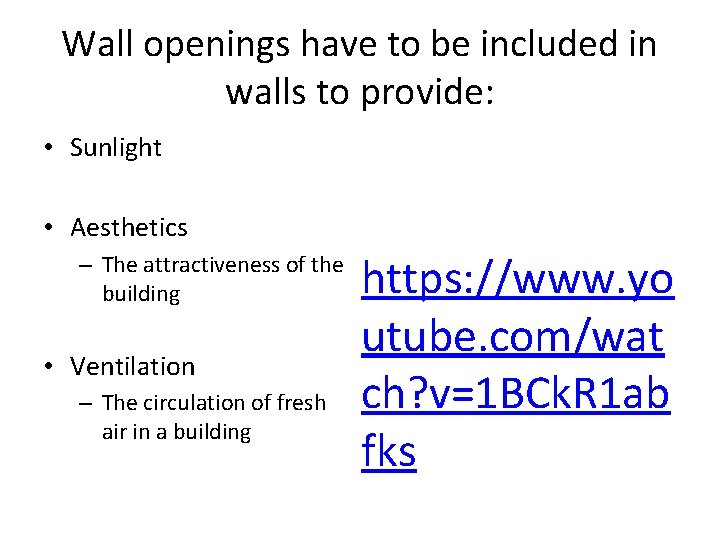
Wall openings have to be included in walls to provide: • Sunlight • Aesthetics – The attractiveness of the building • Ventilation – The circulation of fresh air in a building https: //www. yo utube. com/wat ch? v=1 BCk. R 1 ab fks
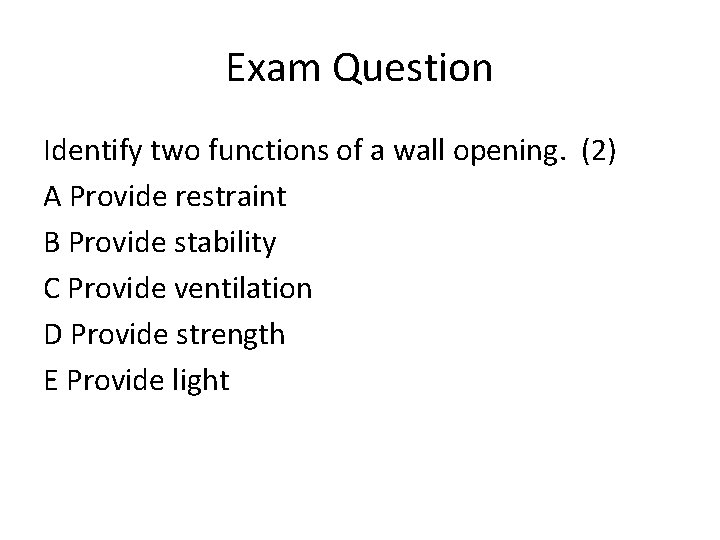
Exam Question Identify two functions of a wall opening. (2) A Provide restraint B Provide stability C Provide ventilation D Provide strength E Provide light
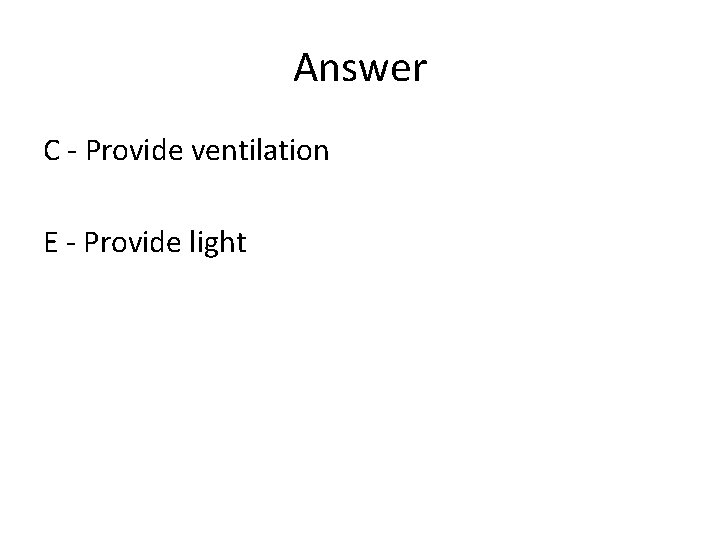
Answer C - Provide ventilation E - Provide light
Exam Question • Give two functions of a wall opening. • 1. . . . . . . . . . . . . . . • 2. . . . . . . . . . . . . . .
Answer 1 mark for each function identified: Up to a maximum of two marks • Provide ventilation • Provide light • Provide aesthetics • Provide access • Provide a means of escape/egress • Provide a view
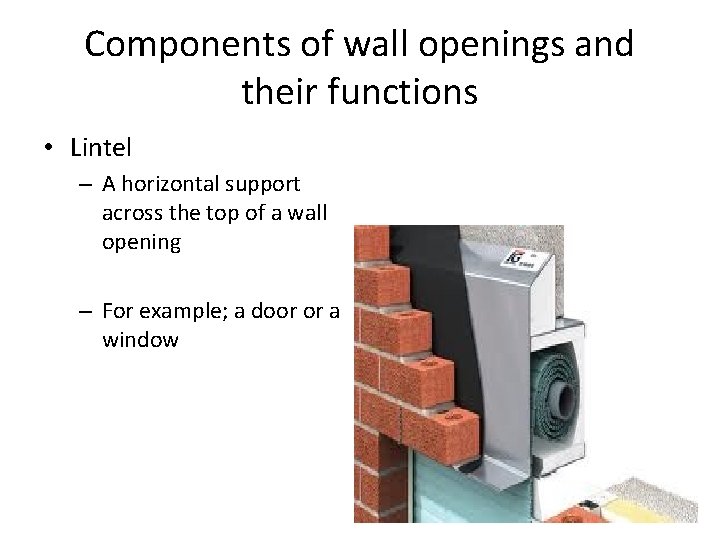
Components of wall openings and their functions • Lintel – A horizontal support across the top of a wall opening – For example; a door or a window
Exam Question Outline the function of a lintel. (1) • . . . . . . . . . . . . . .
Answer • To support the materials/wall above the opening • Aesthetically pleasing/decorative eg. stone/timber
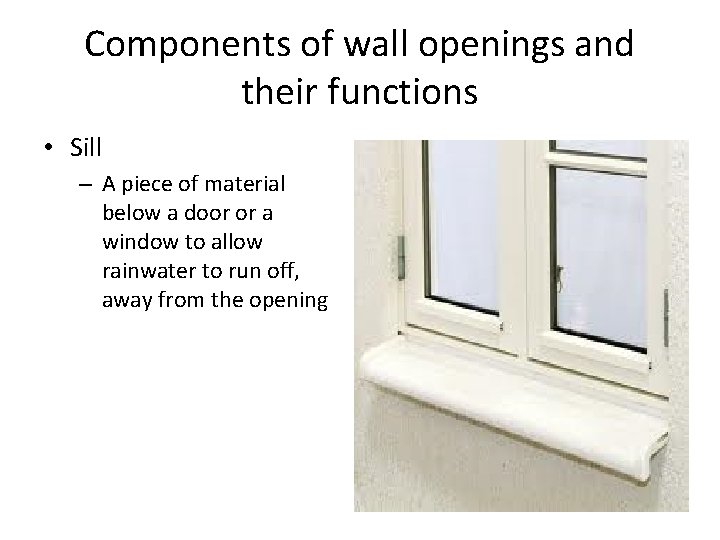
Components of wall openings and their functions • Sill – A piece of material below a door or a window to allow rainwater to run off, away from the opening
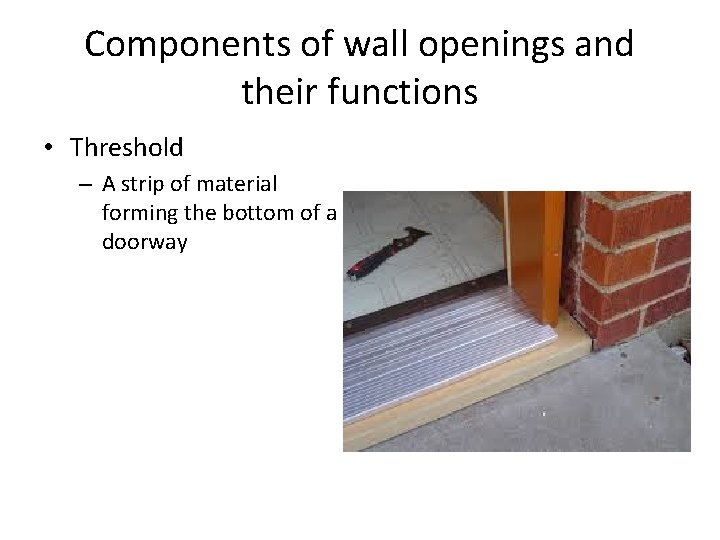
Components of wall openings and their functions • Threshold – A strip of material forming the bottom of a doorway
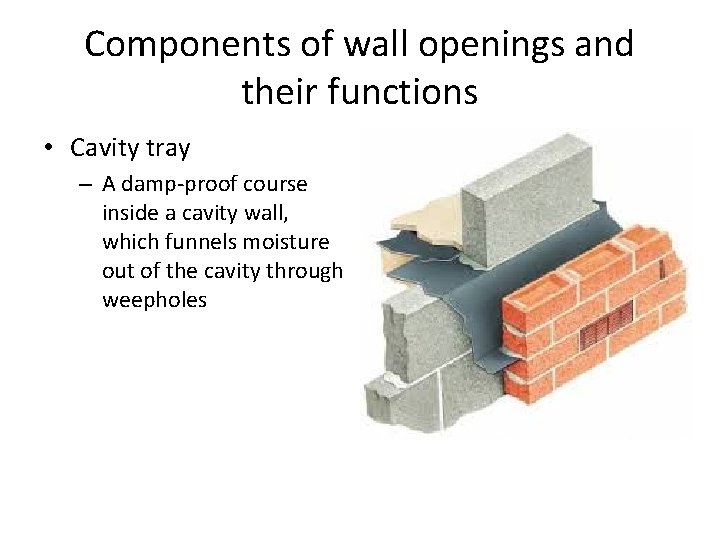
Components of wall openings and their functions • Cavity tray – A damp-proof course inside a cavity wall, which funnels moisture out of the cavity through weepholes
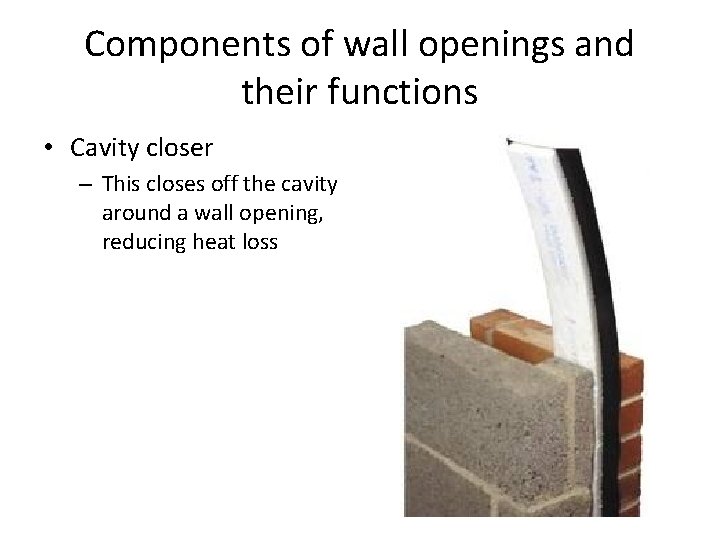
Components of wall openings and their functions • Cavity closer – This closes off the cavity around a wall opening, reducing heat loss
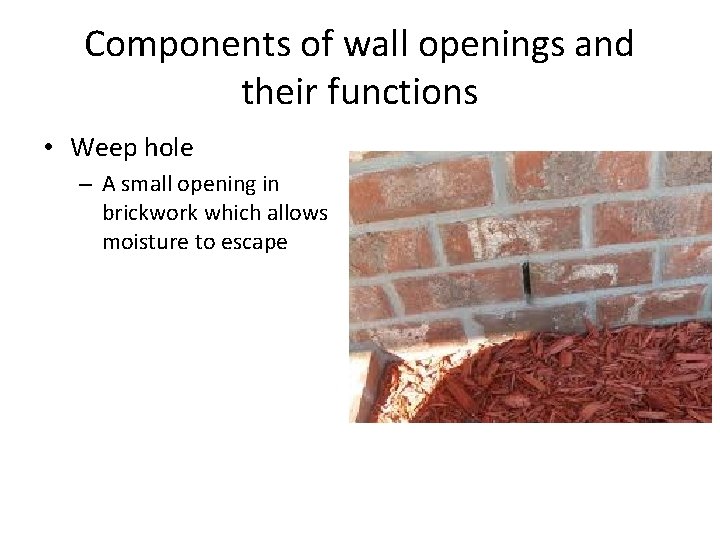
Components of wall openings and their functions • Weep hole – A small opening in brickwork which allows moisture to escape
Exam Question Windows and doors are components of a wall opening. Name one other component of a wall opening. (1) • . . . . . . . . . . . . . .
Answer 1 mark for any of: • lintel (1) • sill (1) • threshold (1) • damp-proof course (1) • cavity tray/closer (1) • weepholes/ vent (1) • jamb (1) • head (1)
Exam Question Identify two components of a wall opening. (2) A Weephole B Skirting C Ridgeboard D Lintel E Gable
Answer A – weephole D – lintel