
Unit One Care of Client with Cancer RADIATION

- Slides: 62
Unit One Care of Client with Cancer RADIATION
This Class Radiation (Chpt 16) Definition Ø Sources of radiation Ø Uses of radiation principles of radiation protection Ø Types of radiation therapy Ø Care of clients receiving radiation therapy Ø Side effects & symptom management
Class Objectives l l l Describe radiation as a modality for cancer treatment, and the uses of radiotherapy Identify factors affecting cell response to radiotherapy. Discuss the principles of radiation protection Describe the types of radiation therapy and related nursing care. Discuss side-effects of radiation therapy and nursing care
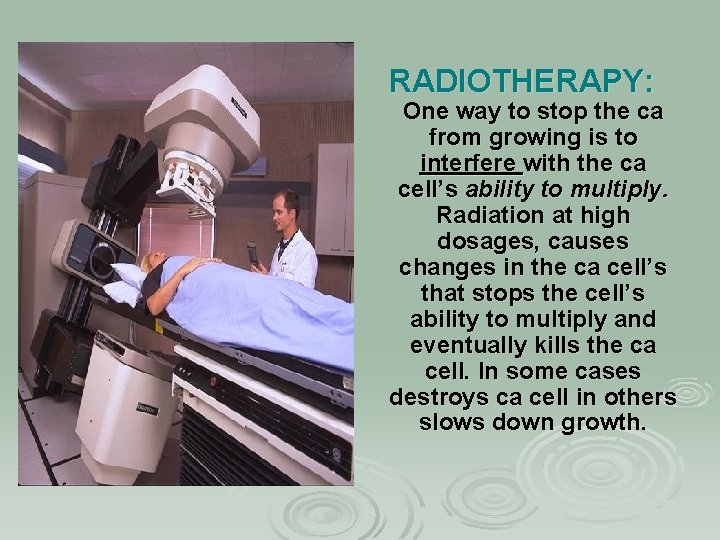
RADIOTHERAPY: One way to stop the ca from growing is to interfere with the ca cell’s ability to multiply. Radiation at high dosages, causes changes in the ca cell’s that stops the cell’s ability to multiply and eventually kills the ca cell. In some cases destroys ca cell in others slows down growth.
Radiotherapy RADIOTHERAPY is the treatment of neoplastic disease using HIGH ENERGY IONIZING RAYS (x-rays or gamma rays) to KILL CANCER CELLS. THESE MAY BE GENERATED BY RADIOACTIVE SOURCES OR LINEAR ACCELERATORS. THE HIGHER THE ENERGY OF THE PHOTON THE DEEPER IT CAN PENETRATE THE BODY BEFORE LOSING ITS EFFECT. Ø Radiation deters the proliferation of malignant cells by decreasing the rate of mitosis or impairing DNA synthesis. Ø
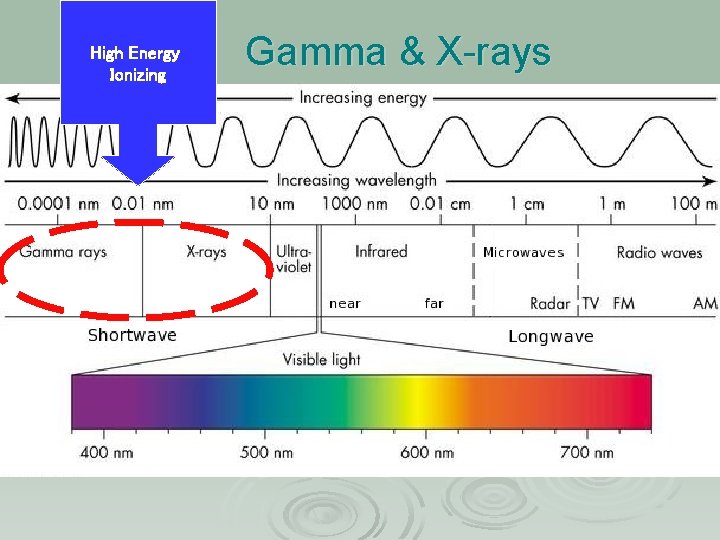
Gamma & X-rays High Energy Ionizing
Terms to Recognize Ø Ø Ø Becquerel (Bq): unit of measure for the amount of of a radioactive nuclide in a particular energy state. One Bq= one nuclear disintegration per second Gray (Gy) Unit of radiation dose (one joule per kg). One Gy= 100 centigray (c. Gy) equals 100 rad (1 rad= 1 c. Gy) Rad (r) Acronym for radiation absorbed dose Roentgen (R) Unit of exposure to ionized radiation Sievert (Sv) The unit of dose equivalent to ionizing radiation is = one joule per kg. (used in radiation safety re occupational exposure)
Action of Radiation Ø Prevents the reproduction of cells as breaks DNA strands Ø Cells most sensitive to radiation M & G 2 phases & least sensitive in S phase Ø Cells that are rapidly dividing cells and undifferentiated are more sensitive to radiation.
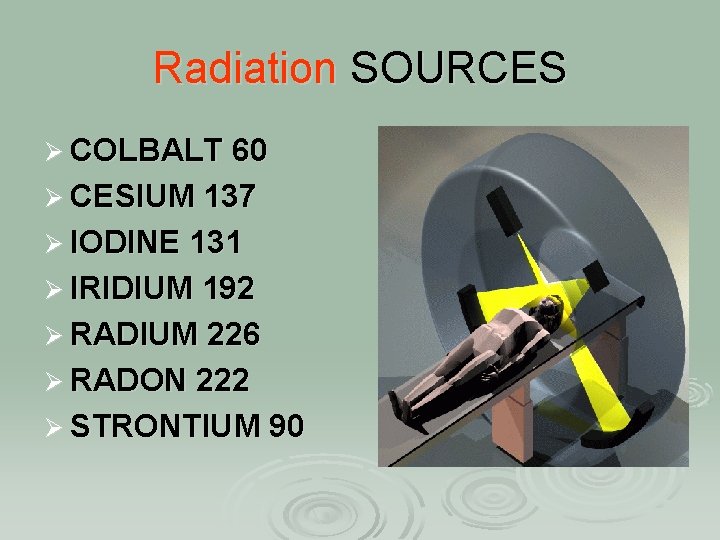
Radiation SOURCES Ø COLBALT 60 Ø CESIUM 137 Ø IODINE 131 Ø IRIDIUM 192 Ø RADIUM 226 Ø RADON 222 Ø STRONTIUM 90
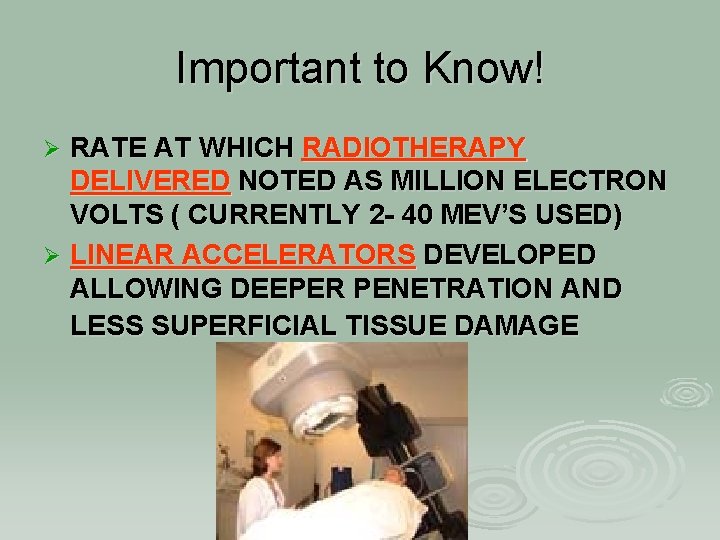
Important to Know! RATE AT WHICH RADIOTHERAPY DELIVERED NOTED AS MILLION ELECTRON VOLTS ( CURRENTLY 2 - 40 MEV’S USED) Ø LINEAR ACCELERATORS DEVELOPED ALLOWING DEEPER PENETRATION AND LESS SUPERFICIAL TISSUE DAMAGE Ø
Three Goals of Radiotherapy Ø Curative Ø Control: Adjuvant Pre/Post Operative Intraoperative Ø Palliation
Ø http: //www. youtube. com/watch? v=Ii- rg. H 6 SAp 4&feature=related Ø http: //www. youtube. com/watch? v=l. Z 9 c. GV ax. Oes&feature=relmfu
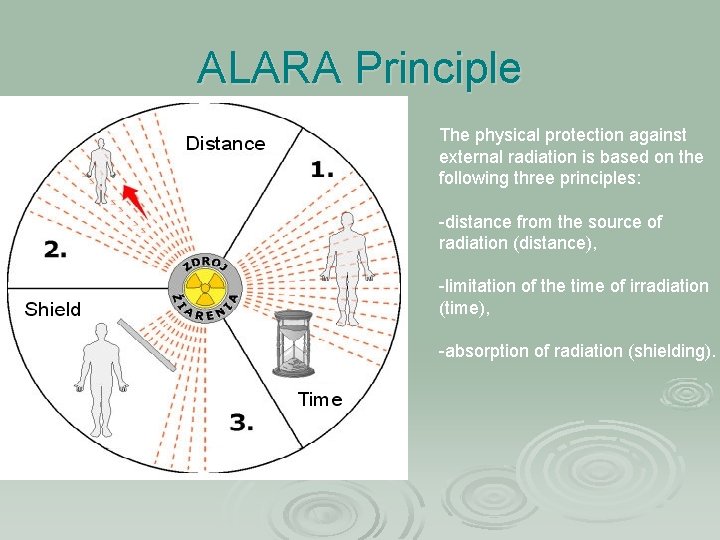
Radiation Protection: Principles ALARA PRINCIPLE: Ø TIME: longer time of exposure, greater amt. of rad. absorbed Ø DISTANCE : intensity of rad. decreases as distance from source increases. Ø SHIELDING: % of rad. penetration decreases as the shield thickness increases.
ALARA Principle The physical protection against external radiation is based on the following three principles: -distance from the source of radiation (distance), -limitation of the time of irradiation (time), -absorption of radiation (shielding).
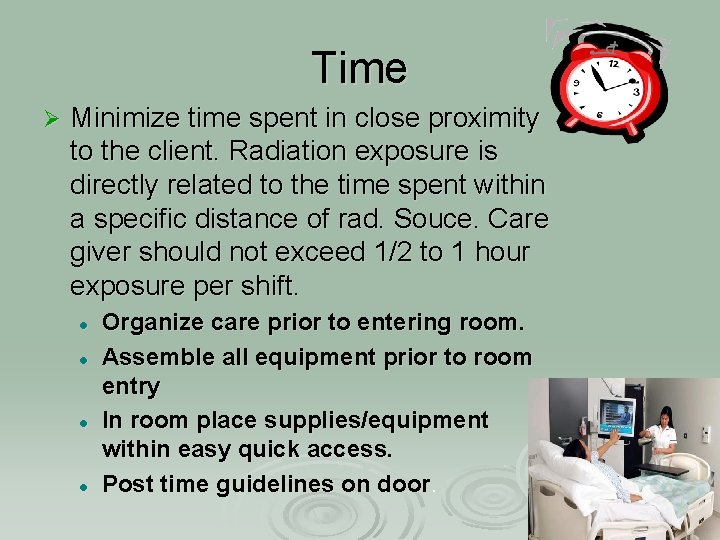
Time Ø Minimize time spent in close proximity to the client. Radiation exposure is directly related to the time spent within a specific distance of rad. Souce. Care giver should not exceed 1/2 to 1 hour exposure per shift. l l Organize care prior to entering room. Assemble all equipment prior to room entry In room place supplies/equipment within easy quick access. Post time guidelines on door.
Distance The amount radiation decreases Doubling the distance from the rad source Quarters the amt. of radiation received! Ø If the exposure at 1 meter from the Rad. Source is X, the exposure at 2 m is ¼ of x, and at 4 m, one sixteenth. Ø Interventions: Ø Teach client self-care & rationale for isolation Ø Limit client care by individual caregiver Ø Use communication devices outside room when possible Ø
Shielding Ø When used properly, lead shielding can provide added protection from radiation. Ø In practice, nurses find lead shielding in be cumbersome to work with. Ø Improper use leads to a false sense of security, and impedes rapid care. Ø Nurses wear a film badge Ø NB pregnant nurses should not care for radiation clients.
Types of Radiation Therapy Ø External Beam or Teletherapy most common type of radiation using machines (linear accelerator) client is not radioactive Ø Internal radiation or Brachytherapy implants (temporary/permanent) client is radioacive
Teletherapy Ø Delivering radiation from a source a distance from the target Ø Radiation department administers Ø Advantage skin sparring effect giving max rad to tumor not the skin. Ø Client monitored via TV or intercom Ø Treatment approx. 10 mins. Ø Not painful client feels heat or tingling.
Brachytherapy Ø Delivers a high dose of radiation to a localized area Ø The specific radioisotope is chosen on the basis of its half-life Ø May be implanted by means of needles, seeds, beads, or catheters into body cavities (vagina, abdomen, prostate, pleural space). Ø May be given orally or IV (thyroid cancer)
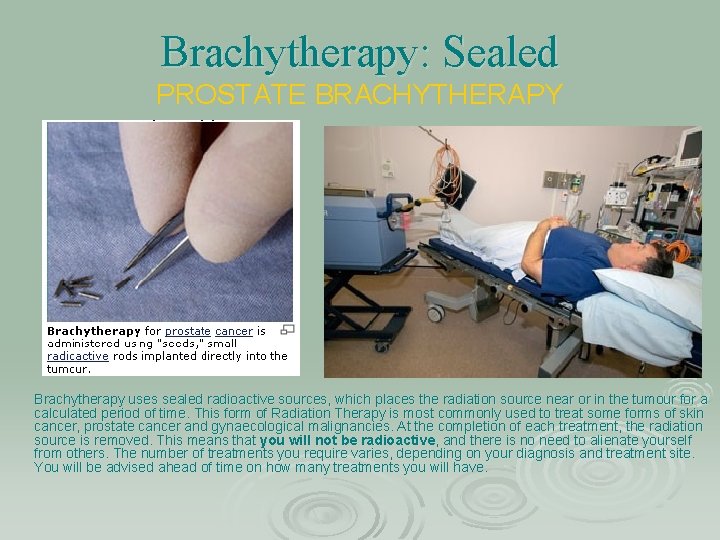
Brachytherapy: Sealed PROSTATE BRACHYTHERAPY Brachytherapy uses sealed radioactive sources, which places the radiation source near or in the tumour for a calculated period of time. This form of Radiation Therapy is most commonly used to treat some forms of skin cancer, prostate cancer and gynaecological malignancies. At the completion of each treatment, the radiation source is removed. This means that you will not be radioactive, and there is no need to alienate yourself from others. The number of treatments you require varies, depending on your diagnosis and treatment site. You will be advised ahead of time on how many treatments you will have.
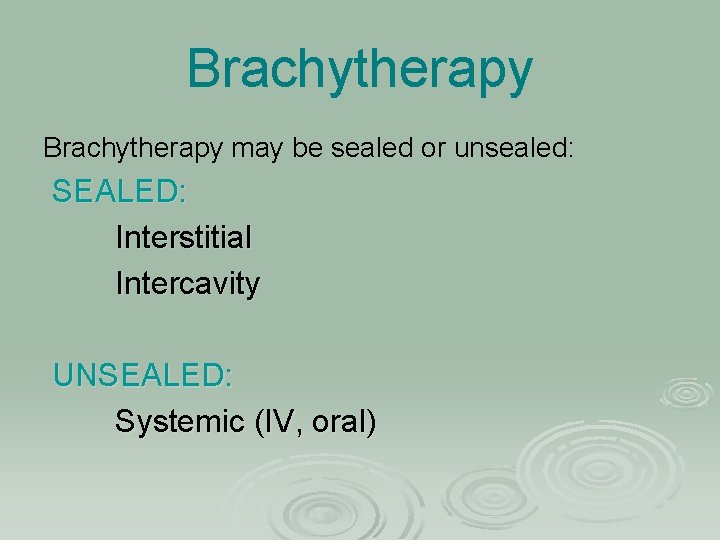
Brachytherapy may be sealed or unsealed: SEALED: Interstitial Intercavity UNSEALED: Systemic (IV, oral)
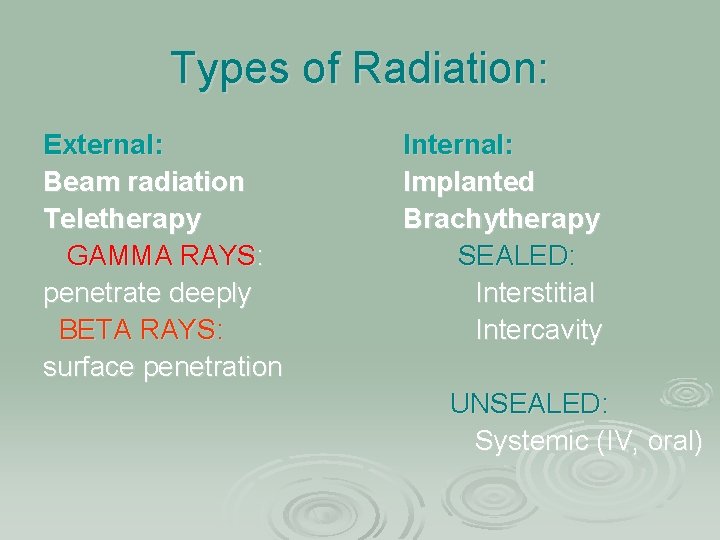
Types of Radiation: External: Beam radiation Teletherapy GAMMA RAYS: penetrate deeply BETA RAYS: surface penetration Internal: Implanted Brachytherapy SEALED: Interstitial Intercavity UNSEALED: Systemic (IV, oral)
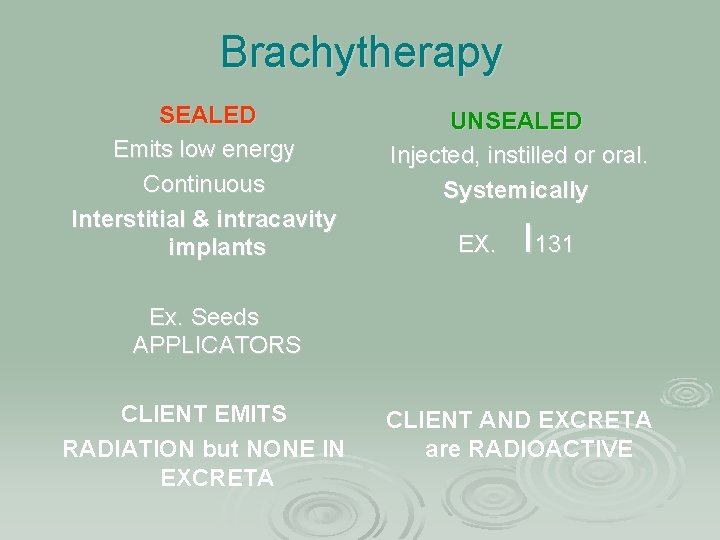
Brachytherapy SEALED Emits low energy Continuous Interstitial & intracavity implants UNSEALED Injected, instilled or oral. Systemically I EX. 131 Ex. Seeds APPLICATORS CLIENT EMITS RADIATION but NONE IN EXCRETA CLIENT AND EXCRETA are RADIOACTIVE
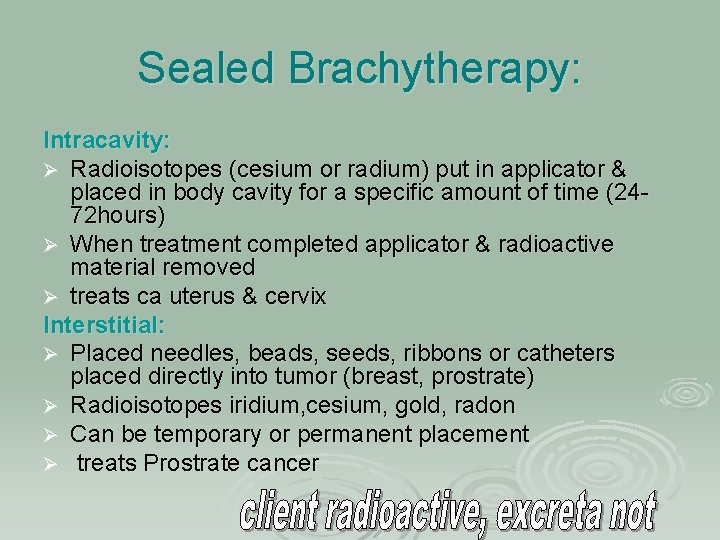
Sealed Brachytherapy: Intracavity: Ø Radioisotopes (cesium or radium) put in applicator & placed in body cavity for a specific amount of time (2472 hours) Ø When treatment completed applicator & radioactive material removed Ø treats ca uterus & cervix Interstitial: Ø Placed needles, beads, seeds, ribbons or catheters placed directly into tumor (breast, prostrate) Ø Radioisotopes iridium, cesium, gold, radon Ø Can be temporary or permanent placement Ø treats Prostrate cancer
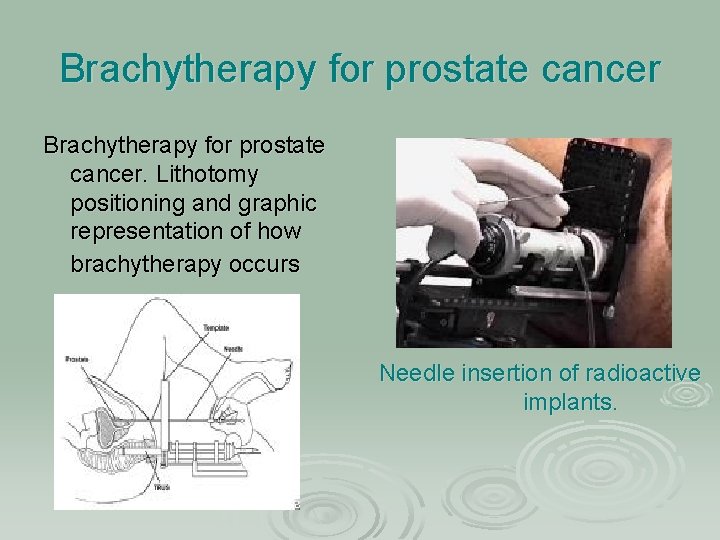
Brachytherapy for prostate cancer. Lithotomy positioning and graphic representation of how brachytherapy occurs Needle insertion of radioactive implants.
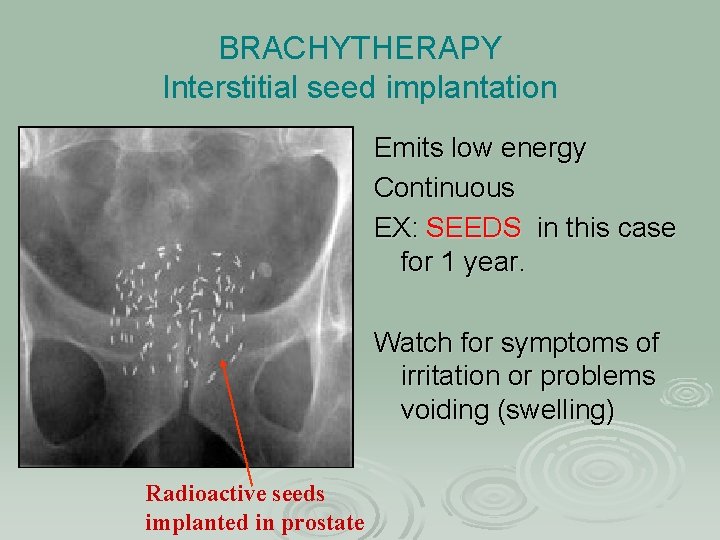
BRACHYTHERAPY Interstitial seed implantation Emits low energy Continuous EX: SEEDS in this case for 1 year. Watch for symptoms of irritation or problems voiding (swelling) Radioactive seeds implanted in prostate
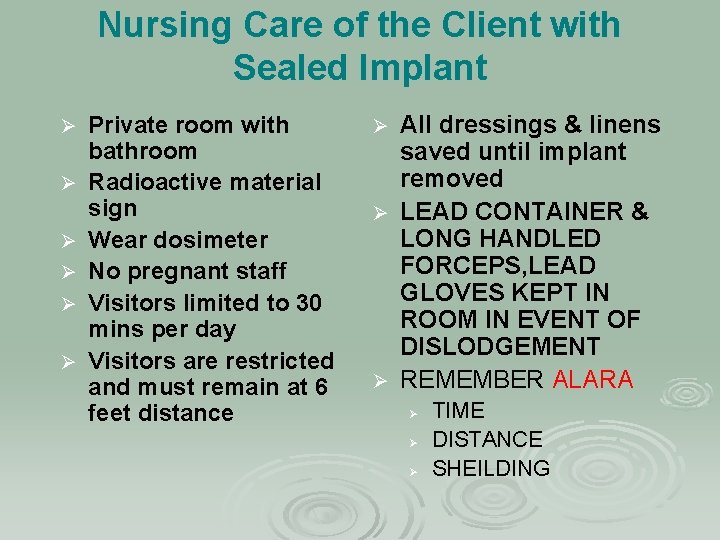
Nursing Care of the Client with Sealed Implant Ø Ø Ø Private room with bathroom Radioactive material sign Wear dosimeter No pregnant staff Visitors limited to 30 mins per day Visitors are restricted and must remain at 6 feet distance All dressings & linens saved until implant removed Ø LEAD CONTAINER & LONG HANDLED FORCEPS, LEAD GLOVES KEPT IN ROOM IN EVENT OF DISLODGEMENT Ø REMEMBER ALARA Ø Ø TIME DISTANCE SHEILDING
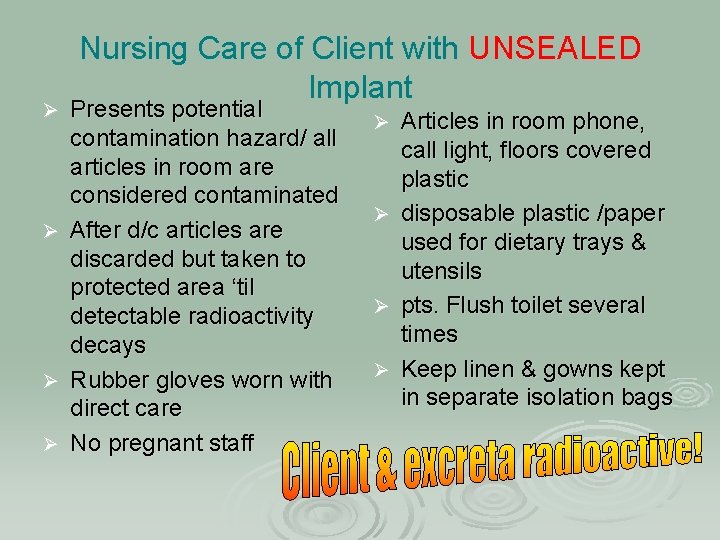
Ø Ø Nursing Care of Client with UNSEALED Implant Presents potential contamination hazard/ all articles in room are considered contaminated After d/c articles are discarded but taken to protected area ‘til detectable radioactivity decays Rubber gloves worn with direct care No pregnant staff Articles in room phone, call light, floors covered plastic Ø disposable plastic /paper used for dietary trays & utensils Ø pts. Flush toilet several times Ø Keep linen & gowns kept in separate isolation bags Ø
Loss of Radioactive Material: Ø Considered an emergency Ø Search initiated by radiation staff Ø Nothing moves from the room while client has radioactive material in place Ø If found radioactive material use forceps & gloves Ø Notify Atomic Energy Canada
Factors affecting cell response to Radiotherapy: Histological type of cell Ø Oxygen effect Ø Type of radiotherapy used Ø Rate at which radiotherapy is delivered Ø
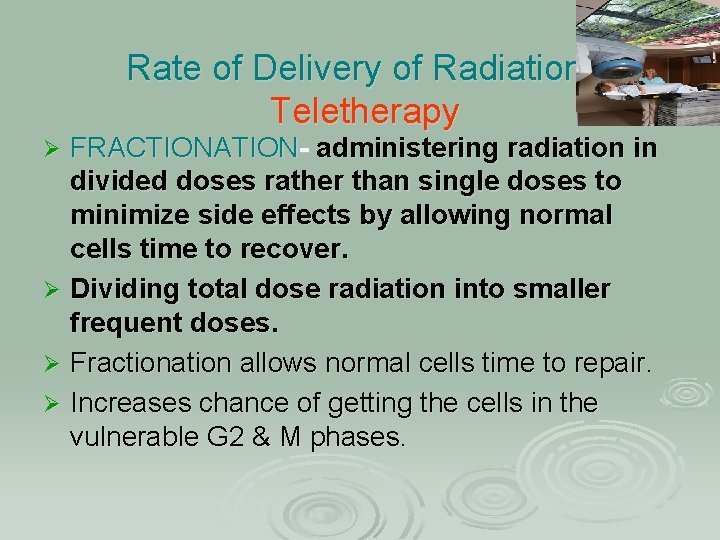
Rate of Delivery of Radiation: Teletherapy FRACTIONATION- administering radiation in divided doses rather than single doses to minimize side effects by allowing normal cells time to recover. Ø Dividing total dose radiation into smaller frequent doses. Ø Fractionation allows normal cells time to repair. Ø Increases chance of getting the cells in the vulnerable G 2 & M phases. Ø
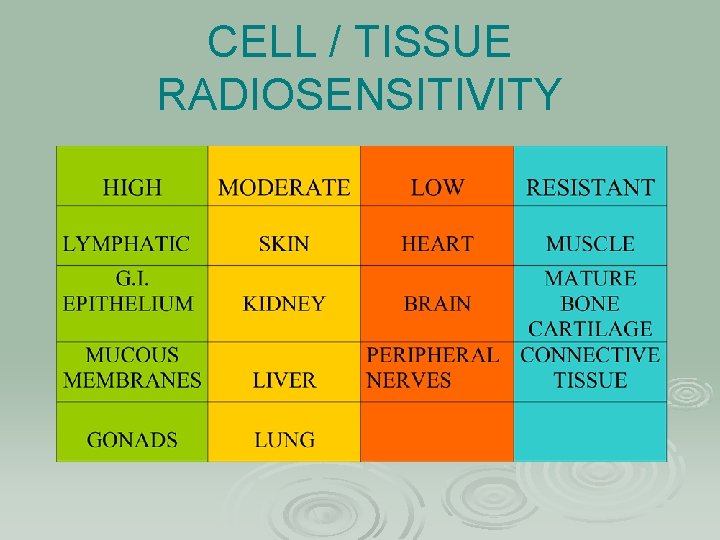
CELL / TISSUE RADIOSENSITIVITY
Chemical Modifiers: Compounds used to increase the radiosensitivity of tumor cells or protect normal cells from the effects of radiotherapy.
Types Chemical Modifiers: RADIOSENSITIZERS - INCREASE CELL KILL RADIOPROTECTORS- PROTECT CELLS
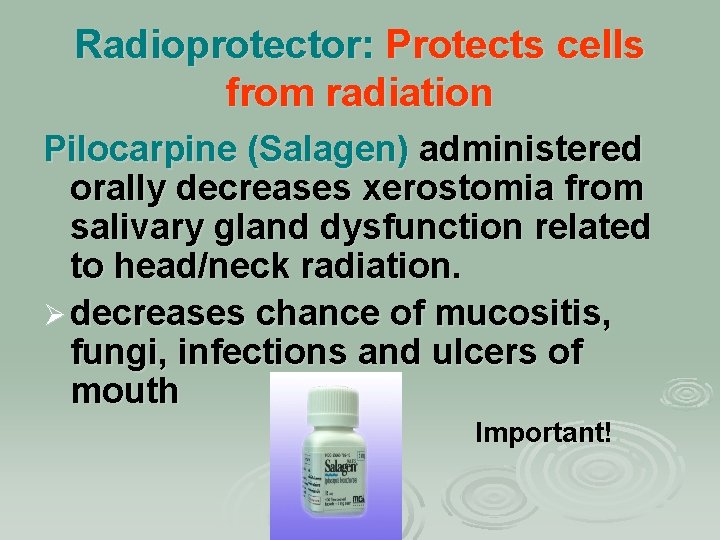
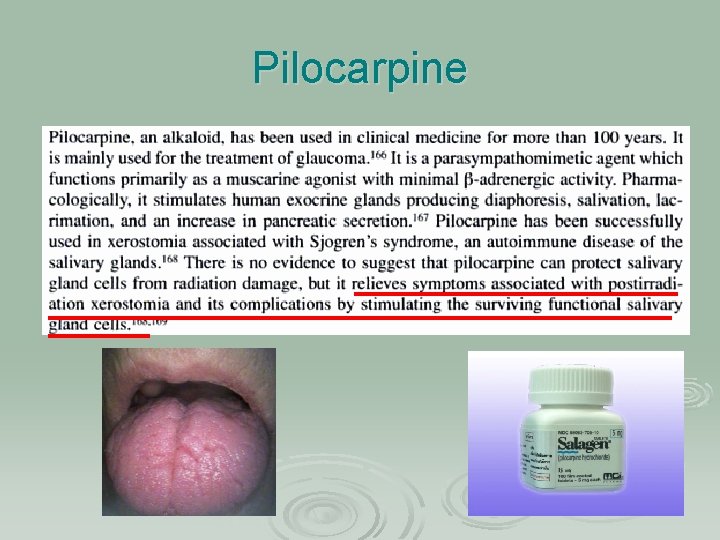
Radioprotector: Protects cells from radiation Pilocarpine (Salagen) administered orally decreases xerostomia from salivary gland dysfunction related to head/neck radiation. Ø decreases chance of mucositis, fungi, infections and ulcers of mouth Important!
Pilocarpine
Factors influencing degree & occurrence of side effects Radiotherapy: Body site irradiated Ø Dosage Ø Extent of body area treated Ø Method of radiation delivery Ø Age of client Ø General health of client Ø Previous surgeries & chemotherapy Ø Radiosensitivity of tissue/organ treated. Ø
Phases of Radiation Injury: Early (acute): occurs within weeks and resolve 4 -6 weeks post radiation. Usually temporary and effect tissue with rapidly dividing cells (skin, mucous membranes) Late Phase: may occur months/years later and usually result from damage to the microcirculation. Affect any/all tissues especially: lymph, thyroid, pituitary, breast, brain, bone, cartilage, pancreas and bile ducts.
SYMPTOM MANAGEMENT IN RADIATION ONCOLOGY
Symptom Management Ø Ø Ø Ø Ø Nausea & vomiting Diarrhea Xerostomia Ocular symptoms ( edema, dryness, photophia) Oral mucositis Alopecia Hyperthermia Headache Cystitis Esophagitis
Skin Reactions Acute or Chronic : Acute or Chronic Ø Acute: begin about 2 weeks after start of treatment and resolve over next 3 -4 weeks. Reactions include erythema, dry desquamation, wet desquamation Ø Chronic: may occur years later and include atrophy, pigment changes, fibrosis and telangiectasia.
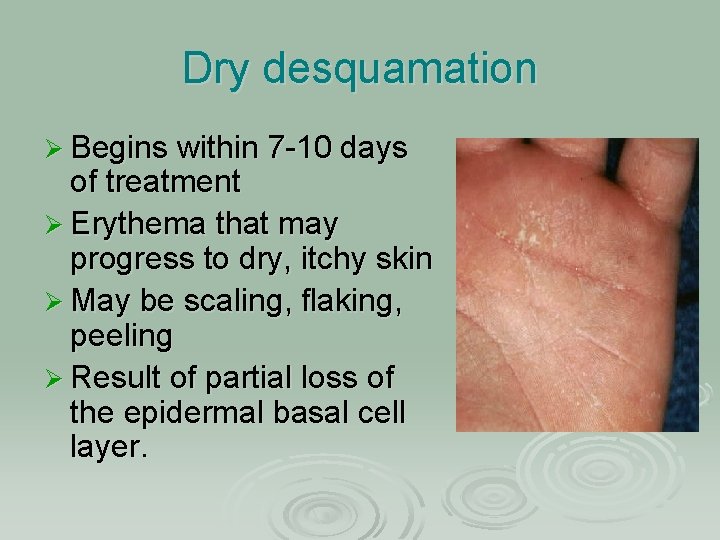
Dry desquamation Ø Begins within 7 -10 days of treatment Ø Erythema that may progress to dry, itchy skin Ø May be scaling, flaking, peeling Ø Result of partial loss of the epidermal basal cell layer.
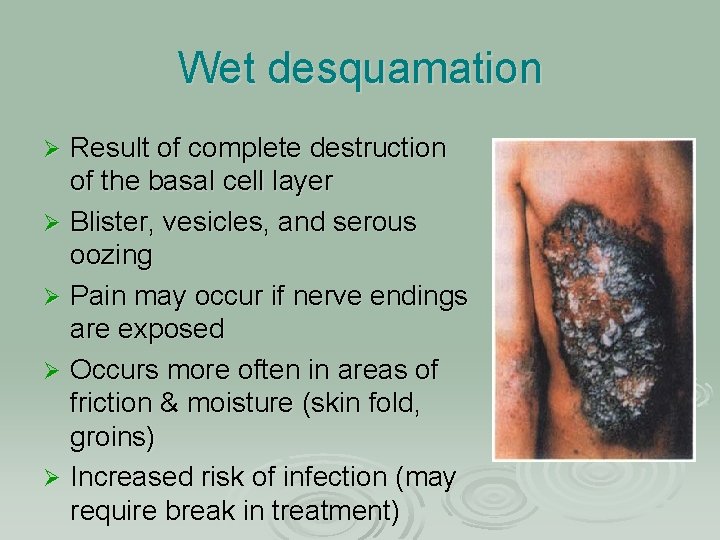
Wet desquamation Result of complete destruction of the basal cell layer Ø Blister, vesicles, and serous oozing Ø Pain may occur if nerve endings are exposed Ø Occurs more often in areas of friction & moisture (skin fold, groins) Ø Increased risk of infection (may require break in treatment) Ø
General Skin Care Radiation Client Ø Ø Ø Wash daily with water or mild scent-free soap (not dove as has creams added) Use hand to wash Rinse soap well If tatooing used so not to worry re washing simulation marks Pat skin dry No powders, ungs, creams unless ordered by Oncologist
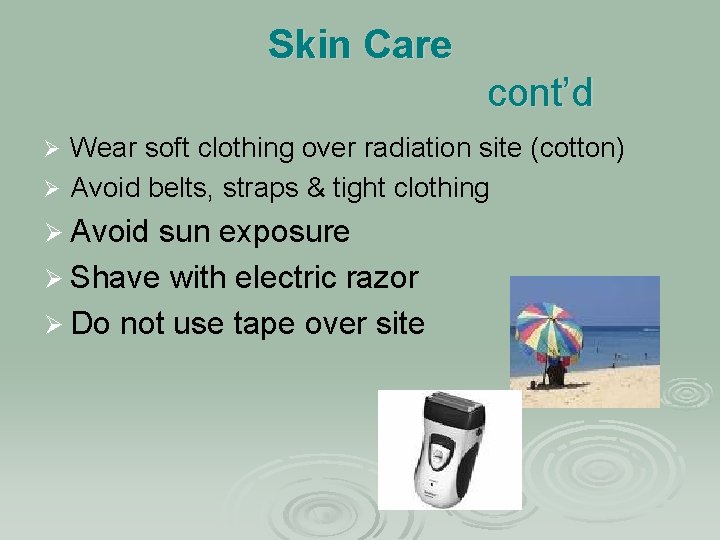
Skin Care cont’d Wear soft clothing over radiation site (cotton) Ø Avoid belts, straps & tight clothing Ø Ø Avoid sun exposure Ø Shave with electric razor Ø Do not use tape over site
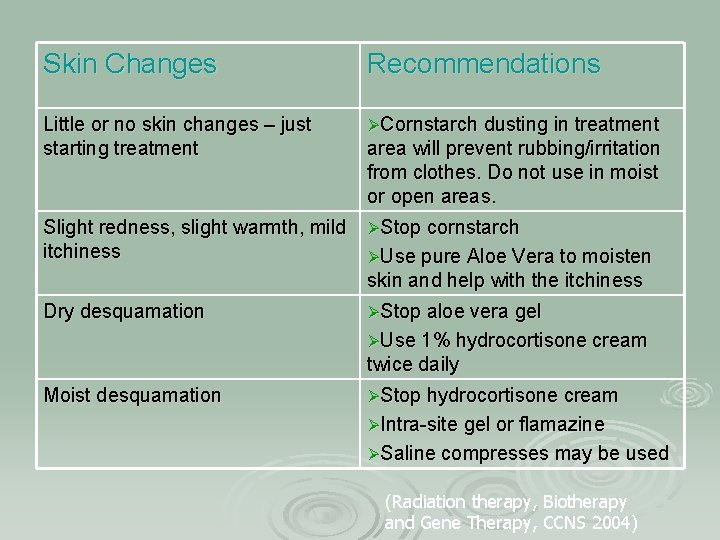
Skin Changes Recommendations Little or no skin changes – just starting treatment ØCornstarch dusting in treatment area will prevent rubbing/irritation from clothes. Do not use in moist or open areas. Slight redness, slight warmth, mild ØStop cornstarch itchiness ØUse pure Aloe Vera to moisten skin and help with the itchiness Dry desquamation ØStop aloe vera gel ØUse 1% hydrocortisone cream twice daily Moist desquamation ØStop hydrocortisone cream ØIntra-site gel or flamazine ØSaline compresses may be used (Radiation therapy, Biotherapy and Gene Therapy, CCNS 2004)
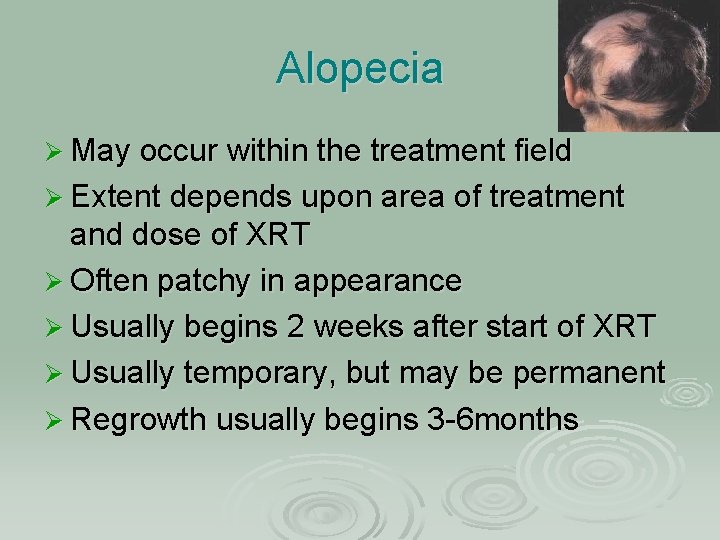
Alopecia Ø May occur within the treatment field Ø Extent depends upon area of treatment and dose of XRT Ø Often patchy in appearance Ø Usually begins 2 weeks after start of XRT Ø Usually temporary, but may be permanent Ø Regrowth usually begins 3 -6 months
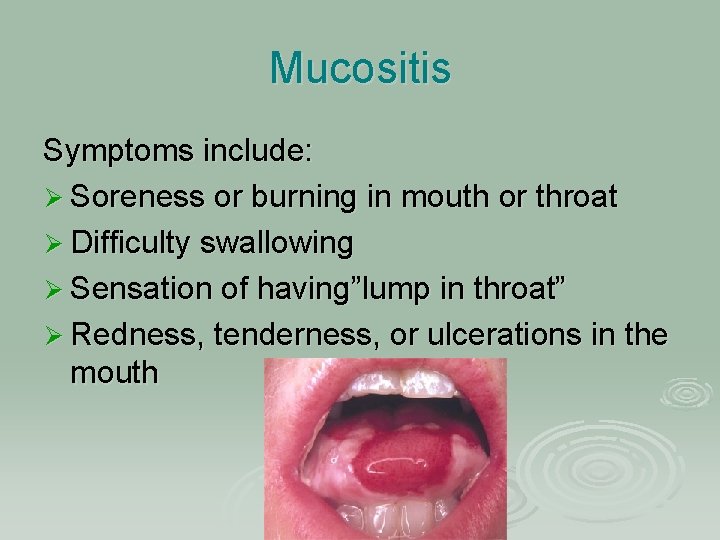
Mucositis Ø Inflammation of the mucosal lining of the G. I. tract Ø If oral cavity - stomatitis Ø If esophagus – esophagitis Ø Common in patients receiving XRT to head & neck Ø Severity depends on dose, size of field, and fractionation schedule of XRT
Mucositis Symptoms include: Ø Soreness or burning in mouth or throat Ø Difficulty swallowing Ø Sensation of having”lump in throat” Ø Redness, tenderness, or ulcerations in the mouth
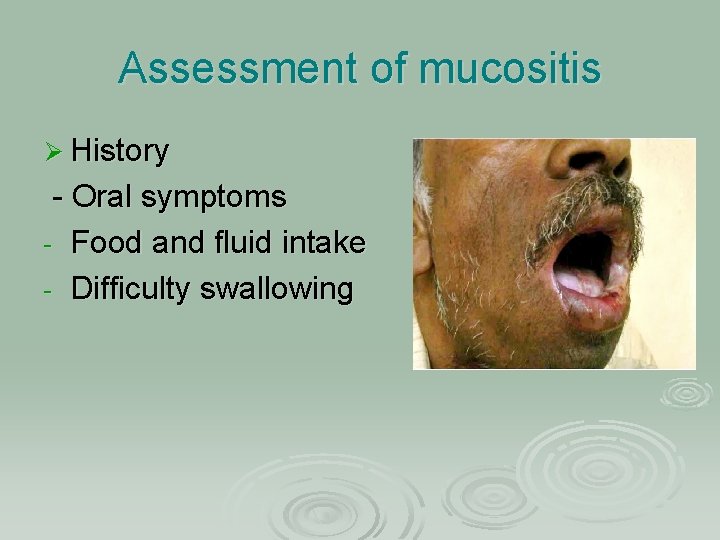
Assessment of mucositis Ø History - Oral symptoms - Food and fluid intake - Difficulty swallowing
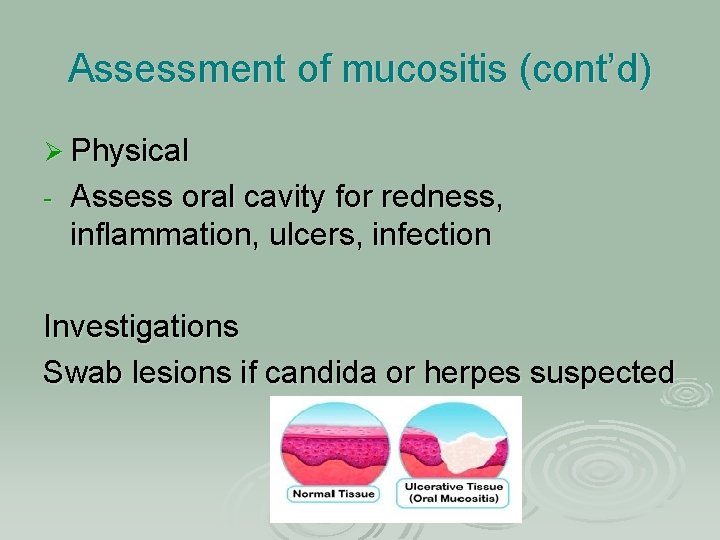
Assessment of mucositis (cont’d) Ø Physical - Assess oral cavity for redness, inflammation, ulcers, infection Investigations Swab lesions if candida or herpes suspected
General Interventions Ø Scrupulous oral care Ø Soft tooth brush Ø No commercial mouthwashes – use normal saline, club soda, or baking soda solution Ø No lemon and glycerin mouth swabs Ø Consider pain relief mouthwash Ø Soft, bland diet
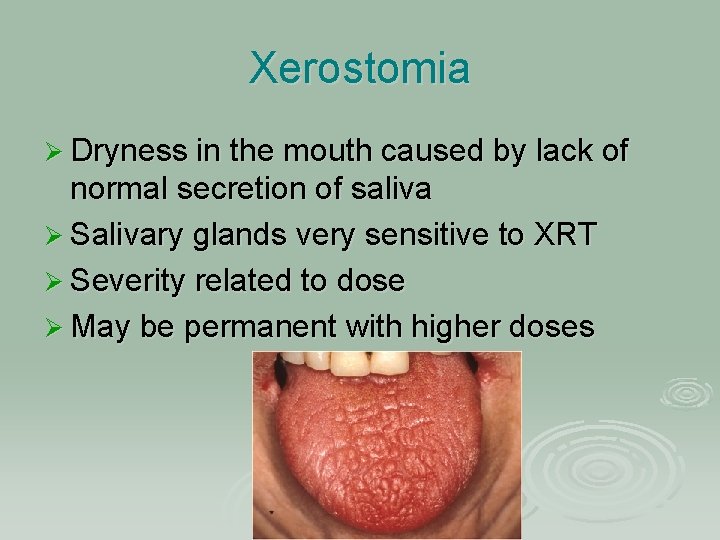
Xerostomia Ø Dryness in the mouth caused by lack of normal secretion of saliva Ø Salivary glands very sensitive to XRT Ø Severity related to dose Ø May be permanent with higher doses
Xerostomia Ø Lack of moisture to mucosa causes irritation to the mucosa, fissures may develop on the corners of the mouth Ø Xerostomia promotes accumulation of bacteria and plaque increasing susceptibility to infection, dental caries, and peridontal disease
Xerostomia Interventions Good oral hygiene Ø Frequent sips water, sugarless gum, avoid dry foods, liquids with meals Ø Avoid alcohol and smoking Ø Humidifier Ø Artificial saliva i. e. Moistir ac meals, hs, & prn Ø Pilocarpine for radiation induced xerostomia Ø
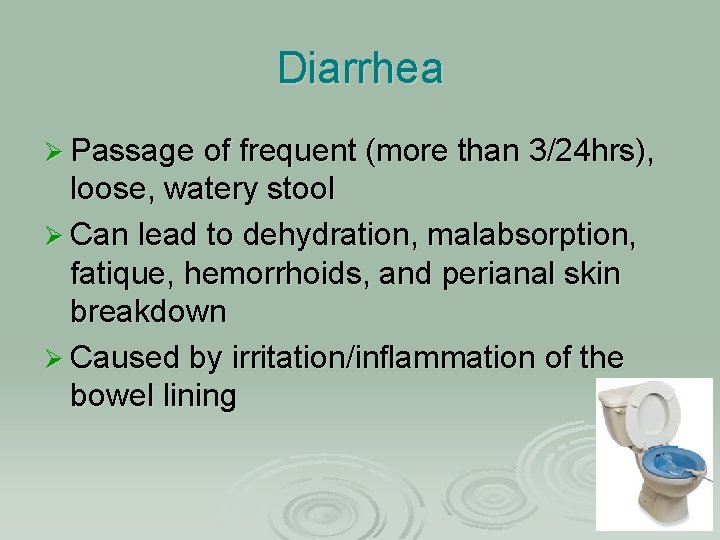
Diarrhea Ø Passage of frequent (more than 3/24 hrs), loose, watery stool Ø Can lead to dehydration, malabsorption, fatique, hemorrhoids, and perianal skin breakdown Ø Caused by irritation/inflammation of the bowel lining
Risk for Diarrhea Ø Higher in patients undergoing chemo or XRT to abdomen or pelvis Ø With XRT usually develops 10 -15 days into treatment Ø Lasts 2 -3 weeks after treatment
Assessment of Diarrhea Ø History - onset, pattern, number of B. M. ’s/24 hrs. Ø Physical – vital signs, abdominal assess. , hydration status Ø Psychological – anxiety, stress Ø Investigations – serum electrolytes, creatinine & urea, stool cultures & stool for c. difficile
Interventions Ø Radiation induced diarrhea usually - managed initially with dietary changes Small freq. meals Drink 8 -10 glasses of fluids Low fat, low fiber diet Avoid gas producing foods Avoid caffeinated beverages
Interventions cont’d Ø Loperamide – if patient has more than 3 watery B. M. ’s per day Ø Protect peri-anal area form skin breakdown - Keep area clean and dry - Sitz bathes several times a day can ease discomfort
Other complications radiation treatment Ø Cystitis (usually occurs 1 -2 weeks post XRT and subsides 2 weeks after XRT complete Ø Lhermitte’s syndrome – after spinal cord radiation Ø Vaginal stenosis – after XRT to pelvis Ø Radiation pneumonitis – after XRT to lungs