
UNIT IV MICROMERITICS By Ms Santoshi Naik Assistant

UNIT –IV MICROMERITICS By: Ms. Santoshi Naik Assistant Professor Yenepoya Pharmacy College and Research Centre
Introduction Is a branch of science which involves the study of small particles which are of the order of few micrometer size.

• Particle size is expressed in micrometers �� m (formerly called as microns �� ). • They are classified as follows: Particle size (�� ) Examples 0. 5 - 10 Suspension, fine emulsion, bacteria, RBC’s 10 - 50 50 - 100 Coarse emulsion, WBC’s, flocculated suspension Fine powders 100 - 1000 Coarse powders 1000 - 3000 Granules
• Particles are characterised by the following properties: a) Fundamental properties - size & shape b) Derived properties - volume, density & flow

As particle size decreases-----Surface Area increases
Applications of Micromeritics All dosage forms at some point involve the use of particle technology in their manufacture. 1) Release and dissolution 2) Absorption and drug action 3) Physical stability 4) Dose uniformity 5) Packaging for dosage form
Particle characteristics Size Shape
Particle Size • Particle size is described in radius or diameter. • Size of the particles may be expressed as follows: • Surface diameter , ds is the diameter of a sphere having the same surface area as the assymetric particle. • Volume diameter, dv is the diameter of a sphere having the same volume as the assymetric particle. • Projected diameter, dp is the diameter of a sphere having the same area as the assymetric particle as observed under a microscope.
• Stokes diameter, dst is the diameter which describes an equivalent sphere undergoing sedimentation at the same rate as the asymmetric particle. • Sieve diameter, dsieve is the diameter of a sphere that passes through the same sieve aperture as the assymetric particle. • Volume surface diameter, dvs is the diameter of a sphere that has same volume to surface area ratio as the assymetric particle.
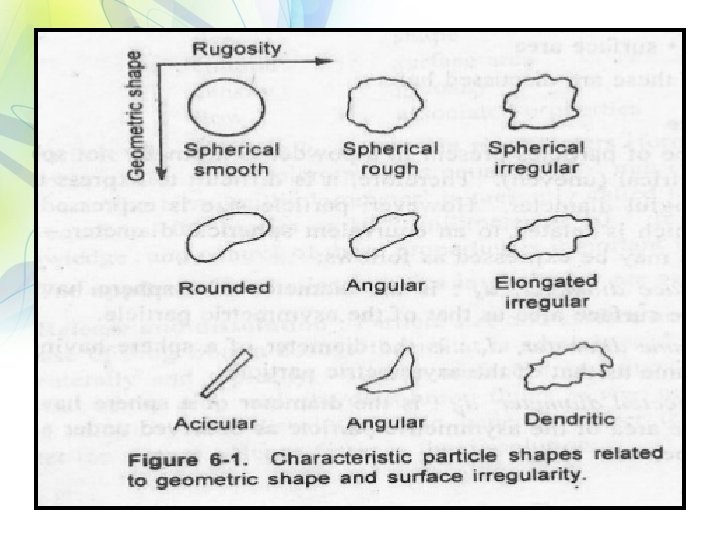
Particle shape • Particle shape is related to geometric shape and surface regularity (rugosity). • Particle shape influences the surface area, flow of particles, packing and compaction properties of the particles. • Spherical particles exhibit better flow than irregularly shaped particles.

POWDER - CHARACTERISTICS Fundamental properties • Powder size • Particle number Derived properties • Surface area • Volume • Density • Porosity • Flow properties
Powder size: can be calculated by measuring mean, median and mode 1) Mean - average particle size Ø Arithmetic mean- Sum of the particle size divided by number of particles. Ø Geometric mean – is the nth root of product of n numbers.
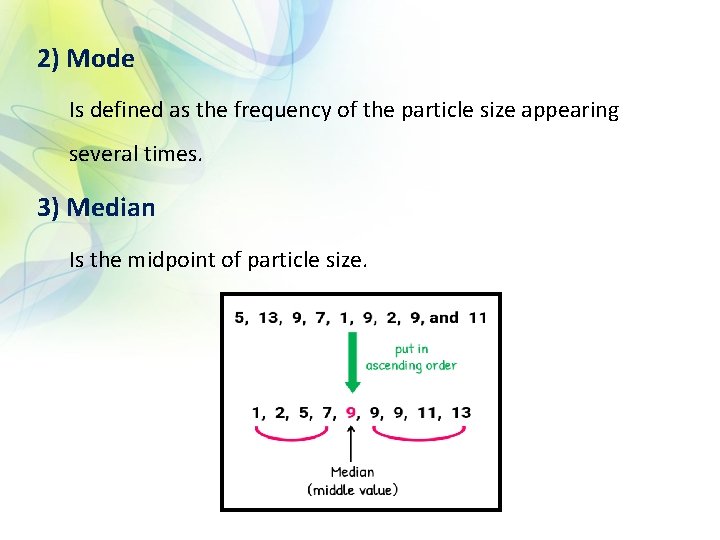
2) Mode Is defined as the frequency of the particle size appearing several times. 3) Median Is the midpoint of particle size.
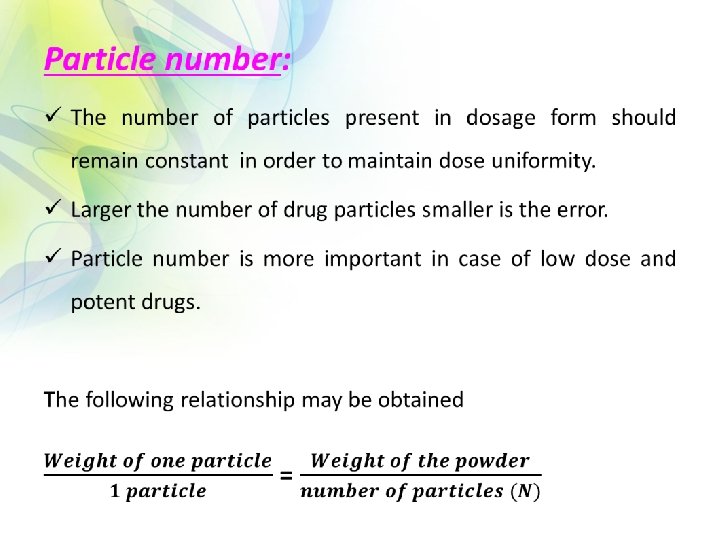

Particle size distribution • All powders are polydispersed (mixture of different size particles). • Particle size distribution is expressed as: a) Number of particles lying within a certain size range - Microscopy. b) Weight of particles lying within a certain size range – sedimentation or sieving techniques
Distribution curves 1) Frequency distribution curve 2) Number frequency distribution curve 3) Weight distribution frequency curve 4) Log – Normal Distribution curve 5) Cumulative Frequency Distribution curve 6) Log Probability plot
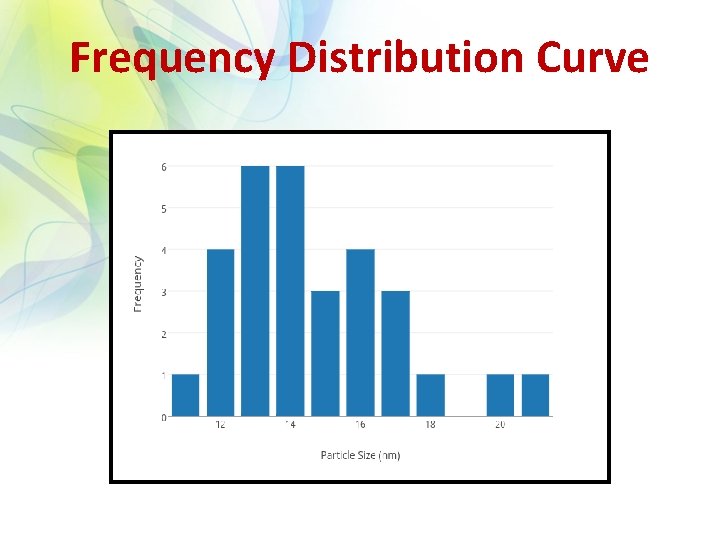
Frequency Distribution Curve

Number Frequency Distribution Curve
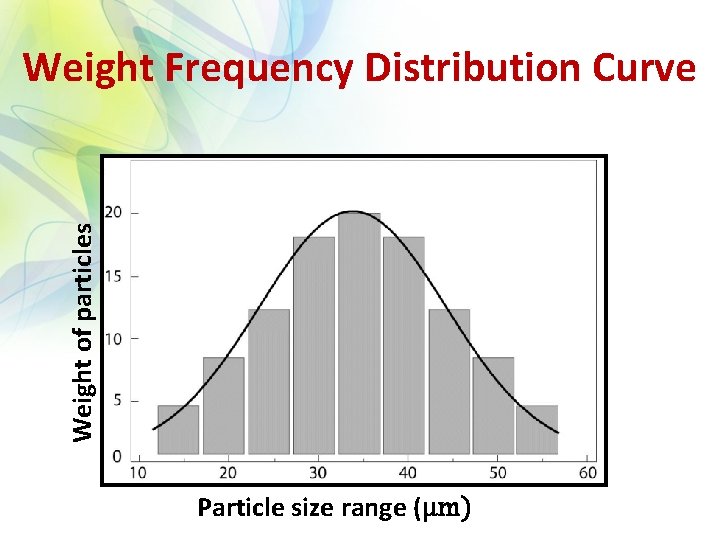
Weight of particles Weight Frequency Distribution Curve Particle size range (μm)
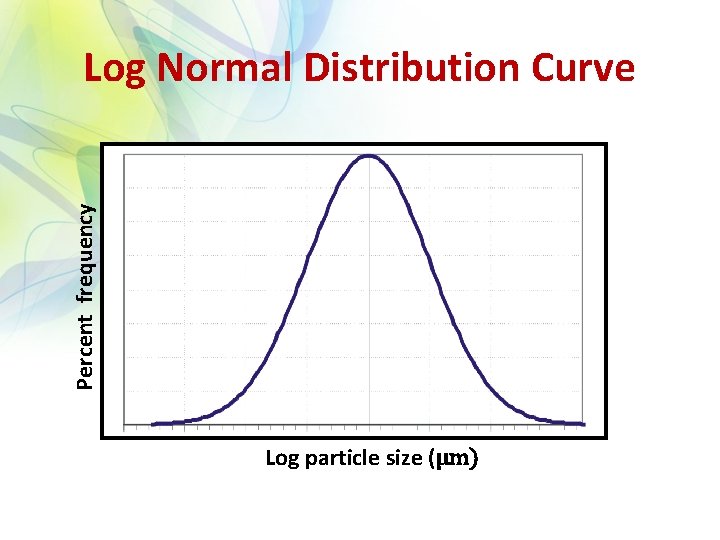
Percent frequency Log Normal Distribution Curve Log particle size (μm)
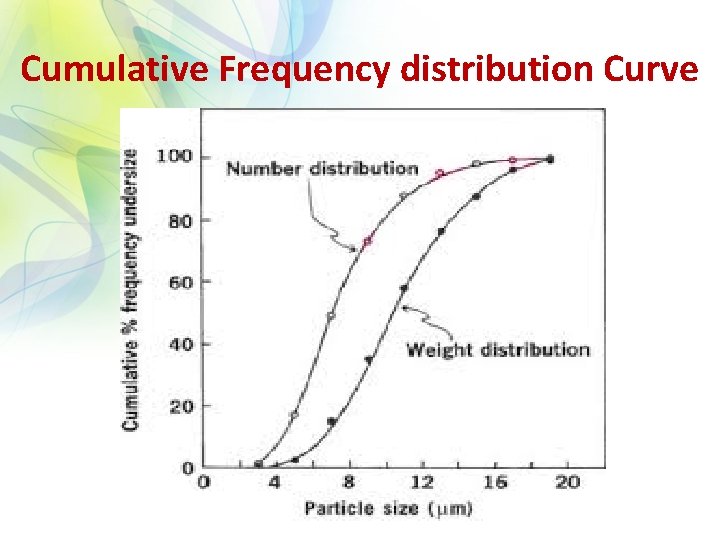
Cumulative Frequency distribution Curve
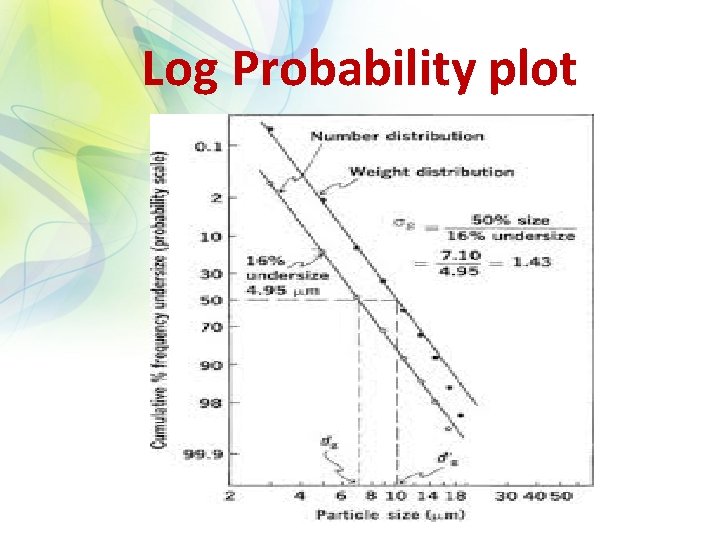
Log Probability plot
PARTICLE SIZE DETERMINATION METHODS
• Methods to determine particle size are: a) Optical microscopy b) Sieving method c) Sedimentation method d) Conductivity method
Optical microscopy • Particle size in the range of 0. 2 – 100 �� m can be estimated. • Particle size is expressed as dp (projected diameter). • It is used to estimate particle size of suspension, emulsions and aerosols.
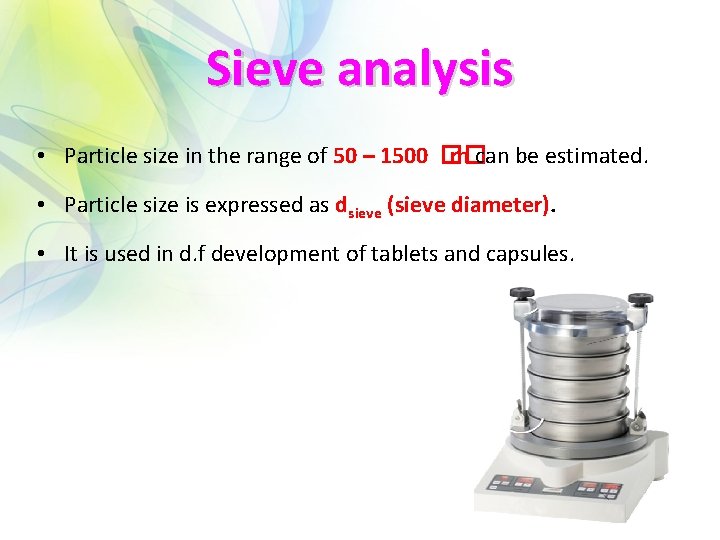
Sieve analysis • Particle size in the range of 50 – 1500 �� m can be estimated. • Particle size is expressed as dsieve (sieve diameter). • It is used in d. f development of tablets and capsules.
Sedimentation method • Particle size in the range of 1 – 200 �� m can be estimated. • Particle size is expressed as dst (stokes diameter). • Sedimentation of particles may be evaluated by Andreason pipette method, balance method and hydrometer method. • Sedimentation method is used in formulation and evaluation of suspension, emulsions and in determination of molecular weight of polymers.
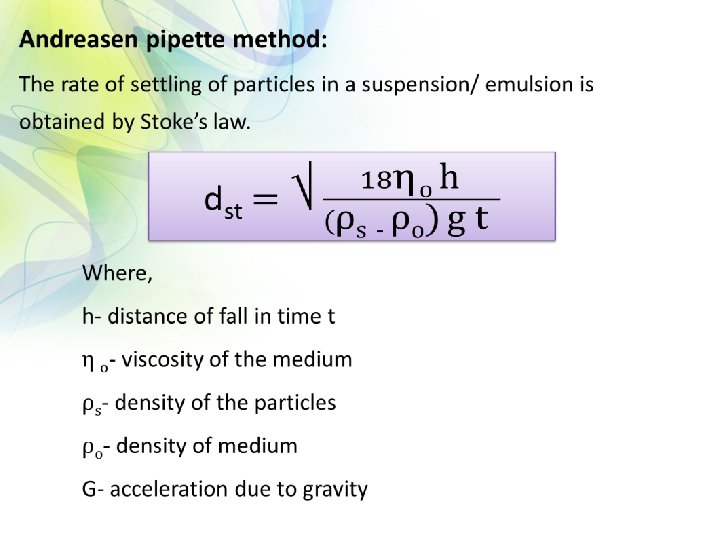
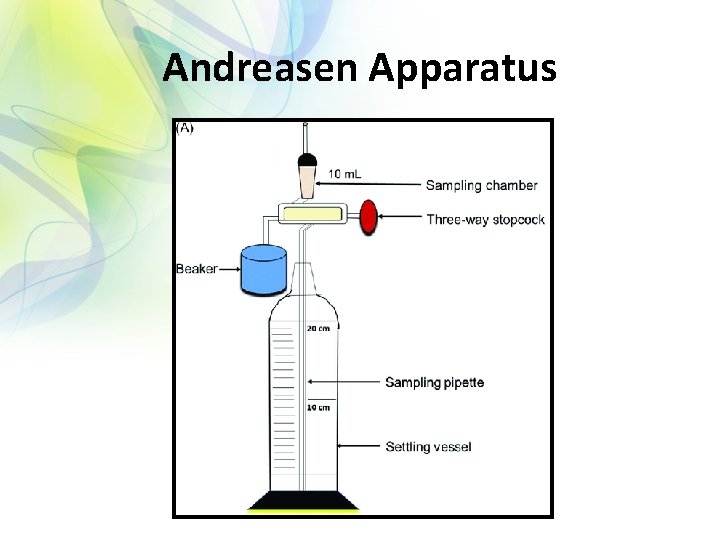
Andreasen Apparatus
Conductivity method • Particle size in the range of 0. 5– 500 �� m can be estimated. • Particle size is expressed as dv (volume diameter). • This method is used in study of particle growth in suspension, effect of antibacterial agents and dissolution of drugs in medium. • Coulter counter apparatus is used to measure the particle volume

Coulter counter apparatus
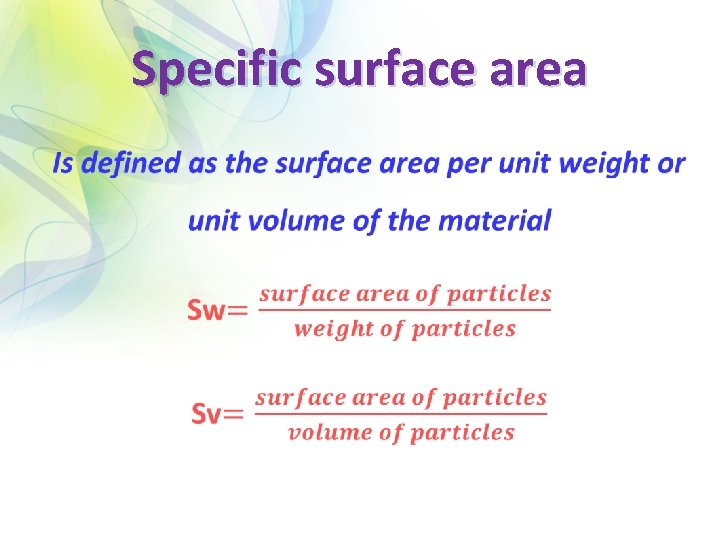
Specific surface area •
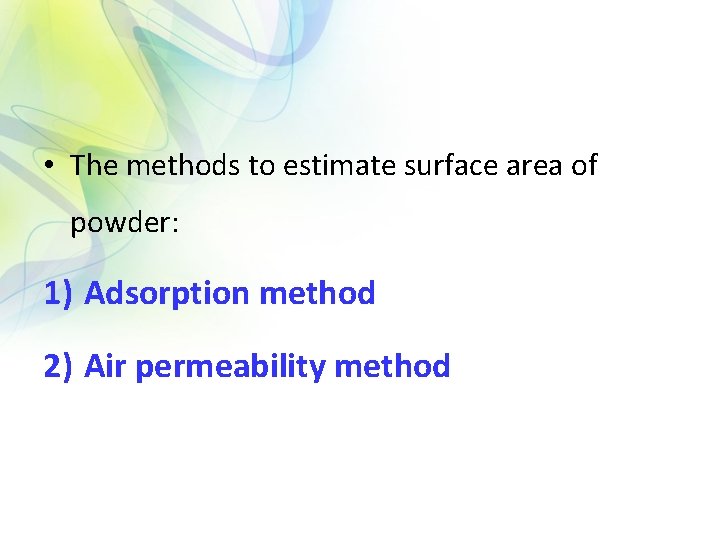
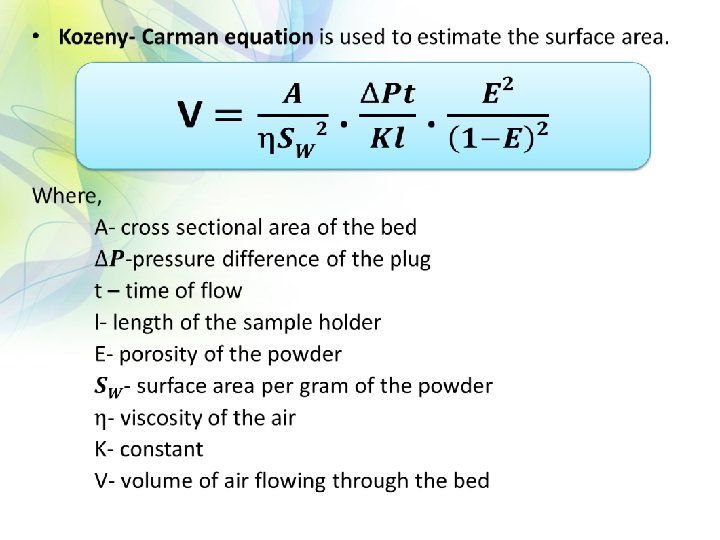
• The methods to estimate surface area of powder: 1) Adsorption method 2) Air permeability method
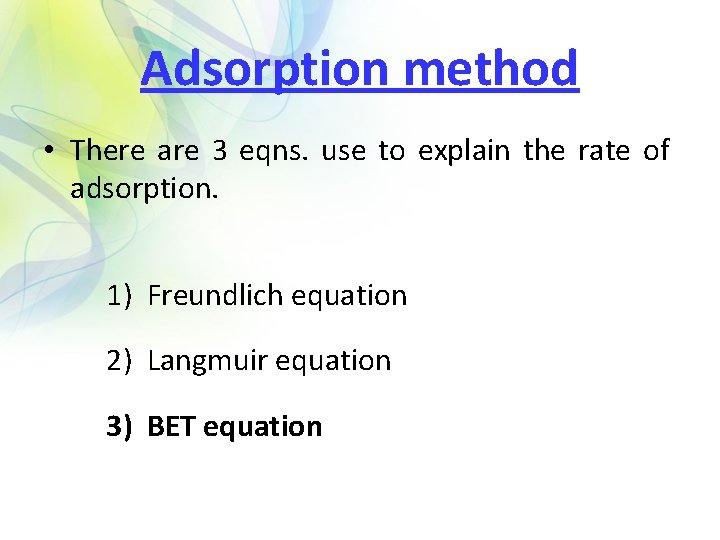
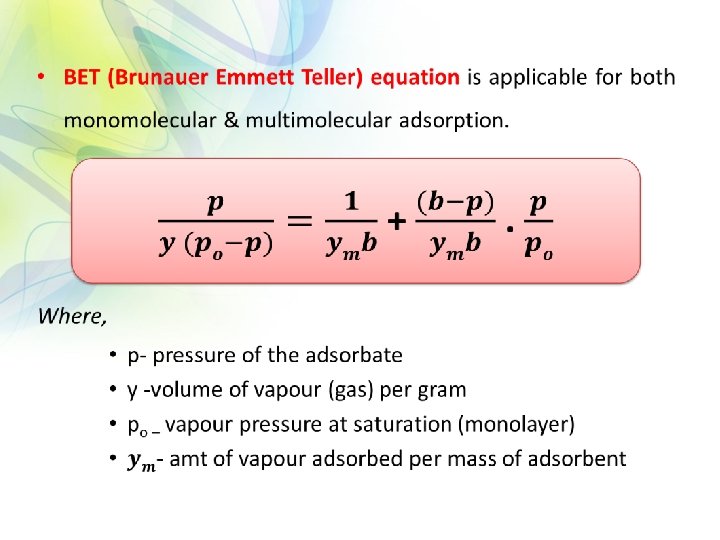
Adsorption method • There are 3 eqns. use to explain the rate of adsorption. 1) Freundlich equation 2) Langmuir equation 3) BET equation
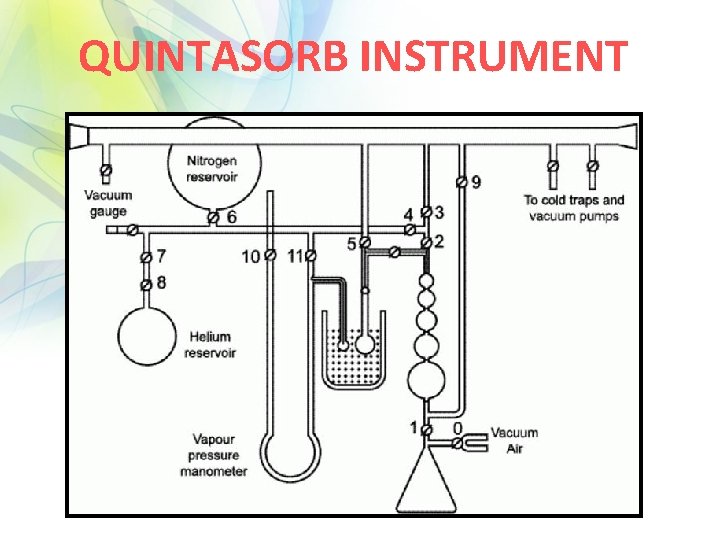
QUINTASORB INSTRUMENT
Air Permeability method: Fisher Subsieve Sizer • This method is official in IP. • It is also use to estimate the surface diameter (ds).
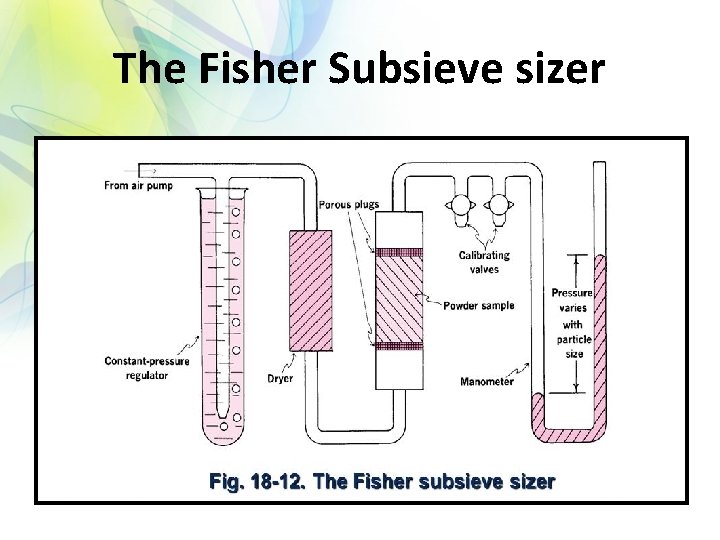
The Fisher Subsieve sizer

DERIVED PROPERTIES OF POWDER
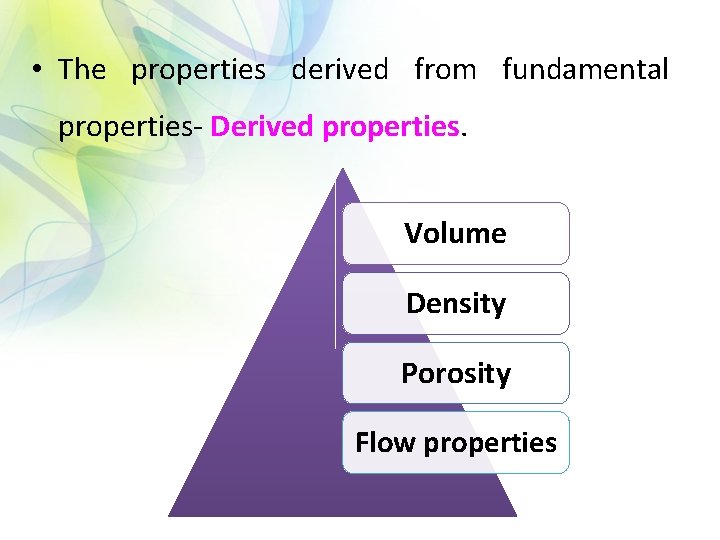
• The properties derived from fundamental properties- Derived properties. Volume Density Porosity Flow properties
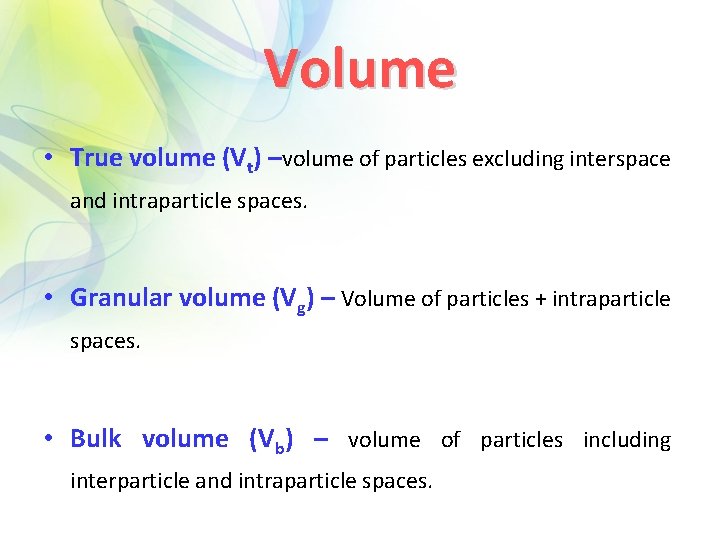
Volume • True volume (Vt) –volume of particles excluding interspace and intraparticle spaces. • Granular volume (Vg) – Volume of particles + intraparticle spaces. • Bulk volume (Vb) – volume of particles including interparticle and intraparticle spaces.
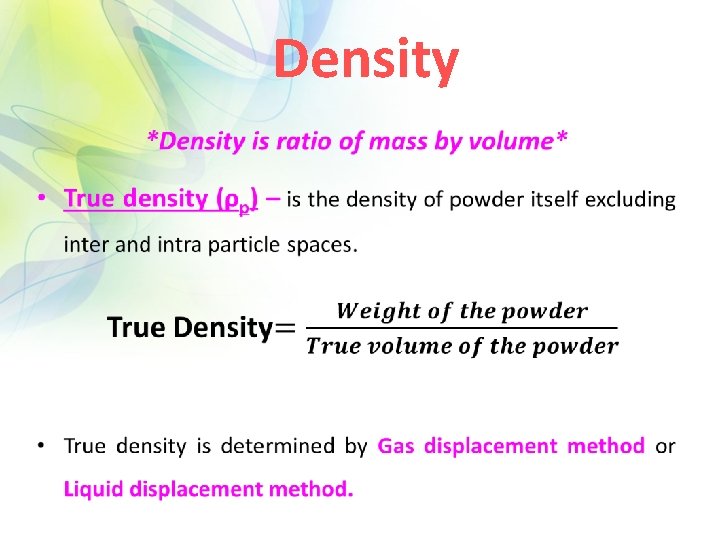
Density •
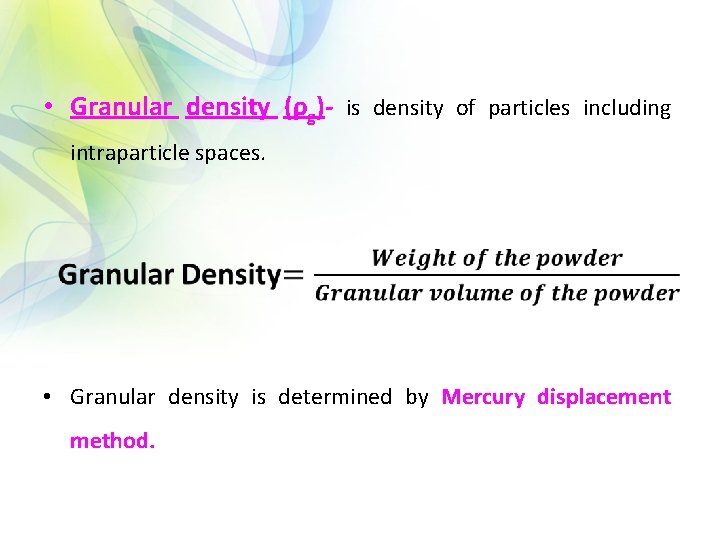
• Granular density (ρg)- is density of particles including intraparticle spaces. • Granular density is determined by Mercury displacement method.
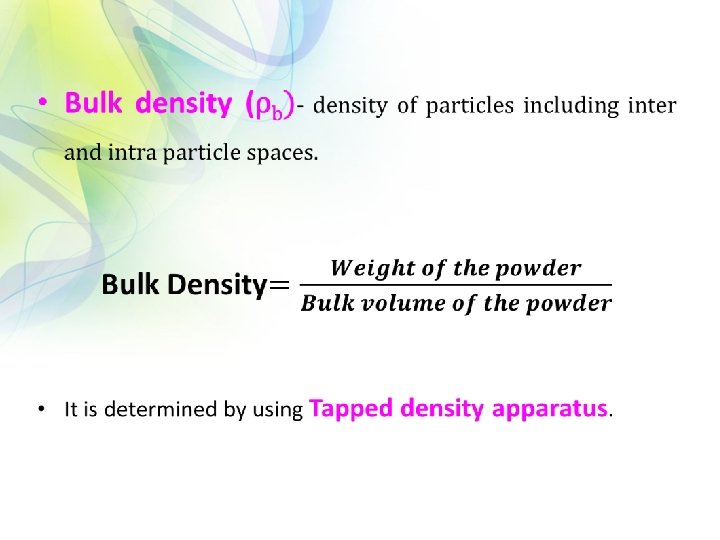
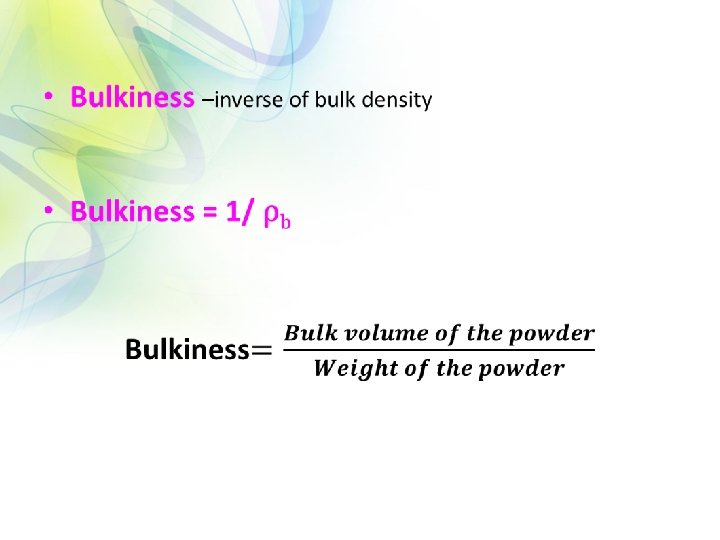
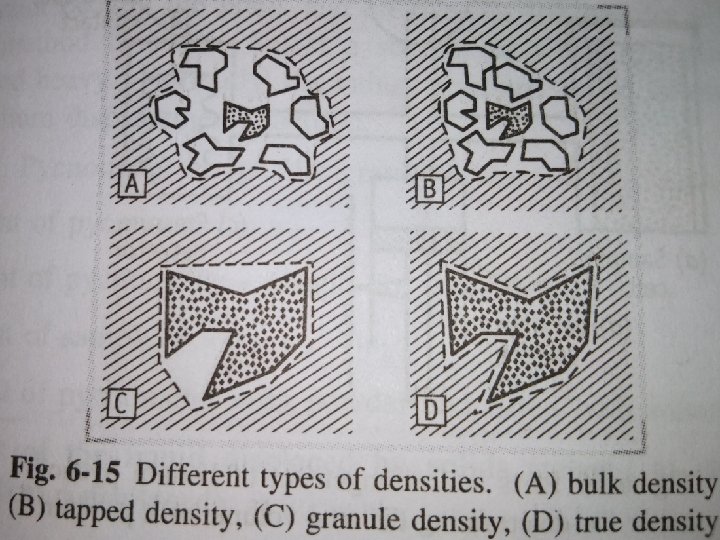
Porosity • Porosity is the total space which is present in a collection of powder and it is given as E and calculated in terms of percentage. • Porosity depends on packing • It varies from 26% in closest packing to 48 % in loosest packing.
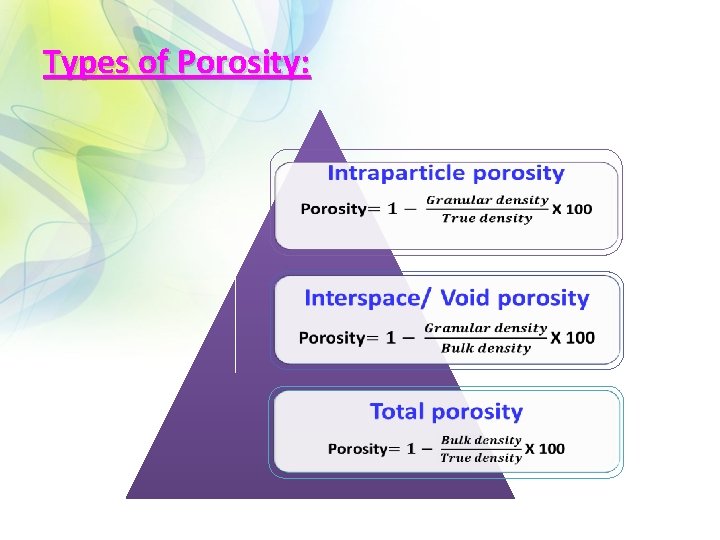
Types of Porosity:
Packing Arrangement • If particles are of uniform size of spheres then 2 types of packing is possible: 1) Closest or rhombohedral packing 2) Most open or loosest or cubic packing
• If Porosity of powder (spherical particles) is 26% - closed packing. • If Porosity of powder (spherical particles) is 48% - loose packing. • In general porosities of powder is between 30% - 50%. • Porosities below 30% - particles differ in size distribution. • Porosities above 50% - particles are aggregated and flocculated.
Flow properties of powder • Flowability is the ability of the powder to flow through reliably. • Flow properties influences mixing and demixing of powders. • It also influences the design of formulation and selection of process equipment.
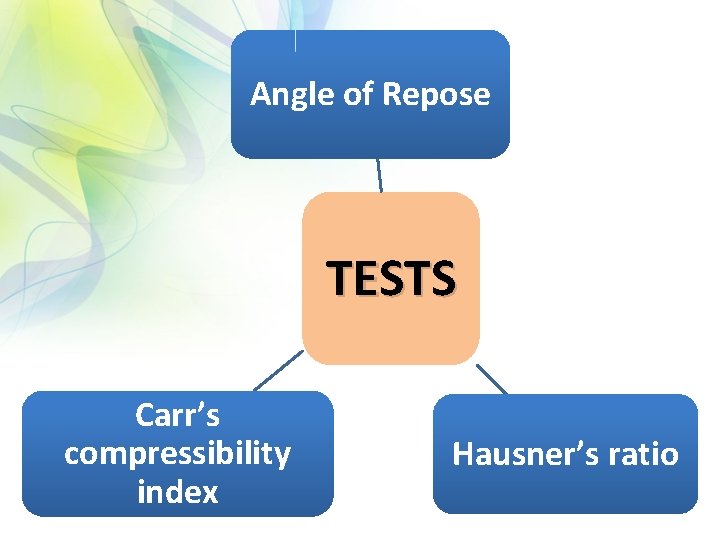
Angle of Repose TESTS Carr’s compressibility index Hausner’s ratio
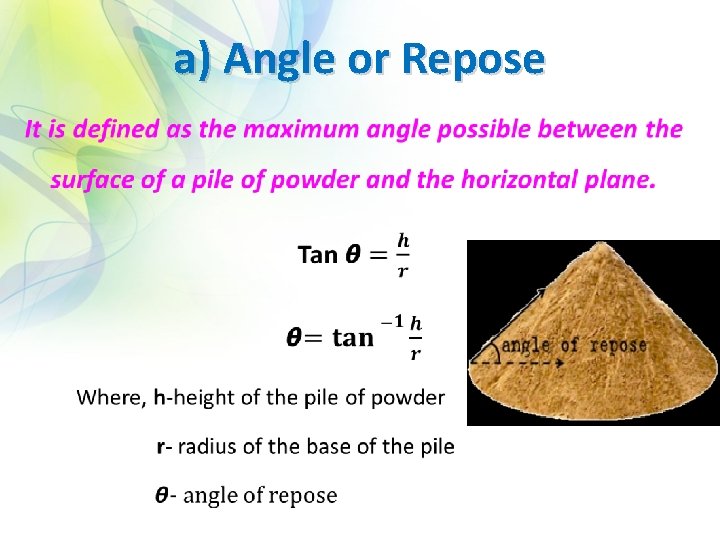
a) Angle or Repose •
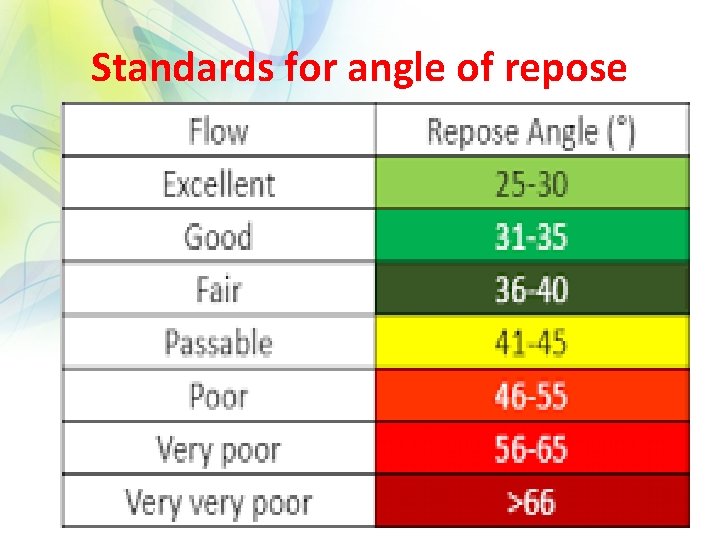
Standards for angle of repose
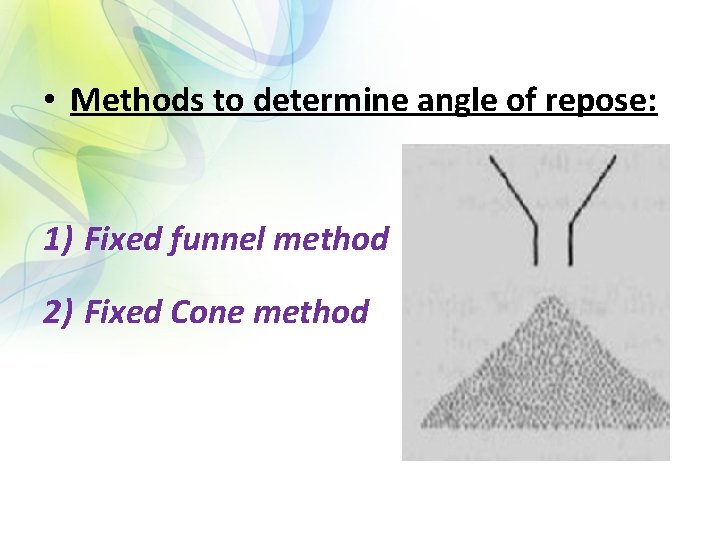
• Methods to determine angle of repose: 1) Fixed funnel method 2) Fixed Cone method
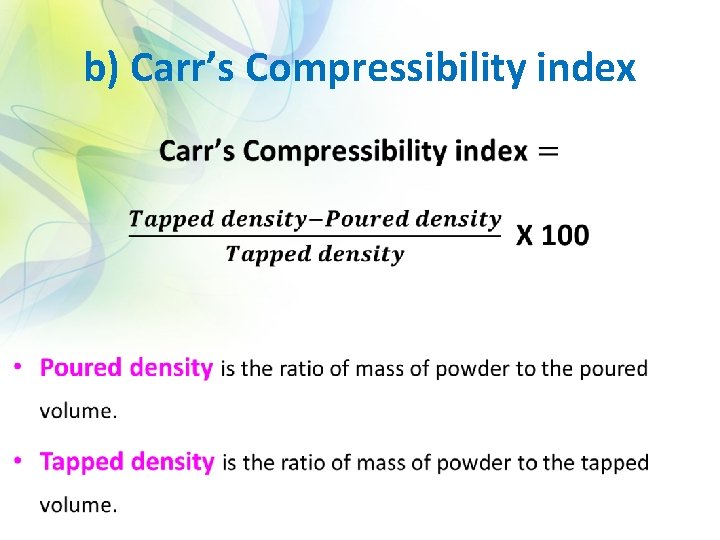
b) Carr’s Compressibility index •

c) Hausner’s ratio •
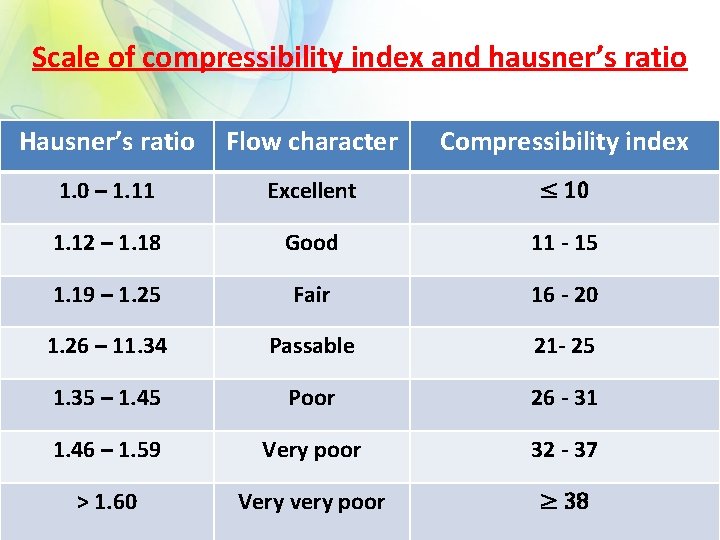
Scale of compressibility index and hausner’s ratio Hausner’s ratio Flow character Compressibility index 1. 0 – 1. 11 Excellent ≤ 10 1. 12 – 1. 18 Good 11 - 15 1. 19 – 1. 25 Fair 16 - 20 1. 26 – 11. 34 Passable 21 - 25 1. 35 – 1. 45 Poor 26 - 31 1. 46 – 1. 59 Very poor 32 - 37 > 1. 60 Very very poor ≥ 38
Factors affecting the flow properties of powder 1. Alteration of Particle’s size & Distribution 2. Alteration of Particle shape & texture 3. Alteration of Surface Forces 4. Formulation additives (Flow activators)

THANK YOU
- Slides: 62