
Unit IV Capital Structure Cardinal Principles of Capital
- Slides: 26
Unit – IV Capital Structure – Cardinal Principles of Capital structure – trading on equity- cost of capital- concept- importance- calculation of individual and composite cost of capital. 1
The term ‘structure’ means the arrangement of the various parts. Capital structure means the arrangement of capital from different sources so that the long term funds needed for the business are raised. Capital structure refers to the proportions or combinations of equity share capital, preference share capital, debentures, longterm loans, retained earnings and other long-term sources of funds in the total amount of capital which a firm should raise to run its business. Decisions relating to financing the assets of a firm are very crucial in every business. The finance manager is regularly fixed in the difficulty of what the optimum proportion of debt and equity. As a general rule, there should be a proper mix of debt and equity capital in financing the firm’s assets. Capital structure is usually considered to serve the interest of the equity shareholders. 2
Meaning of Capital Structure: 1. Gerestenberg, ‘Capital structure of a company refers to the composition or make up of its capitalization and it includes all long term capital resources viz. , loans, reserves, shares and bonds’. 2. Keown et al. defined capital structure as, ‘balancing the array of funds sources in a proper manner, i. e. in relative magnitude or in proportions’. 3. P. Chandra, ‘capital structure is essentially concerned with how the firm decides to divide its cash flows into two broad components, a fixed component that is earmarked to meet the obligations toward debt capital and a residual component that belongs to equity shareholders’. 4. John J. Hampton Capital structure is the combination of debt and equity securities that comprise a firm’s financing of its assets. ” 5. I. M. Pandey “Capital structure refers to the mix of long-term sources of funds, such as, debentures, long-term debts, preference share capital and equity share capital including reserves and surplus. ” 3
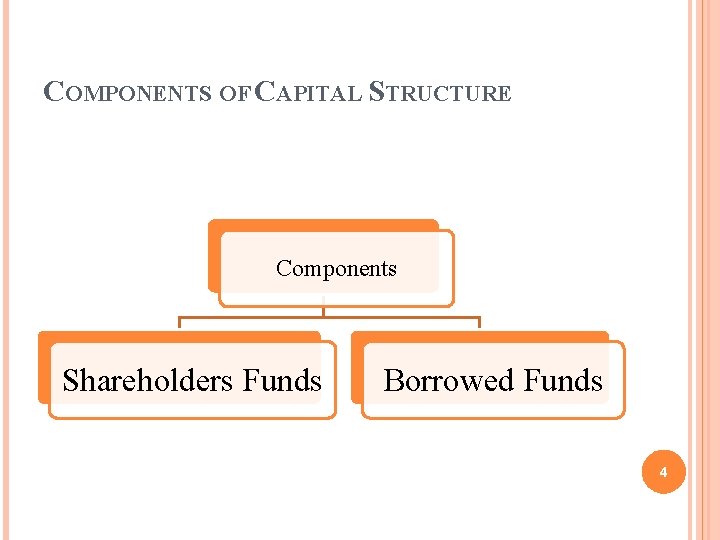
COMPONENTS OF CAPITAL STRUCTURE Components Shareholders Funds Borrowed Funds 4
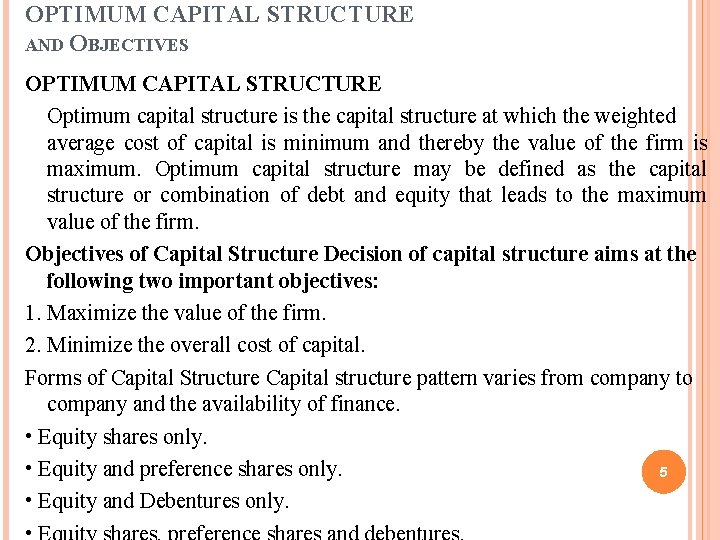
OPTIMUM CAPITAL STRUCTURE AND OBJECTIVES OPTIMUM CAPITAL STRUCTURE Optimum capital structure is the capital structure at which the weighted average cost of capital is minimum and thereby the value of the firm is maximum. Optimum capital structure may be defined as the capital structure or combination of debt and equity that leads to the maximum value of the firm. Objectives of Capital Structure Decision of capital structure aims at the following two important objectives: 1. Maximize the value of the firm. 2. Minimize the overall cost of capital. Forms of Capital Structure Capital structure pattern varies from company to company and the availability of finance. • Equity shares only. • Equity and preference shares only. 5 • Equity and Debentures only.
CAPITAL STRUCTURE THEORIES Capital structure is the major part of the firm’s financial decision which affects the value of the firm and it leads to change EBIT and market value of the shares. There is a relationship among the capital structure, cost of capital and value of the firm. The aim of effective capital structure is to maximize the value of the firm and to reduce the cost of capital. There are two major theories explaining the relationship between capital structure, cost of capital and value of the firm. 6
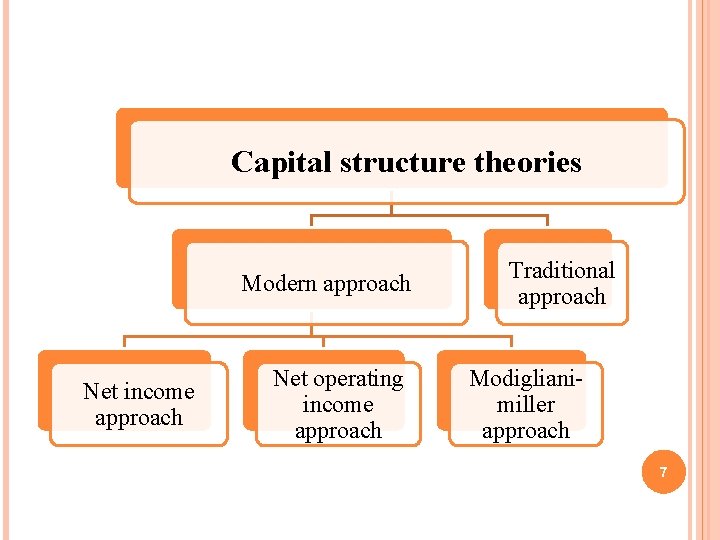
Capital structure theories Modern approach Net income approach Net operating income approach Traditional approach Modiglianimiller approach 7
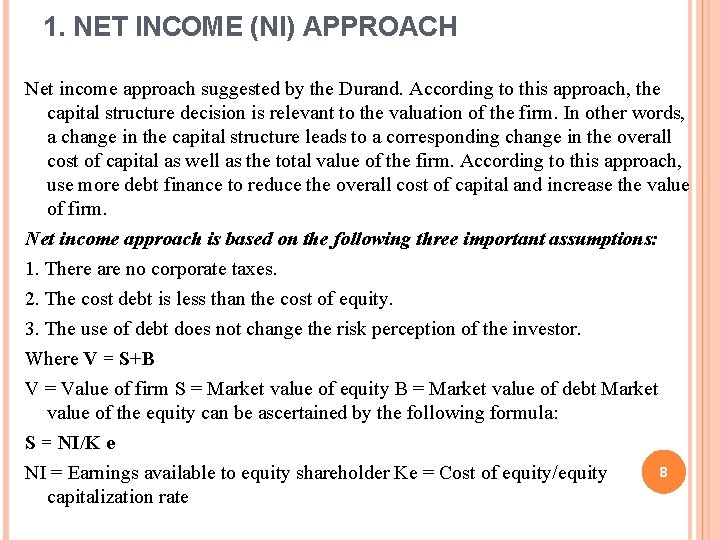
1. NET INCOME (NI) APPROACH Net income approach suggested by the Durand. According to this approach, the capital structure decision is relevant to the valuation of the firm. In other words, a change in the capital structure leads to a corresponding change in the overall cost of capital as well as the total value of the firm. According to this approach, use more debt finance to reduce the overall cost of capital and increase the value of firm. Net income approach is based on the following three important assumptions: 1. There are no corporate taxes. 2. The cost debt is less than the cost of equity. 3. The use of debt does not change the risk perception of the investor. Where V = S+B V = Value of firm S = Market value of equity B = Market value of debt Market value of the equity can be ascertained by the following formula: S = NI/K e 8 NI = Earnings available to equity shareholder Ke = Cost of equity/equity capitalization rate
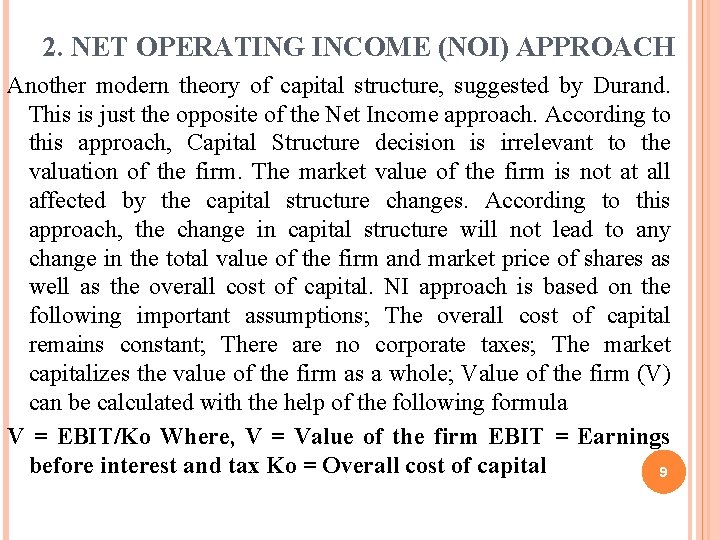
2. NET OPERATING INCOME (NOI) APPROACH Another modern theory of capital structure, suggested by Durand. This is just the opposite of the Net Income approach. According to this approach, Capital Structure decision is irrelevant to the valuation of the firm. The market value of the firm is not at all affected by the capital structure changes. According to this approach, the change in capital structure will not lead to any change in the total value of the firm and market price of shares as well as the overall cost of capital. NI approach is based on the following important assumptions; The overall cost of capital remains constant; There are no corporate taxes; The market capitalizes the value of the firm as a whole; Value of the firm (V) can be calculated with the help of the following formula V = EBIT/Ko Where, V = Value of the firm EBIT = Earnings before interest and tax Ko = Overall cost of capital 9
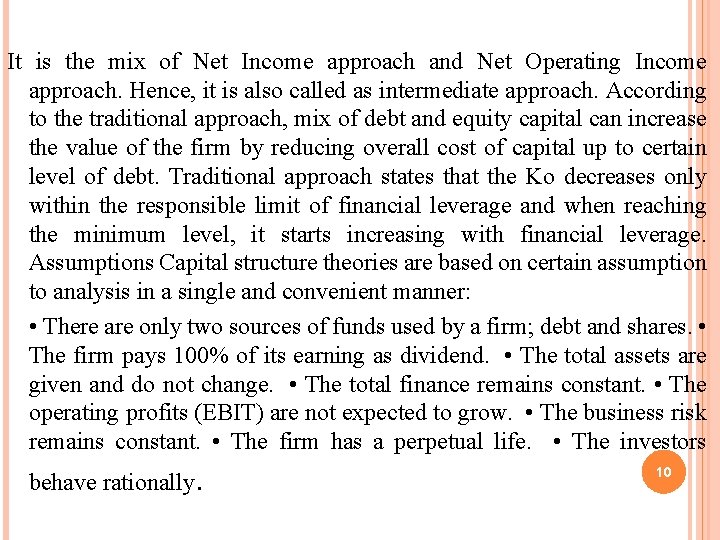
It is the mix of Net Income approach and Net Operating Income approach. Hence, it is also called as intermediate approach. According to the traditional approach, mix of debt and equity capital can increase the value of the firm by reducing overall cost of capital up to certain level of debt. Traditional approach states that the Ko decreases only within the responsible limit of financial leverage and when reaching the minimum level, it starts increasing with financial leverage. Assumptions Capital structure theories are based on certain assumption to analysis in a single and convenient manner: • There are only two sources of funds used by a firm; debt and shares. • The firm pays 100% of its earning as dividend. • The total assets are given and do not change. • The total finance remains constant. • The operating profits (EBIT) are not expected to grow. • The business risk remains constant. • The firm has a perpetual life. • The investors behave rationally. 10
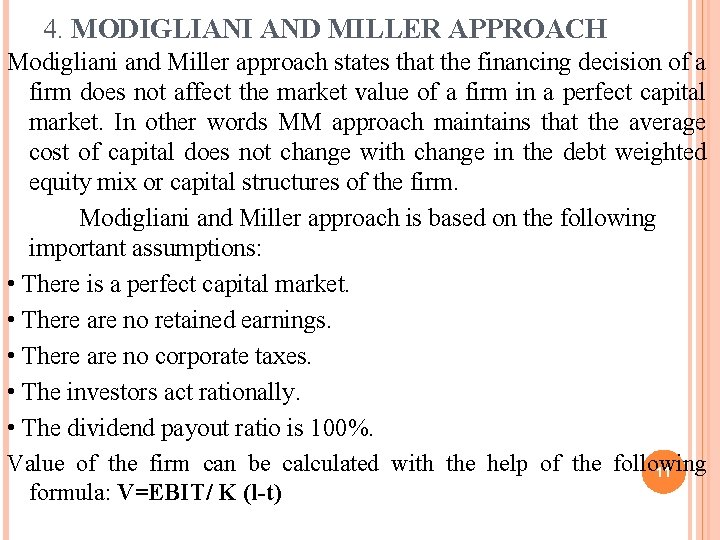
4. MODIGLIANI AND MILLER APPROACH Modigliani and Miller approach states that the financing decision of a firm does not affect the market value of a firm in a perfect capital market. In other words MM approach maintains that the average cost of capital does not change with change in the debt weighted equity mix or capital structures of the firm. Modigliani and Miller approach is based on the following important assumptions: • There is a perfect capital market. • There are no retained earnings. • There are no corporate taxes. • The investors act rationally. • The dividend payout ratio is 100%. Value of the firm can be calculated with the help of the following 11 formula: V=EBIT/ K (l-t)
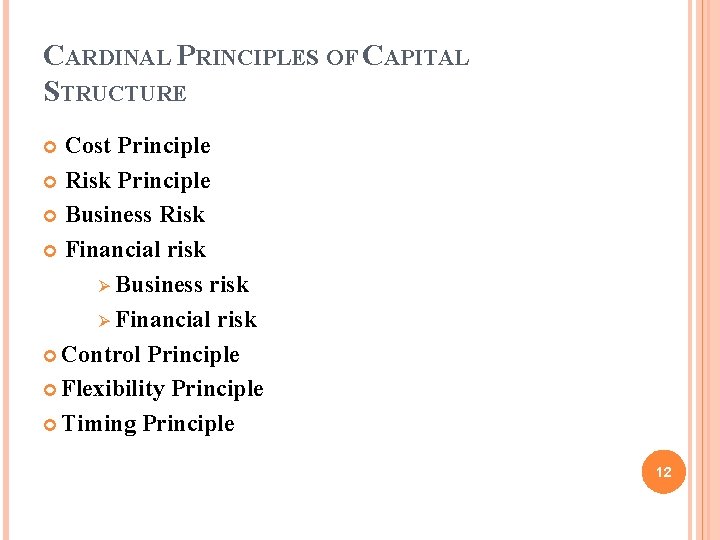
CARDINAL PRINCIPLES OF CAPITAL STRUCTURE Cost Principle Risk Principle Business Risk Financial risk Ø Business risk Ø Financial risk Control Principle Flexibility Principle Timing Principle 12
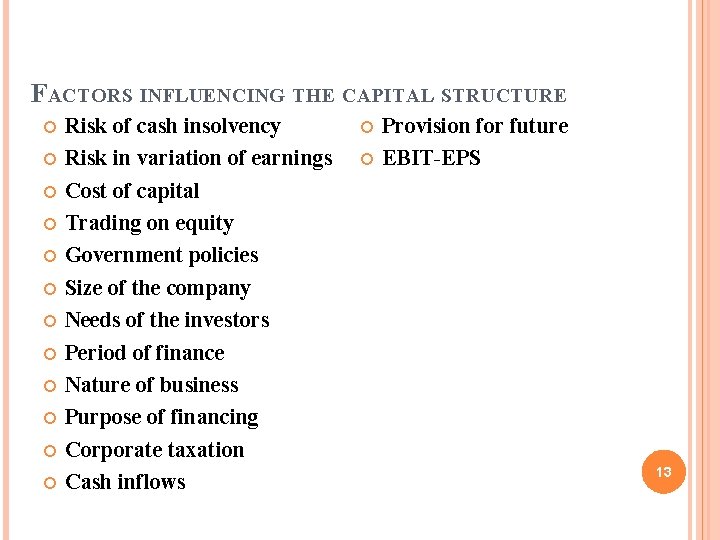
FACTORS INFLUENCING THE CAPITAL STRUCTURE Risk of cash insolvency Risk in variation of earnings Cost of capital Trading on equity Government policies Size of the company Needs of the investors Period of finance Nature of business Purpose of financing Corporate taxation Cash inflows Provision for future EBIT-EPS 13
TRADING ON EQUITY Trading on equity means to raise fixed cost capital (borrowed capital and preference share capital) on the basis of equity share capital so as to increasing the income of equity shareholders. Trading on equity occurs when a corporation uses bonds, other debt, and preferred stock to increase its earnings on common stock. The term trading on equity means debts are contracted and loans are raised mainly on the basis of equity capital. 14
EFFECTS OF TRADING ON EQUITY: TRADING ON EQUITY ACTS LIKE AS A LEVER TO ENLARGE THE INFLUENCE OF FLUCTUATIONS IN EARNINGS. ANY FLUCTUATION IN EARNINGS BEFORE (EBIT) IS MAGNIFIED ON THE EARNINGS PER SHARE (EPS) BY OPERATION INTEREST OF AND TRADING TAXES ON EQUITY LARGER THE MAGNITUDE OF DEBT IN CAPITAL STRUCTURE, THE HIGHER IS THE VARIATION IN EPS GIVEN ANY VARIATION IN EBIT 15
TERMS TO REMEMBER Trading on equity- Trading on equity means to raise fixed cost capital (borrowed capital and preference share capital) on the basis of equity share capital so as to increasing the income of equity shareholders. Trading on equity occurs when a corporation uses bonds, other debt, and preferred stock to increase its earnings on common stock. EBIT - Earnings Before Interest and Taxes- In accounting and finance, earnings before interest and taxes (EBIT), is a measure of a firm's profit that includes all expenses except interest and income tax expenses. It is the difference between operating revenues and operating expenses. EPS- Earnings Per Share- is the portion of a company's profit allocated to each outstanding share of common stock. Earnings per share serves as an indicator of a company's profitability. ROI- Return on Investment- A performance measure used to evaluate the efficiency of an investment or to compare the efficiency of a number of different investments. ROI measures the amount of return on an investment relative to the investment’s cost. 16
COST OF CAPITAL Cost of capital: Cost of capital means cost of raising the capital from different sources of funds. It is the price paid for using the capital. A business enterprise should generate enough revenue to meet its cost of capital and finance its future growth. The finance manager should consider the cost of each source of fund while designing the capital structure of a company. Many of the most successful companies in the world decide their capital structure on one simple consideration —the cost of capital. If you can borrow money at 7 percent for 30 years in a world of 3 percent inflation and reinvest it in core operations at 15 percent, you would be wise to consider at least 40 percent to 50 percent in debt capital 17 in your overall capital structure particularly if your sales and cost structure are relatively stable.
DEFINITIONS James C. Van Horne defines cost of capital as, ”a cut-off rate for the allocation of capital to investments of projects. It is the rate of return on a project that will leave unchanged the market price of the stock. According to Solomon Ezra, “Cost of capital is the minimum required rate of earning or the cut-off rate of capital expenditures”. 18
COMPUTATION OF WEIGHTED AVERAGE COST OF CAPITAL Weighted average cost of capital is the average cost of the costs of various sources of Financing. Weighted average cost of capital is also known as composite cost of capital, overall cost of capital or average cost of capital. The weights may be given either by using the book value of the source or market value of the source. The market value weights suffer from the following limitations: It is very difficult to determine the market values because of frequent fluctuations. With the use of market value weights, equity capital gets greater importance. For the above limitations, it is better to use book value which is readily available. Weighted average cost of capital can be computed as follows: ���� =���� /�� ���� , ���� =�������������� ��������� X = Cost of specific source of finance W = Weight, proportion of specific source of finance 19
MARGINAL COST OF CAPITAL Sometimes, we may be required to calculate the cost of additional funds to be raised, called the marginal cost of capital. The marginal cost of capital is the weighted average cost of new capital calculated by using the marginal weights. The marginal weights represent the proportion of various sources of funds to be employed in raising additional funds. In case, a firm employs the existing proportion of capital structure and the component costs remain the same the marginal cost of capital shall be equal to the weighted average cost of capital. 20
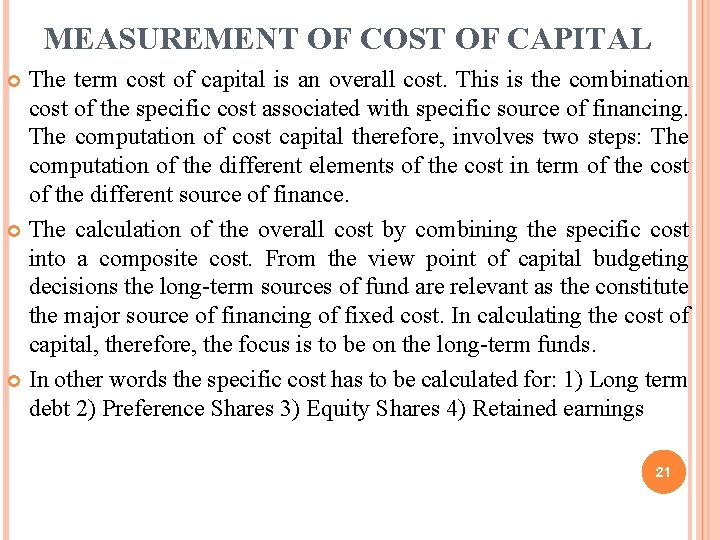
MEASUREMENT OF COST OF CAPITAL The term cost of capital is an overall cost. This is the combination cost of the specific cost associated with specific source of financing. The computation of cost capital therefore, involves two steps: The computation of the different elements of the cost in term of the cost of the different source of finance. The calculation of the overall cost by combining the specific cost into a composite cost. From the view point of capital budgeting decisions the long-term sources of fund are relevant as the constitute the major source of financing of fixed cost. In calculating the cost of capital, therefore, the focus is to be on the long-term funds. In other words the specific cost has to be calculated for: 1) Long term debt 2) Preference Shares 3) Equity Shares 4) Retained earnings 21
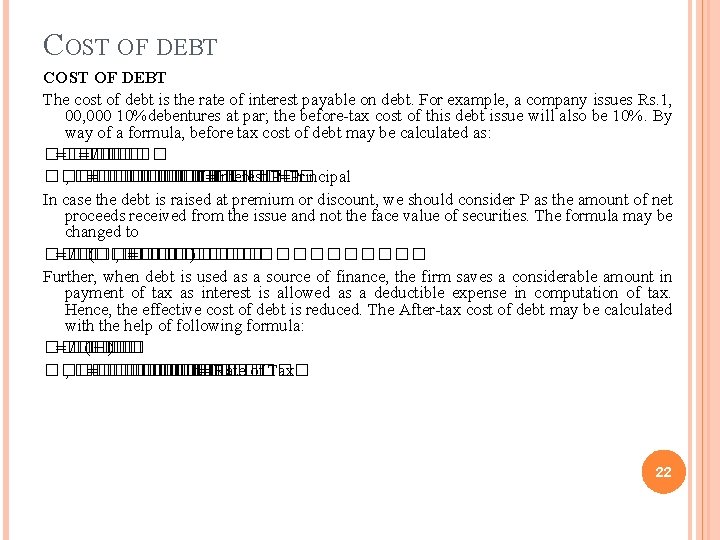
COST OF DEBT The cost of debt is the rate of interest payable on debt. For example, a company issues Rs. 1, 000 10%debentures at par; the before-tax cost of this debt issue will also be 10%. By way of a formula, before tax cost of debt may be calculated as: ������ =�� /�� ����� , ������ =�������� �������� I=Interest P=Principal In case the debt is raised at premium or discount, we should consider P as the amount of net proceeds received from the issue and not the face value of securities. The formula may be changed to ������ =�� /���� (����� , ���� =�������� ) Further, when debt is used as a source of finance, the firm saves a considerable amount in payment of tax as interest is allowed as a deductible expense in computation of tax. Hence, the effective cost of debt is reduced. The After-tax cost of debt may be calculated with the help of following formula: ������ =�� /���� (�� −�� ) ����� , ������ =�������� �������� t= Rate of Tax 22
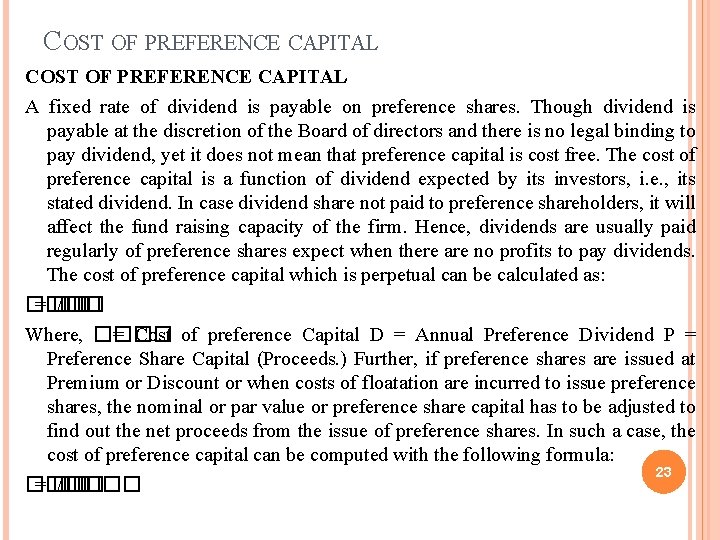
COST OF PREFERENCE CAPITAL A fixed rate of dividend is payable on preference shares. Though dividend is payable at the discretion of the Board of directors and there is no legal binding to pay dividend, yet it does not mean that preference capital is cost free. The cost of preference capital is a function of dividend expected by its investors, i. e. , its stated dividend. In case dividend share not paid to preference shareholders, it will affect the fund raising capacity of the firm. Hence, dividends are usually paid regularly of preference shares expect when there are no profits to pay dividends. The cost of preference capital which is perpetual can be calculated as: ���� = �� /�� Where, ���� = Cost of preference Capital D = Annual Preference Dividend P = Preference Share Capital (Proceeds. ) Further, if preference shares are issued at Premium or Discount or when costs of floatation are incurred to issue preference shares, the nominal or par value or preference share capital has to be adjusted to find out the net proceeds from the issue of preference shares. In such a case, the cost of preference capital can be computed with the following formula: 23 ���� = �� /����
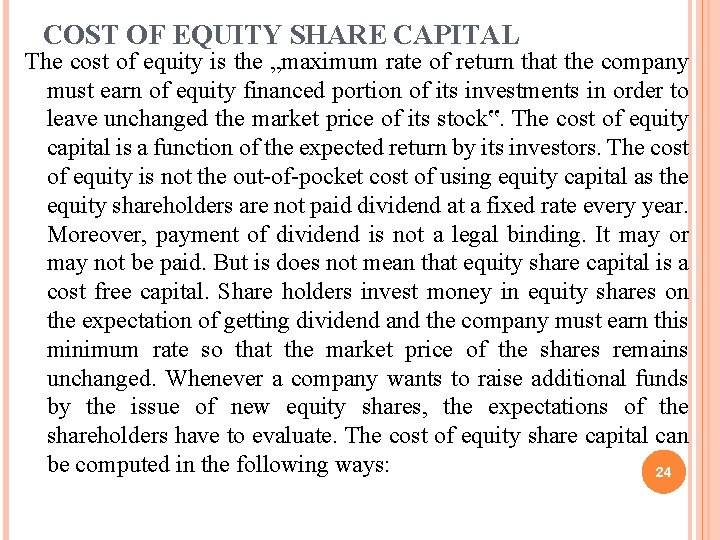
COST OF EQUITY SHARE CAPITAL The cost of equity is the „maximum rate of return that the company must earn of equity financed portion of its investments in order to leave unchanged the market price of its stock‟. The cost of equity capital is a function of the expected return by its investors. The cost of equity is not the out-of-pocket cost of using equity capital as the equity shareholders are not paid dividend at a fixed rate every year. Moreover, payment of dividend is not a legal binding. It may or may not be paid. But is does not mean that equity share capital is a cost free capital. Share holders invest money in equity shares on the expectation of getting dividend and the company must earn this minimum rate so that the market price of the shares remains unchanged. Whenever a company wants to raise additional funds by the issue of new equity shares, the expectations of the shareholders have to evaluate. The cost of equity share capital can be computed in the following ways: 24
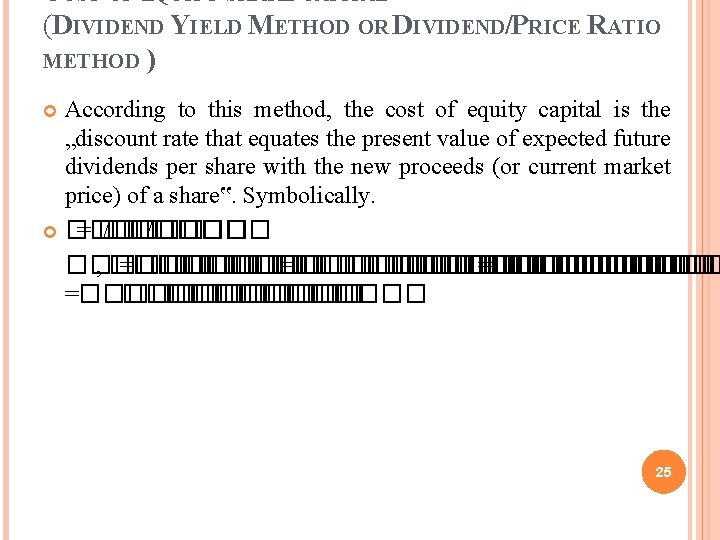
COST OF EQUITY SHARE CAPITAL (DIVIDEND YIELD METHOD OR DIVIDEND/PRICE RATIO METHOD ) According to this method, the cost of equity capital is the „discount rate that equates the present value of expected future dividends per share with the new proceeds (or current market price) of a share‟. Symbolically. ���� = �� /���������� , ���� =����������� �� =���������������� ���� =������ ���� =������ ���������� 25
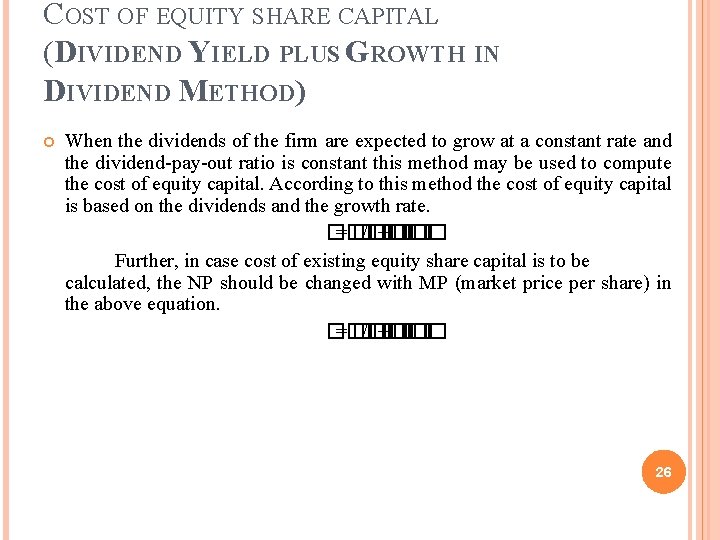
COST OF EQUITY SHARE CAPITAL (DIVIDEND YIELD PLUS GROWTH IN DIVIDEND METHOD) When the dividends of the firm are expected to grow at a constant rate and the dividend-pay-out ratio is constant this method may be used to compute the cost of equity capital. According to this method the cost of equity capital is based on the dividends and the growth rate. ���� = ���� /���� +�� Further, in case cost of existing equity share capital is to be calculated, the NP should be changed with MP (market price per share) in the above equation. ���� = ���� /���� +�� 26