
Unit III Voltage Regulators 10 Marks Course Outcome
- Slides: 24
Unit –III Voltage Regulators -10 Marks
Course Outcome Maintain IC Voltage regulator and SMPS
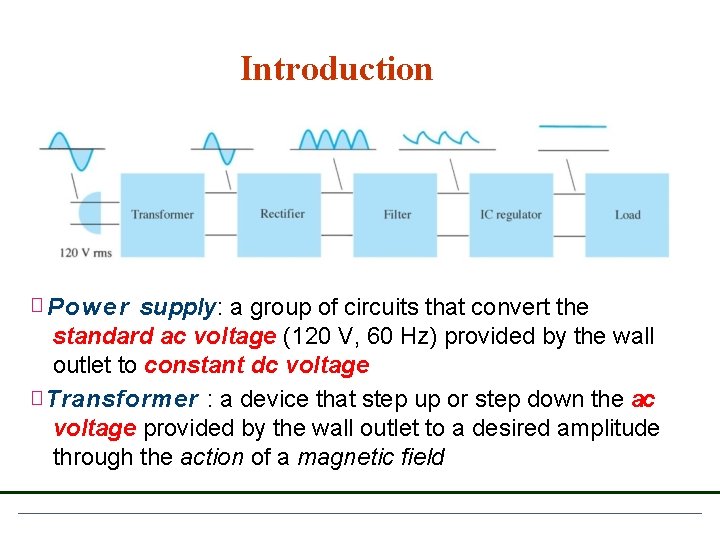
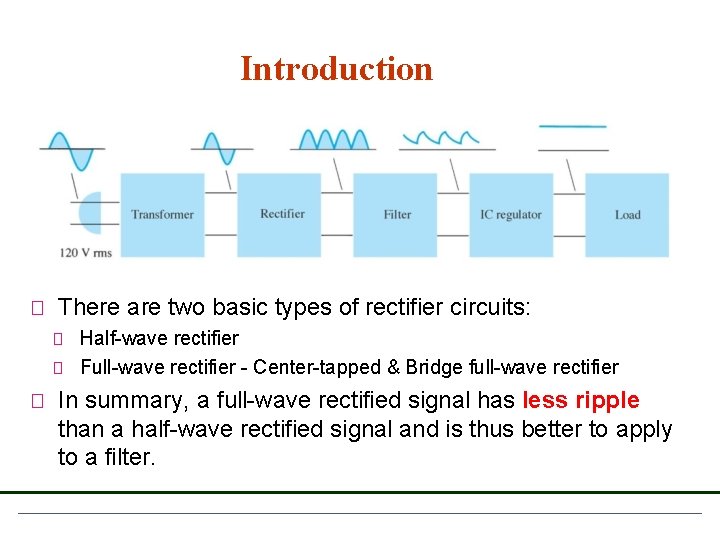
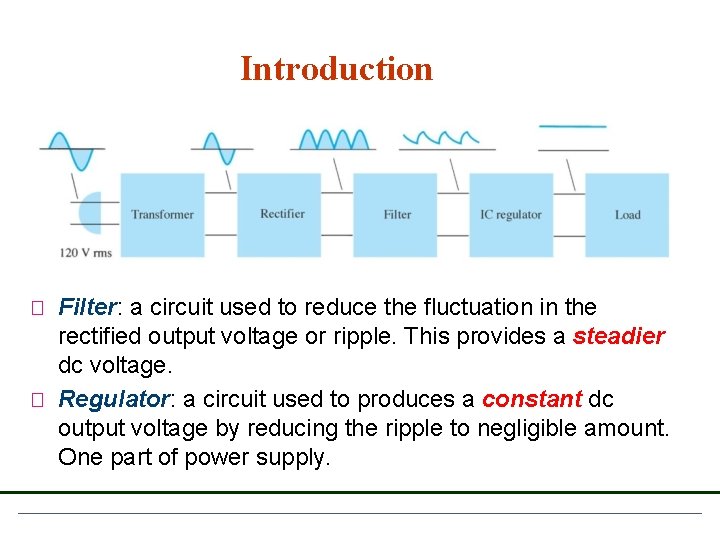
Introduction � Power supply: a group of circuits that convert the standard ac voltage (120 V, 60 Hz) provided by the wall outlet to constant dc voltage � Transformer : a device that step up or step down the ac voltage provided by the wall outlet to a desired amplitude through the action of a magnetic field
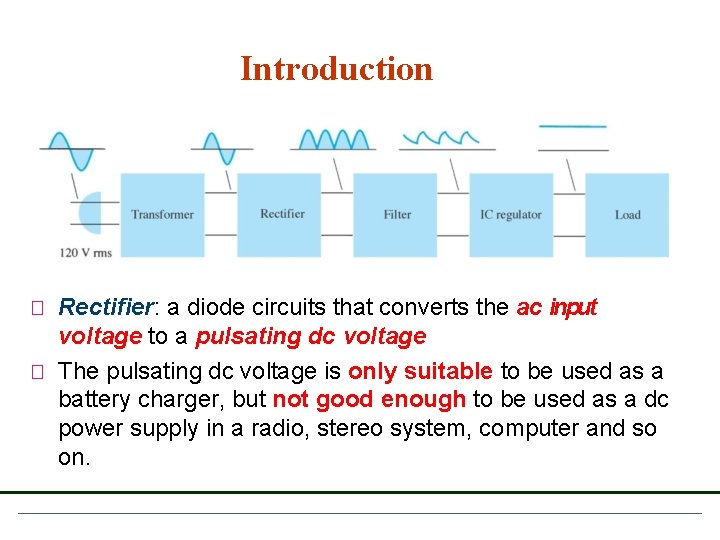
Introduction � Rectifier: a diode circuits that converts the ac input voltage to a pulsating dc voltage � The pulsating dc voltage is only suitable to be used as a battery charger, but not good enough to be used as a dc power supply in a radio, stereo system, computer and so on.
Introduction � There are two basic types of rectifier circuits: � Half-wave rectifier � Full-wave rectifier - Center-tapped & Bridge full-wave rectifier � In summary, a full-wave rectified signal has less ripple than a half-wave rectified signal and is thus better to apply to a filter.
Introduction � Filter: a circuit used to reduce the fluctuation in the rectified output voltage or ripple. This provides a steadier dc voltage. � Regulator: a circuit used to produces a constant dc output voltage by reducing the ripple to negligible amount. One part of power supply.
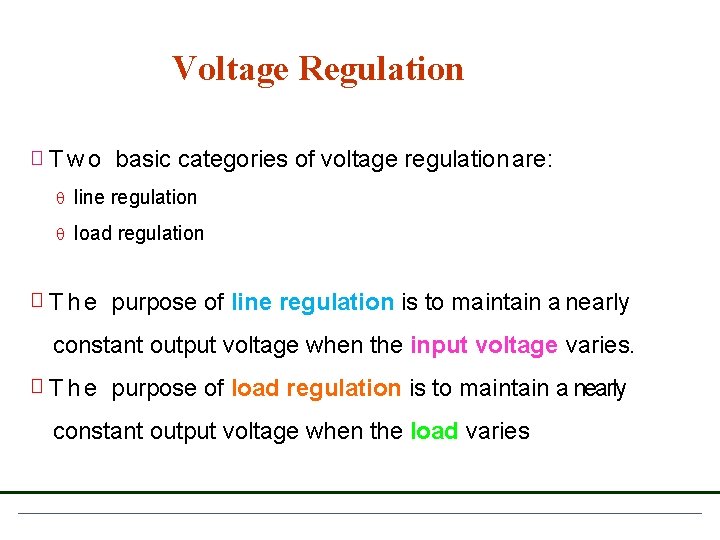
Voltage Regulation � T w o basic categories of voltage regulation are: line regulation load regulation � T h e purpose of line regulation is to maintain a nearly constant output voltage when the input voltage varies. � T h e purpose of load regulation is to maintain a nearly constant output voltage when the load varies
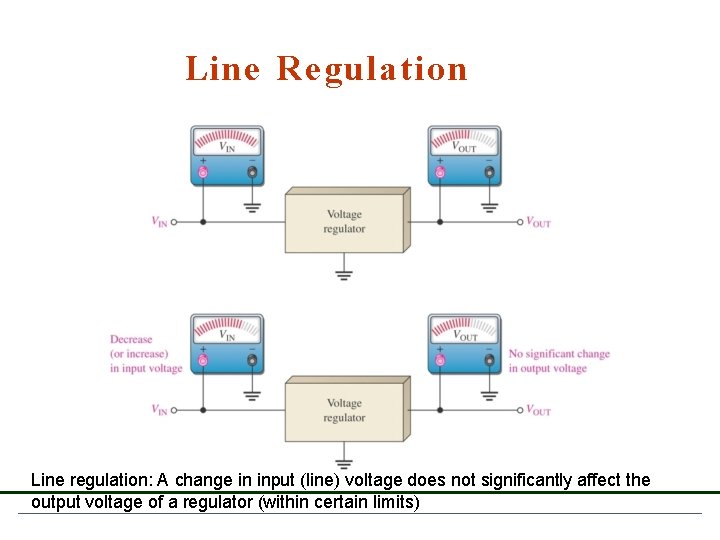
Line Regulation Line regulation: A change in input (line) voltage does not significantly affect the output voltage of a regulator (within certain limits)
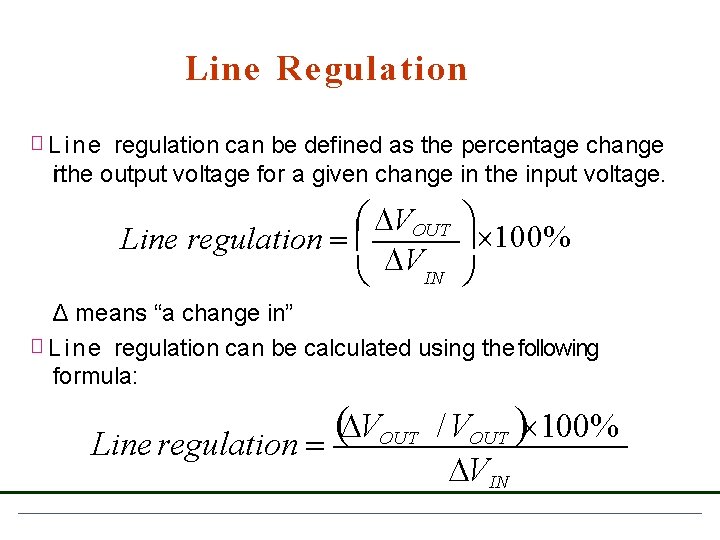
Line Regulation � L i n e regulation can be defined as the percentage change n i the output voltage for a given change in the input voltage. VOUT 100% Line regulation VIN Δ means “a change in” � L i n e regulation can be calculated using the following formula: VOUT Line regulation / VOUT 100% VIN
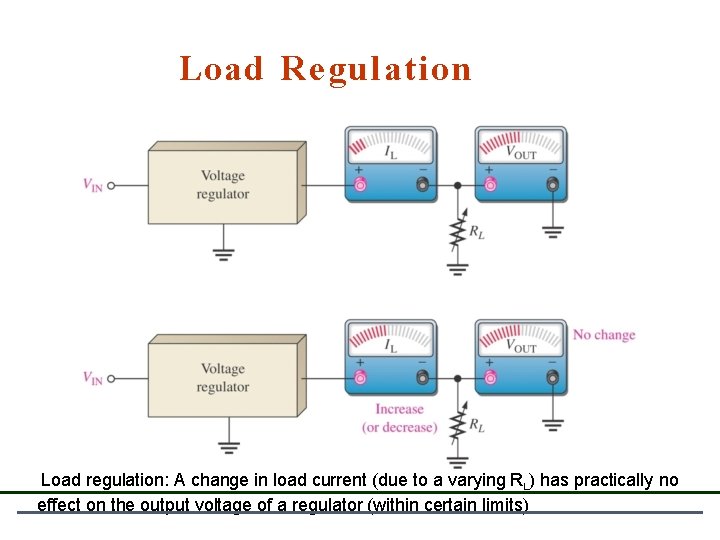
Load Regulation Load regulation: A change in load current (due to a varying RL) has practically no effect on the output voltage of a regulator (within certain limits)
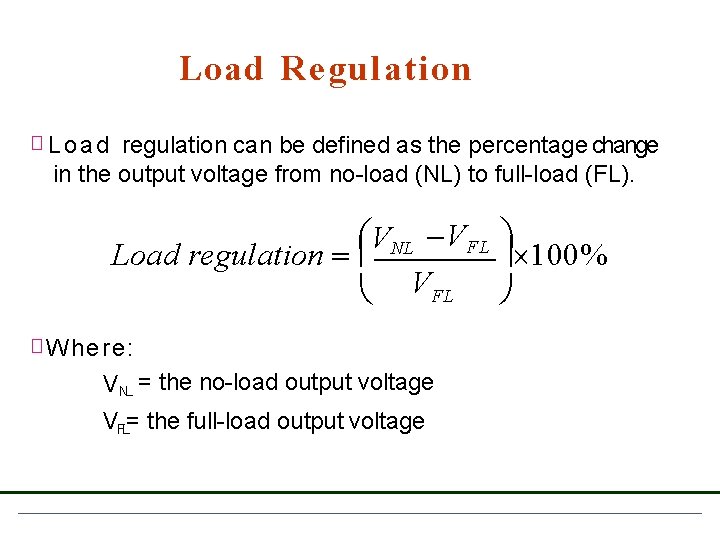
Load Regulation � L o a d regulation can be defined as the percentage change in the output voltage from no-load (NL) to full-load (FL). VNL VFL 100% Load regulation VFL � Where: VNL = the no-load output voltage VFL= the full-load output voltage
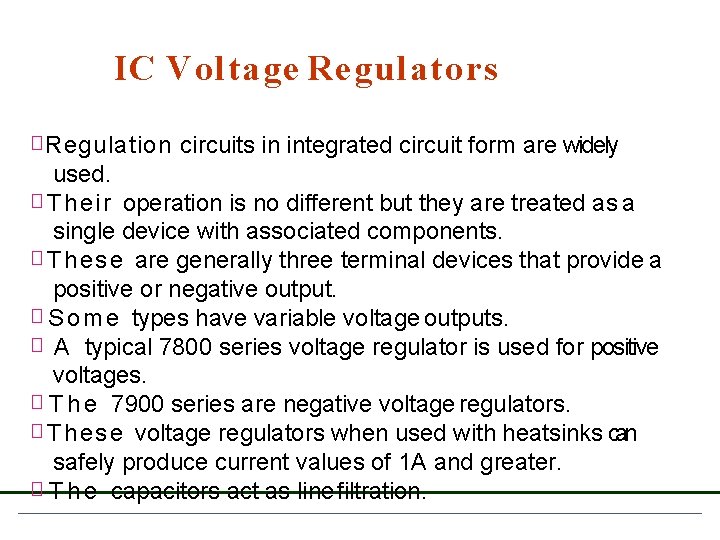
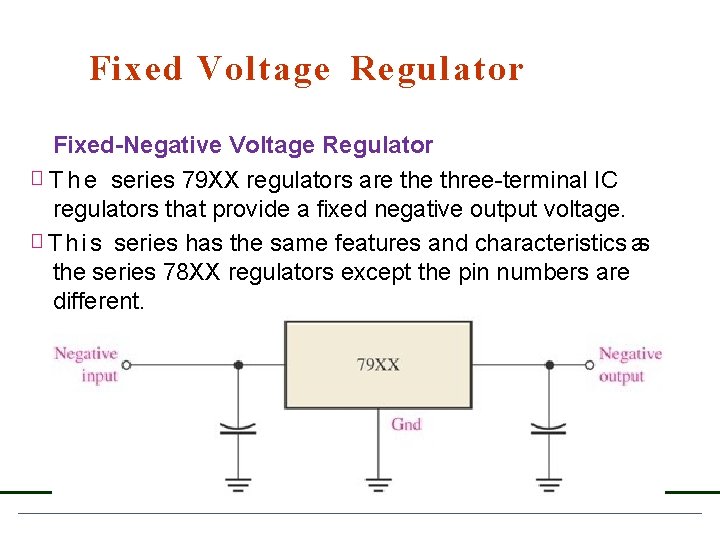
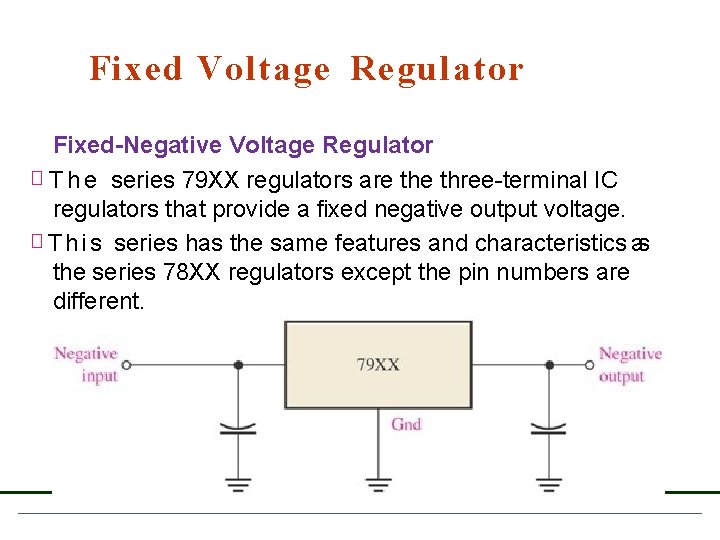
IC Voltage Regulators � Regulation circuits in integrated circuit form are widely used. � T h e i r operation is no different but they are treated as a single device with associated components. � T h e s e are generally three terminal devices that provide a positive or negative output. � S o m e types have variable voltage outputs. � A typical 7800 series voltage regulator is used for positive voltages. � T h e 7900 series are negative voltage regulators. � T h e s e voltage regulators when used with heatsinks can safely produce current values of 1 A and greater. � T h e capacitors act as line filtration.
IC Voltage Regulators � Several types of both linear (series and shunt) and switching regulators are available in integrated circuit (IC) form. � Single IC regulators contain the circuitry for: (1) reference source (2) comparator amplifier (3) control device (4) overload protection � Generally, the linear regulators are three-terminal devices that provides either positive or negative output voltages that can be either fixed or adjustable.
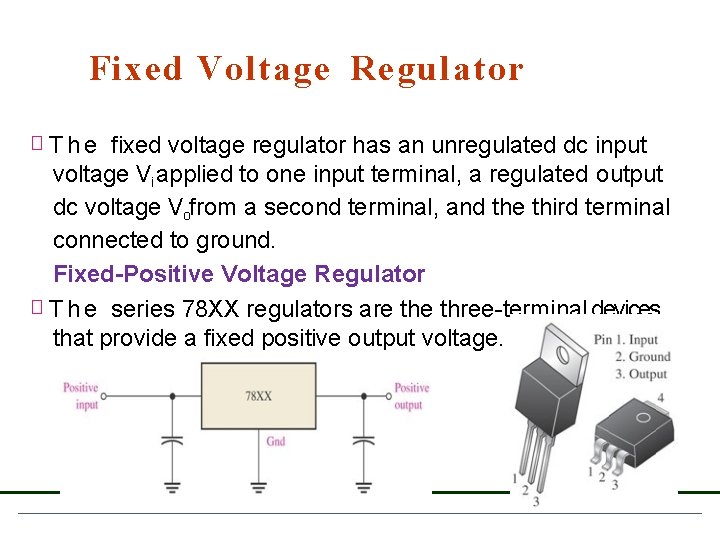
Fixed Voltage Regulator � T h e fixed voltage regulator has an unregulated dc input voltage Vi applied to one input terminal, a regulated output dc voltage Vofrom a second terminal, and the third terminal connected to ground. Fixed-Positive Voltage Regulator � T h e series 78 XX regulators are three-terminal devices that provide a fixed positive output voltage.
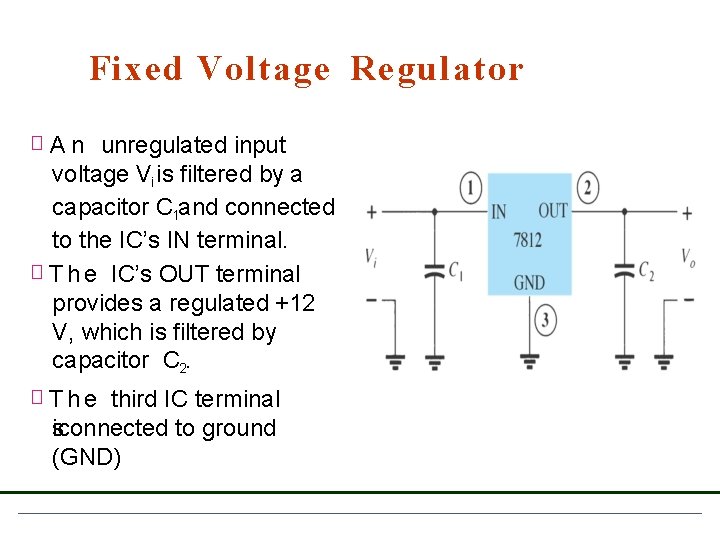
Fixed Voltage Regulator � A n unregulated input voltage Vi is filtered by a capacitor C 1 and connected to the IC’s IN terminal. � T h e IC’s OUT terminal provides a regulated +12 V, which is filtered by capacitor C 2. � T h e third IC terminal siconnected to ground (GND)
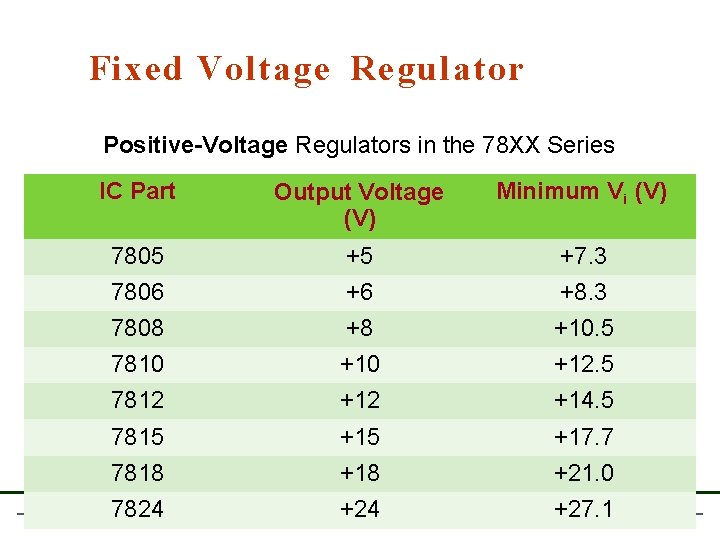
Fixed Voltage Regulator Positive-Voltage Regulators in the 78 XX Series IC Part Output Voltage (V) Minimum Vi (V) 7805 +5 +7. 3 7806 +6 +8. 3 7808 +8 +10. 5 7810 +12. 5 7812 +14. 5 7815 +17. 7 7818 +21. 0 7824 +27. 1
Fixed Voltage Regulator Fixed-Negative Voltage Regulator � T h e series 79 XX regulators are three-terminal IC regulators that provide a fixed negative output voltage. � T h i s series has the same features and characteristics as the series 78 XX regulators except the pin numbers are different.
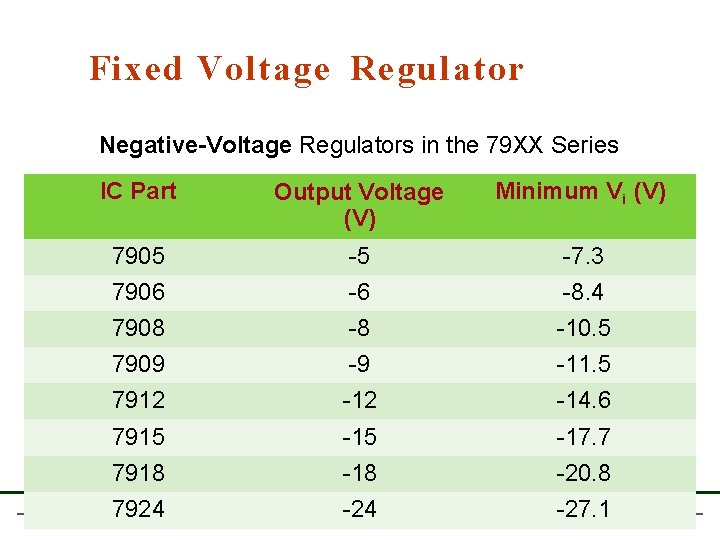
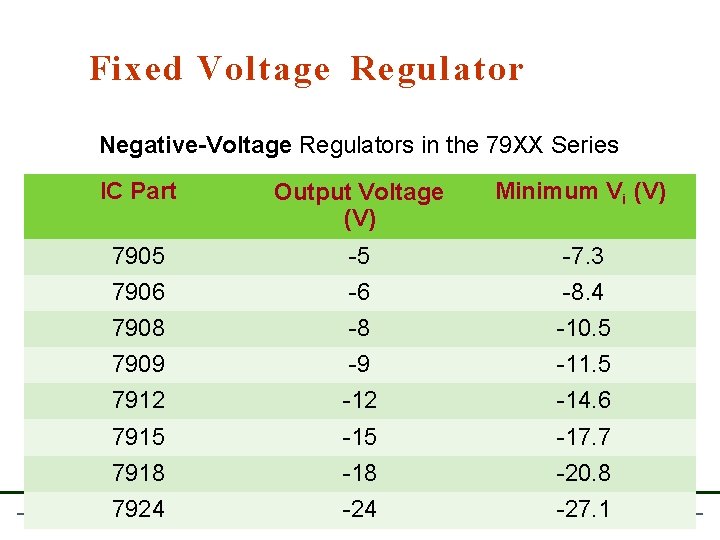
Fixed Voltage Regulator Negative-Voltage Regulators in the 79 XX Series IC Part Output Voltage (V) Minimum Vi (V) 7905 -5 -7. 3 7906 -6 -8. 4 7908 -8 -10. 5 7909 -9 -11. 5 7912 -14. 6 7915 -17. 7 7918 -20. 8 7924 -27. 1
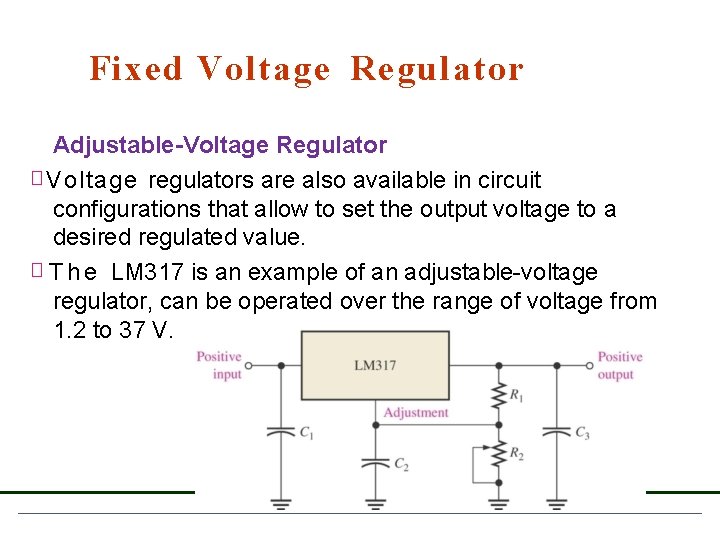
Fixed Voltage Regulator Adjustable-Voltage Regulator � Voltage regulators are also available in circuit configurations that allow to set the output voltage to a desired regulated value. � T h e LM 317 is an example of an adjustable-voltage regulator, can be operated over the range of voltage from 1. 2 to 37 V.
Summary � Voltage regulators keep a constant dc output despite input voltage or load changes. � T h e two basic categories of voltage regulators are linear and switching. � T h e two types of linear voltage regulators are series and shunt. � T h e three types of switching are step-up, step- down, and inverting.
Summary � Switching regulators are more efficient than linear making them ideal for low voltage high current applications. � I C regulators are available with fixed positive o r negative output voltages or variable negative or positive output voltages. � B o t h linear and switching type regulators are available in IC form. � Current capacity of a voltage regulator can b e increased with an external pass transistor.
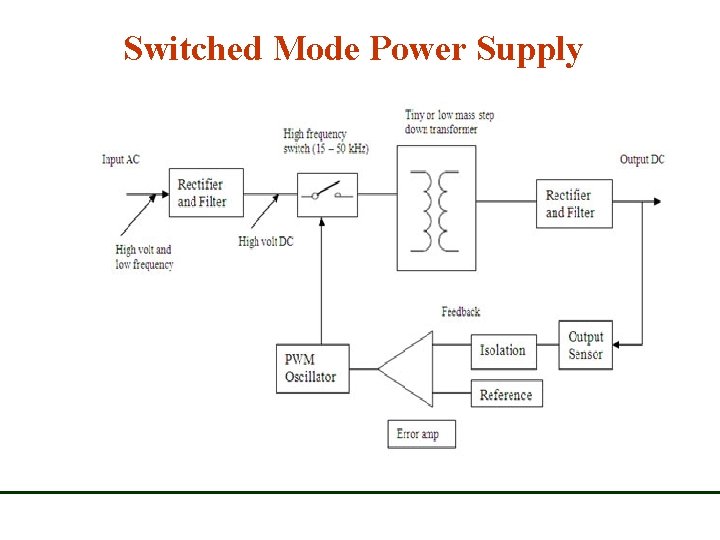
Switched Mode Power Supply