
UNIT III On Proof Facts which need not
- Slides: 13
UNIT III- On Proof
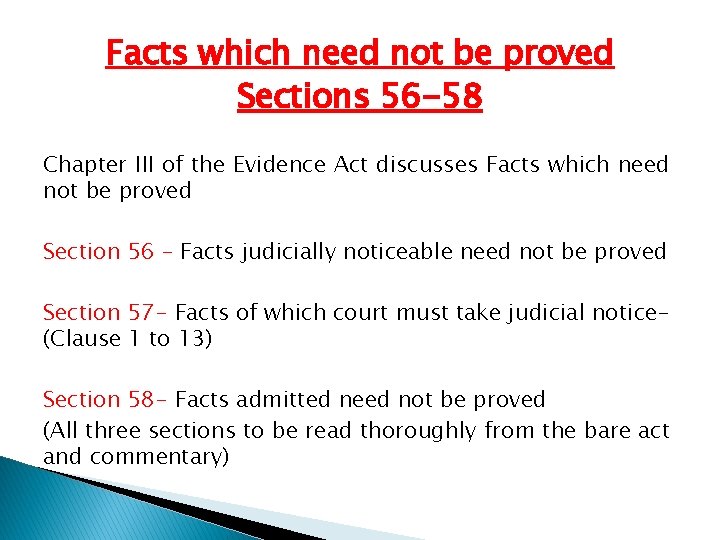
Facts which need not be proved Sections 56 -58 Chapter III of the Evidence Act discusses Facts which need not be proved Section 56 – Facts judicially noticeable need not be proved Section 57 - Facts of which court must take judicial notice(Clause 1 to 13) Section 58 - Facts admitted need not be proved (All three sections to be read thoroughly from the bare act and commentary)
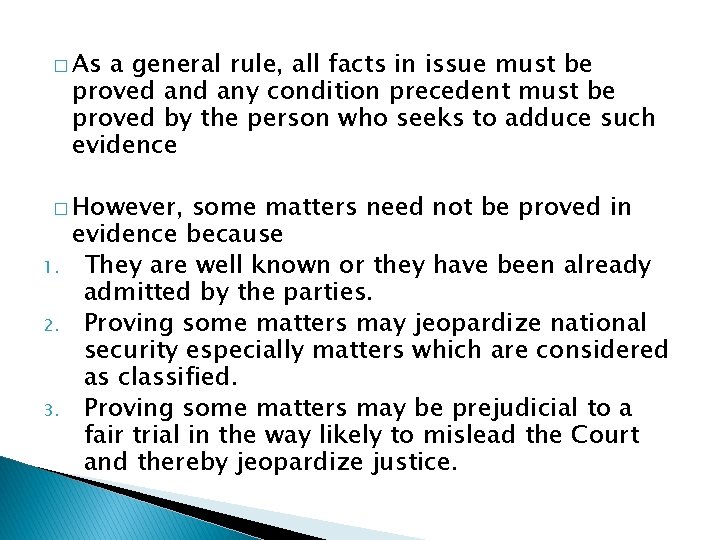
� As a general rule, all facts in issue must be proved any condition precedent must be proved by the person who seeks to adduce such evidence � However, 1. 2. 3. some matters need not be proved in evidence because They are well known or they have been already admitted by the parties. Proving some matters may jeopardize national security especially matters which are considered as classified. Proving some matters may be prejudicial to a fair trial in the way likely to mislead the Court and thereby jeopardize justice.
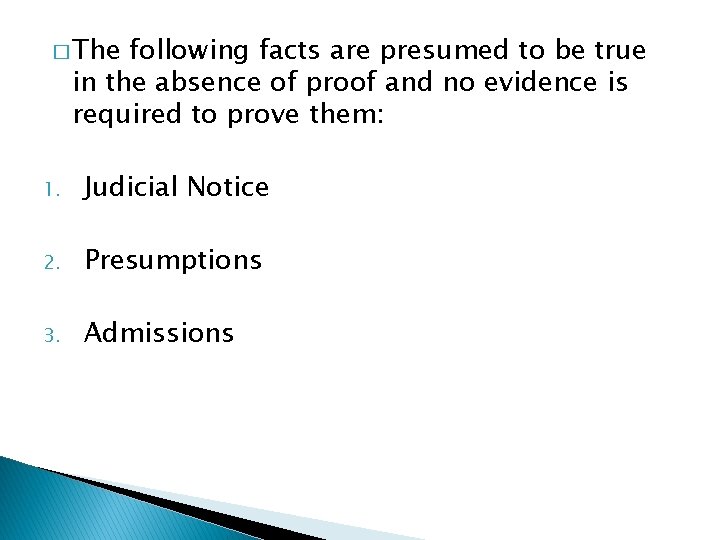
� The following facts are presumed to be true in the absence of proof and no evidence is required to prove them: 1. Judicial Notice 2. Presumptions 3. Admissions
� Section � What 56 and 57 to be read together is Judicial Notice? The Doctrine of Evidence applied by the court that allows it to recognize and accept the existence of a particular fact commonly known by persons of average intelligence without establishing its existence by admitting evidence.
� S. 57 not an exhaustive list � merely provides that the Courts must take judicial notice of the facts enumerated therein � does not prohibit the Courts from taking judicial notice of other facts, not to be found in the list. � For example, in England, the Court takes judicial notice of matters appearing in its own proceedings, and there is no reason why Indian Courts also would not take judicial notice of such proceedings.
Section 58 It lays down that if the parties to the proceeding or their agents agree to admit a fact � at the hearing or � which they agree to admit by writing under their hands before hearing or � which by any rule of pleading in force at the time, they are deemed to have admitted by their pleading it need not be proved.
� Although under section 58 admission made by the parties and their agents need not be proved; it is not conclusive proof of the fact admitted. � Section 58 postulates that things admitted need not be proved. � Under Order 12, Rule 6 of the CPC the court is not bound by admission of the parties and their agents. The court may exercise its discretion to demand some other proof.
Admission in Criminal Cases: � In criminal cases the rules of evidence are that the prosecution is under duty to prove the case against the accused and that they should not rely upon admission made by him in the course of the trial for convicting him. � An accused cannot be convicted upon the admission of his pleader. An admission by the accused in answer to question put by the court under section 313, Cr. PC cannot be utilized to fill up a gap in the evidence for the prosecution.
� The Court by its discretion requires some order evidence to support the admitted facts. � If the court is convinced that the admission was obtained by fraud, collusion or there is suspicion about admission it may require the fact to be proved otherwise than by such admission.
Cases: � M. S. Narayanan Menon v. State of Kerala AIR 2006 SC 3366 - It is not in dispute that transactions comprising purchases and sales of shares by investors is a matter of confidence. Both parties would have to rely upon one another. For the said purpose, the courts of law may also take judicial notice of the practice prevailing in such business.
� Steel Authority of India Ltd. V. Uo. I AIR 2006 SC 3229 - The effect of an admission in the context of Section 58 of the Indian Evidence Act has been considered by this Court in Sangramsinh P. Gaekwad and Others v. Shantadevi P. Gaekwad (Dead) through Lrs. and Others [(2005) 11 SCC 314], wherein it was categorically held that judicial admissions by themselves can be made the foundations of the rights of the parties and admissions in the pleadings are admissible proprio vigore against the maker thereof.
Important: � Apart from the Bare Act, the text books on Law of Evidence as mentioned in the class are to be thoroughly used by the students � The Cases mentioned are to be studied and in case of any doubt, the course instructor must be contacted on email. � Once the class has gone through the material, the course instructor is to be informed so that the next chapter can be sent.