
UNIT III GASTROINTESTINAL SYSTEM Gastrointestinal system Peptic Ulcer




- Slides: 25
UNIT III GASTROINTESTINAL SYSTEM
• Gastrointestinal system: – Peptic Ulcer
PEPTIC ULCERS • Areas of degeneration and necrosis of gastrointestinal mucosa exposed to acid-peptic secretions • Any part in GIT exposed to hydrochloric acid and pepsin • Occur most commonly (98 -99%) in either duodenum or stomach in ratio of 4: 1 • Each types may be acute or chronic
Acute Peptic (Stress) Ulcers • or stress ulcers are multiple, small mucosal erosions, seen most commonly in the stomach but • occasionally involving the duodenum
ETIOLOGY • Due to severe stress, causes are as follows: i) Psychological stress ii) Physiological stress as in the following: • Shock • Severe trauma • Septicaemia • Extensive burns (Curling’s ulcers, in duodenum, reduced plasma volume leads to ischemia and cell necrosis (sloughing) of the gastric mucosa). • Intracranial lesions (Cushing’s ulcers due to hyperacidity following excessive vagal stimulation, associated with elevated intracranial pressure) • Drug intake (e. g. aspirin, steroids, indomethacin)
PATHOGENESIS • not clear • only Cushing’s ulcers from intracranial conditions • in other conditions gastric acid secretion is normal or below normal • possible hypotheses for genesis of stress ulcers: 1. Ischaemic hypoxic injury to mucosal cells 2. Depletion of gastric mucus ‘barrier’ - mucosa susceptible to attack by acid-peptic secretions
Chronic Peptic Ulcers (Gastric and Duodenal Ulcers) • Acid-pepsin secretions are implicated in their pathogenesis • Peptic ulcers are common in present-day life of industrialised and civilised world • Gastric and duodenal ulcers represent two distinct diseases as far as their etiology, pathogenesis and clinical features are concerned. • Morphological findings in both are similar and quite diagnostic.
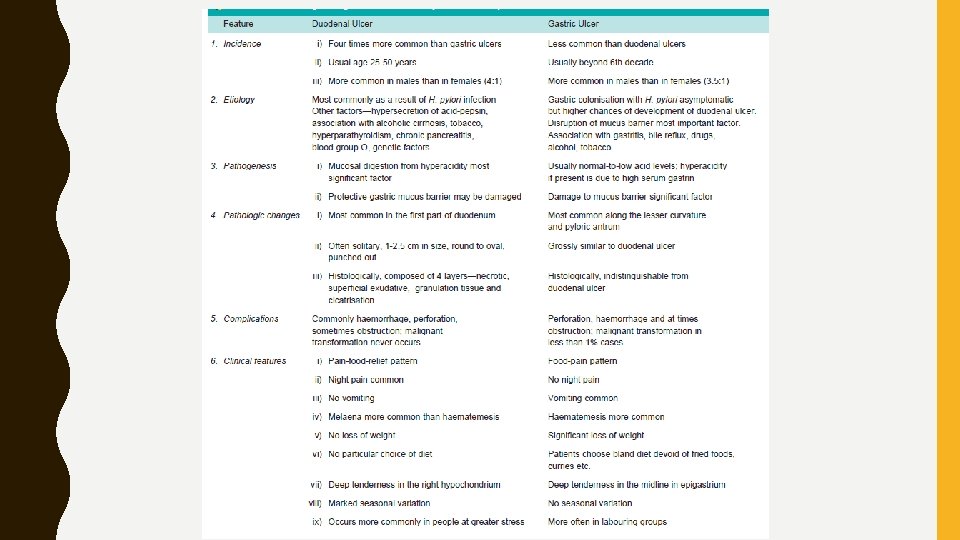
INCIDENCE • Peptic ulcers are more frequent in middle-aged adults. • Peak incidence for duodenal ulcer is 5 th decade, while for gastric ulcer it is a decade later (6 th decade). • Both type of ulcers are more common in males than in females. • Duodenal ulcer is 4 times more common than gastric ulcer • Overall incidence of gastroduodenal ulcers being approximately 10% of male population.
ETIOLOGY • Disturbance in normal protective mucosal ‘barrier’ by acidpepsin- resulting in digestion of the mucosa • in contrast to duodenal ulcers • gastric ulcer have low-to-normal gastric acid secretions • 10 -20% patients of gastric ulcer -coexistent duodenal ulcer • Multifactorial disease: first two most important 1. Helicobacter pylori gastritis • 15 -20% cases infected with H. pylori in antrum develop duodenal ulcer in their life time, while gastric colonisation by H. pylori never develops ulceration and remain asymptomatic
H. pylori identified in mucosal examination, culture and serology samples by histologic 2. NSAIDs-induced mucosal injury. • Non-steroidal anti-inflammatory drugs -direct toxicity, endothelial damage and epithelial injury to both gastric & duodenal mucosa. 3. Acid-pepsin secretions. • acid-pepsin secretion is essential for development of duodenal as well as gastric ulcer. • Peptic ulcers never occur in association with pernicious anaemia (no acid and pepsin-secreting parietal and chief cells)
4. Gastritis. • Some degree of gastritis is always present in region of gastric ulcer, - not clear - cause or effect of ulcer. • population distribution pattern is similar for these two 5. Other local irritants. • Pyloric antrum and lesser curvature of stomach are sites most exposed for longer periods to local irritants, thus common sites for occurrence of gastric ulcers • heavily spiced foods, alcohol, cigarette smoking, unbuffered aspirin 6. Dietary factors. • Nutritional deficiencies e. g. occurrence of gastric ulcer in poor socioeconomic strata, higher incidence of duodenal ulcer in parts of South India • Not supported in European countries and the U. S.
7. Psychological factors • Psychological stress, anxiety, fatigue and ulcer-type personality may exacerbate as well as predispose to peptic ulcer disease. 8. Genetic factors • People with blood group O appear to be more prone • Genetic influences appear to have greater role in duodenal ulcers 9. Hormonal factors • High gastrin by islet-cell tumour in Zollinger-Ellison syndrome, • endocrine secretions in hyperplasia and adenomas of parathyroid glands, • adrenal cortex and anterior pituitary
10. Miscellaneous • association with various other conditions such as alcoholic cirrhosis, chronic renal failure, hyperparathyroidism, chronic obstructive pulmonary disease, and chronic pancreatitis
PATHOGENESIS • Two most important factors in peptic ulcer are as under: • Exposure of mucosa to gastric acid and pepsin secretion • Strong etiologic association with H. pylori infection • distinct differences in the pathogenetic mechanisms in duodenal and gastric ulcers as under:
Duodenal ulcer • high acid-pepsin secretions • Other features in the pathogenesis of duodenal ulcers are as follows: • 1. hypersecretion of gastric acid into the fasting stomach at night - under the influence of vagal stimulation • There is high basal as well as maximal acid output (BAO and MAO) in response to various stimuli
2. Patients of duodenal ulcer have rapid emptying of stomach – food buffers and neutralises the gastric acid, – Thus duodenal mucosa more exposed to aggressive action of gastric acid 3. Helicobacter gastritis caused by H. pylori (95 -100% DU cases) • Underlying mechanisms are as under: • i) Gastric mucosal defense is broken by bacterial - urease, protease, catalase and phospholipase. • ii) Host factors: H. pylori-infected mucosal epithelium releases proinflammatory cytokines such as IL-1, IL-6, IL-8 and tumour necrosis factor-α - causes intense inflammatory reaction • iii) Bacterial factors: – Cytotoxin-associated gene protein (Cag. A) induces epithelial injury – vacuolating cytotoxin (Vac. A) induces cytokines
Gastric ulcer • pathogenesis is explained based on impaired gastric mucosal defences against acid-pepsin secretions Other features: • 1. Hyperacidity may occur in gastric ulcer due to increased serum gastrin levels in response to ingested food • 2 there may low-to-normal gastric acid levels. – Ulcerogenesis in such patients is explained on basis of damaging influence of other factors such as gastritis, bile reflux, cigarette smoke etc. • 3. protective gastric mucus ‘barrier’ against acid-pepsin is deranged in gastric ulcer. – Depletion of gastric mucus. – Colonisation of the gastric mucosa by H. pylori seen in 75 -80%
COMPLICATIONS • Acute and subacute peptic ulcers heal without any visible scar • healing of chronic, larger and deeper ulcers may result in complications • These are as follows: 1. Obstruction. • Development of fibrous scar at or near the pylorus results in pyloric stenosis. • causes duodenal stenosis- fibrosis and contraction. 2. Haemorrhage. • Minor bleeding by erosion of small blood vessels in the base of an ulcer occurs in all the ulcers and can be detected by testing the stool for occult blood. • Chronic blood loss -iron deficiency anaemia. • penetrating chronic ulcer may erode a major artery (e. g. left gastric, gastroduodenal or splenic artery) and cause a massive and severe hematemesis and sometimes death 3. Perforation. • A perforated peptic ulcer - acute abdominal emergency. • commonly in chronic duodenal ulcers than chronic gastric ulcers.
• Following sequelae may result: • i) On perforation contents escape into the lesser sac or into the peritoneal cavity, causing acute peritonitis. • ii) Air escapes from the stomach and lies between the liver and the diaphragm giving characteristic radiological appearance of air under the diaphragm. • iii) Subphrenic abscess between the liver and diaphragm may develop due to infection • iv) Perforation may extend to involve the adjacent organs e. g. the liver and pancreas 4. Malignant transformation. • ‘cancers ulcerate but ulcers rarely cancerate’ • chronic duodenal ulcer never turns malignant, • less than 1% of chronic gastric ulcers may transform into carcinoma
CLINICAL FEATURES. • Peptic ulcers are remitting and relapsing lesions • Their chronic and recurrent behaviour is summed up the saying: ‘once a peptic ulcer patient, always a peptic ulcer patient. ’ • Two major forms of chronic peptic ulcers show variations in clinical features which are as follows: • 1. Age. peak incidence of duodenal ulcer is in 5 th decade while that for gastric ulcer is a decade later. • 2. People at risk. Duodenal ulcer -in people faced with more stress and strain of life (e. g. executives, leaders), while gastric ulcer is seen more often in labouring groups. • 3. Periodicity. attacks in gastric ulcers last from 2 -6 weeks, with interval of freedom from 1 -6 months. • duodenal ulcer- worsened by ‘work, worry and weather. ’
4. Pain. • In gastric ulcer, epigastric pain occurs immediately or within 2 hours after food and never occurs at night. • In duodenal ulcer, pain is severe, occurs late at night (‘hunger pain’) and is usually relieved by food. 5. Vomiting. • Vomiting which relieves the pain is a conspicuous feature in patients of gastric ulcer. Duodenal ulcer patients rarely have vomiting but instead get heart-burn (retrosternal pain) and ‘water brash’ (burning fluid into the mouth). 6. Haematemesis and melaena. • Haematemesis and melaena occur in gastric ulcers in ratio of 60: 40, while in duodenal ulcers in ratio of 40: 60. • Both may occur together more commonly in duodenal ulcer than in gastric ulcer patients.
7. Appetite. • gastric ulcer patients, though have good appetite but are afraid to eat, while duodenal ulcer patients have very good appetite. 8. Diet. • Patients of gastric ulcer commonly get used to a bland diet consisting of milk, eggs etc and avoid taking fried foods, curries and heavily spiced foods. • In contrast, duodenal ulcer patients usually take all kinds of diets.
9. Weight. • Loss of weight is a common finding in gastric ulcer patients while patients of duodenal ulcer tend to gain weight due to frequent ingestion of milk to avoid pain. 10. Deep tenderness. • Deep tenderness is demonstrable in both types of peptic ulcers. • In case of gastric ulcer it is in midline of epigastrium, while in duodenal ulcer it is in right hypochondrium
• Reference: Textbook of Pathology, by Harsh Mohan JAYPEE Publication (Author),