
UNIT III FREE ELECTRON THEORY BAND THEORY OF
UNIT III FREE ELECTRON THEORY & BAND THEORY OF SOLIDS
Introduction: Electron theory is applicable to all solids, both metals and non metals. It has been developed in three main stages. 1. Classical free electron theory 2. Quantum Free Electron Theory. 3. Zone Theory.
1. Classical free electron theory: Ø Developed by Drude and Lorentz in 1900. Ø Metal contains free electrons which are responsible for the electrical conductivity Ø Electrons obey the laws of classical mechanics. 2. Quantum Free Electron Theory: Ø Developed by Sommerfeld in 1928. Ø Free electrons move with a constant potential. Ø This theory obeys quantum laws. 3. Zone Theory or Band Theory of Solids : Ø Bloch introduced the band theory in 1928. Ø Free electrons move in a periodic potential provided by the lattice. Ø It gives complete informational study of electrons.
Classical free electron theory of metals (Drude – Lorentz theory of metals): Ø Drude and Lorentz proposed this theory in 1900. Ø Metals containing the free electrons obey the laws of classical mechanics. Assumptions (or) Salient features: 1. In metals there a large number of free electrons moving freely in all possible directions. 2. Free electrons behave like gas molecules in a container obeying the laws of kinetic theory. 3. In the absence of field the energy associated with each electron at a temperature T is It is related to kinetic energy as 4. In metals, the positive ion cores are at fixed positions and the free electrons move randomly and collide either with positive ion cores or with other free electrons or with boundaries. Hence these collisions are elastic. Therefore the electric conduction is due to free electrons only. 5. Electron velocities in a metal obey Maxwell-Boltzmann distribution of velocities. 6. The free electrons move in a constant potential field. Hence the potential energy of the electrons is constant. 7. When an electric field is applied to a metal, free electrons are accelerated in the direction opposite to the direction of applied electric field with a velocity called drift velocity v d.
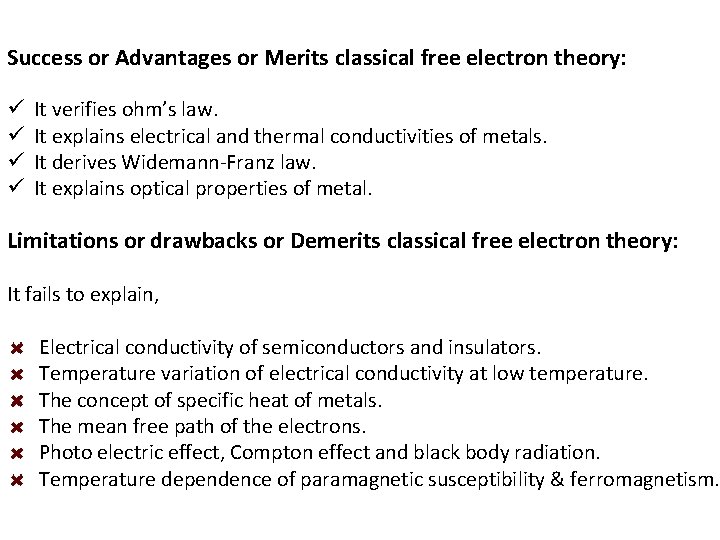
Success or Advantages or Merits classical free electron theory: ü ü It verifies ohm’s law. It explains electrical and thermal conductivities of metals. It derives Widemann-Franz law. It explains optical properties of metal. Limitations or drawbacks or Demerits classical free electron theory: It fails to explain, Electrical conductivity of semiconductors and insulators. Temperature variation of electrical conductivity at low temperature. The concept of specific heat of metals. The mean free path of the electrons. Photo electric effect, Compton effect and black body radiation. Temperature dependence of paramagnetic susceptibility & ferromagnetism.

Quantum Free Electron Theory: • • Quantum free electron theory was proposed by Sommerfeld in 1928. It overcomes many of the drawbacks of classical theory. Sommerfeld explained them by choosing Fermi- Dirac statistics. He developed this theory by applying the principles of quantum mechanics. Assumptions: • • Valence electrons move freely in a constant potential. The electron is trapped in a potential well. The distribution of electrons in energy levels obey Pauli Exclusion Principle. Attraction & repulsion between free electrons and lattice ions are ignored. Distribution of energy among the free electrons is according to F-D statistics. The energy values of free electrons are quantized. To find the possible energy values of electron Schrodinger time independent wave equation is applied. • The problem is similar to that of particle present in a potential box.
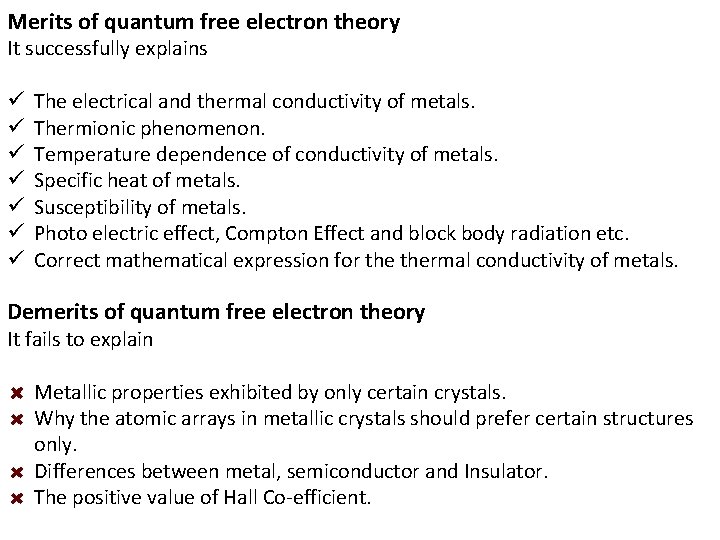
Merits of quantum free electron theory It successfully explains ü ü ü ü The electrical and thermal conductivity of metals. Thermionic phenomenon. Temperature dependence of conductivity of metals. Specific heat of metals. Susceptibility of metals. Photo electric effect, Compton Effect and block body radiation etc. Correct mathematical expression for thermal conductivity of metals. Demerits of quantum free electron theory It fails to explain Metallic properties exhibited by only certain crystals. Why the atomic arrays in metallic crystals should prefer certain structures only. Differences between metal, semiconductor and Insulator. The positive value of Hall Co-efficient.
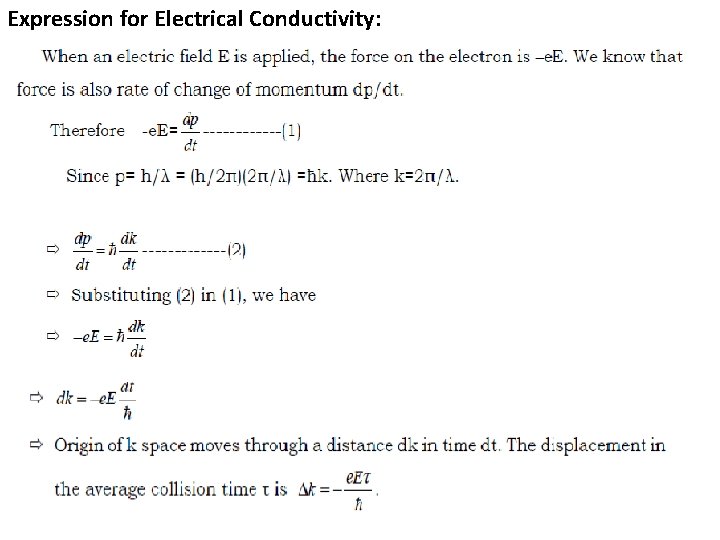
Expression for Electrical Conductivity:
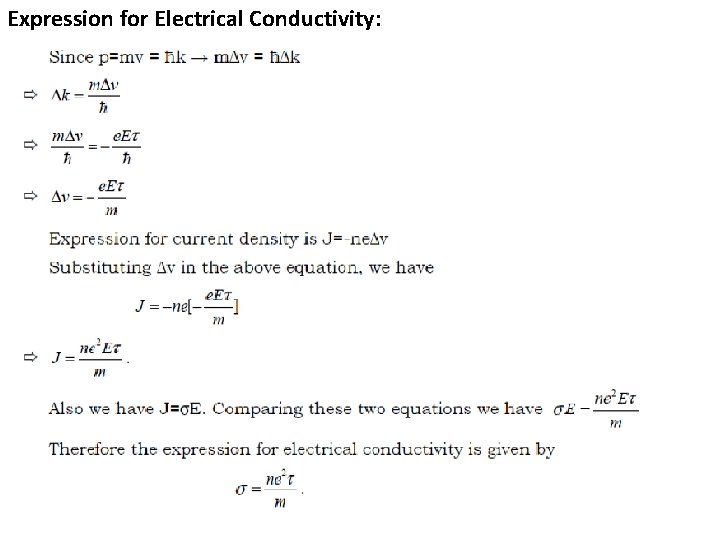
Expression for Electrical Conductivity:
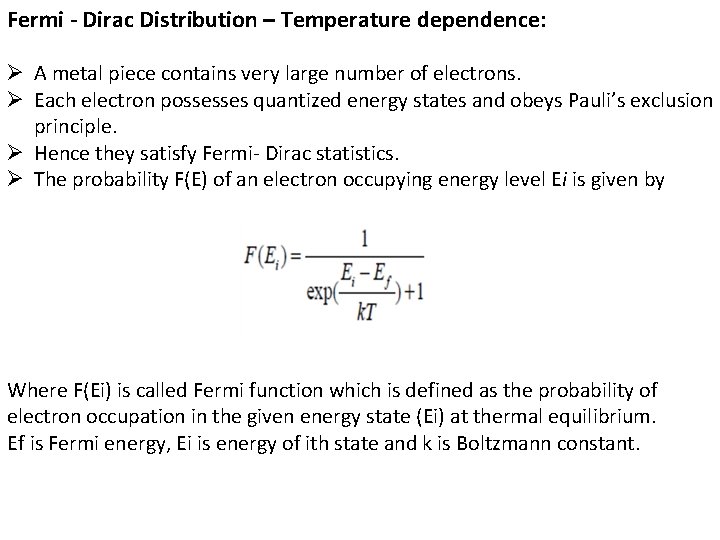
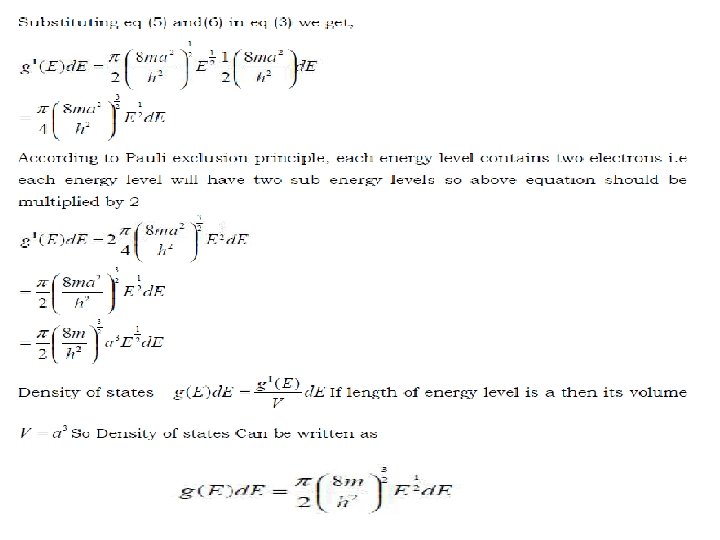
Fermi - Dirac Distribution – Temperature dependence: Ø A metal piece contains very large number of electrons. Ø Each electron possesses quantized energy states and obeys Pauli’s exclusion principle. Ø Hence they satisfy Fermi- Dirac statistics. Ø The probability F(E) of an electron occupying energy level Ei is given by Where F(Ei) is called Fermi function which is defined as the probability of electron occupation in the given energy state (Ei) at thermal equilibrium. Ef is Fermi energy, Ei is energy of ith state and k is Boltzmann constant.
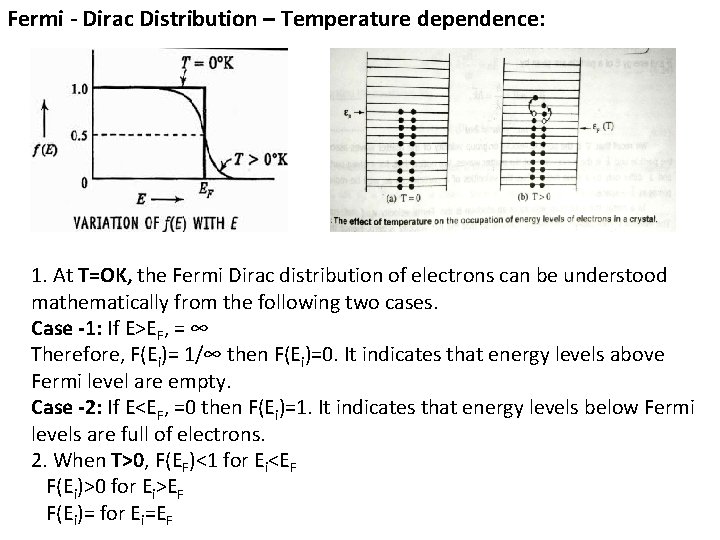
Fermi - Dirac Distribution – Temperature dependence: 1. At T=OK, the Fermi Dirac distribution of electrons can be understood mathematically from the following two cases. Case -1: If E>EF, = ∞ Therefore, F(Ei)= 1/∞ then F(Ei)=0. It indicates that energy levels above Fermi level are empty. Case -2: If E<EF, =0 then F(Ei)=1. It indicates that energy levels below Fermi levels are full of electrons. 2. When T>0, F(EF)<1 for Ei<EF F(Ei)>0 for Ei>EF F(Ei)= for Ei=EF
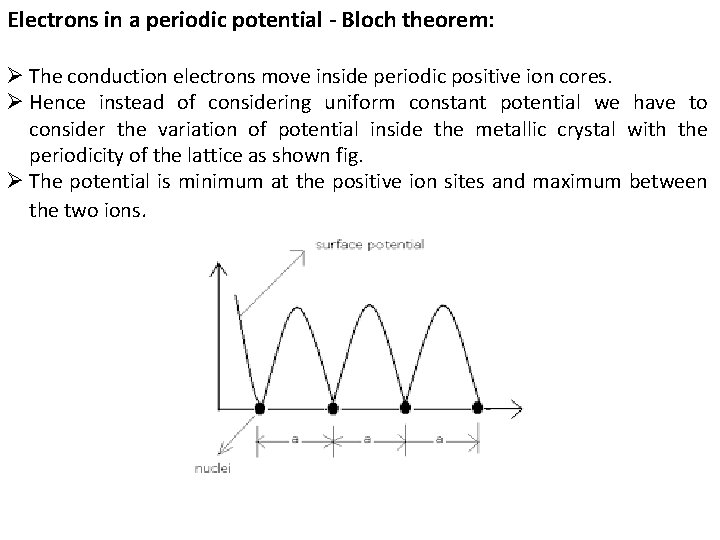
Electrons in a periodic potential - Bloch theorem: Ø The conduction electrons move inside periodic positive ion cores. Ø Hence instead of considering uniform constant potential we have to consider the variation of potential inside the metallic crystal with the periodicity of the lattice as shown fig. Ø The potential is minimum at the positive ion sites and maximum between the two ions.
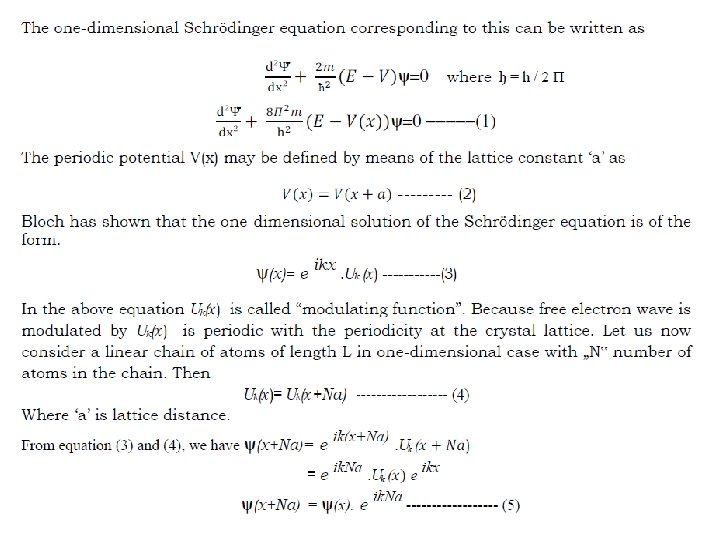
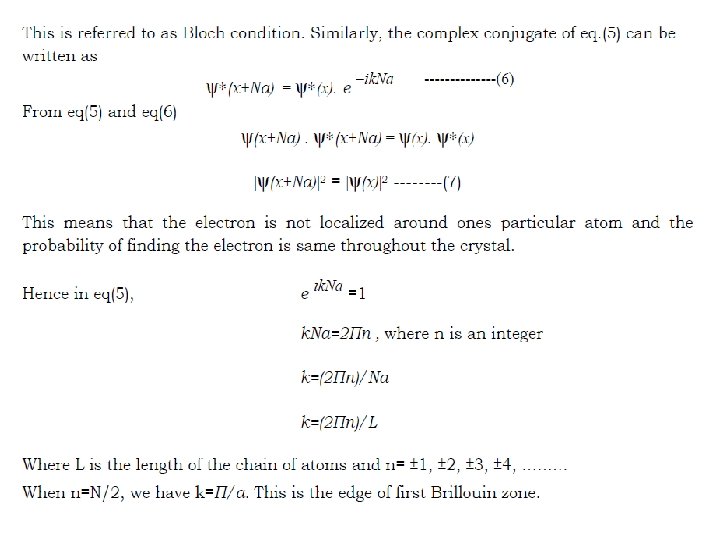
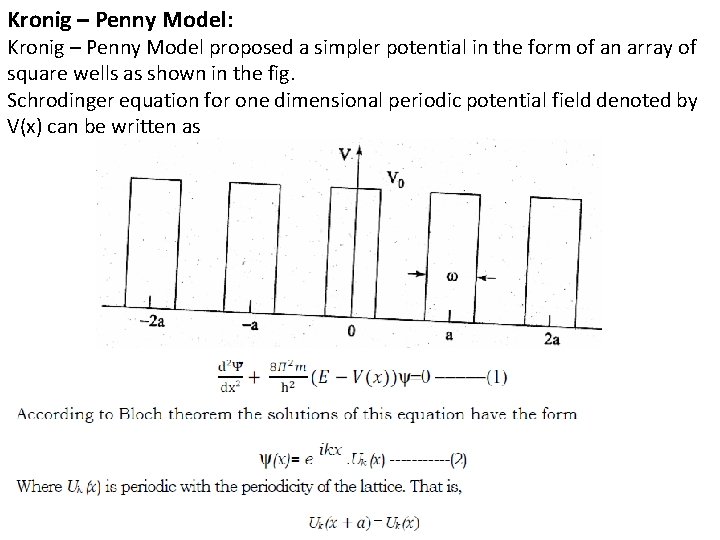
Kronig – Penny Model: Kronig – Penny Model proposed a simpler potential in the form of an array of square wells as shown in the fig. Schrodinger equation for one dimensional periodic potential field denoted by V(x) can be written as
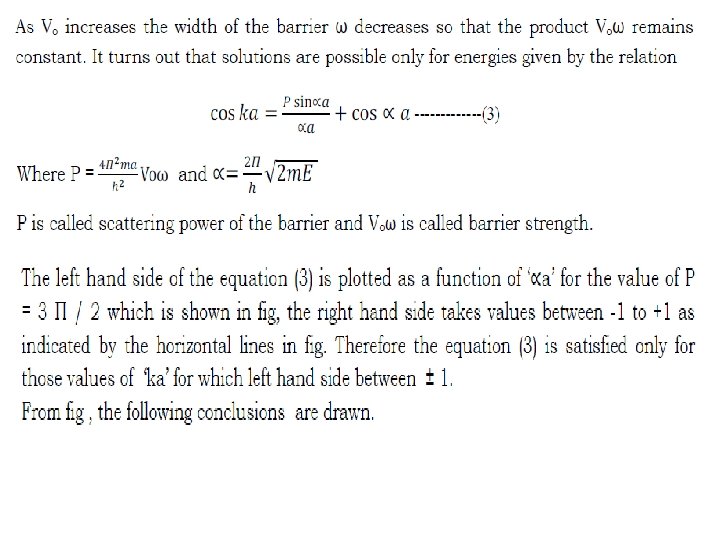
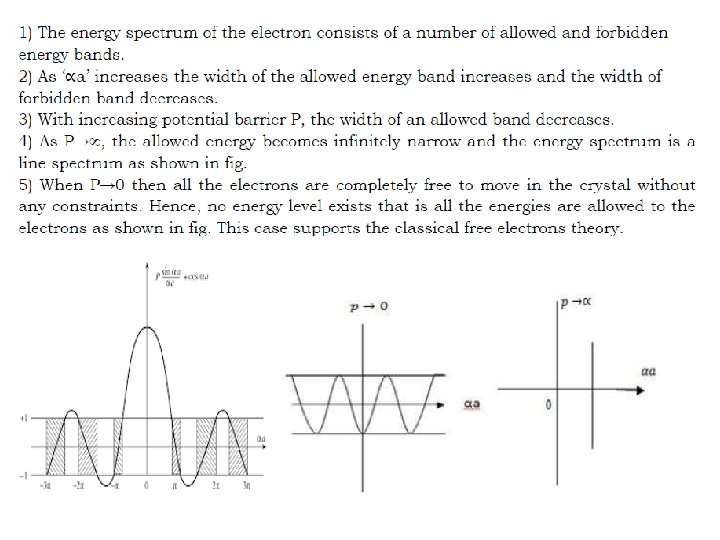
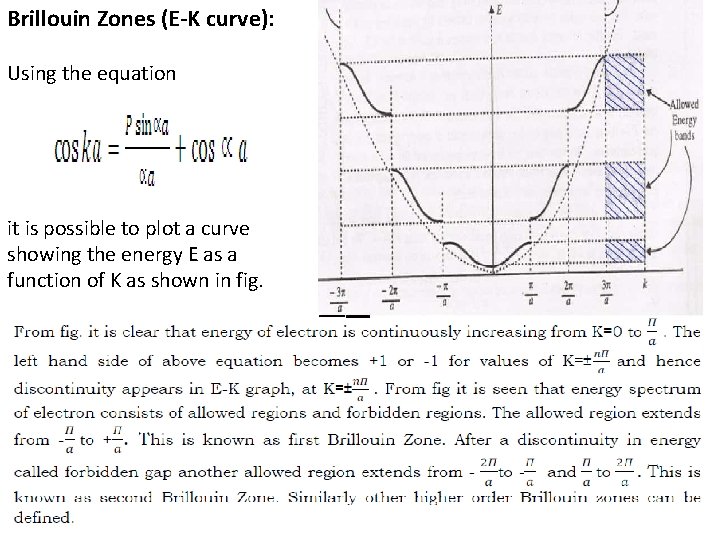
Brillouin Zones (E-K curve): Using the equation it is possible to plot a curve showing the energy E as a function of K as shown in fig.
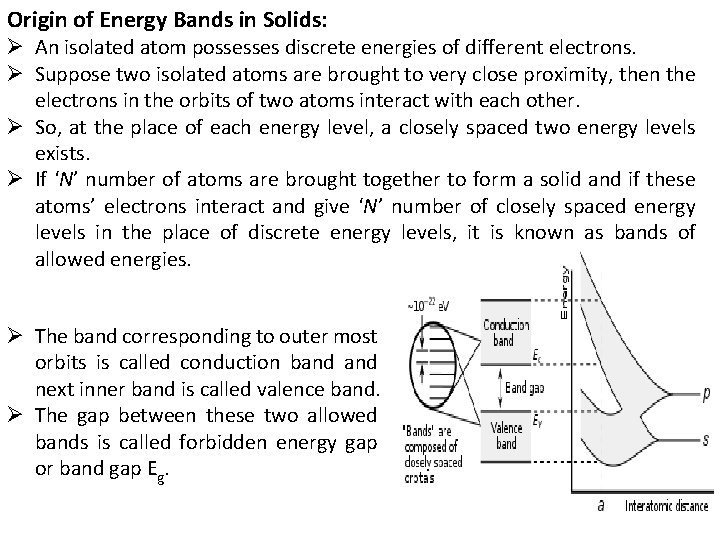
Origin of Energy Bands in Solids: Ø An isolated atom possesses discrete energies of different electrons. Ø Suppose two isolated atoms are brought to very close proximity, then the electrons in the orbits of two atoms interact with each other. Ø So, at the place of each energy level, a closely spaced two energy levels exists. Ø If ‘N’ number of atoms are brought together to form a solid and if these atoms’ electrons interact and give ‘N’ number of closely spaced energy levels in the place of discrete energy levels, it is known as bands of allowed energies. Ø The band corresponding to outer most orbits is called conduction band next inner band is called valence band. Ø The gap between these two allowed bands is called forbidden energy gap or band gap Eg.
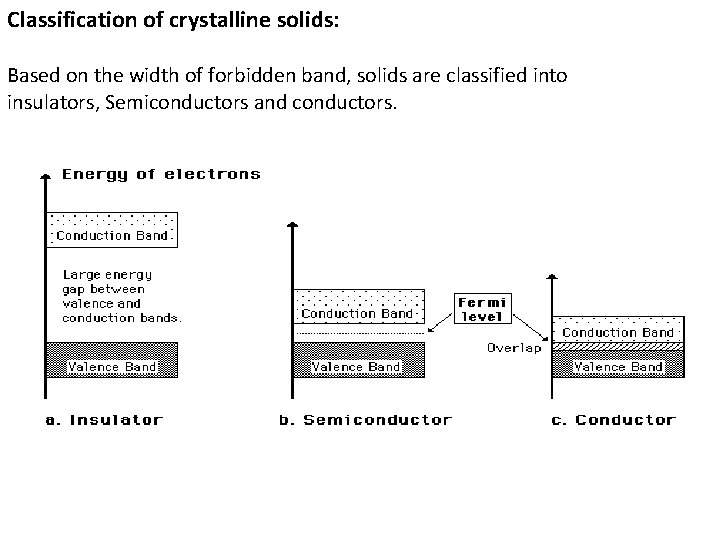
Classification of crystalline solids: Based on the width of forbidden band, solids are classified into insulators, Semiconductors and conductors.
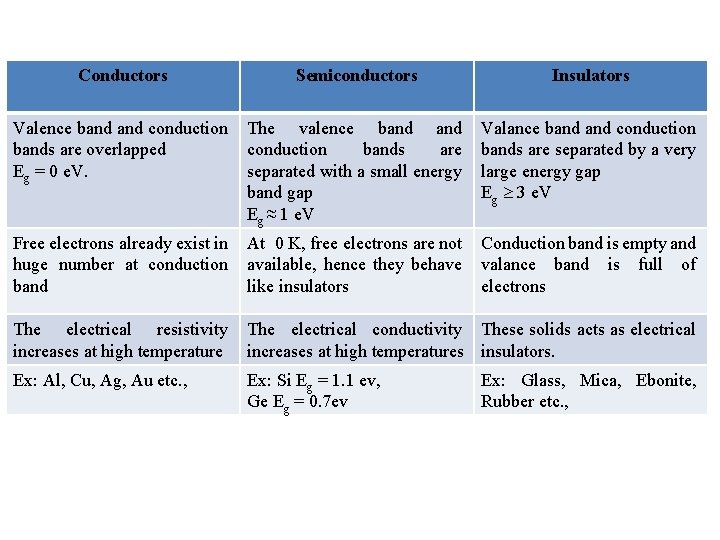
Conductors Semiconductors Insulators Valence band conduction bands are overlapped Eg = 0 e. V. The valence band conduction bands are separated with a small energy band gap Eg ≈ 1 e. V Valance band conduction bands are separated by a very large energy gap Eg 3 e. V Free electrons already exist in huge number at conduction band At 0 K, free electrons are not available, hence they behave like insulators Conduction band is empty and valance band is full of electrons The electrical resistivity increases at high temperature The electrical conductivity These solids acts as electrical increases at high temperatures insulators. Ex: Al, Cu, Ag, Au etc. , Ex: Si Eg = 1. 1 ev, Ge Eg = 0. 7 ev Ex: Glass, Mica, Ebonite, Rubber etc. ,
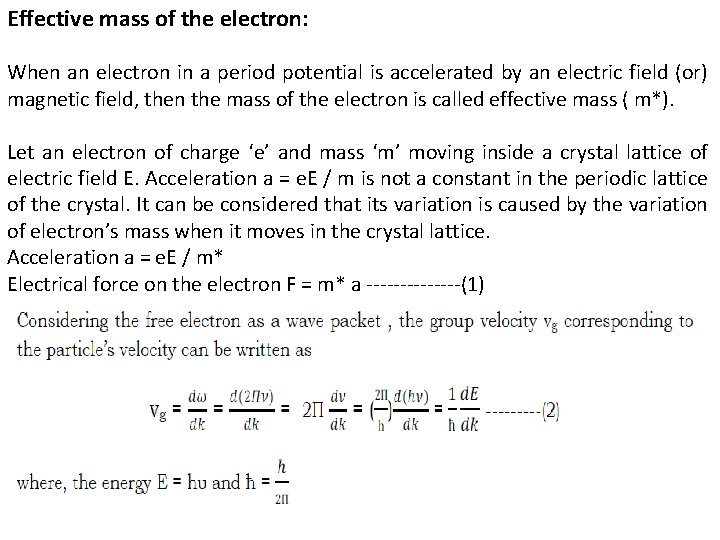
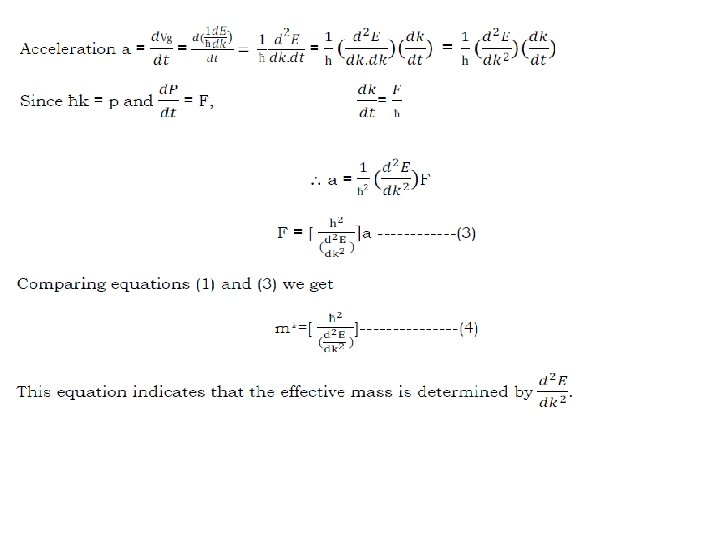
Effective mass of the electron: When an electron in a period potential is accelerated by an electric field (or) magnetic field, then the mass of the electron is called effective mass ( m*). Let an electron of charge ‘e’ and mass ‘m’ moving inside a crystal lattice of electric field E. Acceleration a = e. E / m is not a constant in the periodic lattice of the crystal. It can be considered that its variation is caused by the variation of electron’s mass when it moves in the crystal lattice. Acceleration a = e. E / m* Electrical force on the electron F = m* a -------(1)
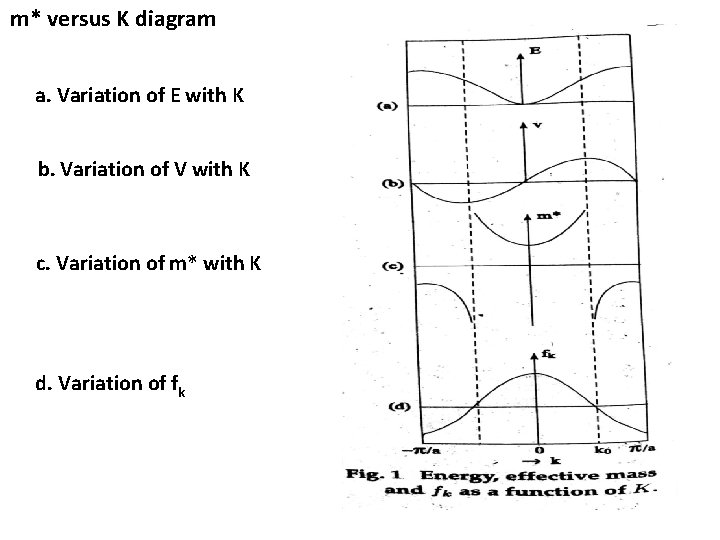
m* versus K diagram a. Variation of E with K b. Variation of V with K c. Variation of m* with K d. Variation of fk

THANK YOU
- Slides: 28