
Unit III Chapter 4 Decision Table Based Testing
Unit III – Chapter 4 Decision Table Based Testing

What is Decision Table Testing? • Decision table testing is a software testing technique used to test system behavior for different input combinations. This is a systematic approach where the different input combinations and their corresponding system behavior (Output) are captured in a tabular form. That is why it is also called as a Cause. Effect table where Cause and effects are captured for better test coverage.

Example 1: How to make Decision Base Table for Login Screen
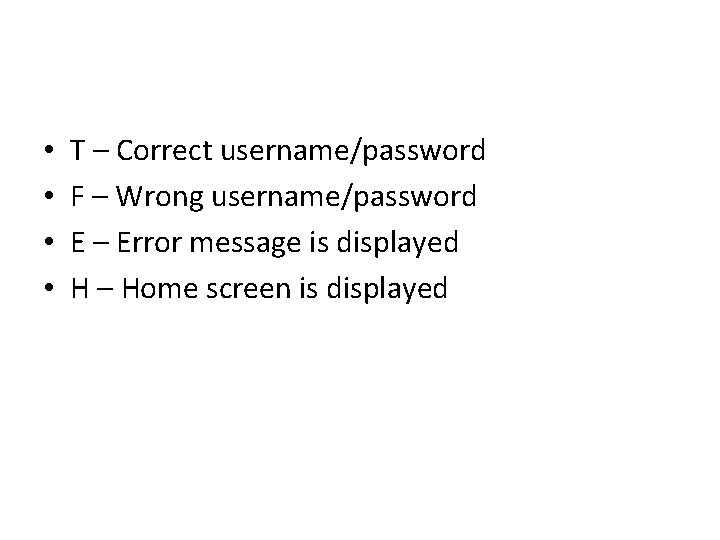
• • T – Correct username/password F – Wrong username/password E – Error message is displayed H – Home screen is displayed

• The condition is simple if the user provides correct username and password the user will be redirected to the homepage. If any of the input is wrong, an error message will be displayed. Conditions Rule 1 Rule 2 Rule 3 Rule 4 Username (T/F) F T Password (T/F) F F T T Output (E/H) E E E H
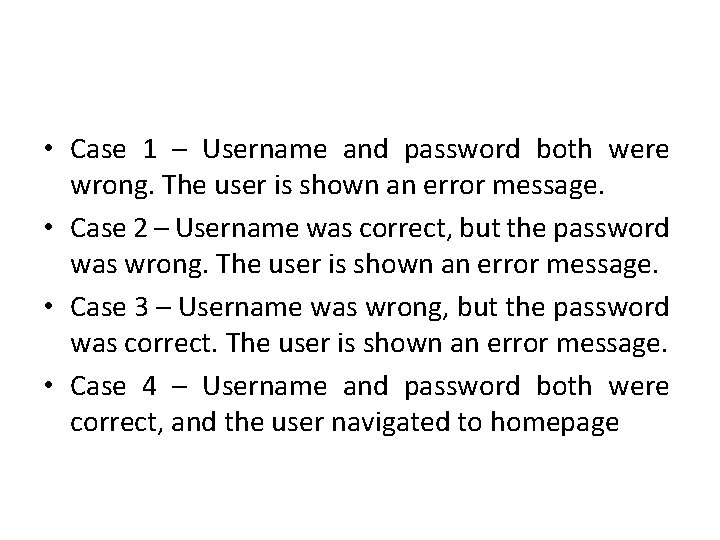
• Case 1 – Username and password both were wrong. The user is shown an error message. • Case 2 – Username was correct, but the password was wrong. The user is shown an error message. • Case 3 – Username was wrong, but the password was correct. The user is shown an error message. • Case 4 – Username and password both were correct, and the user navigated to homepage
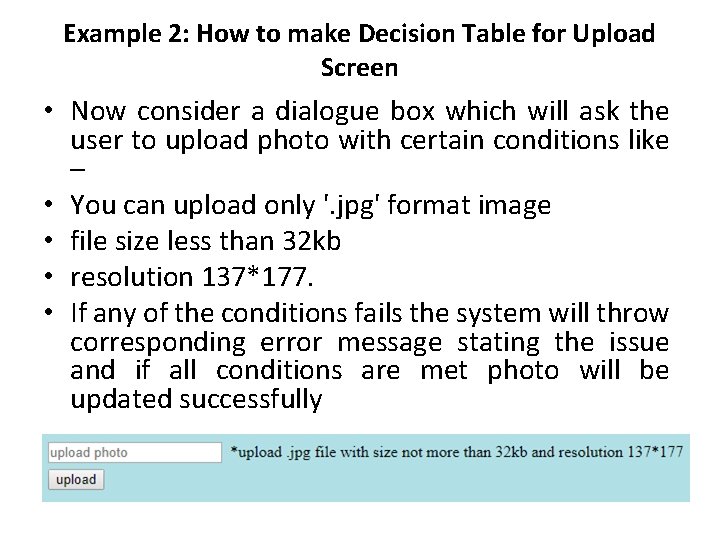
Example 2: How to make Decision Table for Upload Screen • Now consider a dialogue box which will ask the user to upload photo with certain conditions like – • You can upload only '. jpg' format image • file size less than 32 kb • resolution 137*177. • If any of the conditions fails the system will throw corresponding error message stating the issue and if all conditions are met photo will be updated successfully
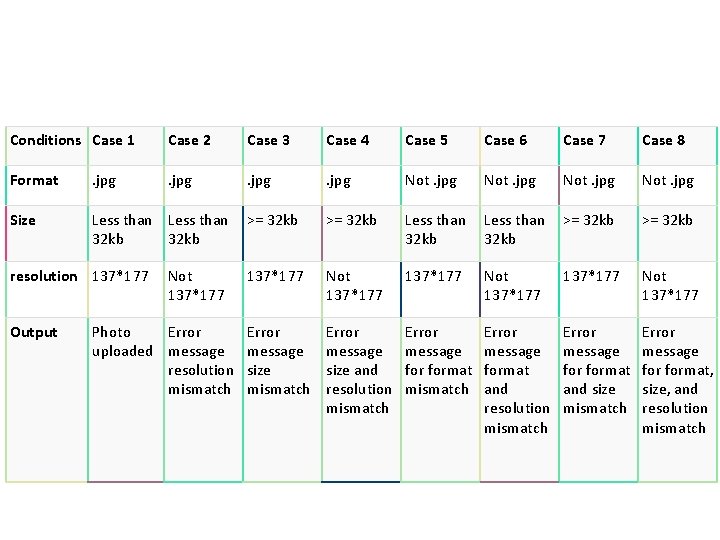
Conditions Case 1 Case 2 Case 3 Case 4 Case 5 Case 6 Case 7 Case 8 Format . jpg Not. jpg Size Less than 32 kb >= 32 kb 137*177 Not 137*177 Error message size mismatch Error message size and resolution mismatch Error message format and resolution mismatch Error message format and size mismatch Error message format, size, and resolution mismatch resolution 137*177 Output Not 137*177 Photo Error uploaded message resolution mismatch
Advantages of Decision Table Testing • When the system behavior is different for different input and not same for a range of inputs, both equivalent partitioning, and boundary value analysis won't help, but decision table can be used. • The representation is simple so that it can be easily interpreted and is used for development and business as well. • This table will help to make effective combinations and can ensure a better coverage for testing • Any complex business conditions can be easily turned into decision tables • In a case we are going for 100% coverage typically when the input combinations are low, this technique can ensure the coverage.

Disadvantages of Decision Table Testing • The main disadvantage is that when the number of input increases the table will become more complex
What is Cause-Effect Graph? • Cause Effect Graph is a black box testing technique that graphically illustrates the relationship between a given outcome and all the factors that influence the outcome.
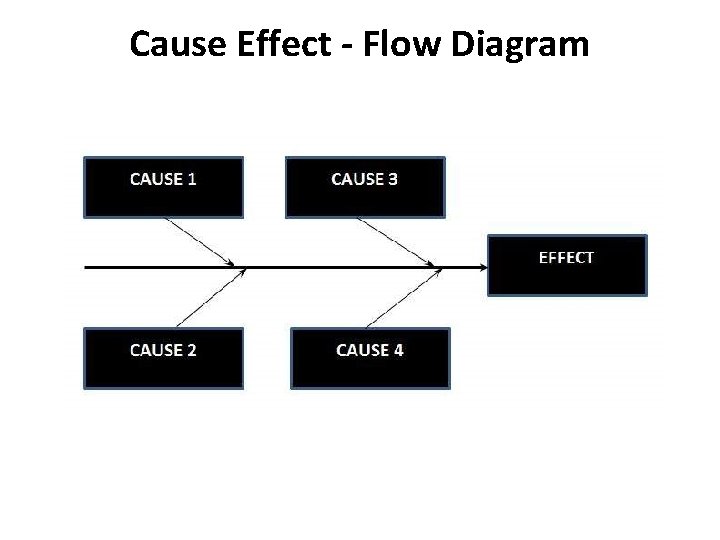
Cause Effect - Flow Diagram
Circumstances - under which Cause. Effect Diagram used • To Identify the possible root causes, the reasons for a specific effect, problem, or outcome. • To Relate the interactions of the system among the factors affecting a particular process or effect. • To Analyze the existing problems so that corrective action can be taken at the earliest.
Steps for generation of test cases • • • Identification of all causes and effects Design the cause effects graph Apply Constraints, if any Design limited entry decision table from graph Write test cases using every column of the decision table
Benefits : • It Helps us to determine the root causes of a problem or quality using a structured approach. • It Uses an orderly, easy-to-read format to diagram cause-and-effect relationships. • It Indicates possible causes of variation in a process. • It Encourages team participation and utilizes the team knowledge of the process.
- Slides: 15