
UNIT II THE FRENCH REVOLUTION 1789 1815 UNIT
- Slides: 15
UNIT II: THE FRENCH REVOLUTION 1789 -1815
UNIT II: LESSON #1 THE FRENCH REVOLUTION I. The Old Regime: (Why were things so bad? ) A. France was considered the most advanced country in the world in many ways at that time: 1. The creators of the Enlightenment 2. Leaders in Science and Literature 3. Most powerful politically and in size. 4. Powerful trade and Mercantilism.
UNIT II: LESSON #1 THE FRENCH REVOLUTION I. The Old Regime: (Why were things so bad? ) B. So what was so wrong about how the French did things? 1. The poor paid all taxes, nobles and clergy were exempt. 2. The Catholic Church controlled a large percentage of the power in France. a. Church Tithe was heavy b. five to ten percent of the land
UNIT II: LESSON #1 THE FRENCH REVOLUTION I. The Old Regime: (Why were things so bad? ) B. So what was so wrong about how the French did things? (cont’d) 3. Absolute Monarchy meant that even nobles had little say in government. a. The Three Estates General (1614 AD) -. 1 st Clergy -. 2 nd Nobles -. 3 rd All Others b. It was socially obsolete and did not correspond to the real distribution of influence or production.
UNIT II: LESSON #1 THE FRENCH REVOLUTION II. The Crisis: (What were the triggers? ) A. The Money Problem 1. Half the gold pieces circulating in Europe were French. 2. The amount of merchant wealth increased five times between 1713 and 1789. 3. Inflation: consumer good prices up 65% wages only up 22%. B. The Bourgeoisie must pay the “Taille” (land tax) and resent noblemen and Bishops who do not. C. Paying the heavy debts for wars, and a massive standing army and navy fell on the 3 rd Estate alone.
UNIT II: LESSON #1 THE FRENCH REVOLUTION II. The Crisis: (What were the triggers? ) B. The Population Problem 1. 4/5 ths of the people of France were rural (-but becoming educated-questioning things. ) 2. The remnants of manor life still existed. Nobles lived off of profits from lands farmed by common folk. (1 st and 2 nd Estate seen as a parasite of the 3 rd. ) 3. 24 million people at the time. (Population is outstripping food base and jobs base) 4. Paris was the second largest city in Europe (thanks to Bourgeoisie Merchants who want more say regarding taxes. ).
UNIT II: LESSON #1 THE FRENCH REVOLUTION II. The Crisis: (What were the triggers? ) C. The Weather Problem 1. Exceptionally Hot Summers -1788 -89 2. Several crop failures, especially in 1788 3. The “Ergot of Rye” syndrome 4. Hungry peasants flocked to the cities for food and there was none. 5. High food prices in towns combined with hungry people made for an explosive summer.
UNIT II: LESSON #1 THE FRENCH REVOLUTION II. The Crisis: (What were the triggers? ) D. The Leadership Problem 1. Louis XVI’s ideas about the “Divine Right of Kings” are obsolete. 2. The Nobility and Bourgeoisie have read and agree with Enlightenment Thinkers, who stand against Absolute Monarchy. 3. Louis is not a strong leader personally and the French do not cherish his Austrian wife. 4. The Royal family seems cut off and isolated from problems in the country. They also seem to not care.
UNIT II: LESSON #1 THE FRENCH REVOLUTION IV. The Collapse of the Old Order: (How do things fall apart? ) A. Louis calls the Estates General B. The Estates General collapses into the National Assembly C. The Bastille and Bread riots inflame the people. D. Louis tries to escape and his family become prisoners of the French People.
UNIT II: LESSON #1 THE FRENCH REVOLUTION IV. The Collapse of the Old Order: (How do things fall apart? ) E. The countries around France begin to fear it and mobilize against it. F. 1792 War is declared against Austria and Prussia and France is losing. There is paranoia that monarchists are sabotaging the war. G. 20 June 1792 the palace in Paris where the royal family are “guests” is attacked by people wanting to prove allegiance. H. The invading armies announce swift punishment for anyone harming the king. The crowds wreck the palace and slaughter the guards.
UNIT II: LESSON #1 THE FRENCH REVOLUTION IV. The Collapse of the Old Order: (How do things fall apart? ) I. French “Nationalism” becomes a motivating factor. J. All are required to participate to support the war. 20 September they win at the Battle of Valmy. (French Year “ 1. ”) K. Plans to export revolution to every country in Europe are carried out. “Assistance to All!”
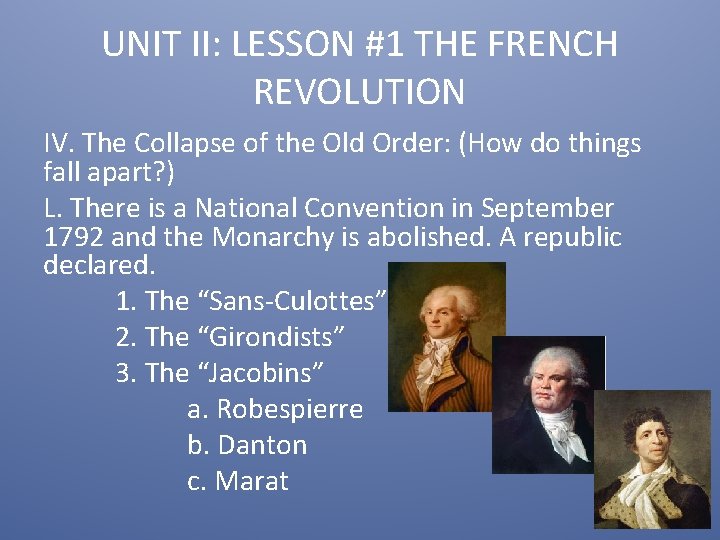
UNIT II: LESSON #1 THE FRENCH REVOLUTION IV. The Collapse of the Old Order: (How do things fall apart? ) L. There is a National Convention in September 1792 and the Monarchy is abolished. A republic declared. 1. The “Sans-Culottes” 2. The “Girondists” 3. The “Jacobins” a. Robespierre b. Danton c. Marat
UNIT II: LESSON #1 THE FRENCH REVOLUTION IV. The Collapse of the Old Order: (How do things fall apart? ) M. The death of the king. 1. The enemy is close to Paris 2. The “sans-culottes mob the jails and murder any monarchists. 3. The Jacobins see this as the moment to take control. a. Dec. 1792 Put the King on Trial b. Out the Girondists for wanting him to live. c. Jan 15, 1793: Kill the king and beginning May 31, they begin to arrest the Girondists. d. Use fear of invasion and conspiracy to gain and maintain power beginning around April 1793.
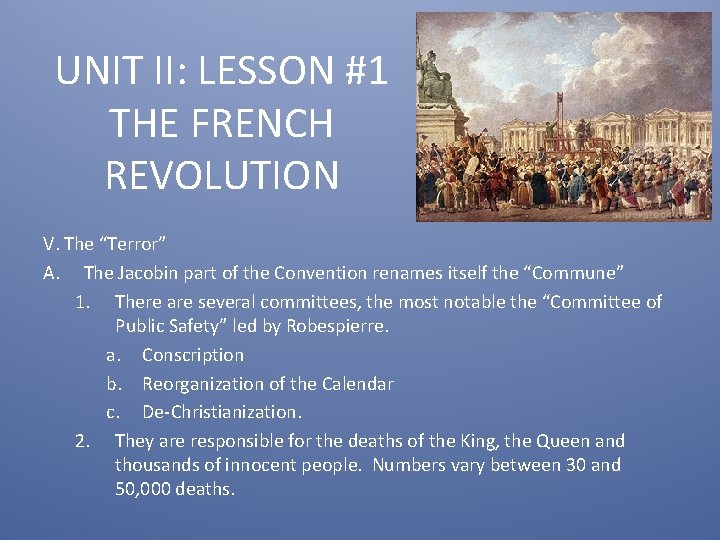
UNIT II: LESSON #1 THE FRENCH REVOLUTION V. The “Terror” A. The Jacobin part of the Convention renames itself the “Commune” 1. There are several committees, the most notable the “Committee of Public Safety” led by Robespierre. a. Conscription b. Reorganization of the Calendar c. De-Christianization. 2. They are responsible for the deaths of the King, the Queen and thousands of innocent people. Numbers vary between 30 and 50, 000 deaths.
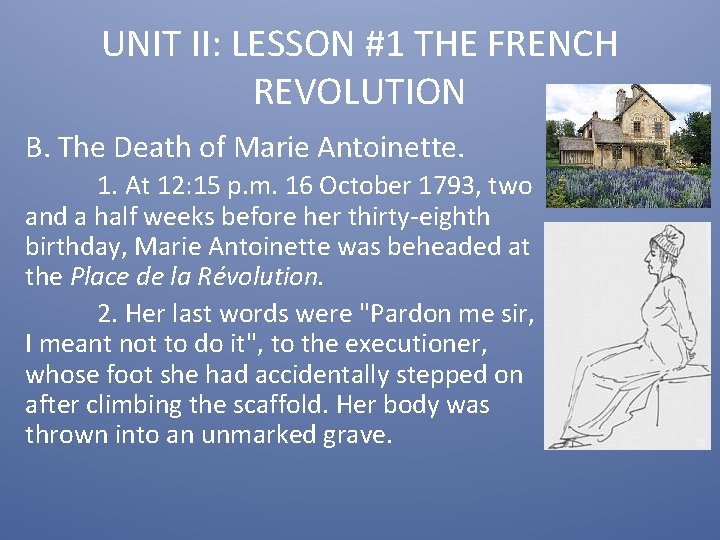
UNIT II: LESSON #1 THE FRENCH REVOLUTION B. The Death of Marie Antoinette. 1. At 12: 15 p. m. 16 October 1793, two and a half weeks before her thirty-eighth birthday, Marie Antoinette was beheaded at the Place de la Révolution. 2. Her last words were "Pardon me sir, I meant not to do it", to the executioner, whose foot she had accidentally stepped on after climbing the scaffold. Her body was thrown into an unmarked grave.