
UNIT II POLITICAL IDEOLOGIES LESSON 2 ANARCHISM VERSUS

- Slides: 21
UNIT II: POLITICAL IDEOLOGIES LESSON 2: ANARCHISM VERSUS ABSOLUTISM
MAJOR POLITICAL IDEOLOGIES 1. Anarchism 2. Absolutism 3. Liberalism 4. Conservatism 5. Socialism The five major political ideologies have played a key role in world history by shaping governments and political movements.
Anarchism The belief that the best government is absolutely no government is known as anarchism. This ideology argues that everything about governments is repressive and therefore must be abolished entirely.
A related ideology known as nihilism emphasizes that everything—both government and society— must be periodically destroyed in order to start anew. Nihilists often categorically reject traditional concepts of morality in favor of violence and terror. Anarchism and nihilism were once associated with socialism because many anarchists and nihilists supported the socialists’ call for revolution and the complete overhaul of government and society in the early to midtwentieth century.
ADVOCATES OF ANARCHISM
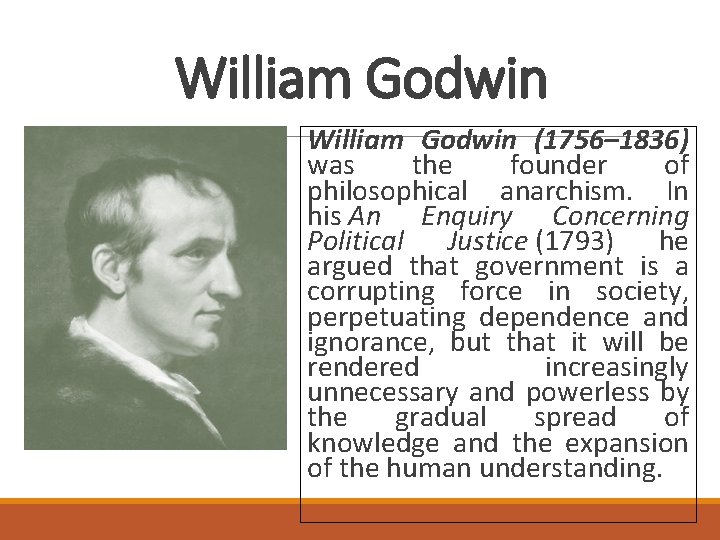
William Godwin (1756– 1836) was the founder of philosophical anarchism. In his An Enquiry Concerning Political Justice (1793) he argued that government is a corrupting force in society, perpetuating dependence and ignorance, but that it will be rendered increasingly unnecessary and powerless by the gradual spread of knowledge and the expansion of the human understanding.
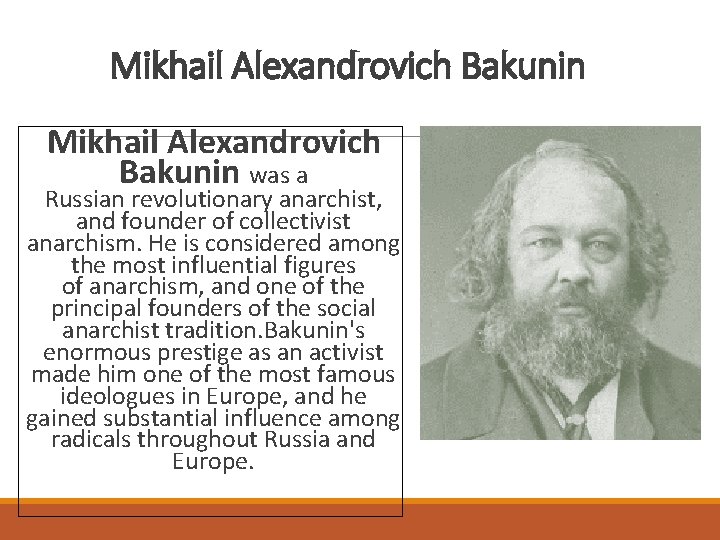
Mikhail Alexandrovich Bakunin was a Russian revolutionary anarchist, and founder of collectivist anarchism. He is considered among the most influential figures of anarchism, and one of the principal founders of the social anarchist tradition. Bakunin's enormous prestige as an activist made him one of the most famous ideologues in Europe, and he gained substantial influence among radicals throughout Russia and Europe.
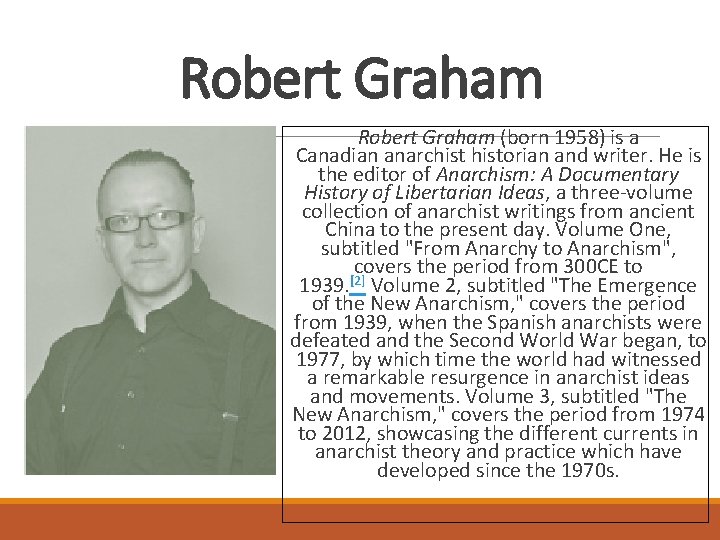
Robert Graham (born 1958) is a Canadian anarchistorian and writer. He is the editor of Anarchism: A Documentary History of Libertarian Ideas, a three-volume collection of anarchist writings from ancient China to the present day. Volume One, subtitled "From Anarchy to Anarchism", covers the period from 300 CE to [2] 1939. Volume 2, subtitled "The Emergence of the New Anarchism, " covers the period from 1939, when the Spanish anarchists were defeated and the Second World War began, to 1977, by which time the world had witnessed a remarkable resurgence in anarchist ideas and movements. Volume 3, subtitled "The New Anarchism, " covers the period from 1974 to 2012, showcasing the different currents in anarchist theory and practice which have developed since the 1970 s.
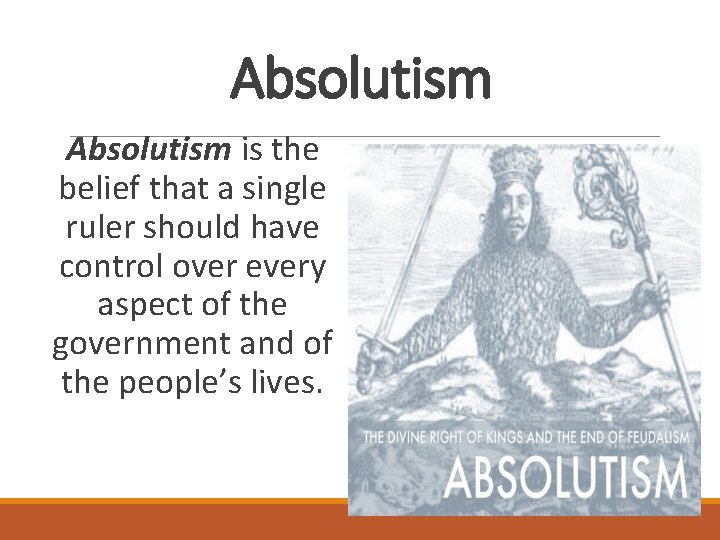
Absolutism is the belief that a single ruler should have control over every aspect of the government and of the people’s lives.
Absolute rulers had a variety of titles, including chieftain, king, shah, pharaoh, emperor, sultan, and prince. In some cultures, the absolute ruler was seen as a god in human form. Other peoples believed that their ruler had the divine right of kings, meaning that God had chosen the ruler to govern the rest. As a result, many cultures with absolute rulers practiced some form of caesaropapism, the belief that the ruler is head of both the governmental authority and the religious authority.
ABSOLUTE MONARCHS
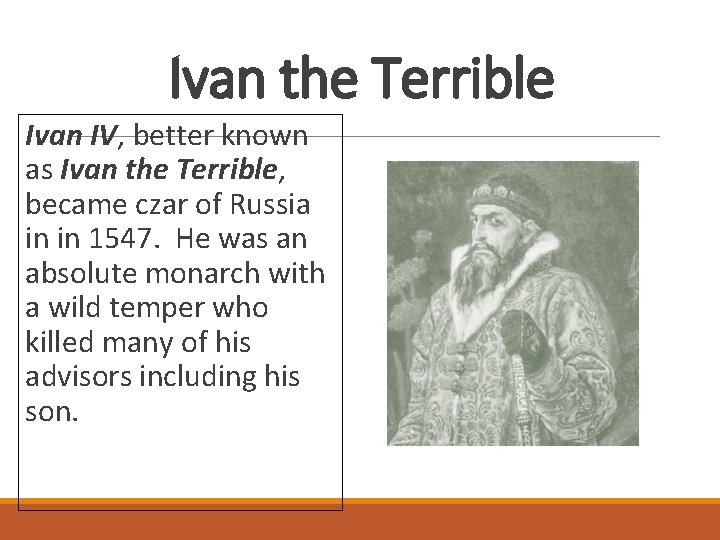
Ivan the Terrible Ivan IV, better known as Ivan the Terrible, became czar of Russia in in 1547. He was an absolute monarch with a wild temper who killed many of his advisors including his son.
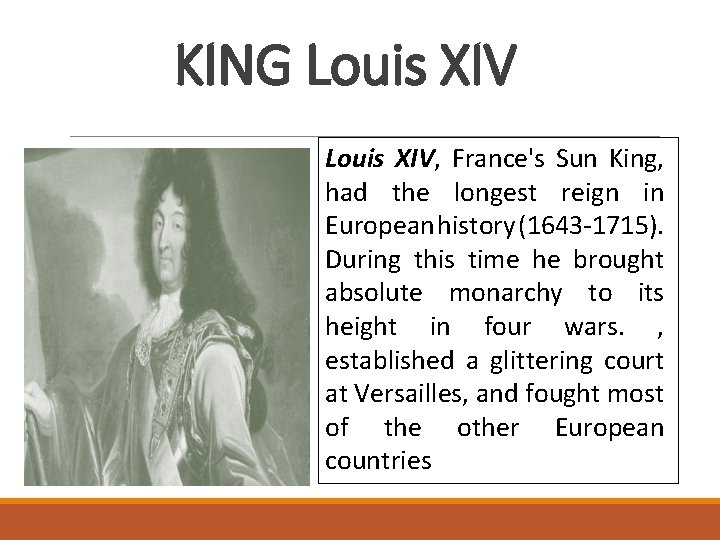
KING Louis XIV, France's Sun King, had the longest reign in European history (1643 -1715). During this time he brought absolute monarchy to its height in four wars. , established a glittering court at Versailles, and fought most of the other European countries
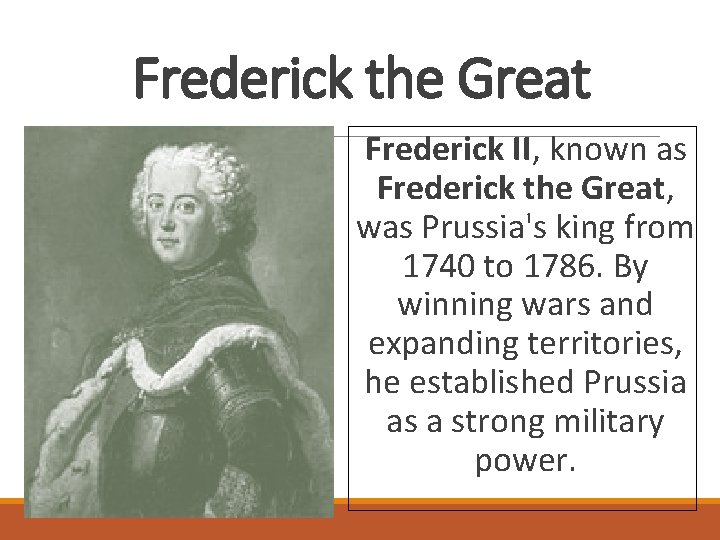
Frederick the Great Frederick II, known as Frederick the Great, was Prussia's king from 1740 to 1786. By winning wars and expanding territories, he established Prussia as a strong military power.
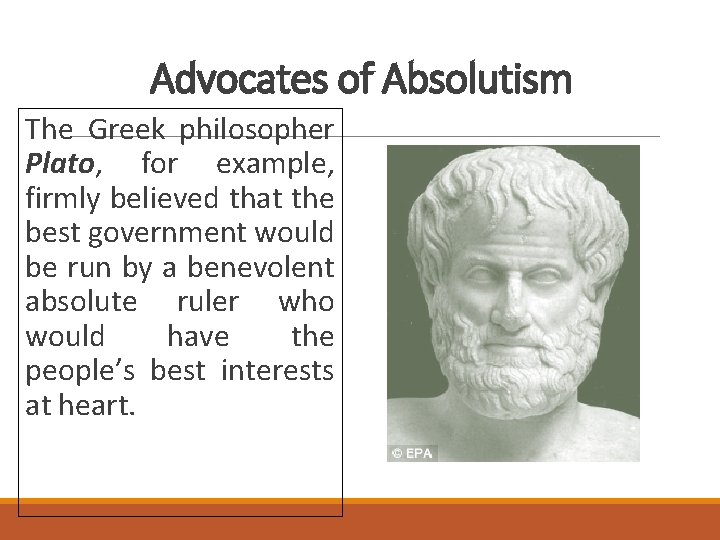
Advocates of Absolutism The Greek philosopher Plato, for example, firmly believed that the best government would be run by a benevolent absolute ruler who would have the people’s best interests at heart.
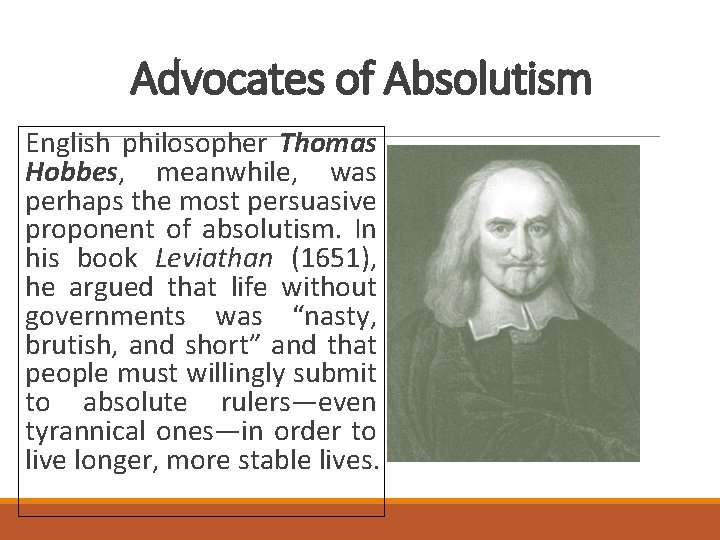
Advocates of Absolutism English philosopher Thomas Hobbes, meanwhile, was perhaps the most persuasive proponent of absolutism. In his book Leviathan (1651), he argued that life without governments was “nasty, brutish, and short” and that people must willingly submit to absolute rulers—even tyrannical ones—in order to live longer, more stable lives.
Absolutism emphasizes: A strong sense of order: Everything should be carefully structured, including society. Disorder and chaos are generally considered to be dangerous. A clear-cut law of nature (or law of God): This law must be obeyed. According to this law, some people are inherently better than others. A natural hierarchy: a power structure in which some people have authority over others exists. Therefore, the superior should rule the inferior. This general view is called elitism, or elite theory.
ACTIVITY 1 Compare and Contrast Anarchism and Absolutism Political Ideology Advantages Disadvantages