
UNIT II NURSING AS A PROFESSION UNIT II





















- Slides: 115
UNIT - II NURSING AS A PROFESSION
UNIT - II NURSING AS A PROFESSION Presented by: Mrs. Anna Thomas Department : Nursing Foundation
Learning Objectives At the end of the class students will be able to : • Define profession • Describe characteristics of profession • Define nursing • Explain concepts of nursing • Describe philosophy of nursing • Discuss objectives of nursing • List out functions of nursing • Explain qualities of a nurse
• • List out categories of nursing personnel Explain nursing as a profession Discuss history of nursing in India Define values Enumerate types of values Describe values clarification Explain values in professional nursing: caring and advocacy
• • Define ethics Explain ethical principles Describe code of ethics Discuss professional conduct for nurses
PROFESSION • DEFINITION A profession is defined as an occupation with ethical components that is devoted to the promotion of human and social welfare. The services offered by a profession are based on specialized knowledge and skills that have been developed in a scientific and learned manner -Kozier
• “ Professionalism involves the application of knowledge and skills , a high standard of practice , leadership , self regulation , professional commitment , social values and service directed activity. ” - MULLER , 1998
Characteristics of a profession • • Specialized education Body of knowledge Service orientation Ongoing research Code of ethics Autonomy Professional organization
1. Specialised education Ø Important aspect of professional status. Ø Education can acquired from colleges and universities.
2. Body of knowledge Ø Helps in the development of various skills, abilities, norms Ø Become an expert.
3. Service orientation Ø Nursing is a service Ø Differentiates nursing from an occupation. Ø Guided by certain rules, policies or code of ethics.
4. Ongoing research Ø Helps to improve client care and enhance nursing’s scientific knowledge base.
5. Code of professional conduct of ethics • A profession will have code of ethics for their members and diciplinary procedures
6. Autonomy • Self regulation • Professionals tend to retain control over their work, even when they are employed outside. • Its considered to be autonomy commitment and responsibility with an advance body of knowledge and skills and an organized value system develop and transmission through extensive, academic preparation and professional socialization of education and practice.
7. Professional organization/association • Professions usually have professional bodies organized by their members, who are intended to enhance the status of their members and have carefully controlled requirements and that standards and practice of profession.
NURSING • The word NURSING came from the Latin word ‘NUTRICIUS’ which means to nourish, to protect and to sustain • The literal meaning of the word NURSE N – Nobility U – Usefulness R – Responsibility S – Simplicity E - Efficiency
NURSING - DEFINITION • “The act of utilizing the environment of the patient to assist him in the recovery. ” -Florence Nightingale, 1860 • It is the diagnosis and treatment of human responses to actual or potential health problems -ANA 1980
NURSING • DEFINITION “ The unique function of the nurse is to assist the individual , sick or well in the performance of those activities contributing to health or its recovery (or to a peaceful death) that he would perform unaided if he had the necessary strength, will or knowledge; and to do this in such a way as to help him gain independence as rapidly as possible” Virginia Henderson 1973
• “Nursing encompasses autonomous and collaborative care of individuals of all ages, families, groups and community , sick or well and in all settings. Nursing includes, the promotion of health, prevention of illness and the care of ill, disabled and dying people. Advocacy, promotion of a safe environment, research , participation in shaping health policy and inpatient and health systems, management and education are also key nursing roles. ” International Council Of Nurses 2010
CONCEPTS OF NURSING • The nursing science is an independent applying science. • Nursing is a profession. • Nursing can assist individual to meet the basic needs. • The tasks of nursing are: to promote heath to prevent disease to assist healing to assist dying patient.
• The client is a holistic human being. • The working place includes hospital, familiy, community and whole society. • Nursing is not only a science , but also an art. • The nursing science attaches importance to human beings living environment and the interaction between human being and its environment. • The nursing science is a gradually perfect and developing science
• There are mainly four concepts of nursing related to v person v. Environment v. Health v. Nursing • The connection between these four concepts are explained in the following statement
• “ Nursing studies the wholesome or health of humans, recognizing that humans are in continuous interaction with their environment” Donaldson and Crowley
PHILOSOPHY OF NURSING • Philosophy is derived from a Greek word which is made up of two words philo and sophia • philo = love • Sophia = wisdom
Definition • Philosophy is the science of science - Cal Ridge • Philosophy is the mother of all arts and medicine for the mind » - Cicero
Curriculum process • Curriculum is composite of entire experience • The learner undergoes the guidance of the school or college • A curriculum is directed to the education of nurses
Phases of curriculum process 1. Formulating statement of philosophy of the school or college or university 2. Establishment of purpose and objectives 3. Selection of learning experiences to achieve the purpose and objectives 4. Effective organization of team 5. Evaluation of the complete programmes
Objectives of philosophy • Self-realization • Spiritual development • Transmission and promotion of cultural heritage • Inculcation of moral values • Character development
OBJECTIVES OF NURSING • To promote health. • To prevent illness. • To restore health. • to facilitate coping with disability or death.
OBJECTIVES Of NURSING EDUCATION • To prepare nurses who will give expert bedside nursing care in the hospital and home • To provide integration of health and social aspect’s theory and practice in generalized public health nursing • To provide an adequate, sound scientific foundation to understand the functioning of body and mind in health and disease
• To prepare nurses who will be able to work coperatively with team members • To ensure opportunities for initiative and resourcefulness • To provide sense of responsibility
CHARACTERISTICS AND NATURE OF NURSING PRACTICE 1. nursing is an art and science • A professional nurse provides nursing care artfully with compassion, care, and respect for each client’s dignity • Nursing is a science because its based upon a body of knowledge 2. nursing is an accountable discipline guided by science, theory, a code of ethics, and the art of care and comfort to treat human responses to health and illness
3. Nursing is that expression of social activities that seeks under qualified instructions and directions. 4. Nursing is a direct human service, goal directed and adoptable to the needs of the individual, family and community during health and illness 5. It’s a dynamic, therapeutic and educative process in meeting health needs of the individual, family, and society.
6. It exists in response to the need of society and holds ideals related to the human health throughout the life span
SCOPE OF NURSING PRACTICE • Levels of nursing education in India 1. Multipurpose health worker female training (ANM or MPHW-F) 2. General nursing and midwifery 3. B. Sc Nursing 4. Post basic B. sc Nursing 5. M. Sc nursing 6. M. Phil in nursing 7. Ph. D Nursing
Opportunities and scope of nursing practice are as follows 1. 2. 3. 4. 5. 6. 7. 8. 9. Ambulatory care nurses Critical care nurses Nursing informatics Neonatal nursing Oncology nursing paediatric nursing Psychiatric nursing Geriatric nurses Midwife nurses
Contd…. 10. Industrial nurse 11. Military nurse 12. Orthopedic/traumatology Nurses 13. Cardio thoracic nurse 14. Neurosurgical nurse 15. Operation theatre nurse 16. Travel nurses 17. MBA in hospital and health care management 18. MHA 19. MPH
FUNCTIONS/ROLES OF A NURSE • • • Caregiver Clinical decision-maker Protector and client advocate Coordinator Case manager Rehabilitator Comforter Communicator Teacher/educator Researcher
QUALITIES OF A NURSE ü Empathy ü Caring ü Professional ü Ethical and non-judgmental ü Honesty and integrity ü Intelligence and common sense ü Good physical and mental health ü technical competence ü Dependability and adjustability
ü Emotional stability ü Confidential and trust worthy ü Open mind to learn ü Be an advocate ü Be a good listener and a good communicator ü Self confident ü Loyalty ü Non-possessive
ü Courtesy ü Concreteness in communication ü Sensitive confrontation ü Accountable ü Good administrator ü Good workmanship ü Courage ü Selflessness
Categories of Nursing Personnel I. In clinical area 1. staff nurse 2. head sister or nursing supervisor or in-charge nurse 3. department supervisor / Assistant nursing superintendent 4. deputy nursing superintendent 5. director of nursing
II. In the community 1. MPHW 2. Health visitor 3. Public health nurse 4. community health officer 5. district public health nurse III. Nursing service administrative positions 1. state level- Deputy director of nursing 2. national level- Nursing advisor to the govt of India
IV. Teaching in nursing 1. School of nursing – clinical instructor/tutor, grade II and grade I tutors, and principal 2. college of nursing – assistant lecturers, Lecturers, Assistant professor, Associate professor, Professor and Principal
NURSING AS A PROFESSION • • Specialized education Body of knowledge Service orientation Ongoing research Code of ethics Autonomy Professional organization
HISTORY OF NURSING IN INDIA • Nursing in India has passed through many phases • The progress in nursing has been relatively slow in the period of early independence • However, through the later part of 20 th century there has been definite growth and development in nursing education and nursing service
1. The primary stage • Ancient history reveals no records of nursing in prehistoric times • Prehistoric men were interested in the mysteries of life birth , disease and death • They lived close to nature • Disease appeared to be asociated with sorcery, magic, breaking a taboo, and bodily invasion by a spirit • If the evil spirit was thought to live in a part of the body, holes were made to allow it to escape
• Nursing evolved as an intuitive response to the desire to keep healthy as well as to provide comfort to the sick • This was reflected in the caring, comforting, nourishing and cleansing aspects to the patient • Right up to the present time we find women protecting and caring for their children, the aged and sick members of the family. Knowledge of these simple skills was passed down from generation to generation.
Evolution of nursing 700 BC • The practice of medicine has passed into the hands of Brahmins who were scholars and members of the priestly class 600 BC • Banaras became the center of medical education • Halls of healing were founded
• This time Sushruta brought the practice of surgery to a very high standard • He and Chanakya, the famous physician, were the leading authorities on the ancient Indian system known as Ayurveda, the science of life.
500 BC to 300 BC • This period saw the rise and development of Buddhism • King Ashoka established many hospitals and health centers for his people • The practice of surgery declined during this period but other branches of medicine made great advances • Hostels were built for the blind, sick and deformed people
• The earliest records of Indian medicine are found in the VEDAS 1. Rig veda – diseases are the result of wrath 2. Atharvana veda – contains incantations and charms for the practice of magic 3. Sama veda 4. Yagur veda
1400 BC • SHUSHRUTHA wrote a valuable book on medicine in which he described many surgical operations including plastic surgery, cataract surgery, amputation, brain tumor, cesarean and so on • There is a special mention of students of nursing and medicine in the vedas
Military Nursing • 25 March 1888 ten qualified nurses landed in Bombay and the Indian Army Nursing Service was founded • The first lady superintendent was Ms. Locke • In 1914 forty five nurses were recruited in India for the first time • In 1927 military nursing in India expanded with 12 matrons, 18 sisters and 25 staff nurses
• They were responsible for the supervision and training of nursing sections of all Indian hospitals • Government and Municipal hospitals started training Indian as nurses • Young girls and women being more humane, were attracted towards this training.
Development of hospitals and nursing in India • 1679 -1688: a hospital was built for civilians in Madras, but staff of the military hospital took care of both the hospitals • 1797: another hospital was built for poor people in Madras, and was named the Lying hospital • 1854: government started a training school for midwives in Lying hospital • 1871: a training school for nurses was started with six students aided by one lady superintendent and four trained nurses from England
• 1676: in Mumbai a hospital was started with a nurse from England a few Anglo-indians • 1784: three hospitals were built for Europeans, the sepoys and for convalescents • 1809: A hospital for Indians was established and later several hospitals were opened • 1866: Sir Cowsaji Hormusji Cama hospital for women and children was established
• 1911 -1915: in Delhi, Lady Hardinge Medical College hospital was established followed by a training school for nurses • 1935: The Irwin Hospital was found a college of nursing was also started • 1925: the medical college at Patna was founded. Later Missionary hospitals were also started in all these cities.
Development of nursing in missionary hospitals • When the East India company was set up, christian missionaries extended their skilled nursing services to the sick and needy and established hospitals to provide medical relief • 1890 -1900: many schools of nursing were established with one year course by Americans or British • 1905: one year course extended to three years
• 1900: The CMCH Vellore was started by Dr. Ida S Scudder and she realized that it is difficult to run the hospital without nurses • 1918: medical and nursing schools were started in the hospital with 40 beds • 1928: Ms. Veera K Pitman from England joined CMCH and retired in 1950. afterwards Ma. Annamma Jacob, an Indian Nurse took up the post of Nursing Superintendent. • 1946: this nursing school got accredited by Madras University.
Nursing development in later period • 1943: this year marked an awakening that had great influence on the practice of nursing in India. World war II was at its height and freedom was within sight. • Realization came to prepare Indian nurses for administration and teaching posts. • The Indian military nursing services persuaded the govt to make provision for the preparation of Indian nurses and to start the first postcertificate school of administration in Delhi
• During this period the appointment of the health survey and development committee known as the Bhore Committee was another important landmark. • The report of the committee was published in 1946
Nursing education in India • Training for midwives were given for 6 months under close supervision and certificates were given. • In 1871 this system of training changed and a training on general nursing for a period of 9 months was included • Later some more changes were introduced at various stages up to the present day diploma program planned for 3 years.
• 1946: the first four year programm was established in Delhi and CMCH • 1963: the school of nursing at Trivandrum instituted the first two year post certificate bachelor degree program. • 1968: Now there are numerous avenues for the PG and Ph. D in nursing.
Present scenario of nursing in India • 1908: TNAI was established • 1949: INC was founded • 1982: the long felt need for setting up a review committee for the nursing profession was brought into sharper focus with the adaptation of a national health policy • 1987: a high power committee was appointed by the Ministry of Health and Family Welfare to review nursing in India
• 1988: the national convention of nurses was held in August • This convention made constructive recommendations and discussed problems related to nursing with the president and prime minister of India.
VALUES • DEFINITION Values are standards for decision making that endure for a significant time in one’s life. - Hall et. al (1982) A value can be described as an individual rule used in conducting one’s life.
TYPES OF VALUES 1, • • 2, ü ü 3, v Intrinsic Extrinsic Personal Professional Operational values: indicated by a specific behavior, which may be a response or performance v Terminal values: regarded as good in themselves v Moral values : involve correct behaviour such as sharing
PROFESSIONAL VALUES IN NURSING • Nurses professional values are acquired during socialization into nursing from code of ethics, nursing experiences, teachers and peers • Watson (1981) outlined four important values of u nursing. 1. Strong commitment to service 2. Belief in dignity and worth of each person 3. Commitment to education 4. Professional autonomy
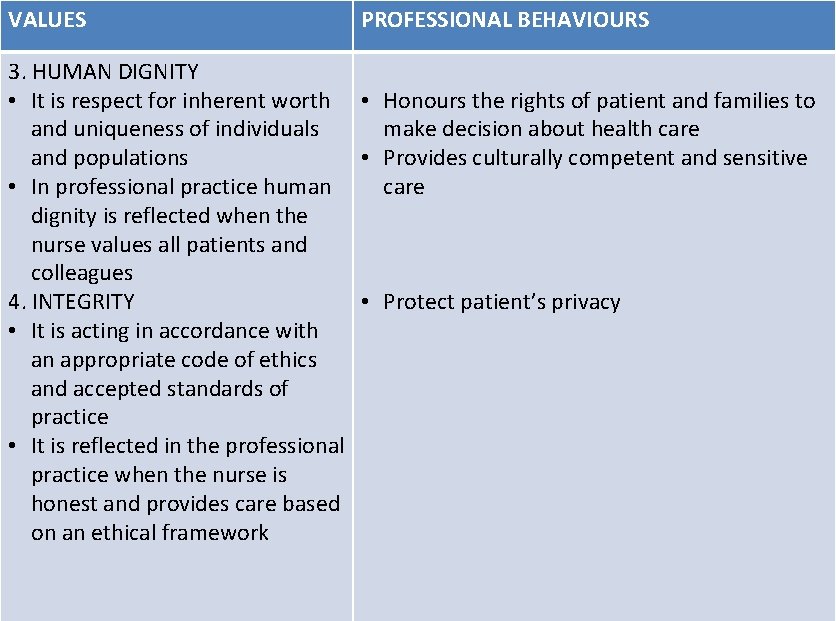
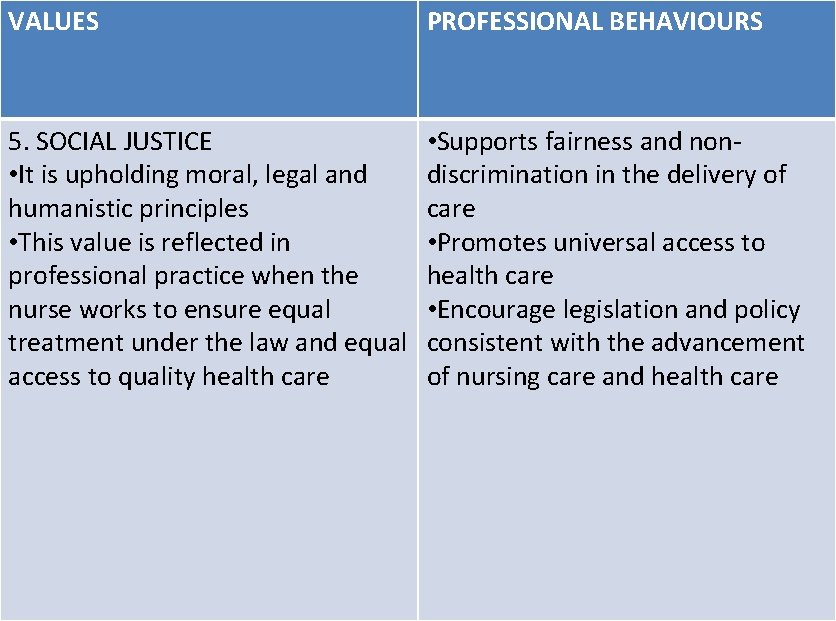
• In comparison American Association of Colleges of Nursing (AACN 1998) identified values essential for professional nurses 1) Altruism 2) Autonomy 3) Human dignity 4) Integrity 5) Social justice/Equality
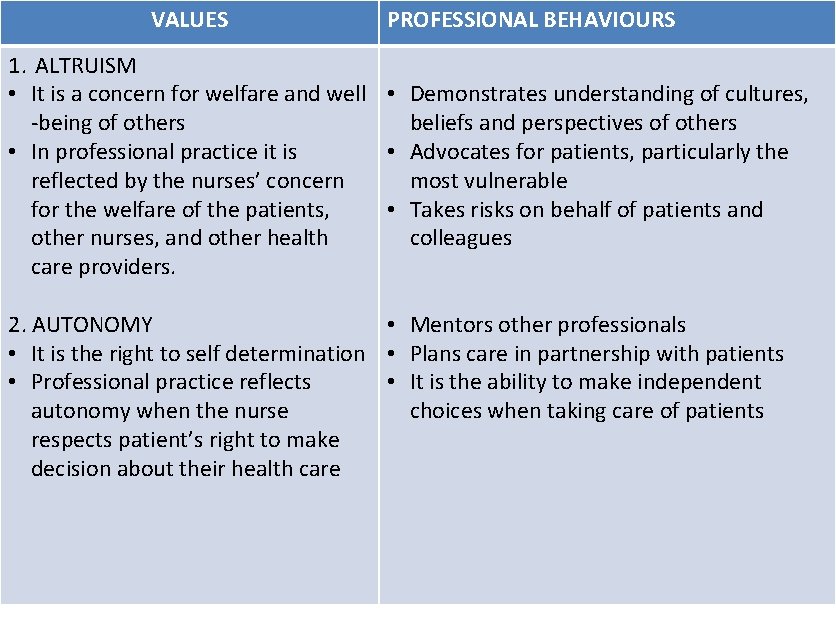
VALUES PROFESSIONAL BEHAVIOURS 1. ALTRUISM • It is a concern for welfare and well • Demonstrates understanding of cultures, -being of others beliefs and perspectives of others • In professional practice it is • Advocates for patients, particularly the reflected by the nurses’ concern most vulnerable for the welfare of the patients, • Takes risks on behalf of patients and other nurses, and other health colleagues care providers. 2. AUTONOMY • Mentors other professionals • It is the right to self determination • Plans care in partnership with patients • Professional practice reflects • It is the ability to make independent autonomy when the nurse choices when taking care of patients respects patient’s right to make decision about their health care
VALUES PROFESSIONAL BEHAVIOURS 3. HUMAN DIGNITY • It is respect for inherent worth • Honours the rights of patient and families to and uniqueness of individuals make decision about health care and populations • Provides culturally competent and sensitive • In professional practice human care dignity is reflected when the nurse values all patients and colleagues 4. INTEGRITY • Protect patient’s privacy • It is acting in accordance with an appropriate code of ethics and accepted standards of practice • It is reflected in the professional practice when the nurse is honest and provides care based on an ethical framework
VALUES PROFESSIONAL BEHAVIOURS 5. SOCIAL JUSTICE • It is upholding moral, legal and humanistic principles • This value is reflected in professional practice when the nurse works to ensure equal treatment under the law and equal access to quality health care • Supports fairness and nondiscrimination in the delivery of care • Promotes universal access to health care • Encourage legislation and policy consistent with the advancement of nursing care and health care
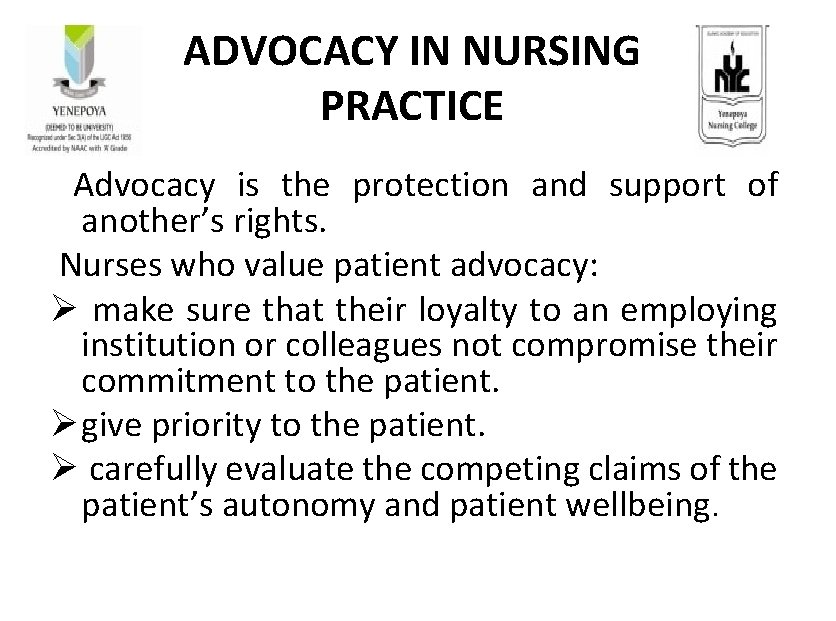
ADVOCACY IN NURSING PRACTICE Advocacy is the protection and support of another’s rights. Nurses who value patient advocacy: Ø make sure that their loyalty to an employing institution or colleagues not compromise their commitment to the patient. Ø give priority to the patient. Ø carefully evaluate the competing claims of the patient’s autonomy and patient wellbeing.
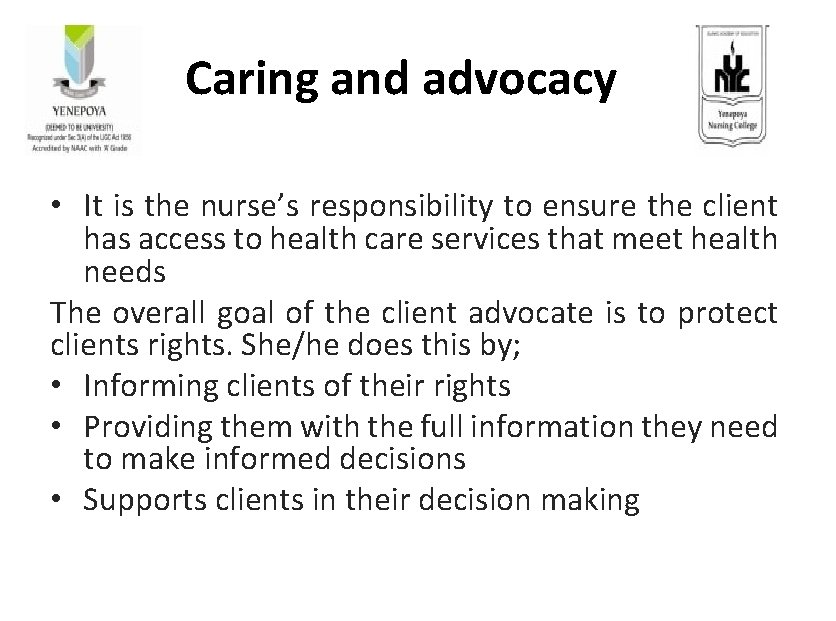
Caring and advocacy • It is the nurse’s responsibility to ensure the client has access to health care services that meet health needs The overall goal of the client advocate is to protect clients rights. She/he does this by; • Informing clients of their rights • Providing them with the full information they need to make informed decisions • Supports clients in their decision making
• Remains objective and doesn’t convey approval or disapproval of client’s choices • Accepting and respectful of the client’s decision • Intervenes on client’s behalf, often influencing others
Values clarification • It is a process by which people identify, examine and develop their own individual values • A principle of values clarification is that no one set of values is right for everyone • When people can identify their values they can retain or change them and thus act based on freely chosen values • It promotes personal growth by fostering awareness, empathy and insight
• One widely used theory of values clarification was Raths, Harmin and Simon in 1978 • They described a “valuing process” of thinking, feeling and behavior that they termed choosing, prizing and acting
Choosing Beliefs are chosen • Freely without outside pressure • From among alternatives • After reflecting and considering consequences • Eg: a person learns about energy resources, production and consumption, the green house effect and other issues including ways to minimize use of and to recycle limited resources.
Prizing • Chosen beliefs are prized and cherished • Eg: the person is proud of the belief that he has an obligation to participate in some way in reducing environmental waste
Acting Chosen beliefs are • Affirmed to others • Incorporated into one’s behavior • Repeated consistently in one’s life
• Eg: the person participates in the city recycling program for household waste, uses public transportation rather than private, helps organize recycling in the workplace, and is active in legislative and political activities related to environmental issues.
Clarifying the nurses values • Nurses and nursing students need to examine the values they hold about life, death, health and illness • One strategy for gaining awareness of personal values is to consider one’s attitudes about specific issues such as abortion
Clarifying client values • To plan effective care, nurse needs to identify clients values as they influence and relate to a particular health problem. • When clients hold unclear or conflicting values that are determined to their health, the nurse should use values clarification as an intervention • The following process may help clients clarify their values
1. List alternatives: make sure that the client is aware of all alternative actions. Ask “are you considering other courses of action? ” “tell me about them” 2. Examine possible consequences of choices: make sure the client has thought about possible results of each action. Ask “what do you think you will gain from doing that”
3. Choose freely: ask “do you have any choice? ” 4. Feel good bout the choice: “some people feel good after a decision making, some others feels bad. How do you feel? ” 5. Affirm the choice: “how will you discuss with family or friends? ”
6. Act on the choice: “will it be difficult to tell with your wife? ” 7. Act with a pattern : “how many times have you done that before? ” • During these 7 steps the nurse assists the client to think each question thorough but does not impose personal values.
ETHICS • They are the rules or the principles that govern right conduct • They deal with what is good and bad with moral duty and obligation • Ethics are designed to protect the rights of human beings • Ethics refers to the practices or beliefs of certain groups
• Ethics refers to the expected standards or behavior of a particular group • These standards are described in the group’s code of professional conduct • Nurses are expected to maintain certain ethical standards in their nursing practice
Ethical Standards / Moral Principles • Ethical standards are statements about broad, general, philosophical concepts like autonomy and justice • They provide the foundation for moral values, with specific prescriptions for action
1. Autonomy • It refers to the right to make one’s own decisions • Nurses should follow the principles of autonomy and respect client’s right to make decisions even when those choices seem not to be in the client’s best interest
2. Justice • It is the foundation for decisions about resource allocation throughout a society or group • The principle of fairness is the basis for the obligation to treat all clients equally and fairly • Health care system provides care on the basis of medical need rather than ability to pay, social status, race or gender
3. Non-maleficence • It is the avoidance of harm or hurt • So its an obligation to never deliberately harm another • The nurse tries to balance the risks and benefits of a plan of care • Ethical practice involves not only the will to do good but also equal commitment not to do harm
4. Beneficence • It means promoting good or doing good to others • It encourages the urge to do good for others
5. Fidility • It means to keep a promise
6. Veracity • It refers to telling truth • Although this seems straight forward, in practice choices are not always clear • The loss of trust in the nurse and the anxiety caused by not knowing the truth
7. Accountability • It is an ability to answer for one’s own action • Nursing professional must agree to evaluate practices and action, and to take actions to preserve nursing excellence • National organizations such as TNAI provide these definitions and offer practice standards to achieve quality as well as structure for evaluation of continuing practice
8. Responsibility • It refers to the specific accountability or liability associated with the performance of duties of a particular role • Thus the ethical nurse is able to explain the rationale behind every action and recognize the standards to which he or she will be held
9. Confidentiality • It refers to the rights and privileges of clients for protection of privacy without diminishing access to quality care. • Its important for trusting relationship • Nurses will not share information about the client unless there is agreement from the client or required by the law
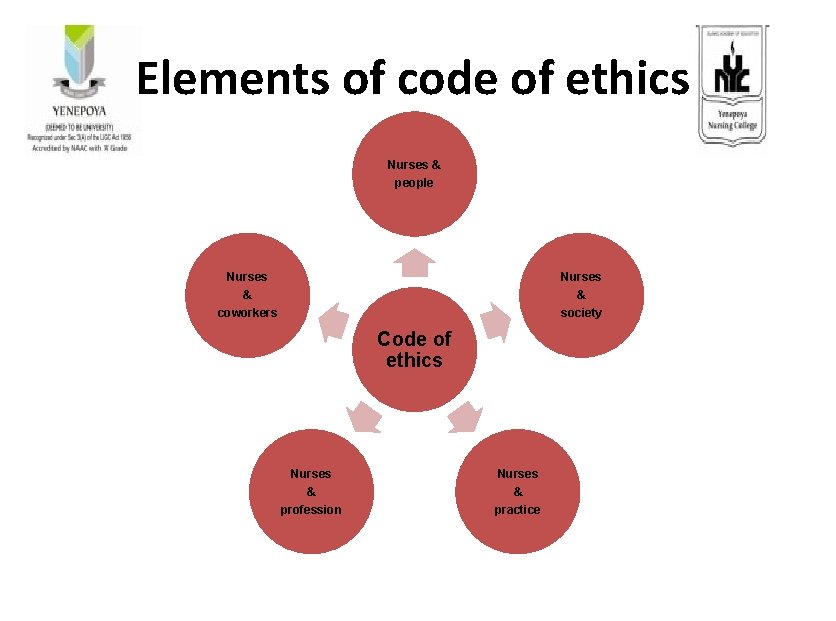
CODE OF ETHICS • In nursing, code of ethics provides professional standards for nursing activities which protect the nurse and the patient • The International Council of Nurses (ICN) first adopted a code of ethics in 1953, and made revisions as follows • The fundamental responsibility of a nurse is four folded. 1. To promote health 2. to prevent illness 3. To restore health 4. to alleviate suffering
Elements of code of ethics Nurses & people Nurses & coworkers Nurses & society Code of ethics Nurses & profession Nurses & practice
1. Nurses and people • The nurses primary responsibility is to save people requiring nursing care • In providing care, nurse promotes an environment in which the human rights, values, customs and spiritual beliefs of the individual, family and community are respected • The nurse holds in confidence personal information and uses judgment in sharing this information
2. Nurses and society • The nurse shares with other citizen in society the responsibility for initiating and supporting actions to meet the health and social needs of the public, in particular those of vulnerable population • The nurse also shares responsibility to sustain and protect the natural environment from depletion, pollution, degradation and destruction
3. Nurses and practice • The nurse carries personal responsibility and accountability for nursing practice and for maintaining competence by continual learning • The nurse maintains a standard of personal health such that the ability to provide care is not compromised • The nurse use judgment in relation to individual competence when accepting and delegating responsibilities
• The nurse when acting in professional capacity should at all times maintain standards of personal conduct which credit upon the profession and enhance public confidence • The nurse in providing care ensure that use of technology and scientific advances are compatible with safety, dignity and rights of people
4. Nurse and profession • The nurse plays a major role in determining and implementing desirable standards of nursing practice, management research and nursing education • The nurse must be active in developing professional knowledge • The nurse acting through the professional organization, participates in establishing and maintaining equitable social and economic working conditions in nursing.
5. Nurse and co-workers • The nurse maintains a cooperative relationship with co-workers in nursing and other fields • The nurse takes appropriate action to safeguard the individual when the care is endangered by a co-worker or any other person
6. Nurses and legislation • The nurse must hold a valid certificate and license showing that he or she has met the requirements to practice as a Registered Nurse and Registered Midwife (RN & RM) in the state in which they are employed
PROFESSIONAL CONDUCT FOR NURSES • Be courteous to all • Be gentle and polite in talk • Greet seniors, co-workers and clients with appropriate words and according to the time of the day • Address the seniors with proper title • Stand up when people of higher rank enter into your room
• Stand up when answering the questions in the class room • Open the door for the seniors and stand aside for them to pass • Excuse yourself when overtaking a senior person • Stand aside and give way to seniors when you cross them on the ways • Maintain silence whenever and wherever necessary
• Keep your dress neat and tidy • While on duty never use any form of jewellery which may interfere your work • Obey seniors without arguing • Help the seniors to carry a heavy load if you find them on the way • Say “Thank you” when someone is doing a favor for you • Get prior permission from the sister in charge when you take any articles from the department
• Give the answers immediately and appropriately • Be punctual always • Avoid thumb sucking and nail biting • In an assembly let the seniors take the seat first • Keep eye contact when speaking with others • Never let other’s secret go out of you
• Always close the door after getting into a room or when you get out of the room • Knock the door and wait for the answer before you enter into other’s room • Do not cover your mouth when speaking with others • You should not give and receive any gifts or presents especially from the clients and thir relatives
EVALUATION • LONG ESSAY 1. a. Define the term profession • b. Characteristics of profession • c. Justify nursing as a profession 2. a. Is nursing a profession • b. Discuss the characteristics and qualities of a professional nurse 3. a. Define profession • b. Explain the characteristics of profession with examples applied to nursing 4. a. Define nursing • b. Discuss briefly on history and scope of nursing