
UNIT II light wave systems 6 L System


- Slides: 53
UNIT II: light wave systems (6 L) • System architectures, • Point-to-Point links: system considerations, • Design guide lines: optical power budget, rise time budget, • Long haul systems Objective v To apply subject understanding in Link Design. Course Outcome v Perform Link power budget and Rise Time Budget by proper selection of components and check its viability.
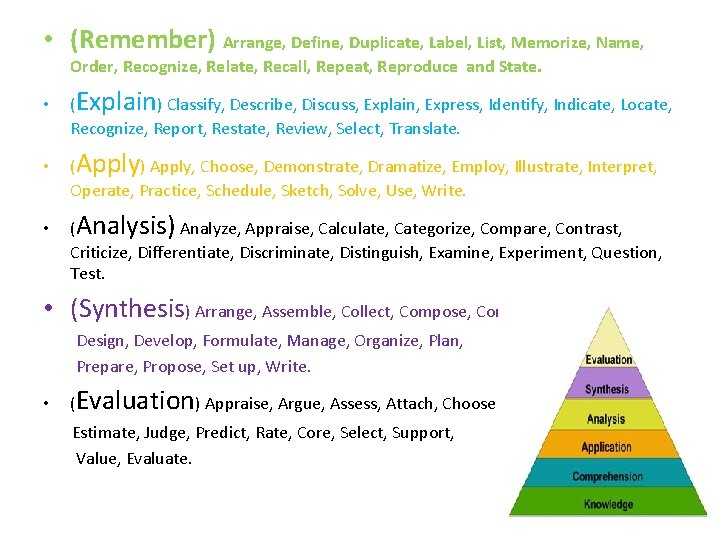
• (Remember) Arrange, Define, Duplicate, Label, List, Memorize, Name, Order, Recognize, Relate, Recall, Repeat, Reproduce and State. • (Explain) Classify, Describe, Discuss, Explain, Express, Identify, Indicate, Locate, Recognize, Report, Restate, Review, Select, Translate. • (Apply) Apply, Choose, Demonstrate, Dramatize, Employ, Illustrate, Interpret, Operate, Practice, Schedule, Sketch, Solve, Use, Write. • (Analysis) Analyze, Appraise, Calculate, Categorize, Compare, Contrast, Criticize, Differentiate, Discriminate, Distinguish, Examine, Experiment, Question, Test. • (Synthesis) Arrange, Assemble, Collect, Compose, Construct, Create, Design, Develop, Formulate, Manage, Organize, Plan, Prepare, Propose, Set up, Write. • (Evaluation) Appraise, Argue, Assess, Attach, Choose Compare, Defend Estimate, Judge, Predict, Rate, Core, Select, Support, Value, Evaluate.
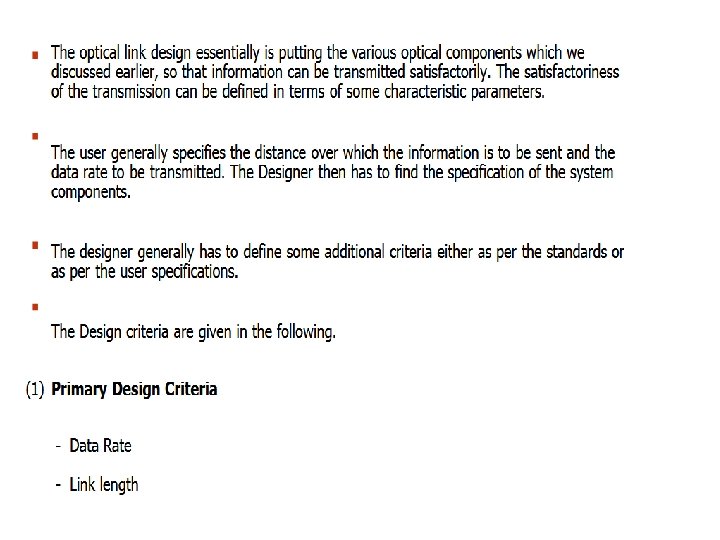
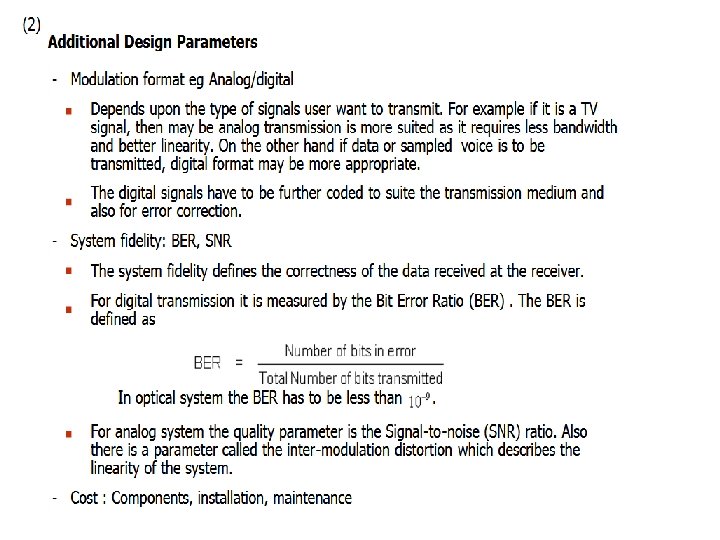
The Objective of this unit is to learn following criteria
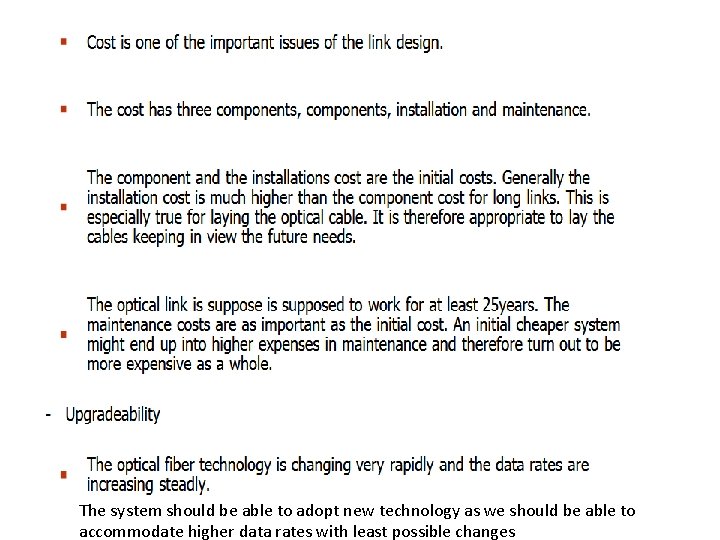
The system should be able to adopt new technology as we should be able to accommodate higher data rates with least possible changes
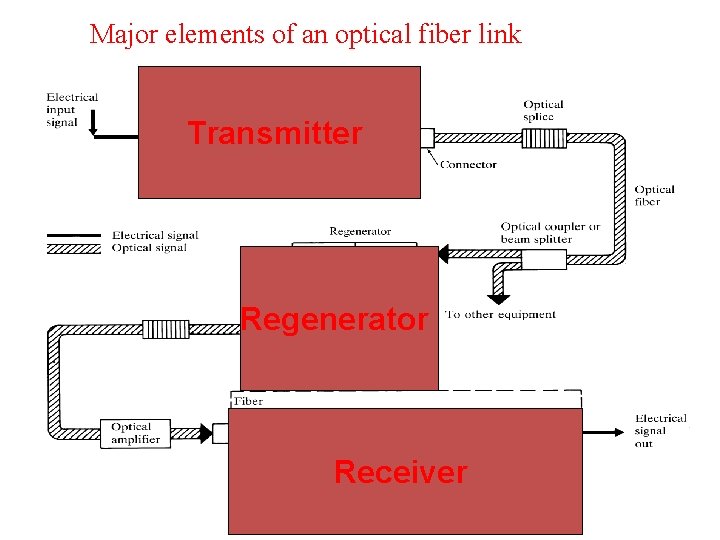
Major elements of an optical fiber link Transmitter Regenerator Receiver
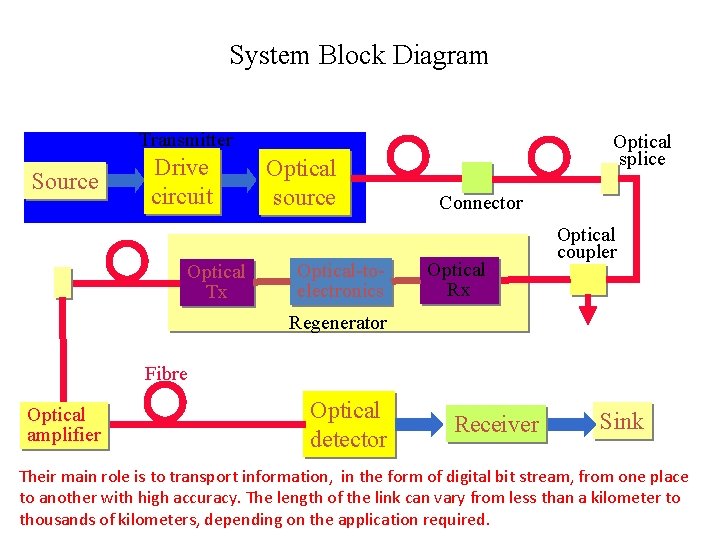
System Block Diagram Transmitter Source Drive circuit Optical Tx Optical source Optical-toelectronics Optical splice Connector Optical Rx Optical coupler Regenerator Fibre Optical amplifier Optical detector Receiver Sink Their main role is to transport information, in the form of digital bit stream, from one place to another with high accuracy. The length of the link can vary from less than a kilometer to thousands of kilometers, depending on the application required.
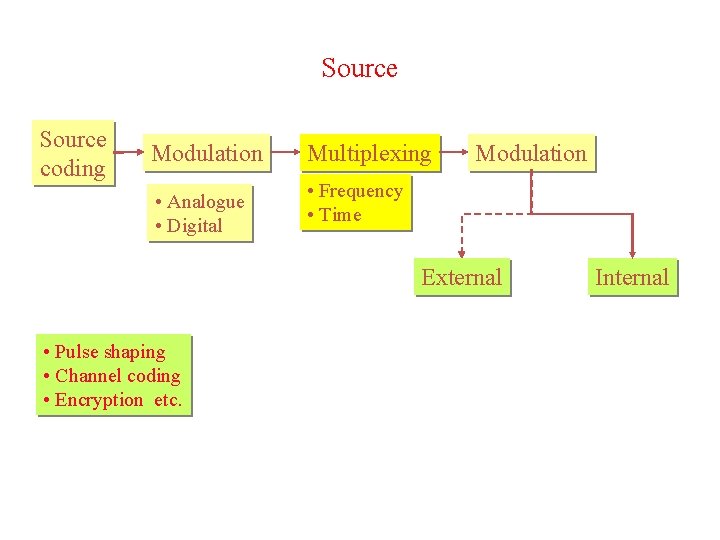
Source coding Modulation • Analogue • Digital Multiplexing Modulation • Frequency • Time External • Pulse shaping • Channel coding • Encryption etc. Internal
Regenerator is a device to overcome attenuation problems. Electronic regenerator regenerates signals by first converting optical signals to electrical signals. The electrical signal is regenerated, converted back to optical, and further injected into the fiber. On WDM systems, each wavelength requires its own opto-electric amplifier, an expensive proposition if there are many wavelengths.
As light travels down a fiber, it loses power, and the sharp transitions (representing binary data - or 1's and 0's) of the digital signal become smoothed out and loses power. This is rectified by placing amplifiers and regenerators into series with the fiber cable. An optic amplifier/repeater merely increases the power of the signal ( makes the light brighter). A regeneration station ("regen") reshape the digital signal into sharp, well-defined 1's and 0's. In general, with metro fiber routes, there about 4 / 5 amps for every ‘regen’.
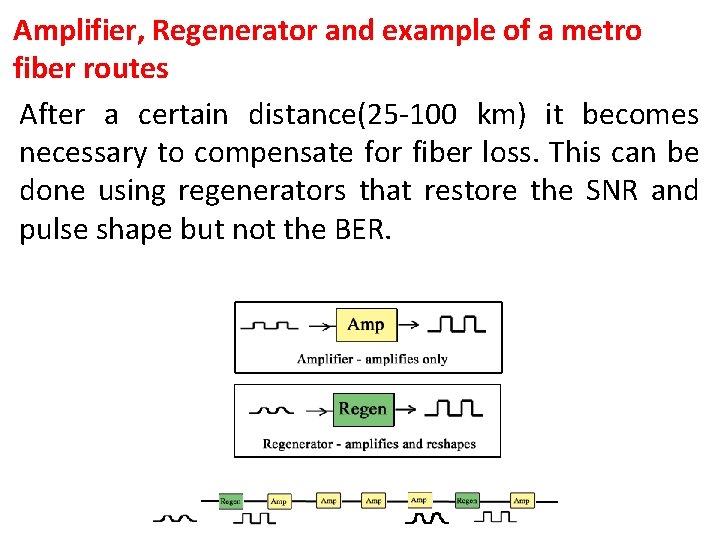
Amplifier, Regenerator and example of a metro fiber routes After a certain distance(25 -100 km) it becomes necessary to compensate for fiber loss. This can be done using regenerators that restore the SNR and pulse shape but not the BER.
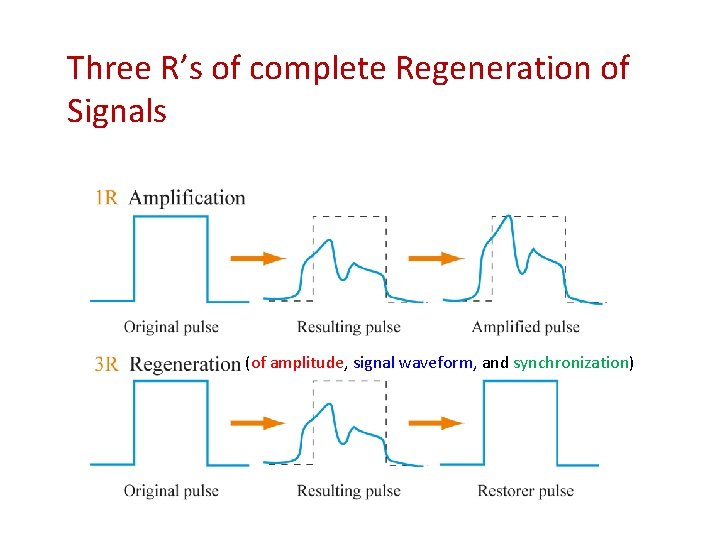
Amplification and Regeneration of Optical pulses The periodic regeneration is usually required to regenerate the original waveform and synchronization of signals. Complete regeneration includes three regenerating operations with a signal viz. 1. Regeneration of amplitude (amplification), 2. Regeneration of signal waveform, and, 3. Regeneration of synchronization.
Three R’s of complete Regeneration of Signals (of amplitude, signal waveform, and synchronization)
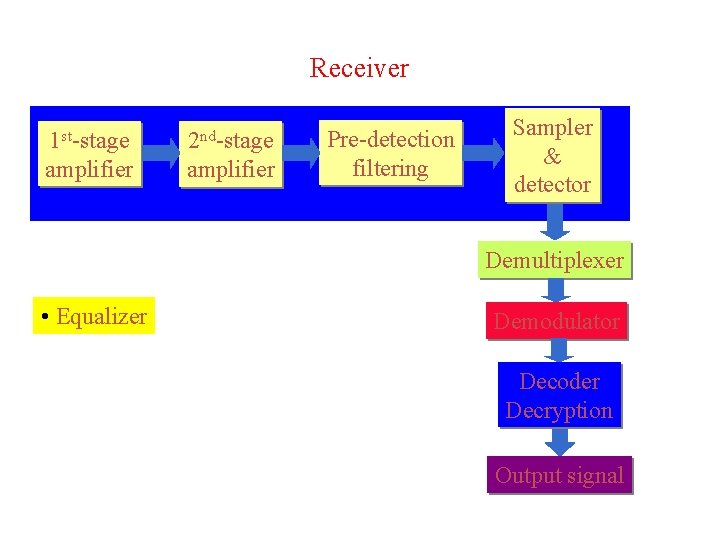
Receiver 1 st-stage amplifier 2 nd-stage amplifier Pre-detection filtering Sampler & detector Demultiplexer • Equalizer Demodulator Decoder Decryption Output signal
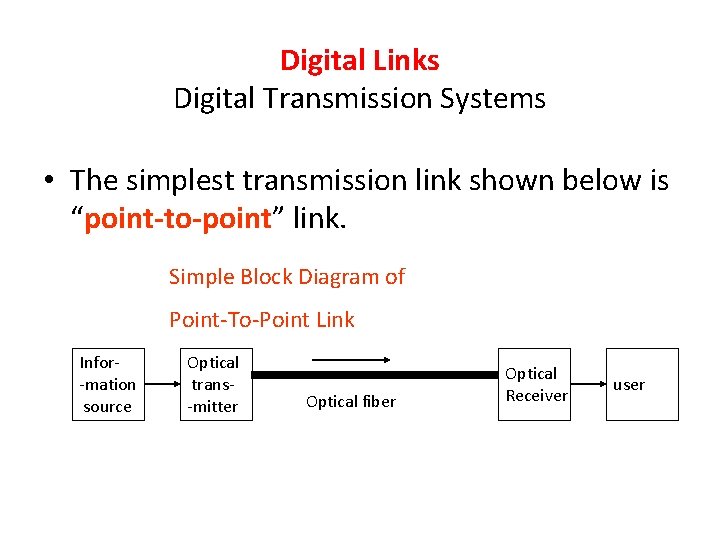
Digital Links Digital Transmission Systems • The simplest transmission link shown below is “point-to-point” link. Simple Block Diagram of Point-To-Point Link Infor-mation source Optical trans-mitter Optical fiber Optical Receiver user
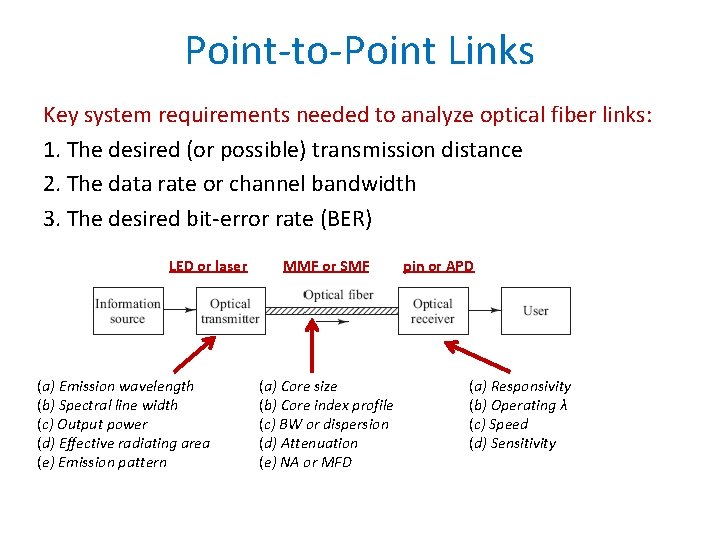
Point-to-Point Links Key system requirements needed to analyze optical fiber links: 1. The desired (or possible) transmission distance 2. The data rate or channel bandwidth 3. The desired bit-error rate (BER) LED or laser (a) Emission wavelength (b) Spectral line width (c) Output power (d) Effective radiating area (e) Emission pattern MMF or SMF (a) Core size (b) Core index profile (c) BW or dispersion (d) Attenuation (e) NA or MFD pin or APD (a) Responsivity (b) Operating λ (c) Speed (d) Sensitivity
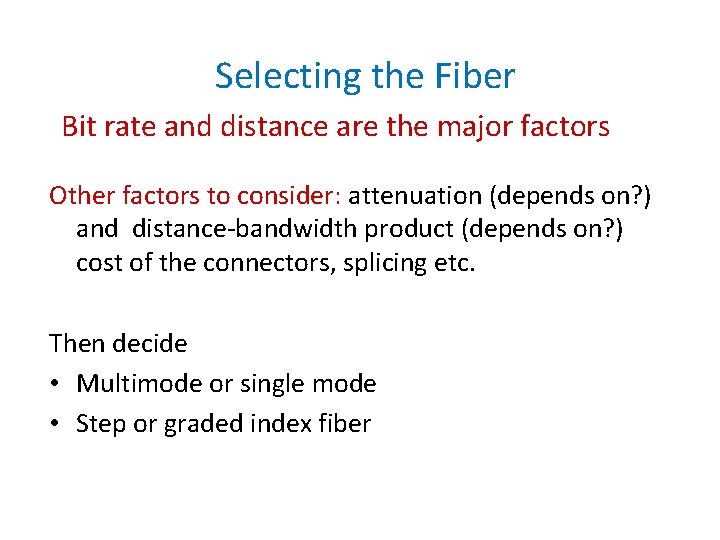
Selecting the Fiber Bit rate and distance are the major factors Other factors to consider: attenuation (depends on? ) and distance-bandwidth product (depends on? ) cost of the connectors, splicing etc. Then decide • Multimode or single mode • Step or graded index fiber
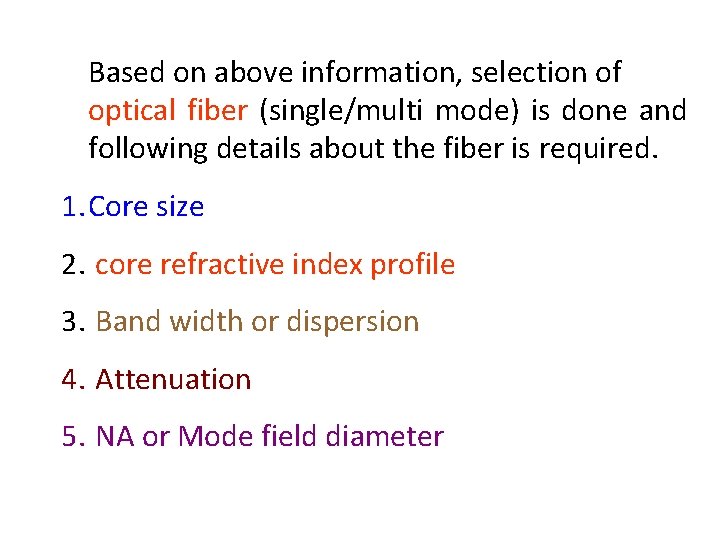
Based on above information, selection of optical fiber (single/multi mode) is done and following details about the fiber is required. 1. Core size 2. core refractive index profile 3. Band width or dispersion 4. Attenuation 5. NA or Mode field diameter
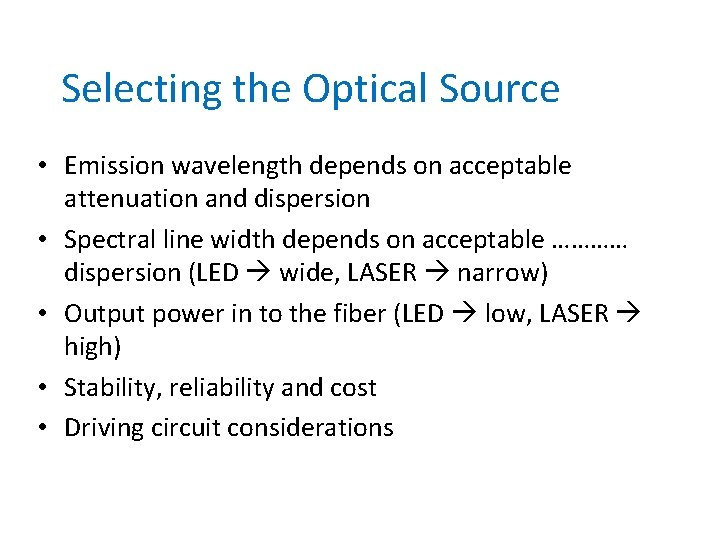
Selecting the Optical Source • Emission wavelength depends on acceptable attenuation and dispersion • Spectral line width depends on acceptable ………… dispersion (LED wide, LASER narrow) • Output power in to the fiber (LED low, LASER high) • Stability, reliability and cost • Driving circuit considerations
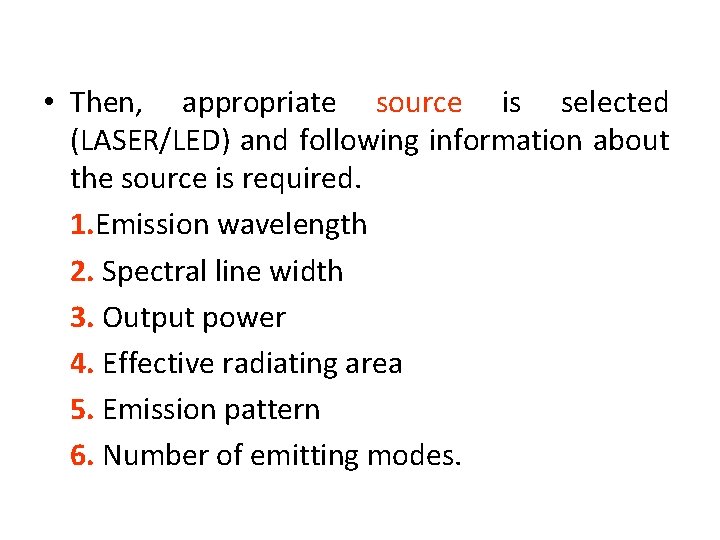
• Then, appropriate source is selected (LASER/LED) and following information about the source is required. 1. Emission wavelength 2. Spectral line width 3. Output power 4. Effective radiating area 5. Emission pattern 6. Number of emitting modes.
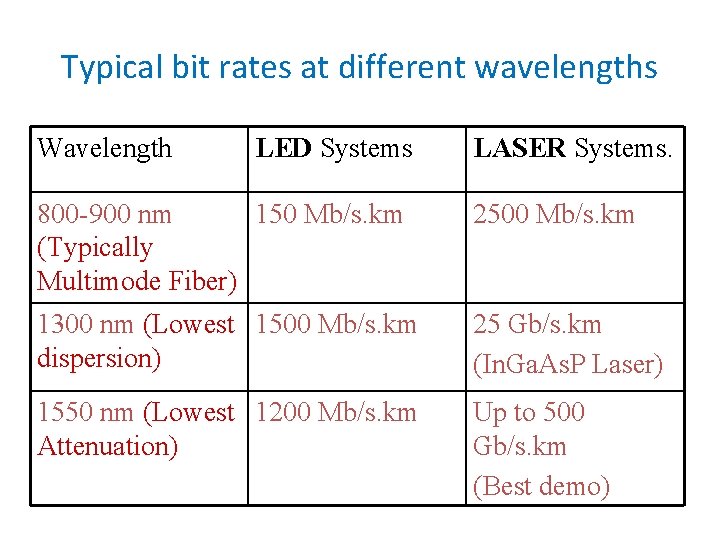
Typical bit rates at different wavelengths Wavelength LED Systems LASER Systems. 800 -900 nm 150 Mb/s. km (Typically Multimode Fiber) 2500 Mb/s. km 1300 nm (Lowest 1500 Mb/s. km dispersion) 25 Gb/s. km (In. Ga. As. P Laser) 1550 nm (Lowest 1200 Mb/s. km Attenuation) Up to 500 Gb/s. km (Best demo)
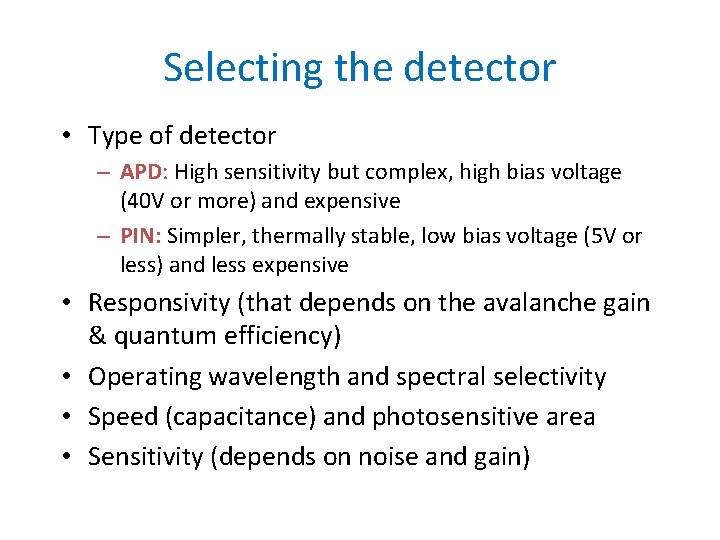
Selecting the detector • Type of detector – APD: High sensitivity but complex, high bias voltage (40 V or more) and expensive – PIN: Simpler, thermally stable, low bias voltage (5 V or less) and less expensive • Responsivity (that depends on the avalanche gain & quantum efficiency) • Operating wavelength and spectral selectivity • Speed (capacitance) and photosensitive area • Sensitivity (depends on noise and gain)
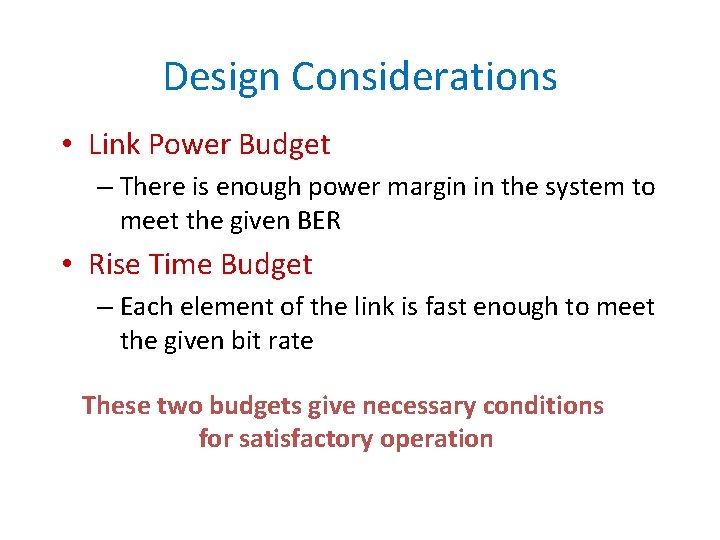
Design Considerations • Link Power Budget – There is enough power margin in the system to meet the given BER • Rise Time Budget – Each element of the link is fast enough to meet the given bit rate These two budgets give necessary conditions for satisfactory operation
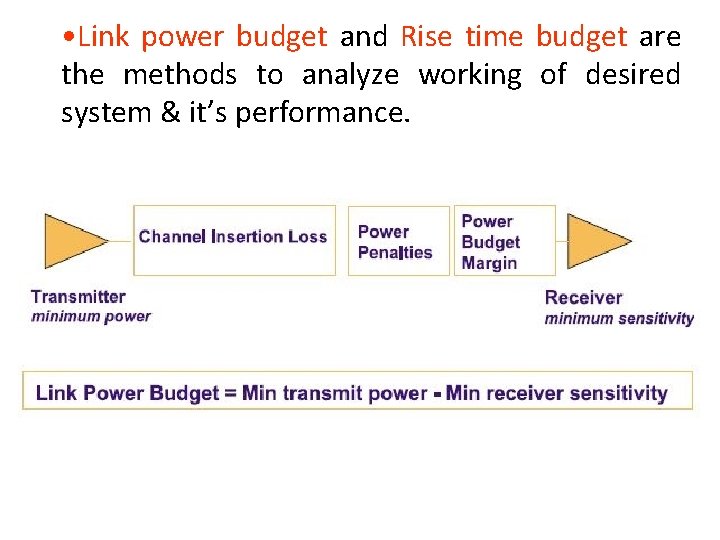
• Link power budget and Rise time budget are the methods to analyze working of desired system & it’s performance.
System Considerations • Selection of “Wave Length” to transmit the data decides the components which operates in this wavelength region. • For example, if transmission distance is small, operating wavelength may be 800 -900 nm and if it is large; the wavelength would be 1300/ 1550 nm (where low attenuation & dispersion occurs).
• While selecting a photo detector, we determine, how much minimum optical power must to fall on the photo-detector to satisfy BER requirement at the specified data rate. • Selection of source requires the parameters to be seen as signal dispersion, data rate, transmission distance and cost. • Selection of optical fiber depends on type of source and amount of dispersion that can be tolerated.
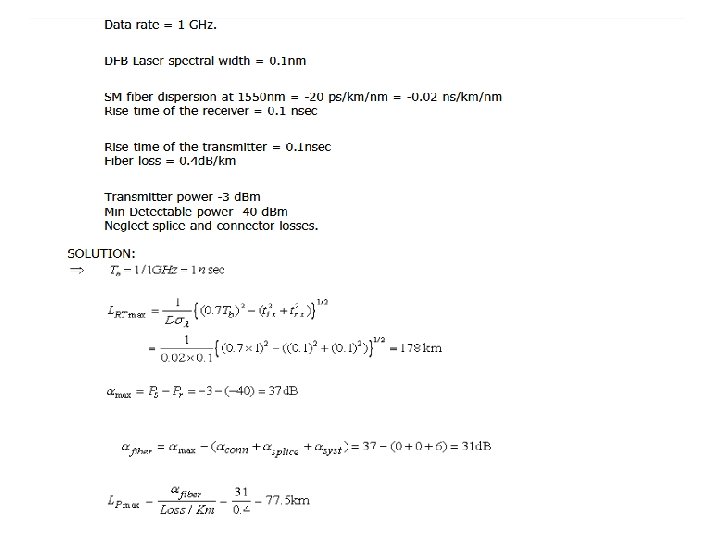
• In the Link power budget; for a specific BER, power margin between ‘optical transmitter output’ and ‘minimum receiver sensitivity’ is determined and then margin is allocated to connectors, splices, fiber losses etc. • In Rise time budget, it is checked that the desired overall system performance is achieved or not? It determines the dispersion limitations of an optical fiber link.
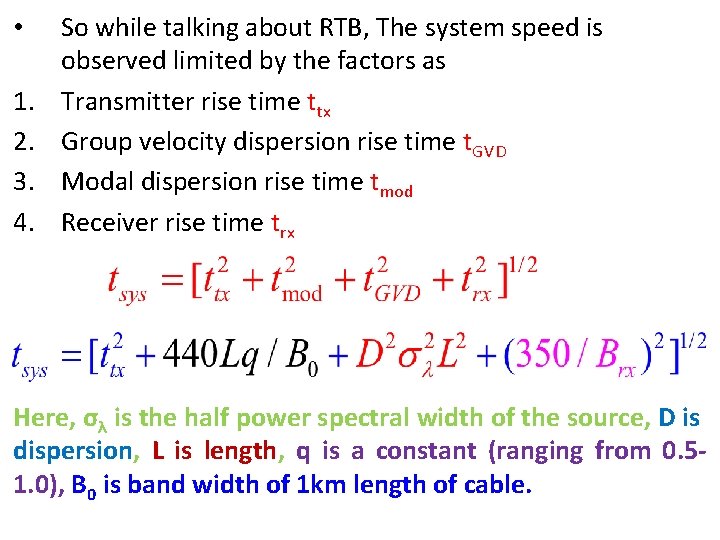
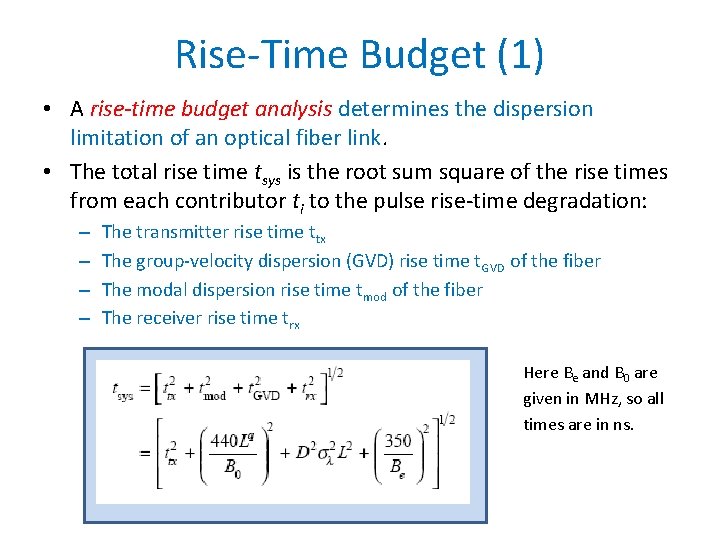
• 1. 2. 3. 4. So while talking about RTB, The system speed is observed limited by the factors as Transmitter rise time ttx Group velocity dispersion rise time t. GVD Modal dispersion rise time tmod Receiver rise time trx Here, σλ is the half power spectral width of the source, D is dispersion, L is length, q is a constant (ranging from 0. 51. 0), B 0 is band width of 1 km length of cable.
Rise-Time Budget (1) • A rise-time budget analysis determines the dispersion limitation of an optical fiber link. • The total rise time tsys is the root sum square of the rise times from each contributor ti to the pulse rise-time degradation: – – The transmitter rise time ttx The group-velocity dispersion (GVD) rise time t. GVD of the fiber The modal dispersion rise time tmod of the fiber The receiver rise time trx Here Be and B 0 are given in MHz, so all times are in ns.
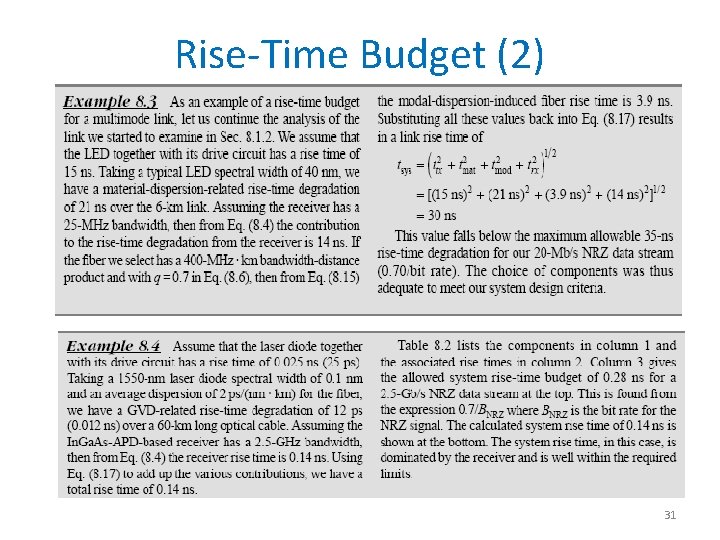
Rise-Time Budget (2) 31
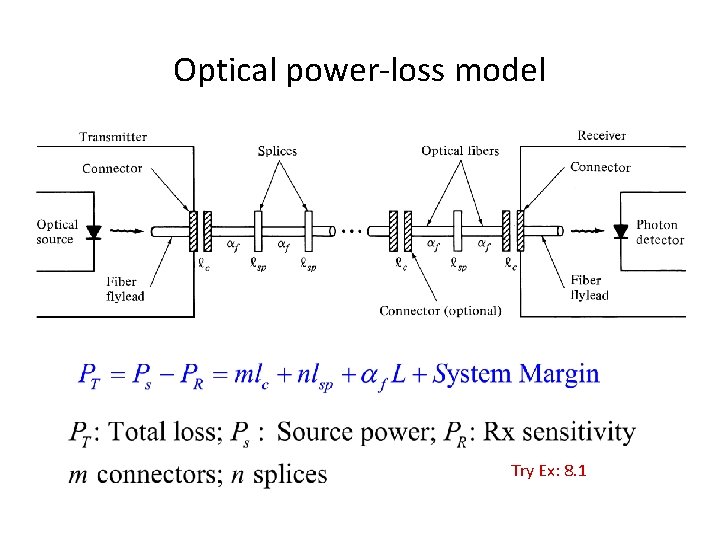
Optical power-loss model Try Ex: 8. 1
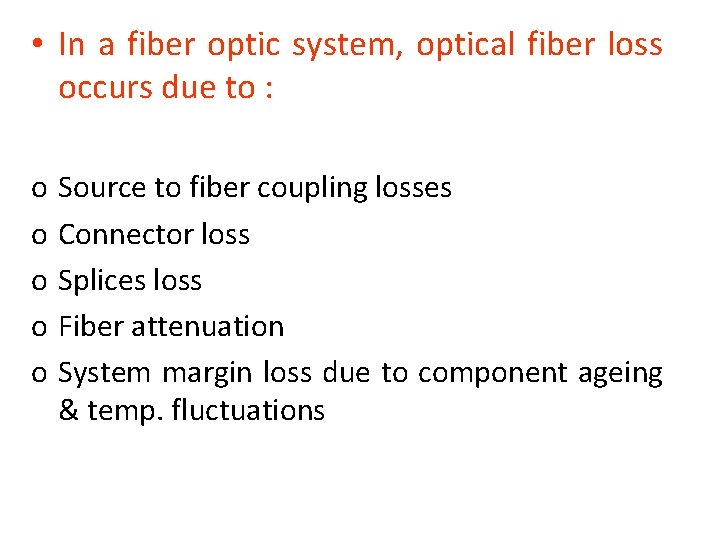
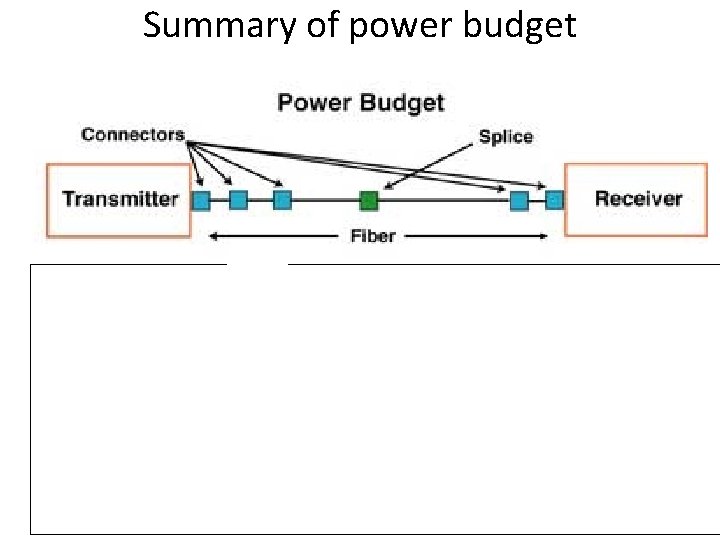
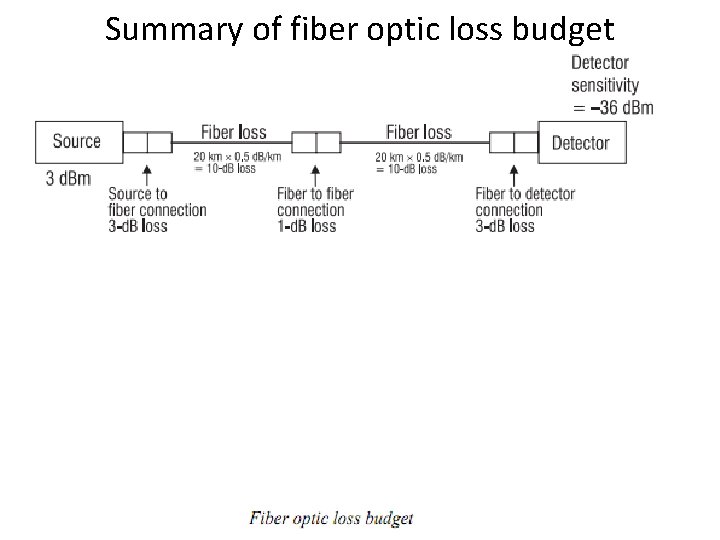
• In a fiber optic system, optical fiber loss occurs due to : o o o Source to fiber coupling losses Connector loss Splices loss Fiber attenuation System margin loss due to component ageing & temp. fluctuations
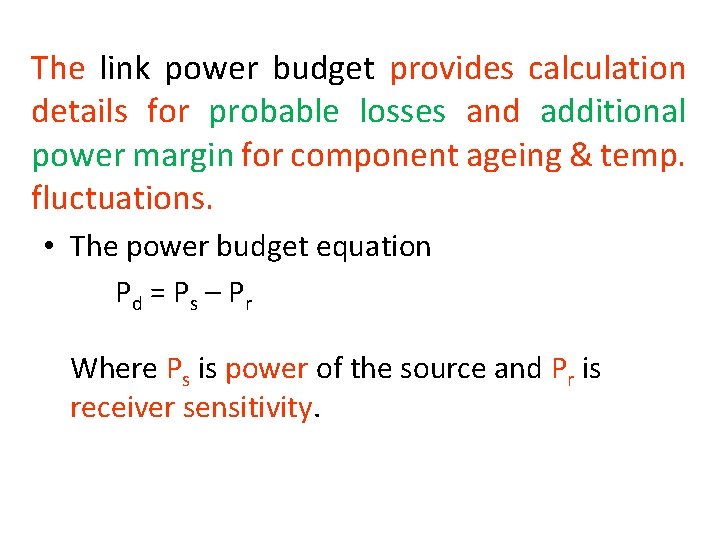
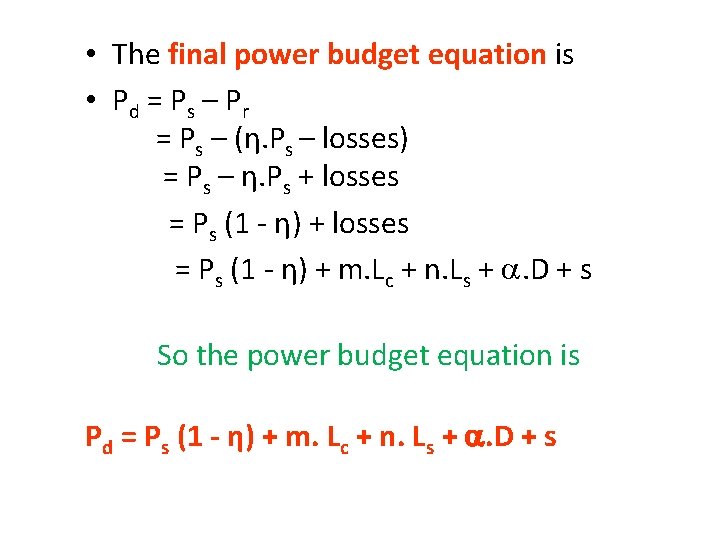
The link power budget provides calculation details for probable losses and additional power margin for component ageing & temp. fluctuations. • The power budget equation Pd = P s – P r Where Ps is power of the source and Pr is receiver sensitivity.
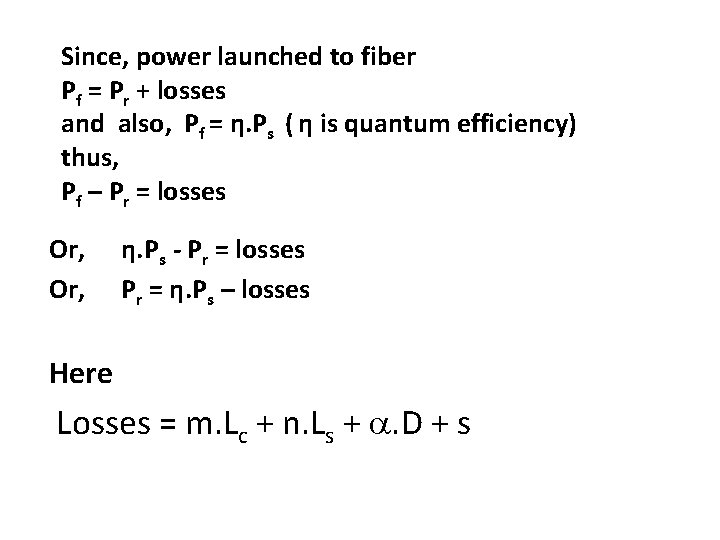
Since, power launched to fiber Pf = Pr + losses and also, Pf = η. Ps ( η is quantum efficiency) thus, Pf – Pr = losses Or, η. Ps - Pr = losses Pr = η. Ps – losses Here Losses = m. Lc + n. Ls + . D + s
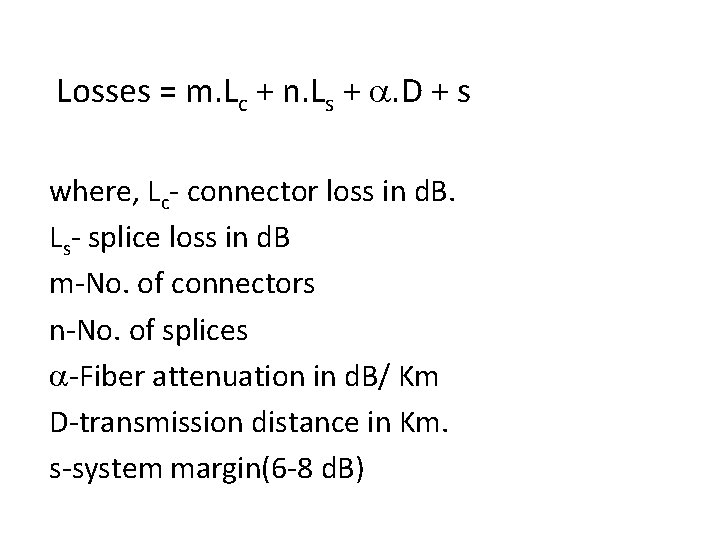
Losses = m. Lc + n. Ls + . D + s where, Lc- connector loss in d. B. Ls- splice loss in d. B m-No. of connectors n-No. of splices -Fiber attenuation in d. B/ Km D-transmission distance in Km. s-system margin(6 -8 d. B)
• The final power budget equation is • Pd = P s – P r = Ps – (η. Ps – losses) = Ps – η. Ps + losses = Ps (1 - η) + m. Lc + n. Ls + . D + s So the power budget equation is Pd = Ps (1 - η) + m. Lc + n. Ls + . D + s
Summary of power budget
Summary of fiber optic loss budget
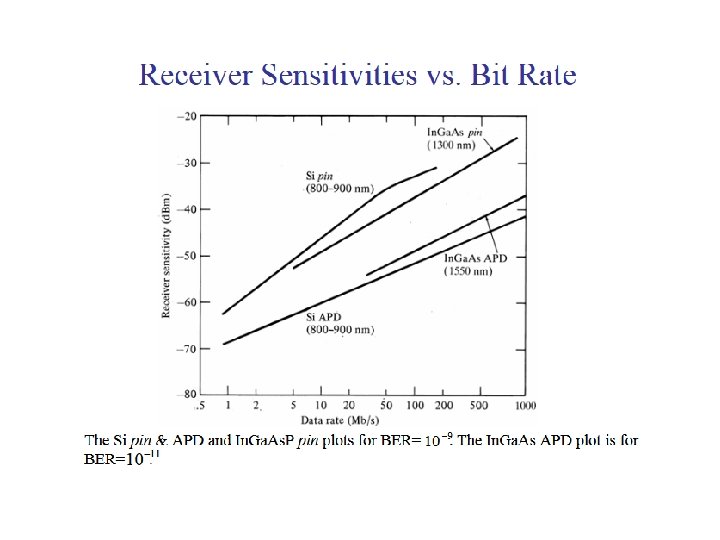
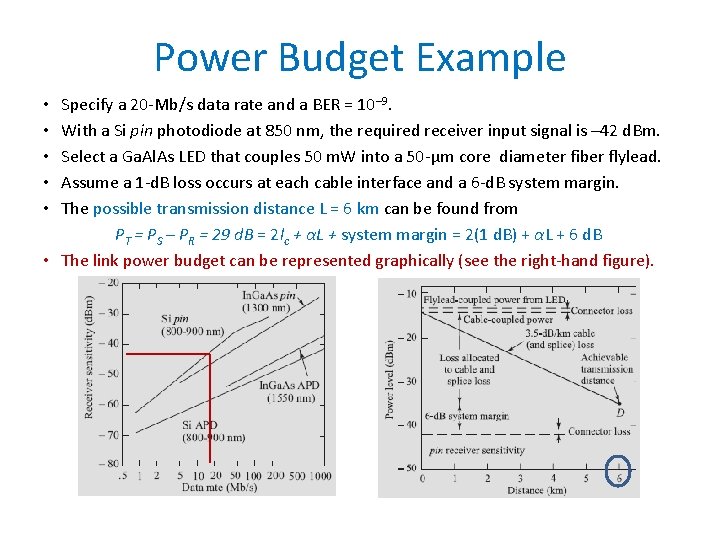
Power Budget Example Specify a 20 -Mb/s data rate and a BER = 10– 9. With a Si pin photodiode at 850 nm, the required receiver input signal is – 42 d. Bm. Select a Ga. Al. As LED that couples 50 m. W into a 50 -μm core diameter fiber flylead. Assume a 1 -d. B loss occurs at each cable interface and a 6 -d. B system margin. The possible transmission distance L = 6 km can be found from PT = PS – PR = 29 d. B = 2 lc + αL + system margin = 2(1 d. B) + αL + 6 d. B • The link power budget can be represented graphically (see the right-hand figure). • • •
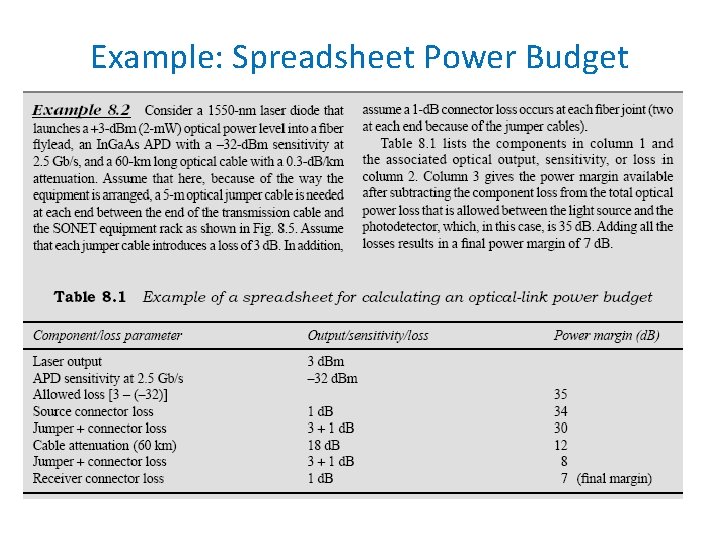
Example: Spreadsheet Power Budget
Long-haul systems In telecommunication, the term long-haul communications has the following meanings: 1. In public switched networks, pertaining to circuits that span large distances, such as the circuits in inter-LATA, interstate, and international communications. 2. In the military community, communications among users on a national or worldwide basis.
Long-haul systems Basically; Long-haul optics refers to the transmission of visible light signals over optical fiber cable for great distances, especially without or with minimal use of repeaters. Normally, repeaters are necessary at intervals in a length of fiber optic cable to keep the signal quality from deteriorating to the point of nonusability. In long-haul optical systems, the goal is to minimize the number of repeaters per unit distance, and ideally, to render repeaters unnecessary.
Long-haul systems The long-haul communications are characterized by (a)Higher levels of users, such as the National Command Authority, (b)More stringent performance requirements, such as higher quality circuits, (c)Longer distances between users, including world wide distances, (d)Higher traffic volumes and densities, (e)Larger switches and trunk cross sections, and (f) Fixed and recoverable assets. The "Long-haul communications" usually pertains to the defense services e. g U. S. Defense Communications System.
Actually, Advances in fiber optic technology have made long-haul communications systems reach distances that were once unheard of. Today's fiber optic transmission links transmit multiple channels of video and audio signals over a worldwide distances, and can reach high traffic volumes. This distance is made possible by a number of devices that amplify optical signals and combine larger & larger numbers of signals for transmission over a single optical fiber.
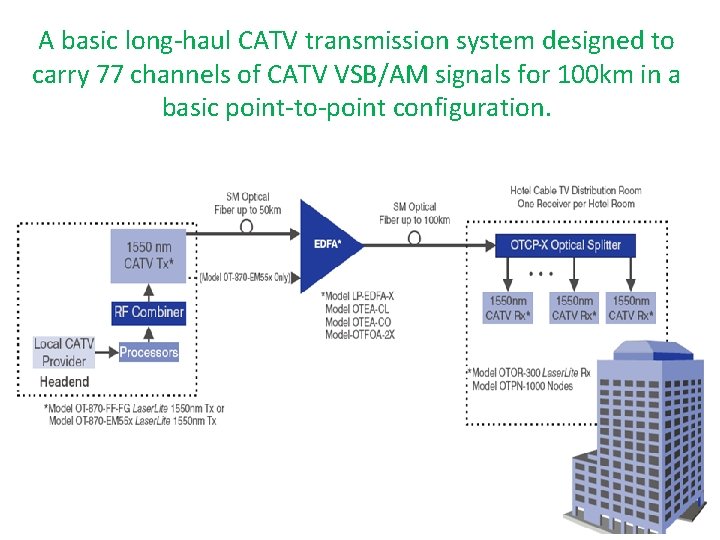
A basic long-haul CATV transmission system designed to carry 77 channels of CATV VSB/AM signals for 100 km in a basic point-to-point configuration.
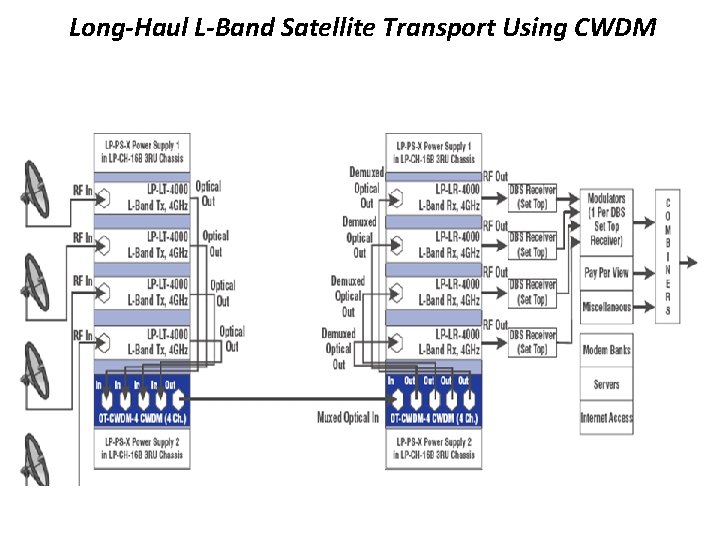
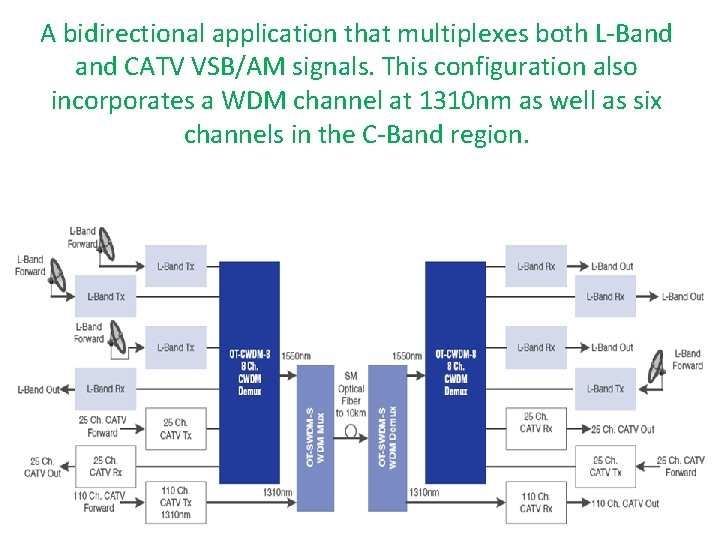
Long-Haul L-Band Satellite Transport Using CWDM
A bidirectional application that multiplexes both L-Band CATV VSB/AM signals. This configuration also incorporates a WDM channel at 1310 nm as well as six channels in the C-Band region.
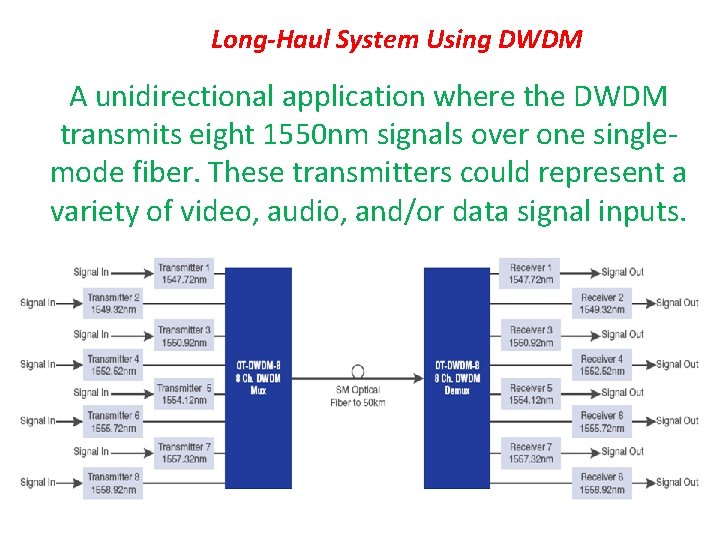
Long-Haul System Using DWDM A unidirectional application where the DWDM transmits eight 1550 nm signals over one singlemode fiber. These transmitters could represent a variety of video, audio, and/or data signal inputs.
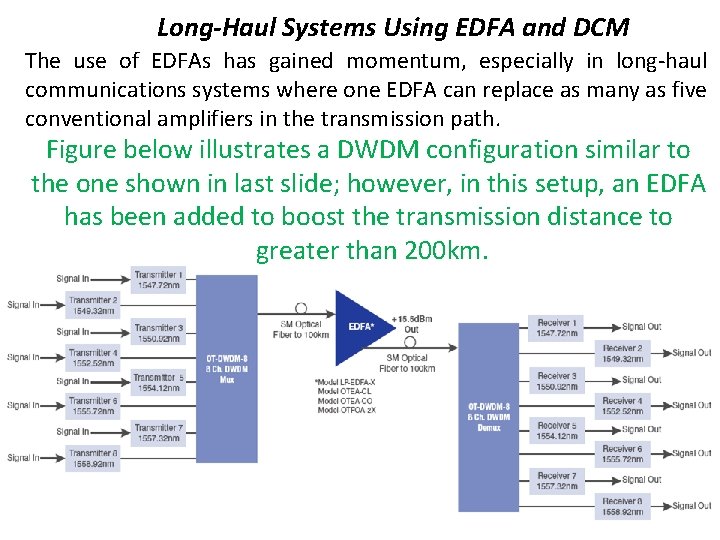
Long-Haul Systems Using EDFA and DCM The use of EDFAs has gained momentum, especially in long-haul communications systems where one EDFA can replace as many as five conventional amplifiers in the transmission path. Figure below illustrates a DWDM configuration similar to the one shown in last slide; however, in this setup, an EDFA has been added to boost the transmission distance to greater than 200 km.
Thank You