
Unit II Biochemistry Chemistry of Life I What
Unit II - Biochemistry Chemistry of Life
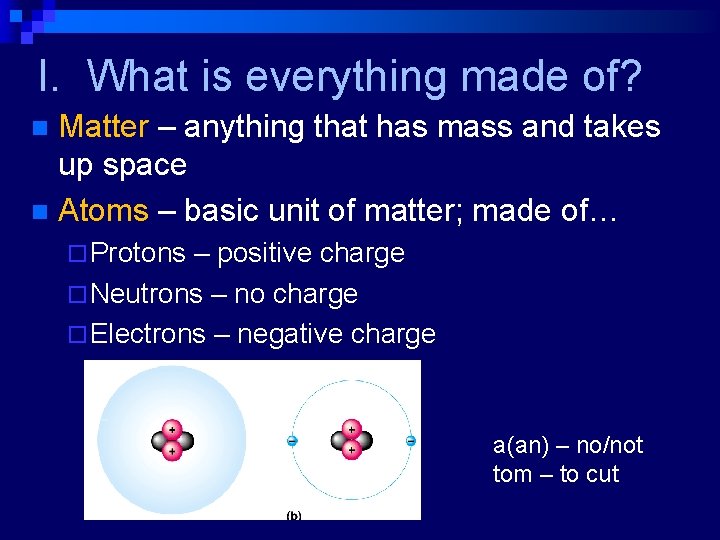
I. What is everything made of? Matter – anything that has mass and takes up space n Atoms – basic unit of matter; made of… n ¨ Protons – positive charge ¨ Neutrons – no charge ¨ Electrons – negative charge a(an) – no/not tom – to cut
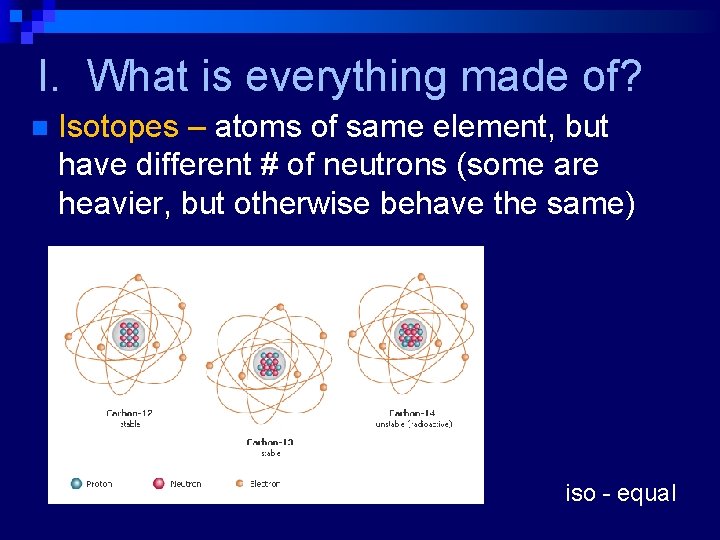
I. What is everything made of? n Isotopes – atoms of same element, but have different # of neutrons (some are heavier, but otherwise behave the same) a(an) – no/not tom – to cut iso - equal
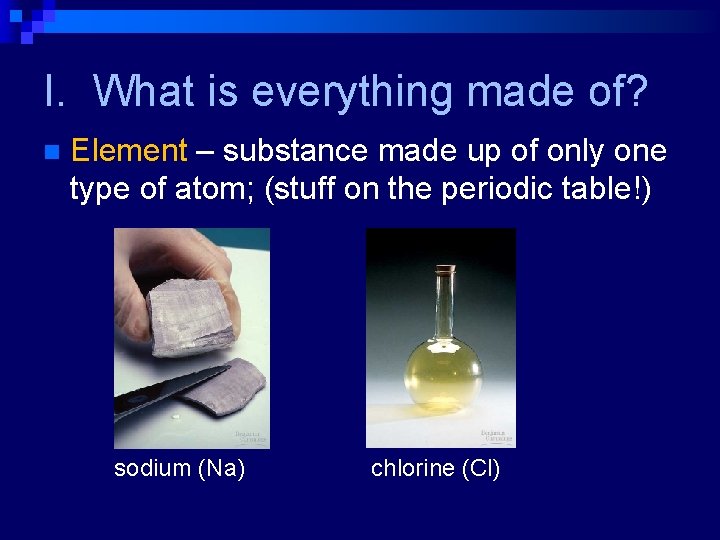
I. What is everything made of? n Element – substance made up of only one type of atom; (stuff on the periodic table!) sodium (Na) chlorine (Cl)
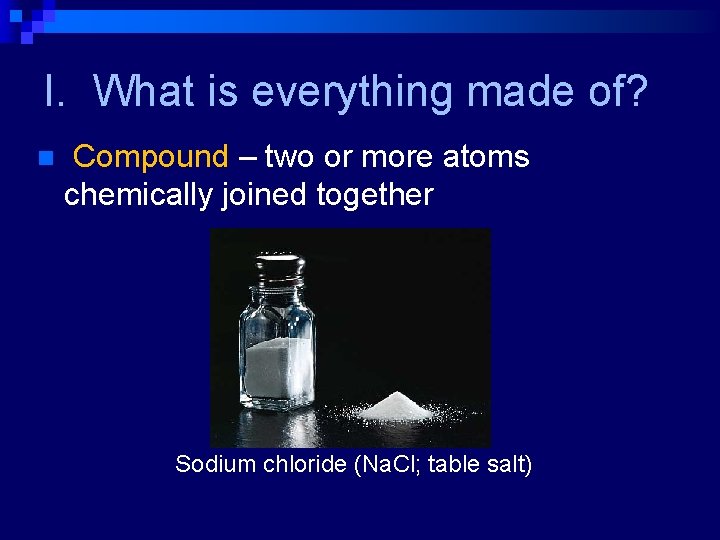
I. What is everything made of? n Compound – two or more atoms chemically joined together Sodium chloride (Na. Cl; table salt)
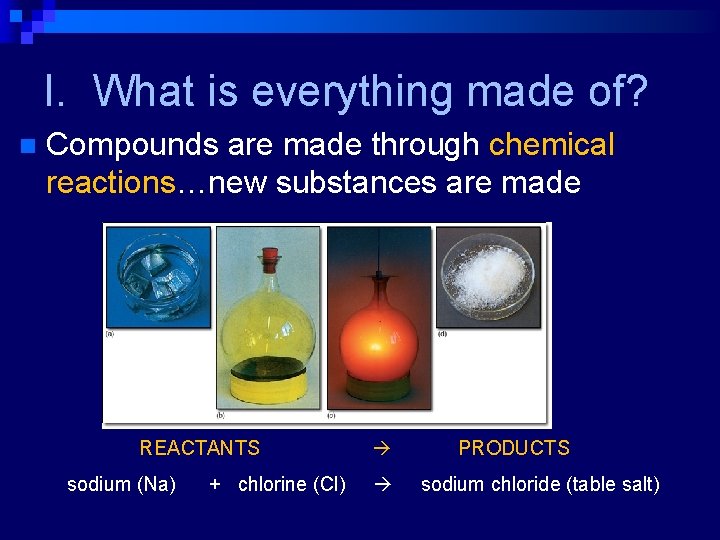
I. What is everything made of? n Compounds are made through chemical reactions…new substances are made REACTANTS sodium (Na) + chlorine (Cl) PRODUCTS sodium chloride (table salt)
I. What is everything made of? n Mixture – two or more compounds physically joined together ¨ Solution – one substance (solute) dissolves in another (solvent) ¨ Suspension – large particles settle at the bottom
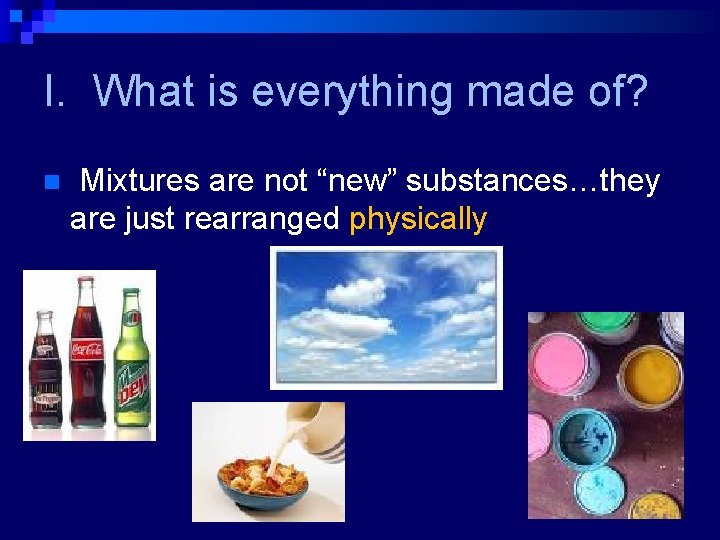
I. What is everything made of? n Mixtures are not “new” substances…they are just rearranged physically
Self-Quiz n n n 1. oil 2. wood 3. water 4. carbon 5. starch 6. shampoo 7. air 8. silicon 9. sugar 10. cookies 11. copper Label as… E, C, or M (element, compound, or mixture)
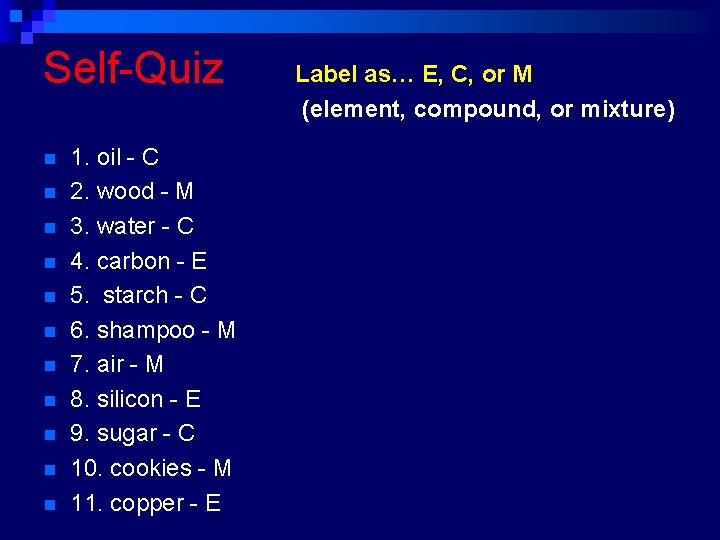
Self-Quiz n n n 1. oil - C 2. wood - M 3. water - C 4. carbon - E 5. starch - C 6. shampoo - M 7. air - M 8. silicon - E 9. sugar - C 10. cookies - M 11. copper - E Label as… E, C, or M (element, compound, or mixture)
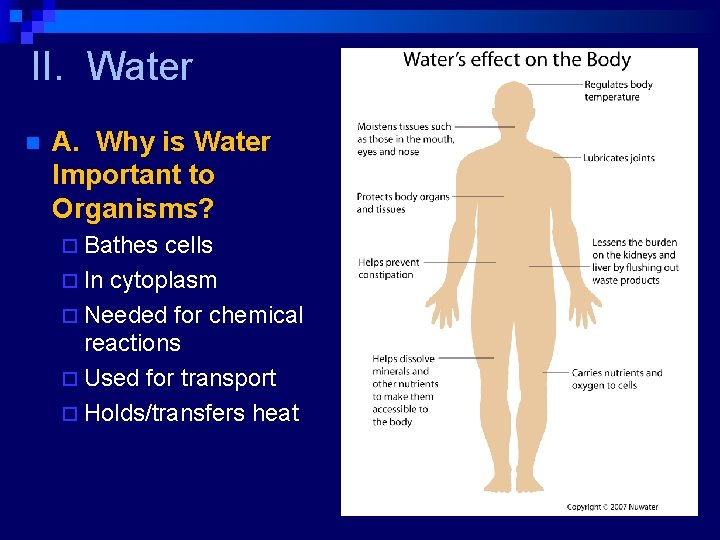
II. Water n A. Why is Water Important to Organisms? ¨ Bathes cells ¨ In cytoplasm ¨ Needed for chemical reactions ¨ Used for transport ¨ Holds/transfers heat
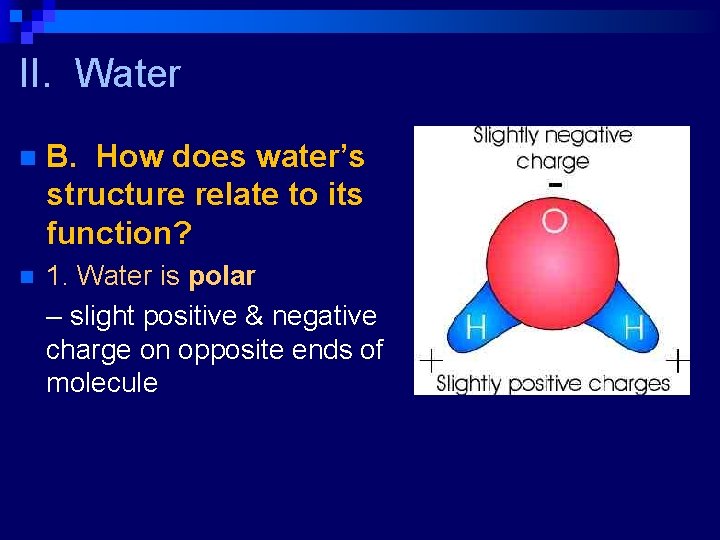
II. Water n B. How does water’s structure relate to its function? n 1. Water is polar – slight positive & negative charge on opposite ends of molecule
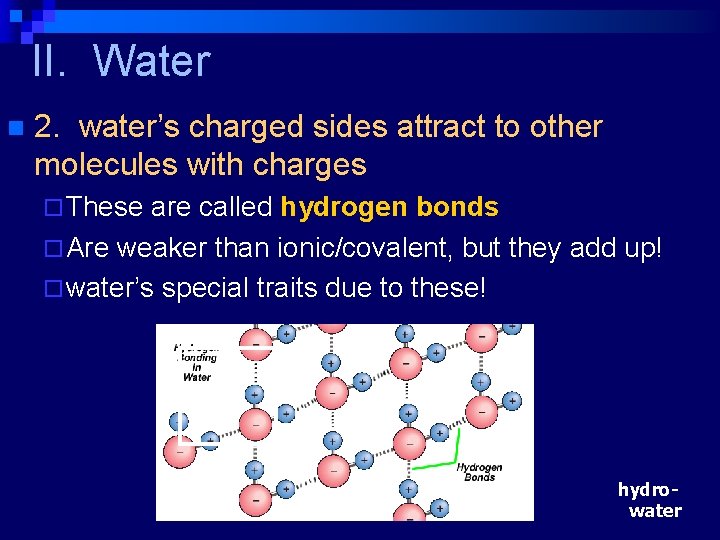
II. Water n 2. water’s charged sides attract to other molecules with charges ¨ These are called hydrogen bonds ¨ Are weaker than ionic/covalent, but they add up! ¨ water’s special traits due to these! hydrowater
II. Water has many special properties, most of which occur because of the hydrogen bonding n As you go through each of the properties be sure to look for 3 things: n ¨ Definition of the property ¨ Why the property happens ¨ Why the property is important to organisms
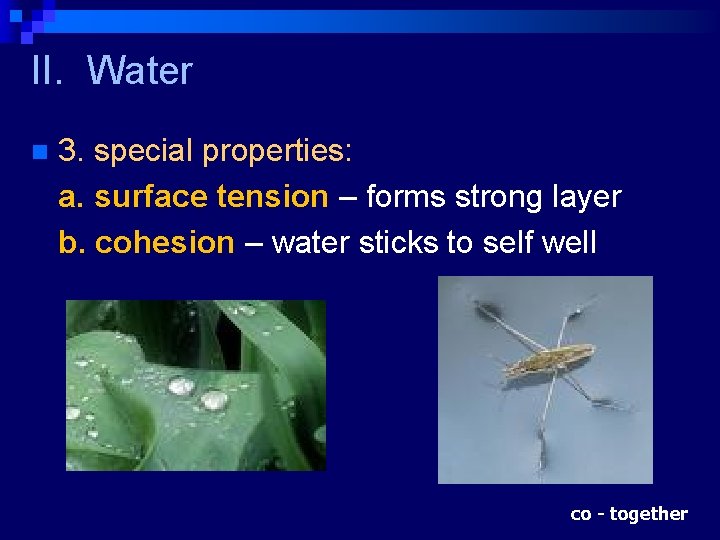
II. Water n 3. special properties: a. surface tension – forms strong layer b. cohesion – water sticks to self well co - together
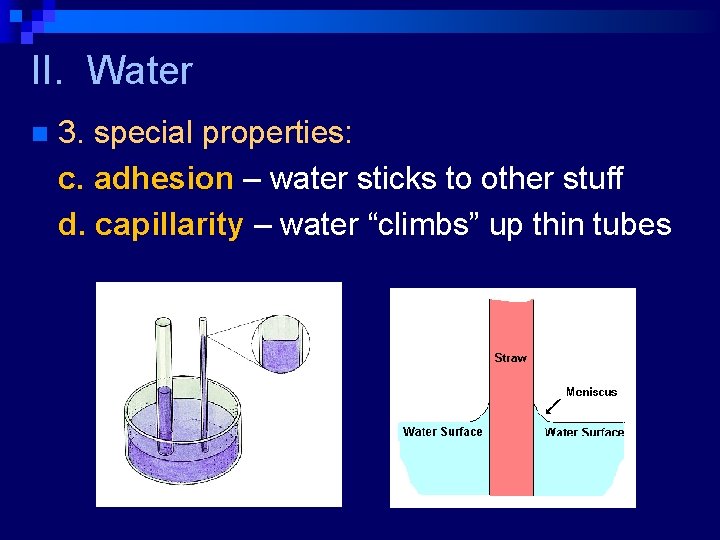
II. Water n 3. special properties: c. adhesion – water sticks to other stuff d. capillarity – water “climbs” up thin tubes
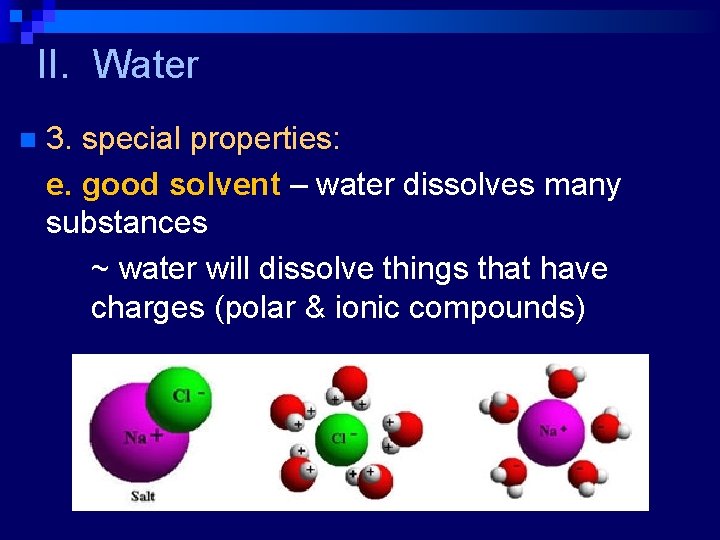
II. Water n 3. special properties: e. good solvent – water dissolves many substances ~ water will dissolve things that have charges (polar & ionic compounds)
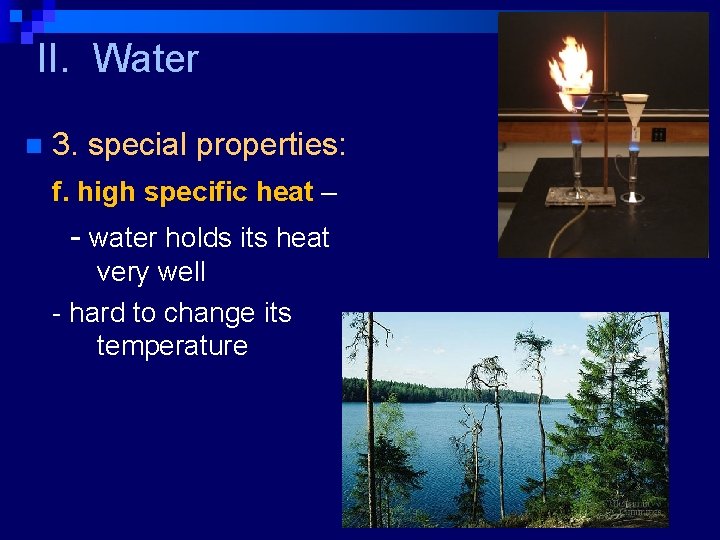
II. Water n 3. special properties: f. high specific heat – - water holds its heat very well - hard to change its temperature
II. Water n 3. special properties: g. high heat of vaporization – - when water does change its temperature (higher) it “carries” heat with it
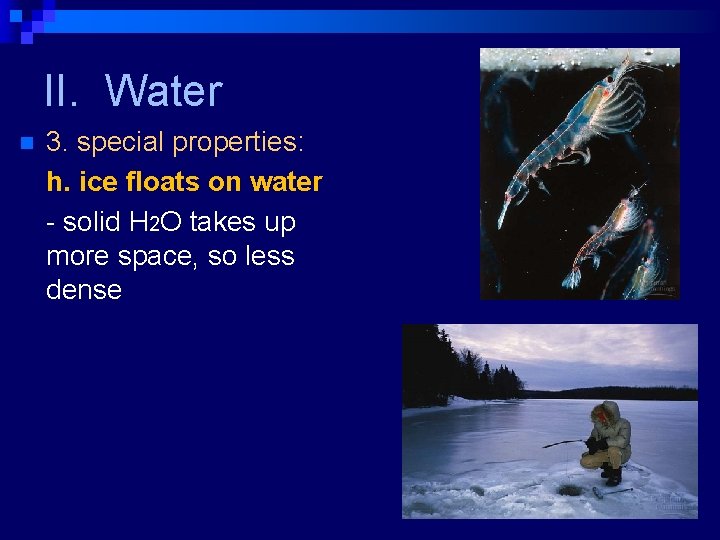
II. Water n 3. special properties: h. ice floats on water - solid H 2 O takes up more space, so less dense
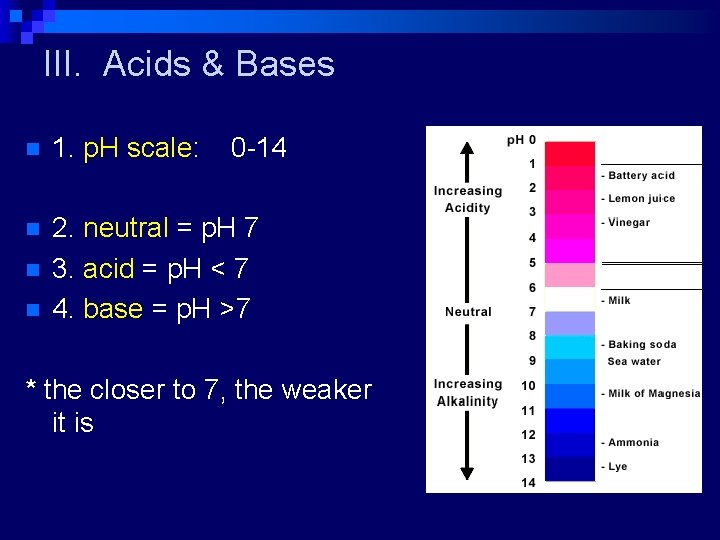
III. Acids & Bases n 1. p. H scale: n 2. neutral = p. H 7 3. acid = p. H < 7 4. base = p. H >7 n n 0 -14 * the closer to 7, the weaker it is
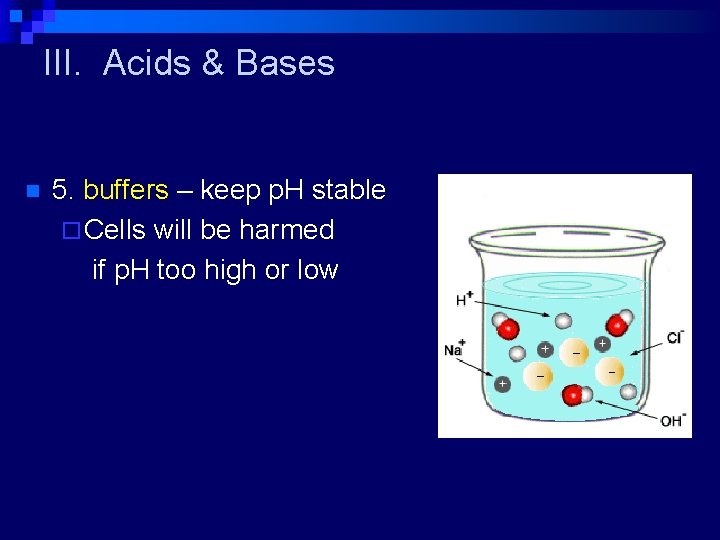
III. Acids & Bases n 5. buffers – keep p. H stable ¨ Cells will be harmed if p. H too high or low
IV. Organic Compounds n Organic compounds come from organisms n All include very large molecules (polymers) that are built from smaller units called monomers mono - one poly - many
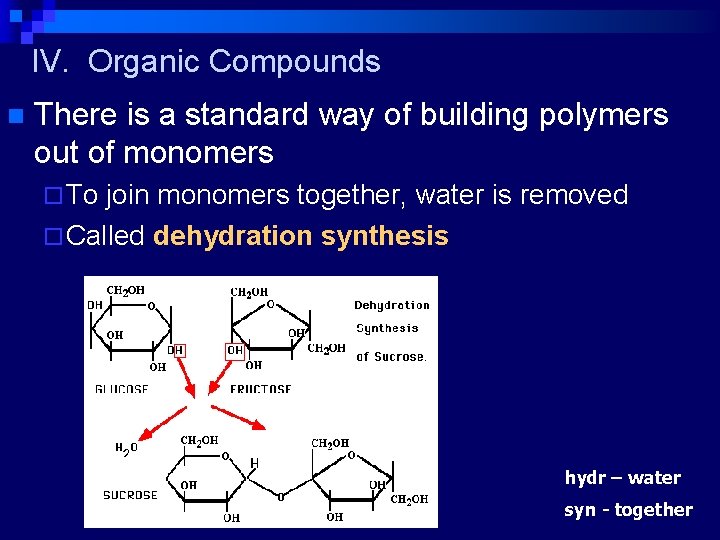
IV. Organic Compounds n There is a standard way of building polymers out of monomers ¨ To join monomers together, water is removed ¨ Called dehydration synthesis hydr – water syn - together
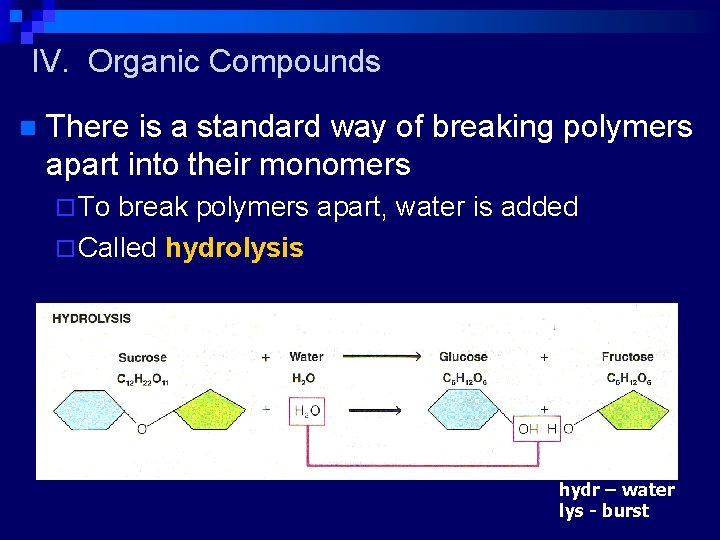
IV. Organic Compounds n There is a standard way of breaking polymers apart into their monomers ¨ To break polymers apart, water is added ¨ Called hydrolysis hydr – water lys - burst
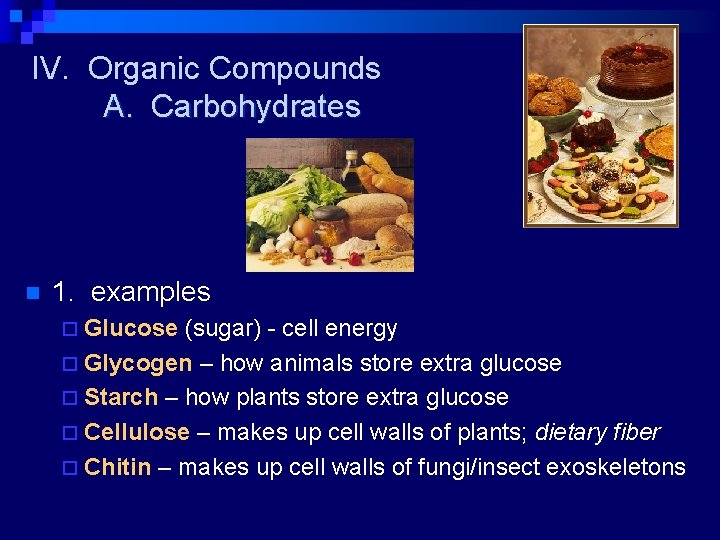
IV. Organic Compounds A. Carbohydrates n 1. examples ¨ Glucose (sugar) - cell energy ¨ Glycogen – how animals store extra glucose ¨ Starch – how plants store extra glucose ¨ Cellulose – makes up cell walls of plants; dietary fiber ¨ Chitin – makes up cell walls of fungi/insect exoskeletons
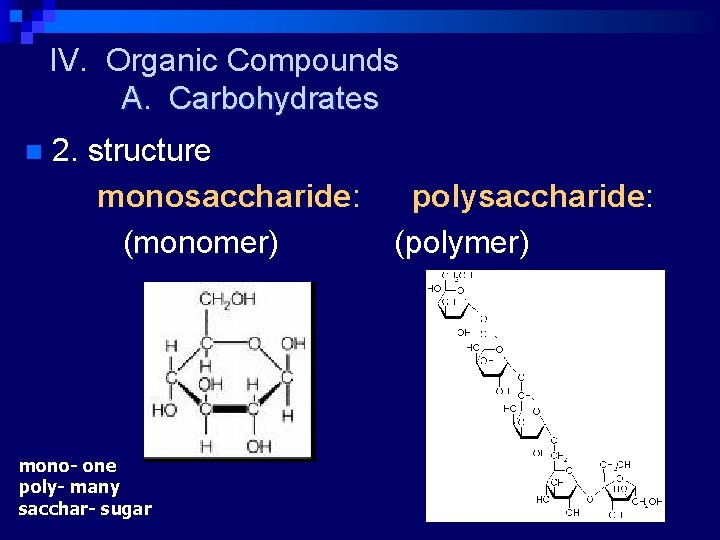
IV. Organic Compounds A. Carbohydrates n 2. structure monosaccharide: (monomer) mono- one poly- many sacchar- sugar polysaccharide: (polymer)
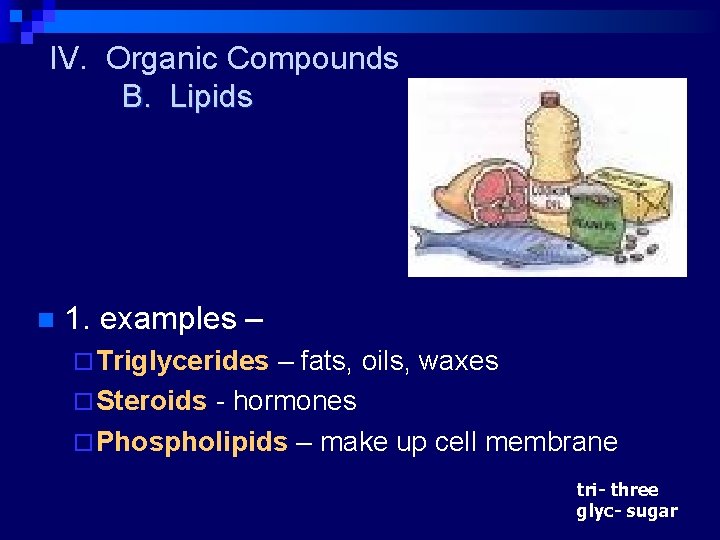
IV. Organic Compounds B. Lipids n 1. examples – ¨ Triglycerides – fats, oils, waxes ¨ Steroids - hormones ¨ Phospholipids – make up cell membrane tri- three glyc- sugar
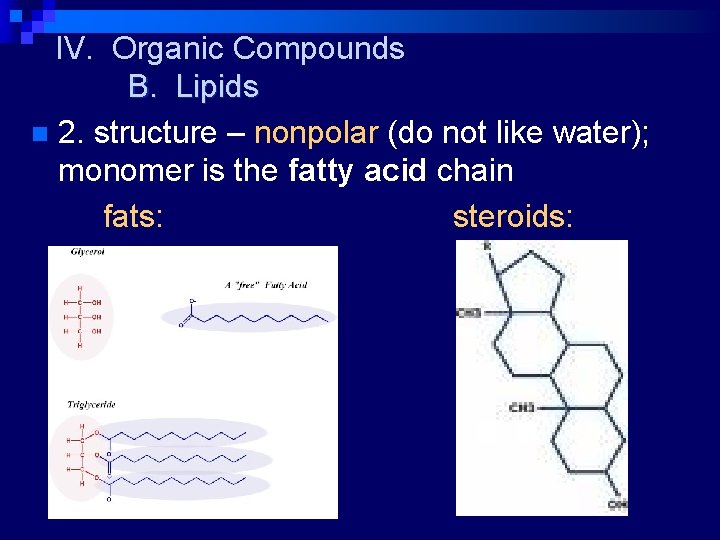
IV. Organic Compounds B. Lipids n 2. structure – nonpolar (do not like water); monomer is the fatty acid chain fats: steroids:
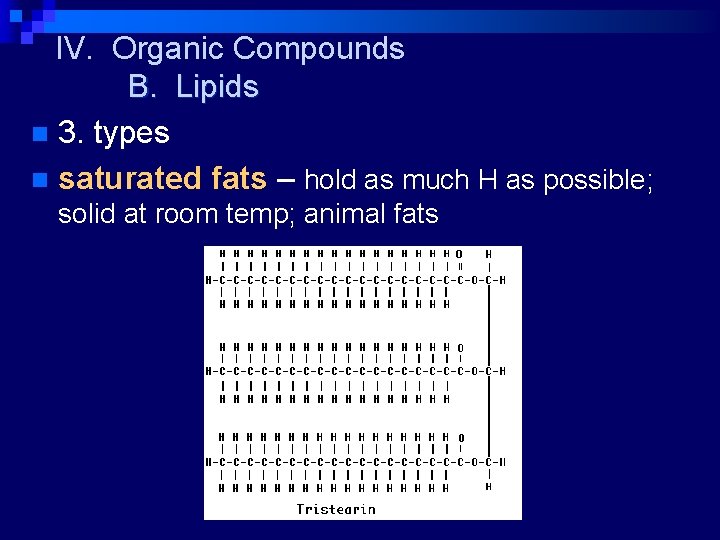
IV. Organic Compounds B. Lipids n 3. types n saturated fats – hold as much H as possible; solid at room temp; animal fats
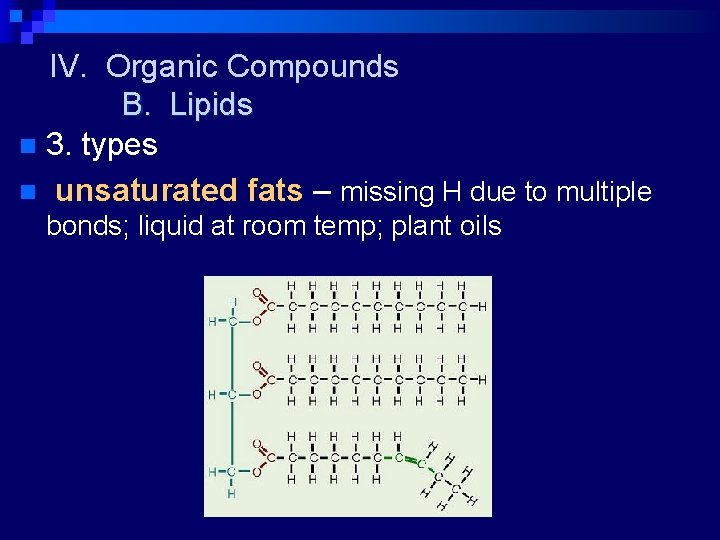
IV. Organic Compounds B. Lipids n 3. types n unsaturated fats – missing H due to multiple bonds; liquid at room temp; plant oils
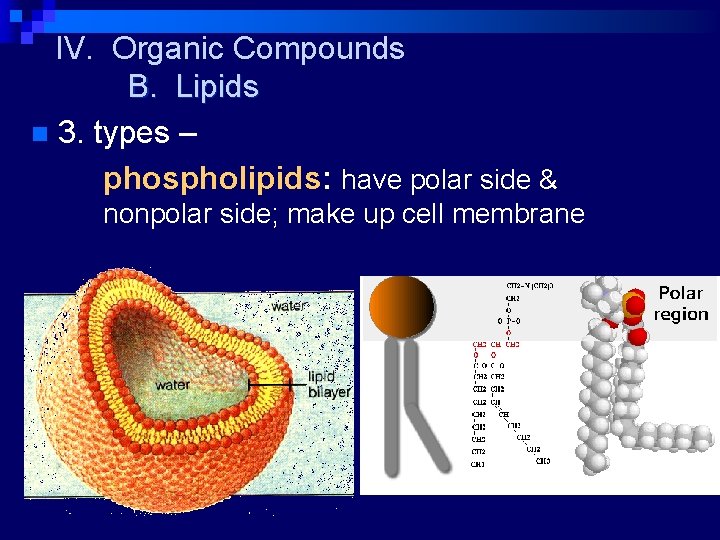
IV. Organic Compounds B. Lipids n 3. types – phospholipids: have polar side & nonpolar side; make up cell membrane
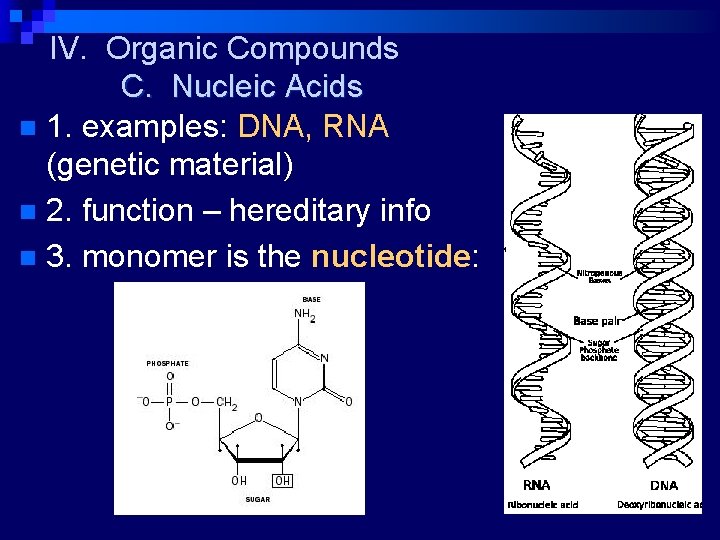
IV. Organic Compounds C. Nucleic Acids n 1. examples: DNA, RNA (genetic material) n 2. function – hereditary info n 3. monomer is the nucleotide:
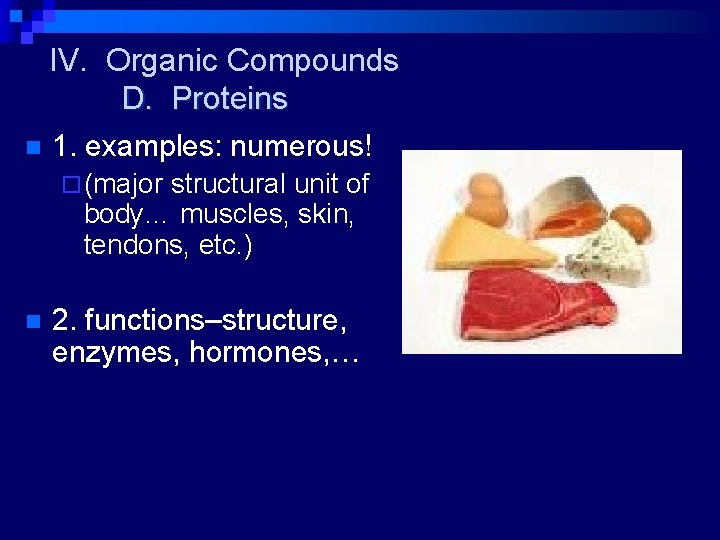
IV. Organic Compounds D. Proteins n 1. examples: numerous! ¨ (major structural unit of body… muscles, skin, tendons, etc. ) n 2. functions–structure, enzymes, hormones, …
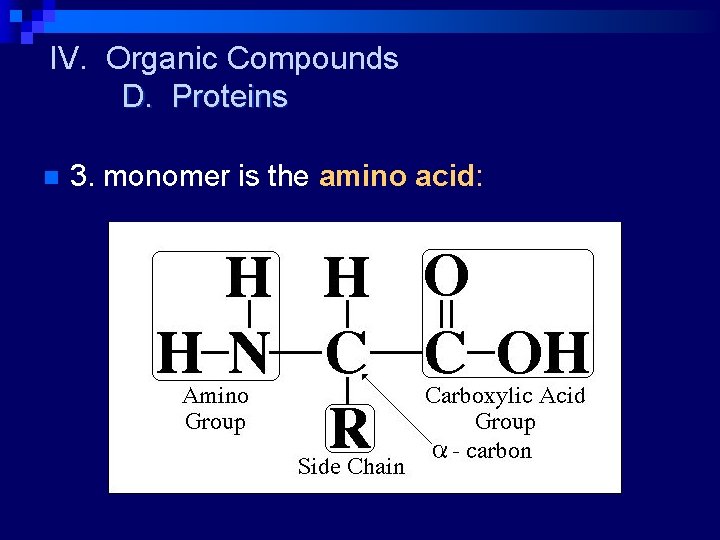
IV. Organic Compounds D. Proteins n 3. monomer is the amino acid:
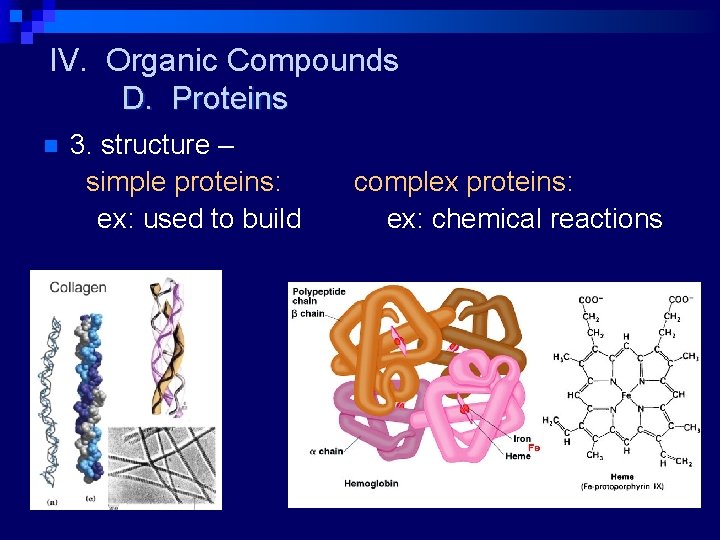
IV. Organic Compounds D. Proteins n 3. structure – simple proteins: ex: used to build complex proteins: ex: chemical reactions
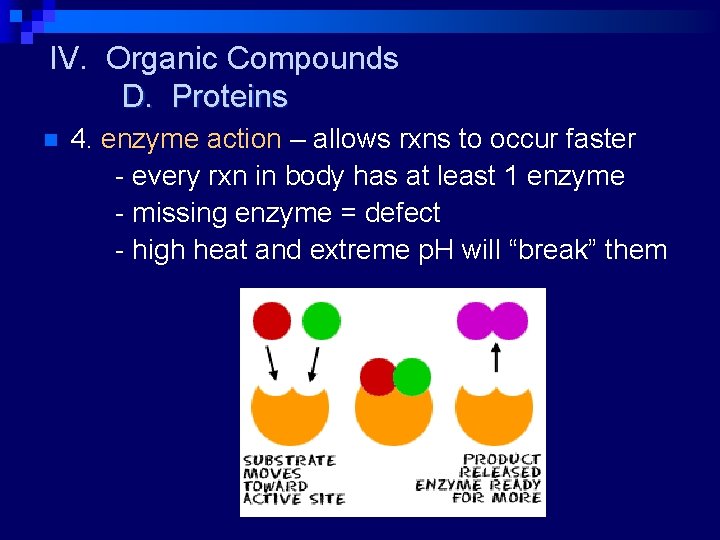
IV. Organic Compounds D. Proteins n 4. enzyme action – allows rxns to occur faster - every rxn in body has at least 1 enzyme - missing enzyme = defect - high heat and extreme p. H will “break” them
Self-Quiz – Chemistry n 1. An example of an element would be: A. Ne B. CO 2 C. C 6 H 12 O 6 D. H 2 O n 2. Which of the following is the weakest? A. ionic bonds C. hydrogen bonds B. electrovalent bonds D. covalent bonds
Self-Quiz – Chemistry n 3. Most of water’s special properties are due to the fact that it is – A. polar B. neutral C. covalent D. nonpolar n 4. Ringed lipids are called A. triglycerides C. steroids B. phospholipids. D. both B and C.
Self-Quiz – Chemistry n 5. When your body has too much glucose, the extra is stored as glycogen. Glucose is a ____, or building block, of many ____. A. monomer…triglycerides B. monomer…carbohydrates C. polymer…proteins D. polymer…nucleic acids
Self-Quiz – Chemistry n 6. Unsaturated fats: A. contain all the hydrogen atoms they can hold B. contain only single bonds between carbon atoms C. are usually solids at room temperature D. will kink/bend at double bonds between C atoms

The End
- Slides: 42