
Unit I Top management Business objectives and Mr
Unit I: Top management Business objectives and Mr. Manish Kumar
In this unit you will study about • Responsibilities and tasks of top management-objectives of business characteristics, classifications, types of objectives and their overall hierarchy, setting of objectives, key areas involved.
Top Management • Top Management plays a critical role in firms as they are charged with formulating and implementing strategies effectively. • The strategic decisions made by top level managers, influence how the firm is designed and whether or not goals achieved. • Top executives need to have self-confidence but must guard against allowing it to become arrogance and a false belief in their own invincibility. • The job of Top-Level executives is complex and requires a broad knowledge of the firms operation, as well as the three key parts of the firms external environment- the general, industry and competitor environments.
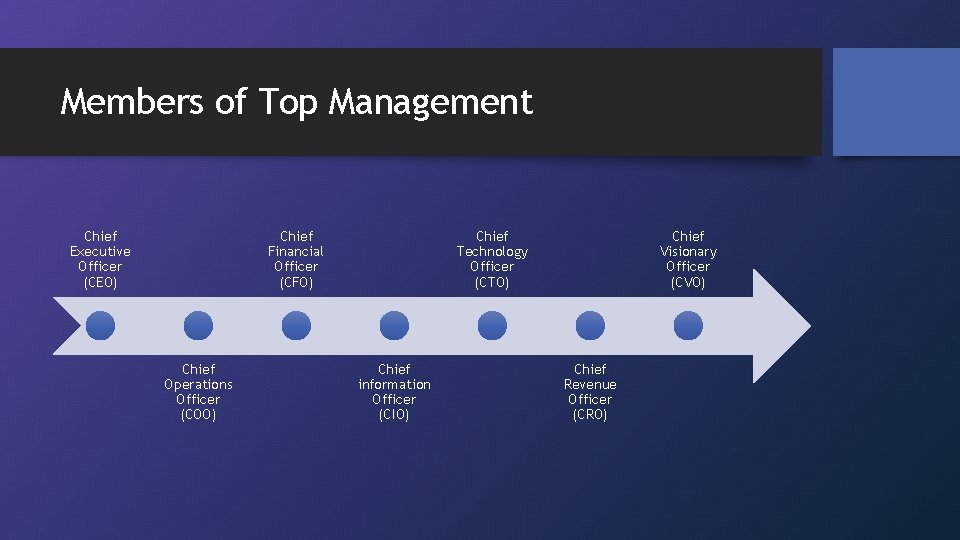
Members of Top Management Chief Executive Officer (CEO) Chief Financial Officer (CFO) Chief Operations Officer (COO) Chief Technology Officer (CTO) Chief information Officer (CIO) Chief Visionary Officer (CVO) Chief Revenue Officer (CRO)
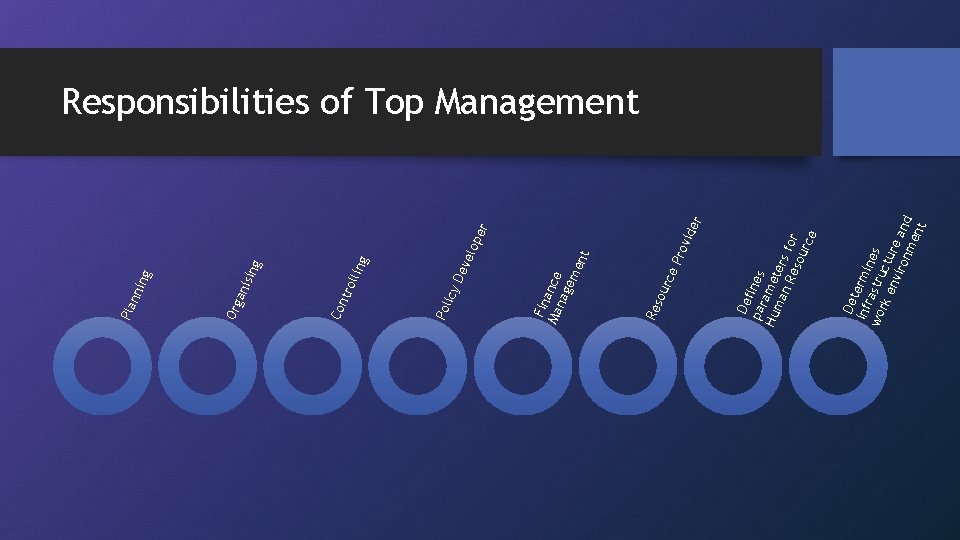
icy Det inf ermi wo rastru nes rk env cture iro nm and ent er vid Pro nt De par fines Hu amet ma n R ers fo eso r urc e ce our Res per elo Dev Fin Ma ance nag em e Pol g llin tro Con sin g ani Org ng nni Pla Responsibilities of Top Management
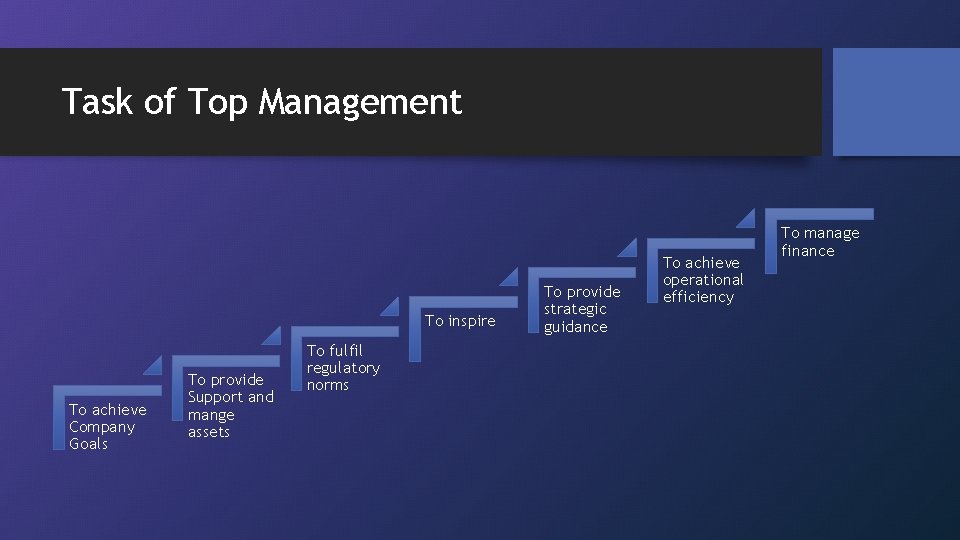
Task of Top Management To inspire To achieve Company Goals To provide Support and mange assets To fulfil regulatory norms To provide strategic guidance To achieve operational efficiency To manage finance
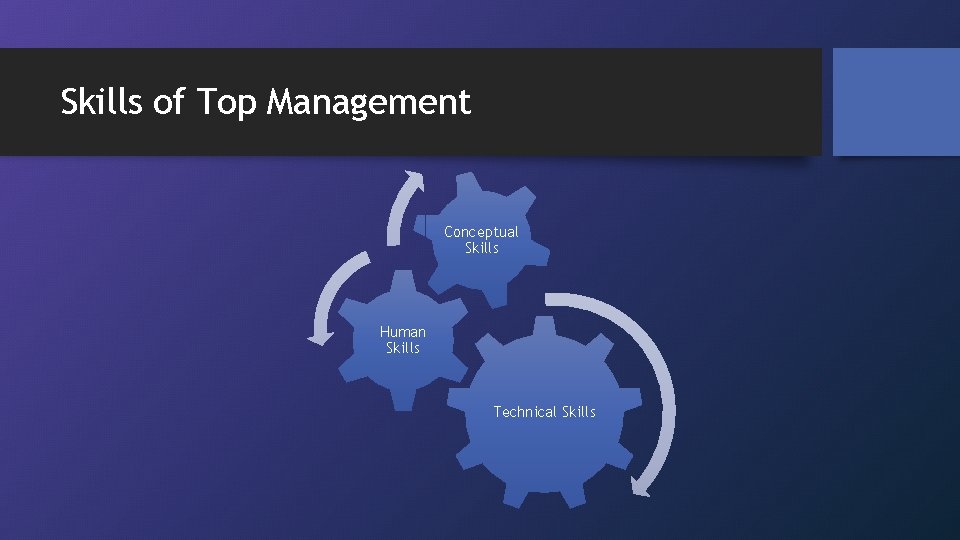
Skills of Top Management Conceptual Skills Human Skills Technical Skills
Strategic Intent • Effective strategic management begins with the organisation clearly articulating its vision for the future. The concept of strategic intent, popularised by Gary Hamel and C. K. Prahalad refers to the purpose of the organisation and the ends it wishes to pursue. • The strategic intent of the firm represents the organisations belief about its state of the future. The purpose or ends the organisation wishes to pursue vary from being really broad and long term (Vision and mission), to being narrow, with a focus on the short term or near term.
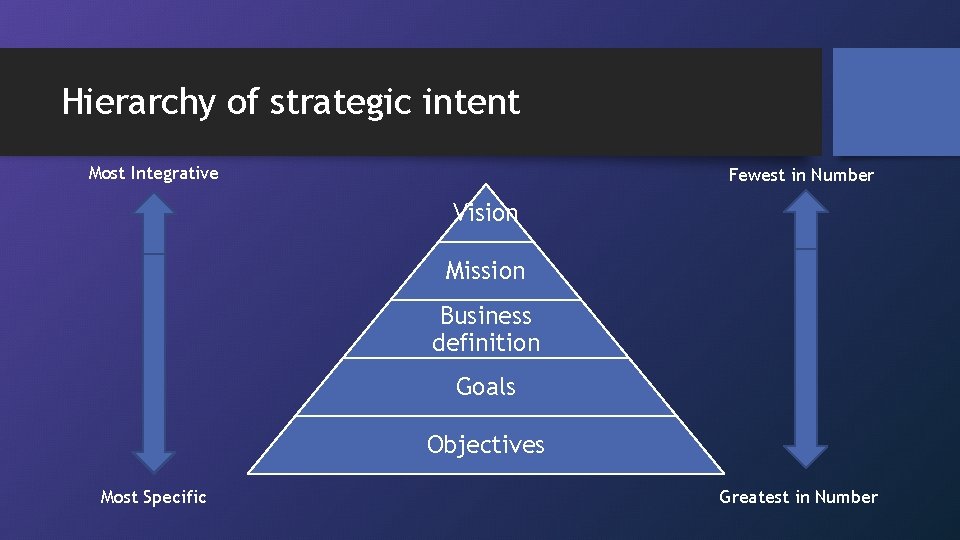
Hierarchy of strategic intent Most Integrative Fewest in Number Vision Mission Business definition Goals Objectives Most Specific Greatest in Number
Vision • A vision is more dreamt of than it is articulated. This is the reason why it is difficult to say, what vision an organisation has. • Sometimes it is not even evident to the entrepreneur who usually thinks of the vision. • According to Kotler, “ Vision is a description of something ( an organisation, corporate culture, a business, a technology, an activity) in the future. • Strategic management is a recursive, interactive, circular process, with analysis leading to some ideas on strategy, leading to questions of how to implement them, and leading to forecast of potential results- all possible leading back to a revised strategy.
Features of vision • Mental exercise • Constitutes organisations objectives and focus • Dynamic and flexible • Time-bound • Simple and concise • Pervasive • Well-defined • • Selects the target market Reflects future plans Comprehensive Anticipates future Effective Objective Orientation
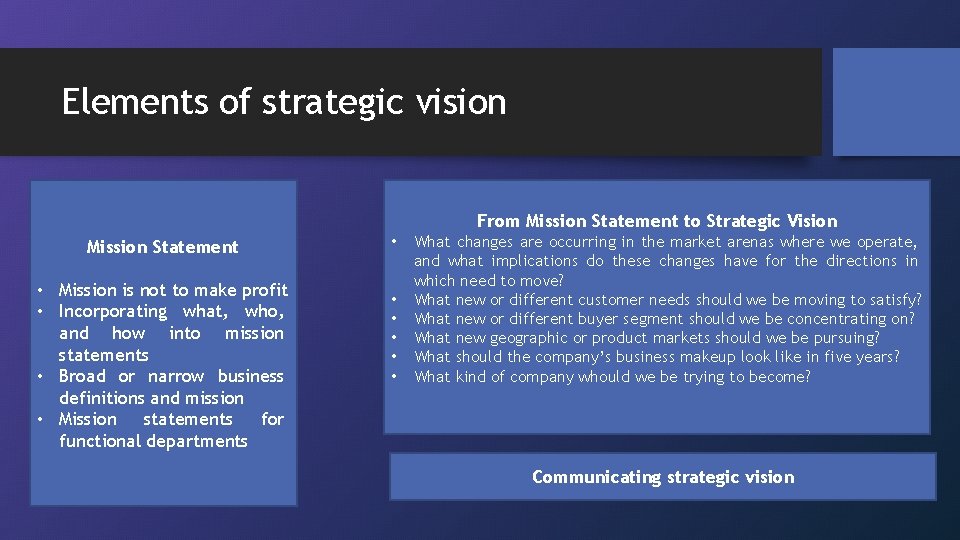
Elements of strategic vision From Mission Statement to Strategic Vision Mission Statement • Mission is not to make profit • Incorporating what, who, and how into mission statements • Broad or narrow business definitions and mission • Mission statements for functional departments • • • What changes are occurring in the market arenas where we operate, and what implications do these changes have for the directions in which need to move? What new or different customer needs should we be moving to satisfy? What new or different buyer segment should we be concentrating on? What new geographic or product markets should we be pursuing? What should the company’s business makeup look like in five years? What kind of company whould we be trying to become? Communicating strategic vision
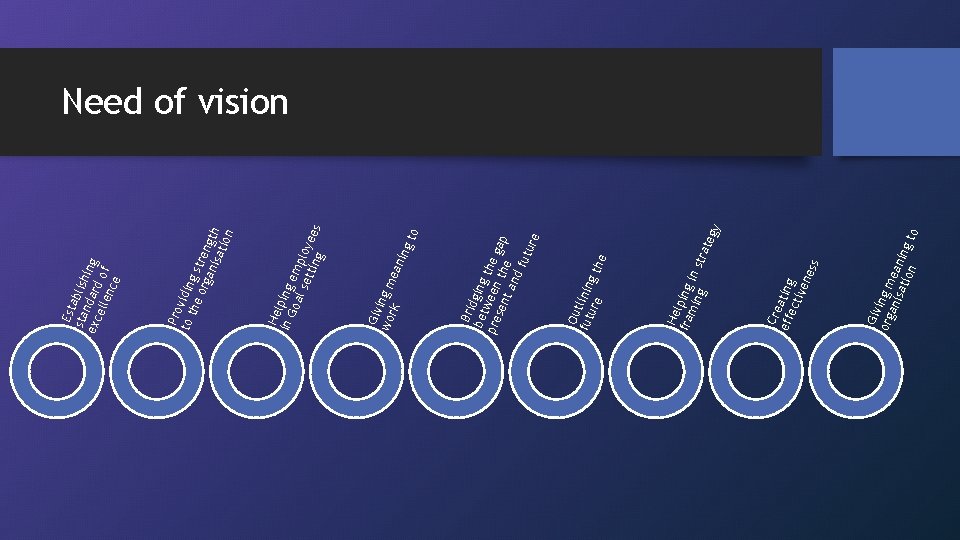
ng to egy Giv org ing m ani ea sat nin ion g to s Cre eff ating ect ive nes He fra lping min in str g at Ou fut tlinin ure g th e Bri bet dging pre ween the g sen a the p nd fut ure ani Giv wo ing m rk e He in Glping oal emp set loye tin g es Pro to vidin the g s org tren ani gth sat ion Est sta ablish exc ndard ing elle of nce Need of vision
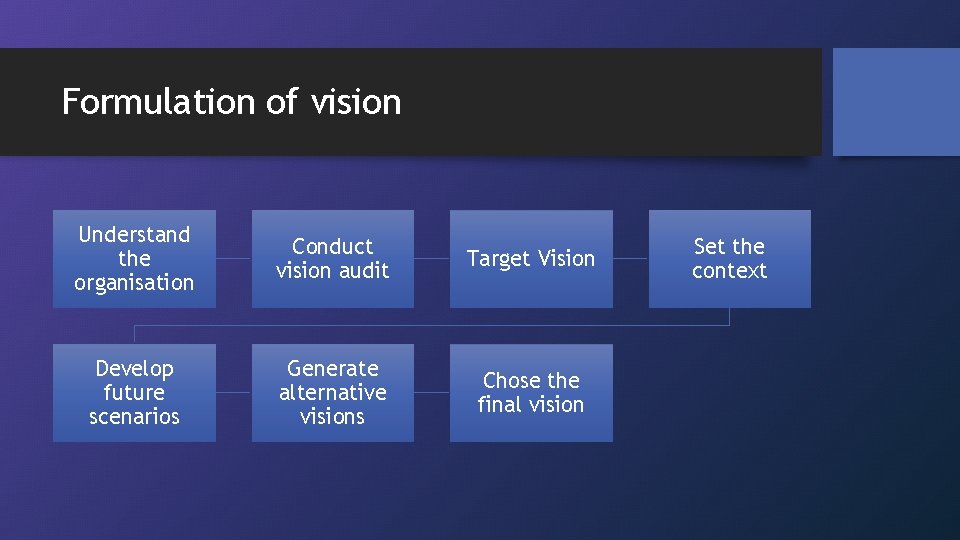
Formulation of vision Understand the organisation Conduct vision audit Target Vision Develop future scenarios Generate alternative visions Chose the final vision Set the context
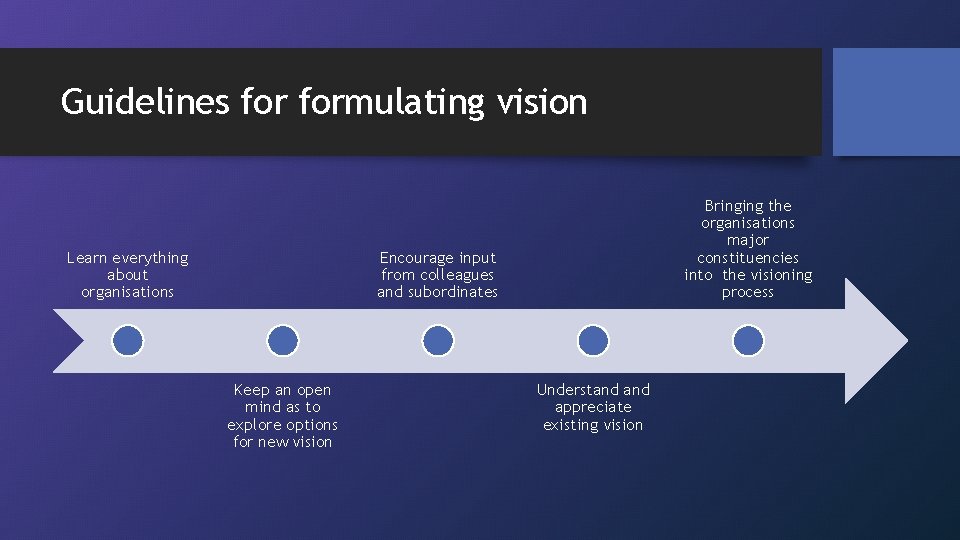
Guidelines formulating vision Learn everything about organisations Bringing the organisations major constituencies into the visioning process Encourage input from colleagues and subordinates Keep an open mind as to explore options for new vision Understand appreciate existing vision
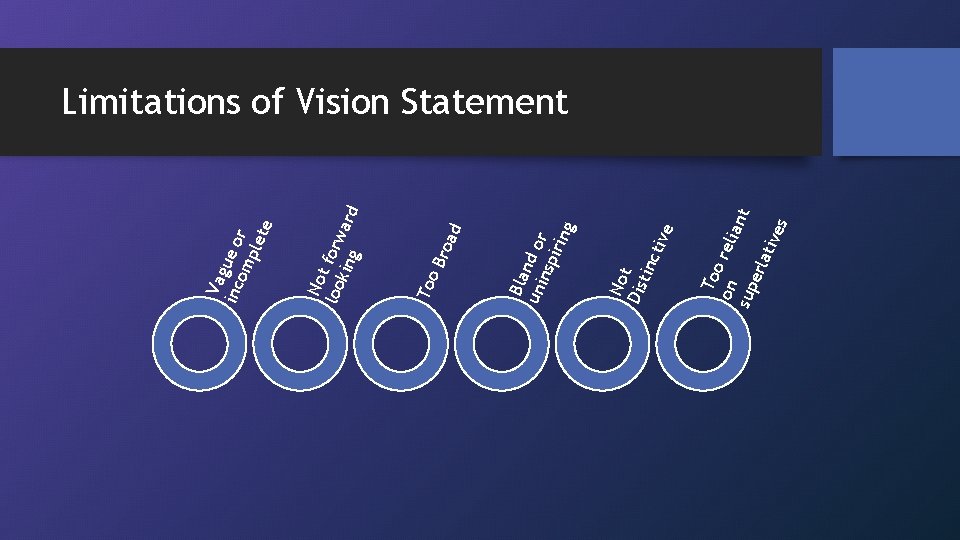
ad Bro Too on relia nt sup erl ati ves ctiv e Not Dis tin Bla uni nd or nsp irin g Too Not loo forw kin g ard Vag inc ue o om r ple te Limitations of Vision Statement
Mission • Mission is what an organisation is and why it exists. Organisations relate their existence to satisfying a particular need of the society. They do this in terms of their mission. • Mission is a “ a statement which defines the role that an organisation plays in society”. • According to Thompson, “ Mission is the essential purpose of the organisation, concerning particularly why it is in existence, the nature of the business it in, and the customers it seeks to serve and satisfy”.
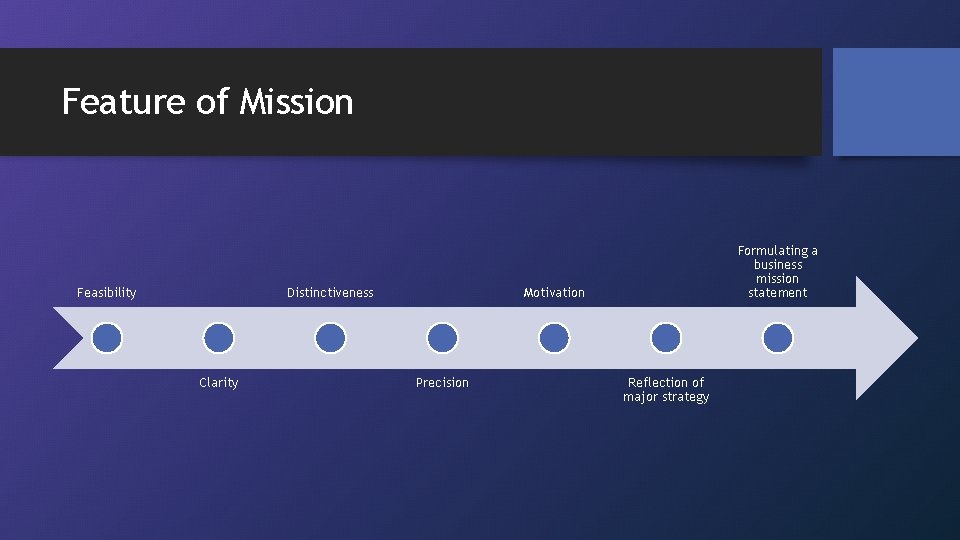
Feature of Mission Feasibility Distinctiveness Clarity Formulating a business mission statement Motivation Precision Reflection of major strategy
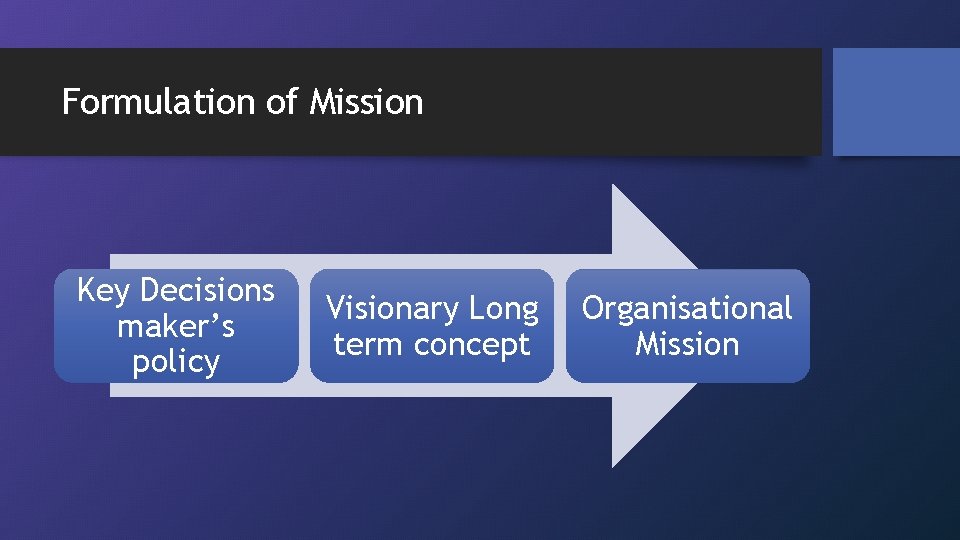
Formulation of Mission Key Decisions maker’s policy Visionary Long term concept Organisational Mission
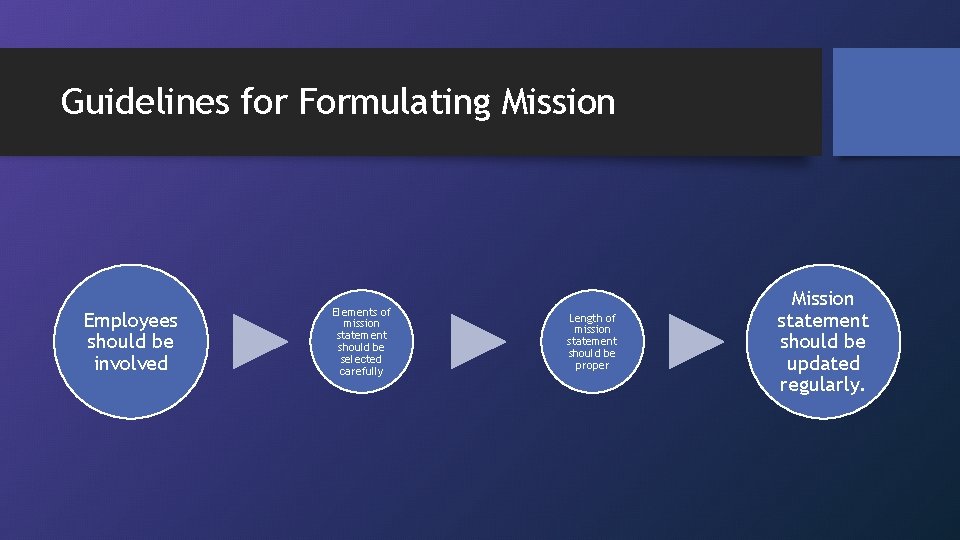
Guidelines for Formulating Mission Employees should be involved Elements of mission statement should be selected carefully Length of mission statement should be proper Mission statement should be updated regularly.
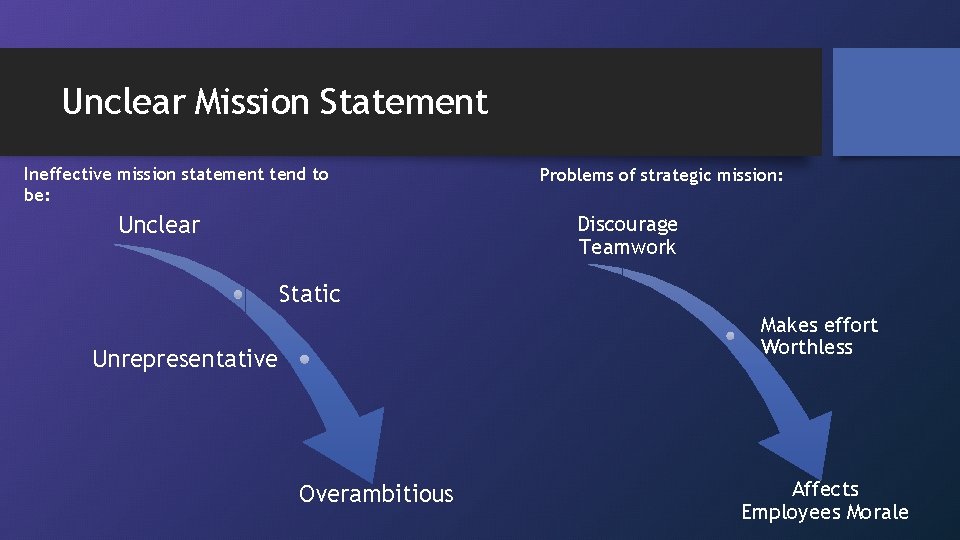
Unclear Mission Statement Ineffective mission statement tend to be: Unclear Problems of strategic mission: Discourage Teamwork Static Makes effort Worthless Unrepresentative Overambitious Affects Employees Morale
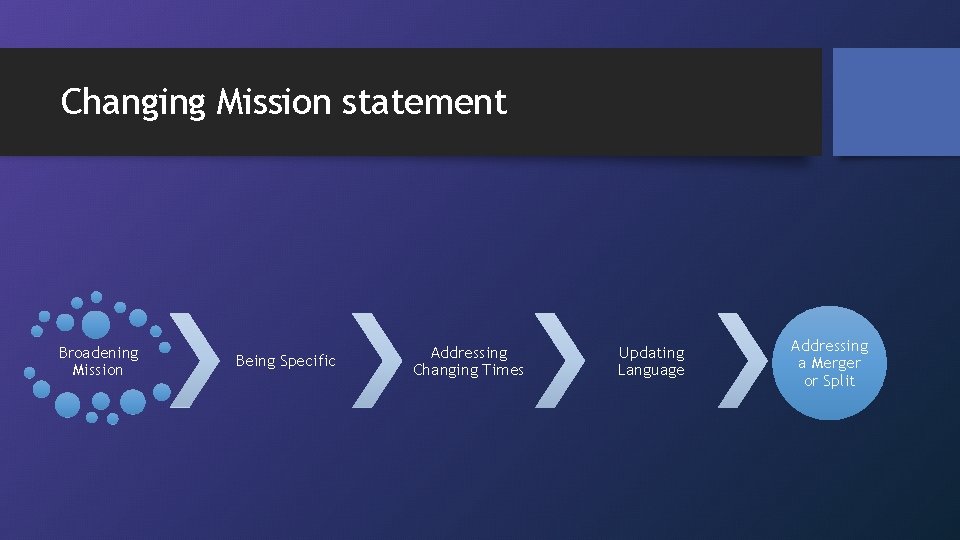
Changing Mission statement Broadening Mission Being Specific Addressing Changing Times Updating Language Addressing a Merger or Split
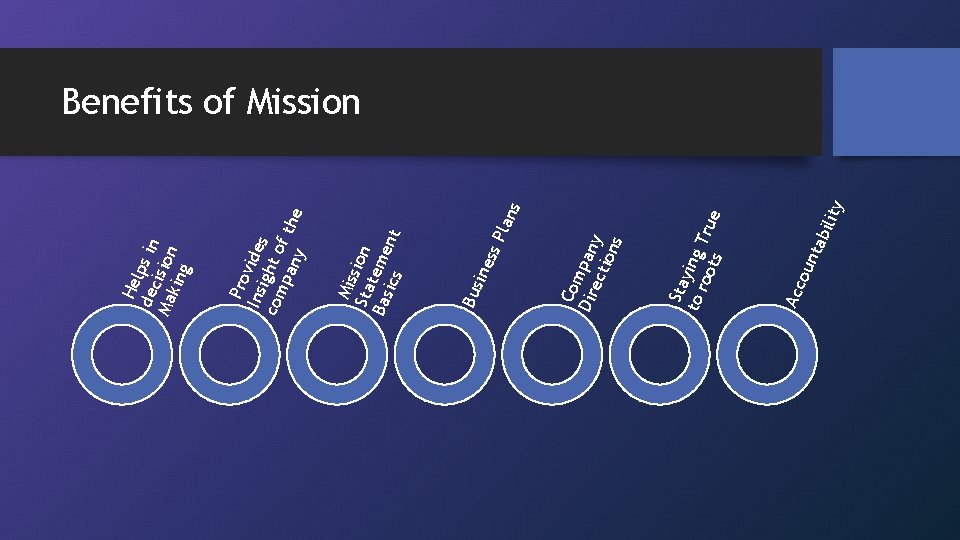
y s tab ilit oun Acc Sta to ying roo Tru ts e Com Dir pan ect y ion s lan ine ss P Bus Mis Sta sion Bas teme ics nt Pro Ins vides comight o pan f th e y He dec lps in Ma ision kin g Benefits of Mission
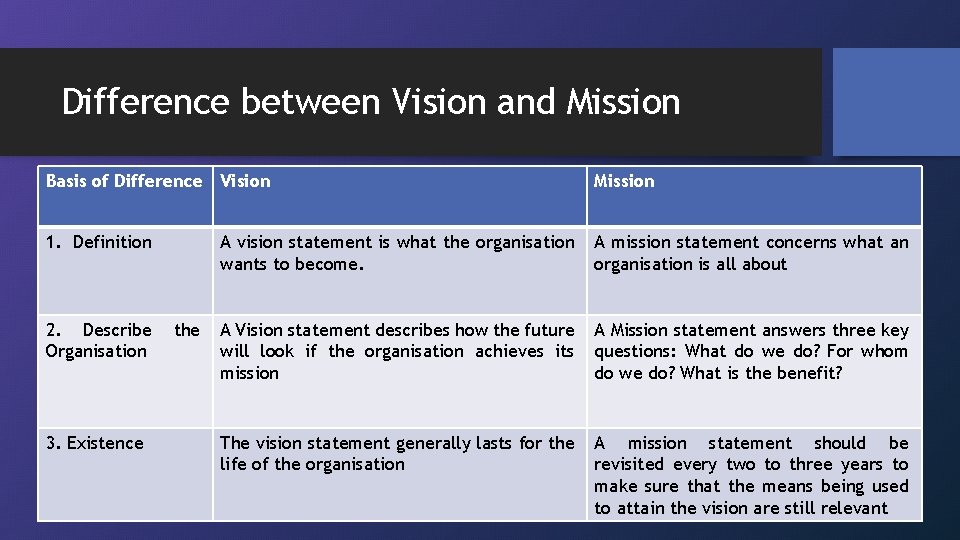
Difference between Vision and Mission Basis of Difference Vision Mission 1. Definition A vision statement is what the organisation wants to become. A mission statement concerns what an organisation is all about A Vision statement describes how the future will look if the organisation achieves its mission A Mission statement answers three key questions: What do we do? For whom do we do? What is the benefit? The vision statement generally lasts for the life of the organisation A mission statement should be revisited every two to three years to make sure that the means being used to attain the vision are still relevant 2. Describe Organisation 3. Existence the
Defining Business • ‘What is our business? ’ is a pertinent question every entrepreneur asks at some point of time. • This questions needs to be answered as it Leeds to generation of ideas, which can be further built up strategy managers to arrive at a business mission statement. • A business definition is a clear statement of the business the firm is engaged in or is planning to enter. It answers the questions: what is our business, in a precise way.
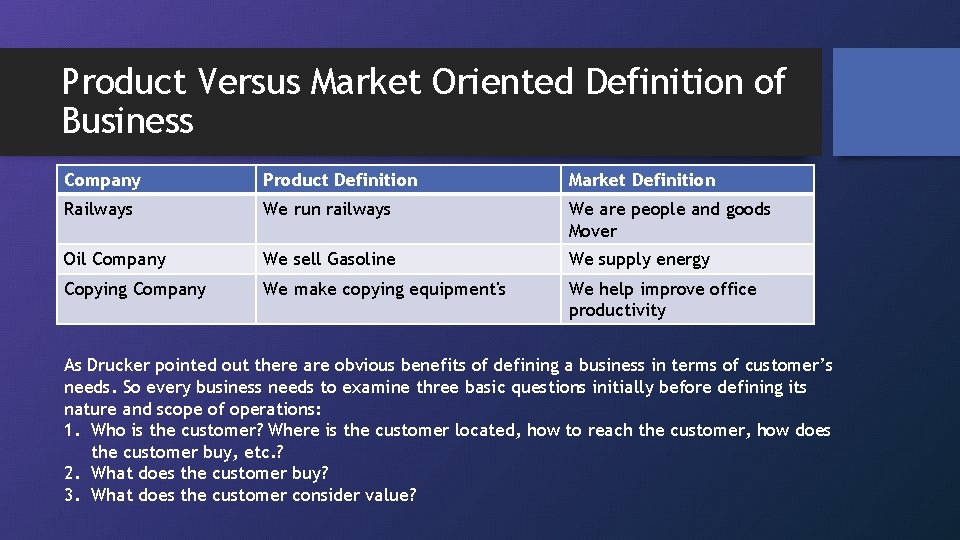
Product Versus Market Oriented Definition of Business Company Product Definition Market Definition Railways We run railways We are people and goods Mover Oil Company We sell Gasoline We supply energy Copying Company We make copying equipment's We help improve office productivity As Drucker pointed out there are obvious benefits of defining a business in terms of customer’s needs. So every business needs to examine three basic questions initially before defining its nature and scope of operations: 1. Who is the customer? Where is the customer located, how to reach the customer, how does the customer buy, etc. ? 2. What does the customer buy? 3. What does the customer consider value?
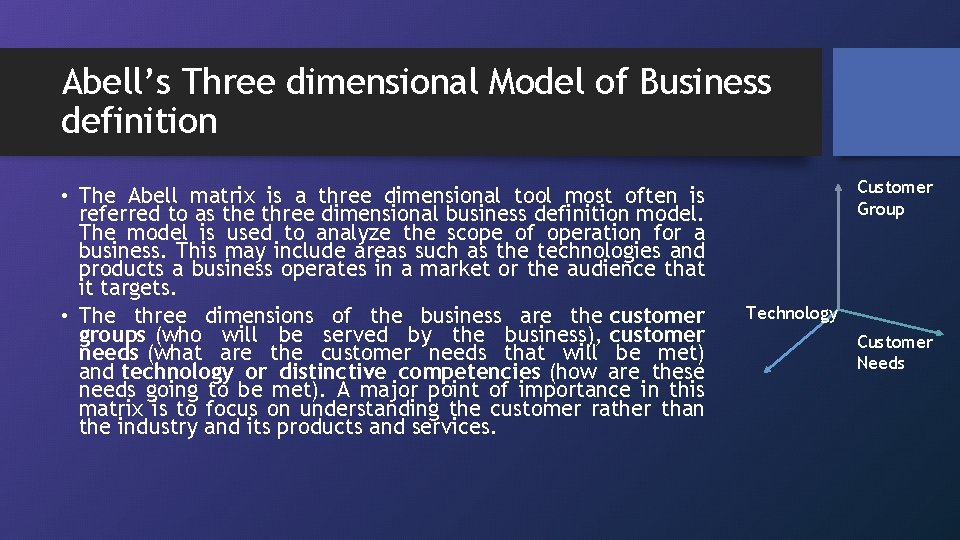
Abell’s Three dimensional Model of Business definition • The Abell matrix is a three dimensional tool most often is referred to as the three dimensional business definition model. The model is used to analyze the scope of operation for a business. This may include areas such as the technologies and products a business operates in a market or the audience that it targets. • The three dimensions of the business are the customer groups (who will be served by the business), customer needs (what are the customer needs that will be met) and technology or distinctive competencies (how are these needs going to be met). A major point of importance in this matrix is to focus on understanding the customer rather than the industry and its products and services. Customer Group Technology Customer Needs
UNDERSTANDING THE MATRIX Abell used three key questions as the three dimensions on his model and these are the foundation for the formulation of the mission statement itself. • What are the customers of the organization? • How can the organization meet the needs of its customers? • What techniques are employed by the organization to meet these customer needs? • When plotted on a three dimensional model, the horizontal axis is taken as the customer groups, the vertical axis as their buying needs and the inclined axis is taken as the applied technologies. Taken together, a summarized version of the organization’s business model can be viewed in one glance.
The Three Dimensions • Customer Needs: This leg of the model identifies and lists down all the customer needs that are relevant to the company in question. Customer needs are identified based on the product offering and a link is made to customer benefits. • Technologies: Unlike the name suggests, the word technologies is taken here in a broader context to describe all those technologies that are used to create a product as well as put in on the market. Issues here include things as diverse as the marketing campaign being use or the way market research must be conducted. • Customer Groups: There would be no market without customers purchasing products on offer. This is why marketing is all about the buyers. It is vital for every organization to understand how to segment the market and which segments to target in order to successfully sell a product to them. Once the market has been segmented, the company needs to work toward acquiring as much knowledge as possible about the different target groups and offer specific products or campaigns to these segments
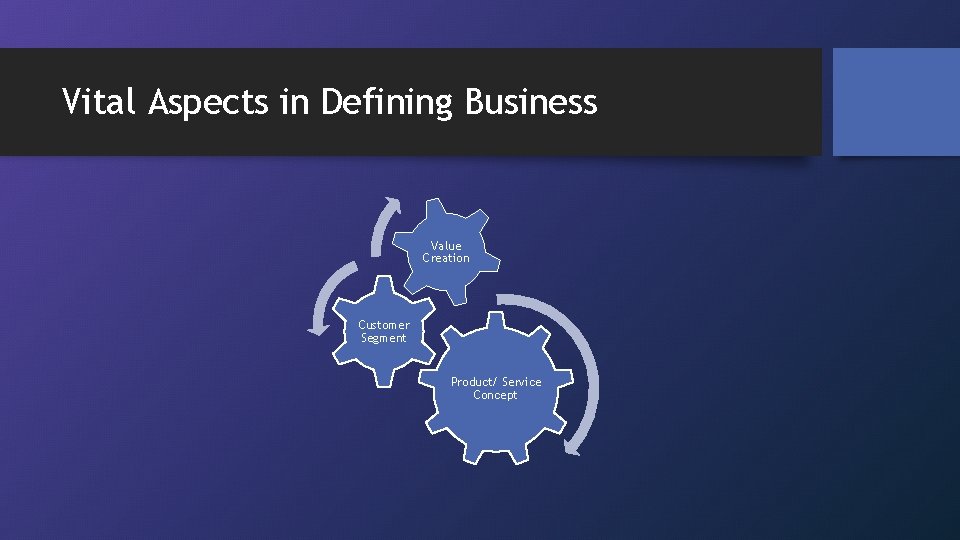
Vital Aspects in Defining Business Value Creation Customer Segment Product/ Service Concept
Goals • Company goals denote what company hopes to accomplish in future period of times. • They represent a future state or an outcome of the effort put in now. Broad categories of financial and non financial issues are addressed by the goals that a firm sets for it. • According to King and Cleland, “ Goals is to establish a venereal tone or organisational climate; to serve as a focus point for those who can identify with the organisational purpose and directions and to defer those who cannot, from participating in the organisation’s activities; to facilitate the translation of the broad purposes and mission into indetifiable tasks and to help in allocating organisational resources”
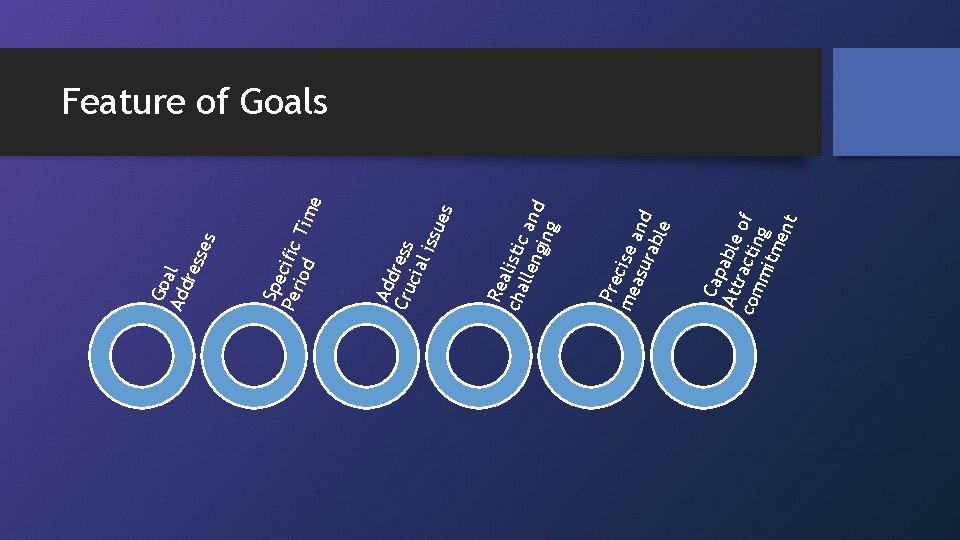
Cap Att able comractin of mit g me nt Pre me cise asu and rab le Rea cha listic llen an gin d g Add Cru ress cia l is sue s Spe Per cific iod Tim e s Go Addal res se Feature of Goals

Types of Goals Official Goals Operative Goals Operational Goals
Objectives of Goals • Objectives are the organisation’s operational targets, usually for periods of one year or less, and closely tied to annual budgets. They represent the intended outcomes of the organisation’s efforts to meet day-to-day needs of its customers and other direct stakeholders. • According to H. Igor Ansoff, “ Objectives are decision rules which enable management to guide and measure the firm’s performance towards its purpose”
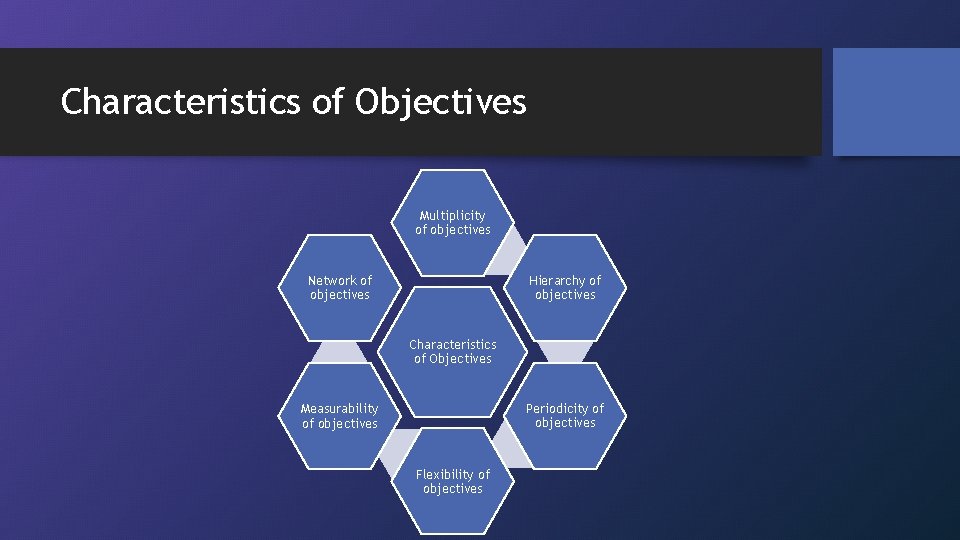
Characteristics of Objectives Multiplicity of objectives Network of objectives Hierarchy of objectives Characteristics of Objectives Periodicity of objectives Measurability of objectives Flexibility of objectives
Importance of Objectives • Objectives serves the process of revival • Objectives act as base for business decisions • Objectives defines the organisation’s relationship with its environment • Objectives provide the standards for performance appraisal • Direction • Benchmark for success • Objectives ensure growth • Objectives provide base for decentralisation • Legitimacy • Coordination • Motivation • Objectives help an organisation to pursue its vision and mission
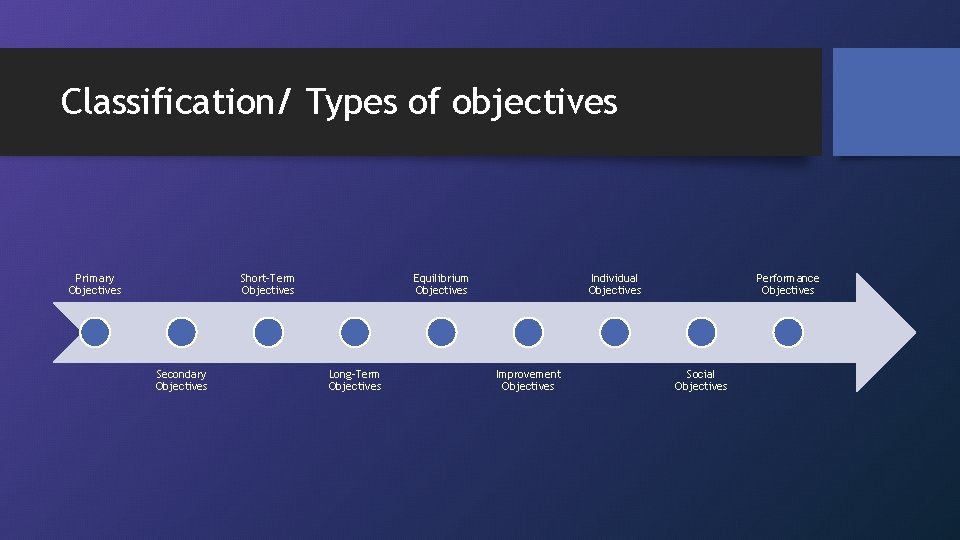
Classification/ Types of objectives Primary Objectives Short-Term Objectives Secondary Objectives Equilibrium Objectives Long-Term Objectives Individual Objectives Improvement Objectives Performance Objectives Social Objectives
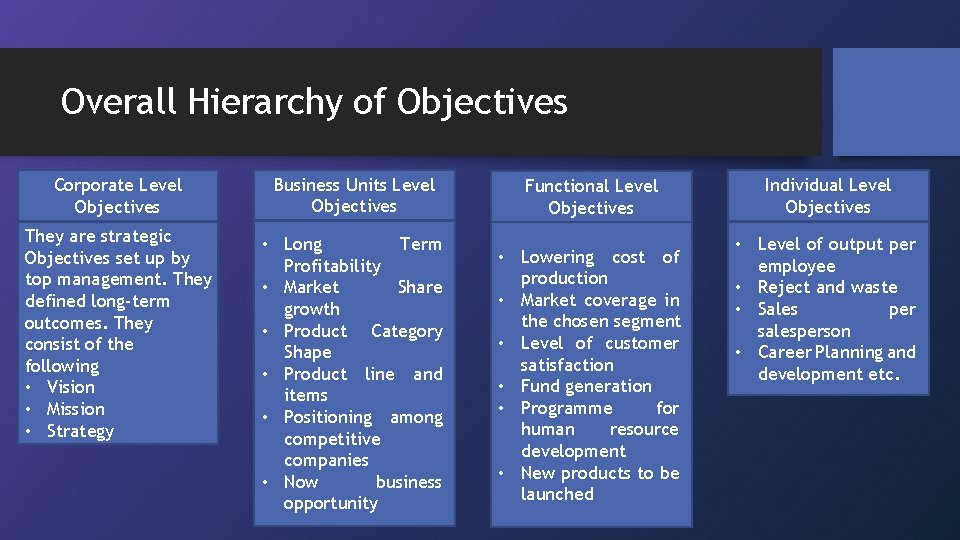
Overall Hierarchy of Objectives Corporate Level Objectives Business Units Level Objectives Functional Level Objectives They are strategic Objectives set up by top management. They defined long-term outcomes. They consist of the following • Vision • Mission • Strategy • Long Term Profitability • Market Share growth • Product Category Shape • Product line and items • Positioning among competitive companies • Now business opportunity • Lowering cost of production • Market coverage in the chosen segment • Level of customer satisfaction • Fund generation • Programme for human resource development • New products to be launched Individual Level Objectives • Level of output per employee • Reject and waste • Sales per salesperson • Career Planning and development etc.
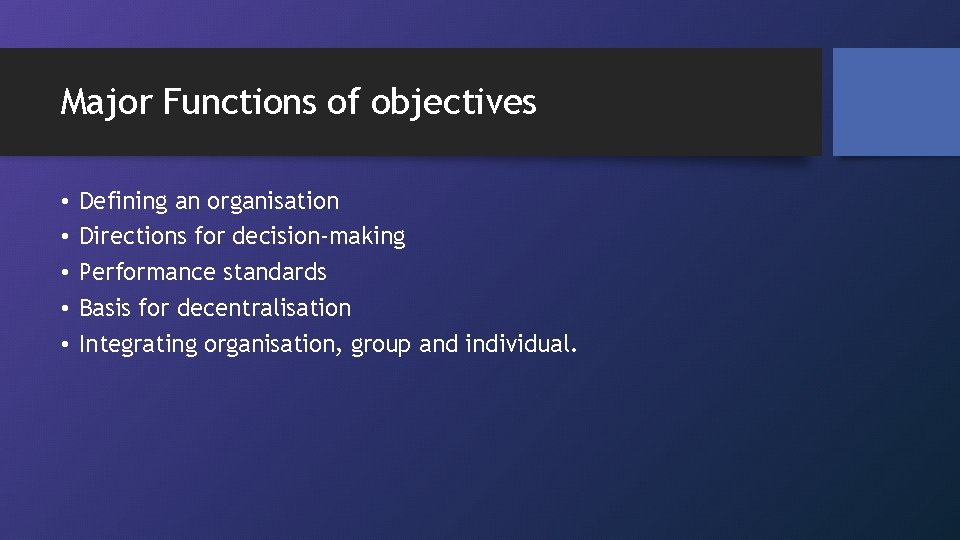
Major Functions of objectives • • • Defining an organisation Directions for decision-making Performance standards Basis for decentralisation Integrating organisation, group and individual.
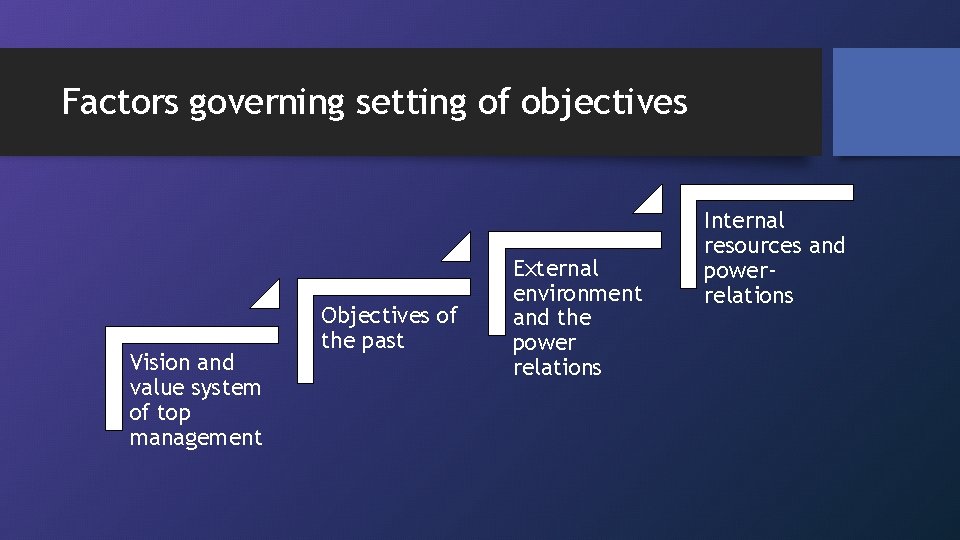
Factors governing setting of objectives Vision and value system of top management Objectives of the past External environment and the power relations Internal resources and powerrelations
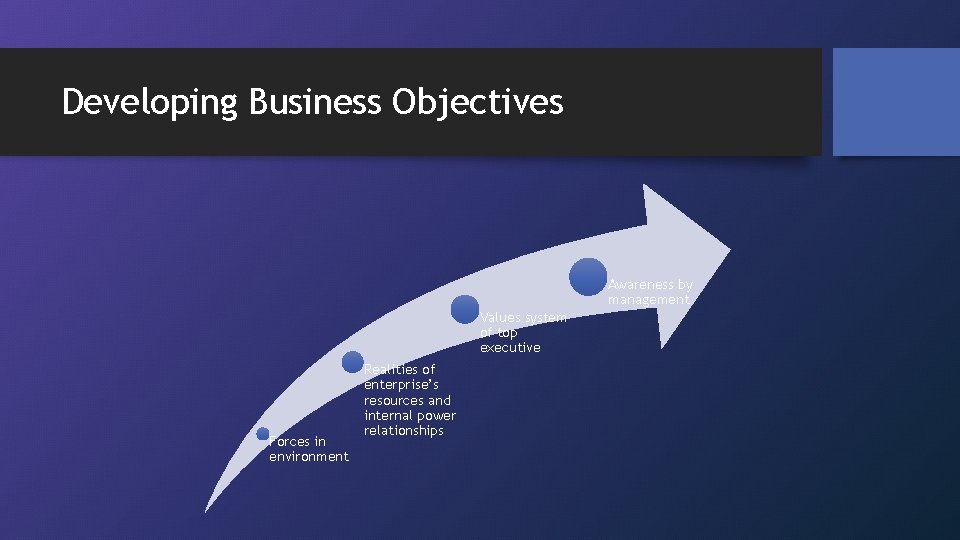
Developing Business Objectives Awareness by management Values system of top executive Forces in environment Realities of enterprise’s resources and internal power relationships
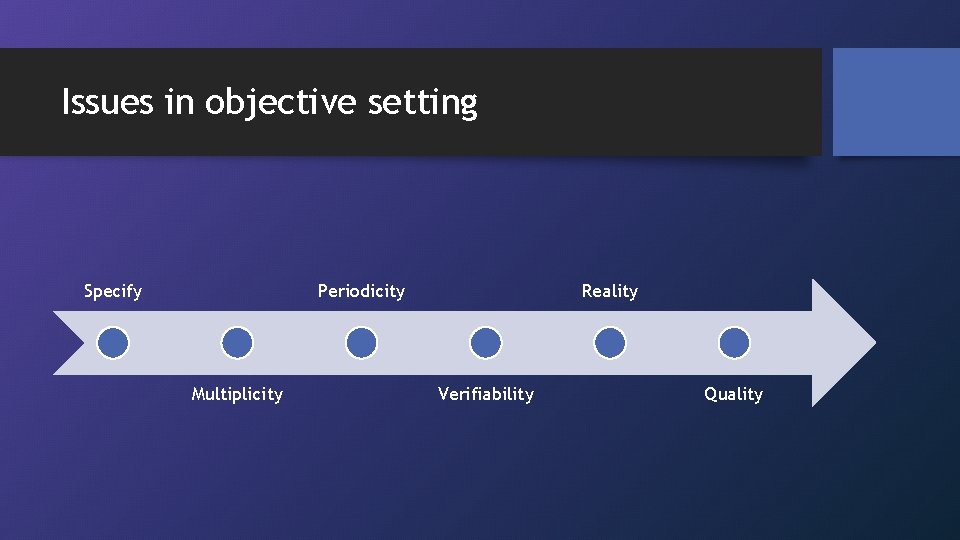
Issues in objective setting Specify Periodicity Multiplicity Reality Verifiability Quality
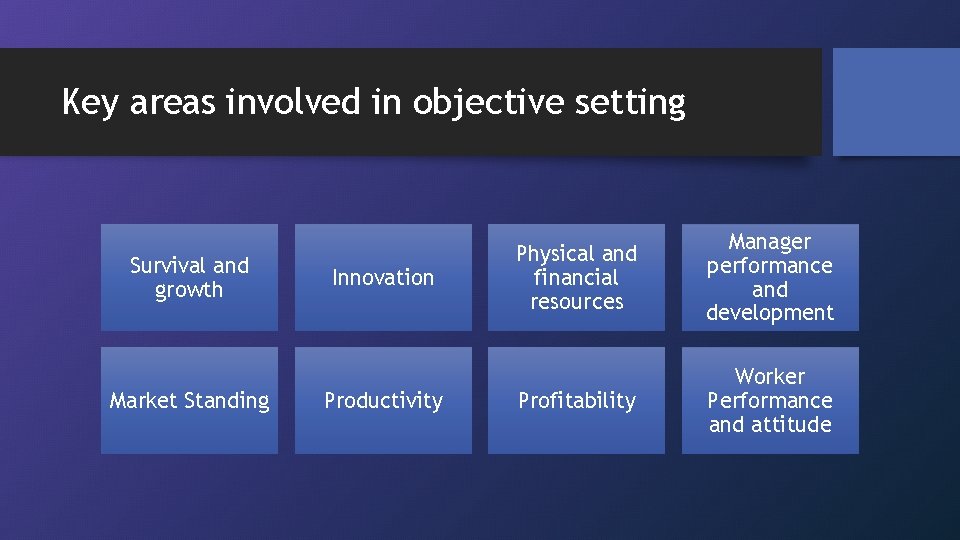
Key areas involved in objective setting Survival and growth Market Standing Innovation Productivity Physical and financial resources Manager performance and development Profitability Worker Performance and attitude
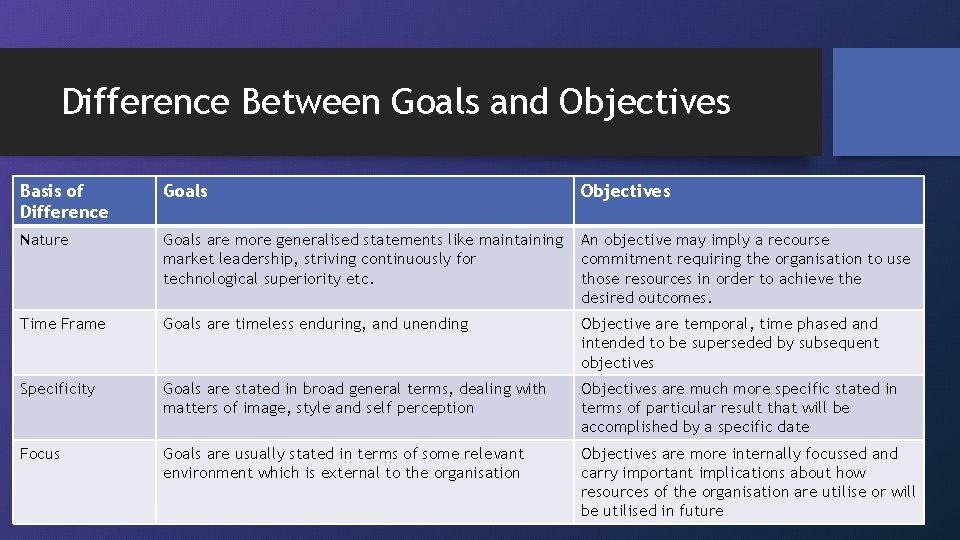
Difference Between Goals and Objectives Basis of Difference Goals Objectives Nature Goals are more generalised statements like maintaining market leadership, striving continuously for technological superiority etc. An objective may imply a recourse commitment requiring the organisation to use those resources in order to achieve the desired outcomes. Time Frame Goals are timeless enduring, and unending Objective are temporal, time phased and intended to be superseded by subsequent objectives Specificity Goals are stated in broad general terms, dealing with matters of image, style and self perception Objectives are much more specific stated in terms of particular result that will be accomplished by a specific date Focus Goals are usually stated in terms of some relevant environment which is external to the organisation Objectives are more internally focussed and carry important implications about how resources of the organisation are utilise or will be utilised in future
- Slides: 44