
UNIT I Power Semiconductor Devices Introduction What are






- Slides: 65
UNIT I Power Semiconductor Devices
Introduction • What are Power Semiconductor Devices (PSD)? They are devices used as switches or rectifiers in power electronic circuits • What is the difference of PSD and low-power semiconductor device? Ø Large voltage in the off state Ø High current capability in the on state EE 2301 -POWER ELECTRONICS
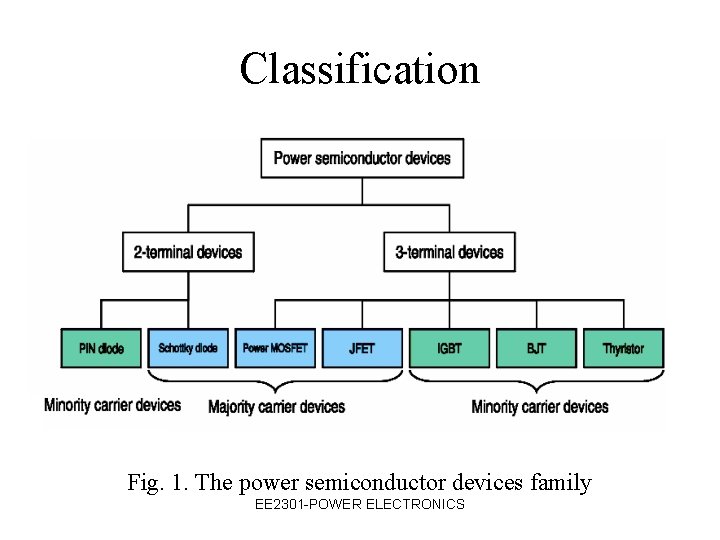
Classification Fig. 1. The power semiconductor devices family EE 2301 -POWER ELECTRONICS
Important Parameters • • Breakdown voltage. On-resistance. Trade-off between breakdown voltage and on -resistance. Rise and fall times for switching between on and off states. Safe-operating area. EE 2301 -POWER ELECTRONICS
Power MOSFET: Structure Power MOSFET has much higher current handling capability in ampere range and drain to source blocking voltage(50 -100 V) than other MOSFETs. Fig. 2. Repetitive pattern of the cells structure in power MOSFET EE 2301 -POWER ELECTRONICS
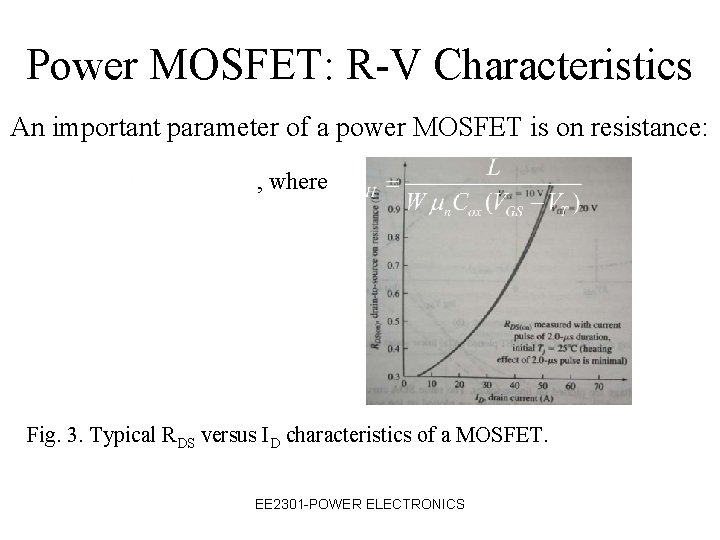
Power MOSFET: R-V Characteristics An important parameter of a power MOSFET is on resistance: , where Fig. 3. Typical RDS versus ID characteristics of a MOSFET. EE 2301 -POWER ELECTRONICS
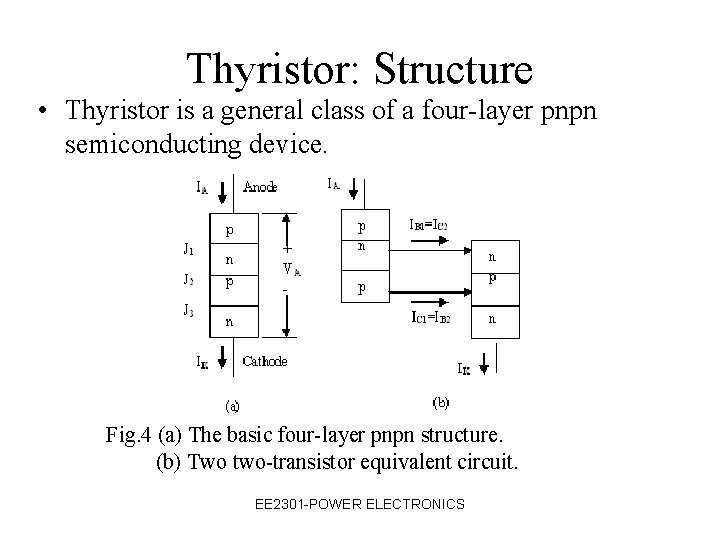
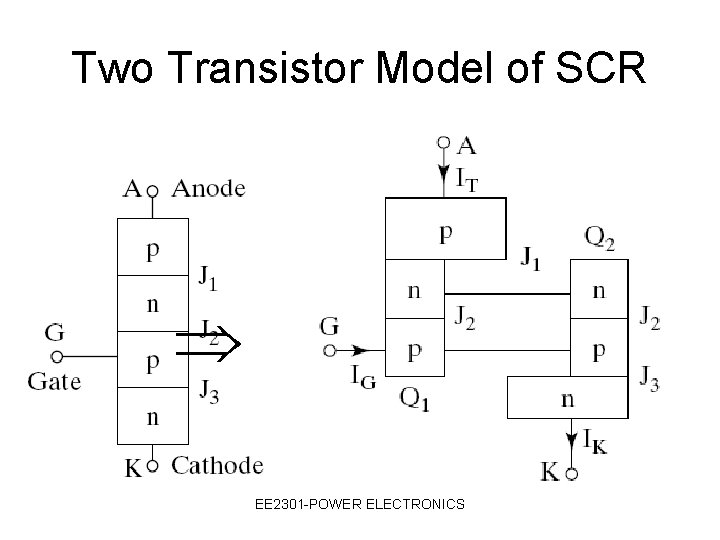
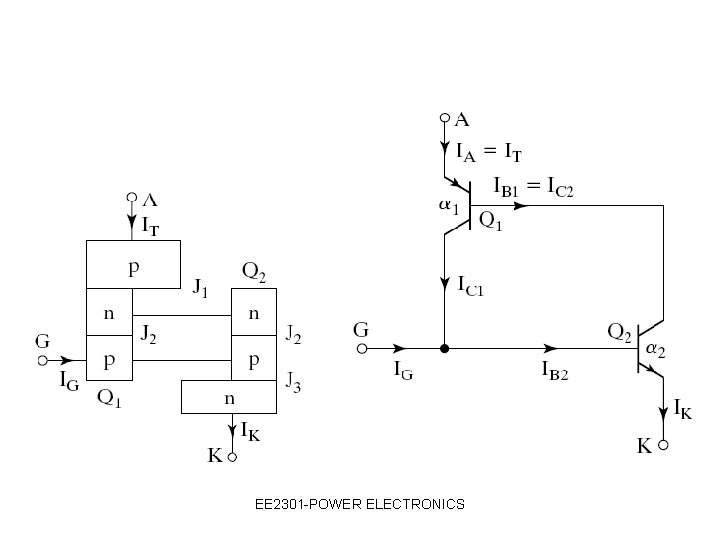
Thyristor: Structure • Thyristor is a general class of a four-layer pnpn semiconducting device. Fig. 4 (a) The basic four-layer pnpn structure. (b) Two two-transistor equivalent circuit. EE 2301 -POWER ELECTRONICS
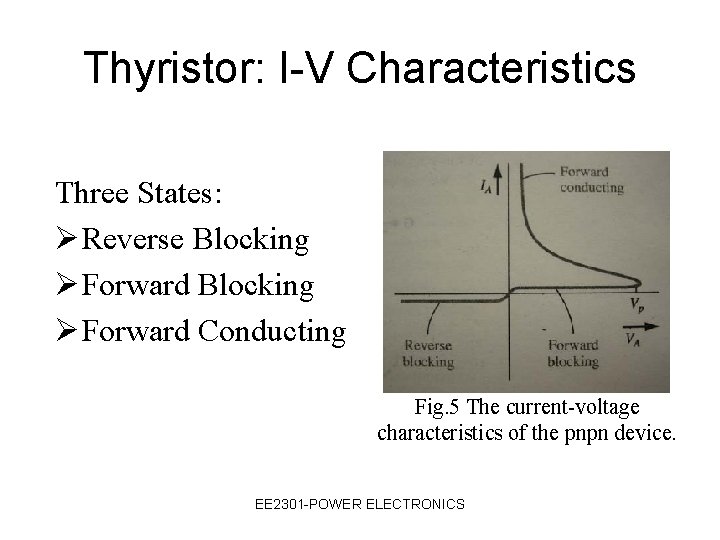
Thyristor: I-V Characteristics Three States: Ø Reverse Blocking Ø Forward Conducting Fig. 5 The current-voltage characteristics of the pnpn device. EE 2301 -POWER ELECTRONICS
Applications Power semiconductor devices have widespread applications: Ø Automotive Alternator, Regulator, Ignition, stereo tape Ø Entertainment Power supplies, stereo, radio and television Ø Appliance Drill motors, Blenders, Mixers, Air conditioners and Heaters EE 2301 -POWER ELECTRONICS
Thyristors • Most important type of power semiconductor device. • Have the highest power handling capability. they have a rating of 1200 V / 1500 A with switching frequencies ranging from 1 KHz to 20 KHz. EE 2301 -POWER ELECTRONICS
• Is inherently a slow switching device compared to BJT or MOSFET. • Used as a latching switch that can be turned on by the control terminal but cannot be turned off by the gate. EE 2301 -POWER ELECTRONICS
Different types of Thyristors • • Silicon Controlled Rectifier (SCR). TRIAC. DIAC. Gate Turn-Off Thyristor (GTO). EE 2301 -POWER ELECTRONICS
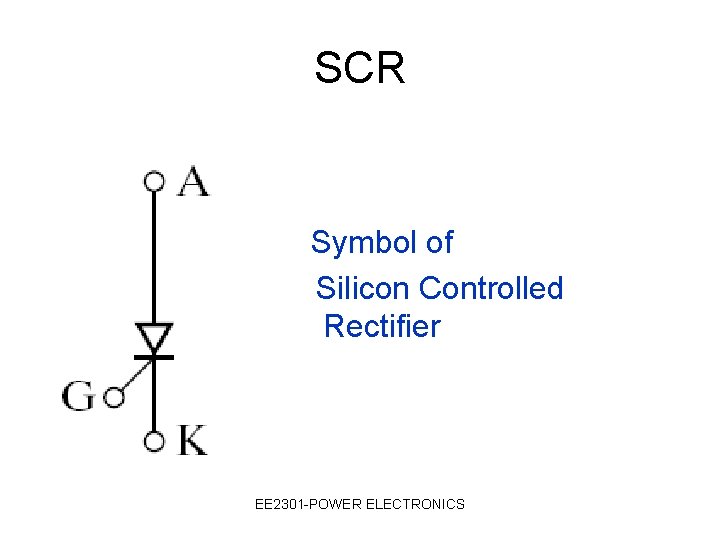
SCR Symbol of Silicon Controlled Rectifier EE 2301 -POWER ELECTRONICS
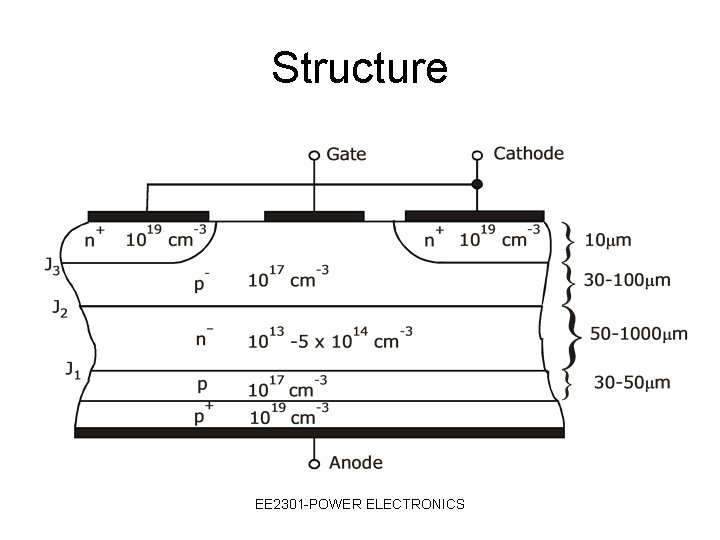
Structure EE 2301 -POWER ELECTRONICS
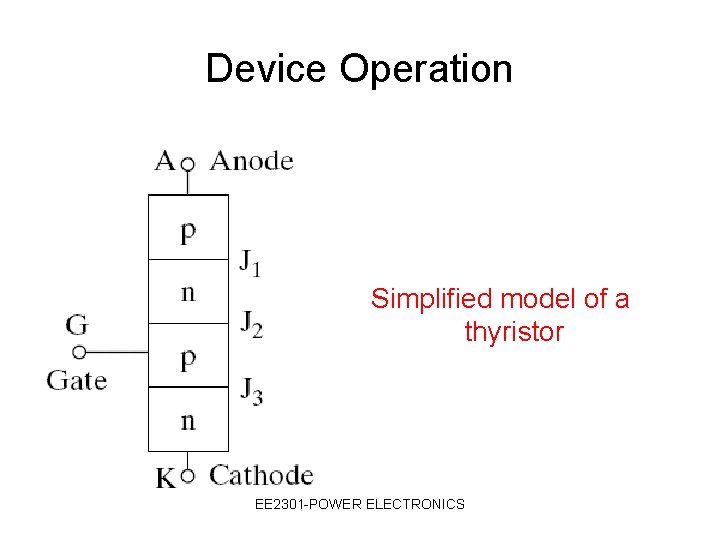
Device Operation Simplified model of a thyristor EE 2301 -POWER ELECTRONICS
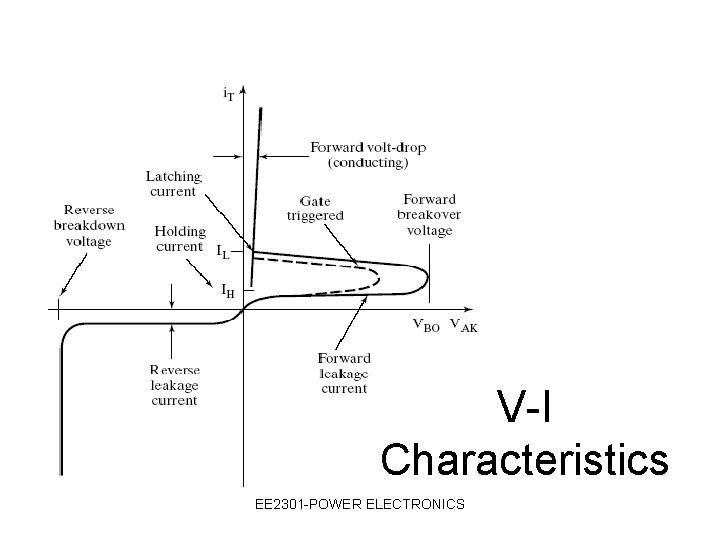
V-I Characteristics EE 2301 -POWER ELECTRONICS
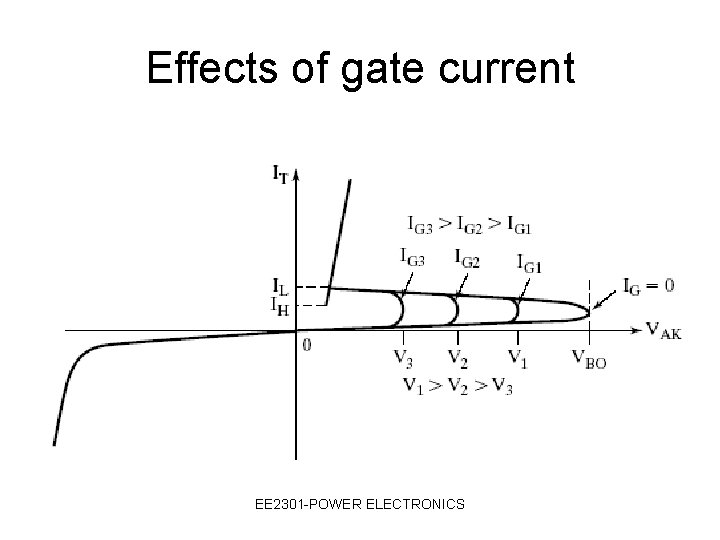
Effects of gate current EE 2301 -POWER ELECTRONICS
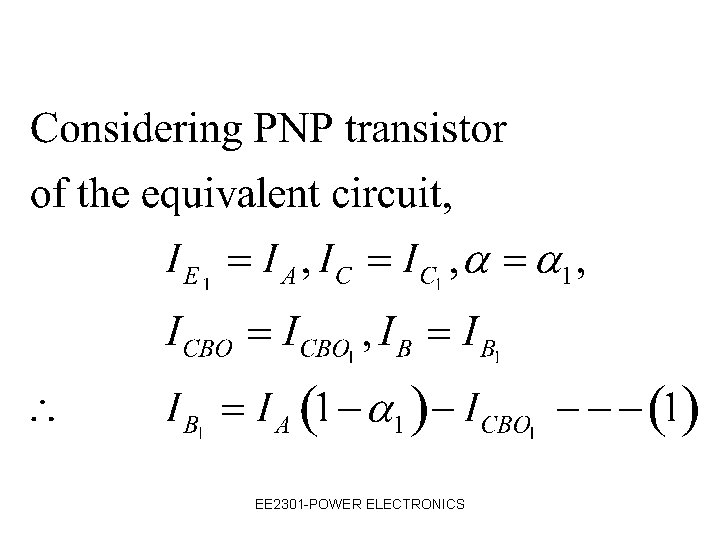
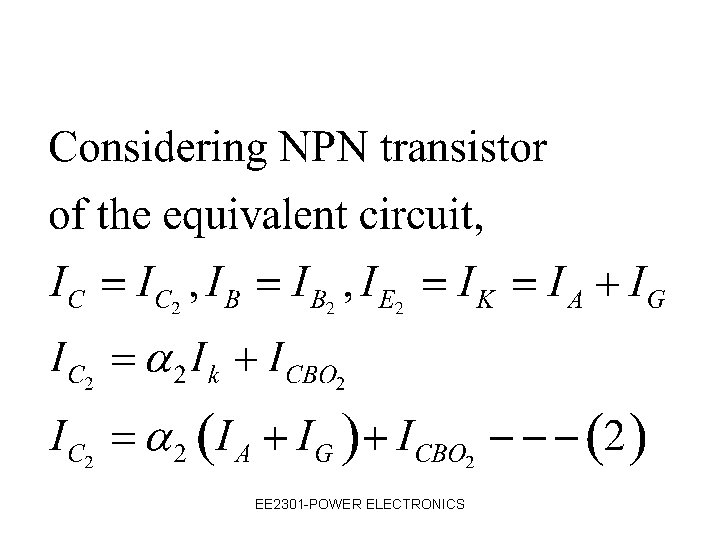
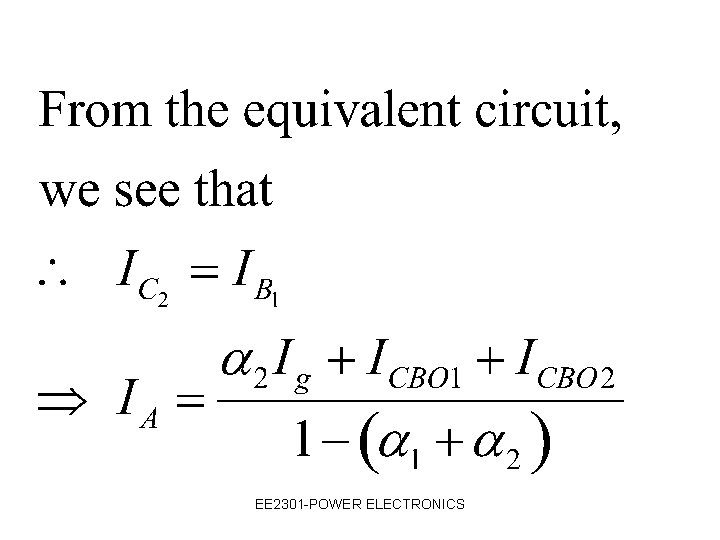
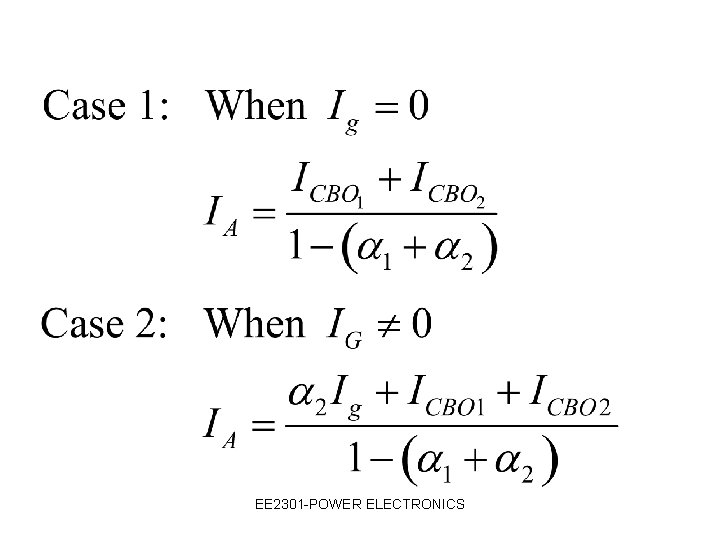
Two Transistor Model of SCR EE 2301 -POWER ELECTRONICS
EE 2301 -POWER ELECTRONICS
EE 2301 -POWER ELECTRONICS
EE 2301 -POWER ELECTRONICS
EE 2301 -POWER ELECTRONICS
EE 2301 -POWER ELECTRONICS
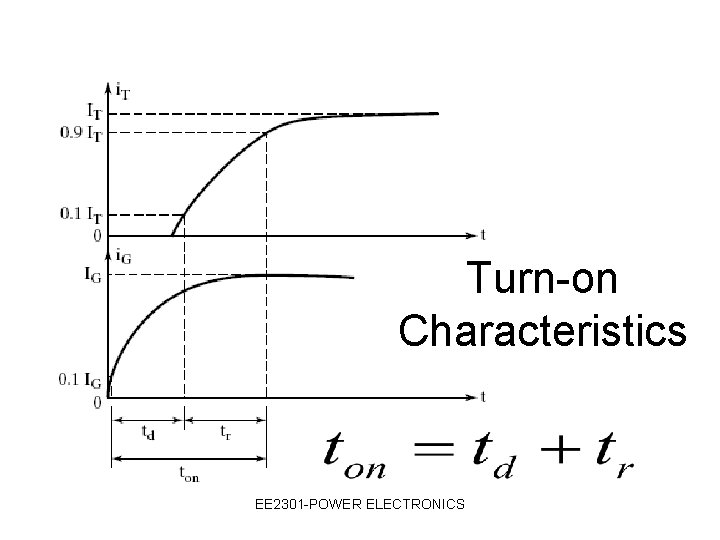
Turn-on Characteristics EE 2301 -POWER ELECTRONICS
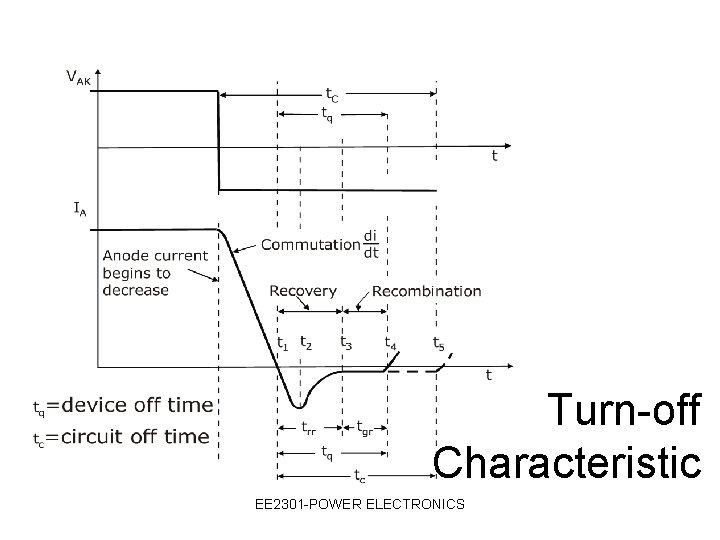
Turn-off Characteristic EE 2301 -POWER ELECTRONICS
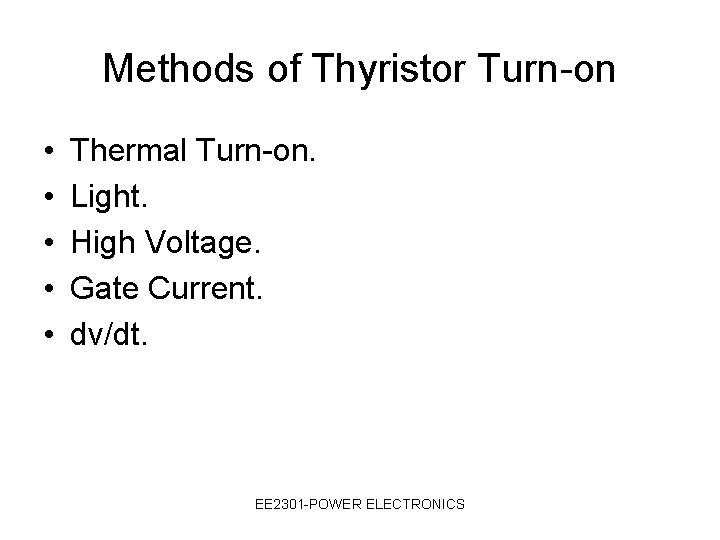
Methods of Thyristor Turn-on • • • Thermal Turn-on. Light. High Voltage. Gate Current. dv/dt. EE 2301 -POWER ELECTRONICS
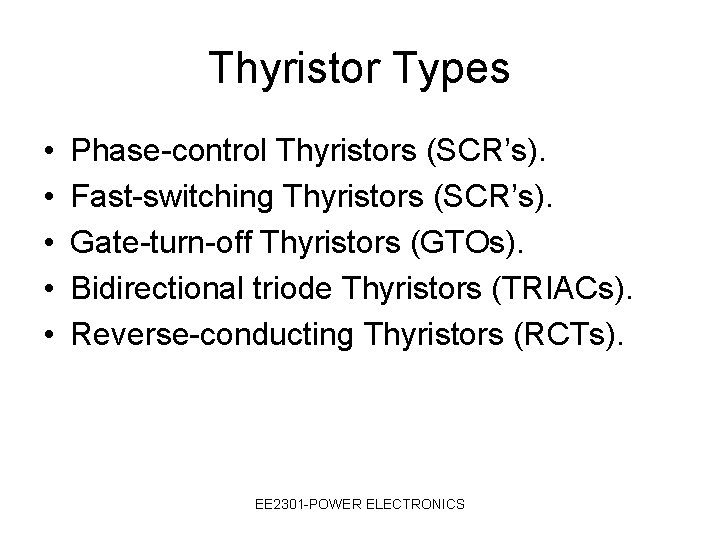
Thyristor Types • • • Phase-control Thyristors (SCR’s). Fast-switching Thyristors (SCR’s). Gate-turn-off Thyristors (GTOs). Bidirectional triode Thyristors (TRIACs). Reverse-conducting Thyristors (RCTs). EE 2301 -POWER ELECTRONICS
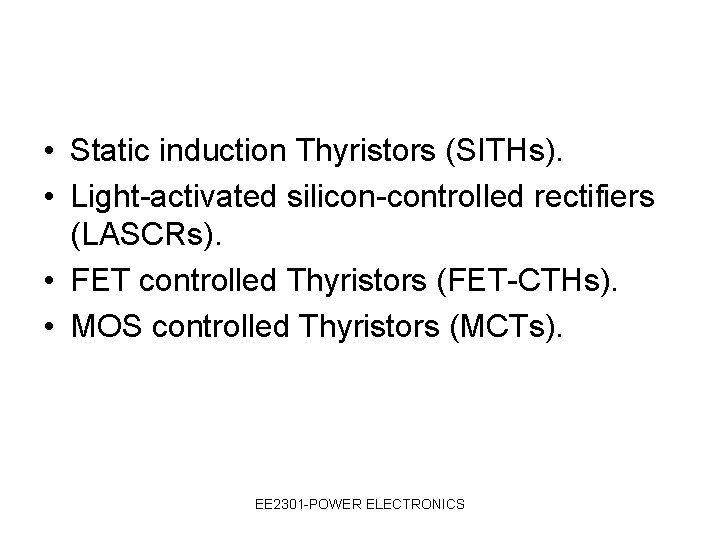
• Static induction Thyristors (SITHs). • Light-activated silicon-controlled rectifiers (LASCRs). • FET controlled Thyristors (FET-CTHs). • MOS controlled Thyristors (MCTs). EE 2301 -POWER ELECTRONICS
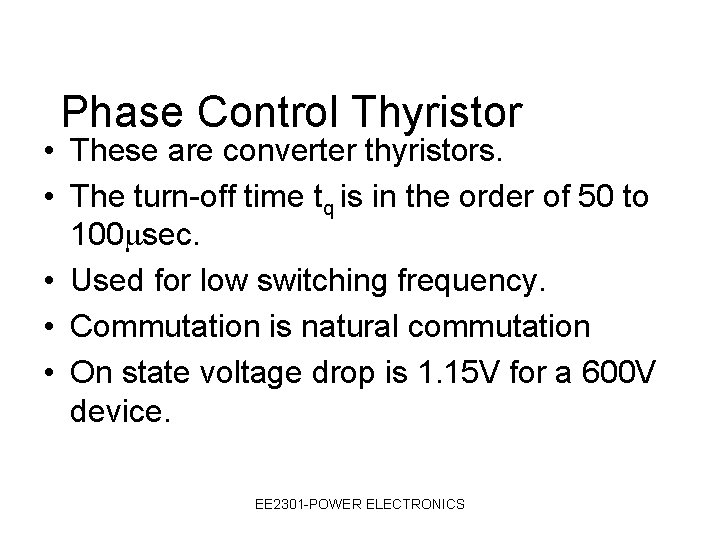
Phase Control Thyristor • These are converter thyristors. • The turn-off time tq is in the order of 50 to 100 sec. • Used for low switching frequency. • Commutation is natural commutation • On state voltage drop is 1. 15 V for a 600 V device. EE 2301 -POWER ELECTRONICS
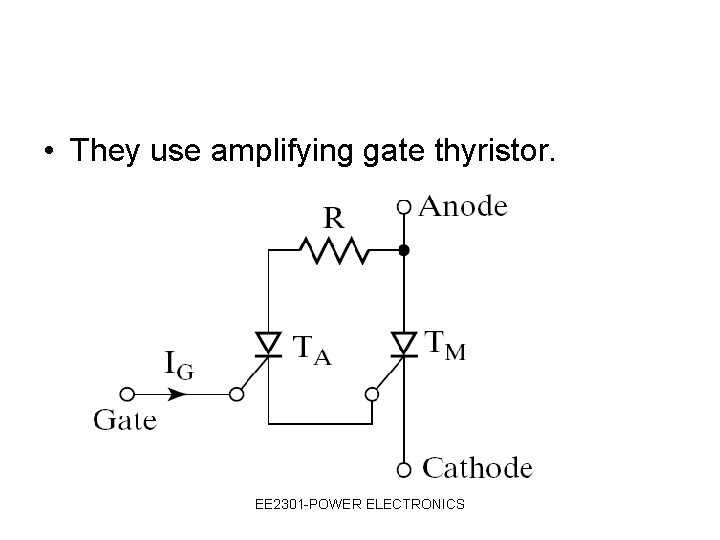
• They use amplifying gate thyristor. EE 2301 -POWER ELECTRONICS
Fast Switching Thyristors • • Also called inverter thyristors. Used for high speed switching applications. Turn-off time tq in the range of 5 to 50 sec. On-state voltage drop of typically 1. 7 V for 2200 A, 1800 V thyristor. • High dv/dt and high di/dt rating. EE 2301 -POWER ELECTRONICS
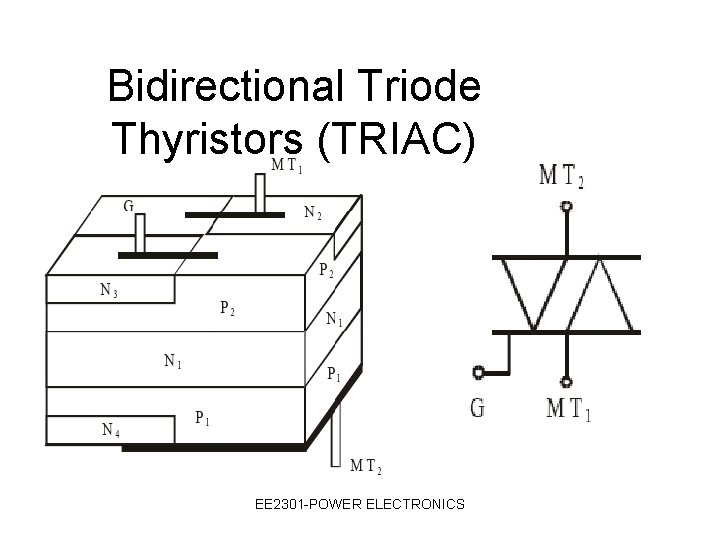
Bidirectional Triode Thyristors (TRIAC) EE 2301 -POWER ELECTRONICS
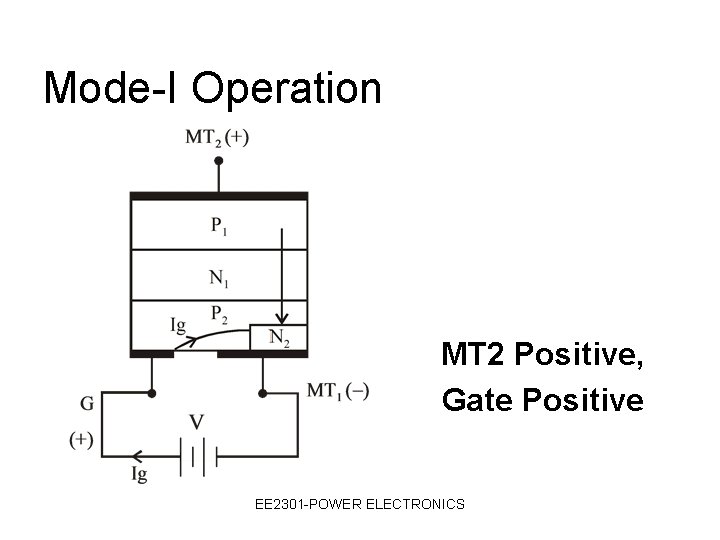
Mode-I Operation MT 2 Positive, Gate Positive EE 2301 -POWER ELECTRONICS
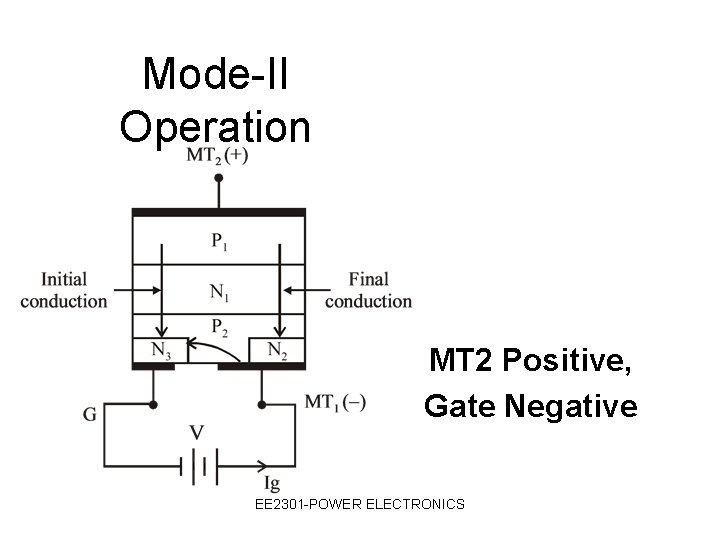
Mode-II Operation MT 2 Positive, Gate Negative EE 2301 -POWER ELECTRONICS
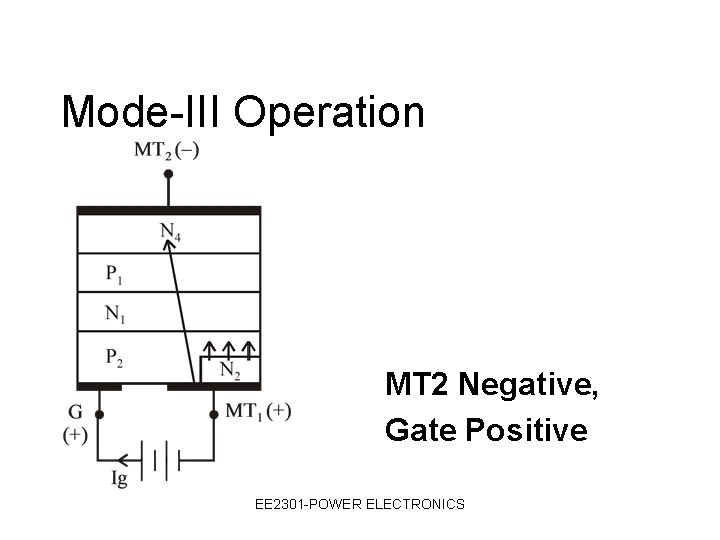
Mode-III Operation MT 2 Negative, Gate Positive EE 2301 -POWER ELECTRONICS
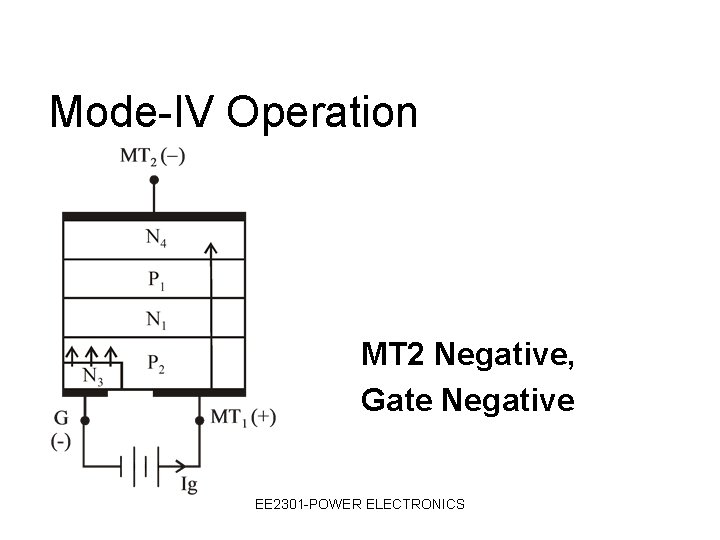
Mode-IV Operation MT 2 Negative, Gate Negative EE 2301 -POWER ELECTRONICS
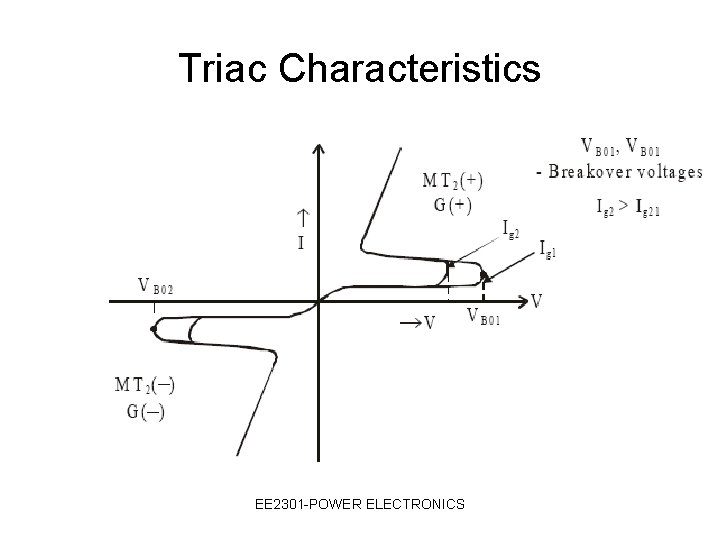
Triac Characteristics EE 2301 -POWER ELECTRONICS
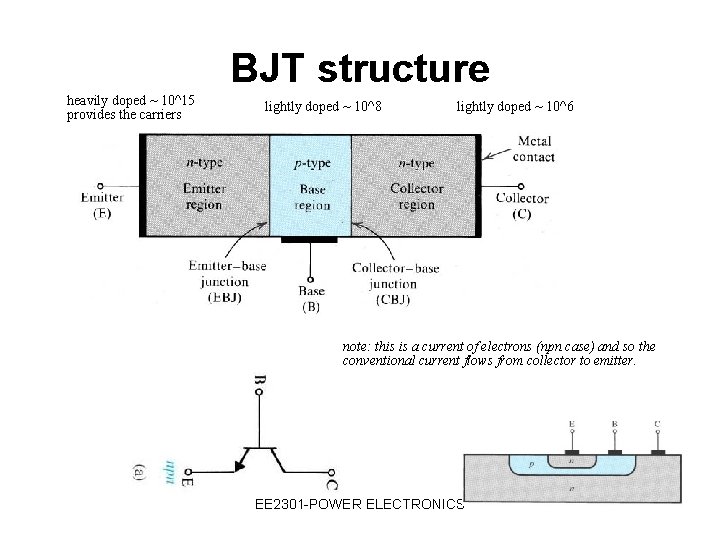
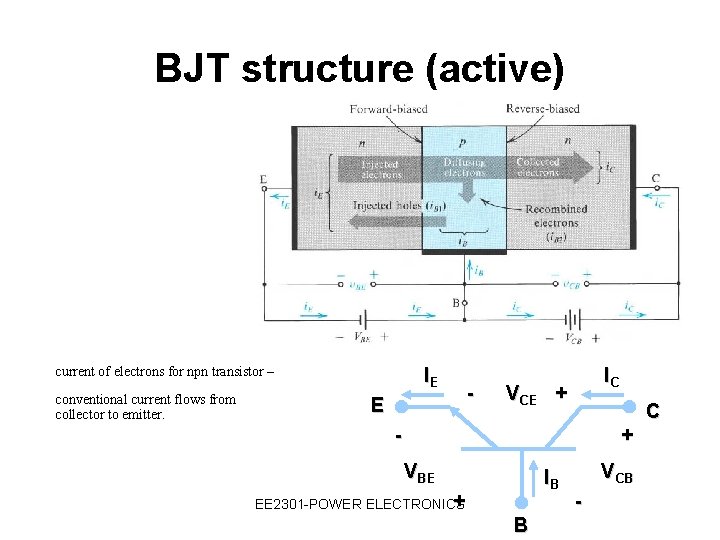
BJT structure heavily doped ~ 10^15 provides the carriers lightly doped ~ 10^8 lightly doped ~ 10^6 note: this is a current of electrons (npn case) and so the conventional current flows from collector to emitter. EE 2301 -POWER ELECTRONICS
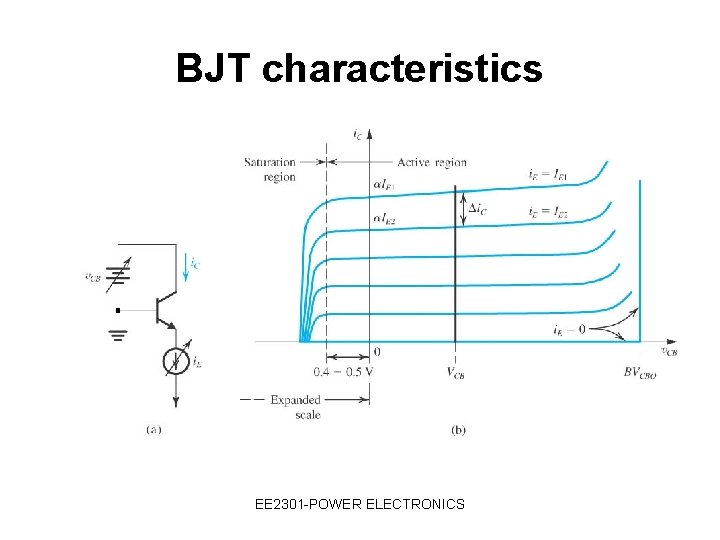
BJT characteristics EE 2301 -POWER ELECTRONICS
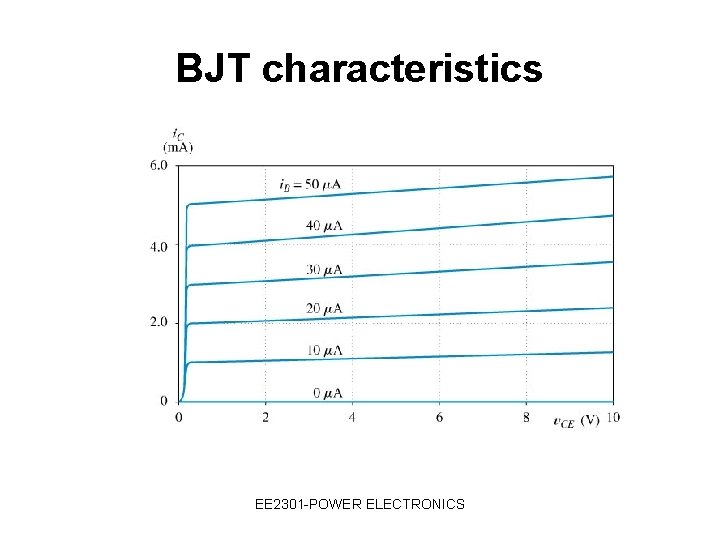
BJT characteristics EE 2301 -POWER ELECTRONICS
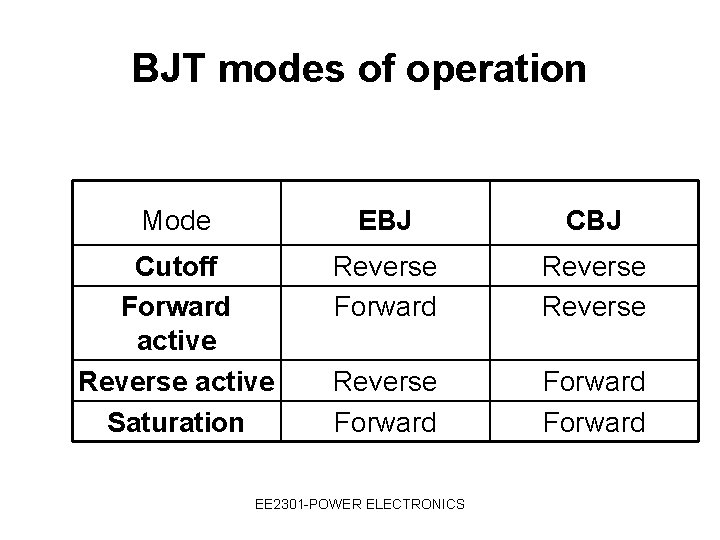
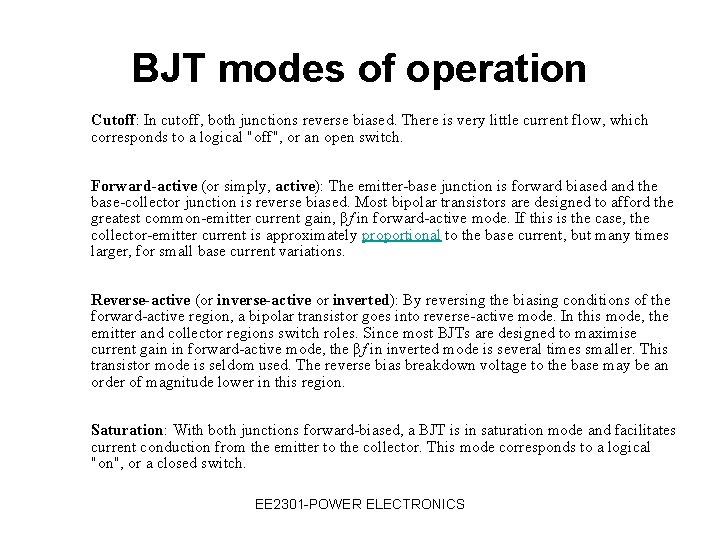
BJT modes of operation Mode EBJ Cutoff Forward active Reverse active Saturation Reverse Forward Reverse Forward EE 2301 -POWER ELECTRONICS
BJT modes of operation Cutoff: In cutoff, both junctions reverse biased. There is very little current flow, which corresponds to a logical "off", or an open switch. Forward-active (or simply, active): The emitter-base junction is forward biased and the base-collector junction is reverse biased. Most bipolar transistors are designed to afford the greatest common-emitter current gain, βf in forward-active mode. If this is the case, the collector-emitter current is approximately proportional to the base current, but many times larger, for small base current variations. Reverse-active (or inverse-active or inverted): By reversing the biasing conditions of the forward-active region, a bipolar transistor goes into reverse-active mode. In this mode, the emitter and collector regions switch roles. Since most BJTs are designed to maximise current gain in forward-active mode, the βf in inverted mode is several times smaller. This transistor mode is seldom used. The reverse bias breakdown voltage to the base may be an order of magnitude lower in this region. Saturation: With both junctions forward-biased, a BJT is in saturation mode and facilitates current conduction from the emitter to the collector. This mode corresponds to a logical "on", or a closed switch. EE 2301 -POWER ELECTRONICS
BJT structure (active) current of electrons for npn transistor – conventional current flows from collector to emitter. IE E - IC VCE + C - + VBE IB + EE 2301 -POWER ELECTRONICS B VCB -
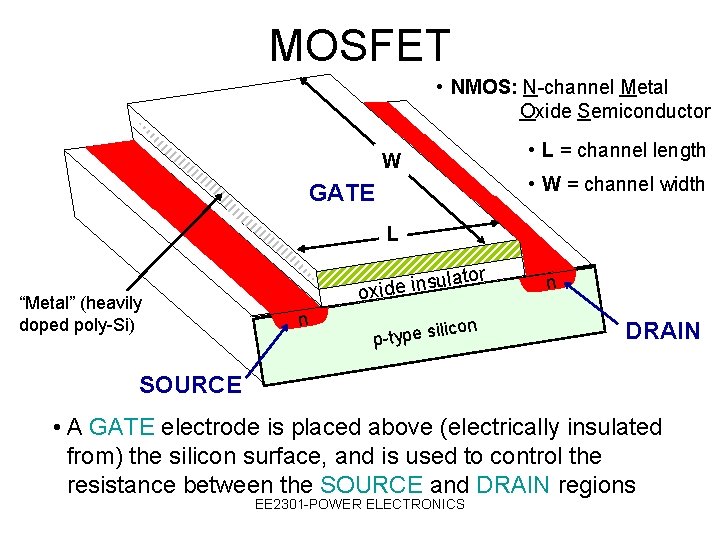
MOSFET • NMOS: N-channel Metal Oxide Semiconductor • L = channel length W • W = channel width GATE L lator “Metal” (heavily doped poly-Si) su oxide in n con ili p-type s n DRAIN SOURCE • A GATE electrode is placed above (electrically insulated from) the silicon surface, and is used to control the resistance between the SOURCE and DRAIN regions EE 2301 -POWER ELECTRONICS
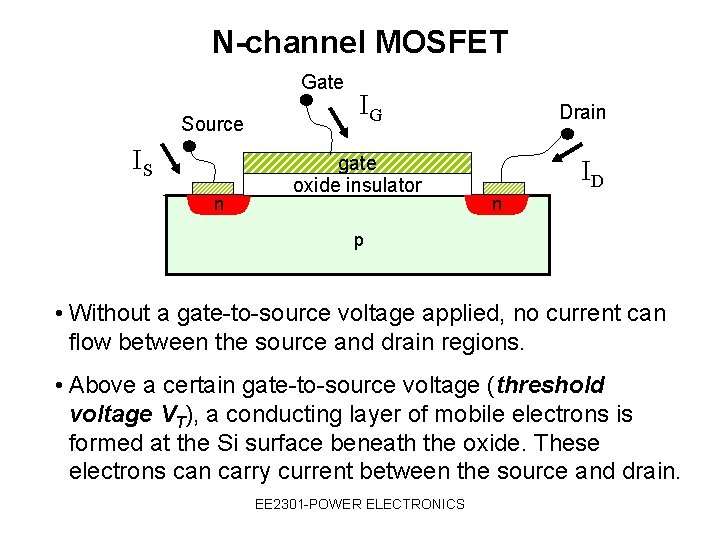
N-channel MOSFET Gate Source IS n IG gate oxide insulator Drain ID n p • Without a gate-to-source voltage applied, no current can flow between the source and drain regions. • Above a certain gate-to-source voltage (threshold voltage VT), a conducting layer of mobile electrons is formed at the Si surface beneath the oxide. These electrons can carry current between the source and drain. EE 2301 -POWER ELECTRONICS
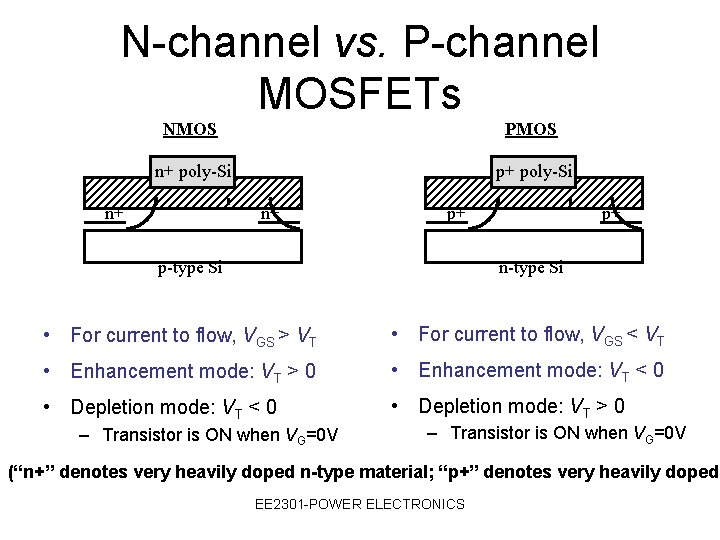
N-channel vs. P-channel MOSFETs NMOS PMOS n+ poly-Si p+ poly-Si n+ n+ p+ p-type Si p+ n-type Si • For current to flow, VGS > VT • For current to flow, VGS < VT • Enhancement mode: VT > 0 • Enhancement mode: VT < 0 • Depletion mode: VT > 0 – Transistor is ON when VG=0 V (“n+” denotes very heavily doped n-type material; “p+” denotes very heavily doped EE 2301 -POWER ELECTRONICS
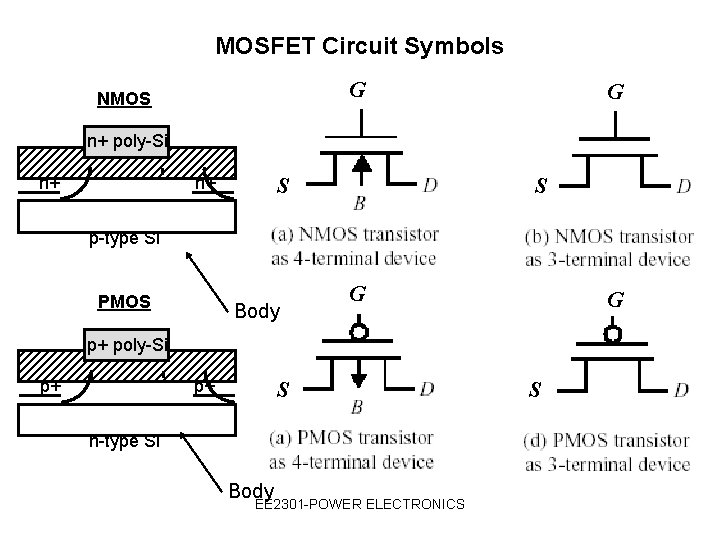
MOSFET Circuit Symbols G NMOS G n+ poly-Si n+ n+ S S p-type Si PMOS Body G G p+ poly-Si p+ p+ S n-type Si Body EE 2301 -POWER ELECTRONICS S
MOSFET Terminals • The voltage applied to the GATE terminal determines whether current can flow between the SOURCE & DRAIN terminals. – For an n-channel MOSFET, the SOURCE is biased at a lower potential (often 0 V) than the DRAIN (Electrons flow from SOURCE to DRAIN when VG > VT) – For a p-channel MOSFET, the SOURCE is biased at a higher potential (often the supply voltage VDD) than the DRAIN (Holes flow from SOURCE to DRAIN when VG < VT ) • The BODY terminal is usually connected to a fixed potential. – For an n-channel MOSFET, the BODY is connected to 0 V – For a p-channel MOSFET, the BODY is connected to VDD EE 2301 -POWER ELECTRONICS
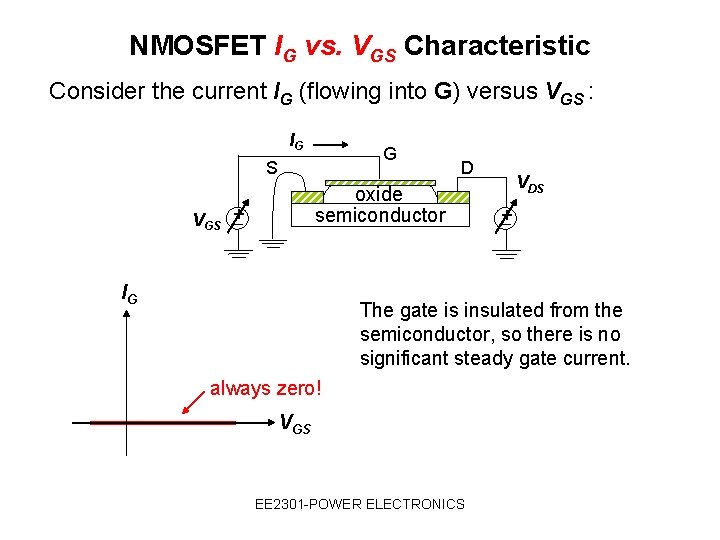
NMOSFET IG vs. VGS Characteristic Consider the current IG (flowing into G) versus VGS : IG G S D oxide semiconductor VGS + IG VDS + The gate is insulated from the semiconductor, so there is no significant steady gate current. always zero! VGS EE 2301 -POWER ELECTRONICS
The MOSFET as a Controlled Resistor • The MOSFET behaves as a resistor when VDS is low: – Drain current ID increases linearly with VDS – Resistance RDS between SOURCE & DRAIN depends on VGS • RDS is lowered as VGS increases above VT oxide thickness tox NMOSFET Example: ID VGS = 2 V VGS = 1 V > VT VDS IDS = 0 if VGS < VT Inversion charge density Qi(x) = -Cox[VGS-VT-V(x)] where Cox eox / tox EE 2301 -POWER ELECTRONICS
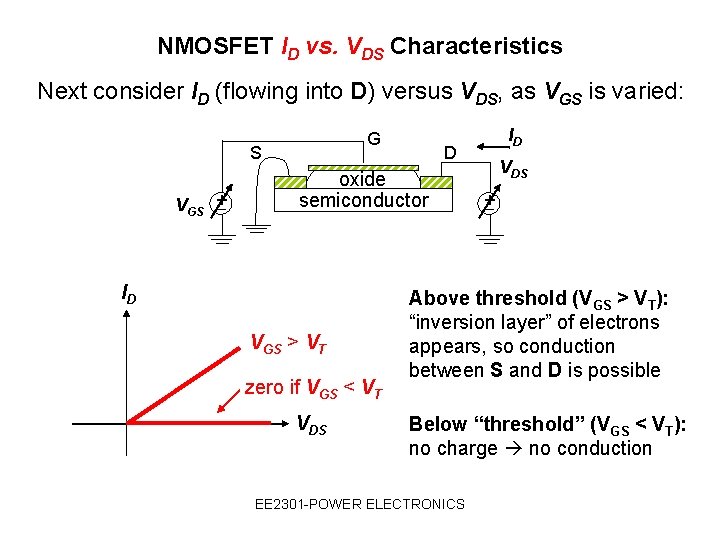
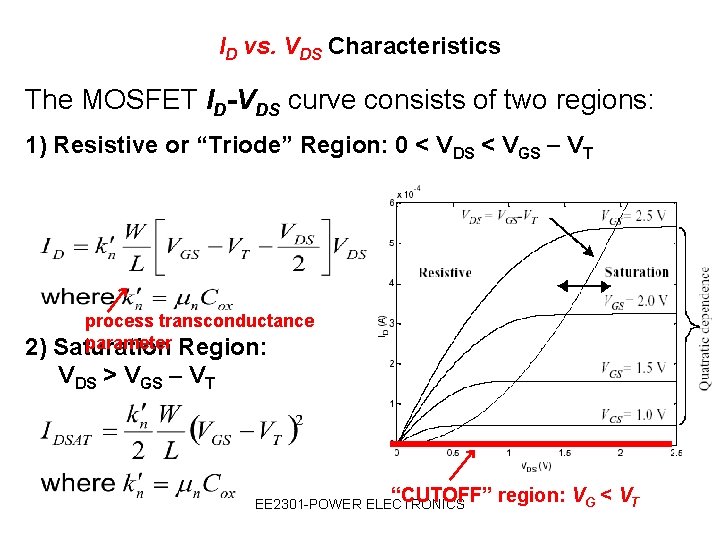
NMOSFET ID vs. VDS Characteristics Next consider ID (flowing into D) versus VDS, as VGS is varied: G S VGS + D oxide semiconductor ID VGS > VT zero if VGS < VT VDS ID VDS + Above threshold (VGS > VT): “inversion layer” of electrons appears, so conduction between S and D is possible Below “threshold” (VGS < VT): no charge no conduction EE 2301 -POWER ELECTRONICS
ID vs. VDS Characteristics The MOSFET ID-VDS curve consists of two regions: 1) Resistive or “Triode” Region: 0 < VDS < VGS VT 2) process transconductance parameter Region: Saturation VDS > VGS VT “CUTOFF” region: VG < VT EE 2301 -POWER ELECTRONICS
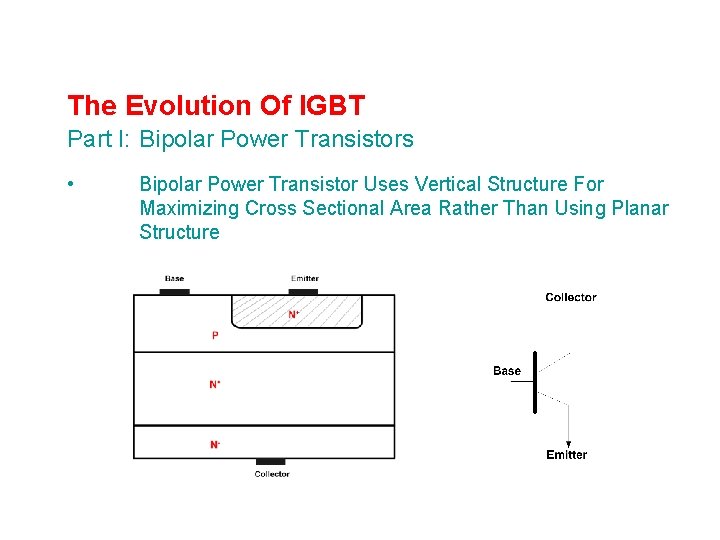
The Evolution Of IGBT Part I: Bipolar Power Transistors • Bipolar Power Transistor Uses Vertical Structure For Maximizing Cross Sectional Area Rather Than Using Planar Structure
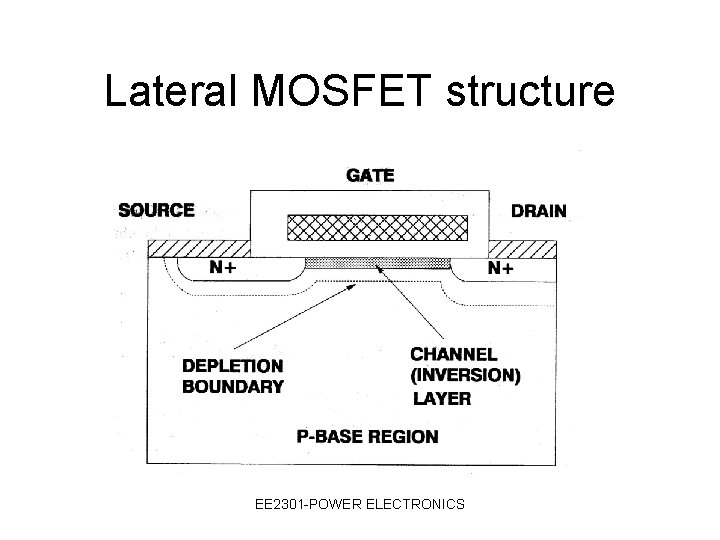
The Evolution Of IGBT Part II: Power MOSFET • Power MOSFET Uses Vertical Channel Structure Versus The Lateral Channel Devices Used In IC Technology
Lateral MOSFET structure EE 2301 -POWER ELECTRONICS
The Evolution Of IGBT Part III: BJT(discrete) + Power MOSFET(discrete) • Discrete BJT + Discrete Power MOSFET In Darlington Configuration
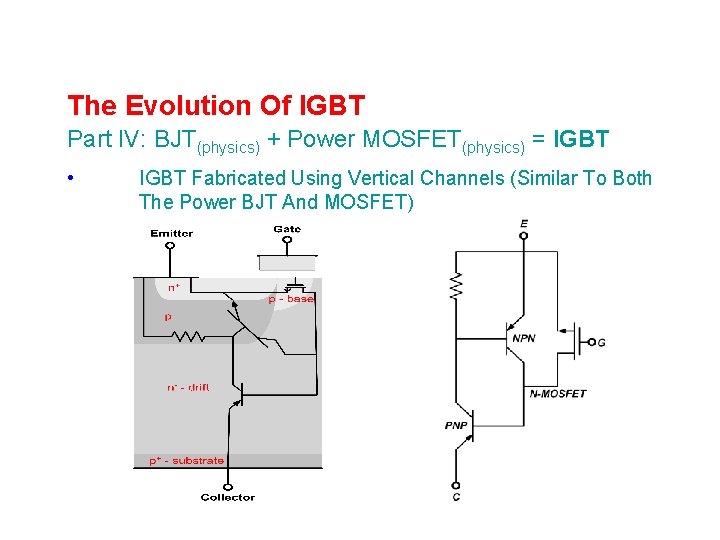
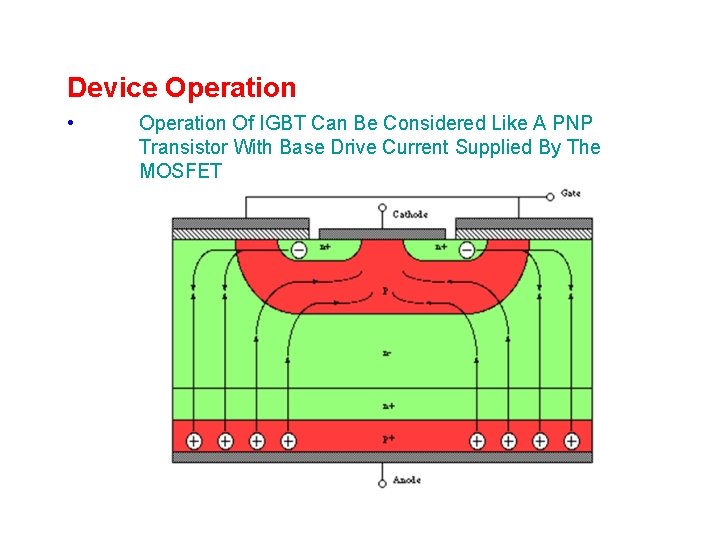
The Evolution Of IGBT Part IV: BJT(physics) + Power MOSFET(physics) = IGBT • More Powerful And Innovative Approach Is To Combine Physics Of BJT With The Physics Of MOSFET Within Same Semiconductor Region • This Approach Is Also Termed Functional Integration Of MOS And Bipolar Physics • Using This Concept, The Insulated Gate Bipolar Transistor (IGBT) Emerged • Superior On-State Characteristics, Reasonable Switching Speed And Excellent Safe Operating Area
The Evolution Of IGBT Part IV: BJT(physics) + Power MOSFET(physics) = IGBT • IGBT Fabricated Using Vertical Channels (Similar To Both The Power BJT And MOSFET)
Device Operation • Operation Of IGBT Can Be Considered Like A PNP Transistor With Base Drive Current Supplied By The MOSFET
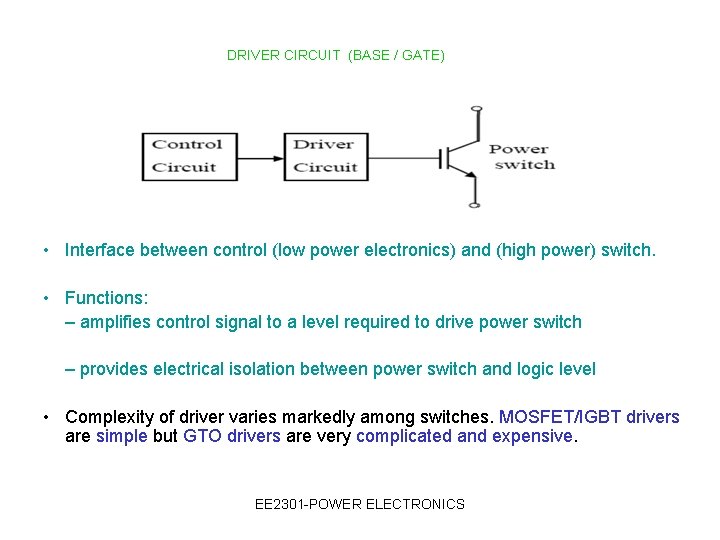
DRIVER CIRCUIT (BASE / GATE) • Interface between control (low power electronics) and (high power) switch. • Functions: – amplifies control signal to a level required to drive power switch – provides electrical isolation between power switch and logic level • Complexity of driver varies markedly among switches. MOSFET/IGBT drivers are simple but GTO drivers are very complicated and expensive. EE 2301 -POWER ELECTRONICS
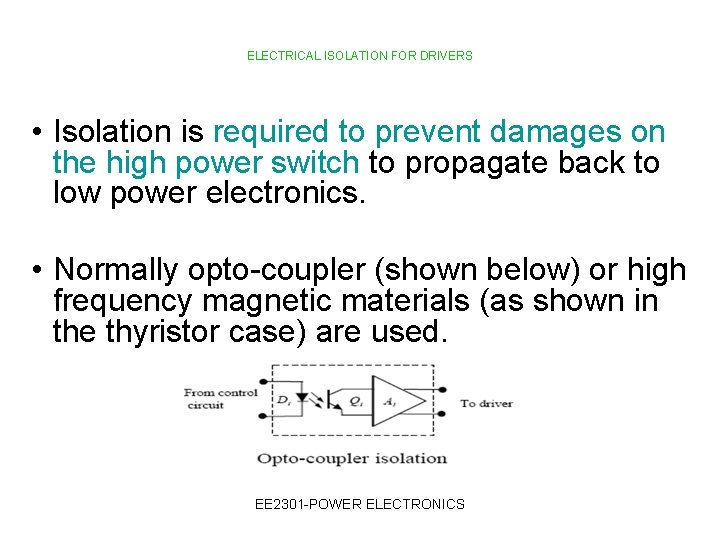
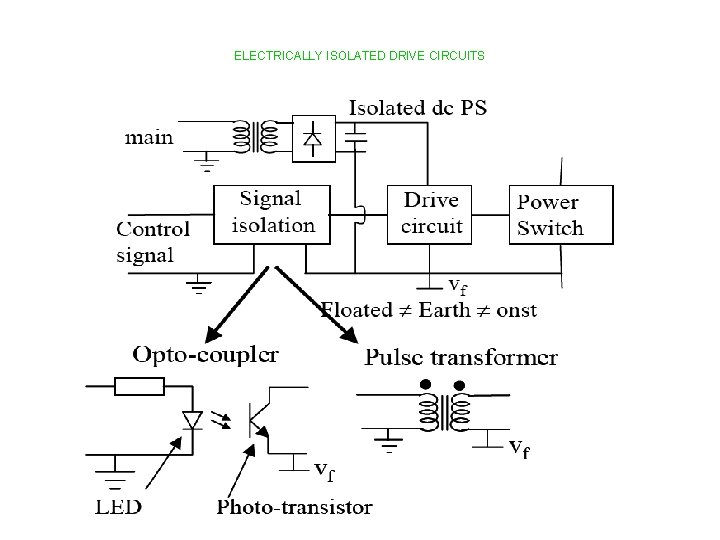
ELECTRICAL ISOLATION FOR DRIVERS • Isolation is required to prevent damages on the high power switch to propagate back to low power electronics. • Normally opto-coupler (shown below) or high frequency magnetic materials (as shown in the thyristor case) are used. EE 2301 -POWER ELECTRONICS
ELECTRICAL ISOLATION FOR DRIVERS • Power semiconductor devices can be categorized into 3 types based on their control input requirements: a) Current-driven devices – BJTs, MDs, GTOs b) Voltage-driven devices – MOSFETs, IGBTs, MCTs c) Pulse-driven devices – SCRs, TRIACs EE 2301 -POWER ELECTRONICS
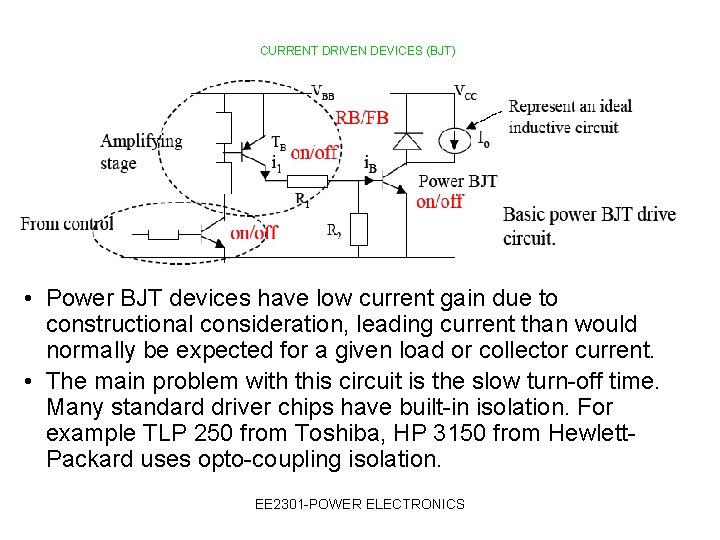
CURRENT DRIVEN DEVICES (BJT) • Power BJT devices have low current gain due to constructional consideration, leading current than would normally be expected for a given load or collector current. • The main problem with this circuit is the slow turn-off time. Many standard driver chips have built-in isolation. For example TLP 250 from Toshiba, HP 3150 from Hewlett. Packard uses opto-coupling isolation. EE 2301 -POWER ELECTRONICS
ELECTRICALLY ISOLATED DRIVE CIRCUITS EE 2301 -POWER ELECTRONICS
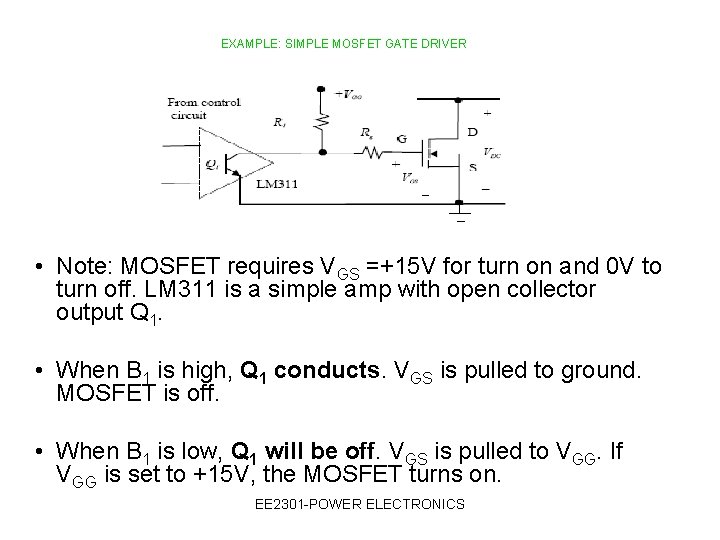
EXAMPLE: SIMPLE MOSFET GATE DRIVER • Note: MOSFET requires VGS =+15 V for turn on and 0 V to turn off. LM 311 is a simple amp with open collector output Q 1. • When B 1 is high, Q 1 conducts. VGS is pulled to ground. MOSFET is off. • When B 1 is low, Q 1 will be off. VGS is pulled to VGG. If VGG is set to +15 V, the MOSFET turns on. EE 2301 -POWER ELECTRONICS