
UNIT I Inflammation WOUND HEALING WOUND HEALING Healing
- Slides: 16
UNIT I Inflammation WOUND HEALING
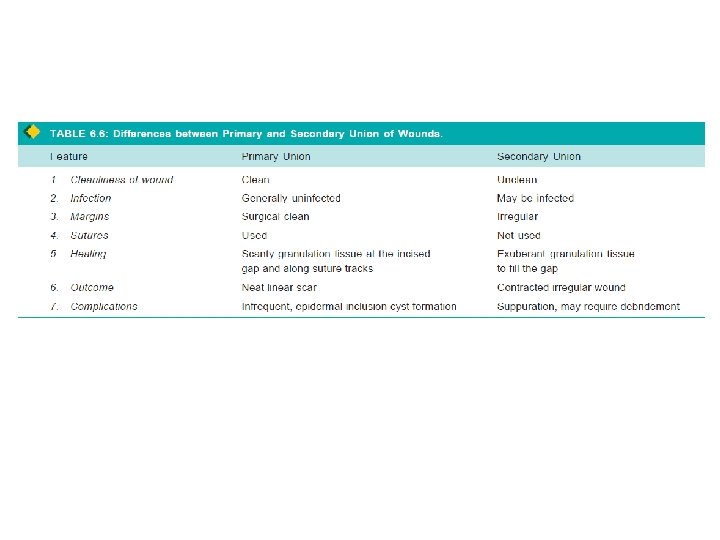
WOUND HEALING • Healing of skin wounds - example of combination of regeneration and repair • Wound healing can be accomplished by: – Healing by first intention (primary union) – Healing by second intention (secondary union)
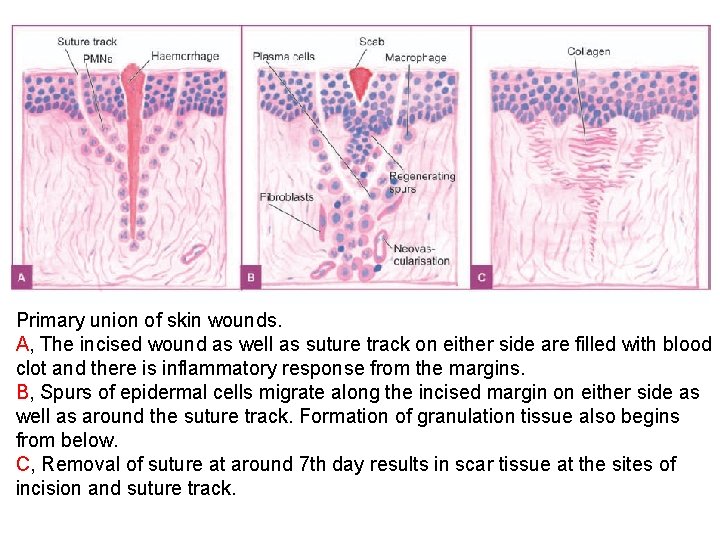
Primary union of skin wounds. A, The incised wound as well as suture track on either side are filled with blood clot and there is inflammatory response from the margins. B, Spurs of epidermal cells migrate along the incised margin on either side as well as around the suture track. Formation of granulation tissue also begins from below. C, Removal of suture at around 7 th day results in scar tissue at the sites of incision and suture track.
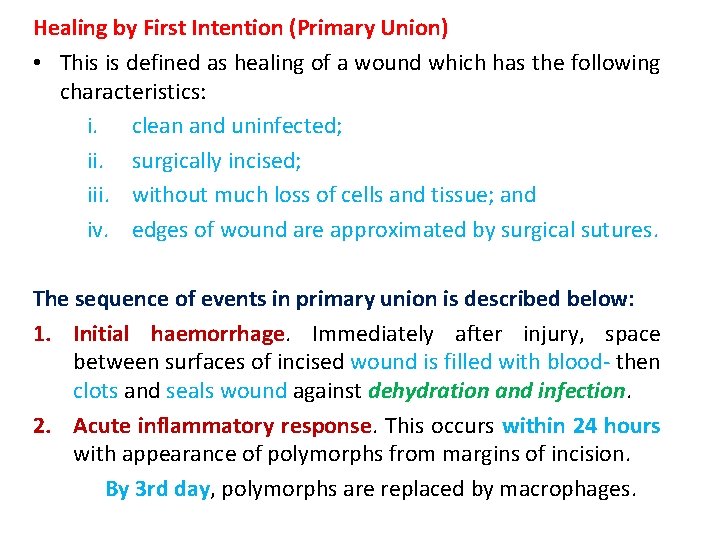
Healing by First Intention (Primary Union) • This is defined as healing of a wound which has the following characteristics: i. clean and uninfected; ii. surgically incised; iii. without much loss of cells and tissue; and iv. edges of wound are approximated by surgical sutures. The sequence of events in primary union is described below: 1. Initial haemorrhage. Immediately after injury, space between surfaces of incised wound is filled with blood- then clots and seals wound against dehydration and infection. 2. Acute inflammatory response. This occurs within 24 hours with appearance of polymorphs from margins of incision. By 3 rd day, polymorphs are replaced by macrophages.
3. Epithelial changes. • basal cells of epidermis from both cut margins start proliferating and migrating towards incisional space • wound is covered by a layer of epithelium in 48 hours. • migrated epidermal cells separate underlying viable dermis • covering necrotic material and clot, forms a scab- is cast off. • basal cells from the margins continue to divide. • By 5 th day, a multilayered new epidermis is formed differentiated into superficial and deeper layers. 3. Organisation. • By 3 rd day, fibroblasts also invade the wound area • By 5 th day, new collagen fibrils start forming which dominate till healing is completed • In 4 weeks, scar tissue with scanty cellular and vascular elements, a few inflammatory cells and epithelialised surface is formed
5. Suture tracks. • Each suture track is a separate wound and heal up by same phenomena as in healing of the primary wound i. e. • filling the space with haemorrhage, • some inflammatory cell reaction, • epithelial cell proliferation along the suture track from both margins, • fibroblastic proliferation and • formation of young collagen. • sutures are removed around 7 th day.
• sometimes suture track gets infected (stitch abscess), or the epithelial cells may persist in the track (implantation or epidermal cysts). • scar formed in a sutured wound use of adhesive tapes avoids removal of stitches and its complications
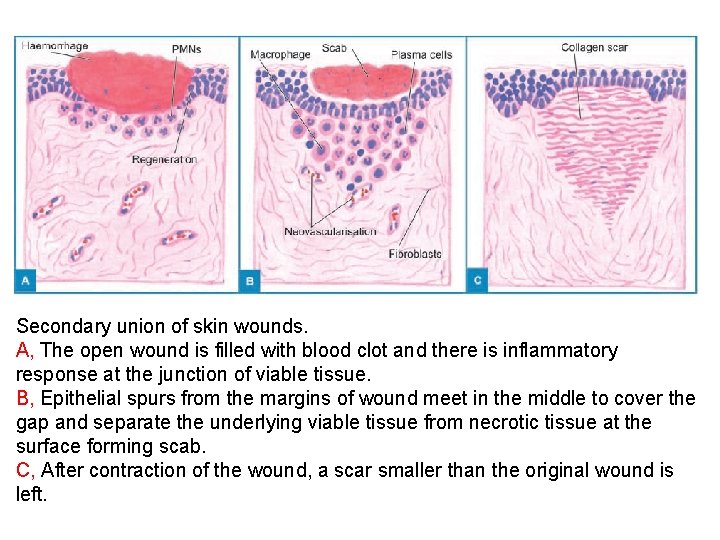
Secondary union of skin wounds. A, The open wound is filled with blood clot and there is inflammatory response at the junction of viable tissue. B, Epithelial spurs from the margins of wound meet in the middle to cover the gap and separate the underlying viable tissue from necrotic tissue at the surface forming scab. C, After contraction of the wound, a scar smaller than the original wound is left.
Healing by Second Intention (Secondary Union) • This is defined as healing of a wound having the following characteristics: i. open with a large tissue defect, at times infected; ii. having extensive loss of cells and tissues; and iii. wound is not approximated by surgical sutures but is left open. • basic events in secondary union are similar to primary union • differ in having a larger tissue defect which has to be bridged. • Hence healing takes place from the base upwards as well as from the margins inwards. • healing by second intention is slow and results in a large, scar as compared to rapid healing and neat scar of primary union.
• The sequence of events in secondary union is described below: • 1. Initial haemorrhage. As a result of injury, the wound space is filled with blood and fibrin clot which dries. • 2. Inflammatory phase. There is an initial acute inflammatory response followed by appearance of macrophages which clear off the debris as in primary union. • 3. Epithelial changes. As in primary healing, the epidermal cells from both the margins of wound proliferate and migrate into the wound in the form of epithelial spurs till they meet in the middle and re-epithelialise the gap completely.
• proliferating epithelial cells- do not cover the surface fully until granulation tissue from base- started filling wound space. • regenerated epidermis becomes stratified and keratinised. 4. Granulation tissue. Main bulk of secondary healing is by granulations. • Granulation tissue is formed by – proliferation of fibroblasts and – neovascularisation from the adjoining viable elements. • newly-formed granulation tissue is deep red, granular and fragile. • scar on maturation becomes pale and white due to increase in collagen and decrease in vascularity. • Specialised structures of the skin like hair follicles and sweat glands -not replaced unless their viable residues may regenerate.
5. Wound contraction. • not seen in primary healing. • Due to the action of myofibroblasts present in granulation tissue, wound contracts to one-third to one fourth of its original size. 6. Presence of infection. • Bacterial contamination of an open wound delays the process of healing due to release of bacterial toxins that provoke necrosis, pus formation and thrombosis. • Surgical removal of dead and necrosed tissue, debridement, helps in preventing the bacterial infection of open wounds.
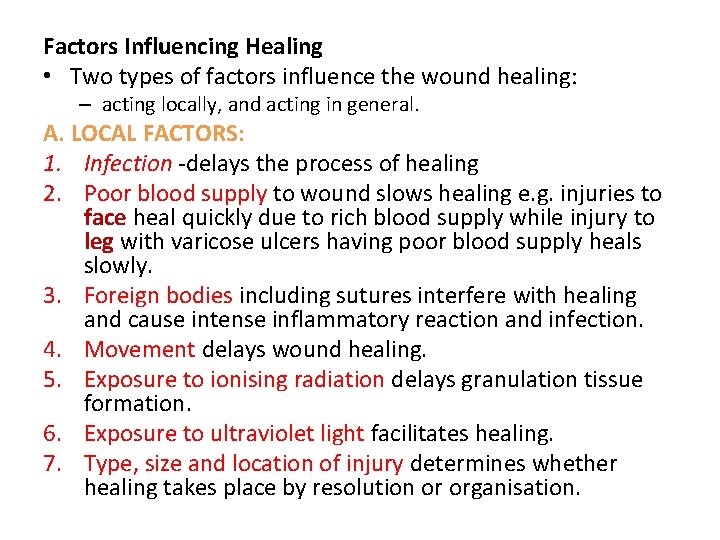
Factors Influencing Healing • Two types of factors influence the wound healing: – acting locally, and acting in general. A. LOCAL FACTORS: 1. Infection -delays the process of healing 2. Poor blood supply to wound slows healing e. g. injuries to face heal quickly due to rich blood supply while injury to leg with varicose ulcers having poor blood supply heals slowly. 3. Foreign bodies including sutures interfere with healing and cause intense inflammatory reaction and infection. 4. Movement delays wound healing. 5. Exposure to ionising radiation delays granulation tissue formation. 6. Exposure to ultraviolet light facilitates healing. 7. Type, size and location of injury determines whether healing takes place by resolution or organisation.
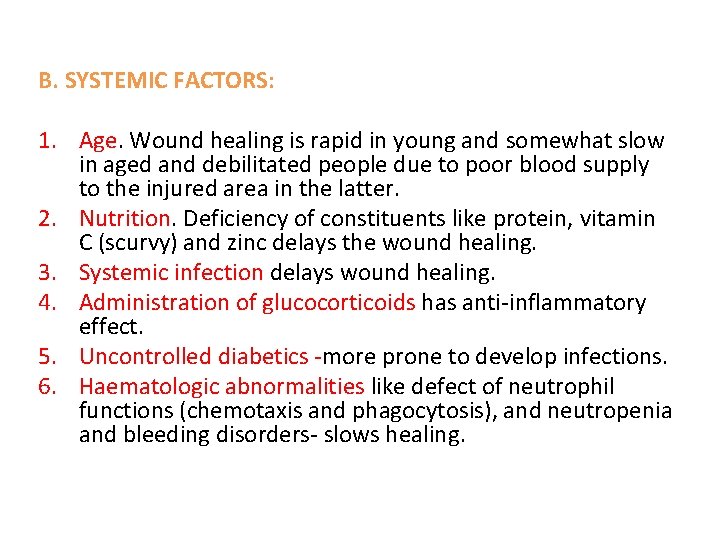
B. SYSTEMIC FACTORS: 1. Age. Wound healing is rapid in young and somewhat slow in aged and debilitated people due to poor blood supply to the injured area in the latter. 2. Nutrition. Deficiency of constituents like protein, vitamin C (scurvy) and zinc delays the wound healing. 3. Systemic infection delays wound healing. 4. Administration of glucocorticoids has anti-inflammatory effect. 5. Uncontrolled diabetics -more prone to develop infections. 6. Haematologic abnormalities like defect of neutrophil functions (chemotaxis and phagocytosis), and neutropenia and bleeding disorders- slows healing.
• Reference: Textbook of Pathology, by Harsh Mohan (Author), JAYPEE Publication