
Unit I Basics of Management 1 Introduction Definition
Unit – I Basics of Management 1. Introduction, Definition of management, characteristics of management, 2. functions of management - Planning, Organising, 3. Staffing, Directing, Co-ordination, Controlling, 4. Motivating, Communication, Decision Making, 5. Principles of management – F. W. Taylor, Henry Fayol, Elton Mayo, 6. Administration and management, Nature of management, levels of management, managerial skills, managerial roles, 7. Forms of Organization- Line , Line – staff etc. Forms of ownerships – Partnership, Proprietorship, Joint stock, Cooperative society, Govt. Sector etc, concept of Globalisation. -(8 hrs) 1

Introduction �As Managers people carry out the managerial functions of planning, Organizing, Staffing, Leading, and controlling �Management applies to any kind of organization �It applies to managers at all organizational levels �The aims all managers is the same- Profit maximization �Managing is concerned with productivity – This implies Effectiveness and Efficiency 2
BUSINESS � An enterprise engaged in the production & distribution of goods for sale in a market or the rendering of service for a price �Business is a complex of gainful human- activities, the main objective of which is to create, exchange & possess wealth in the form of physical output and useful service 3
ADMINISTRATION �In business firms, administration refers to the higher and policy determining levels. � Administration is concerned with the determination of overall corporate objectives, policies and master strategies 4
ORGANIZATION A deliberate arrangement of people to accomplish some specific purpose �involves the interactions and efforts of People �in order to achieve Objectives �channelled and coordinated through Structure �directed and controlled via Management 5
MANAGEMENT �Management is the process of designing and maintaining an environment in which individuals, working together in groups efficiently accomplish selected goals �It is the activity for getting things done through other people. For getting the work of an enterprise completed through the efforts of other people, it becomes necessary to guide, direct, co-ordinate and control human efforts towards the fulfillment of certain common goals or purposes 6
Functions of management � Planning � Defining goals, establishing strategies to achieve goals, developing plans to integrate and coordinate activities. � Organizing � - Arranging work to accomplish organizational goals. Staffing The recruitment, selection, assignment, training, development, evaluation and compensation of staff � Leading � Working with and through people to accomplish goals. � Controlling � Monitoring, comparing, and correcting the work. 7
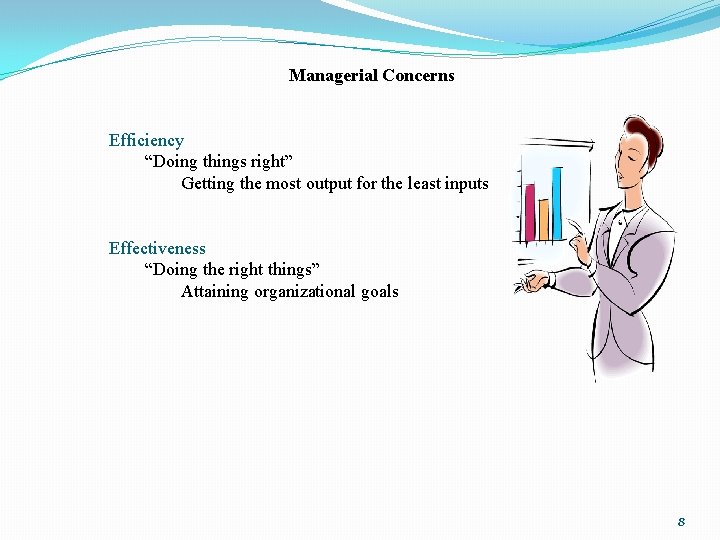
Managerial Concerns Efficiency “Doing things right” Getting the most output for the least inputs Effectiveness “Doing the right things” Attaining organizational goals 8
Management is absolutely essential when: Ø There is a scarcity of resources Ø There is a need to enhance effectiveness and efficiency Ø We need to adhere to time schedules Ø Where there is societal obligation/social responsibility Ø Where there is economic compulsions or profit motives Ø When there are new opportunities Ø When there are global challenges 9
Characteristics of management �Management is process �It is an endeavor to achieve the pre-determined objectives �Group activity �Management aims at reaping rich results in economic terms �Management also implies skills & experience in getting things done through people �Management is a profession �The principles of management are of universal application 10
Cont…. �Mgmt needed at different levels of organization �Need of organization �Managers need not be owners �Principles of management are dynamic not static �It is a system of authority �It is all characterized by the quality of leadership �Decision making is the primary part of managerial process 11
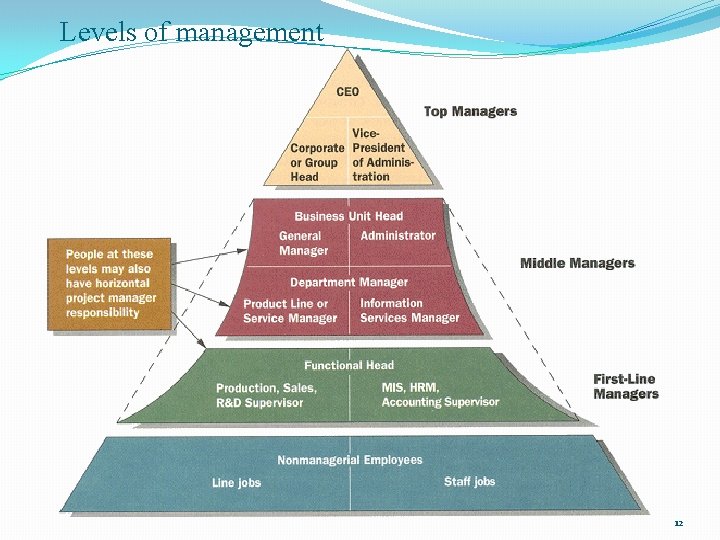
Levels of management 12
Scope of Management 1. Subject-matter of mgmt 2. Functional area of mgmt - Financial - Personal - Purchasing - Production - Maintenance - Transport - Distribution - Office - Development 13
3. Management is an inter-disciplinary approach 4. The principles of management are of universal application 5. Modern management is an agent of change 14
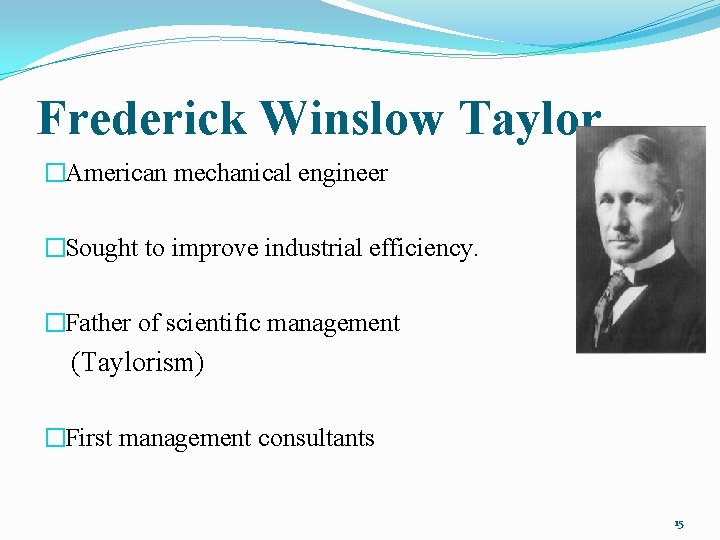
Frederick Winslow Taylor �American mechanical engineer �Sought to improve industrial efficiency. �Father of scientific management (Taylorism) �First management consultants 15
Scientific Management �Develop a science for each element of job to replace old rule of thumb methods. �Select employees scientifically & train them �Supervise employees �Plan the job & use workers to do work 16
Fundamental principles �Replacing rule of thumb with science. �Working for maximum output, rather than restricted output. �Developing all workers as maximum as possible for their own and their company’s highest prosperity. �Obtaining harmony in group action, rather than discord. �Achieving cooperation of human being, rather than chaotic individualism. 17
Limitations of Scientific Management �Focuses problems from engineering point of view. �Fails at operational level and not at management level. �Economic and physical needs are emphasized. �Social needs are overlooked. �Totally ignored the human desire for job satisfaction, working conditions, job contents. 18
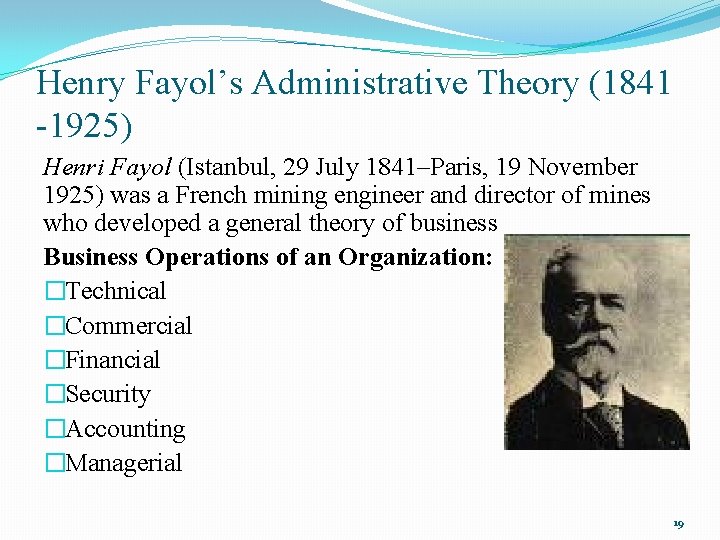
Henry Fayol’s Administrative Theory (1841 -1925) Henri Fayol (Istanbul, 29 July 1841–Paris, 19 November 1925) was a French mining engineer and director of mines who developed a general theory of business Business Operations of an Organization: �Technical �Commercial �Financial �Security �Accounting �Managerial 19
Fayol’s fourteen principles of management �Division of work based on specialization. �Authority and responsibility. �Discipline. �Unity of command. �Unity of direction. �Subordination of individual interest to general interest. �Remuneration. �Centralization. �Scalar chain. �Order. �Equity. �Stability of tenure. �Initiative. �Union is strength. 20
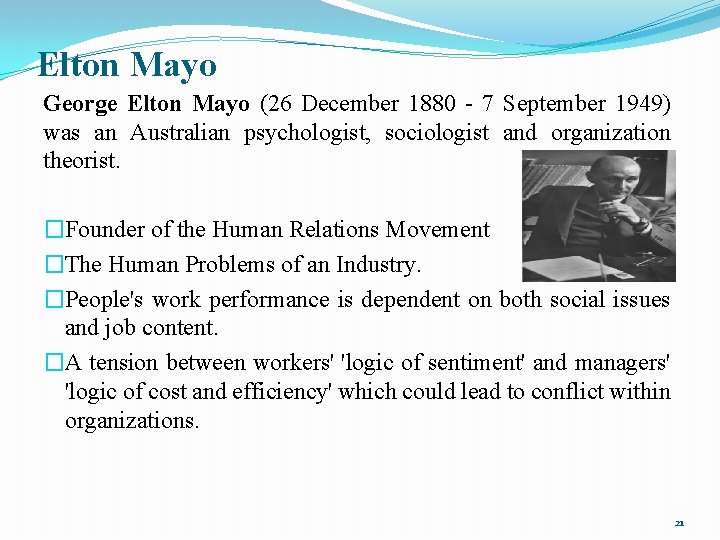
Elton Mayo George Elton Mayo (26 December 1880 - 7 September 1949) was an Australian psychologist, sociologist and organization theorist. �Founder of the Human Relations Movement �The Human Problems of an Industry. �People's work performance is dependent on both social issues and job content. �A tension between workers' 'logic of sentiment' and managers' 'logic of cost and efficiency' which could lead to conflict within organizations. 21
�Individual workers cannot be treated in isolation, but must be seen as members of a group. �Monetary incentives and good working conditions are less important to the individual than the need to belong to a group. �Informal or unofficial groups formed at work have a strong influence on the behaviour of those workers in a group. �Managers must be aware of these 'social needs' and cater for them to ensure that employees collaborate with the official organization rather than work against it. 22
�Mayo's simple instructions to industrial interviewers: - 1. Give your full attention to the person interviewed, and make it evident that you are doing so. 2. Listen - don't talk. 3. Never argue; never give advice. 4. Listen to: what he wants to say; what he does not want to say; what he can not say without help. 5. As you listen, plot out tentatively and for subsequent correction the pattern that is being set before you. To test, summarize what has been said and present for comment. Always do this with caution - that is, clarify but don't add or twist. 23
Concept of Globalization Definition of Globalisation �Globalization is a social change, an increase in connections among societies and their elements. The term is applied to many social, commercial and economic activities. �Development of a global financial system. History of Globalization �Europeans discover the Americas �Industrial Revolution �Inventions �Transportation �Telephone �Telegraph 24
What is Globalization: Globalization is the flow across national boundaries of goods and services, capital, people, technology, ideas, and culture. Flow of People, Goods, Ideas Flow of Insects, Disease Vectors, Viruses, Economic, Political, Cultural, Social & Health Impacts 25
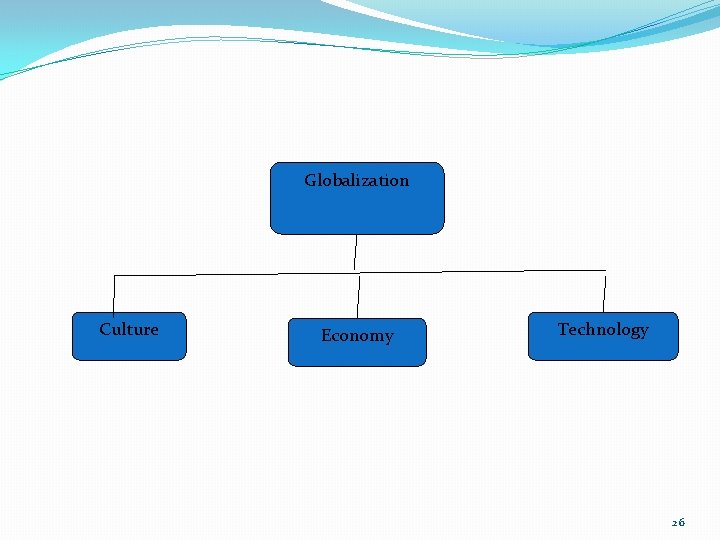
Globalization Culture Economy Technology 26
“Globalization in its current phase has been described as an extraordinary compression of time and space reflected in the tremendous intensification of social, political, economic, and cultural interconnections and interdependencies on a global scale. ” Stegler, p. ix 27
Advantages of globalization • Technological advances • Expansion of international commerce (exports and imports) • Rising importance of private capital flows (stock markets and multinational corporations) • Increasing travel and migration (international tourism and domestic diversity) • Increased communication and interaction between peoples (through all sorts of media) 28
- Slides: 28