
UNIT I 1 Introduction to structure of polymers


- Slides: 33
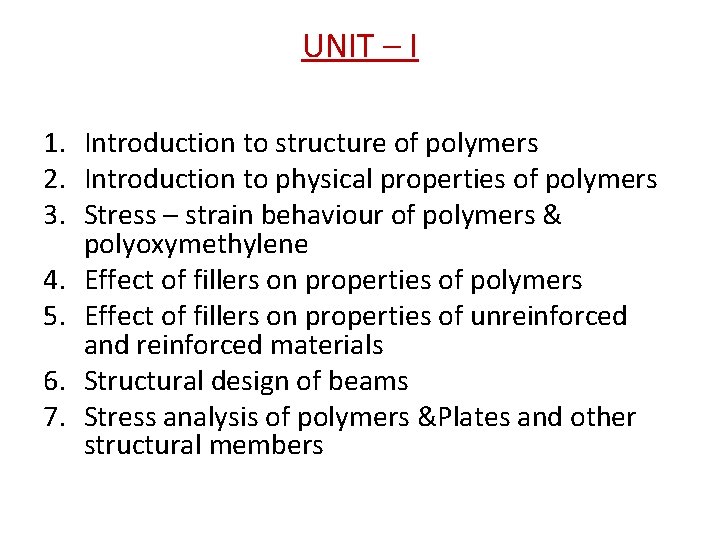
UNIT – I 1. Introduction to structure of polymers 2. Introduction to physical properties of polymers 3. Stress – strain behaviour of polymers & polyoxymethylene 4. Effect of fillers on properties of polymers 5. Effect of fillers on properties of unreinforced and reinforced materials 6. Structural design of beams 7. Stress analysis of polymers &Plates and other structural members
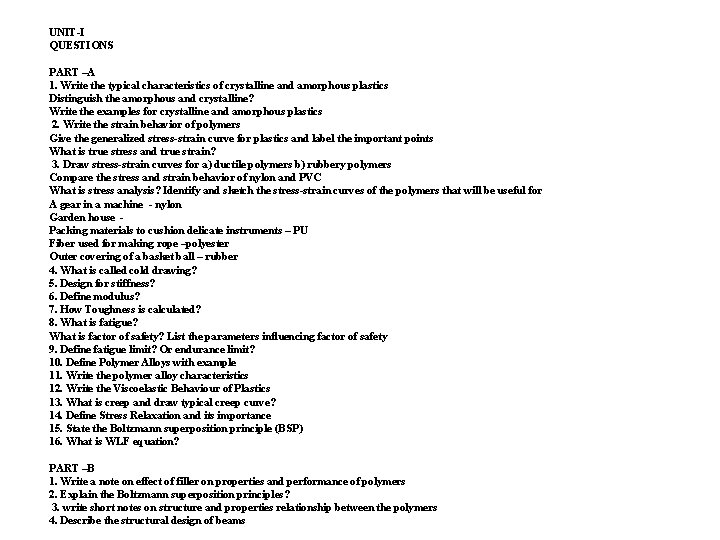
UNIT-I QUESTIONS PART –A 1. Write the typical characteristics of crystalline and amorphous plastics Distinguish the amorphous and crystalline? Write the examples for crystalline and amorphous plastics 2. Write the strain behavior of polymers Give the generalized stress-strain curve for plastics and label the important points What is true stress and true strain? 3. Draw stress-strain curves for a) ductile polymers b) rubbery polymers Compare the stress and strain behavior of nylon and PVC What is stress analysis? Identify and sketch the stress-strain curves of the polymers that will be useful for A gear in a machine - nylon Garden house Packing materials to cushion delicate instruments – PU Fiber used for making rope –polyester Outer covering of a basket ball – rubber 4. What is called cold drawing? 5. Design for stiffness? 6. Define modulus? 7. How Toughness is calculated? 8. What is fatigue? What is factor of safety? List the parameters influencing factor of safety 9. Define fatigue limit? Or endurance limit? 10. Define Polymer Alloys with example 11. Write the polymer alloy characteristics 12. Write the Viscoelastic Behaviour of Plastics 13. What is creep and draw typical creep curve? 14. Define Stress Relaxation and its importance 15. State the Boltzmann superposition principle (BSP) 16. What is WLF equation? PART –B 1. Write a note on effect of filler on properties and performance of polymers 2. Explain the Boltzmann superposition principles? 3. write short notes on structure and properties relationship between the polymers 4. Describe the structural design of beams
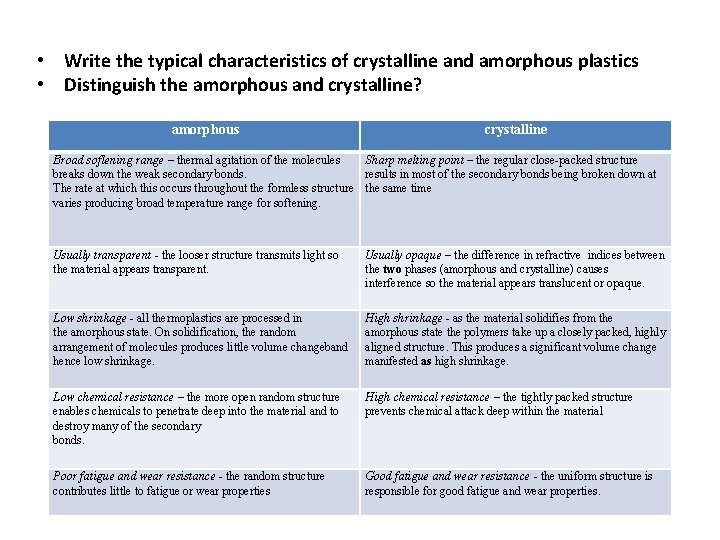
• Write the typical characteristics of crystalline and amorphous plastics • Distinguish the amorphous and crystalline? amorphous crystalline Broad soflening range – thermal agitation of the molecules Sharp melting point – the regular close-packed structure breaks down the weak secondary bonds. results in most of the secondary bonds being broken down at The rate at which this occurs throughout the formless structure the same time varies producing broad temperature range for softening. Usually transparent - the looser structure transmits light so the material appears transparent. Usually opaque – the difference in refractive indices between the two phases (amorphous and crystalline) causes interference so the material appears translucent or opaque. Low shrinkage - all thermoplastics are processed in the amorphous state. On solidification, the random arrangement of molecules produces little volume changeband hence low shrinkage. High shrinkage - as the material solidifies from the amorphous state the polymers take up a closely packed, highly aligned structure. This produces a significant volume change manifested as high shrinkage. Low chemical resistance – the more open random structure enables chemicals to penetrate deep into the material and to destroy many of the secondary bonds. High chemical resistance – the tightly packed structure prevents chemical attack deep within the material Poor fatigue and wear resistance - the random structure contributes little to fatigue or wear properties Good fatigue and wear resistance - the uniform structure is responsible for good fatigue and wear properties.
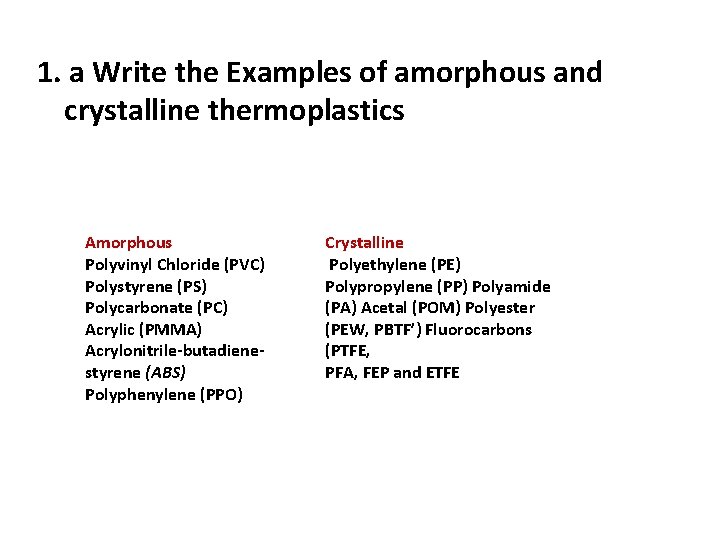
1. a Write the Examples of amorphous and crystalline thermoplastics Amorphous Polyvinyl Chloride (PVC) Polystyrene (PS) Polycarbonate (PC) Acrylic (PMMA) Acrylonitrile-butadienestyrene (ABS) Polyphenylene (PPO) Crystalline Polyethylene (PE) Polypropylene (PP) Polyamide (PA) Acetal (POM) Polyester (PEW, PBTF’) Fluorocarbons (PTFE, PFA, FEP and ETFE
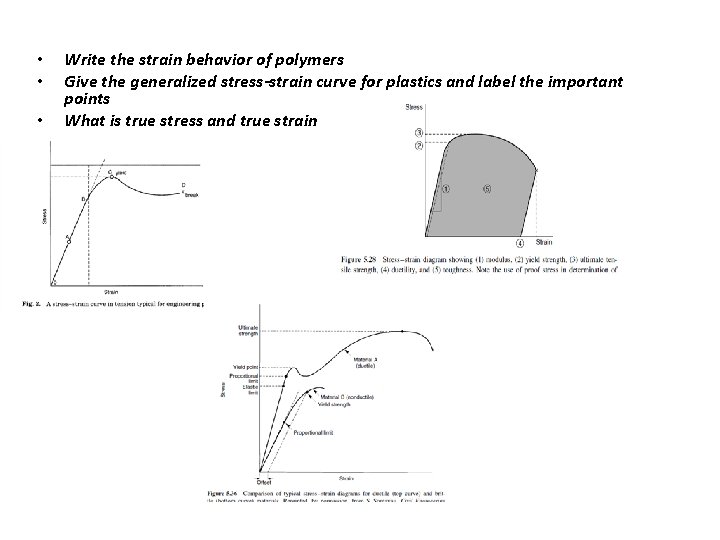
• • • Write the strain behavior of polymers Give the generalized stress-strain curve for plastics and label the important points What is true stress and true strain
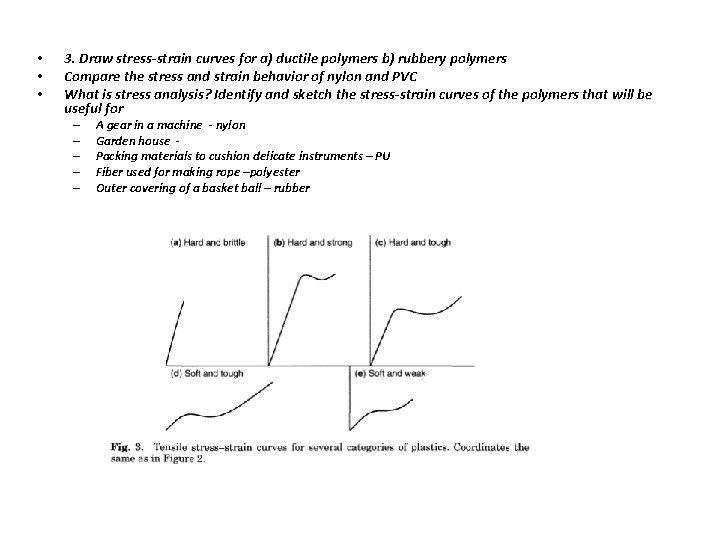
• • • 3. Draw stress-strain curves for a) ductile polymers b) rubbery polymers Compare the stress and strain behavior of nylon and PVC What is stress analysis? Identify and sketch the stress-strain curves of the polymers that will be useful for – – – A gear in a machine - nylon Garden house Packing materials to cushion delicate instruments – PU Fiber used for making rope –polyester Outer covering of a basket ball – rubber
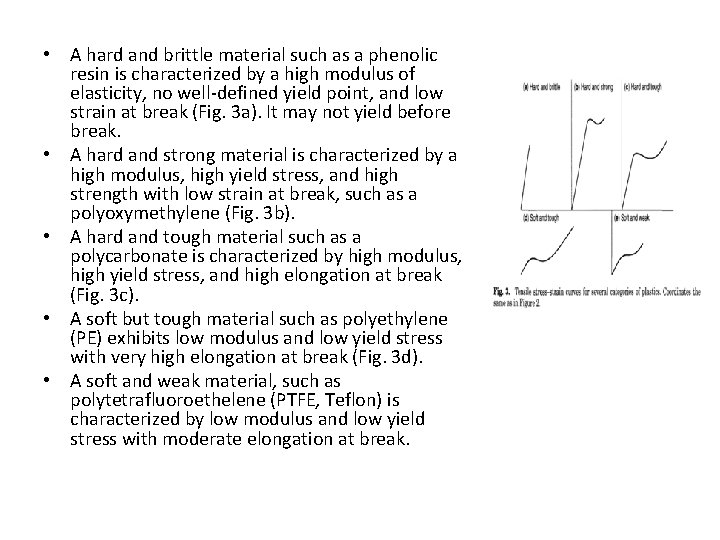
• A hard and brittle material such as a phenolic resin is characterized by a high modulus of elasticity, no well-defined yield point, and low strain at break (Fig. 3 a). It may not yield before break. • A hard and strong material is characterized by a high modulus, high yield stress, and high strength with low strain at break, such as a polyoxymethylene (Fig. 3 b). • A hard and tough material such as a polycarbonate is characterized by high modulus, high yield stress, and high elongation at break (Fig. 3 c). • A soft but tough material such as polyethylene (PE) exhibits low modulus and low yield stress with very high elongation at break (Fig. 3 d). • A soft and weak material, such as polytetrafluoroethelene (PTFE, Teflon) is characterized by low modulus and low yield stress with moderate elongation at break.
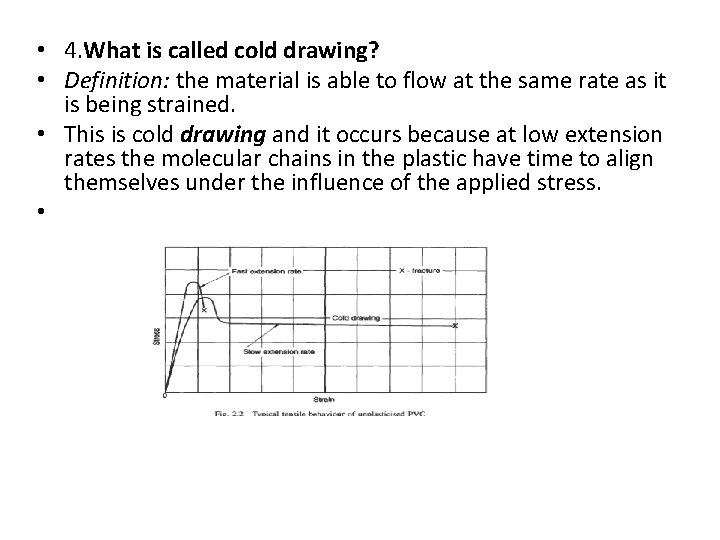
• 4. What is called cold drawing? • Definition: the material is able to flow at the same rate as it is being strained. • This is cold drawing and it occurs because at low extension rates the molecular chains in the plastic have time to align themselves under the influence of the applied stress. •
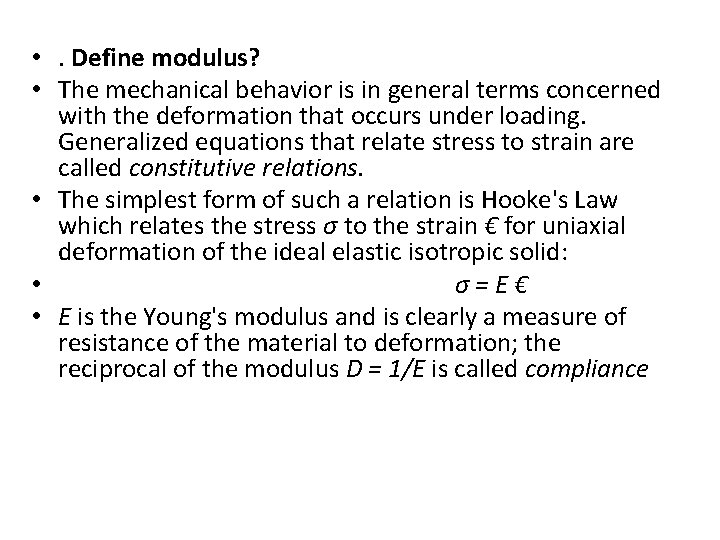
• . Define modulus? • The mechanical behavior is in general terms concerned with the deformation that occurs under loading. Generalized equations that relate stress to strain are called constitutive relations. • The simplest form of such a relation is Hooke's Law which relates the stress σ to the strain € for uniaxial deformation of the ideal elastic isotropic solid: • σ=E€ • E is the Young's modulus and is clearly a measure of resistance of the material to deformation; the reciprocal of the modulus D = 1/E is called compliance
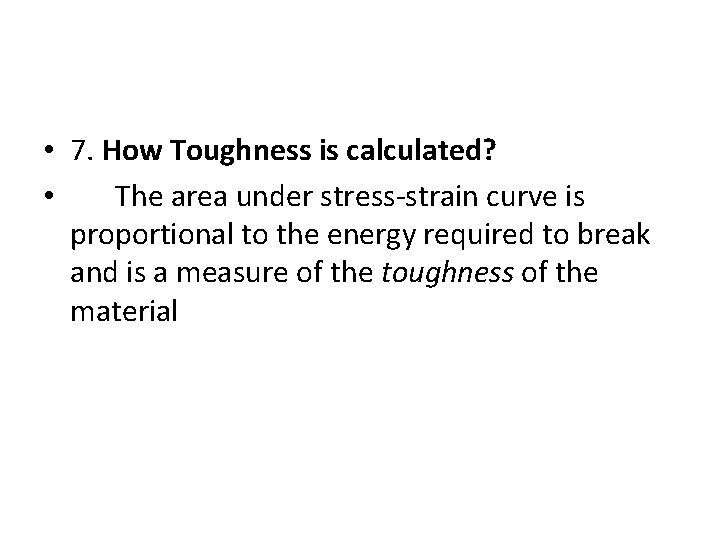
• 7. How Toughness is calculated? • The area under stress-strain curve is proportional to the energy required to break and is a measure of the toughness of the material
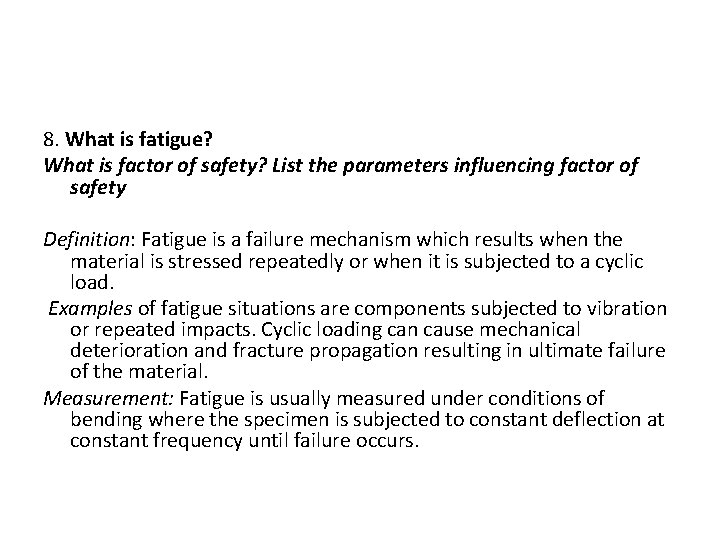
8. What is fatigue? What is factor of safety? List the parameters influencing factor of safety Definition: Fatigue is a failure mechanism which results when the material is stressed repeatedly or when it is subjected to a cyclic load. Examples of fatigue situations are components subjected to vibration or repeated impacts. Cyclic loading can cause mechanical deterioration and fracture propagation resulting in ultimate failure of the material. Measurement: Fatigue is usually measured under conditions of bending where the specimen is subjected to constant deflection at constant frequency until failure occurs.
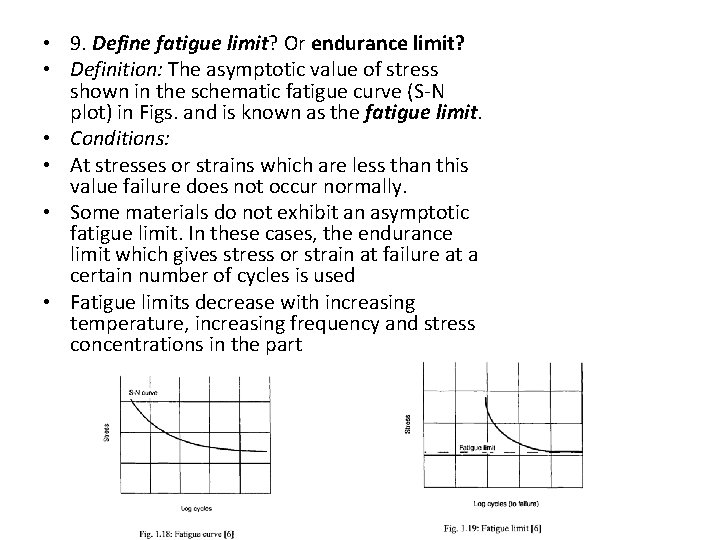
• 9. Define fatigue limit? Or endurance limit? • Definition: The asymptotic value of stress shown in the schematic fatigue curve (S-N plot) in Figs. and is known as the fatigue limit. • Conditions: • At stresses or strains which are less than this value failure does not occur normally. • Some materials do not exhibit an asymptotic fatigue limit. In these cases, the endurance limit which gives stress or strain at failure at a certain number of cycles is used • Fatigue limits decrease with increasing temperature, increasing frequency and stress concentrations in the part
• 10. Define Polymer Alloys with example The principle of alloying plastics is similar to that of alloying metals - to achieve in one material the advantages possessed by several others. Example: ABS, is in fact an alloy of acrylonitrile, butadiene and styrene. Impact strength may be improved by using polycarbonate, ABS and polyurethanes. Heat resistance is improved by using polyphenylene oxide, polysulphone, PVC, polyester (PET and PBT) and acrylic. • Barrier properties are improved by using plastics such as ethylene vinyl alchol (EVA).
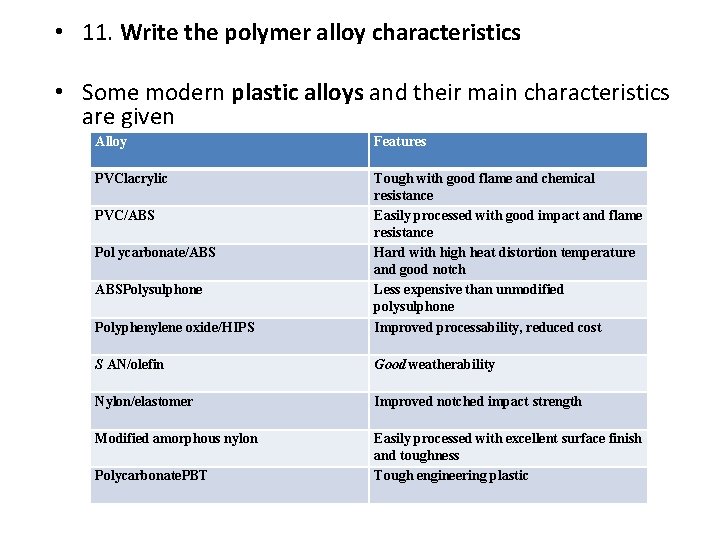
• 11. Write the polymer alloy characteristics • Some modern plastic alloys and their main characteristics are given Alloy Features PVClacrylic Polyphenylene oxide/HIPS Tough with good flame and chemical resistance Easily processed with good impact and flame resistance Hard with high heat distortion temperature and good notch Less expensive than unmodified polysulphone Improved processability, reduced cost S AN/olefin Good weatherability Nylon/elastomer Improved notched impact strength Modified amorphous nylon Easily processed with excellent surface finish and toughness Tough engineering plastic PVC/ABS Pol ycarbonate/ABS ABSPolysulphone Polycarbonate. PBT
12. Write the Viscoelastic Behaviour of Plastics Polymeric materials exhibit mechanical properties which come somewhere between these two ideal cases and hence they are termed viscoelastic. In a viscoelastic material the stress is a function of strain and time and so may be described by an equation of the form σ = f(E, t ) The most characteristic features of viscoelastic materials are that they exhibit a time dependent strain response to a constant stress (creep) and a time dependent stress response to a constant strain (relaxation). In addition when the applied stress is removed the materials have the ability to recover slowly over a period of time.
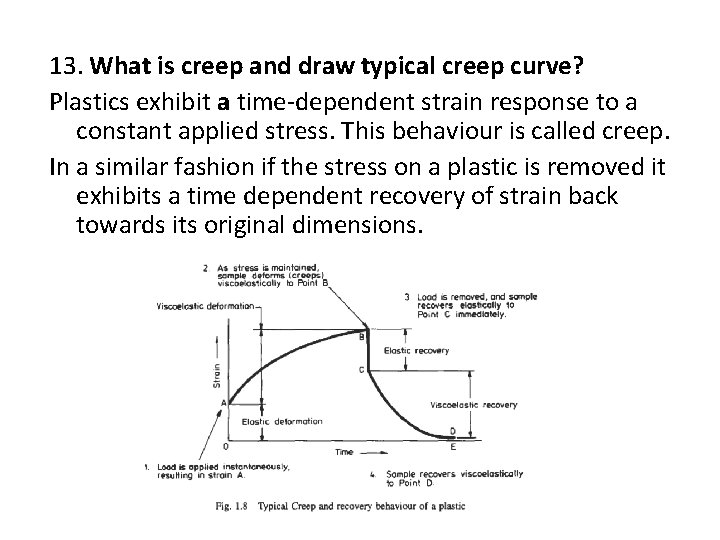
13. What is creep and draw typical creep curve? Plastics exhibit a time-dependent strain response to a constant applied stress. This behaviour is called creep. In a similar fashion if the stress on a plastic is removed it exhibits a time dependent recovery of strain back towards its original dimensions.
14. Define Stress Relaxation and its importance viscoelastic nature of plastics -if they are subjected to a particular strain and this strain is held constant it is found that as time progresses, the stress necessary to maintain this strain decreases. Importance: This is termed stress relaxation and is of vital importance in the design of gaskets, seals, springs and snap-fit assemblies.
15. State the Boltzmann superposition principle (BSP) Boltzmann extended the idea of linearity in viscoelastic behaviour to take account of the time dependence. He assumed that, in a creep experiment; (i) The strain observed at any time depends on the entire stress history up to that time and (ii) Each step change in stress makes an independent contribution to the strain at any time and these contributions add to give the total observed strain. •
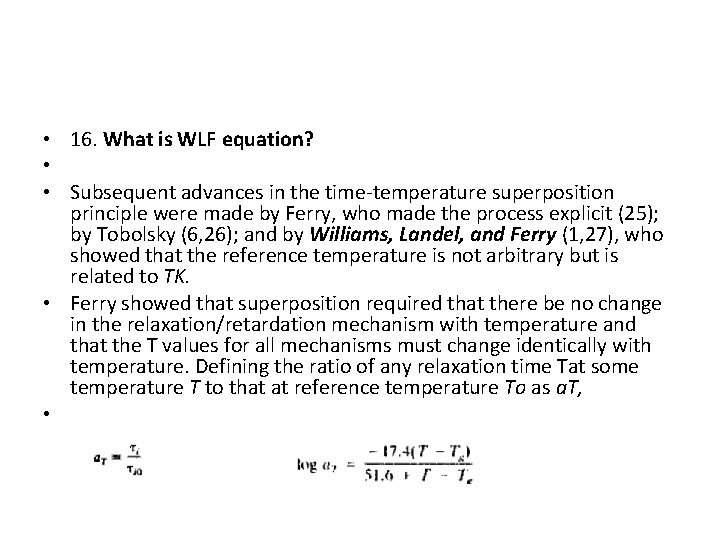
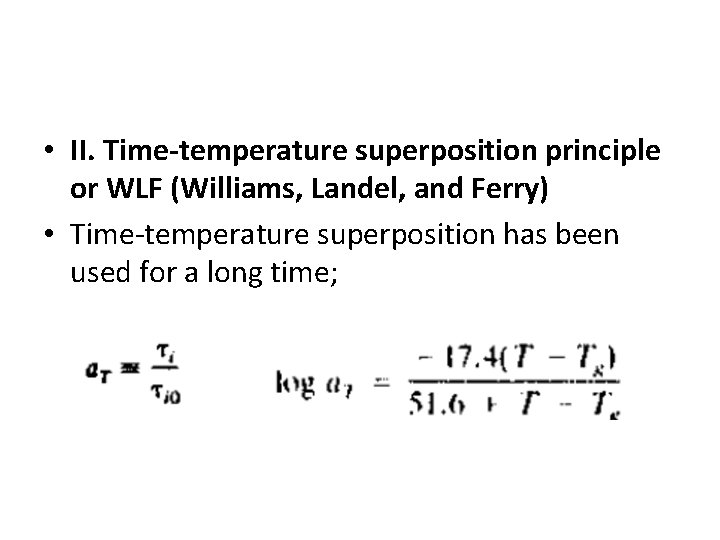
• 16. What is WLF equation? • • Subsequent advances in the time-temperature superposition principle were made by Ferry, who made the process explicit (25); by Tobolsky (6, 26); and by Williams, Landel, and Ferry (1, 27), who showed that the reference temperature is not arbitrary but is related to TK. • Ferry showed that superposition required that there be no change in the relaxation/retardation mechanism with temperature and that the T values for all mechanisms must change identically with temperature. Defining the ratio of any relaxation time Tat some temperature T to that at reference temperature To as a. T, •
PART-B
• 1. Write the Effect of filler on properties and performance Definition of filler A filler is defined as any material added to polymer that is significantly different structurally or chemically from the basic polymer. Classification The fillers can be grouped into several ways In terms of their structure The way that interact with the polymer matrix In terms of their composition
1. In terms of their structure The fillers may be aggregates with essentially round or polyhedral shape such as clay or chalk. Plates or flakes-such as mica, lamellar glass Fibers-such as fiber glass, asbestos, synthetic fibers Cellular material-such as foamed glass, hollow glass beads. 2. Interaction with polymer matrix The filler can be adherent to the polymer matrix whether inherently or by special surface treatment. Fillers may absorb the polymer phase because of high surface area and inherent wetability Can react chemically with the polymer material to form a chemical bond Can cause cross linking of the structures. 3. In terms of their composition The fillers can be inert and no-adherent to the polymer and remain as just void filler. Example of filler Mineral filler- clays, silica, chalk Crystalline materials- mica, asbestos Amorphous glass material- fiberglass and fused silica fibers Synthetic fibers- polyester, polyamides, polyimides Cellular materials- glass beads, foamed glass Polymer materials-vermicultite, foamed glass Foamed plastic- urethane and phenolic foam
Advantage and disadvantage of non-adherent fillers Advantage: The non-adherent filler is play an important role in the manufacture of films to be used in printing and other paper applications. The preparation of these films requires a degree of microporosity. So, they can absorb conventional links and pass through water vapour and other gases. To produce the effect fillers are added to the plastic materials which are non-adherent to the polymer structure. During orientation process at film, the polymer separates from filler to form a micro void and entire structure is micro porous
Disadvantage Because of non-adherence, they make the material brittle and weak in tension and bending. This result form the fact that each particle act as stress risers increasing the sress level around each particle. So that the premature failure will occur. Diagram
Effect of stress on non-adherent filler. The resin and filler co-act under stress When the adhesion between the filler and the resin matrix is adequate, the resin and the filler co-act under stress. Consider a bundle of fiber glass filaments and the effect of applying tensile, compressive, bending shear stresses to the bundle
Effect of resin binder on fiber glass. Fiberglass with no binders The tensile and compression load applied axially along the direction of fibers. Compressive loads The fibers can not take any compressive load since the tiny fibers have no column stability at all and buckle at low land. Tensile load The load is applied over a length where the fibers are continuous the material is very strong and the bundle will exhibit almost the maximum strength of the filaments. The material has no significant elongation so that it will undergo brittle failure. Bending load: The small diameter filament acting individually bend at low stress levels. Diagram
Orientation effect of fillers: The use of plate or flake like material reinforcement is common in plastic composition ex: mica or flake glass. The effects of this type of reinforcement depend upon on the orientation of the flanks on the quality of the resin reinforcement bond flakes lie parallel to each other in layers. Diagram • •
2. Explain the Boltzmann superposition principles? There are two superposition principles that are important in theory of Viscoelasticity. Boltzmann superposition principle- which describes the response of a material to different loading histories. time-temperature superposition principle or WLF (Williams, Landel, and Ferry) -which describes the effect of temperature on the time scale of the response
Boltzmann superposition principle for creep For the case of creep, if there are several stresses σ0, σ1, σ2, σ3, . . σi 1. applied at times 0, t 1, t 2, t 3. . . ti the Boltzmann superposition principle may be expressed by €(t) =J(t) σ0+ J(t-t 1)( σ1 -σ0)+. . . . + J(t-ti)( σi –σi-1) The creep €(t) at time / depends on the compliance function J(t) which is a characteristic of the polymer at a given temperature, and on the initial stress σ0. At a later time t 1 the load is changed to a value of σt At still ti the load is changed to a value of σi but for each additional stress, a different time scale has to be employed in J(t-t 1) the time over which that stress was applied. Furthermore, while €(t) for any load is given by the product J(t) σ the stress of concern is the incremental added stress σi- σ0
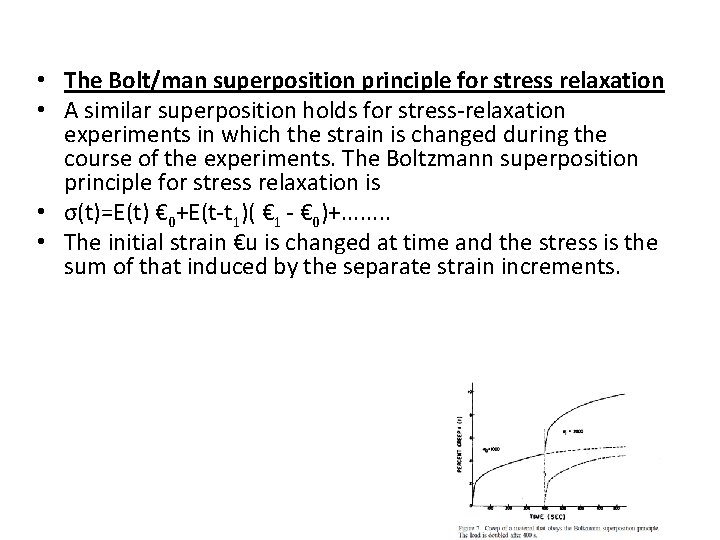
• The Bolt/man superposition principle for stress relaxation • A similar superposition holds for stress-relaxation experiments in which the strain is changed during the course of the experiments. The Boltzmann superposition principle for stress relaxation is • σ(t)=E(t) € 0+E(t-t 1)( € 1 - € 0)+. . . . • The initial strain €u is changed at time and the stress is the sum of that induced by the separate strain increments.
• II. Time-temperature superposition principle or WLF (Williams, Landel, and Ferry) • Time-temperature superposition has been used for a long time;