
Unit Hydrograph Reading Applied Hydrology Sections 7 1

- Slides: 23
Unit Hydrograph Reading: Applied Hydrology Sections 7. 1 -7. 3, 7. 5, 7. 7,
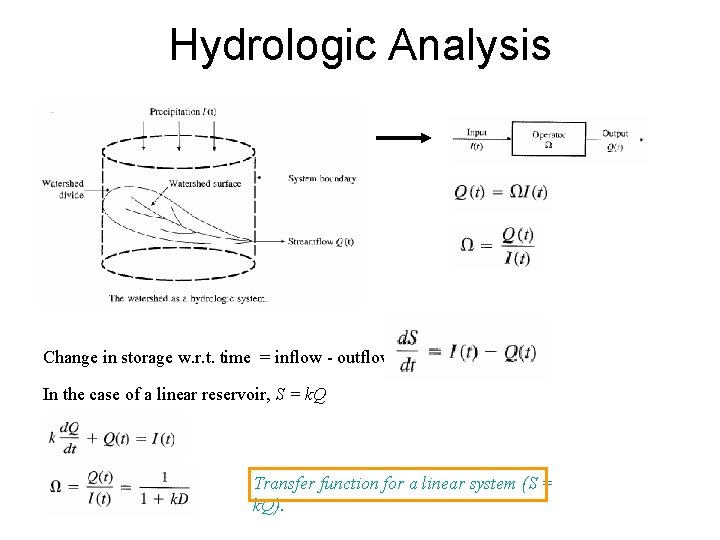
Hydrologic Analysis Change in storage w. r. t. time = inflow - outflow In the case of a linear reservoir, S = k. Q Transfer function for a linear system (S = k. Q).
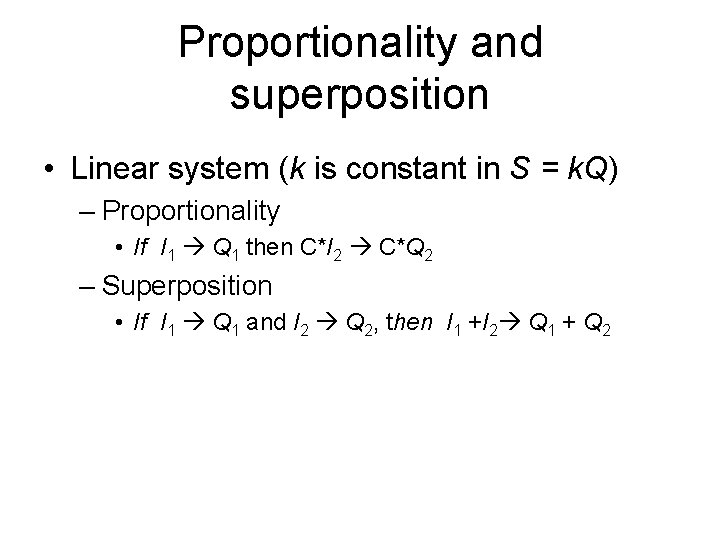
Proportionality and superposition • Linear system (k is constant in S = k. Q) – Proportionality • If I 1 Q 1 then C*I 2 C*Q 2 – Superposition • If I 1 Q 1 and I 2 Q 2, then I 1 +I 2 Q 1 + Q 2
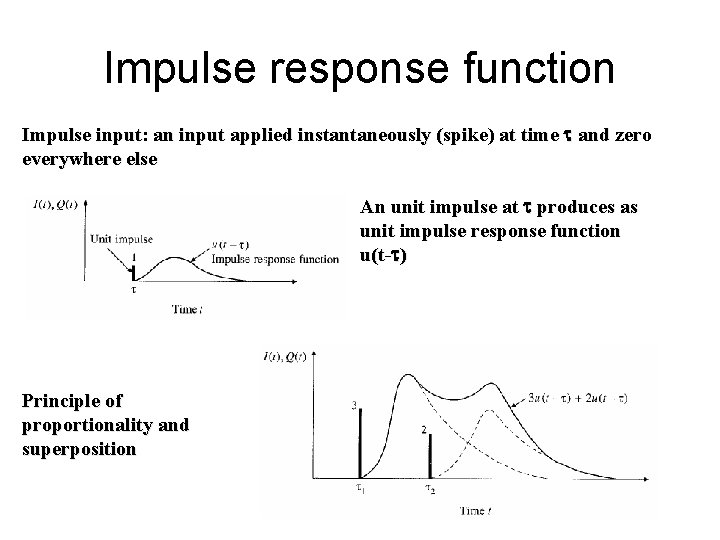
Impulse response function Impulse input: an input applied instantaneously (spike) at time t and zero everywhere else An unit impulse at t produces as unit impulse response function u(t-t) Principle of proportionality and superposition
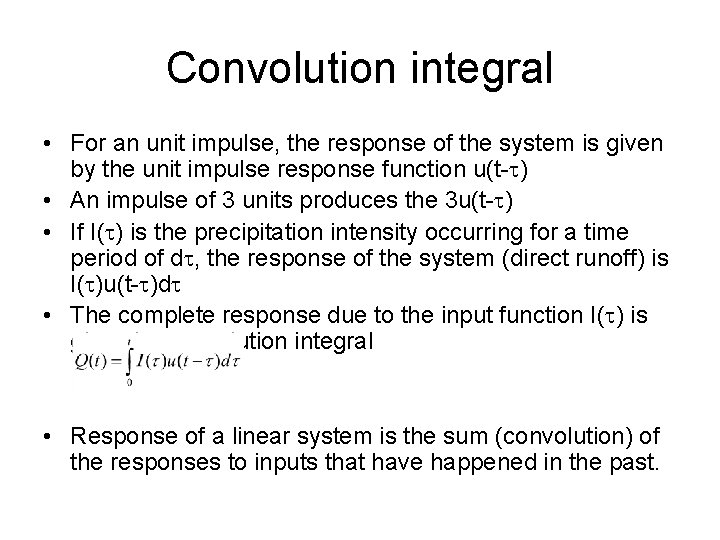
Convolution integral • For an unit impulse, the response of the system is given by the unit impulse response function u(t-t) • An impulse of 3 units produces the 3 u(t-t) • If I(t) is the precipitation intensity occurring for a time period of dt, the response of the system (direct runoff) is I(t)u(t-t)dt • The complete response due to the input function I(t) is given by convolution integral • Response of a linear system is the sum (convolution) of the responses to inputs that have happened in the past.
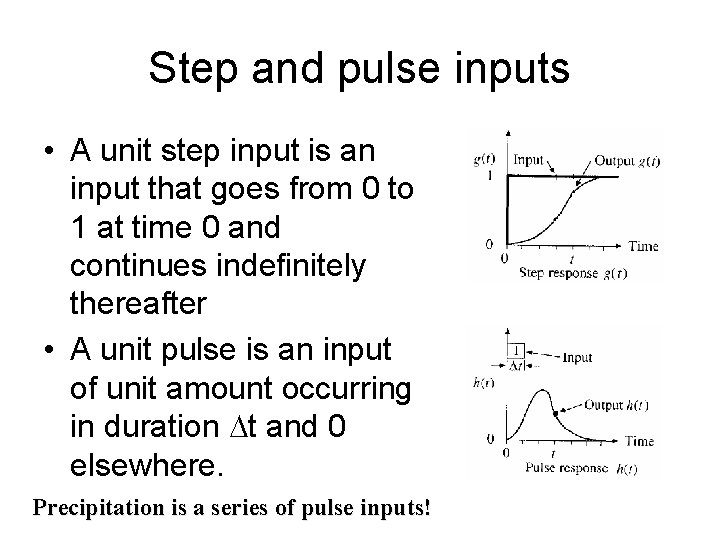
Step and pulse inputs • A unit step input is an input that goes from 0 to 1 at time 0 and continues indefinitely thereafter • A unit pulse is an input of unit amount occurring in duration Dt and 0 elsewhere. Precipitation is a series of pulse inputs!
Unit Hydrograph Theory • Direct runoff hydrograph resulting from a unit depth of excess rainfall occurring uniformly on a watershed at a constant rate for a specified duration. • Unit pulse response function of a linear hydrologic system • Can be used to derive runoff from any excess rainfall on the watershed.
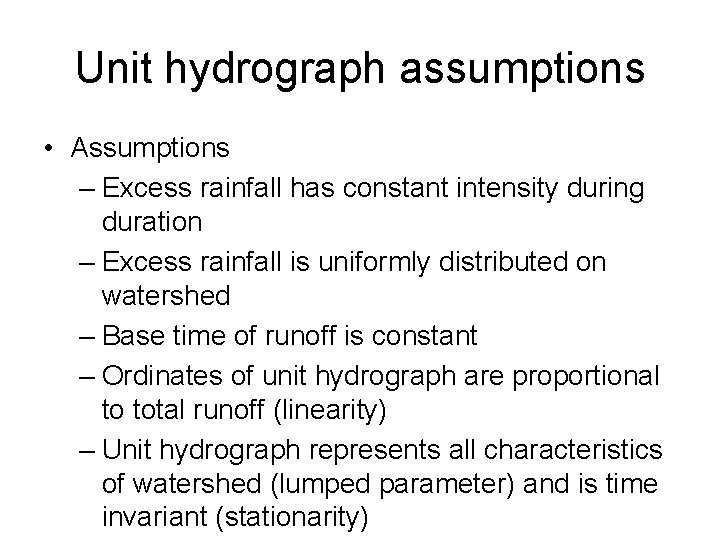
Unit hydrograph assumptions • Assumptions – Excess rainfall has constant intensity during duration – Excess rainfall is uniformly distributed on watershed – Base time of runoff is constant – Ordinates of unit hydrograph are proportional to total runoff (linearity) – Unit hydrograph represents all characteristics of watershed (lumped parameter) and is time invariant (stationarity)
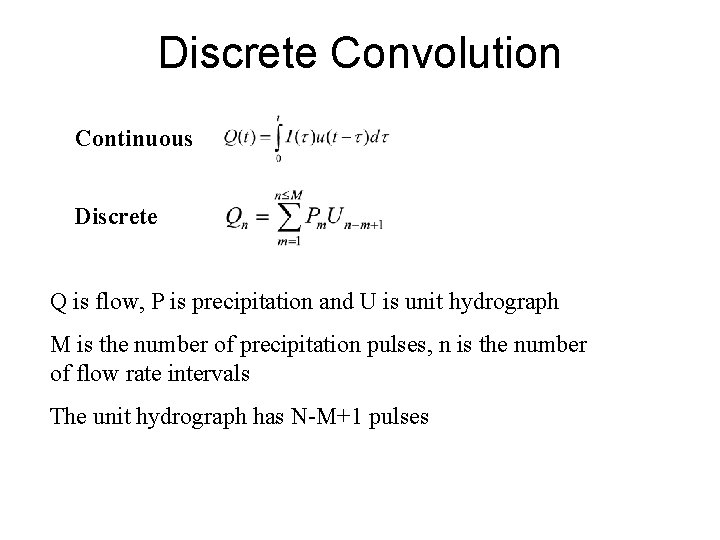
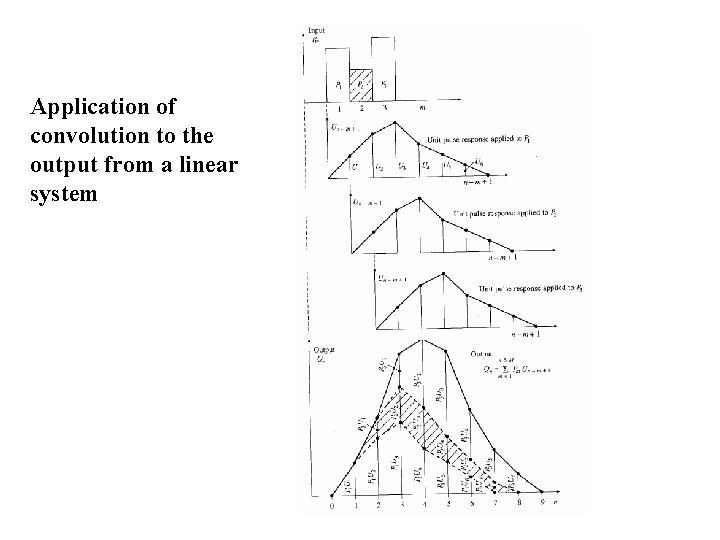
Discrete Convolution Continuous Discrete Q is flow, P is precipitation and U is unit hydrograph M is the number of precipitation pulses, n is the number of flow rate intervals The unit hydrograph has N-M+1 pulses
Application of convolution to the output from a linear system
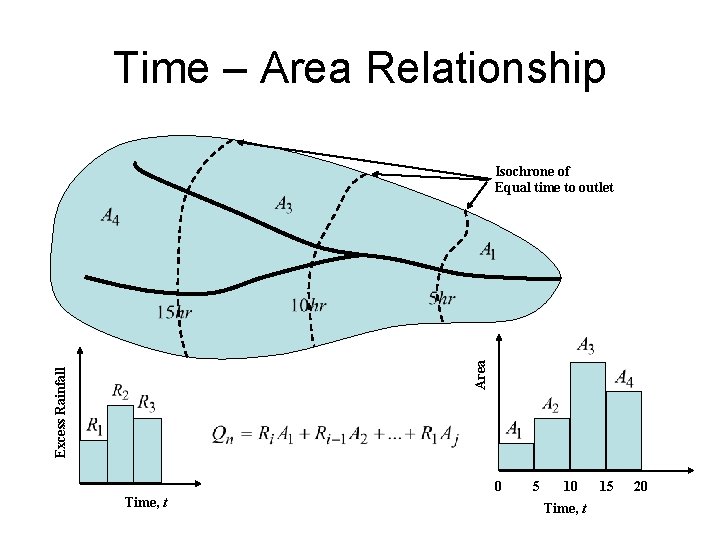
Time – Area Relationship Excess Rainfall Area Isochrone of Equal time to outlet 0 Time, t 5 10 Time, t 15 20
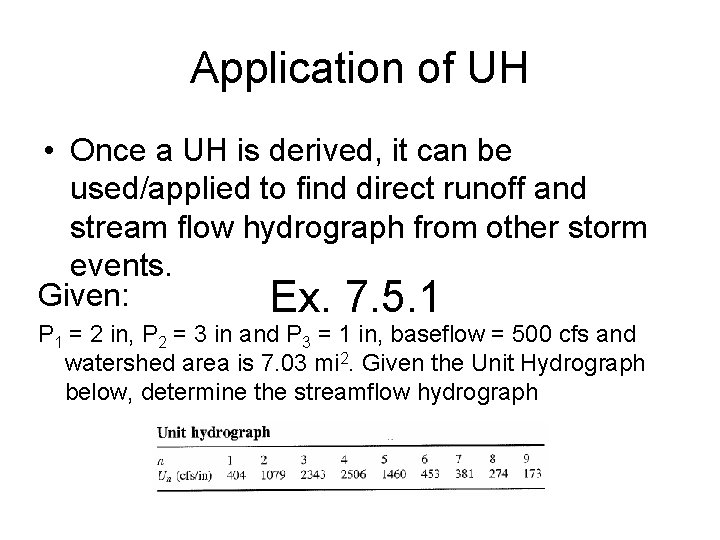
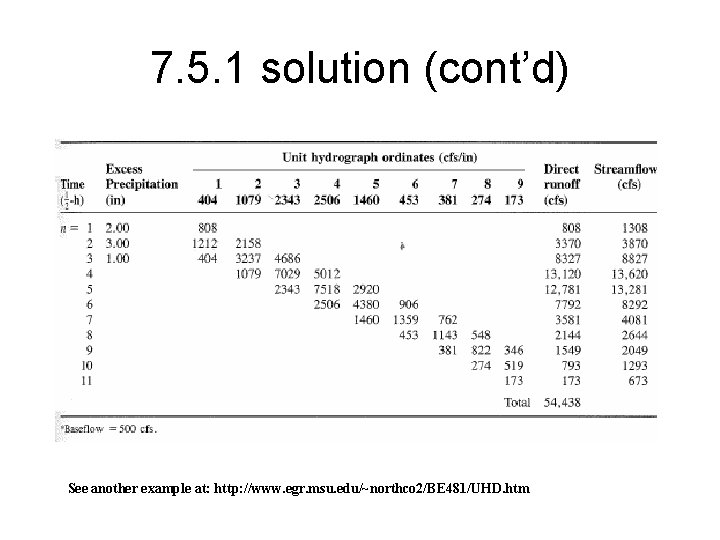
Application of UH • Once a UH is derived, it can be used/applied to find direct runoff and stream flow hydrograph from other storm events. Given: Ex. 7. 5. 1 P 1 = 2 in, P 2 = 3 in and P 3 = 1 in, baseflow = 500 cfs and watershed area is 7. 03 mi 2. Given the Unit Hydrograph below, determine the streamflow hydrograph
7. 5. 1 solution (cont’d) See another example at: http: //www. egr. msu. edu/~northco 2/BE 481/UHD. htm
Gauged and ungauged watersheds • Gauged watersheds – Watersheds where data on precipitation, streamflow, and other variables are available • Ungauged watersheds – Watersheds with no data on precipitation, streamflow and other variables.
Need for synthetic UH • UH is applicable only for gauged watershed and for the point on the stream where data are measured • For other locations on the stream in the same watershed or for nearby (ungauged) watersheds, synthetic procedures are used.
Synthetic UH • Synthetic hydrographs are derived by – Relating hydrograph characteristics such as peak flow, base time etc. with watershed characteristics such as area and time of concentration. – Using dimensionless unit hydrograph – Based on watershed storage
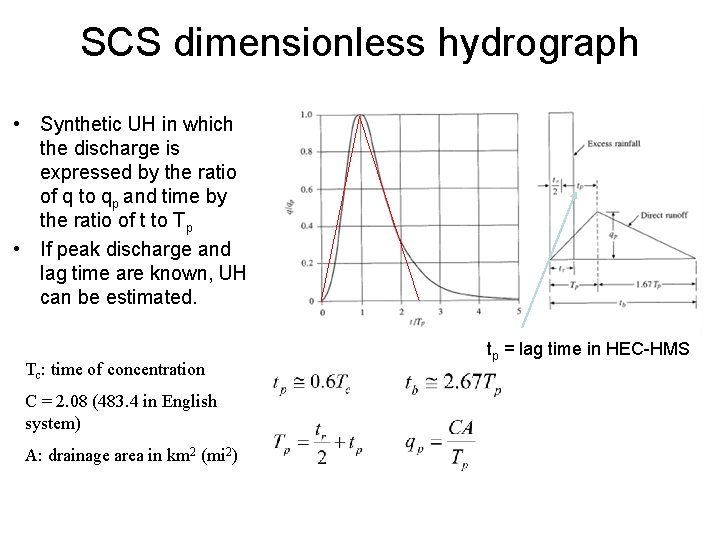
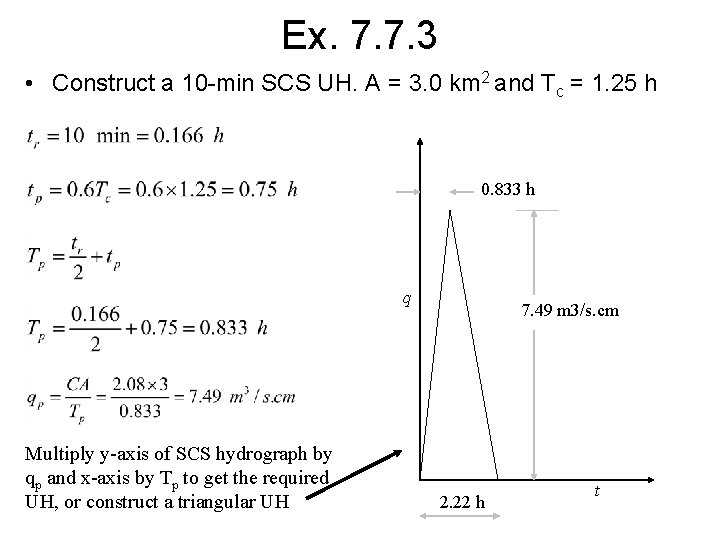
SCS dimensionless hydrograph • Synthetic UH in which the discharge is expressed by the ratio of q to qp and time by the ratio of t to Tp • If peak discharge and lag time are known, UH can be estimated. Tc: time of concentration C = 2. 08 (483. 4 in English system) A: drainage area in km 2 (mi 2) tp = lag time in HEC-HMS
Ex. 7. 7. 3 • Construct a 10 -min SCS UH. A = 3. 0 km 2 and Tc = 1. 25 h 0. 833 h q Multiply y-axis of SCS hydrograph by qp and x-axis by Tp to get the required UH, or construct a triangular UH 7. 49 m 3/s. cm 2. 22 h t
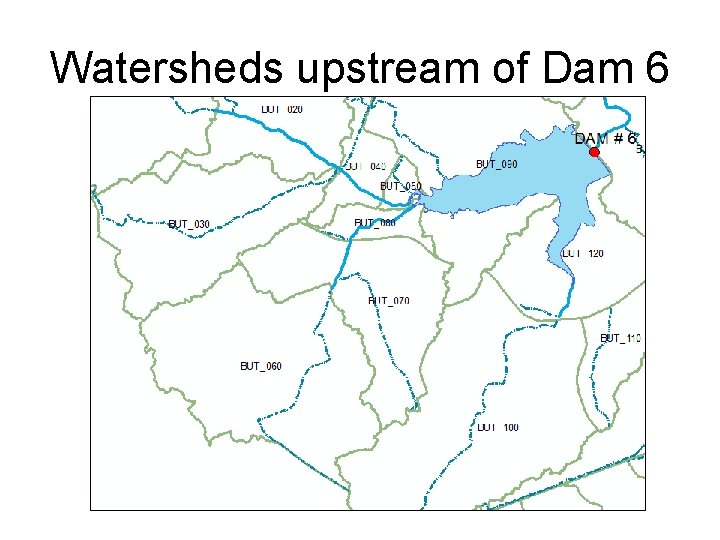
Watersheds upstream of Dam 6
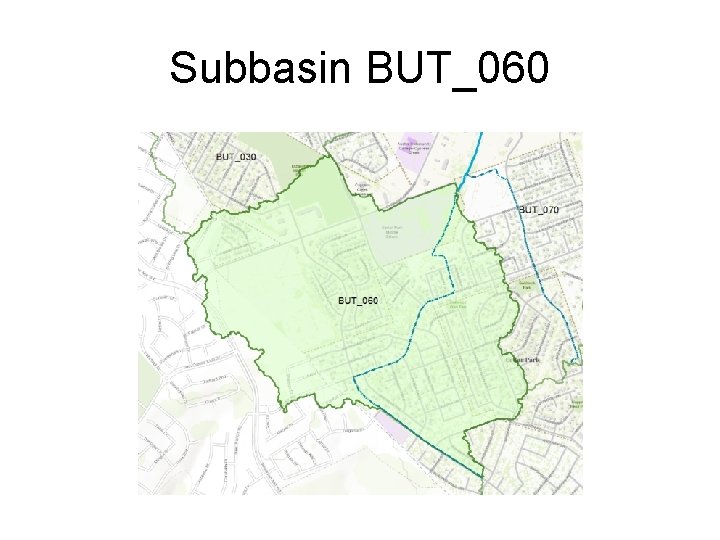
Subbasin BUT_060
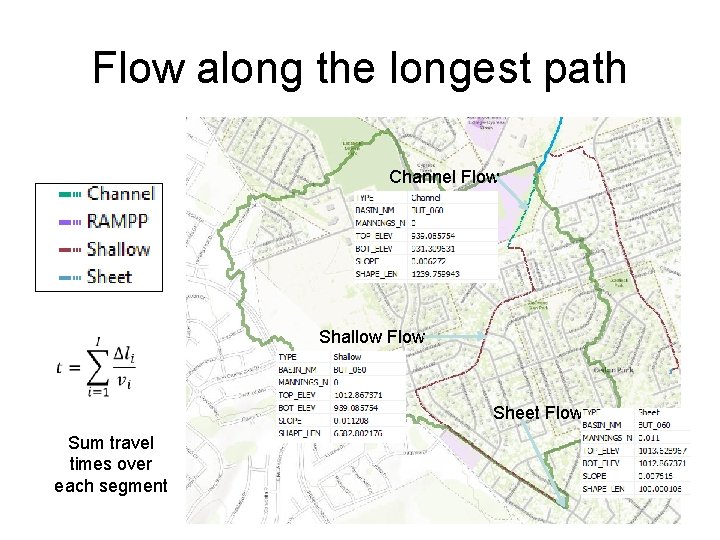
Flow along the longest path Channel Flow Shallow Flow Sheet Flow Sum travel times over each segment
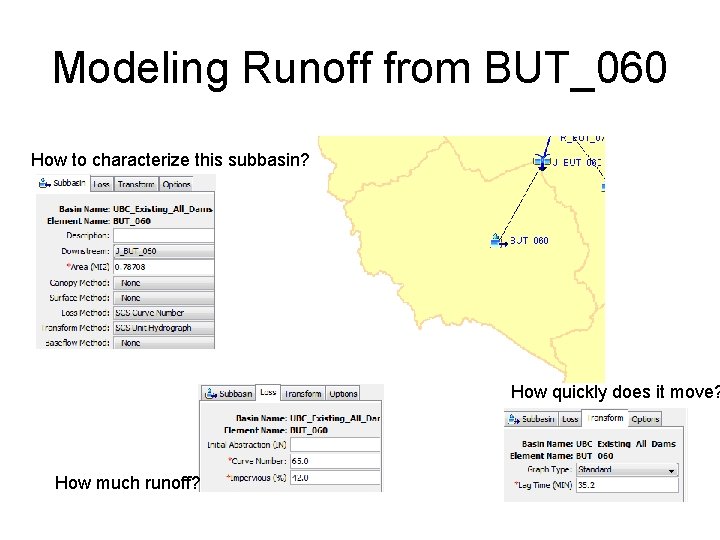
Modeling Runoff from BUT_060 How to characterize this subbasin? How quickly does it move? How much runoff?
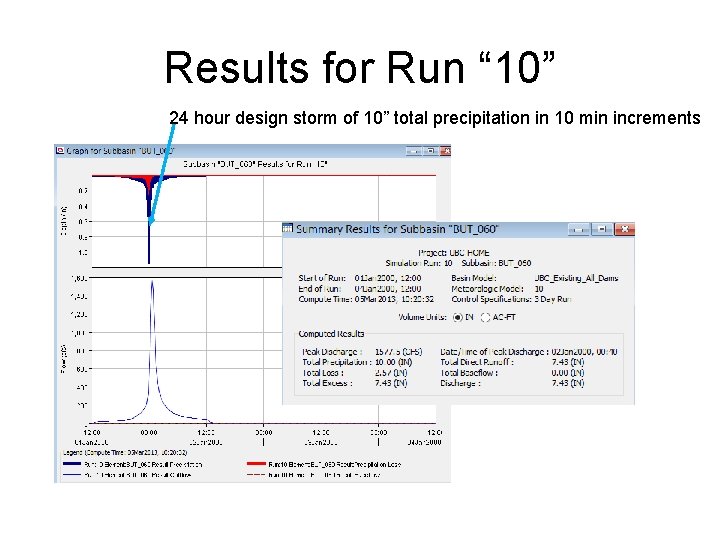
Results for Run “ 10” 24 hour design storm of 10” total precipitation in 10 min increments