
UNIT FIVE AGRICULTURE PRIMARY ECONOMIC ACTIVITIES ADVANCED PLACEMENT


- Slides: 30
UNIT FIVE AGRICULTURE: PRIMARY ECONOMIC ACTIVITIES ADVANCED PLACEMENT HUMAN GEOGRAPHY Session 1
Advanced Placement Human Geography Review Sessions: Unit Five By Geri Flanary To accompany AP Human Geography: A Study Guide 3 rd edition By Ethel Wood
Overview
A crucial influence on the organization of the earth’s surface is the way that people make a living. Economic activities can be organized as follows: primary secondary tertiary
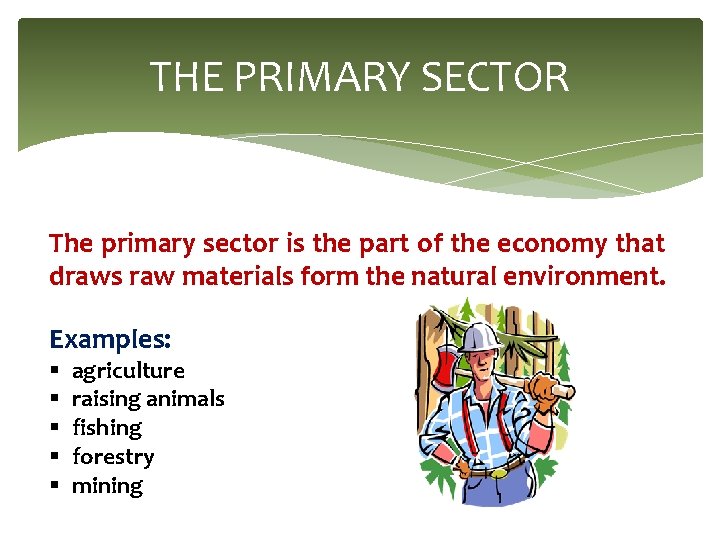
THE PRIMARY SECTOR The primary sector is the part of the economy that draws raw materials form the natural environment. Examples: § § § agriculture raising animals fishing forestry mining
THE PRIMARY SECTOR The primary sector is the largest sector of the economy in low-income, preindustrial nations.
THE SECONDARY SECTOR The secondary sector is the part of the economy that transforms raw materials into manufactured goods. Examples: • Refining petroleum into gasoline • Turning metals into tools and automobiles
THE SECONDARY SECTOR
THE TERTIARY SECTOR The tertiary sector is the part of the economy that involves services rather than goods. • • Construction Trade Finance Real estate • Private services • Government • Transportation
THE TERTIARY SECTOR Ø The quaternary sector is often seen as a subset of the tertiary sector. Ø It includes jobs concerned with: • research and development • management and administration • processing and disseminating information
THE TERTIARY SECTOR ØThe tertiary sector grows with industrialization and comes to dominate post-industrial societies, or countries where most people are no longer employed in industry.
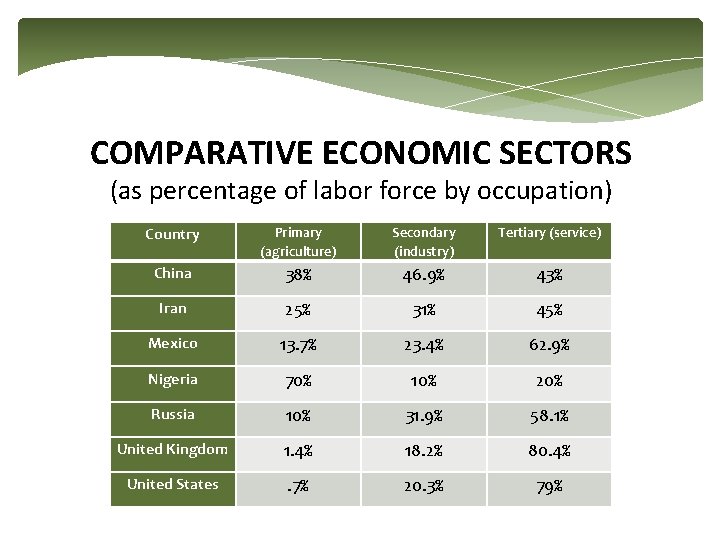
COMPARATIVE ECONOMIC SECTORS (as percentage of labor force by occupation) Country Primary (agriculture) Secondary (industry) Tertiary (service) China 38% 46. 9% 43% Iran 25% 31% 45% Mexico 13. 7% 23. 4% 62. 9% Nigeria 70% 10% 20% Russia 10% 31. 9% 58. 1% United Kingdom 1. 4% 18. 2% 80. 4% United States . 7% 20. 3% 79%
ECONOMIC ACTIVITIES For thousands of years agriculture was the main economic activity of most people on earth, until the Industrial Revolution transformed economies first in Europe and North America, and eventually influenced most countries in the world.
Because the sectors represent necessary economic activities, most countries today have some people employed in ALL economic sectors.
The Origin and Spread of Agriculture
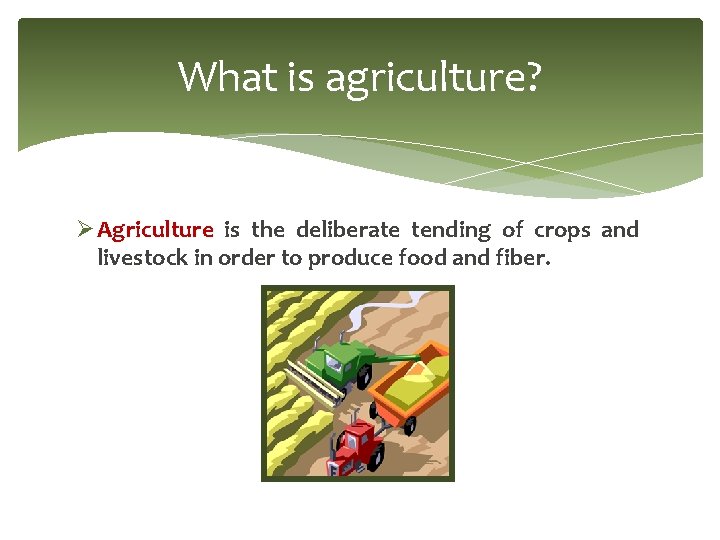
What is agriculture? Ø Agriculture is the deliberate tending of crops and livestock in order to produce food and fiber.
About agriculture… Agricultural production in the world today is at an all-time high, mainly because the nature of farming has changed with: mechanization farm consolidation These changes have had the most impact in industrial and post-industrial countries.
How does culture relate to agriculture? Ø In ALL countries, the processes that determine the production, distribution, and consumption of food form an important part of culture. Ø Other cultural factors affect agriculture: Ø the ways that land is distributed Ø functions of livestock Ø consumption of food from crops and animals
How does culture relate to agriculture? Ø Example : Ø Hindus do not eat beef and Muslims do not eat pork. Ø Therefore, the two religions greatly impact the nature of agriculture in regions where they have many adherents.
HUNTERS AND GATHERERS
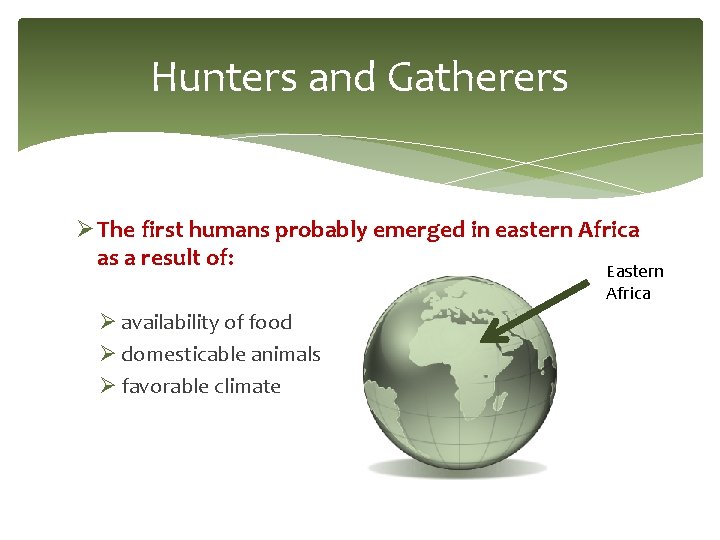
Hunters and Gatherers Ø The first humans probably emerged in eastern Africa as a result of: Eastern Africa Ø availability of food Ø domesticable animals Ø favorable climate
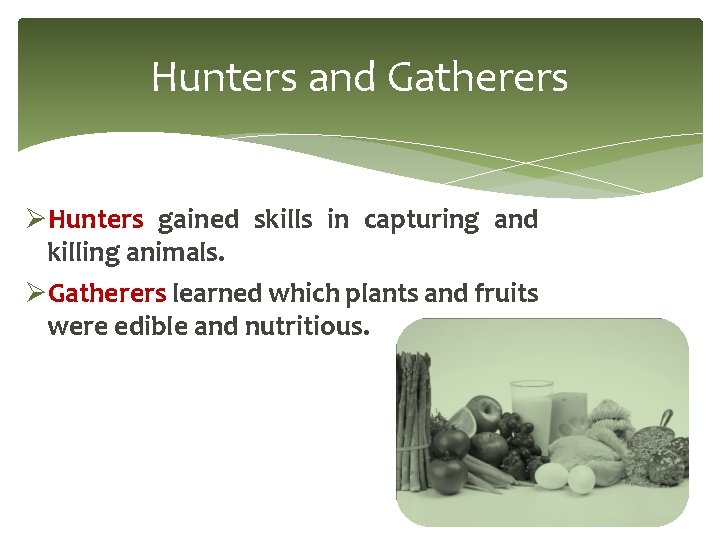
Hunters and Gatherers ØHunters gained skills in capturing and killing animals. ØGatherers learned which plants and fruits were edible and nutritious.
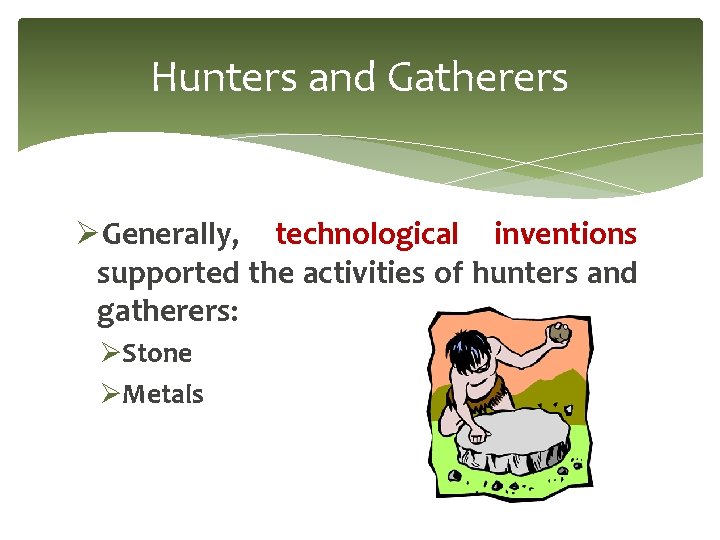
Hunters and Gatherers ØGenerally, technological inventions supported the activities of hunters and gatherers: ØStone ØMetals
Hunters and Gatherers ØThe groups traveled frequently, establishing new home bases or camps. ØTheir migration patterns depended on the movement of game and the seasonal growth of plants.
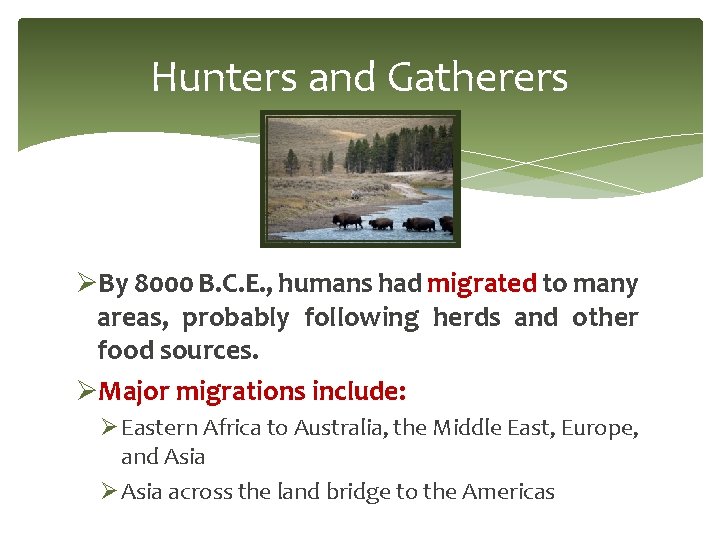
Hunters and Gatherers ØBy 8000 B. C. E. , humans had migrated to many areas, probably following herds and other food sources. ØMajor migrations include: Ø Eastern Africa to Australia, the Middle East, Europe, and Asia Ø Asia across the land bridge to the Americas
THE NEOLITHIC REVOLUTION
When and how did people give up their wandering and settle to live in one place?
Settlements ØThe ability to settle was based almost entirely on the cultivation of plants and the domestication of animals. ØThese drastic changes in human life are known collectively as the NEOLITHIC REVOLUTION (8000 B. C. E. ).
Settlements ØAgricultural hearths developed independently in several regions of the world over a long period of time. ØFrom these agricultural hearths, farming practices diffused across the earth.
Changes that resulted from the Neolithic Revolution Ø Increase in reliable food supplies Ø Rapid increase in total human population Ø Job specialization Ø Development of distinction between settled people and nomads Ø Widening of genderspecific activities Ø Men agricultural production and domestication of animals Ø Women child-rearing, food preparation, care of home