
Unit Essential Question How did the Roman Empire
- Slides: 57
Unit Essential Question How did the Roman Empire influence world civilization?
Lesson Essential Question How did Roman culture influence world civilization?
• During the early years of the empire, about 1 million people lived in Rome. • Rome faced many problems like cities today. o o o One problem was too little housing. The air was polluted. There was crime in the streets. The cost of living was high. Many Romans could not find jobs. They had to pay taxes on almost everything.
• Describe the homes of the rich. o o A rich person lived in a domus. Define domus: Roman house Wealthy homes had marble walls, colored stone floors, and windows made with panes of glass. They had furnaces to heat the rooms, and pipes brought water even to the upper floors.
• Describe the homes of the poor. o o o Most Romans were poor and lived in apartment houses called islands. Islands were six or more stories high, and each island covered an entire block. At one time, there were 26 blocks of islands for every private house in Rome.
The Family (p. 237 -238) The Roman Family The Father • The father was head of the household. • His word was law. • The father arranged the children’s marriages to improve social position or to increase wealth.
Cousins • Cousins were expected to help one another politically.
Boys • Most Roman boys and girls went to school together until • • • age 12. Sons of the poor went to work at age 12. At age 12, sons of the wealthy began their formal education. Sons of the rich studied reading, grammar, writing, music, etc. When they were 15, boys entered a school or rhetoric, or speech and writing, to prepare for a political career. Some boys went to Athens or Alexandria to study philosophy or medicine.
Girls • Girls received a different kind of education. • When they were 12, their formal education stopped. • Daughters of the wealthy were given private lessons at • • home. As a result, many Roman women were just as educated, if not more educated, than most men. Some women worked in or owned small shops. Wealthy women had slaves to do housework. Having enslaved people allowed rich women free to study the arts, literature, and fashion, or to ride chariots in the country.
At Leisure (p. 238 -239) �At home, the Romans enjoyed gambling with dice. �The Romans would meet friends at public bathhouses, where they could take warm, cold, or steam baths. �The bathhouses of Rome provided more than baths. �Some bathhouses had gymnasiums, sports stadiums , and libraries. �There, the Romans could watch or play games. �They also could listen to lectures, see musical shows, exercise, or just sit and talk.
Public Games �During the republic, the games had been staged by politicians who were looking for votes. �During the empire, the games were staged by the government. �The games included circuses, chariot races, and gladiatorial games. �Many chariot races were held at the Circus Maximus, an oval arena that held more than 200, 000.
Gladiators �Define gladiators: Gladiators were people who fought animals and one another in arenas. �Most gladiators were enslaved people, prisoners of war, criminals, or poor people. �Gladiators were trained by managers who hired them out. �A few gladiators were upper-class Romans who wanted excitement and public attention. �The night before a fight, gladiators would appear at a banquet. �There, they could be looked over by fans and gamblers who wanted to bet on the outcome of a match.
Gladiators �When gladiators would enter the arena, they would walk past the emperors box and say, “Hail Emperor, those who are about to die salute you. ” �Many gladiators did die. �Those whose fighting pleased the crowd became idols of the people. �All kinds of animals were used in the public games.
Roman Technology The Arch o Most arches consist of wedge-shaped blocks. o The top center stone, called the keystone, is the last block to be inserted. During construction, arches are often supported by a wooden frame. o When the frame is removed, both sides of the arch press against the keystone and thereby support the arch.
Concrete o Using a mixture that included lime and volcanic ash, the Romans created a very strong and durable type of concrete.
Roman Roads o The roads were built for the military. o They were also used for trade. o Over the course of the Roman Republic and Roman Empire, 55, 000 miles of roads were built. o There was a very famous saying, “All roads road lead to Rome. ”
Bridges o They were built with concrete and/or stone and utilized the arch.
Aqueduct o The word aqueduct comes from the Latin word for water, aqua, and the Latin word for channel, ductus. o Aqueducts used gravity to carry water from the mountain springs to Roman cities and towns. o Water was used in public bathhouses, fountains, latrines, and private homes.
Architecture o Romans used their knowledge of concrete, baked brick, and arch building innovations to build many great buildings.
Architecture o The Forum – A series of building used for government business. It was the center of Roman daily life.
Architecture o The Pantheon – It was a Roman temple dedicated to all the gods. Today it is the most preserved building of ancient Rome.
Architecture The Colosseum – An amphitheater, or arena, built by the emperor Vespasian and finished by his son Titus. It is the largest amphitheater from ancient times. It was built of stone and cement, and could seat between 50, 000 and 80, 000 people. It was used for gladiatorial games and public spectacles, such as mock sea battles, executions, animal hunts, and dramas based on Classical Mythology.
Architecture Circus Maximus – A huge oval arena used for chariot races and other mass entertainment. It could accommodate over 150, 000 spectators.
Christianity in Rome �Christians brought new ideas and important changes to the Roman Empire. �Christianity began in Palestine. �Christianity is based on the life and teachings of Jesus. �Jesus would spread and teach his message using parables, or stories. �Many followers of Jesus believed he was the Messiah.
Christianity in Rome �The Roman Empire allowed Christianity to spread. The Pax Romana let missionaries to move across Roman lands in safety. The system of Roman roads helped them go from one place to another quickly. Most people spoke either Latin or Greek, which allowed the missionaries to talk with people directly.
Christianity in Rome �Christianity was not favored in Rome for several reasons. While Christians were allowed to worship freely, the Romans expected everyone to honor the emperor as a god. The Christians, like the Jews, refused to do this. The Christians stated only gods could be worshipped. The Romans also did not like other Christian ideas. For example, Christians did not want to serve in the army or hold public office.
Christianity in Rome �The Romans blamed and punished Christians for things such as plagues and famines. �In 64 A. D. , the Romans accused the Christians of starting a fire that burned much of Rome. �Christianity was made illegal and many Christians were killed.
Christianity in Rome �Christianity was of interest to poor workers and enslaved people in the cities. They led very hard lives. They liked a religion that promised a better life after death.
Church Structure �Christians needed a way to keep their churches together. �One way was by organizing the churches. �They used the Roman Empire’s structure of government as a model for their organization.
Church Structure Each church was called a parish. Their leader was known as a church. Several parishes were put together, which became known as a diocese. Diocese originally meant a Roman military district. A bishop headed each diocese. The most important bishops were called archbishop. They governed churches in major cities. The five leading archbishops were called patriarchs. Over time, the archbishop of Rome began to claim power over the other archbishops. By 600, he was called Pope is the Latin word for father. Christians who spoke Latin saw him as head of all the churches.
Church Structure People who spoke Greek did not see the Pope as head of the church. They turned to the archbishop of Constantinople. In 1054 A. D. , the two church groups split. The Latin churches became known as the Roman Catholic Church. The Greek churches became known as the Eastern Orthodox Church.
Monasteries (p. 254 -256) �Hermits were Christians who left the city to live and pray alone in isolated areas. They believed this would bring them closer to Christ. Hermits were protected from the temptations of daily life, but they were not doing anything to improve the world.
Monasteries (p. 254 -256) �Basil was a bishop who suggested a different way of life. He said Christians should form religious settlements near cities. There, they would be protected from the evils of the world. At the same time, they could help other people by doing good deeds and set an example of Christian living.
Monasteries (p. 254 -256) �Monks were Christian men who did as Basil suggested and lived in religious settlements. Monasteries were the religious settlements of monks. Nuns were Christian women who did the same. Convents were the living quarters of nuns. �Basil drew you a list of rules these religious communities. This list was known as the Basilian Rule, and it became the model for Eastern Orthodox religious life.
Monasteries (p. 254 -256) �In the West, another set of rules called the Benedictine Rule was followed. It was created by an Italian monk named Benedict. Under Benedict’s rules, the men agreed to give up all of their possessions before entering the monasteries, wore simple clothing, and eat only certain foods. They could not marry. They had to obey the orders of the abbot, or leader of the monastery. They had to attend religious services seven times during the day and once at midnight.
Monasteries (p. 254 -256) �By 800 A. D. , monks were playing an important role in spreading Christianity throughout Europe. �By preserving old Roman and Greek writings, they helped western civilization progress and survive.
Lesson Essential Question Why did the Roman empire decline?
Fall of the Roman Empire �Pax Romana ended after about 200 years. �From then on, conditions in the Roman Empire grew worse. �There are many reasons the Roman Empire fell.
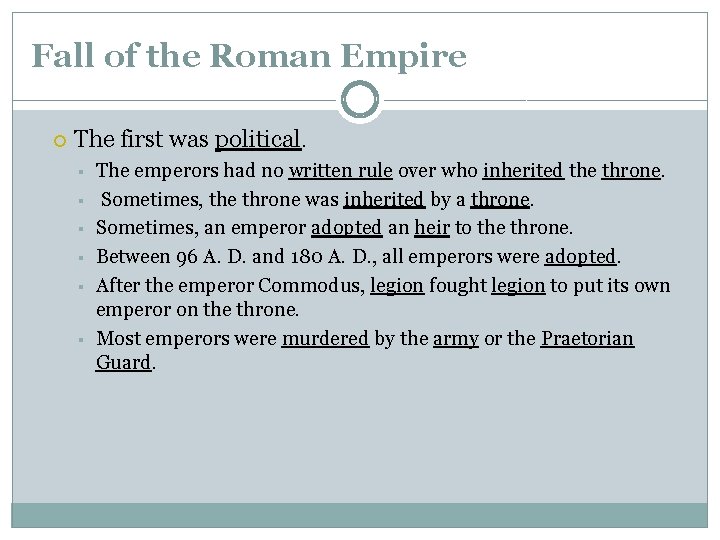
Fall of the Roman Empire The first was political. § § § The emperors had no written rule over who inherited the throne. Sometimes, the throne was inherited by a throne. Sometimes, an emperor adopted an heir to the throne. Between 96 A. D. and 180 A. D. , all emperors were adopted. After the emperor Commodus, legion fought legion to put its own emperor on the throne. Most emperors were murdered by the army or the Praetorian Guard.
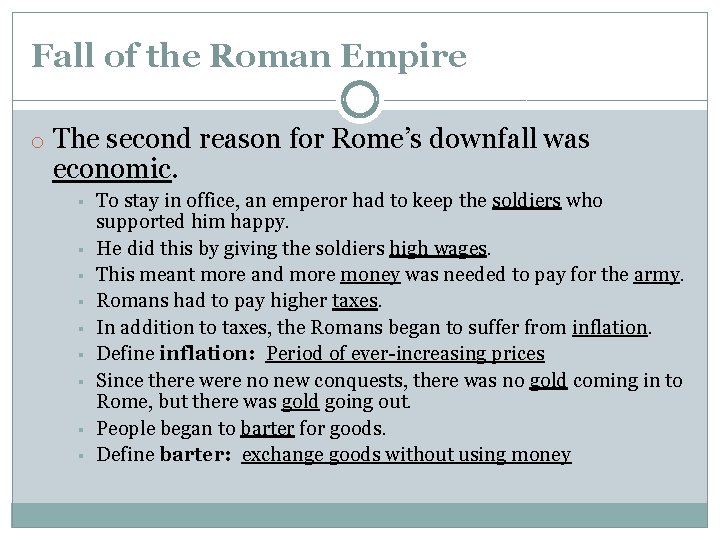
Fall of the Roman Empire o The second reason for Rome’s downfall was economic. § § § § § To stay in office, an emperor had to keep the soldiers who supported him happy. He did this by giving the soldiers high wages. This meant more and more money was needed to pay for the army. Romans had to pay higher taxes. In addition to taxes, the Romans began to suffer from inflation. Define inflation: Period of ever-increasing prices Since there were no new conquests, there was no gold coming in to Rome, but there was gold going out. People began to barter for goods. Define barter: exchange goods without using money
Fall of the Roman Empire o The third major reason Rome fell centered on foreign enemies. § § Roman frontiers were open for attack. Germanic hunters and herders began to raid Greece and Gaul. Trade and farming in Greece and Gaul declined. Cities again began to surround themselves with walls to protecting themselves.
Lesson Essential Question How did Roman emperors try to save the empire?
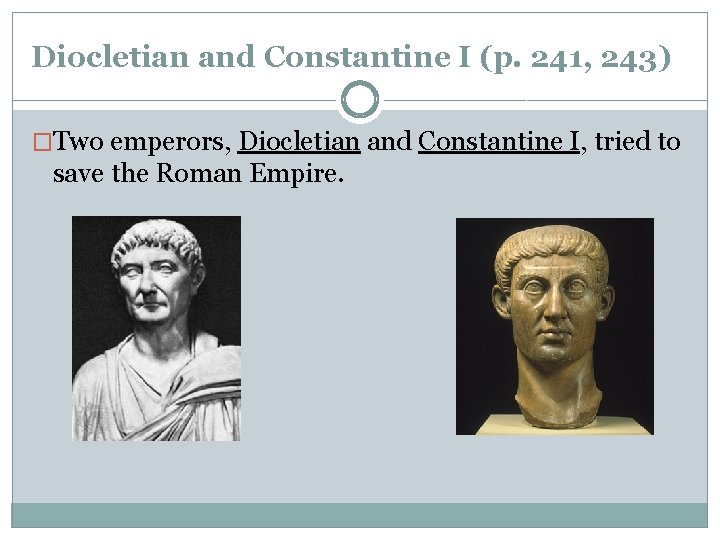
Diocletian and Constantine I (p. 241, 243) �Two emperors, Diocletian and Constantine I, tried to save the Roman Empire.
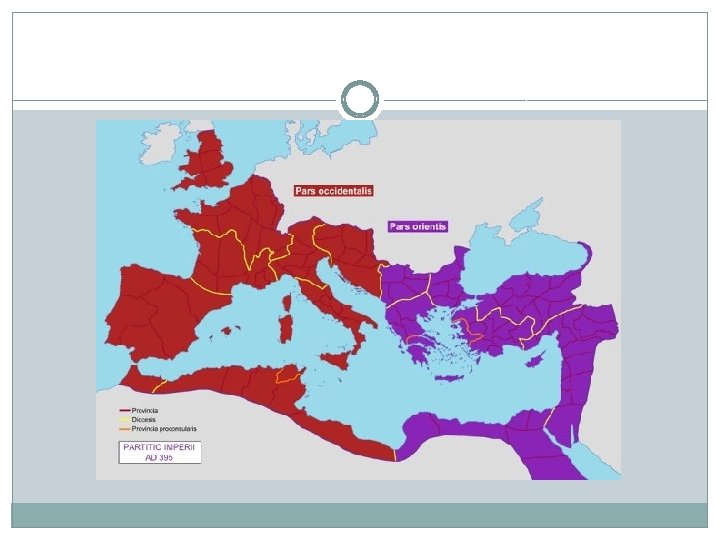
Diocletian and Constantine I (p. 241, 243) � Diocletian was the son of a freedman who made many changes. He fortified the frontiers to stop invasions. Diocletian reorganized different governments to make them work better. To keep prices from rising, he set maximum prices for goods and wages. To make sure goods were produced, he ordered workers to stay in the same jobs until they died. Diocletian made city officials personally responsible for the taxes their communities had to pay. Diocletian established the policy of rule by divine right. Define rule by divine right: rule based on theory an emperor’s right to rule comes from God Diocletian divided the empire into two parts. § He had someone rule the western provinces, while he ruled the richer eastern provinces.
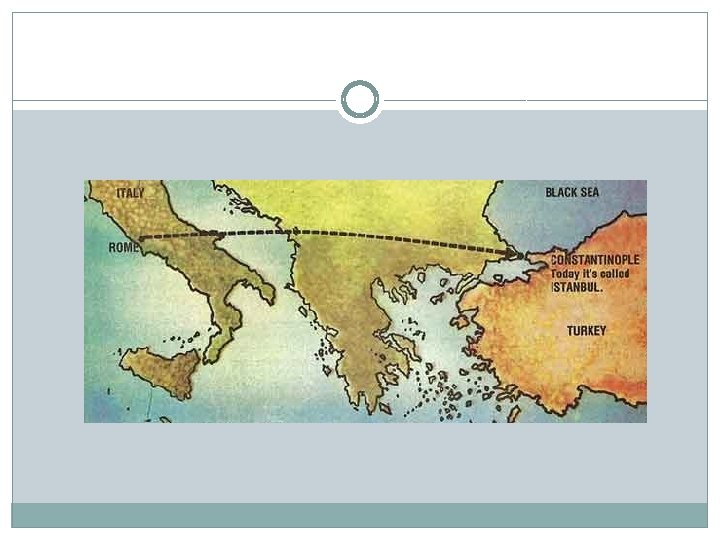
Diocletian and Constantine I (p. 241, 243) � Constantine issued several orders to keep people from leaving their jobs. The sons of workers had to follow their fathers’ trades. The sons of farmers had to stay and work the land their fathers worked. The sons of ex-soldiers had to serve in the army. � To escape government control and pressure, wealthy landowners moved to their villas, or country estates. Most villas were like small, independent cities, or kingdoms. Each villa produced enough food and goods to meet the needs of everyone who lived in the villa. � In 330 A. D. , Constantine moved the capital from a dying Rome east to the newly built city of Constantinople in present-day Turkey.
End of the Empire (p. 243 -244) �Germanic attacks increased, especially in western Europe. �The Germans crossed into Western Europe to escape from the Huns.
End of the Empire (p. 243 -244) �In 378 A. D. , a Germanic group defeated the Roman legions at the Battle of Adrianople. One reason the Germans were able to defeat the Romans was because of an invention from the Huns, the iron stirrup. Using iron stirrups made cavalry strong than infantry, even the powerful Roman legions.
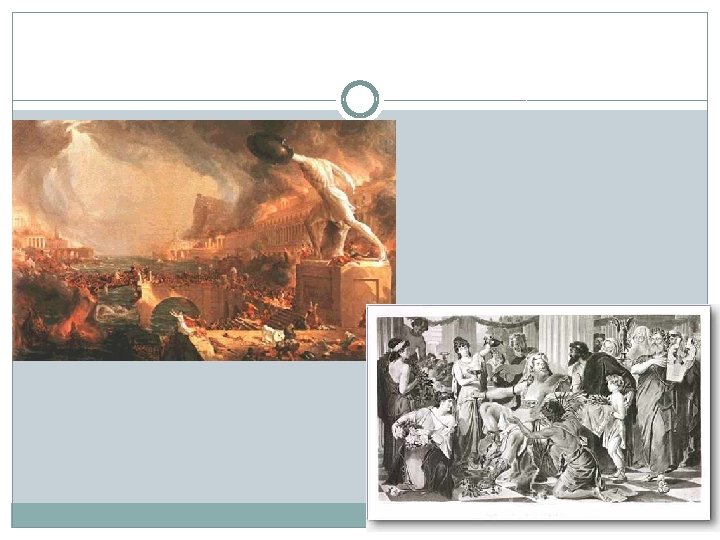
End of the Empire (p. 243 -244) �In the winter of 406 A. D. , the Rhine River froze and groups of Germans crossed into Gaul. The Romans were not able to force them back. �In 410 A. D. , the Germanic chief Alaric and his soldiers invaded Rome. They burned records and looted the treasury. The Roman Senate told the people “You can no longer rely on Rome for finance or direction. You are on your own. ”
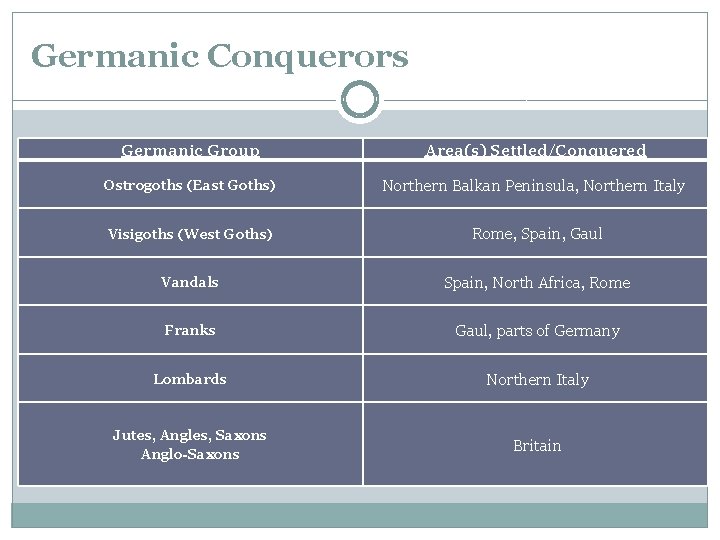
Germanic Conquerors �The Goths were a Germanic people who lived in the Balkan Peninsula of Europe. They were divided into two groups. The Visigoths were the West Goths. The Ostrogoths were the East Goths. �The Ostrogoths were conquered by the Huns.
Germanic Conquerors �The West Goths asked the Roman emperor for protection from the Huns. The emperor let them settle just inside the Roman Empire’s frontier. In return, the Visigoths gave up their weapons and promised their loyalty to Rome. Soon, trouble broke out between the West Goths and Roman officials. The West Goths had to buy the empire’s food at high prices. The Romans also kidnapped many young West Goths and enslaved them.
Germanic Conquerors �In 410 A. D. , the Visigoths captured and looted Rome. After they captured Rome, the West Goths took over Gaul. Next, the Visigoths took over Spain, which was already occupied by another Germanic group called the Vandals. The West Goths ended Roman rule in Spain and forced the Vandals out.
Germanic Conquerors �The Vandals were another Germanic group. The Vandals crossed the Mediterranean to North Africa. They became pirates and attacked cities along the Mediterranean coast. The English word “vandalism” comes from the Vandal attacks along the Mediterranean coast. In 455 A. D. , the Vandals burned and attacked Rome.
Germanic Conquerors �By 550, the Roman Empire in the West had faded away. In its place were six major and a lot of minor Germanic kingdoms. Many Roman beliefs and practices remained in use, and would shape later civilizations.
Germanic Conquerors Germanic Group Area(s) Settled/Conquered Ostrogoths (East Goths) Northern Balkan Peninsula, Northern Italy Visigoths (West Goths) Rome, Spain, Gaul Vandals Spain, North Africa, Rome Franks Gaul, parts of Germany Lombards Northern Italy Jutes, Angles, Saxons Anglo-Saxons Britain